In re G.C. Chemie Pharmie Limited (CAAR Mumbai)
Summary: The Customs Authority for Advance Rulings (CAAR), Mumbai, in the matter of G.C. Chemie Pharmie Limited, ruled that the proposed import of Galacto-Oligosaccharides (GOS) powder, containing at least 70% GOS and residual lactose and glucose, is classifiable under Customs Tariff Item 2940 00 00 of the First Schedule to the Customs Tariff Act, 1975, rather than Tariff Heading 1702. The ruling, numbered CAAR/Mum/ARC/129/2026, was issued on 29 October 2026 by Shri Rajesh Fattesing Dhabre, Customs Authority for Advance Rulings, Mumbai. The Authority examined the product’s chemical composition, manufacturing process, laboratory analysis, technical specifications, relevant Chapter Notes, Harmonized System Explanatory Notes and the principles governing tariff classification. The principal dispute concerned whether the imported product, consisting of a mixture of galactose-containing oligosaccharides and residual sugars, could qualify for classification under Heading 2940.
The applicant, G.C. Chemie Pharmie Limited, was engaged in the import, manufacture and trading of pharmaceutical, nutraceutical and related products. It proposed to import Galacto-Oligosaccharides powder from China through the port of Nhava Sheva, Maharashtra. The product was described as a non-digestible prebiotic carbohydrate produced from lactose through enzymatic transgalactosylation. GOS is used in infant formula, dairy products, functional foods, confectionery and dietary supplements because of its role in supporting beneficial intestinal microbiota. The applicant sought an advance ruling under Section 28H(2)(a) of the Customs Act, 1962, on whether the product should be classified under Customs Tariff Heading 2940 as a chemically pure sugar or under Heading 1702 covering other sugars and sugar syrups.
The applicant submitted that the product contained a minimum of 70% Galacto-Oligosaccharides, while lactose and glucose together did not exceed 30%. It argued that the residual sugars were unavoidable manufacturing impurities resulting from the enzymatic conversion of lactose. According to the applicant, Heading 2940 covered chemically pure sugars, including certain oligosaccharides, while Heading 1702 dealt with common sugars and related products. It relied on Chapter Note 1(a) of Chapter 29 and the HSN Explanatory Notes to contend that the presence of impurities arising from the manufacturing process did not necessarily exclude a chemically defined organic product from Chapter 29. The applicant also cited the earlier CAAR ruling in In re Nutricia International Private Limited, relating to the classification of a 5-HMO Mix used in infant formula, in support of classification under Heading 2940.
The applicant’s supporting technical documents included a manufacturer’s certificate, process flow chart and laboratory test report. The test report indicated an oligosaccharide content of 72.0% on a dry basis, lactose content of 9.53%, glucose content of 7.17%, moisture content of 3.30% and ash content below 0.05%. The manufacturing process involved enzymatic treatment of lactose, filtration, purification, chromatographic separation, concentration and drying. The applicant submitted that the presence of residual lactose and glucose arose naturally during production and did not change the commercial identity or essential character of the finished product. It maintained that GOS should not be treated as ordinary food sugar merely because it was derived from lactose and contained certain residual sugars.
During the personal hearing held on 4 August 2026, the applicant reiterated its claim for classification under Heading 2940. The Authority examined the General Rules for Interpretation, particularly Rule 1, which requires classification according to the terms of the headings and relevant Section or Chapter Notes. It also considered Rule 3(a), relating to the preference for a more specific description. The ruling discussed the requirement under Chapter 29 that products generally comprise separate chemically defined organic compounds, subject to permitted impurities. The Authority observed that the imported GOS powder comprised oligosaccharide molecules of varying chain lengths and degrees of polymerization, together with residual lactose and glucose arising from the manufacturing process.
The Authority’s discussion contained observations concerning the heterogeneous molecular composition of the product and the requirement of chemical purity under Chapter 29. However, in its subsequent analysis, it treated the residual lactose and glucose as permissible process-related impurities and placed emphasis on the predominant GOS content, the manufacturing specifications and the commercial identity of the finished goods. It considered that the imported product derived its essential character from Galacto-Oligosaccharides and not from ordinary lactose or glucose. The Authority also examined Heading 1702, which covers other sugars, including certain sugar products, before ultimately accepting the proposed classification under Heading 2940.
In its operative findings, the Authority concluded that the imported Galacto-Oligosaccharides product, comprising oligomeric species with degrees of polymerization ranging from DP 2 to DP 8 and having a minimum purity of 70%, was appropriately classified under Chapter 29. Accordingly, it ruled that the product was classifiable under Tariff Item 2940 00 00 of the First Schedule to the Customs Tariff Act, 1975. The ruling concerns the specific GOS product, composition and manufacturing characteristics presented by the applicant. It is relevant to the tariff treatment of imported prebiotic carbohydrates and related ingredients, particularly where their classification depends upon the distinction between chemically pure sugars and other sugar preparations. The decision also illustrates the importance of technical specifications, laboratory reports and the treatment of residual process-related substances when determining customs tariff classification.
Cases Discussed
1. In re Nutricia International Private Limited (CAAR Mumbai); CAAR/Mum/ARC/197/2024-25; 09/01/2025 — Relied upon by the applicant for classification of oligosaccharide-based products under Customs Tariff Heading 2940 despite the presence of process-related impurities. The precedent concerned the classification of 5-HMO Mix for infant formula under Tariff Item 2940 00 00.
FULL TEXT OF THE ORDER OF CUSTOMS AUTHORITY FOR ADVANCE RULINGS, MUMBAI — DISCUSSION AND OPERATIVE RULING
M/s. G. C. Chemie Pharmie Limited (IEC No.: 0395065895) (hereinafter referred to as ‘the Applicant’) filed an application (CAAR-1) for advance ruling in the Office of Secretary, Customs Authority for Advance Ruling (CAAR) Mumbai. The said application was received in the secretariat of the CAAR, Mumbai on 24.06.2026 along with its enclosures in terms of Section 28H (1) of the Customs Act, 1962 (hereinafter referred to as the ‘Act’ also). The Applicant is seeking advance ruling on the issue of classification of “Galacto – Oligosachharide”. The applicant intends to import the said goods from the ports of Nhava Sheva, Uran, Distt. Raigad.
2. Applicant’s eligibility for Advance Ruling:
2.1 I observe that the applicant holds a valid Importer-Exporter Code (IEC) No. 0395065895 and, therefore, qualifies as an “applicant” within the meaning of Section 28E(c)(i) of the Customs Act, 1962.
2.2. The question on which the advance ruling is sought pertains to the classification of goods described as “Galacto – Oligosachharide”, which is a permissible subject matter for an advance ruling under Section 28H(2)(a) of the Customs Act, 1962. The relevant statutory provisions are reproduced below:
Section 28 E. Definitions. –
(c) “applicant” means any person, –
(i) holding a valid Importer-Exporter Code Number granted under Section 7 of the Foreign Trade (Development and Regulation) Act, 1992; or
Section 28 H, Application for advance ruling. –
(1) An applicant desirous of obtaining an advance ruling under this chapter may make an application in such form and in such manner and accompanied by such fee as may be prescribed, stating the question on which the advance ruling is sought.
(2) The question on which the advance ruling is sought shall be in respect of,-
(a) classification of goods under the Customs Tariff Act, 1975 (51 of 1975);
2.3 Further, the applicant has declared that no proceedings involving the same issue are pending before any Customs Authority, Appellate Tribunal or any Court of Law. In view of the foregoing, and subject to verification of the other statutory requirements, the applicant appears to fulfil the eligibility criteria for seeking an advance ruling under Section 28E(c) of the Customs Act, 1962. The admissibility of the application is accordingly examined under Section 28-I of the said Act.
3. Applicant’s Submissions:
3.1 The applicant is, inter alia, engaged in the business of importing, manufacturing and trading various goods. The applicant proposes to import “Galacto-Oligosaccharide” (GOS) Powder from Baolingbao Biology Co., Ltd, China. GOS is an oligosaccharide produced from lactose by way of enzymatic conversion. Galacto-Oligosaccharides are naturally present in human breast milk and are used as an ingredient/raw material in the manufacture of infant formulae, so as to make such formulae more closely resemble the composition of human breast milk.
3.2 About Galacto-Oligosachharides –
Galacto-oligosaccharides (GOS) are non-digestible prebiotic carbohydrates consisting of galactose units linked to a terminal glucose or galactose unit. GOS are produced through the enzymatic transgalactosylation of lactose. Commercially, GOS are available in the form of viscous syrups or white powders and are widely used in infant formulae, dairy products and functional foods, primarily on account of their prebiotic properties and their role in supporting gut health.
GOS are used in various food applications, including baby food, yoghurt and other dairy products, protein bars, confectionery, and soups and sauces.
4. The following characteristics of the product are noteworthy:
(a) Galacto-oligosaccharides (GOS) are functional oligosaccharides comprising multiple galactose units with a terminal galactose or glucose unit. GOS generally have a degree of polymerisation (DP) ranging from 2 to 8. Their chemical properties, processing stability and biological characteristics are closely associated with their degree of polymerisation and the type of glycosidic linkages present. The glycosidic linkages found in GOS may include β-(1→2), β-(1→3), β-(1→4) and β-(1→6) linkages.
(b) The product contains a minimum of 70% total Galacto-oligosaccharides (GOS), while the combined content of lactose and glucose does not exceed 30%.
(c) The product is a white powder, free from any visible impurities. It has no unusual odour and possesses a mild, sweet taste, without any objectionable or abnormal taste or odour. The product has a pH ranging from 2.8 to 5.5 and can be stored for a period of two years at room temperature under appropriate storage conditions.
5. The applicant has sought Advance Ruling on the following question:
Whether the product (Galacto-Oligosaccharides) (GOS) is classifiable under CTSH 2940 00 00 as Chemically Pure Sugar or alternatively under CTSH 170290 90 as Other Sugar?
6. Applicant’s interpretation of Law: –
6.1 The classification of the goods imported into India is to be determined based on the General Rules of Interpretation (hereinafter referred to as the “GRI”) set out in the Tariff. As per Rule 1 of the GRI, classification of the imported products shall be determined according to the terms of the headings and any relative Section or Chapter Notes.
6.2 The product in question i.e., Galacto-oligosaccharides (GOS) are a mixture of non-digestible carbohydrates (saccharides) containing varying numbers of galactose molecules (typically 1 to 7 or up to 10) attached to a terminal glucose or galactose unit. Oligosaccharides are specifically covered under Heading 2940. Thus, at the outset classification under Heading 2940 should be examined.
7. Classification under Tariff Heading 2940:
7.1 CTH 2940 is reproduced below:
| HS Code | Item Description |
|---|---|
| 2940 00 00 | Sugars, chemically pure, other than sucrose, lactose, maltose, glucose and fructose; Sugar ethers, sugar acetals and sugar esters, and their salts, other than products of heading 29.37, 29.38 or 29.39 |
That Tariff heading 2940 of the Customs Tariff Act covers Sugars, chemically pure, other than sucrose, lactose, maltose, glucose and fructose; sugar ethers, sugar acetals and sugar esters, and their salts, other than products of headings 2937, 2938 or 2939. Relevant extracts of HSN Explanatory Notes to Heading 2940 are set out below:
| HSN Explanatory Notes to Chapter Heading 29.40: –
Other Organic Compounds 29.40 – Sugars, chemically pure, other than sucrose, lactose, maltose, glucose and fructose; sugar ethers, sugar acetals and sugar esters, and their salts, other than products of headings 29.37, 29.38 or 29.39. A) SUGARS, CHEMICALLY PURE This heading covers only chemically pure sugars. The term “sugars” covers monosaccharides, disaccharides and oligosaccharides. Each saccharide unit must consist of at least four, but not more than eight, carbon atoms and, as a minimum, must contain a potential reducing carbonyl group (aldehydic or ketonic) and at least one asymmetric carbon atom bearing a hydroxyl group and a hydrogen atom. The heading excludes: a) Sucrose, this, even when chemically pure, falls in heading 17.01. b) Glucose and lactose; these, even when chemically pure, fall in heading 17.02. c) Maltose which, even when chemically pure, falls in heading 17.02. Isomeric with sucrose. Crystalline mass. Used in medicine. d) Fructose (laevulose) which, even when chemically pure, falls in heading 17.02. Isomeric with glucose. Yellowish crystals in the pure state. Used in medicine (for diabetic diets). e) Aldol (heading 29.12) and acetoin (3-hydroxy-2-butanone) (heading 29.14), which, though they meet the criteria for being saccharide units, are not sugars. The following are included among the chemically pure sugars falling under this heading: (1) Galactose. Isomeric with glucose. Obtained by hydrolysing lactose. Found in pectin substances and mucilages. Crystalline when pure. (2) Sorbose (sorbenose). Isomeric with glucose. White crystalline powder, very soluble in water. Used in the synthesis of ascorbic acid (vitamin C), and in the preparation of culture media. (3) Xylose (wood sugar) (C5H10O5). White crystals. Used in pharmacy. (4) Trehalose, isomeric with sucrose. Ribose and arabinose, isomeric with xylose. Raffinose (C18H32O16). Fucose, rhamnose (C6H12O5), digitoxose (C6H12O4) and other deoxy sugars. These sugars are all essentially laboratory products. The sugars of this heading may be in the form of aqueous solutions. (B) SUGAR ETHERS, SUGAR ACETALS AND SUGAR ESTERS, AND THEIR SALTS Heading 29.40 also covers sugar ethers, sugar acetals and sugar esters, as well as their salts. Sugar acetals may be formed between any two hydroxy groups of the sugar, or at the anomeric carbon to give a glycoside. However, natural glycosides are excluded (heading 29.38). Sugar ethers, acetals and esters which are constituent parts of products of headings 29.37, 29.38, 29.39 or any heading later than heading 29.40 are also excluded (see General Explanatory Note to this Chapter, Part (E)). These products, which fall in the heading whether or not they are chemically defined, include: (1) Hydroxypropyl sucrose*. A sugar ether. (2) Phosphoric esters of sugars (e.g. glucose and fructose phosphates) and their salts (e.g.; their barium, potassium, etc. salts). They are crystalline or amorphous powders, and are used in organic synthesis. (3) Sucrose octa-acetate. White hygroscopic powder. Used as an alcohol denaturant, in preparing adhesives, plasticisers and insecticides, in the paper industry and as a textile stiffener. (4) Sucrose mono-acetate. Has surface-active properties. (5) Sucrose acetate isobutyrate. Used as a modifying agent in varnishes. (6) Lactitol (INN) (4-O-β-D-galactopyranosyl-D-glucitol). Used as a sweetening agent. (7) Non-natural glycosides (other than products of heading 29.37, 29.38 or 29.39) in which the glycosidic linkage is an acetal function formed by etherification at the anomeric carbon atom (e.g., tribenoside (INN)). This heading, however, does not cover deliberate intermixtures of sugar ethers, sugar acetals, sugar esters or their salts, nor does it cover products which have been deliberately prepared or manufactured from starting materials in which the non-sugar components are mixtures, e.g., sugar esters made from fatty acids of heading 38.23. In addition, the heading excludes sugar anhydrides, thio sugars, amino sugars, uronic acids and other sugar derivatives, which generally are classifiable elsewhere in Chapter 29, according to their chemical structure. |
7.2 In view of the above, it is clear that Tariff Heading 2940 only includes Chemically Pure Sugars. The term “sugars” referred to in Tariff Heading 2940 specifically covers monosaccharides, disaccharides, and oligosaccharides.
8. Based on the literature provided, it is evident that GOS is composed of Galacto-Oligosaccharides (>70%), & Reducing Sugars (Lactose + Glucose (< 30%) and are widely recognized for their prebiotic properties, supporting the growth of beneficial gut microbiota. The Galacto-Oligosaccharides content clearly constitutes the predominant component of the product. Galacto oligosaccharides are produced through the enzymatic conversion of lactose, a component of bovine milk. Galacto-oligosaccharides (GOS) powder consists primarily of short chains of galactose molecules (2 to 9 units) attached to a terminal glucose or galactose. High-purity commercial GOS powder typically contains about 90% active prebiotic oligosaccharides, with the remaining 10% composed of residual digestible sugars like lactose, galactose, and glucose left over from the enzymatic manufacturing process.
9. The applicant’s interpretation that the said GOS powder, being an Oligosaccharide is rightly classifiable under Customs Tariff Heading 2940 00 00 as Chemically Pure Sugar. The HSN Explanatory Notes under Heading 2940 specifically mention Oligosaccharides as Sugar covered by Heading 2940. Further, as per the HSN Explanatory Notes under Chapter 29, the goods of Heading 2940 are listed as an exception to the requirement of Note 1(a) of Chapter 29 which provides that Headings of chapter 29 apply only to separate chemically defined organic compound. Accordingly, classification of the said GOS powder under Heading 2940 cannot be disputed on the ground that apart from Galacto-Oligosaccharide (70%), it also contains Glucose and Lactose to the extent of 30%. Further, the presence of Glucose and Lactose to the extent of 30% is on account of it being present in the starting material and the same are not deliberately added in the process of manufacture of GOS powder. The essential character of the goods is Galacto-Oligosaccharide only. The same are therefore correctly classifiable as Oligosaccharide under Heading 2940 00 00.
10. While Sugars are classifiable under Chapter 17, the Note to Chapter 17 specifically provides that it will not cover Chemically pure sugars and other products of Heading 29.40. Accordingly, if GOS is held to be classifiable under Heading 2940, it stands excluded from Chapter 17. The Applicant submits that if for any reason, it is held that GOS is not covered by Heading 29.40, then the same will merit classification under as other Sugars under CTSH 1702 90 90.
11. Further, in terms of Chapter Note 1(a) of Chapter 29, the headings of this chapter are restricted to separate chemically defined compounds, whether or not containing impurities. The relevant extract of the Note 1(a) of Chapter is reproduced herein below for ready reference:
| Note 1 | Except where the context otherwise requires, the headings of this Chapter apply only to: |
| (a) separate chemically defined organic compounds, whether or not containing impurities; |
12. The phrase ‘separate chemically defined compounds’ has been defined in HSN Explanatory Notes to Chapter 29 as under:
| HSN Explanatory Notes to Chapter 29
“A separate chemically defined compound is a substance which consists of one molecular species (e.g., covalent or ionic) whose composition is defined by a constant ratio of elements and can be represented by a definitive structural diagram. In a crystal lattice, the molecular species corresponds to the repeating unit cell. Separate chemically defined compounds containing other substances deliberately added during or after their manufacture (including purification) are excluded from this Chapter. Accordingly, a product consisting of saccharin mixed with lactose, for example, to render the product suitable for use as a sweetening agent is excluded.” The separate chemically defined compounds of this Chapter may contain impurities (Note 1 (a)). An exception to this rule is created by the wording of heading 29.40 which, with regard to sugars, restricts the scope of the heading to chemically pure sugars. The term “impurities” applies exclusively to substances whose presence in the single chemical compound results solely and directly from the manufacturing process (including purification). These substances may result from any of the factors involved in the process and are principally the following: (a) Unconverted starting materials. (b) Impurities present in the starting materials. (c) Reagents used in the manufacturing process (including purification). (d) By-products. It should be noted, however, that such substances are not in all cases regarded as “impurities” permitted under Note 1 (a). When such substances are deliberately left in the product with a view to rendering it particularly suitable for specific use rather than for general use, they are not regarded as permissible impurities. For example, a product consisting of methyl acetate with methanol deliberately left in with a view to improving its suitability as a solvent is excluded (heading 38.14). For certain compounds (e.g., ethane, benzene, phenol, pyridine), there are specific purity criteria, indicated in Explanatory Notes to heading 29.01, 29.02, 29.07 and 29.33. |
13. Further, on a careful perusal of the HSN Notes, it is evident that a separate chemically defined compound refers to a substance consisting of a single molecular species, the composition of which is defined by a constant ratio of elements and which can be represented by a definitive structural formula.
14. That Separate chemically defined compounds to which other substances have been deliberately added during or after manufacture (including during purification) are excluded from this Chapter.
15. However, the presence of certain impurities in such products is permissible, provided that these impurities arise solely and directly from the manufacturing process (including purification). Such impurities may result from various factors inherent in the process and principally include the following:
(a) Unconverted starting materials.
(b) Impurities present in the starting materials.
(c) Reagents used in the manufacturing process (including purification).
(d) By-products
16. As per the technical literature, GOS is composed of Galacto-Oligosaccharides (>70%), & Reducing Sugars (Lactose + Glucose (< 30%) and are widely recognized for their prebiotic properties, supporting the growth of beneficial gut microbiota.
17. In terms of the HSN Explanatory Notes to Chapter 29, a separately chemically defined compound may contain certain impurities, provided such impurities arise solely and directly from the manufacturing process (including purification) and are not deliberately added. These permissible impurities expressly include unconverted starting materials and by-products.
18. It is evident that GOS satisfy the statutory and explanatory requirements of Chapter 29, particularly Chapter Note 1(a), and are squarely covered under Customs Tariff Heading 2940, which expressly covers oligosaccharides as per the HSN Explanatory Notes.
The presence of residual reducing sugars is merely incidental, arising from the manufacturing process, and does not alter the essential character of GOS as a separately chemically defined compound. Even by applying Rule 3(a) of the GRI, the more specific classification under Heading 2940 must prevail over the general Heading 1702. Therefore, in light of the relevant Chapter Notes, Explanatory Notes, and interpretative rules, GOS is correctly classifiable under Tariff Heading 2940 of the Customs Tariff Act.
19. Reliance is placed on the following relevant ruling pronounced by this Hon’ble Advance Ruling Authority for supporting the claim of above said classification:
| S. No. | Citation | Relevant Para and Ratio Decidendi |
|---|---|---|
| 1. | Re: Nutricia International Private Limited, CAAR/Mum/ARC/197,198/2024-25 dated 09-01-2025 | “7.11 From the above, I find that the constituent oligosaccharides of 5-HMO mix individually can be classified under CTH 2940 and the wet-blending process used to mix these 5 constituent Oligosaccharides does not chemically alter them. Now the question before me is whether the mixture of these oligosaccharides containing some miniscule amount of impurity can also be classified under heading 2940 or not.”
“7.12 I find that the Heading 2940 under the Harmonized System (HSN) refers to “chemically pure sugars,” and the term “chemically pure” generally means that the substance should have a high level of purity, typically without significant impurities. I further find that Chapter note 1(a) of Chapter 29 allows for the presence of a small amount of impurities (such as residual solvents, starting materials, or by-products) and therefore, although the heading mentions Chemically Pure sugars, the presence of small amount of impurities might not disqualify the product from being considered “chemically pure” as long as the primary substance is clearly identifiable and predominant and the impurities are not altering the characteristics of the compound.” “7.13 I further find that the mixture i.e. ‘5-HMO Mix’ predominantly consists of these 5 oligosaccharides (more than 90%) with only trace amount of impurities. the mixture can be classified and under Heading 2940 as Chemically Pure Sugar.” “7.14 The Heading 1702 covers common sugars, such as glucose, lactose, fructose, sucrose, and other sugars in solid form, including refined sugars or crude sugars whereas the constituent oligosaccharide present in 5-HMO Mix are synthesized from a carbon source (e.g. Sucrose, Glucose or Glycerol) and Lactose as precursor by production strains. Further, the explanatory notes of Heading 2940 clearly states that the term “Sugars” in the heading 2940 covers Oligosaccharides. Since, Oligosaccharides are specifically mentioned in heading 2940, they cannot be classified under Heading 1702.” |
20. The above-cited ruling squarely applies to the present case, as the product in question is composed of oligosaccharides. Therefore, the product clearly merits classification under CTH 2940 of the Customs Tariff Act.
Classification under CTH 1702:
21. Relevant portion of CTH 1702 is reproduced below: –
| Tariff Item | Description |
|---|---|
| 1702 | OTHER SUGARS, INCLUDING CHEMICALLY PURE LACTOSE, MALTOSE, GLUCOSE AND FRUCTOSE, IN SOLID FORM; SUGAR SYRUPS NOT CONTAINING ADDED FLAVOURING OR COLOURING MATTER; ARTIFICIAL HONEY, WHETHER OR NOT MIXED WITH NATURAL HONEY; CARAMEL |
| 1702 11 | Lactose and lactose syrup – containing by weight 99% or more lactose, expressed as anhydrous lactose, calculated on the dry matter |
| 1702 11 10 | In solid form |
| 1702 11 90 | Other |
| 1702 19 | Other lactose and lactose syrup |
| 1702 19 10 | In solid form |
| 1702 19 90 | Other |
| 1702 20 | Maple sugar and maple syrup |
| 1702 20 10 | In solid form |
| 1702 20 90 | Other |
| 1702 30 | Glucose and glucose syrup, not containing fructose or containing in the dry state less than 20% by weight of fructose |
| 1702 30 10 | Glucose, liquid |
| 1702 30 20 | Glucose, solid |
| 1702 30 31 | Dextrose – In solid form |
| 1702 30 39 | Dextrose – Other |
| 1702 40 | Glucose and glucose syrup, containing in the dry state at least 20% but less than 50% by weight of fructose, excluding invert sugar |
| 1702 40 10 | Glucose, liquid |
| 1702 40 20 | Glucose, solid |
| 1702 40 31 | Dextrose – In solid form |
| 1702 40 39 | Dextrose – Other |
| 1702 50 00 | Chemically pure fructose |
| 1702 60 | Other fructose and fructose syrup, containing in the dry state more than 50% by weight of fructose, excluding invert sugar |
| 1702 60 10 | In solid form |
| 1702 60 90 | Other |
| 1702 90 | Other, including invert sugar and other sugar and sugar syrup blends containing in the dry state 50% by weight of fructose |
| 1702 90 10 | Palmyra sugar |
| 1702 90 20 | Chemically pure maltose |
| 1702 90 30 | Artificial honey, whether or not mixed with natural honey |
| 1702 90 40 | Caramel |
| 1702 90 50 | Insulin syrup |
| 1702 90 60 | Golden syrup |
| 1702 90 90 | Other |
That Tariff heading 1702 covers common sugars, such as glucose, lactose, fructose, sucrose and other sugars in solid form; sugar syrups not containing added flavouring or colouring matter; artificial honey, whether or not mixed with natural honey; caramel. Thus, alternatively, the product may be classifiable under Tariff Heading 1702. However, Chapter Note 1(b) to Chapter 17 reveals that Chapter 17 does not cover Chemically Pure Sugar (other than Sucrose, lactose, maltose, glucose and fructose) under Tariff Heading 29.40. Relevant portion of Chapter Notes to Chapter 17 is extracted below:
| Chapter 17 – Sugars and sugar confectionery | |
|---|---|
| Notes | |
| 1. | This Chapter does not cover:
(a) sugar confectionery containing cocoa (heading 1806); (b) chemically pure sugars (other than sucrose, lactose, maltose, glucose and fructose) or other products of heading 2940; or (c) medicaments or other products of Chapter 30. |
22. From the perusal of the above, it appears that Chapter 17 does not covers chemically pure sugars other than sucrose, lactose, maltose, glucose and fructose or other products of heading 2940. Therefore, it is clear that the products falling under Tariff Heading 2940 are specifically excluded from the Tariff Heading 1702.
23. Further, GOS is composed of Galacto-Oligosaccharides (>70%), & Reducing Sugars (Lactose + Glucose (< 30%) and are widely recognized for their prebiotic properties, supporting the growth of beneficial gut microbiota. The Galacto-Oligosaccharides content clearly constitutes the predominant component of the product. The presence of reducing sugars (<30%) alters the fundamental character of the substance as a chemically pure sugar derivative. Further, the HSN Explanatory notes to Heading 2940 clearly states that the term “Sugars” in the heading 2940 covers Oligosaccharides. Since Oligosaccharides are specifically mentioned in heading 2940, they cannot be classified under Heading 1702. Thus, GOS being an oligosaccharide is excluded from Tariff Heading 1702 in view of Chapter Note 1(b) of Chapter 17 and correctly classifiable under CTH 2940 of the Customs Tariff.
Manufacturing Process Flowchart
The applicant vide mail dated 06.10.2026, submitted following process flow chart as under:
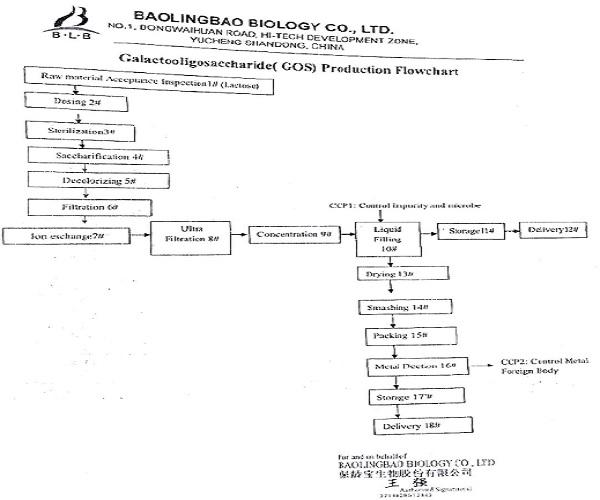
24. In the present case, the imported goods as certified by the manufacturer is as follows:
a) The percentage of oligosaccharides in GOS powder manufactured by Baolingbao Biology Co., Ltd, China is minimum 70%, which is duly supported by Test Report No. A2250521830101001Ea. As per the Test Result in Sr. No.20 in the said Test Report, the percentage of oligosaccharides is found to be 72%.
b) The said percentage of minimum 70% of oligosaccharides consists of range of galacto oligosaccharides with different degree of polymerization (DP), typically ranging from DP2 to DP8. We do not have the individual percentage by weight of oligosaccharides DP2 to DP8 in the said 70% of oligosaccharides.
c) As per the said Test Report the percentage of Lactose in GOS powder was found to be 9.53% as per test result in Sr. No.11 of the Test Report and the percentage of Glucose in GOS powder was found to be 7.17% as per test result in Sr. No.25.
d) The starting material for manufacture of Galacto-oligosaccharides is “Lactose” and “Glucose” emerges during the process of Saccharification (break-down) of Lactose. By process of filtration, solid impurities are removed and by process of Ultra filtration, galactose is removed and glucose is to a large extent removed. However, traces of lactose and glucose as mentioned in the Test report remain in the GOS powder.
25. As regards the composition of the said minimum 70% of oligosaccharides, the manufacturer has by the said Certificate clarified that the same consists of range of galacto oligosaccharides with different degree of polymerization (DP), typically ranging from DP 2 to DP 8. The manufacturer does not have the individual percentage by weight of oligosaccharides DP 2 to DP 8 in the said minimum 70% of oligosaccharides. As per the Flow Chart, the process is of filtration and ultra-filtration. As clarified by the Manufacturer in the Certificate, by process of filtration, solid impurities are removed and by process of Ultra-filtration, galactose is removed and glucose is to a large extent removed. However, traces of lactose and glucose as mentioned in the Test report remain in the GOS powder.
26. As regards the query as to how the product is considered chemically pure, reliance is placed on the HSN notes under Heading 29.40, as per which, Oligosaccharides are specifically mentioned under (A) Sugars, chemically pure. Since the essential character of GOS powder is Oligosaccharide only and the goods are bought and sold and used as Galacto-Oligosaccharide only and since as per HSN notes under Heading 29.40, Oligosaccharides are listed as Chemically pure sugar, the goods are correctly classifiable as Oligosaccharide under Heading 2940 00 00.
It is re-iterated that as per the HSN Explanatory Notes under Chapter 29, the goods of Heading 2940 are listed as an exception to the requirement of Note 1 (a) of Chapter 29 which provides that Headings of chapter 29 apply only to separate-chemically defined organic compound. Accordingly, classification of the said GOS powder under Heading 2940 cannot be disputed on the ground that apart from Galacto-Oligosaccharide (70%), it also contains Glucose and Lactose in small quantity in view of the starting material being lactose.
27. Port of Import and reply from jurisdictional Commissionerate.
The applicant in their CAAR-I indicated that they intend to import the subject goods from the jurisdiction of Office of the Commissioner of Customs, NS-I, Nhava Sheva, JNCH, Uran, Distt. Raigad. The applications were forwarded to the Office of the Principal Commissioner of Customs, NS-I, Nhava Sheva, JNCH, Uran for their comments on 22.07.2026, however, no replies have been received in this regard.
28. Records of Personal Hearing: –
A personal hearing was granted to the Applicant on 04.08.2026. During the hearing, the Applicant’s authorised representative reiterated the submissions made in their written submission filed with the application and contended that the imported goods, namely Galacto-Oligosaccharide, which is ‘Basically Infant Feed Formula’ is classifiable under HSN code 2940 00 00. Or else classifiable for sugars under 1702, however, it excludes sugar of Chapter 2940. Also, precedence of previous ruling classifying identical products in 2940 CTH. No representative appeared for PH from the department side.
29. Discussion and findings: –
29.1 I have considered all the materials placed before me in respect of the classification of subject goods. I have also gone through the submissions made by the applicant during the personal hearing on 04.08.2026. Therefore, I proceed to pronounce a ruling on the basis of information available on record as well as existing legal framework.
29.2 I observe that the issue involved in the case is to arrive at correct classification of the “Galacto-Oligosaccharides” to be imported. At the outset, we find that the issue raised is squarely covered under Section 28H(2)(a) of the Customs Act, 1962 being a matter related to classification of goods under the provisions of this Act.
29.3 The applicant is engaged inter alia in the import, manufacture and trading of pharmaceutical and nutraceutical products. They propose to import from China “Galacto-Oligosaccharides (GOS)” in powder form. The applicant has submitted that Galacto-Oligosaccharides (GOS) are produced from Lactose by enzymatic conversion. The product is recognized as a prebiotic ingredient that selectively promotes the growth of beneficial gut microbiota. The applicant has sought Advance Ruling in respect of the following question: –
Whether the product (Galacto-Oligosaccharides) is classifiable under Tariff Heading 2940 or Tariff Heading 1702 of the Customs Tariff Act 1975?
29.4 As per the technical literature and specifications furnished by the applicant, the composition of the imported product is stated to be as follows:
GOS Powder
- Total GOS (Dry Substance): >70%
- Lactose + Glucose (On dry basis): <30%
- PH: 2.8 – 5.5
In this case, the issue for determination is whether the product “Galacto-Oligosaccharides (GOS)” is classifiable under heading 2940 as chemically pure sugar or 1702 as other sugars and sugar syrups.
29.5 General Rules for Interpretation (GRI) Rule 1 of the General Rules for Interpretation provides that classification shall be determined according to the terms of the headings and any relevant Section or Chapter Notes. Rule 3(a) provides that the heading which provides the most specific description shall be preferred to a heading providing a more general description.
29.6 Before deciding on the issue, let me deliberate on the legal framework prescribed in Customs Tariff Act, 1975, Chapter/Section notes along with HSN explanatory notes, Classification of goods in the Harmonized System of Nomenclature (HSN) is governed by the General Rules for the interpretations Rule 1 of the General Rules for the interpretation of the Import Tariff to the Customs Tariff Act, 1975 stipulate that for legal purpose, the classification of the import item shall be determined according to the terms of the heading and any relative section or chapter notes. Accordingly, the first issue requiring examination is whether the imported goods satisfy the legal requirements of Heading 2940.
30. Relevant portion of CTH 2940 is reproduced below for ease of reference: –
| HS Code | Item Description |
|---|---|
| 2940 00 00 | Sugars, chemically pure, other than sucrose, lactose, maltose, glucose and fructose; Sugar ethers, sugar acetals and sugar esters, and their salts, other than products of heading 29.37, 29.38 or 29.39 |
30.1 It is found that Chapter Note 1 to Chapter 29 provides that, except where the context otherwise requires, the headings of Chapter 29 apply only to separate chemically defined organic compounds, whether or not containing impurities. The Note reflects the fundamental scheme of Chapter 29, namely that the Chapter is intended to cover identifiable chemical compounds possessing a defined chemical constitution. The Harmonized System Explanatory Notes to Chapter 29 similarly explain that chemically defined compounds are substances consisting of one molecular species whose composition is defined by a constant ratio of elements and whose structure can be represented by a definitive structural formula.
30.2 Further, heading 2940 specifically covers “Sugars, chemically pure, other than sucrose, lactose, maltose, glucose and fructose; sugar ethers, sugar acetals and sugar esters and their salts.” The expression “chemically pure” employed by the legislature is neither redundant nor incidental. The heading therefore contemplates sugars having a distinct and identifiable chemical identity. The legislative emphasis is not merely on the presence of sugar molecules but on the existence of chemically pure sugar compounds.
30.3 Applying the above principles to the present case, I find that the imported product is described as Galacto-Oligosaccharides (GOS), produced from lactose through enzymatic transgalactosylation and comprising a mixture of galactose-containing oligosaccharides of varying chain lengths and degrees of polymerization. The product specification itself prescribes a minimum GOS content of 70%, while permitting lactose and glucose, collectively, up to a maximum of 30%. Such composition demonstrates that the imported goods are not constituted of a single molecular species having one fixed molecular structure and composition. Rather, the product is a commercial preparation comprising a distribution of GOS molecules having different degrees of polymerization and molecular weights, together with residual lactose and glucose arising from the manufacturing process. The variation in the GOS composition and the presence of the residual carbohydrate fraction is therefore intrinsic to the nature and manufacturing specification of the imported product and cannot, merely on the basis of their presence, be treated as insignificant impurities.
30.4 I therefore conclude that the imported goods derive their essential character from the predominant presence of Galacto-Oligosaccharides (GOS), comprising a heterogeneous distribution of galactose-containing oligosaccharides having varying chain lengths and degrees of polymerization, rather than from any single chemically pure sugar such as lactose or glucose. I have also examined the manufacturer’s technical specifications about the product and analytical results furnished in respect of the imported goods. The laboratory report describes the product as a white powder having a sweet taste and no odour, with an oligosaccharide content of 72.0% on a dry basis, lactose content of 9.53% on a dry basis and glucose content of 7.17% on a dry basis. The moisture content is reported as 3.30%, while the ash content is less than 0.05%. The report further records that several specified microbiological contaminants, heavy metals and aflatoxins were not detected or were present below the stated limits. The presence of residual lactose and glucose within the specified limits, particularly where arising from the enzymatic conversion of lactose during the manufacturing process, does not by itself alter the essential character of the imported goods as a GOS product.
31. Scope of Heading 1702
Heading 1702 covers “Other sugars, including chemically pure lactose, maltose, glucose and fructose, in solid form; sugar syrups not containing added flavouring or colouring matter”. The imported goods are derived from lactose and consist predominantly of Galacto-oligosaccharides. The product retains the character of a carbohydrate sugar product irrespective of whether it is imported in powder form or syrup form.
32. “While the goods are commercially known and traded as ‘Galacto-Oligosaccharides (GOS),’ their trade identity as a non-digestible carbohydrate compound does not relegate them to Chapter 17. To the contrary, the HSN Explanatory Notes to Heading 2940 explicitly dictate that ‘oligosaccharides’ qualify as ‘sugars’ for the purposes of Chapter 29. Furthermore, as confirmed by CAAR precedents, a high-purity (≥70%) enzymatic prebiotic structure cannot be classified under Chapter 17 as a common food sugar. The residual lactose and glucose are strictly permitted impurities under Chapter 29 Note 1, ensuring the product remains squarely under HSN 2940.”
33. The Manufacturer’s Certificate confirms that Lactose is the unreacted starting material and Glucose is the emergent process by product of the reaction. Because these free sugars are unavoidable, natural processing remnants required to isolate the active ≥ 70% GOS matrix, they legally constitute “permissible impurities” under Chapter 29. Their residual presence does not strip the product of its primary organic chemical identity. I further note that the manufacturing process commences with sugar and water as raw materials and involves dosing, sterilization, saccharification, decolorization, filtration, ion-exchange treatment, concentration, chromatographic separation, pH adjustment, sterilization and final packaging. The process culminates in the production of Galacto-oligosaccharides (GOS) in powder or syrup form. The manufacturing process is relevant in determining the nature and identity of the finished goods. The resultant product is commercially identified and traded as GOS falling under Heading 2940.
34. This Authority rules that the product “Galacto-Oligosaccharides (GOS)” consisting of a distribution of oligomeric species from DP 2 to DP 8 with a purity level of ≥ 70% is correctly classified under Chapter 29, heading 2940, and specifically under Tariff Item 2940.00.00 of the First Schedule to the Customs Tariff Act, 1975.
35. I rule accordingly.