In re Zen Restaurant Regarding Alleged Levying of Service Charge (CCPA Delhi)
Summary: The Central Consumer Protection Authority (CCPA) took suo-moto cognizance of a grievance registered by Akshay Kumar Malhotra before the National Consumer Helpline against Zen Restaurant regarding levy of a discretionary service charge. The consumer alleged that a bill of Rs. 924/- included a discretionary service charge of Rs. 80/-, besides applicable CGST and SGST.
The CCPA noted the Delhi High Court judgment dated 28th March 2025 in National Restaurant Association of India & Ors. Vs Union of India & Anr., which upheld the CCPA Guidelines on service charge and held that mandatory collection of service charge is contrary to law and violative of the guidelines. The Court also held that CCPA was free to enforce the guidelines in accordance with law.
The CCPA conducted a preliminary inquiry under Sections 18(2) and 19 of the Consumer Protection Act, 2019. It prima facie found that Zen Restaurant had levied service charge in the guise of “Discretionary Service Charge” through its software-generated bill. Since such billing could affect a wider class of consumers, the matter was treated as fit for class action under Section 10.
The Director General (Investigation) found that the restaurant had added a discretionary service charge of Rs. 80 to the Rs. 800 subtotal for Non-Veg Lunch. The investigation observed that the charge was automatically included without a documented consent mechanism, separate opt-in or post-order acceptance option. The invoice did not contain a disclaimer that the charge was optional and the presentation created an impression that payment was mandatory. The investigation further found that GST was applied to the enhanced amount and concluded that the practice violated consumer rights and constituted an unfair trade practice.
The restaurant contended that the charge was discretionary rather than mandatory, that the consumer had the opportunity to decline payment, that the amount had subsequently been refunded and that the grievance had therefore been resolved. It also denied harassment or embarrassment of the consumer and stated that the restaurant had ceased operations since November 2025.
The CCPA examined Sections 2(9), 2(28), 2(46) and 2(47) of the Consumer Protection Act, 2019. It referred to the CCPA’s Guidelines to Prevent Unfair Trade Practices and Protection of Consumer Interest with Regard to Levy of Service Charge in Hotels and Restaurants dated 04.07.2022, which provide, inter alia, that no hotel or restaurant shall add service charge automatically or by default, collect it under another name, force a consumer to pay it, or add it along with the food bill and levy GST on the total amount.
The CCPA also relied upon the Delhi High Court judgment in National Restaurant Association of India & Ors. Vs Union of India & Anr. The Court had held that service charge or tip is voluntary, cannot be compulsory or mandatory, and that mandatory collection is contrary to consumer interest and violative of consumer rights. The Court further held that the CCPA guidelines are valid and that voluntary tips may be paid at the customer’s discretion but should not be added by default in the bill or invoice.
On the facts, the CCPA found that the billing software operated on an “opt-out” rather than “opt-in” mechanism. The automatic addition of “Discretionary Service Charge” undermined informed consumer choice, placed the burden on consumers to object at the billing counter and created social pressure to accept the charge. The subsequent refund did not erase the violation because the infringement occurred when the charge was automatically imposed at the billing stage.
The CCPA found violations of consumer rights under Section 2(9)(ii) and (v), misleading advertisement under Section 2(28)(i) and (iii), unfair trade practice under Section 2(47) read with Section 2(46)(vi), and the CCPA Guidelines dated 04.07.2022. The Authority also observed that the restaurant had not demonstrated whether its billing software had been modified to eliminate default imposition of service charge or furnished any undertaking concerning future compliance.
While considering penalty under Sections 20 and 21, including the factors specified in Section 21(7), the CCPA took into account the mitigating circumstances, particularly the prompt refund following NCH intervention and the closure of the establishment in November 2025. The Authority consequently took a lenient view regarding the quantum of penalty.
The CCPA directed the Restaurant to discontinue and refrain from levying or collecting any service charge automatically or by default, whether under the nomenclature “Discretionary Service Charge” or any other name, and to strictly comply with the 04.07.2022 Guidelines. It further directed immediate modification of the software-generated billing system to remove default addition of service charge or any other similar charge. The Restaurant was also directed to pay a penalty of Rs. 10,000/- and submit a compliance report within 15 days of receipt of the order.
Cases Discussed
- National Restaurant Association of India & Ors. Vs Union of India & Anr. (Delhi High Court)
FULL TEXT OF THE JUDGMENT/ORDER OF CENTRAL CONSUMER PROTECTION AUTHORITY
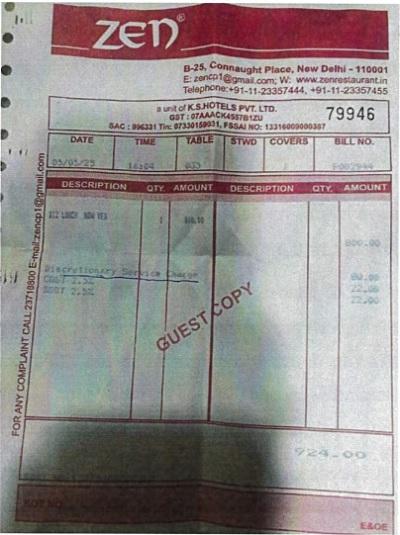
1. The Central Consumer Protection Authority (CCPA) has taken suo-moto cognizance of the grievance from Akshay Kumar Malhotra registered at National Consumer Helpline 1915 (NCH) vide docket no. 7107216 dated 06.05.2025 against Zen Restaurant (hereinafter referred to as “The Restaurant”). The complainant alleged that “he was presented with a charge of ₹924/-, which included a discretionary service charge of ₹80/-, in addition to applicable CGST and SGST”. The Consumer in support of his grievance had attached the bill, which is reproduced below:
2. It is pertinent to mention that vide judgement dated 28th March, 2025 the Hon’ble High Court of Delhi in National Restaurant Association of India & Ors. v. Union of India & Anr., had held that: “All restaurant establishments would have to adhere to the guidelines passed by the CCPA. If there is any violation of the same, action would be liable to be taken in accordance with law. CCPA is free to enforce its guidelines in accordance with law.” Further the Hon’ble High Court had upheld the applicability of the CCPA guidelines which is in the interest of consumers and declaring the levy of any mandatory service charge as contrary to law and violates the guidelines.
3. The CCPA in exercise of power conferred under Section 18(2) and Section 19 of the Consumer Protection Act, 2019 (the Act, 2019) conducted a preliminary inquiry to examine the veracity of the claim made against the aforementioned Restaurant.
4. In the preliminary inquiry, CCPA prima facie found, that the Restaurant had levied service charge in the guise of ‘Discretionary Service Charge’ on the bill despite the Hon’ble High Court of Delhi upholding the Guidelines to Prevent Unfair Trade Practices and Protection of Consumer Interest with regard to levy of service charge in Hotels and Restaurants, 2022 issued by CCPA (hereinafter referred to as Guidelines, 2022), Considering that the bill is software generated, the practice adopted by the Restaurant might have impacted a wider base of consumers visiting the restaurant thereby making it a fit case for class action as envisaged in section 10 of Consumer Protection Act 2019,
5. Based on the preliminary inquiry findings, CCPA directed the restaurant to furnish their response vide Notice dated 19th May, 2025 for violation of various provisions of the Act, 2019 and Guidelines to Prevent Unfair Trade Practices and Protection of Consumer Interest with Regard to Levy of Service Charge in Hotels and Restaurants issued on 04.07.2022.
6. In response to the said notice, the restaurant vide email dated 30th May, 2026 submitted that the matter has already been resolved with the complainant and proof of the settled amount was enclosed.
7. Upon examination of the response of the Restaurant, CCPA observed that the restaurant has not given any justification for its continued levy of service charge in the food bill, which is in direct contravention of the Guidelines issued by the Central Consumer Protection Authority (CCPA) and the judgment of the Hon’ble High Court of Delhi and has adversely impacted consumers as a class.
8. In light of the above observations, CCPA vide letter dated 30 June, 2026 directed Director General (Investigation) to conduct a detailed investigation.
9. The Director General (Investigation) submitted the Investigation Report dated 05th June, 2026 vide email dated 10th June, 2026. The findings in the Investigation report are as under:
a. Zen Restaurant while offering the restaurant services to the customer added a discretionary service charge of Rs. 80 to the Rs. 800 subtotal for Non-Veg Lunch on the May 5, 2025 invoice. This created a significant imbalance in rights and obligations to the consumer’s detriment by imposing pecuniary liability and additional charges without the consumer’s express contract agreement. The pre-inclusion of the charge inflated the taxable base to Rs. 924 without any documented consent mechanism, separate opt-in, or post-order acceptance option, effectively making it mandatory while the restaurant claimed it was discretionary verbal communication thus shifting the rejection burden onto the consumer.
b. Restaurant also mentions that the allegations raised by the consumer under Docket No. 7107216 is been resolved by refunding the discretionary service charge amount of Rs. 84. Even though the restaurant provided the latest invoice showing removing of discretionary service charge by compliance, it is a clear indication that the restaurant indulged in violations by imposing a discretionary service charge unreasonably and creating conditions that put the customer into awkward situations, amounting to a violation of Unfair Contract.
c. The Zen Restaurant invoice bill indicates “discretionary Service charge 10% — Rs. 80, presented similarly to statutory taxes like GST shows that there is no disclaimer indicating that the charge is optional. This presentation creates the impression that the payment is mandatory, placing the burden on the customer to actively object at the counter to avoid paying Service charge. Any practice that misleads consumers or falsely represents a charge as compulsory constitutes an unfair trade practice. Since restaurant has indulged in levy of discretionary service charge is automatically and integrated into the bill—with GST applied on Service charge—the billing format itself reinforces this misleading costumer. This restaurant’s practice amounts to a violation of Unfair Trade Practice.
d. The Zen Restaurant invoice shows levy of discretionary service charge of Rs. 80 on a subtotal of Rs. 800 for Non-Veg Lunch, with GST applied on the enhanced amount, resulting in a final bill of Rs. 924. This practice of restaurant demonstrates that the consumer paid tax on a non-statutory charge, and the total payable amount was inflated due to the automatic inclusion of the discretionary service charge without any recorded voluntary contract agreement by the customer. In this present case, Customer was entitled to protection against unfair trade practices, the right to be informed.
e. The automatic addition of the discretionary service charge undermines informed choice, creates pressure at the billing stage, and makes it socially uncomfortable for customers to object, imposing a financial burden unless actively disputed. Offering a refund after payment does not rectify the violation, as the infringement occurs at the time of billing, when consent must be free and informed. It clearly indicates that the restaurant has indulged in violation of consumer rights.
f. In view of the findings on record, it is conclusively established that the automatic levy of Service Charge @10% (80) by Zen Restaurant, Delhi, amounts to indulgence in violation of Section 2(9), 2(46), 2(47), Consumer Protection Act, 2019.
10. Thereafter, the Investigation Report submitted by DG (Investigation) was shared with the Restaurant vide letter dated 22nd June, 2026 to furnish its comments and an opportunity of hearing was also provided to the Restaurant on 21st July, 2026 under Section 20 and 21 of the Act, 2019 before passing an order.
11. On 08th July, 2026, the Opposite Party submitted its comments on investigation report stating as follows:
a. It is submitted that as noted in Para 4 of the Investigation Report itself, the specific grievance registered under National Consumer Helpline Docket No. 7107216 by the Complainant, Mr. Akshay Kumar Malhotra, was fully, finally, and amicably resolved way back on 15th May 2026. The Restaurant refunded the service charge of Rs. 84/- in full. Since the Complainant has already received his refund and the grievance is resolved, there is no active dispute left to pursue.
b. It is submitted that during the time of investigation, no proper discussion was done with the Respondent Restaurant by the enquiry officer of CCPA and accordingly an investigation report was filed.
c. That at the very outset, it is submitted that the charge in question was a discretionary service charge, and not a mandatory or statutory levy of any kind. If the Complainant did not wish to pay the said discretionary charge, as it was open to him, at the time of payment, he had the option to decline paying the service charge. However, the Complainant chose not to do so, and paid the bill in full without raising any objection at that point. Having had a clear and effective opportunity to opt out before payment, and having nonetheless chosen to pay, the Complainant cannot, after the transaction stood concluded, contend that the amount was extracted from him under compulsion or without his consent.” This was in the nature of a tip which he gave voluntarily.
l. That a person who makes a payment voluntarily, with full knowledge of what he is paying for and with a clear option available to decline, cannot thereafter turn around and treat that very payment as an actionable grievance. What is voluntarily paid cannot be later stated as something wrongly or forcibly collected.
The Restaurant denies that the staff has harassed or embarrassed the Complainant. It is pertinent to mention that the restaurant staffs did not make any inappropriate remarks to the Complainant therefore issue of harassment and humiliation in a public space does not arise.
That it is further respectfully submitted that M/s Zen Restaurant is presently not functional.
l. It is submitted that as per your communication dated 15.05.2025 setting out the details of the alleged Complaint, it is specifically mentioned in the said communication as under:-
“We invite you to partner in the Convergence Programme of the National Consumer Helpline, the grievance redressal mechanism of the Department of Consumer Affairs, Govt. of India. The convergence partnership is a free, fair and fast grievance redressal mechanism and works as an Alternate Dispute Redressal (ADR) at the pre litigation level by resolving your customer grievances without him/her necessarily having to approach a consumer commission.” In accordance with the above, we have acted in letter and in spirit by making refund of the amount of service charge and both the parties treated the matter as closed. Accordingly, no grievance survives.
h. The content of para 8 of the investigation report is denied on the below mentioned grounds:-
A) Unfair Contract Violations:
The finding that the Restaurant was indulged in an unfair contract is vehemently denied. No contractual compulsion requiring the consumer to pay the service charge was there into existence. It is pertinent to mention that the invoice itself clearly reflected the amount as a Discretionary Service Charge, indicating that the same was voluntary and not obligatory. Since the Complainant chose to pay the amount without raising any objection at the time of payment, subsequent claim that the charge was imposed compulsorily cannot be raised at a later stage.
B) Unfair Trade Practice:
The finding that the Restaurant was also indulged in an Unfair Trade Practice is specifically denied. The service charge was neither represented as a statutory levy nor was the Complainant informed that payment thereof was mandatory. The Complainant, being fully aware of the invoice particulars, voluntarily proceeded to settle the bill. The subsequent challenge to a voluntarily paid discretionary amount is an afterthought and cannot constitute an Unfair Trade Practice. Moreover, the Restaurant has already refunded the disputed amount in full, thereby resolving the consumer grievance.
C) Violation of Consumer Rights:
The finding regarding alleged violation of consumer rights is denied. The Complainant was neither deprived of information nor subjected to any coercive or unfair practice. The invoice clearly specified the amount charged, and the Complainant exercised his own discretion in making the payment. It is submitted that a consumer who voluntarily pays an amount without protest and subsequently accepts a refund cannot continue to allege violation of consumer rights in respect of the same transaction.
i. The contents mentioned in the conclusion given by the Director General in its Investigation Report are wrong and hence vehemently denied. It is submitted that M/s Zen Restaurant, Delhi has not violated any provision of the Consumer Protection Act, 2019 as the levying of service charge was clearly mentioned on the Complainant’s bill as a discretionary service charge indicating that the same was voluntary and not obligatory. Moreover, since the Restaurant has already refunded the disputed amount in full, hence no consumer grievance is active to be adjudicated as the said dispute has been resolved.
12. At the hearing held on 21st July 2026, Dr. Lalit Bhasin, Senior Advocate, appeared alongside the restaurant owner, Mr. Manpreet Singh, on behalf of the restaurant and submitted as under:
a. The Refund was made as soon as the complaint was brought to the notice of the restaurant,
b. That the solitary complaint is erroneously being treated as a class action, which is legally impermissible and unsustainable under the prevailing law.
c. That the grievance stands fully redressed, as the disputed amount was promptly refunded to the complete satisfaction of the Complainant.
d. That the establishment has ceased operations since November 2025; consequently, no question arises of levying or collecting any service charge.
e. That at the very outset, it is respectfully submitted that the levy in question was strictly a discretionary service charge rather than a mandatory or statutory imposition, and the Complainant was entirely at liberty to decline payment at the time of billing.
13. Before delving into the specifics of the case, it is pertinent to examine the relevant legal framework that governs such transactions.
a. Section 2(9) (ii) and (v) of the Act, 2019 includes- “the right to be informed about the quality, quantity, potency, purity, standard and price of goods, products or services, as the case may be, so as to protect the consumer against unfair trade practices” and “the right to seek redressal against unfair trade practices or restrictive trade practices or unscrupulous exploitation of consumers.”
b. From the bare reading of Section 2 (28) of the Act, 2019 it can clearly be concluded that when a restaurant displays a menu with specific prices, the consumer is duly informed about the cost of the food. However, if a mandatory service charge is added later, it conveys an express or implied representation that the restaurant, a service provider had deliberately concealed the actual price of the food and service thereof, constituting an unfair trade practice.
c. Section 2 (46) “unfair contract” means a contract between a manufacturer or trader or service provider on one hand, and a consumer on the other, having such terms which cause significant change in the rights of such consumer, and imposing on the consumer any unreasonable charge, obligation or condition which puts such consumer to disadvantage;
l. Furthermore, Section- 2(47) of the Consumer Protection Act, 2019 defines “Unfair Trade Practice” which includes deceptive or unethical methods used to promote the sale of goods, use or supply of any goods or provision of services.
CCPA had issued Guidelines to Prevent Unfair Trade Practices and Protection of Consumer Interest with Regard to Levy of Service Charge in Hotels and Restaurants, on 4th July, 2022. The extracts of which are given below:
“3. Service charge is being levied in addition to the total price of the food items mentioned in the menu and applicable taxes, often in the guise of some other fee or charge.
4. It may be mentioned that a component of service is inherent in price of food and beverages offered by the restaurant or hotel. Pricing of the product thus covers both the goods and services component. There is no restriction on hotels or restaurants to set the prices at which they want to offer food or beverages to consumers. Thus, placing an order involves consent to pay the prices of food items displayed in the menu along with applicable taxes. Charging anything other than the said amount would amount to unfair trade practice under the Act.
7. Therefore, to prevent unfair trade practices and protect consumer interest with regard to levying of service charge, the CCPA issues the following guidelines —
(i) No hotel or restaurant shall add service charge automatically or by default in the bill.
(ii) Service charge shall not be collected from consumers by any other name.
(iii) No hotel or restaurant shall force a consumer to pay service charge and shall clearly inform the consumer that service charge is voluntary, optional and at consumer’s discretion.
(iv) No restriction on entry or provision of services based on collection of service charge shall be imposed on consumers.
(v) Service charge shall not be collected by adding it along with the food bill and levying GST on the total amount.”
f. The Hon’ble High Court of Delhi [National Restaurant Association of India & Ors. Vs Union of India & Anr.] passed the Judgment on 28th March, 2025 held in favor of CCPA wherein the Court held the following:
i. Service charge or TIP as is colloquially referred, is a voluntary payment by the customer. It cannot be compulsory or mandatory. The practice undertaken by the restaurant establishments of collecting service charge that too on a mandatory basis, in a coercive manner, would be contrary to consumer interest and is violative of consumer rights.
ii. The collection of service charge and use of different terminologies for the said charge is misleading and deceptive in nature. The same constitutes an unfair trade practice under Section 2(47) of the CPA, 2019.
iii. The guidelines framed by the CCPA are thus valid and are in the interest of the consumers and the same are upheld.
iv. While this Court holds that the mandatory collection of service charge is contrary to law and violates the guidelines, it is also of the opinion that if consumers wish to pay any voluntary Tip for services which they had enjoyed, the same would obviously not be barred. The amount however, ought not to be added by default in the bill/invoice and should be left to the customer’s discretion.
v. All restaurant establishments would have to adhere to the guidelines passed by the CCPA. If there is any violation of the same, action would be liable to be taken in accordance with law. CCPA is free to enforce its guidelines in accordance with law.
14. In light of the above provisions and consideration of the investigation report of DG Investigation (CCPA) along with the submissions of the Restaurant, CCPA arrives at the following findings:
(a) It is pertinent to note that when a restaurant displays prices on its menu, a component of service is already inherent in the pricing of the food and beverages offered, ensuring consumers are informed of the actual cost upfront. Because establishments have absolute freedom to set their menu prices, placing an order constitutes consent only to pay the displayed price plus applicable taxes. Consequently, levying service charge such as ‘Discretionary Service Charge’ creates an express or implied representation that the restaurant concealed the true cost of food and service, thereby misrepresenting the final cost of dining out.
(b) Further, the genesis of the service charge in the bill is the command embedded in the billing software, leading to default addition of service charge in the guise of ‘Discretionary Service Charge’ to every bill, requiring consumers to opt out rather than opt in. This contradicts the restaurant’s submission that the charge is discretionary, optional and non-compulsory. This aspect is also borne out from the Investigation Report, which records that the restaurant’s invoice indicates no disclaimer that the charge is optional. This presentation creates the impression that the payment is mandatory, placing the burden on the customer to actively object at the counter to avoid paying service charge. Any practice that misleads consumers to actively object at the counter to avoid paying service charge.
(c) The practice of the restaurant to levy ‘Discretionary Service Charge’ automatic addition of Discretionary service charge undermines informed choice, creates pressure at the billing stage and makes it socially uncomfortable for consumer to object, imposing a financial burden and that subsequent refund of the amount does not erase the violation occurring at the time of billing when consent must be free and informed.
(d) It could not be ascertained from the restaurant’s reply or its submissions during the hearing when it ceased to levy a service charge under the nomenclature of ‘Discretionary Service Charge’ or whether the practice continued until operations ceased in November 2025. Furthermore, the restaurant neither demonstrated whether its billing software has been revised to eliminate this default imposition nor tendered any undertaking or assurance to the authority regarding the same.
(e) Service charge or TIP as is colloquially referred, is a voluntary payment by the customer. It cannot be compulsory or mandatory. The practice undertaken by the restaurant establishments of collecting service charge that too on a mandatory basis, in a coercive manner, would be contrary to consumer interest and is violative of consumer rights. Moreover, the collection of service charge and use of different terminologies for the said charge is misleading and deceptive in nature. The same constitutes an unfair trade practice under Section 2(47) of the CPA, 2019.
(a) Hence, the Restaurant is in violation of the following provisions of Consumer Protection Act 2019:
(i) Consumer rights under section 2(9) (ii) of the Act, 2019.
(ii) Consumer rights under section 2(9) (v) of the Act, 2019.
(iii) Misleading advertisement under Section 2(28) (i) and (iii) of the Act, 2019.
(iv) Engaging in Unfair Trade Practice as defined in section 2(47) of Act, 2019 read with section 2(46) (vi) of Act, 2019;
(v) Guidelines to Prevent Unfair Trade Practices and Protection of Consumer Interest with Regard to Levy of Service Charge in Hotels and Restaurants, on 4th July, 2022.
15. Considering the above findings and the violations noted in the foregoing paras the CCPA is empowered under Section 20 and 21 of the Consumer Protection Act, 2019 to issue directions to modify the advertisement or discontinue such advertisement and practices, if necessary, it may, by order, impose a penalty which may extend to ten lakh rupees and for every subsequent contravention may extend to fifty lakh rupees. Further, Section 21 (7) of the above Act, 2019 prescribes that following may be regarded while determining the penalty:
i. the population and the area impacted or affected by such offence;
ii. the frequency and duration of such offence;
iii. the vulnerability of the class of persons likely to be adversely affected by such offence;
iv. the gross revenue from the sales effected by virtue of such offence
16. Having regard to the totality of facts, findings, and statutory mandates, it is concluded that the mechanism of “opt-out” rather than “opt-in” fundamentally vitiates consumer free consent. According to the Guidelines, 2022, no hotel or restaurant shall add service charge automatically or by default in the bill and shifting the burden onto the consumer to identify, contest, and demand the removal of the levy at the time of payment exploits social dynamics. This practice creates undue embarrassment and commercial coercion, violating the consumer’s statutory right to be informed under Section 2(9) of the Act. Therefore, the conduct of the restaurant attracts the applicability of Section 21(7) of the Act, 2019. However, taking into account the mitigating circumstances, specifically the prompt refund of the amount charged as ‘Discretionary Service Charge’, issued upon NCH intervention and the establishment’s closure in November 2025 the Authority takes a lenient view regarding the quantum of the penalty imposed.
17. In light of the above CCPA issues the following directions:
a. The Restaurant shall discontinue and refrain from levying or collecting any service charge automatically or by default, whether under the nomenclature of “Discretionary Service Charge” or by any other name, and shall ensure strict compliance with the Guidelines to Prevent Unfair Trade Practices and Protection of Consumer Interest with Regard to Levy of Service Charge in Hotels and Restaurants dated 04.07.2022. To take immediate steps to modify its software generated billing system by removing default addition of service charge or charge by any other name.
b. Considering the established violations and applying the statutory factors under Section 21(7) of the Consumer Protection Act, 2019, the Restaurant is directed to pay a penalty of ₹10,000/- only.
The Restaurant shall submit a compliance report of the above-mentioned directions to the CCPA within 15 days from the receipt of this order.