Cooperative Rabobank U.A. Singapore Branch Vs Shailendra Ajmera (NCLAT Delhi)
Summary: The National Company Law Appellate Tribunal (NCLAT), New Delhi, in Cooperative Rabobank U.A. Singapore Branch Vs Mr. Shailendra Ajmera, examined whether a bank that discounted bills of exchange arising from the supply of goods to a corporate debtor could claim the status of a financial creditor under the Insolvency and Bankruptcy Code, 2016. The dispute arose during the corporate insolvency resolution process of Ruchi Soya Industries Limited, where Cooperative Rabobank U.A. Singapore Branch submitted a substantial claim based on bills of exchange accepted by the corporate debtor for goods supplied by Aavanti Industries Pte Ltd. Although the claim was admitted for consideration, the Resolution Professional classified the bank as an operational creditor rather than a financial creditor. The National Company Law Tribunal, Mumbai Bench, affirmed this classification by its order dated 14 May 2018. The bank challenged that determination before the NCLAT, contending that bill discounting constituted a financial transaction involving consideration for the time value of money.
The appellant bank submitted that it was engaged in international banking and trade-finance activities, including financing export and import transactions through discounting bills of exchange. According to the bank, the discount interest and commission earned on such instruments represented consideration calculated with reference to their maturity periods and therefore reflected the time value of money. The bank argued that discounting bills of exchange was commercially equivalent to lending money against interest and that the resulting liability should qualify as financial debt under Section 5(8) of the IBC. It further contended that treating banks discounting trade instruments as operational creditors would discourage institutional financing of international trade transactions and undermine the objective of developing the credit market.
The bank relied upon a Master Sales and Purchase Agreement dated 22 October 2013, entered into with Aavanti Industries Pte Ltd. Under the arrangement, bills of exchange accepted by Ruchi Soya Industries Limited were discounted by the bank, which paid the discounted proceeds to Aavanti. The bank asserted that the corporate debtor had unconditionally accepted the bills and thereby undertaken to pay their face value upon maturity. It further submitted that the discounting arrangement was without recourse to the supplier, meaning that the bank was entitled to seek payment from the corporate debtor rather than recover the discounted amount from Aavanti under the agreed terms. The bills were subsequently dishonoured on presentation. The appellant maintained that the corporate debtor’s direct payment obligation under the accepted bills established an independent financial liability in favour of the bank.
In support of its contention, the appellant invoked Sections 32 and 37 of the Negotiable Instruments Act, 1881, arguing that the acceptor of a bill of exchange becomes principally liable for payment. Reliance was placed upon American Express Bank Ltd. Vs Calcutta Steel Co., (1993) 2 SCC 199 (Supreme Court), concerning the legal implications of negotiable instruments. The appellant also referred to Dr. B.S.V. Lakshmi Vs Geometrix Laser Solutions Pvt. Ltd., decided on 13 March 2017 (NCLAT), in support of its argument concerning financial debt and the time value of money. It maintained that the commercial substance of the transaction, the discounting charges and the corporate debtor’s acceptance of the bills justified recognition of the bank as a financial creditor rather than an operational creditor.
The Resolution Professional opposed the appeal, submitting that the underlying liability arose exclusively from the supply of goods by Aavanti to Ruchi Soya Industries Limited. Aavanti was therefore an operational creditor within the meaning of Sections 5(20) and 5(21) of the IBC. The subsequent discounting or transfer of the right to receive payment could not alter the original nature of the debt. The Resolution Professional emphasised that the definition of operational creditor expressly includes a person to whom operational debt has been legally assigned or transferred. Consequently, even where the transferee was a bank or financial institution, it would acquire the rights of an operational creditor in relation to the transferred debt. The central issue was therefore not whether bill discounting was a recognised financing activity, but whether the transaction created a financial debt owed by the corporate debtor to the appellant.
The NCLAT accepted the Resolution Professional’s interpretation and examined the statutory scheme governing operational debt and its assignment. It observed that Section 5(21) defines operational debt by reference to claims arising from the provision of goods or services. Since the original liability of Ruchi Soya Industries Limited arose from goods supplied by Aavanti, the debt was operational in nature. The Tribunal also noted that the corporate debtor’s books of account reflected the overdue amounts as liabilities towards the provision of goods and services. Applying Section 5(20), the NCLAT held that the transfer of the right to collect payment did not change the character of the debt. The appellant bank, as transferee of the supplier’s receivable, remained an operational creditor. The Tribunal further relied upon Section 21(5), which expressly provides that where an operational creditor assigns or legally transfers operational debt to a financial creditor, the assignee or transferee is treated as an operational creditor to the extent of the assignment or transfer.
The Tribunal also considered the appellant’s reliance upon the Negotiable Instruments Act, 1881. Referring to Section 3(37) of the IBC, which identifies specified enactments whose definitions may be adopted for expressions used but not defined in the Code, the NCLAT held that the appellant could not derive the claimed advantage from expressions under the Negotiable Instruments Act. More importantly, the Tribunal examined the Master Sales and Purchase Agreement, the Deed of Exchange and a specimen bill of exchange to determine the actual nature of the transaction. It found that the financing was provided to Aavanti Industries Pte Ltd., Singapore, and not to the corporate debtor. Ruchi Soya Industries Limited had received goods, and its payment obligation arose from that supply transaction. The presence of a bank, discount interest, accepted bills of exchange and contractual payment arrangements did not, on the facts of the case, establish that the bank had advanced financial debt to the corporate debtor.
Accordingly, the NCLAT held that Cooperative Rabobank U.A. Singapore Branch was not a financial creditor of Ruchi Soya Industries Limited and could, at best, claim the status of an operational creditor. The Tribunal affirmed the classification adopted by the Resolution Professional and upheld by the NCLT Mumbai Bench. Finding no merit in the appeal, it dismissed Company Appeal (AT) (Insolvency) No. 261 of 2018 by judgment dated 29 April 2019, without any order as to costs. The decision establishes that, in the circumstances examined, the legal character of a debt arising from the supply of goods is not transformed merely because the receivable is discounted or transferred to a financial institution. The classification depends upon the underlying obligation and the applicable statutory provisions, particularly Sections 5(20), 5(21) and 21(5) of the IBC.
Cases Discussed
- Dr. B.S.V. Lakshmi Vs Geometrix Laser Solutions Pvt. Ltd. (NCLAT); decided on 13/03/2017. — Relied upon by the appellant in support of its argument that financial debt involves disbursement against consideration for the time value of money. The judgment records the appellant’s submission that an appeal against that decision was dismissed by the Supreme Court. The NCLAT did not treat the cited decision as establishing that the present trade receivable constituted financial debt.
- American Express Bank Ltd. Vs Calcutta Steel Co., (1993) 2 SCC 199 (Supreme Court). — Cited by the appellant in support of its submissions concerning the independent nature of bills of exchange and the liability of an acceptor under the Negotiable Instruments Act, 1881. The NCLAT nevertheless classified the present claim by reference to the underlying supply transaction and the applicable provisions of the IBC.
FULL TEXT OF THE JUDGMENT OF NATIONAL COMPANY LAW APPELLATE TRIBUNAL, NEW DELHI
In the Corporate Insolvency Resolution Process against ‘Ruchi Soya Industries Ltd.’ (Corporate Debtor), the Appellant – ‘Cooperative Rabobank U. A. Singapore Branch’, one of the creditors, made claim before the Resolution Professional stating that the Corporate Debtor owed to pay USD 107,36,972.90, basing on the Bills of Exchanges, ordering this Corporate Debtor to pay to the Creditor for the goods supplied by another party in between, i.e. ‘Avanti Industries Pvt. Ltd.’. The Appellant claimed to be the ‘Financial Creditor’ which was rejected by the Resolution Professional. The Adjudicating Authority (National Company Law Tribunal), Mumbai Bench by order dated 14th May, 2018 also held that the Appellant is not a ‘Financial Creditor’ but an ‘Operational Creditor’.
2. The question arises for consideration in this appeal is whether on the basis of Deed of Exchange, the Appellant can claim to be a ‘Financial Creditor’?
3. The case of the Appellant is that it is an international bank, which is in the business of providing banking and financial services including financing export/ import transactions by discounting bills of exchange (BoEs). The sole consideration for the Appellant in discounting BoEs is the discount interest and commission earned by the Appellant based upon the maturity period of the BoEs i.e. based on the time value of money. Such discounting facilities are akin to lending of money for earning interest and are, therefore, purely financial in nature. The Appellant is neither made a party to the export/ import contracts nor is it responsible for any obligations whatsoever under the export/ import contracts.
4. BoEs discounting is one of the modes of raising finance in trade transactions. Banks and financial institutions extend such discounting facilities on the premise that the repayment of debts owed under the BoEs would not be subject to the underlying export/ import transaction.
5. According to learned counsel for the Appellant, certain banks in India such as ‘Export Import Bank of India’ are primarily involved in the business of discounting BoEs for financing export/import transactions. To classify such BoEs discounting transactions as ‘operational debts’ would discourage banks and financial institutions from financing trade debts, unless they want to be automatically classified as ‘operational creditors’ much like suppliers of goods. This would defeat the very objective of the Insolvency and Bankruptcy Code, 2016 to promote the growth of credit market in India.
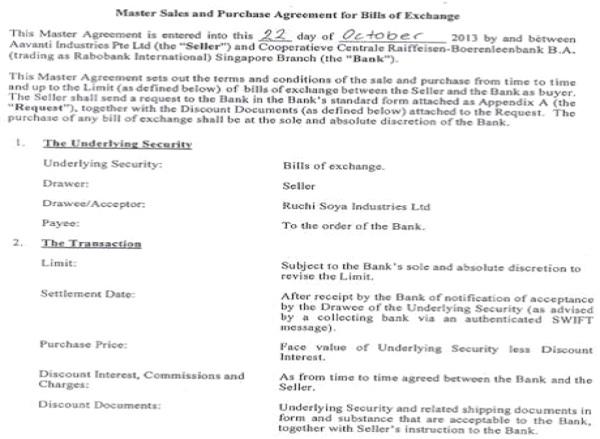
6. According to the Appellant, it entered into a Master Sales and Purchase Agreement dated 22nd October 2013 (MSPA), wherein it was agreed that upon acceptance by the Corporate Debtor of certain BoEs, the Appellant would discount the BoEs and disburse the discounted proceeds to a third party supplier of the Corporate Debtor, Aavanti Industries Pvt. Ltd. (Aavanti). (Clause 1,2 of the MSPA).
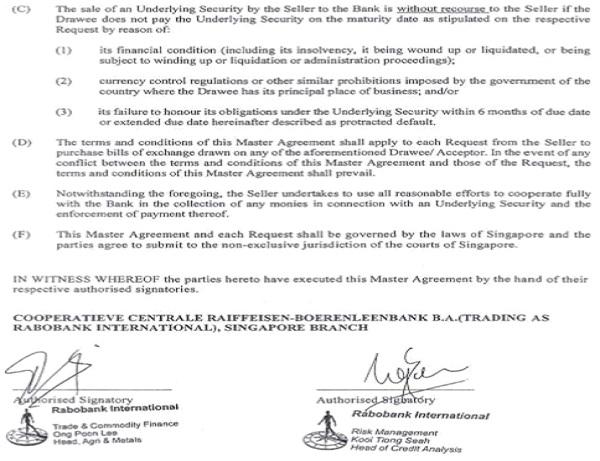
7. It was further agreed under the MSPA that the Appellant will not have any recourse to Aavanti and would be able to claim the amounts due under the BoEs only from the Corporate Debtor. (Clause 4 (C) of the MSPA)
8. In accordance with the MSPA, the Corporate Debtor accepted the BoEs by signing on the BoEs and thereby, unconditionally agreed to pay the amounts due under the BoEs to the Appellant. (Sample BoE)
9. It is only upon the acceptance of the BoEs by the Corporate Debtor, that the Appellant disbursed the discounted proceeds to Aavanti. Accordingly, an aggregate amount of USD 107,376,972.90 (excluding interest and other charges) was payable by the Corporate Debtor to the Appellant under the BoEs. Subsequently, on the maturity of the said BoEs, the BoEs were presented for payment to the Corporate Debtor and were dishonoured due to non-payment
10. Learned counsel for the Appellant submitted that the Resolution Professional has accepted and admitted Appellant’s claim of USD 107,36,972.90 alongwith interest and other charges. However, attempt is being made to classify the debt as an ‘Operational Debt’ and not a ‘Financial Debt’ despite the pure financial nature of the payments.
11. It was submitted that Bill of Exchange is an independent contract under the provision of Negotiable Instruments Act, 1881 (NI Act). As per Section 32 and 37 of the NI Act, upon acceptance of Bill of Exchange, the acceptor i.e. Corporate Debtor becomes the Principal Debtor of the amount due under the Bill of Exchange. Under the law, unless agreed to the contrary, the drawer would continue to remain liable. However, in the present case, the Bill of Exchanges were discounted without recourse to the Drawer i.e. ‘Avanti Industries Pvt. Ltd.’. Reliance has been placed on the decision of Hon’ble Supreme Court in “American Express Bank Ltd. Vs. Calcutta Steel Co. (1993) 2 SCC 199”.
12. It was further submitted that discounting of Bill of Exchange falls within the definition of ‘Financial Debt’ as defined under Section 5(8) of the Insolvency and Bankruptcy Code, 2016 (for short ‘I&B Code’) and the ‘time value’ means the compensation or the price paid for the length of time for which the money has been disbursed. Reliance has also been placed on decision of this Appellate Tribunal in “Dr. B.S.V. Lakshmi Vs. Geometrix Laser Solutions Pvt. Ltd., decided on 13th March, 2017”, against which the appeal was dismissed by the Hon’ble Supreme Court.
13. Learned counsel appearing for the Resolution Professional submitted that the dispute in the present case arises out of a transaction, whereby ‘Aavanti Industries Pte.’ (“Aavanti” – an Operational Creditor of the Corporate Debtor) entered into an agreement to supply goods and services to ‘Ruchi Soya Industries Limited’ (Corporate Debtor) and Aavanti granted the Corporate Debtor, the usual credit facility for supply of goods and services.
14. It was submitted that in terms of Section 5(20) of the Insolvency and Bankruptcy Code, 2016, which defines an ‘Operational Creditor’ to mean a person to whom an ‘Operational Debt’ is owed and includes any person to whom such debt has been legally assigned or transferred, the Aavanti being an ‘Operational Creditor’, its assignee i.e. Appellant will also come within the meaning of ‘Operational Creditor’.
15. We have heard learned counsel for the parties and perused the record.
16. Section 5(21) of the I&B Code defines ‘Operational Debt’ means a claim in respect of the provision of ‘goods or services including employment’ or a ‘debt in respect of the payment of dues arising under any law for the time being in force and payable to the Central Government, any State Government or any local authority’. Admittedly, the Corporate Debtor owed money to ‘Aavanti’, who is an ‘Operational Creditor’, which supplied goods which falls squarely within the definition of ‘Operational Debt’. Furthermore, in the books of accounts of the ‘Corporate Debtor’, the overdue amounts have been reflected as over-dues towards ‘provision of goods and services’.
17. Section 5(20) of the Code defines an ‘Operational Creditor’ to mean not only a person to whom an ‘Operational Debt’ is owed but also a person to whom such ‘operational debt’ is assigned. In other words, the ‘Aavanti’ having transferred its right to collect payment due towards the sale of goods to any person, including the Appellant bank, under a Bill of Exchange, the transferee Appellant bank will also remain as an ‘Operational Creditor’, and cannot become a ‘Financial Creditor’.
18. The aforesaid proposition of law is also evident from Sub-section (5) of Section 21 of the I&B Code, which reads as follows:-
“21. (5) Where an operational creditor has assigned or legally transferred any operational debt to a financial creditor, the assignee or transferee shall be considered as an operational creditor to the extent of such assignment or legal transfer.”
19. Therefore, it is clear that an ‘Operational Creditor’, who has assigned or legally transferred any ‘Operational Debt’ to a ‘Financial Creditor’, the assignee or transferee shall be considered as an ‘Operational Creditor’ to the extent of such assignment or legal transfer.
20. Section 3 (37) of I&B Code provides that the words and expressions used but not defined in the Code have the same meaning as defined in other Acts as mentioned therein and reads as follows:-
“3. In this Code, unless the context otherwise requires,—
….x …..x……x….
(37) words and expressions used but not defined in this Code but defined in the Indian Contract Act, 1872, the Indian Partnership Act, 1932, the Securities Contact (Regulation) Act, 1956, the Securities Exchange Board of India Act, 1992, the Recovery of Debts Due to Banks and Financial Institutions Act, 1993, the Limited Liability Partnership Act, 2008 and the Companies Act, 2013, shall have the meanings respectively assigned to them in those Acts.”
In view of Section 3(37), the Appellant cannot derive any advantage of expressions used in Negotiable Instruments Act, 1881.
21. The agreement dated 22nd October, 2013 has been enclosed by the Appellant. It is between ‘Aavanti Industries Pte Ltd.’ (the “Seller”) and ‘Cooperatieve Centrale Raiffeisen-Boerenleenbank B.A. (trading as Rabobank International) Singapore Branch’ (the “Bank”). The relevant portion relating to transaction is as under:-
–
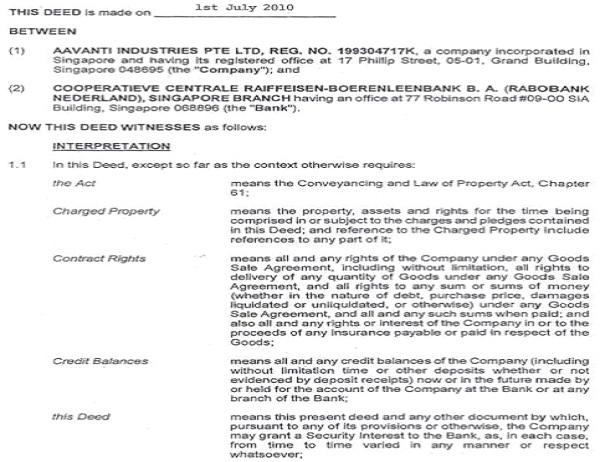
22. The Deed of Exchange has also been enclosed, which is between ‘Aavanti Industries Pte Ltd., Singapore’ and ‘Cooperatieve Centrale Raiffeisen-Boerenleenbank B.A. (Rabobank Nederland) Singapore Branch’.
23. One Bill of Exchange out of many has been enclosed by the Appellant, which reads as follows:-
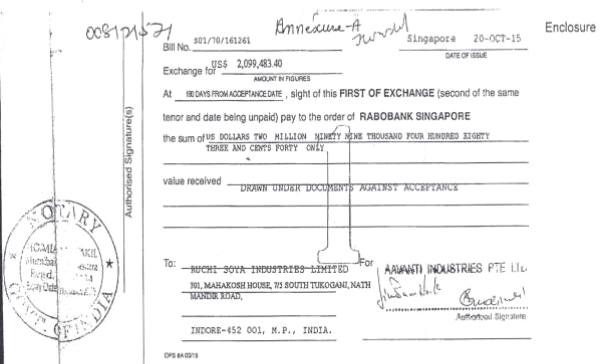
24. From the record also we find that the ‘Bill of Exchange’ relates to supply of goods and whatever finance given by the Appelant is to ‘Aavanti Industries Pte Ltd., Singapore’ and not to the ‘Corporate Debtor’. The Corporate Debtor has merely received the goods and therefore we hold that the Appellant is not a ‘Financial Creditor’ but at best can claim to be an ‘Operational Creditor’ as held by the Adjudicating Authority.
25. We find no merit in this appeal. It is accordingly dismissed. There shall be no orders as to costs.