J.C. Flowers Asset Reconstruction Pvt. Ltd. Vs Stargaze Entertainment Pvt. Ltd. (NCLT Delhi)
Summary: The NCLT, New Delhi Bench (Court-II), in J.C. Flowers Asset Reconstruction Pvt. Ltd. Vs Stargaze Entertainment Pvt. Ltd., rejected the revised resolution plan submitted through IA-37/ND/2026 and ordered liquidation of the corporate debtor. CIRP had commenced on 13 May 2024 on a financial creditor’s application alleging default of ₹70,33,51,777.91. Following assignment of the debt, CFM Asset Reconstruction Pvt. Ltd. became the sole financial creditor and sole member of the Committee of Creditors (CoC). The revised plan of Cine Corp Filmdom Pvt. Ltd., approved with 100% voting share, offered ₹50.25 lakh: ₹49.50 lakh to the financial creditor, ₹50,000 to statutory authorities and ₹25,000 to other operational creditors, with CIRP costs addressed in the plan’s distribution provisions.
The Tribunal had earlier rejected the original ₹50 lakh plan and remitted the matter to the CoC and RP after noting that recoveries from pending asset-possession applications, estimated at approximately ₹3 crore, would benefit the successful resolution applicant. The revised plan increased the total offer by ₹25,000 and changed the treatment of avoidance recoveries and surplus sale proceeds in favour of the CoC. The CoC maintained that the cinema business was closed, assets at different locations were disputed or outside the corporate debtor’s possession, liquidation recovery was uncertain and operational creditors would otherwise receive nothing. The Tribunal nevertheless found that its substantive concerns remained unresolved.
On examining the Section 29 and Regulation 36″formation Memorandum (IM) and valuation material, the Tribunal found discrepancies between the asset inventory and the plan-approval application. It noted that several assets, including a ₹50 crore deposit with the holding company, were excluded from the valuation, and that the position regarding recovery or control of that deposit remained unclear. It also criticised the delayed transaction-audit exercise under Regulation 35A. The RP had sought directions in four applications to obtain assets and security deposits from third parties, yet proceeded with plan approval without securing control of those assets and subsequently withdrew the applications. The Tribunal considered this inconsistent with the duties under Sections 17, 18 and 25(2)(a), and questioned how the invitation process and Information Memorandum had been completed without control of the entire asset base.
The Tribunal further found that the proposed revival measures did not explain how the causes of default would be addressed. It questioned reliance on further borrowing where higher borrowing and interest costs were themselves cited as causes of failure, and held that the plan lacked a revival vision and did not comply with Regulation 38(3)(a). Describing the CIRP as opaque and fundamentally vitiated, it rejected the revised plan despite unanimous CoC approval. Its discussion of commercial wisdom emphasised the broader objectives of revival, employment, creditor survival and statutory dues, rather than treating recovery of some amount by the financial creditor as sufficient justification.
Invoking Section 33(1)(b), the Tribunal appointed Gorang Moudgil as liquidator and restored IA-5441/ND/2024, IA-5442/ND/2024, IA-1779/ND/2025 and IA-2236/ND/2025. For this case, it directed that the sole CoC member’s initial distribution be confined to the amount accepted under the resolution plan, followed by distribution to statutory authorities and other creditors; any remaining distributable balance would then be dealt with under Section 53. It required the RP to transfer CIRP records and account for asset-sale money, directed completion of liquidation within 180 days, continued the CoC during liquidation, and stated that no further opportunity to restore CIRP would be available under Section 33(1B). These distribution directions are reported as the Tribunal’s case-specific order.
FULL TEXT OF THE NCLT JUDGMENT/ORDER
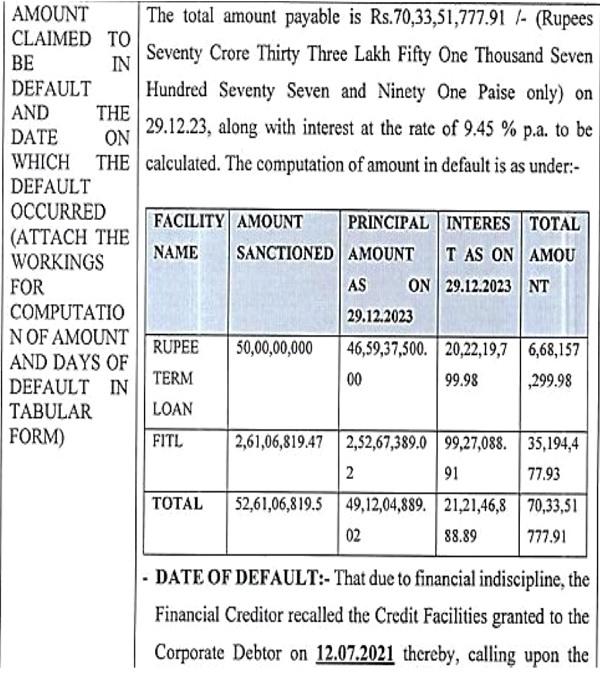
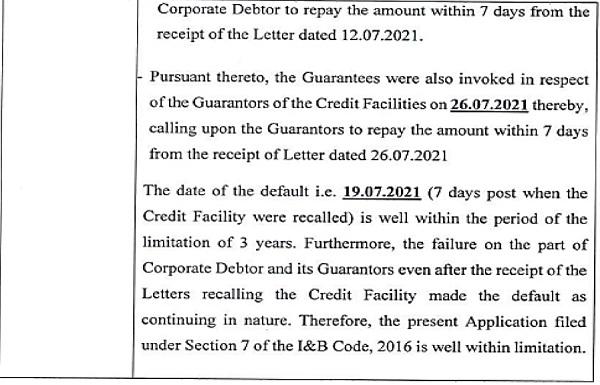
CIRP in the captioned matter was initiated by J.C. Flowers Asset Reconstruction Private Limited, acting as Trustee for JCF Yes Trust 202223/5. According to the FC viz. J.C. Flowers Asset Reconstruction Private Limited, the Corporate Debtor defaulted to pay an amount of Rs. 70,33,51,777.91/-. The relevant excerpts from Part-IV of the application preferred under Section 7 of IBC, 2016 reads thus:-
–
2. CIRP was directed to be commenced in terms of the order dated 13.05.2024. As can be seen from the order, despite service of notice no one appeared on behalf of the Corporate Debtor viz. Stargaze Entertainment Private Limited. The Applicant was admitted with reference to NeSL report. The paras 4 and 10 of the order reads thus:-
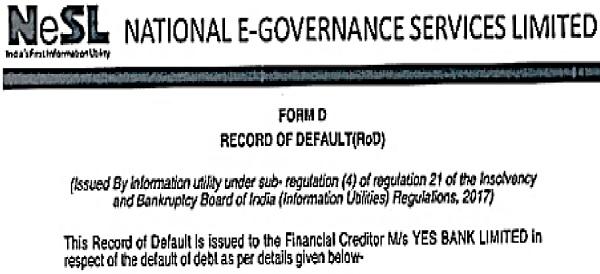
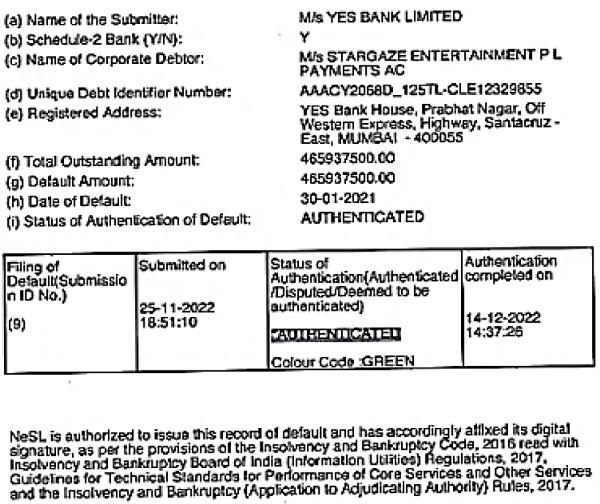
“4. With the application filed by him, the Applicant has enclosed the report of NeSL (information utility). As can be seen from Form-D (the relevant excerpt of the record), the default committed by the corporate debtor was on 30.01.2021 Form-D (default report) from NeSL reads thus:-
–
XXX
10. Despite notice served upon it, the CD chose not to appear before this Tribunal. Thus, in terms of the order dated 06.05.2024, the proceedings qua it were set ex-parte.”
3. As can be seen from the contents of IA-37/ND/2026 in response to the public announcement made in terms of Regulation 6(1) of the CIRP Regulations, 2016 besides the sole Financial Creditor who initiated the CIRP, the RP received claims from certain Operational Creditors. Para-VI (f and g) of the application reads thus:-
“f. Accordingly, as required under sub-regulation (1) of Regulation 13 of the CIRP Regulations, 2016, the Applicant verified every claim and thereafter maintained a list of creditors containing the name s of creditors along with the amount claimed by them along with the amount of their claims admitted. The Committee of Creditors was duly constituted and the report on formation of the Committee of Creditors was submitted with this Hon’ble Tribunal on 15.06.2024 as per Regulation 17 of the CIRP Regulations 2016. The details of the claims received and collated by the Applicant as on 14.06.2024 are as under;
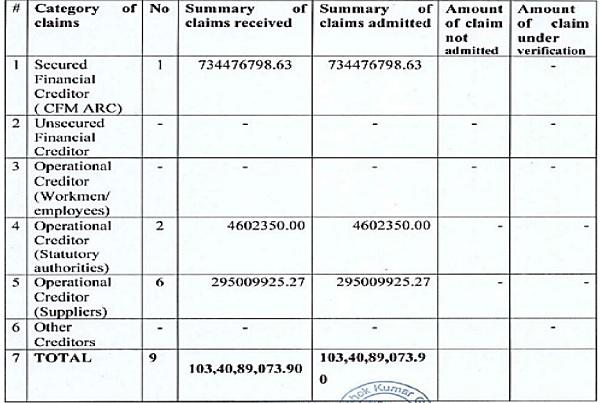
g. That the Operational Creditors (Statutory Authorities) claim of Rs 19,61,925/- from Commercial Sales Tax office, Raipur and amount of Rs 2640425/- from Sales Tax office, Raipur (Total Rs 4602350/-) have been admitted in full. That the Operational Creditors (Supplier) Claims received and admitted in full are as follows: (1) Rs. 3,67,08,035.00/-of Lal Ganga Builder, Ranchi; (2) Rs. 13,67,07,399.00/- OF MDDA RAMKY, Dehradun; (3) Rs. 4.40,34,640/- of City Mall, Bilaspur; (4) Rs. 3,34,44,129.98/ of ASJ Developer. Muzaffarnagar; (5) Rs. 4,40,76,842/- of Blue City Mall, Jodhpur; and (6) Rs. 38879.29/- of NSDL, totalling Rs. 29,50,09,925.27/-”
4. In response to the advertisement published in prescribed form viz. Form-G, inviting EoI, second time, the RP received Expression of Interest (EoI) from 3 PRA’s. Paras-VI (k & l) of the application, wherein particulars of Form-G and PRA’s have been referred to reads thus:-
“k. Accordingly, the RP re-issued Form-G on 02.08.2024, in Financial Express and Jansatta (Hindi Edition) inviting EOI for submission of the Resolution Plan for (i) sale of the Corporate Debtor site-wise (Single or Multiple) (ii) Sale of the Corporate Debtor after excluding certain assets (iii) Corporate Debtor as a whole. The last date for submission of EOI was 23.08.2024, and last date for submission of the Resolution Plan was proposed to be 04.10.2024. The said Form G was uploaded on the website of IBBI on 02.08.2024 and on the website of IPE to which RP is associated i.e. www.rbsa.in.
I. That in response to the advertisement, 3 EOIs were received from Prospective Resolution Applicant’s (PRA’s) till the last date of submission as under:

5. When in terms of the provisions of Regulation 35A of IBBI (Resolution Process for Corporate Persons) Regulations, 2016, the opinion as to whether the Corporate Debtor had been subjected to any transaction covered under Section 43, 45, 50 or 66 is required to be formed on or before 75th day of insolvency commencement date, in the present case the CA firm to conduct the transaction audit for determination of preferential, undervalued, fraudulent, and extortionate transactions was appointed on 04.10.2024, when the CIRP had commenced on 13.05.2024 and Expression of Interest (EoI) had already been received. Apparently, the exercise in terms of the provisions of Regulation 35A of IBBI (Resolution Process for Corporate Persons) Regulations, 2016 was not completed within prescribed time limit. On 04.12.2024, the RP was informed by JCF ARC that vide assignment dated 02.12.2024 executed between JCF ARC and CFM Asset Reconstruction Pvt. Ltd. (CFM ARC), JCF ARC had assigned and transferred, in favor of CFM ARC, the loans and dues payable by CD to JCF ARC in full. In terms of the assignment, CFM ARC became the sole Financial Creditor qua the Corporate Debtor and emerged as sole member of the Committee of Creditors. In 10th meeting of CoC held on 24.12.2024, the findings of the transaction auditor were discussed at length and it was concluded that the transaction of Rs. 2233.62 lakhs between related parties was fraudulent. Resultantly, the Applicant preferred an application under Section 66 of the Code against the suspended directors of the Corporate Debtor on 02.01.2025 viz. IA-131/ND/2025.
6. The RP engaged two companies viz. Protocol Valuers Pvt. Ltd. (Protocol)and Armslength Advisors Pvt. Ltd. (Armslength) to carry out a fair valuation and liquidation value of the Corporate Debtor. The protocol submitted its report on 16.01.2025 assessing fair value and liquidation value of the CD as Rs. 119.96 lakhs and 75.28 lakhs respectively. Likewise, the Armslength submitted its report on 27.01.2025 assessing fair value and liquidation value of the CD as Rs. 127.69 Lakhs and Rs. 89.38 Lakhs respectively. On the basis of these two reports, the average fair value and average liquidation value of the CD emerged as Rs. 123.62 Lakhs and 82.33 Lakhs respectively.
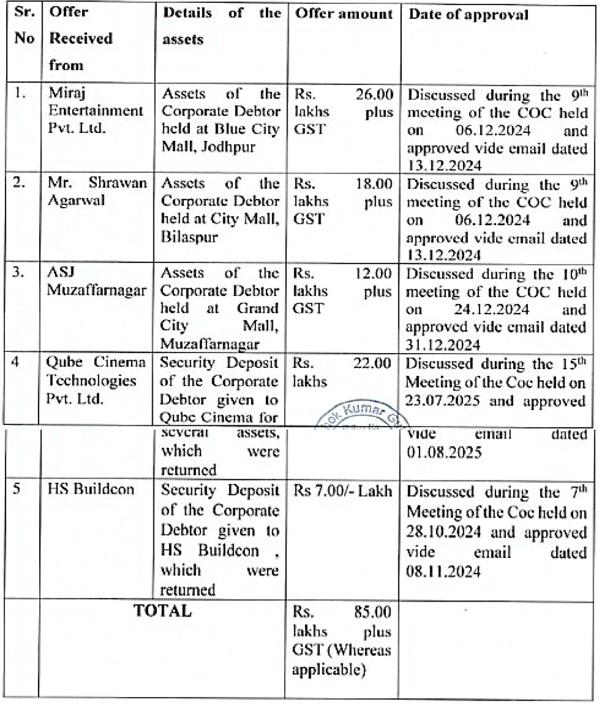
7. As has been stated in para-VI (z) of the application, the RP disposed of some of the assets of the CD under Section 28 of IBC, 2016. The para reads thus:-
“z. The offers received by some of the developers have been approved in the following manner, in consonance with Section 28 of the Code and Regulation 29 of the IBBI (Insolvency Resolution process for Corporate persons) Regulations, 2016:
8. In para VI (ee) of the application, the Applicant (RP) has asserted that the CD has the assets other than those included in the valuation reports, the value of which arrived at by valuers is Rs. 68.29 Lakhs and Rs. 42.69 Lakhs respectively as on CIRP commencement date. According to Applicant (RP), the present status of the aforementioned assets is not known, as physical inspection thereof was not allowed by the developer and the developers raised counter claims arising out of pending rent, CAM, Electricity and other charges which have been admitted by the other Applicant.
9. The resolution plan submitted by Cine Corp Filmdom Pvt. Ltd. could be approved by sole member of CoC in terms of the e-mail dated 07.04.2025 with 100% vote share. The IA-23/ND/2025 came up for consideration before this Tribunal on 08.07.2026 and was rejected on the ground that when as an outcome of IA-5441/ND/2024, IA-5442/ND/2024, IA-1779/ND/2025 and IA-2236/ND/2025, the SRA could be benefitted by Rs. 3 Crores, the total value of the plan is Rs. 50 Lakhs only. The order dated 08.07.2026 reads thus:-
“IA-23/ND/2025: Indubitably, the applications IA-5441/2024, 5442/2024, IA-1779/2025 and IA-2236/2025 are preferred by RP for taking possession of certain assets of CD which are pending adjudication. During the course of hearing, the Ld. Counsel for the RP submitted that after the assets on being taken over by the RP, are the same would fetch certain consideration.
In his submission, in terms of the Resolution Plan, the proceed of outcome of the pending application will go to RA. He also espoused that the value of the assets of which the control is yet to be taken over is almost approximately 3 Crores.
On perusal of the resolution plan, we find that the amount offered to secured financial creditor is only Rs. 49,50,000/- and the same to Government is only Rs. 25,000/-. The relevant excerpt of the Resolution Plan reads thus:-
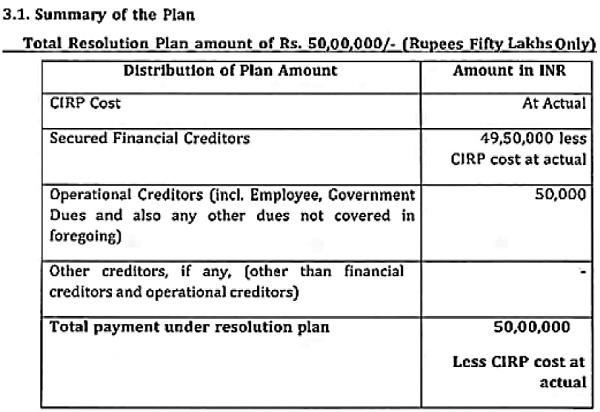
When the total amount offered to all the creditors is only Rs. 50,00,000/-, the SRA is going to be benefited by an amount of Rs. 3 Crore. Maybe, one may say that such decision is exercise of commercial wisdom by CoC, but still the wisdom should be judicious and explainable and not like the same is exercised in the present case.
In the wake, we are not inclined to allow the application. The application is rejected and the matter is remitted back to CoC and RP for examined examination and appropriate view. The application for approval of the revised plan be filed within 15 days from today. IA-5441/ND/2024, IA-IA-5442/ND/2024, IA-1779/ND/2025, 2236/ND/2025: Ex-facie we are of the view, that the dispute being contractual in nature and pertaining to the period prior to commencement of CIRP does not fall within our jurisdiction.
Confronted with the situation, the Ld. Counsel for the RP seeks an adjournment to study the law on the subject convince this Tribunal regarding the maintainability of the application. At his request, the hearing is deferred to 27.07.2026.
IA-131/ND/2025: List on 27.07.2026.”
10. Subsequently, the RP could withdraw the aforementioned applications. The order dated 27.07.2026, in terms of which the applications were withdrawn reads thus:-
“IA -5441/ND/2024, IA-5442/ND/2024, IA-1779/ND/2025 & IA-2236/ND/2025: As prayed by the Ld. Counsel for the RP, the applications is dismissed as withdrawn. It goes without saying that the Corporate Debtor would be entitled to resort to the remedies available to it in accordance with law to seek the remedies sought in the present applications.
IA-131/ND/2025: As prayed by the Ld. Counsel for the RP, the hearing is deferred to 19.08.2026.”
11. Later, the CoC approved the modified/revised resolution plan. The salient modifications/contours/provisions contained in revised resolution plan have been referred to/reproduced in para VI (jj to ll) of the plan which reads thus:-
“jj. That pursuant to the directions of this Hon’ble Tribunal, the resolution applicant submitted a revised resolution plan on 13.07.2026. That the modifications made in the revised resolution plan are as under:
-
- Para 2.1 – one of the directors of the Resolution Applicant Mr. Tapinder Tucker is replaced by Mr. Harsh Shah (profile included in the plan)
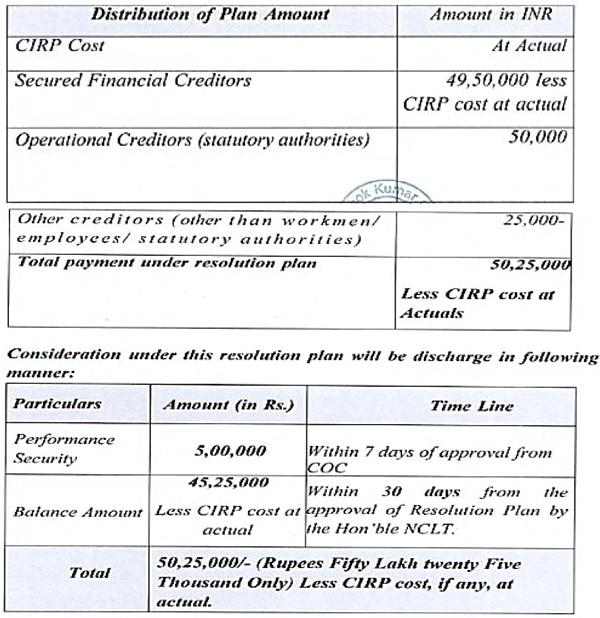
- Para 3.1 – Summary of the Resolution Plan: The amount to be provided under the revised resolution plan is Rs. 50.25 lakhs, out of which Rs. 49,50 lakhs will be paid to the financial creditor, Rs. 0.50 lakhs to the Operational Creditor (statutory authorities) and Rs. 0.25 lakhs in Operational Creditors (other than statutory authorities). The amount earlier proposed was Rs. 50.00 lakhs, out of which Rs. 49.50 lakhs was to be paid to the financial creditor and Rs. 0.50 lakhs to the Operational Creditors.
-
- Para 3.2.2-Secured Financial Creditors:
i. The COC shall have the right to continue pursuing avoidance transaction application being presently pursued by the Resolution Professional and any recovery from the said avoidance transaction applicatiom or from any fraudulent transaction undertaken by the non-related secured financial creditor of the CD shall belong to the COC. Post approval of the Resolution plan, change of parties in NCLT will be submitted by the Resolution Professional.
Under the previous resolution plan, any recovery from the avoidance transactions were to belong to the Resolution Applicant.
ii. For recovery of the assets of the Corporate Debtor, the RA shall have the right to initiate proceedings against the developers, lessors, service providers etc. before the competent court, or any other authority having jurisdiction, in accordance with applicable laws.
iii. After payment of all insolvency resolution process expenses outstanding as on the date of approval of the resolution plan, the balance amount remaining in the account of the Corporate Debtor out of sales proceed from settlement shall exclusively accrue to the Committee of Creditors. The Resolution Applicant and the Corporate Debtor shall have no right, title or interest in such balance amount.
Under the previous resolution plan, any amount remaining was to vest in the Resolution Applicant.
-
- Para 4.1: Term and Implementation Schedule – Term of the Resolution Plan shall commence on the approval of the Resolution plan by Adjudicating Authority, and all payment shall be cleared as per the resolution pan on or before the 30 days.
Under the previous resolution plan, term and implementation was 180 days from approval of Resolution plan by Adjudicating Authority.
kk. The Members of CoC have considered these changes in the Resolution Plan and approve the Revised Resolution Plan dated 13.07.2026 The sole member of CoC discussed the Financial Offer and based on commercial wisdom considered the earlier Resolution Plan as also the Revised Resolution Plan dated 13.07.2026 as feasible and viable as per Section 30 (4) of the Code based on following factors:
-
- The Cinema business is closed, and CD does not have in control and possession of assets held at various locations. Hence, it is difficult to get any recovery if the CD is admitted into Liquidation and instead the CoC will have to meet Liquidation Cost.
- The complete details of assets of the CD held at various locations are not known as there are dispute with the Developers. The outcome of the legal case is difficult to predict at this stage.
- The Operational creditors would not get any amount in case of Liquidation. Hence, the offer made by the Resolution Applicant for Financial and Operational is considered reasonable.
ll. Some of the salient features of the resolution plan are as under:
“3.1 Summary of the Plan
Total Resolution Plan amount of Rs. 50,25,000/- (Rupees Fifty Lakhs Twenty Five Thousand Only)
12. On 19.08.2026, when the captioned application viz. IA-37/ND/2026 came up for consideration before this Tribunal, we desired to see the breakup of the assets mentioned in the Information Memorandum (IM) and passed the following order:-
“IA-37/ND/2026: The Ld. Counsel for the Applicant could draw our attention to the valuation report, which pointed out the summary of assets. Para 1.1 of the report reads thus:-
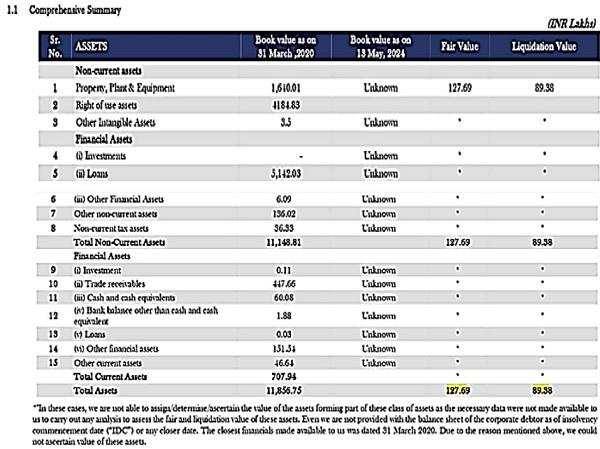
We need to see the breakup of the assets mentioned in the information memorandum. Let the applicant place on record a copy of the information memorandum, as well as the list of assets as mentioned therein, separately. Needful be done within one week from today. List on 27.08.2026.
IA-131/ND/2025: List on 27.08.2026.”
13. In compliance of the aforementioned order, the RP placed on record, the Valuation Report as also Information Memorandum (IM) by way of affidavit dated 21.08.2026. The value of assets of CD shown in the IM (Gross Block 1 April 2019) is Rs. 5,20,59,532.44/-, while the same shown in the IM (Net Block March 2020) is Rs. 92,36,327.90/-. Apparently, the figures given in the inventory (ibid) do not match with the figures given in application for approval of the resolution plan.
14. We are also surprised to note that the valuation of the Corporate Debtor does not include several assets including Rs. 50.00 Crores deposit with the holding company. The relevant excerpt of the IM reads thus:-
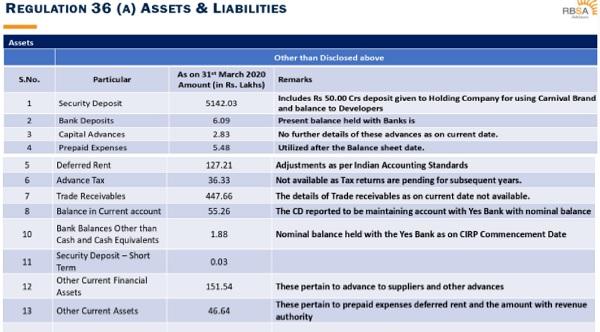 15. When an amount of Rs. 50.00 Cr. of CD is deposit with holding company, the total value of the plan is Rs. 50,25,000/- only. A perusal of the plan reveal that the cause of default by the CD was higher borrowing and impact of interest caused which could not be funded on account of impact on business. The reason for default given by the SRA does not match with Information Memorandum (IM). As has been mentioned in the Information Memorandum (IM), the CD had deposited Rs. 50.00 Cr. with holding company. Besides, once, according to SRA, the cause of default was higher borrowing and impact of interest, it is not understood that how by arranging further borrowing, the SRA would make the situation different. The SRA has also raised concern regarding government policies, higher tax burden and competition from Peer companies. However, it has not explained that how the situation would be different after approval of the resolution plan. The clause 4.5.1 and 4.5.2 of the plan reads thus:-
“4.5.1. Cause of Default (Regulation 38(3)(a))
The cause of default as per our understanding by the CD are as under: –
i. Liquidity Crunch
ii. Stretched receivables leading to cash flow mismatch
iii. Working Capital gap.
Besides above the cause of default as mentioned in Resolution Applicant’s view was also on account of sudden changes in the economic parameters and changes in law effecting the cash flows and Corporate Debtor was more seriously impacted on account of higher borrowings and impact of interest cost which could not be funded on account of impact in business. The Resolution Applicant though cannot predict economic scenario beyond a period it can surely and would ensure that the borrowing for the project is kept at sustainable level and cash generated from the business is reinvested both to reduce the cost of borrowing and also to install modern and more efficient equipment. It also intends to adopt world class methodologies and system to ensure that the Corporate Debtor is managed on a professional basis and working capital cycle is kept at bare minimum requirement for maximum turnaround of available cash flows.
4.5.2. Feasibility and Viability (Regulation 38(3)(b))
As can be seen from the profile of Directors submitted by the Resolution Applicants along with this plan the Company is operationally viable. As per our understanding it was mainly on account of Government policies higher Tax Burden and competition from Peer companies, which led to financial scarcity and the operation of the Company got impacted. Unable to manage the working capital cycle Company faced multiple issues. It is confident of being able to turn around the Corporate Debtor and barring for situation arising out of Covid-19 situation, Company was able to manage the operations profitably. Resolution Applicant is however post Covid-19 situation and stability in the market is confident of achieving the projected financials and Resolution Applicant are sure to bring back the Company to its earlier operational/growth level.
In order to demonstrate our Managerial, Technical and
Financial capabilities. we would like to state as under:
4.5.2.1. Managerial capacity & Past experience
Mr. Pritam Athavale and Mr. Harsh Shah are the Directors of Cine-Corp Filmdom Pvt Ltd. Mr. Pritam Athavale is a Chartered accountant having wide experience in Finance and Accounts. Mr. Harsh Shah has wide experience in TV Shows, Movies production and organizing and managing events
Financial Capability
The Resolution Applicant has managerial and financial capabilities to implement the plan. Presently it successfully managing various businesses which demonstrates the managerial and financial capabilities of the Resolution Applicant.”
16. From the aforementioned clause, it writ large that the SRA has no vision regarding revival of the corporate debtor and there is no compliance of Regulation 38(3)(a) of IBBI (CIRP) Regulations, 2016.
17. The RP had preferred as many as four applications viz. IA-5441/2024, IA-5442/2024, IA-1779/2025 and IA-2236/2025, espousing therein that he could not take control of sizeable amount of the assets of the CD. The prayer made in IA-5441/2024 reads thus:-
“a. Allow the instant application.
b. Direct the respondent to grant access to the applicant to take control and custody of the said assets of the Corporate Debtor affixed at the said multiplex space of the respondent.
c. Direct the Respondent to transfer/ return the interest free refundable security deposit amount of Rs. 15,00,000/- (Rupees Fifteen lakhs) tendered by the corporate debtor to the Respondent as per the Revenue Share Agreement dated 11th February 2011.”
18. In para 5 of the application, the Applicant has given trail of the transaction/development of events in which the assets are involved. The para reads thus:-
“5. OBLIGATION OF THE PARTIES
The parties recognize that STARGAZE shall make significant investments in the MULTIPLEX SPACE in the form of installation of equipment, fitting and fixtures and other movable assets, and other matter incidental thereto, The parties further recognize that in order to ensure smooth functioning of the MULTIPLEX SPACE during the term. STARGAZE shall be entitled to continue exercising the aforesaid rights as per the terms and conditions of this Agreement and such rights shall be irrevocable by the DEVELOPER during the term of this Agreement.
A copy of the operation and management agreement dated 11″ February 2011 is annexed herewith and marked as Annexure A-1.
d. That pursuant to the agreement being entered into, SEPL began to operate its cinema from the said multiplex space and incurred huge expenditures in installing various assets at the said multiplex space, which included furniture’s and fixtures, plant and machinery, leasehold improvements and other assets amounting to Rs. 2,14,05,000/- as shown in the books of SEPL as on 31.03.2020 (hereinafter referred to as ‘said assets“).
e. That the financial creditor above named preferred an application under Section 7 of the Insolvency and Bankruptcy Code, 2016 against the Corporate Debtor, which came to be admitted by this Hon’ble Tribunal on 13.05.2024. That by the said order, moratorium was declared, and the applicant was appointed as the Interim Resolution Professional and was directed to take control of the assets of SEPL and to carry on the operations and management of the Corporate Debtor. That the applicant was confirmed as the Resolution professional by the Committee of Creditors.
f. That pursuant to the order dated 13.05.2024, the Applicant has taken complete control of the affairs of the corporate debtor. That upon perusal of the books of accounts of SEPL, the applicant came across the transaction wherein SEPL had deposited the security deposit of Rs. 21,00,000/- with the respondent, as per the terms of the said agreement. Furthermore, the books of accounts of SEPL, also reflect SEPL as the owner of the assets which are currently affixed at the said multiplex space and in the possession of the developers.
g. That in compliance with the provisions of law, vide letters dated 34 June 2024 and 2 August 2024, the applicant made repeated requests to the respondent to handover possession of the said assets and to return the security deposit deposited with the respondent by the corporate debtor in terms of the said agreement. That by the said letters, it was also informed to the respondent that they have no legal authority to retain possession of the assets belonging to SEPL and if there are any outstanding dues, they may file a claim with the applicant. However, despite repeated requests and/ or reminders, the respondent failed and/or neglected to do the same for reasons best known to them, which is a blatant violation of the laws under the IBC, 2016. A copy of the letters dated 3 June 2024 and 19 July 2024 is annexed herewith and marked as Annexures- A-2.
h. The applicant was thus constrained to issue a legal notice through its advocate on 28.08.2024 calling upon the respondent to handover possession of the said assets and to return the security deposit deposited with the corporate debtor by SEPL, in terms of the said agreement, both being part of the estate of corporate debtor. That the respondent responded to the aforesaid legal notice on 19.09.2024. alleging that the corporate debtor stopped making payment of rent from 1″ March 2020 and that the respondent to realize its pending dues, forfeited the security deposit of Rs. 19,80,000/- made by the corporate debtor along with all furniture, fixtures and assets installed at the multiplex space to realize the outstanding dues owed by the corporate debtor to the respondent. That the averments made by the Respondent are vehemently denied and disputed. A copy of the legal notice dated 28.08.2024 and reply to dated 19 September 2024 is annexed herewith and marked as Annexure-A-3
i. Having no other option, this instant application”
19. Like IA-5441/2024, the Applicant had made prayers in IA-5442/2024, IA-1779/2025 and IA-2236/2025, seeking issuance of directions for granting excess to Applicant/RP to take control and custody of assets of the Corporate Debtor and transfer/return of the security deposited by it. The prayers made in the applications reads thus:-
“a. Allow the instant application;
b. Direct the respondent to grant access to the applicant to take control and custody of the said assets of the Corporate Debtor affixed at the said premises of the respondent;
c. Direct the Respondent to transfer/ return the security deposit amount of Rs. 20,00,000/- (Rupees Twenty lakhs) tendered by the corporate debtor to the Respondent as per the Revenue Share Agreement dated 12th July, 2011
XXX
a. Allow the instant application;
b. Direct the Respondent to transfer/ return the security deposit amount of Rs. 20,00,000/- (Rupees Twenty Lakhs only) tendered by the Corporate Debtor to the Respondent in lieu of the Operation and Management Agreement dated 10th march, 2013
XXX
a. Allow the instant application.
b. Direct the respondents to grant access to the applicant to ta control and custody of the said assets of the Corporate Deb affixed at the said Multiplex Area or in the alternative settle dues of the Corporate Debtor for the said assets to the tune of 92,36,327/-.”
20. Indubitably, without taking control and possession of assets of the CD (supra), the Applicant preferred IA-23/ND/2025 for approval of the resolution plan, thus the IA preferred for approval of resolution plan deserve to be rejected on this ground alone. To take the position worst, the Applicant could withdraw all the four applications on 27.07.2026. Thereafter, he filed the present application. As can be seen from the provisions of Section 17(2) of IBC, 2016, the RP is responsible for complying with the requirements under any law for the time being in force on behalf of the Corporate Debtor. The Section 17(2)(e) reads thus:-
“17: Management of affairs of corporate debtor by interim resolution professional.
…
(2) The interim resolution professional vested with the management of the corporate debtor shall-
(e) [be responsible for complying with the requirements under any law for the time being in force on behalf of the corporate debtor.]”
21. Further in terms of the provisions of Section 18(1)(f) of the Code, the IRP is required to take control and custody of any assets over which the CD has ownership rights as recorded in the balance sheet of the CD or with Information Utility or the depository of the securities or any other history that records the ownerships of assets. The Section 18(f) reads thus:-
“18. Duties of interim resolution professional. –
…
(f) take control and custody of any asset over which the corporate debtor has ownership rights as recorded in the balance sheet of the corporate debtor, or with information utility or the depository of securities or any other registry that records the ownership of assets including –
i. assets over which the corporate debtor has ownership rights which may be located in a foreign country;
ii. assets that may or may not be in possession of the corporate debtor;
iii. tangible assets, whether movable or immovable;
iv. intangible assets including intellectual property;
v. securities including shares held in any subsidiary of the corporate debtor, financial instruments, insurance policies;
vi. assets subject to the determination of ownership by a court or authority.”
22. In the present case, at the first instance, the RP filed application for approval of the plan, when the applications for issuance of direction to handover control of certain assets of CD were still pending and when this Tribunal refused to entertain the application for approval of plan, the four applications preferred for issuance of directions to third parties to handover the assets of CD to RP were withdrawn. Apparently, the present application preferred by RP is in disregard of the provisions of Section 17 and 18 of the Code. We also fail to appreciate that how without taking control of the assets of the CD, the RP could take steps under Regulation 36A of IBBI (CIRP) Regulations, 2016. It is also not understood that how the RP could prepare the Information Memorandum (IM) in terms of the provisions of Section 29 of IBC, 2016, when he was unable to take control of entire assets of the CD, as per Section 18 and 25(2)(a) of the Code. The entire process has been conducted in extremely opaque and absurd manner. There is no clarity even about taking control of the deposits of Rs. 50 Cr. by CD with its holding company. The foundation of process of CIRP in itself is vitiated, thus the plan cannot be approved and the same is rejected. Though, the object of CIRP is to rescue the Corporate Debtor and to put it back to its feet and liquidation should not be priority, in the present case, even after the rejection of the application for approval of resolution plan and remission of the same back to CoC, we noted vital irregularities in the process and even fresh application preferred for approval of the revised resolution plan is not found acceptable. In such situation, at this stage, the only way forward left is to order liquidation of the Corporate Debtor. However, since on two different occasions, the sole member of CoC could accept the amount offered to be distributed to it and the resolution plan could be approved with 100% vote share, in our view, it would be in the interest of justice and fair play, if distribution of the amount to be recovered in liquidation process in favour of the sole member of the CoC is confined, at the first instance to the amount distributed in its favour as per resolution plan and the balance amount is distributed to statutory authorities and other creditors. If after discharge of the claim of statutory authorities and other creditors as per Section 30(2)(b) of IBC, the distributable amount remain balance, the same would be distributive as per Section 53 of IBC, 2016. Here, it would not be out of context to discuss the term “Commercial Wisdom”. Wisdom is the practical ability to use knowledge, life experience and deep understanding to make choices and act with sound judgment. “Commercial Wisdom” is a specialized, legally recognized business judgment used by financial stakeholders to evaluate the economic viability and feasibility towards the way forward in a given situation. In view of the object of IBC, the “Commercial Wisdom” can be classified in micro and macro spheres. The vision of IBC is to encourage entrepreneurship and innovation. Some business ventures will always fail but they will be handled rapidly and swiftly. Entrepreneurs are lenders need to move on rather being bogged down with the decision taken in the past. Unfortunately, such aspect of IBC has not been understood even after a decade and consciously or unconsciously, in most of the cases, the initiator of CIRP approach the Tribunal with a thought and idea to recover the debt, while a separate mechanism is provided for the purpose. In few other cases, the applications under Section 7, 9 and 10 are preferred in a designed way either to extend the benefit of moratorium to CD or to help the CD to avoid paying the statutory dues/discharging the debt of banks and financial institutions. The micro understanding of “Commercial Wisdom” can be a thought of a creditor that when the Corporate Debtor is not in a position to discharge the debt, it is better to resort to a mechanism, in terms of which at least some recovery can be there from its resources. The “Macro Commercial Wisdom” can be a thought which only banks and financial institution can have. Such wisdom can also be classified in two parts viz.
i. A thought that if the Corporate Debtor is rescued, it will be in need of further finances and would again approach the bank/financial institutions for financial facility, which would result in expansion of business of the bank/financial institutions and will make good the haircut sustained by it in CIRP;
ii. Concern for the economy at larger level i.e., the revival of CD would generate resources and employment which would create revenue for deposits in the banks/financial institutions, creating scope for them to extend further financial facilities to those who are in need of the same resulting in expansion of the economy. With such concern, the financial creditors who are entitled to distribution as per Section 53 of IBC, 2016 take haircut, to ensure that some amount of money goes also to Operational Creditors, so that their business also survive and they also continue contributing to the economy, by expanding scope for employment and generating revenue. With such macro thought, the CoC/financial creditors also ensrue that some of the statutory dues are also discharged so that a contribution also goes to public fund/services.
23. However, it would not be gainsaid that the “Commercial Wisdom” is largely not understood in correct macro perspective and is perceived only as a synonym of the thought that “Something is better than nothing”. With such thought, the members of CoC are mostly keen to usurp large part of the plan value, leaving peanuts for the creditors in other category. Such approach cannot be perceived as “Commercial Wisdom” in terms of vision of IBC. With narrow understanding of “Commercial Wisdom”, even the provisions contained in Section 30(2)(b) of IBC, 2016 are diluted. When the provisions provide that the payment of debt of the Operational Creditor should not be less than the amount to be paid to such creditors in the event of liquidation of the Corporate Debtor under Section 53. Similar provision is there in clause ‘ba’ of sub-section 2 of Section 30 of the Code regarding dissenting creditors. Though, the clause b above specifically provides that higher amongst amount payable to the Operational Creditor in the event of liquidation or as per distribution in accordance with Section 53(1) of the Code should be paid, still there is very strong perception that those included in clause ‘b’ of sub- section of Section 1 of Section 53 are entitled to retain the amount received as plan value or liquidation value to the extent and satisfaction of their entire claim and there may or may not be any distribution in favor of other creditors. Could it be true then there could not be no need for keeping any amount to be paid to other creditors as an alm only. Nevertheless, in the present case, the sole member of CoC has accepted a particular amount of distribution in the CIRP, thus as has been viewed hereinabove, at the first instance, it would be entitled to same amount and only after distribution of fair share of receipts (liquidation value) in favour of other creditors, in liquidation process, the balance amount would be distributed as per Section 53 of IBC in second round. As a ramification of rejection of the resolution plan, we pass order in terms of Section 33(1)(b) of IBC, 2016 and direct liquidation of the Corporate Debtor. Mr. Gorang Moudgil having Reg. No. IBBI/IPA-001/IP-P02984/2025-2026/14602 and e-mail ID: [email protected], is appointed as Liquidator. In the changed circumstances, the IA-5441/ND/2024, IA-5442/ND/2024, IA-1779/ND2025 and IA-2236/ND/2025 are restored. It is further directed that:-
i. Subject to provisions of Section 52, there shall be a moratorium for the purposes referred to in clauses ‘a’ and ‘c’ of sub-section 1 read with sub-section 3 which shall mutatis mutandis apply to the liquidation proceedings.
ii. All powers of the Board of Directors, key managerial person qua the Corporate Debtor shall be vested in the liquidator.
iii. Any person who is or has been a personnel of CD or its promoter or associated with the management of the CD or engaged in a contract for service with the CD shall extend all assistance and cooperation to the liquidator as may be required by him for the purposes of managing the affairs of the CD or the duties conferred on him under chapter III of IBC.
iv. The Resolution Professional shall forward to the liquidator all records relating to the conduct of CIRP. He will also account for the money referred to in para 7 above to the liquidator.
v. The liquidator shall discharge duty and perform function in terms of the provisions of Section 35(1)(a) to (o) of IBC, 2016 as amended in terms of insolvency and bankruptcy code (Amendment) Act, 2026.
vi. It would be for liquidator either to pursue IA-5441/ND/2024, IA-5442/ND/2024, IA-1779/ND2025 and IA-2236/ND/2025 or to take steps in terms of the provisions of Section 35(1)(k) and (l) of IBC, 2016, with due application of mind.
vii. No suit or other legal proceedings shall be commenced or if pending as on date, shall be proceeded with by the liquidator on behalf of the CD except with the leave of this authority and subject to such terms and conditions as may be imposed by this authority at appropriate stage, if required.
viii. The present order shall be deemed to be notice of discharge to the officers, employees and workman of the Corporate Debtor, unless the business of the Corporate Debtor is continued during the liquidation process by the liquidator.
ix. The liquidator shall complete the process within 180 days and if for such purpose, he need to resort to the provisions of Section 54 (1A) and (1B) of the Code, he will do so.
x. The liquidator shall issue a public announcement stating that the Corporate Debtor is in liquidation. He would also send a copy of this order to the concerned RoC with whom the CD is registered.
xi. The CoC constituted in terms of the provisions of Section 21 of IBC, 2016 would remain in place even during liquidation process.
xii. As the resolution plan was once remitted back to CoC for reconsideration and even also in revised process, the concern expressed by this Tribunal in its order in terms of which the plan was remitted back was not addressed, in terms of the provisions of Section 33 (1B), the CoC would have no further opportunity to take decision for restoration of CIRP. No Cost.