Spectra Kolors Vs Saalim Shoes Pvt Ltd (NCLT Chennai)
NCLT Chennai directs initiation of liquidation proceedings under section 33 of the Insolvency and Bankruptcy Code of the Corporate Debtor due to failure of implementing the resolution plan. Thus, the present application is allowed.
Facts- The present application has been preferred under Section 33(3) of the IB Code, 2016 r/w Section 60(5) (a) and (C) r/w Rule 11 of NCLT Rules, 2016 on account of failure of implementation of resolution plan and contravention of the terms and conditions of the Resolution Plan as approved by Adjudicating Authority and to pass directions under Section 33(4) of the IB Code, 2016 to commence Liquidation of the Corporate Debtor as under Section 33(1)(b) (i), (ii), (iii) and (iv) of the IB Code, 2016.
Conclusion- Held that the payments have not been made as per the stipulated time schedule, we hold that the resolution plan approved by the Adjudicating Authority has been contravened by the corporate debtor under the control of SRA.
The Hon’ble Supreme Court in Arcelormittal India versus Satish Kumar Gupta, 2018 SCC OnLine SC 1733, decided on 04.10.2018 has clarified that liquidation under Section 33 can be triggered not just by failure to get a plan, but also if a confirmed plan is breached.
Held that we have no option but to pass liquidation order under Section 33(4) of IBC. We observe that Dr. S.R. Shriraam Shekher who was the Resolution Professional of the Corporate Debtor was appointed as the Chairman of the Monitoring Committee. The CIRP Cost and cost incurred during implementation period amounting to Rs. 98 lakhs have not been paid yet either by the financial creditor or the SRA. There was no recommendation by Monitoring Committee or financial creditor for appointment of any other person as liquidator. If any new person is appointed as liquidator, he will take time to take charge as liquidator and understand the affairs of the Corporate Debtor. We therefore, appoint Dr. S.R. Shriraam Shekher as liquidator as he is familiar with the Corporate Debtor.
FULL TEXT OF THE NCLT JUDGMENT/ORDER
Vide common order pronounced in Open Court, the application filed by the SRA is dismissed and the application filed by the Monitoring Committee seeking liquidation of the Corporate Debtor is allowed. Shri. S.R. Shriraam Shekher is appointed as the Liquidator.
1. IA / 8 / Liq / CHE / 2025 is an application filed by the Applicant seeking following reliefs:
a) Directing to initiate Liquidation proceeding of the Corporate Debtor due to failure of implementing the Resolution Plan as approved by the Honourable Adjudicating Authority;
b) Direct that the cost and expenses incurred by the Monitoring Committee and in Implementation Process be paid to the Insolvency Professional by the Resolution Applicant and/or the Stakeholders; and
c) Pass such other consequential order(s)/direction(s) and provide such reliefs and pass any other order as this Hon’ble Bench may deem fit and proper in the facts and circumstances of the case in the interest of justice and equity.
2. IA / IBC / 953 / CHE / 2025 is an application filed by the applicant seeking following reliefs:
i) That the pending final decision on this application the IA (Liq.) No.8/2025 filed by the Respondent No.3, for Liquidation of the Corporate Debtor, herein be deferred;
ii) That optionally this application and the IA (Liq.) No.8/2025 filed by Respondent 3, for liquidation of the Corporate Debtor, scheduled for hearing on 30th May 2025 may be heard together on a convenient date after 6th June 2025;
iii) That the Respondent 1 herein may be directed to credit the amount of Rs.19 Crores, received from Respondent 3, is credited against the one-time settlement under consideration, net of the proportionate amount to be released to ECGC, based on the recovery by R1;
iv) That optionally R1 may be directed to credit the said amount of Rs.19 Crores, towards the payment proposed under the resolution plan and the proportionate amount to be refunded to ECGC with every instalment aid by the CD as per the terms of the plan;
v) That the negligence and conduct of R3 be referred to IBBI for further investigation and action;
vi) Any other relief that is deemed fit under the circumstances to ensure that the Resolution Plan is implemented and the CD is not forced to liquidation.
3. BRIEF HISTORY
3.1. It is stated that the order for initiation of Corporate Insolvency Resolution Process of the Corporate Debtor was passed by the NCLT Chennai on 22.09.2020 in IBA/1104/2019.
3.2. It is stated that Expression of Interest (hereinafter referred to as EoI) was issued as prescribed under Form G on 01.02.2021. Since the Committee of Creditors (hereinafter referred to as CoC) was not satisfied with the responses, a fresh EoI was issued on 22.06.2021. Pursuant to the same, the RP received only one EoI submitted by the Erstwhile Promoter/Director of the Corporate Debtor. There were repeated negotiations and in sixteenth CoC held on 19.03.2022, modified plan was approved by the CoC unanimously with 100% voting. The application for approval of resolution plan was filed before the tribunal in IA/1212/CHE/2022 on 31.03.2022. The order for approval of Resolution plan was passed by NCLT, Chennai on 20.09.2023.
3.3. It is stated that the Resolution Plan envisaged total repayment of Rs. 170 Crores to all the creditors both financial & operational (including interest payable) over a period of 10 years. The Resolution Plan included a statement under Regulation 38(1A) of the CIRP Regulations as to how it dealt with the interests of all the stakeholders. The SRA, in compliance with the Code and regulations proposed to pay an upfront amount of Rs. 22.0 Crores within 90 days from the Order of the AA, to the creditors, besides bringing in working capital of Rs.15.0 Crores by fresh infusion by way of USL in a phased manner.
3.4. It is stated that as per the approved resolution Plan, the Successful Resolution Applicants had to make an upfront payment of Rs.21,60,62,686/- in two tranches as follows: i) To infuse a fund of Rs.9,60,62,686/- (5.65%) within 5 days of acceptance of Lol and ii) Rs.12 Crores (7.06%) within 90 days. Thus a sum of Rs. 21.61 Crores had to be paid by the Successful Resolution Applicants without any cure period being made available as requested by SRA. It is stated that the 90 days period ended on 19.12.2023. It is stated that the issue of time period for part implementation as approved by the Adjudicating Authority, was discussed in the Second Monitoring Committee Meeting.
3.5. It is stated that Mr. Aejaz Ahmed Tarkathi, the new investor and one of the Successful Resolution Applicants, as proposed in the Resolution Plan was not able to pay his share as per the plan and take part in the Resolution Process or implementation of the Resolution Plan due to medical reasons. The above Respondent No 1 (in IA 2427 CHE of 2023) filed an Affidavit in reply stating that due to medical reasons, he is unable to be a part of the CD.
3.6. The Successful Resolution Applicants sought an extension of 87 days in plan implementation and evinced interest to bring in a new investor. The Members of the Monitoring Committee, after due consideration, noted that Rs.9,60,62,686/- (5.65%) paid till date are not the fresh funds infused but the adjustment of Fixed Deposit held by the Corporate Debtor for 5-6 years. Thus, the Monitoring Committee keeping in mind that no fresh funds have been infused even after 90 days clearly expressed its apprehension about the capability of the Successful Resolution Applicants towards compliance of the resolution plan.
3.7. It is stated that an application for liquidation was preferred under Section 33(3) of IBC for failure of implementation of the Resolution Plan vide IA/2427 of 2023.
3.8. Mr. Mohamed Saalim, the Respondent No 2 filed a reply and an Additional Affidavit with allegations against the Applicant. It is stated that the company was changed to ‘active’ only on 20.08.2024 and there was no activity between 20.09.2023 to 20.08.2024. Subsequently Mr.Mohamed Saalim filed an additional affidavit on 01.08.2024 undertaking to pay the balance dues of Rs.9.50 Crores out of 21.60 Crores within 90 days.
3.9. During the pendency of the aforesaid IA, the tribunal had on 30.04.2024 directed Chairman of the MC to resolve the issues that were existing between the members of the Committee i.e., Indian Overseas Bank and the Successful Resolution Applicant represented by Mr. Mohd Saalim. It is stated that Chairman MC organised the 3rd Monitoring Committee Meeting, where the SRA placed on record certain proposals. However, the Monitoring Committee (MC) concluded that the proposals suggested by the SRA are not feasible. A memo along with the minutes of the meeting was filed in IA 2427 of 2023.
3.10. On 09.09.2024, the Tribunal extended the timeline for payment of balance upfront payment till 19.11.2024 in IA 2427/2023.
3.11. It is stated that the SRA submitted an undertaking to make Rs.12.0 Cr in two tranches i.e., 60 days (tranche I) and 90 days (tranche II) with effect from 20.8.2024. It is stated that the Fourth Monitoring Committee Meeting was held on 30.11.2024 as no payments were made by the SRA. The SRA once again stated that as the investors of the SRA had not conducted their due diligence, no payment could be made.
3.12. It is stated that IOB requested the Chairman of the Monitoring Committee to take appropriate action as per the Code.
3.13. It is stated that the Financial Creditor, Indian Overseas Bank issued a communication to the Chairman MC vide e-mail on 13.12.2024, requesting that the Liquidation Application may be filed on account of failure of implementation of the Resolution Plan.
3.14. Thus, IA/LIQ/8/CHE/2025 has been preferred under Section 33(3) of the IB Code, 2016 r/w Section 60(5) (a) and (C) r/w Rule 11 of NCLT Rules, 2016 on account of failure of implementation of resolution plan and contravention of the terms and conditions of the Resolution Plan as approved by Adjudicating Authority and to pass directions under Section 33(4) of the IB Code, 2016 to commence Liquidation of the Corporate Debtor as under Section 33(1)(b) (i), (ii), (iii) and (iv) of the IB Code, 2016. An Application IA 953 / CHE/ 2025 has also been filed by SRA stating that his submissions should be heard by the tribunal before deciding the liquidation application.
4. SUBMISSIONS BY LIQUIDATOR
4.1. It is stated that as per the approved resolution Plan, the Successful Resolution Applicants had to make an upfront payment of Rs.21,60,62,686/-. The Resolution Plan as approved by the tribunal mandated that the Successful Resolution Applicants should infuse a fund of Rs.9,60,62,686/- (5.65%) within 5 days of acceptance of Lol and a sum of Rs.12 Crores (7.06%) within 90 days. Thus a sum of Rs. 21.61 Crores was to be paid by the Successful Resolution Applicants without any cure period being made available as requested by them. It is stated that the said 90 day period ended on 19.12.2023.
4.2. It is stated that, issue of delay in part implementation as approved by the Tribunal, was discussed in the Second Monitoring Committee meeting held on 11.12.2023. The Successful Resolution Applicants communicated to the Chairman MC that the First Respondent, i.e., Mr. Aejaz Ahmed Tarkathi, the new investor and one of the Successful Resolution Applicants was not able to pay his share as per the resolution plan and was unable to take part in the Resolution Process or implementation of the Resolution Plan in any manner due to medical reasons. The Successful Resolution Applicants sought a further extension of 87 days in plan implementation and evinced interest to bring in a new investor. The Members of the Monitoring Committee after due consideration noted that Rs.9,60,62,686/-(5.65%) paid till date was not the fresh funds but the adjustment of Fixed Deposit held by the Corporate Debtor for 5-6 years. The Monitoring Committee members, keeping in mind that the Successful Resolution Applicants had not contributed a single penny to Rs.21.61 crores, expressed their apprehension about the capability of the Successful Resolution Applicants towards compliance of the resolution plan.
4.3. It is stated that, the Monitoring Committee during the Second Meeting expressed their apprehension and wanted to take additional measures to protect the properties, machineries and stocks which are under the charge with the Bank. The Applicant constantly reminded the respondents of adherence to the timeline as mentioned under the Resolution Plan, however, the timelines were not adhered to. In the meeting, the financial creditors having lost faith in the Successful Resolution Applicants and their ability to fulfil the Resolution Plan noted that appropriate directions from the Tribunal have to be sought. Notably, the representative of the Successful Resolution Applicants in the Second Monitoring Committee meeting also agreed that necessary directions must be sought from the Tribunal.
4.4. It is stated that, in this regard, the Applicant issued a notice dated 20.12.2023 to the Successful Resolution Applicants. Since the plant and machineries are in possession of the Successful Resolution Applicants it was decided that, the Monitoring Committee should take appropriate steps to take an inventory of the stock, plant and machineries of the Corporate Debtor, including appointing of supervisors to preserve and protect the properties.
4.5. It is stated that, IA/2427/2023 in CP/1104/IB/2019 was filed by the Liquidator, seeking for liquidation of the CD, on account of failure of implementing the Resolution Plan as approved by this Tribunal and that the cost and expenses incurred by the Monitoring Committee in the process of implementation be paid to the Insolvency Professional by the Resolution Applicants and / or the Stakeholders.
4.6. It is stated that, during the pendency of the aforesaid IA, the Tribunal on 30.04.2024 directed Chairman MC to resolve the issues that are existing between the members of the committee i.e., Indian Overseas Bank and the Successful Resolution Applicants represented by Mr. Mohd Saalim. Necessary initiative was taken by the Chairman to organize the meeting on 04.05.2024. In the said 3rd Monitoring Committee Meeting, the SRA placed on record certain proposals to amicably resolve the issue and the same were considered by the members of the Monitoring Committee i.e., the Creditor Banks. However, the Monitoring Committee concluded that the proposals suggested by the SRA are not feasible.
4.7. It is stated that, the Respondent No.2 filed a Reply and an Additional Affidavit with allegations against the Applicant. The Respondent No.2 subsequently on 01.08.2024 undertook to pay the balance consideration of the Resolution Plan within a period of 90 days. The Respondent stated that the company was changed to ‘active’ in MCA website only on 20.08.2024 and there was no activity between 20.09.2023 to 20.08.2024. Subsequently the Respondent No.2 filed an additional affidavit undertaking to pay the balance dues of Rs.12 Crores out of 21.60 Crores, that had to be infused within 90 days.
4.8. It is stated that the Tribunal on 09.09.2024 vide IA 2427 of 2023 in CP/1104/CHE/2019 extended the timeline for payment of the balance dues till 19.11.2024 i.e. 90 days from the alleged date on which handover was completed i.e., on 20.08.2024. The relevant portion of the aforesaid order is reproduced hereinbelow,
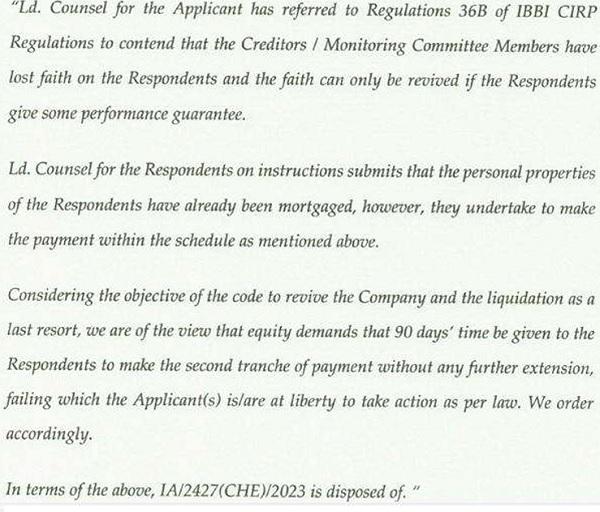
“Ld. Counsel for the Applicant has referred to Regulations 36B of IBBI CIRP Regulations to contend that the Creditors / Monitoring Committee Members have lost faith on the Respondents and the faith can only be revived if the Respondents give some performance guarantee.
Ld. Counsel for the Respondents on instructions submits that the personal properties of the Respondents have already been mortgaged, however, they undertake to make the payment within the schedule as mentioned above.
Considering the objective of the code to revive the Company and the liquidation as a last resort, we are of the view that equity demands that 90 days’ time be given to the Respondents to make the second tranche of payment without any further extension, failing which the Applicant(s) is/are at liberty to take action as per law. We order accordingly.
In terms of the above, IA/2427(CHE)/2023 is disposed of.”
4.9. It is stated that, the SRA submitted an undertaking to make payment of Rs.12.0 Cr in two phases i.e., 60 days (phase I) and 90 days (phase II) with effect from 20.8.2024. The Fourth Monitoring Committee Meeting was held on 30.11.2024 as no payments were made by the SRA. The SRA once again stated that no payment could be made as the investors of the SRA had not conducted their due diligence. Thus the Financial Creditors requested the Chairman of the Monitoring Committee to take appropriate action as per the Code.
4.10. It is stated that the Financial Creditor, Indian Overseas Bank issued a communication to the Monitoring Committee Chairman vide e-mail on 13.12.2024, requesting that the Liquidation Application be filed on account of failure of implementation of the Resolution Plan.
4.11. In the Fourth Monitoring Committee, Chairman informed that an amount of Rs.99.0 lakhs had been incurred, details of which are furnished below.
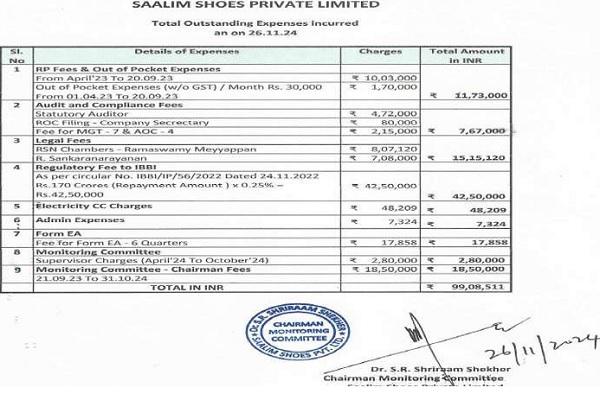
The same was taken on record, however no resolution was passed.
4.12. It is stated that, the Applicant preferred the instant application under Section 33(3) of the IB Code, 2016 r/w Section 60(5) (a) and (C) r/w Rule 11 of NCLT Rules, 2016 on account of failure of implementation, and contravening the Resolution Plan as approved by the Tribunal and to pass direction under Section 33(4) of the IB Code, 2016 to commence Liquidation of the Corporate Debtor under Section 33(1)(b) (i), (ii), (iii) and (iv) of the IB Code, 2016.
5. REPLY BY RESPONDENTS 2 TO 4
5.1. It is stated that the law based on the jurisprudence on the subject had given authority to the tribunal to appreciate the circumstances leading to the default and decide whther by forbearance a solution to implement the approved resolution plan could be found. It is stated that the law does not prescribe dissolution without exploring alternative option to run the CD as a going concern. It is stated that the Hon’ble Supreme Court has time and again stated that Liquidation is the last option and this has been recorded by this tribunal in the order under reference.
5.2. It is stated that the Chairman MC has not placed the efforts made by the respondents to honour the undertaking given to this tribunal and it is the compliance failures of the Applicant which resulted in a serious delay in the evaluation of the investment proposal and completion of due diligence by the Investors.
5.3. It is stated that respondent had taken all actions required before and after the tribunal order dated 09.09.2024. It is stated that the Corporate Debtor was not handed over, by converting the status to ‘Active’ by the applicant by filing appropriate form with MCA. Further the balance sheet which was sought by the investors was partially submitted by liquidator only in third week of November 2024. The statutory returns, financial information along with income tax returns were sought by the investment advisors as early as 16.12.2023.
5.4. It is stated that tribunal order dated 09.09.2024 was based on the undertaking given by R2 to make the balance payment in 90 days. Respondents made the commitment based on the assumption that compliance would be made by the applicant within 30 days. However the compliance was made by the applicant well beyond the 90 days.
5.5. It is stated that the negligence and indifference of the applicant resulted in serious delays in the due diligence process. Thus, the inability to infuse funds within the assured timeline is directly attributable to the failure of the RP in doing his duties as prescribed in Sec.25 of the Code.
5.6. It is stated that these lapses of the Applicant were pointed out to the sole FC by the respondents and the investment advisor in the meeting with the DGM of IOB on 27.11.2024. It was informed that the process could not be completed in 90 days as the investors would not be able to complete due diligence pending these compliances, as the state of the financial position of the CD was unclear and there was no finality on the assets and liabilities of the CD to complete the business valuation for investment purposes.
5.7. It is stated that the investor was not in in a position to decide on valuation due to non- availability of crucial documents and it was suggested by them that they might consider a One-Time Settlement as that would reduce the risk of a valuation error on their part due to lack of documents. Hence, based on the discussion with the Investors, a detailed “ONE TIME SETTLEMENT’ proposal for Rs.50 Crores was placed before the bank for consideration, by the SRA vide letter dated 21.12.2024 on the terms and conditions stated therein.
5.8. It is stated that the adjustment of Rs.19 crore received from ECGC by IOB was one of the conditions in the One Time settlement. The SRA also approached IOB to understand the terms of the policy. Despite the fact that, the premium for the policy was paid by the Corporate Debtor, the amount which was received by IOB during CIRP towards the claim was not disbursed to the Corporate Debtor. Though as per the policy, the amount was paid by ECGC towards replenishment of the working capital erosion / insolvency of the Corporate Debtor which could facilitate the revival / restructure of the Corporate Debtor. It is stated that the amount of insurance claim received by IOB was not distributed to the Corporate Debtor. The RP, despite having knowledge of the same, did not take any action to collect the funds from IOB. SRA has brought this fact to the knowledge of the Tribunal by filing the IA.
5.9. It is stated that as there was no response from IOB, the financial creditor, SRA improved the offer of One Time Settlement to Rs.55.77 crore on 17th April 2025. It is stated that RP had not taken steps to finalise the financial statements, the tax returns, conduct of AGM, ROC compliance, etc. from the FY 2018-19 onwards. No AGM had been called for adoption of accounts and for conduct of other businesses till date, for the period during which the Applicant was in charge of the This was revealed after a search report obtained by the SRA at ROC and thereafter a detailed letter was sent to the Applicant listing all the non-compliances vide dated 20.09.2024, immediately after the order of this tribunal on 09.09.2024.
5.10. The respondents have relied on the following judgements to substantiate their case:
i) Gayatri Polyrub Pvt Ltd vs Anil Kohli & Anr. (2023) in 645 NCLAT
ii) G. Prasad Rao vs Anand & Anr . Company Appeal (AT) (Insolvency) No. 1697 of 2023 and R.G.Prasad Rao vs Union Bank of India & Anr Company Appeal (AT) (Insolvency) No 1699 of 2023.
6. SUBMISSIONS OF APPLICANT
6.1. It is stated that, the Applicant is the representative of Successful esolution Applicants, the promoter Director of the Corporate Debtor an MSME, whose Resolution Plan was approved by this Tribunal on 20.09.2023.
6.2. It is stated that, the approved plan provided for a payment of Rs.21.60 crores by the SRAs on or before 90th day of the effective date of implementation of the resolution plan.
6.3. It is stated that the Applicant paid Rs.10.60 crores against the said amount of Rs.21.60 crores payable on or before 19.12.2023. It is further stated that this was excluding an amount of Rs.19.0 crores towards ECGC claim which is the subject matter of the present Application. If the present Application is allowed, there would be no default in the timelines of repayment. It is stated that the IA (Liq.) No.8 of 2025 is premature, untenable and unsustainable in law.
6.4. It is stated that, the Chairman Monitoring Committee filed an application being IA No.2427 of 2024 seeking Liquidation of the CD, alleging failure of the SRAs to infuse the required funds in the timeline provided in the approved plan, exceeding the authority resolution passed at the 2nd Monitoring Committee (hereinafter referred to as ‘MC’) meeting held on 11.12.2023.
6.5. It is stated that, this Tribunal vide Order dated 09.09.2024 allowed the SRAs 90 days from 20.08.2024 to make the balance payment of Rs.12 Crores as per the Resolution Plan.
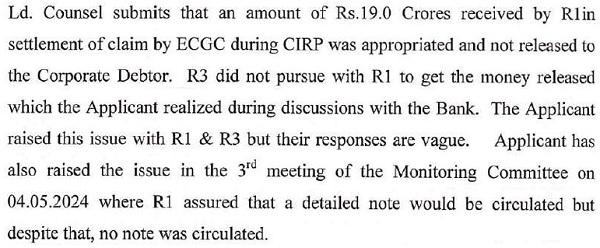
6.6. It is stated that an amount of Rs. 19 crores received by IOB , in settlement of the claim by ECGC during CIRP was appropriated and not released to the CD. It is stated that, Chairman Monitoring Committee was negligent of not pursuing with IOB to get the money released.
6.7. It is stated that, the Applicant raised this issue in various communications to IOB and Chairman Monitoring Committee. However, the responses from IOB and ECGC were vague. Chairman Monitoring Committee refused to respond when the SRA visited them, directing the SRA to approach IOB regarding the issue of Rs. 19 crores. This issue was raised in the 3rd meeting of MC held on 04.05.2024 on the directions of this Tribunal. In the said meeting, the officials of IOB assured that a detailed note would be circulated on the issue; however, despite reminders to this effect, no note on the issue was received from IOB. Further, Chairman MC despite many reminders has not shared the video recording of the said meeting which had crucial discussion which has not been reported in the minutes.
6.8. It is stated that, the Applicant approached IOB to understand the terms of the policy. Even though the premium for the policy was paid by the CD but the amount was received by IOB from ECGC during CIRP, towards the claim. It was not disbursed to the CD, despite the fact that as per the terms of the policy, the amount was paid by ECGC towards the replenishment of the working capital erosion / insolvency of the CD to facilitate the revival/restructuring of the CD. Therefore, the amount of insurance claim received by IOB was to be disbursed to the CD. The terms of the policy also provide for proportional payment to ECGC based on the recovery from the CD. These were the facts gathered by the Applicant based on the website of ECGC.
6.9. It is stated that, despite having brought these things to the knowledge of Chairman MC, no action was taken to obtain the funds from IOB. Therefore, chairman MC was negligent in not raising this issue with IOB and has not claimed the funds, being the asset of the CD received during CIRP, despite repeated reminders by the Applicant.
6.10. It is stated that, this aspect was brought to the knowledge of this Tribunal during the hearing of IA/2427/2023. This Tribunal stated that the Applicant may file a separate IA for the same. Further, the Tribunal directed that the balance payment of Rs.12 crores under default had to be paid and based on the directions of this Tribunal, the Applicant filed an undertaking to pay the balance amount of Rs. 12 crores in 120 days. However, the Tribunal was willing to permit only 90 days and accordingly a revised affidavit was filed by the Applicant. Based on the said affidavit this Tribunal passed the Order dated 09.09.2024.
6.11. It is stated that, the Applicant, thereafter sincerely made efforts to complete the commitment made to this Tribunal. It is stated that the undertaking was filed on the assumption that the due diligence by the investor would take about 30 days to complete and that the first tranche would thereafter be paid by the SRAs by the 60th day and the balance by the 90th day from 20.08.24, being the date on which Chairman Monitoring Committee completed formalities for changing the status of the CD to ACTIVE from UNDER CIRP to facilitate the SRA to begin completion of formalities under the Resolution Plan.
6.12. It is stated that one of the requirements to complete the due diligence was to provide the prospective investor with the financial statements and the income tax return of the CD pertaining to the time the CD was under the control of Chairman MC. This aspect was part of the pleadings in IA 2427 of 2024. It is further stated that, after considerable follow up, this was partially completed by Chairman MC only on 27th November 2024. The financial statements, the IT return for the F.Y. 23-24 and the filing in MCA are yet to be provided by Chairman MC.
6.13. It is stated that, under section 17(2) (e) of the code, RP is under legal obligation to comply with all the laws. Therefore, RP was bound to provide all the documents till the date of hand over, which is 20.08.2024. The failure of Chairman MC to provide all the documents and complete the compliance on time, delayed the due diligence process, All due diligence, except financial due diligence, was completed by then. Hence, there was a delay in execution of the final binding term sheet with the investor.
6.14. It is stated that, it was the applicant who requested for the MC meeting on 29.11.24 when the documents were not provided; however, the submissions of the Applicant were not recorded by Chairman MC in the minutes.
6.15. It is stated that Chairman MC was keen on ensuring Liquidation of the CD and ensuring that the inflated CIRP cost, which included the penalty payable by him in his personal capacity, is somehow approved. It is stated that the conduct of Chairman MC was unbecoming of an insolvency professional and merits a reference to IBBI for further action.
6.16. It is stated that IOB was keen on suppressing the fact that it has received Rs. 19.0 Crores from ECGC as insurance claim. It is stated that, when the applicant enquired about it with IOB, they were evasive.
6.17. It is stated that the Applicant in order to complete the payment in the timeline undertaken, met IOB continuously to find a resolution. The investor representative met IOB along with the Applicant on 27.11.2024 and sent a detailed proposal based on the meeting. The Investor pending financial due diligence, was unwilling to commit payments over 10 years and stated that in order to support the applicant, they are willing to make onetime settlement offer which would ensure that the liability is repaid and all parties could de-risk themselves; IOB is derisked by the reduction of risk due to One Time Settlement (OTS) as the payment otherwise would be received over a period of 10 years thus reducing the exposure timeline. The investor’s outlay is reduced which derisks them, and the CD gets an opportunity to leverage for future requirements with a lower debt on the books.
6.18. It is stated that IOB via mail dated 26.12.2024 sought for increase of the offer and a revised offer was sent on 28.12.2024. Thereafter, again a revised offer was made on 17th April 2025 which is still under consideration.
6.19. It is stated that, the bone of contention in the offer by the Applicant and the reply by IOB is the amount of Rs.19 Crores received during CIRP which is not credited to the account of the CD. This is a crucial factor in the successful implementation of the Resolution Plan.
6.20. It is stated that, the Applicant is confident that in case the relief sought is permitted, the Resolution plan can easily be implemented.
6.21. It is submitted that the present application be adjudicated before the IA (Liq.) No.8 of 2025 of 2025 filed by the Chairman MC, is considered, as the resolution of this issue shall provide a ground for successful implementation of the Resolution Plan.
7. REPLY BY LIQUIDATOR
7.1. It is stated that Mr. Aejaz Ahmed Tarkathi, the new investor and one of the Successful Resolution Applicants as proposed under the Resolution Plan was not able to pay his share as per the plan and was unable to take part in the Resolution Process or implementation of the Resolution Plan due to medical reasons. The above Respondent No 1 (in IA2427 of 2023) has filed an Affidavit to this effect.
7.2. It is stated that an application for liquidation was preferred under Section 33(3) of IBC for failure of implementation of the Resolution Plan vide IA/2427 of 2023.
7.3. Mr. Mohamed Saalim, the applicant filed a Reply and an Additional Affidavit with allegations against the Chairman MC. Mr.Mohamed Saalim subsequently on 01.08.2024 undertook to pay the balance consideration of the upfront Resolution Plan amount within a period of 90 days. Mr. Mohamed Saalim stated that the company was changed to active only on 20.08.2024 and there was no activity between 20.09.2023 to 20.08.2024. Subsequently Mr. Mohamed Saalim filed an additional affidavit undertaking to pay the balance dues of Rs.12 Crores out of 21.60 Crores that had to be infused within 90 days of approval of resolution plan as upfront money.
7.4. During the pendency of the aforesaid IA, the tribunal on 30.04.2024 directed Chairman of the MC to resolve the issues that were existing between the members of the Committee i.e., Indian Overseas Bank and the Successful Resolution Applicants represented by Mr. Mohd Saalim. Necessary initiative was taken by the Chairman to organize the meeting on 04.05.2024. In the 3rd Monitoring Committee Meeting, the SRA placed on record certain proposals. However, the Monitoring Committee concluded that the proposals suggested by the SRAs are not feasible. A memo along with the minutes of the meeting was also filed in IA 2427 of 2023.
7.5. It is stated that the SRA submitted an undertaking to make Rs.12.0 Cr in two phases i.e., 60 days (phase I) and 90 days (phase II) with effect from 20.8.2024. Based on this, tribunal passed an order in IA 2427 of 2023 on 09.09.2024.
7.6. It is stated that the Fourth Monitoring Committee Meeting was held on 30.11.2024 as no payments were made by the SRAs. The SRAs once again stated that no payment could be made as the alleged investors of the SRA have not conducted their due diligence.
7.7. It is stated that transfer of possession and control, including keys and relevant documents of the company, was effected on 04.10.2023. However, SRAs demonstrably lacked the necessary investors, funds, or capability to operate the unit or adequately safeguard its assets. Despite the factory being handed over, the factory was not made operational, no work was done nor was intended, nor have they brought any purchase orders. The factory became non-operational and was left to rust in the hands of the SRAs. The security personnel deployed at the CD’s factory have not been paid salary, and the number of security personnel were significantly reduced.
7.8. It is stated that the statutory filings of the CD are up to date. It is stated that as per the Resolution Plan (Pg.157 of the Liquidation Application Vol-2), under the heading ‘Filing with Various Authorities’ the Resolution Applicant assumed direct and explicit responsibility to file all necessary documentation with the government bodies to facilitate both implementation of the Plan and any proposed investments. The heading ‘Accounting Provisions and Compliance’ (Pg.158 of the Liquidation Application Vol-2), outlines the Resolution Applicant’s undertaking to prepare financial statements for the Corporate Debtor, in full compliance with applicable accounting standards. The same was approved by this Tribunal in the Resolution Plan approved vide an order dated 20.09.2023. It is stated that delay if any, in filing the Balance Sheets and the IT Returns was solely because neither the SRA nor the Financial Creditor cleared the past dues of the professionals like auditors. Despite these delays, the erstwhile Resolution professional had in good faith, taken diligent steps to ensure that all requisite filings are current.
7.9. As regards the ECGC claim, the minutes of the 3rd Monitoring Committee held on 04.05.2024 were referred where the issue as to payment of Rs.19.0 Crores by way of ECGC received on 30.03.2023 came and it was submitted by the AGM of Indian Overseas Bank that this fund has nothing to do with the SRA repayment nor for adjusting in the CIRP account. ECGC is only a guarantee against default and is kept in trust. This could not be construed as a substitute for repayment or the payment against the dues.
7.10. It is stated that with regard to the alleged attempts to resolve outstanding dues through One Time Settlement, it is well-settled that once a Resolution Plan is approved, any such material change in the payouts cannot arbitrarily be done through One Time Settlement. The issue was put to rest by the Hon’ble Supreme Court in the case of Ebix Singapore Private Limited v. Committee of Creditors of Educomp Solutions Limited (2021) 2 SCC 401. The principle set out in the Ebix judgement has recently been reiterated by the Hon’ble Supreme Court in the case of SREI Multiple Asset Investment Trust Vision India Fund v. Deccan Chronicle Marketeers & Others 2023 SCC OnLine SC 298. The Hon’ble Supreme Court while relying on this principle has, held that once the Resolution Plan stands approved by the Committee of Creditors (“CoC”), no modifications are permissible. It is either to be approved or disapproved, but any modification after approval of the Resolution Plan by the CoC, based on its commercial wisdom, is not open for review by the Adjudicating Authority unless it is found to be contrary to the mandate of the IBC. Moreover, in the case of M.K Rajagopalan v. Dr. Periasamy Palani Gounder 2023 SCC OnLine SC574, the Hon’ble Supreme Court has held that even a procedural/technical change to a Resolution Plan would require prior approval of the CoC.
7.11. It is stated that IOB rejected the OTS proposal of the Respondent via email dated 30.05.2025. The authorized officer of IOB also appeared via virtual mode on 30.05.2025 and clarified the same.
7.12. It is stated that in light of the SRAs’ repeated failures to adhere to the approved resolution plan, coupled with Mr. Aejaz Ahmed Tarkathi’s (Respondent No. 1) affidavit indicating his inability to proceed, the Financial Creditor directed the Liquidator to file a liquidation application. As stipulated under Section 33(3) of the Insolvency and Bankruptcy Code, 2016, where a resolution plan approved by the Adjudicating Authority is contravened, any person other than the corporate debtor, whose interests are prejudicially affected by such contravention, may make an application to the Adjudicating Authority for a liquidation order. Thus, the only remedy in case of contravention of Resolution Plan as envisaged under the IBC is liquidation and hence liquidation application has been filed.
8. ANALYSIS AND FINDINGS
8.1. Heard the submissions of the parties and perused the pleadings and written submissions placed on record.
8.2. The Corporate Debtor was admitted to Corporate Insolvency Resolution Process by the tribunal vide an order dated 22.09.2020 in IBA/1104/2019.
8.3. The RP received only one EoI by the erstwhile promoter directors of the Corporate Debtor which led to submission of the Resolution Plan. There were repeated negotiations. In sixteenth CoC held on 19.03.2022, the modified plan was approved by the CoC with 100% voting. The application for plan approval was filed before the Tribunal in IA/1212/CHE/2022 on 31.03.2022. The order for approval of Resolution plan was passed by NCLT, Chennai on 20.09.2023.
8.4. The Resolution Plan envisaged total repayment of Rs. 170 Crores to all the financial & operational creditors (including interest payable) over a period of 10 years. The Resolution Plan included a statement under Regulation 38(1A) of the CIRP Regulations as to how it dealt with the interests of all the stakeholders The SRA in compliance with the Code and regulations proposed to pay an upfront amount of Rs. 22.0 Crores within 90 days from the order of the Adjudicating Authority, to the creditors, besides bringing in working capital of Rs.15.0 Crores by fresh infusion by way USL in a phased manner.
8.5. As per the approved resolution plan, the Successful Resolution Applicants had to infuse a fund of Rs.9,60,62,686/- (5.65%) within 5 days of acceptance of Lol and a sum of Rs.12 Crores (7.06%) within 90 days. Thus a sum of Rs. 21.61 Crores had to be paid by the Successful Resolution Applicants without any cure period as requested by them. The said 90 days period ended on 19.12.2023. The issue of time period for part implementation as approved by the Adjudicating Authority, was discussed in the Second Monitoring Committee Meeting.
8.6. Mr. Aejaz Ahmed Tarkathi, the proposed investor and one of the Successful Resolution Applicants was not able to bring the investment as per the plan and was unable to take part in the Resolution Process or implementation of the Resolution Plan in any manner due to medical reasons.
8.7. The Successful Resolution Applicants sought further extension of 87 days for plan implementation and evinced interest to bring a new investor. The members of the Monitoring Committee after due consideration noted that the Rs.9,60,62,686/- (5.65%) paid till date were not the fresh funds but the Fixed Deposit held by the Corporate Debtor for 5-6 years. Thus, the Monitoring Committee members, keeping in mind that no fresh funds have been infused even after 90 days i.e., and the Successful Resolution Applicants have not contributed a single penny to Rs.21.61 crores, expressed their apprehension about the capability of the Successful Resolution Applicants towards compliance of the resolution plan.
8.8. An application for liquidation was initially preferred under Section 33(3) of IBC for failures of implementation of the Resolution Plan vide IA/2427 of 2023.
8.9. Mr. Mohamed Saalim, one of the SRAs, subsequently on 01.08.2024 undertook to pay the balance amount as per the Resolution Plan within a period of 90 days. The SRA stated that the company was changed to ‘active status’ only on 20.08.2024 and there was no activity between 20.09.2023 to 20.08.2024. Subsequently the Respondent No. 2 filed an additional affidavit undertaking to pay the balance dues of Rs.12.0 Crores out of 21.60 Crores that had to be infused within 90 days of approval of resolution plan.
8.10. During the pendency of the aforesaid IA, the tribunal on 30.04.2024 directed the Chairman of the MC to resolve the issues that were existing between the members of the Committee. In the 3rd Monitoring Committee Meeting held on 04.05.2024, the SRA placed on record certain proposals, however, the Monitoring Committee concluded that the proposals suggested by the SRA are not feasible.
8.11. On 09.09.2024, tribunal extended the timeline for the balance upfront payment till 19.11.2024 in IA 2427/2023 with the following observations:
8.12. Despite the undertaking submitted by the SRA to make payment of Rs.12.0 Cr in two phases i.e., 60 days (phase I) and 90 days (phase II) with effect from 20.8.2024, no payments were made. The Fourth Monitoring Committee Meeting was held on 30.11.2024. The SRA once again stated that no payment could be made as the alleged investors of the SRA have not conducted their due diligence. The Financial Creditors requested the Chairman of the Monitoring Committee to take appropriate action as per the Code.
8.13. The Financial Creditor, Indian Overseas Bank issued a communication to the Monitoring Committee Chairman via e-mail on 13.12.2024, requesting that the Liquidation Application be filed on account of failure of implementation of the Resolution Plan. The IOB rejected the OTS proposal of the Respondent vide email dated 30.05.2025. The authorized officer of IOB also appeared via virtual mode during the hearing on 30.05.2025 and clarified the same.
8.14. Present liquidation application has been preferred under Section 33(3) of the IB Code, 2016 r/w Section 60(5) (a) and (C) r/w Rule 11 of NCLT Rules, 2016 on account of failure of implementation, and contravening the Resolution Plan as approved by Adjudicating Authority and to pass directions under Section 33(4) of the IB Code, 2016 to commence Liquidation of the Corporate Debtor under Section 33(1)(b) (i), (ii), (iii) and (iv) of the IB Code, 2016.
8.15. IA 953 /CHE/2025 has been filed by SRAs stating that this application has to be heard before any decision is made on the liquidation application. It is stated that Resolution plan could not be implemented by SRAs due to non-compliance of the conditions precedent by the Chairman Monitoring Committee and due to noncredit of amount received from ECGC by the financial creditor.
8.16. Extensive arguments were made by both the parries during the hearing on 25.06.2025 which were recorded as part of the proceedings. The extracts are as under:
Ld Counsel for SRA stated as under:
8.17. It was stated by SRA that the status of company was not made ‘active’ from ‘under CIRP’ till 20.08.2024. The audited financials of the Corporate Debtor were not finalised and statutory returns were not filed by the Chairman MC, either in the present role or in his earlier role as RP. It was stated that due to this reason, the proposed investors could not complete the due diligence which resulted in delay in making the upfront payment due. It was further submitted by SRA that IOB, the financial creditor received Rs.19.0 crores from ECGC during CIRP period which were not given credit to the CD’s account. If the amount is accounted for, there will be no obligation for the SRA to pay any amount towards the upfront payment. It was further stated that as the financial due diligence could not be completed, investors suggested for One Time Settlement (OTS) with financial creditor and accordingly SRAs submitted OTS with IOB which was further revised.
8.18. It was submitted by the Chairman MC that the investor, Mr. Aejaz Ahmed Tarkathi with whom SRAs submitted the proposal backed out from making the investment citing medical reasons and SRAs could not find any new investor. It was stated that though physical possession of the Corporate Debtor was handed over on 04.10.2023, SRAs did not take any steps to preserve the plant and machinery and inventor. Further the security staff guarding the assets were not paid properly. Jt was stated that the delay in preparing the Audited Balance sheets and filing of statutory returns was due to reluctance on the part of the SRA and financial creditor to pay the professional fees of the auditor.
8.19. Jt was submitted by JOB that Rs. 19.0 crore received from ECGC is a guarantee amount which was to be kept in trust account and for every amount recovered from the CD, proportionate amount was to be shared to ECGC by JOB. Regarding OTS, JOB said that the OTS is not acceptable to it and SRA was already conveyed about the same.
8.20. For better understanding of the case and identifying the issues , let us go through the chronology of developments so far:
DATES AND EVENTS:
| DATES | EVENTS |
|---|---|
| 22.09.2020 | CJRP commencement date. |
| 20.09.2023 | Resolution Plan approved by Tribunal. Total repayment of Rs. 170 crores envisaged towards payment to all creditors over a period of 10 years. |
| 04.10.2023 | Assets of Corporate Debtor handed over to SRAs physically. |
| 11.12.2023 | Second Monitoring Committee held. |
| 19.12.2023 | Rs.10.60 crore out of Rs. 21.60 crore of upfront money received/ adjusted. |
| 27.12.2023 | IA 2427 / CHE / 2023 filed recommending liquidation. |
| 04.05.2024 | Third Monitoring Committee held. |
| 20.08.2024 | The status of the company was made as ‘Active’ in MCA website. |
| 09.09.2024 | Tribunal allowed SRA 90 days from 20.08.2024 until 19.11.2024 to make payment of Rs.12 crore. |
| 27.11.2024 | SRA along with investor met IOB officials along with Chairman MC. |
| 30.11.2024 | Fourth Monitoring Committee was held as no payments received from SRA. |
| 13.12.2024 | IOB recommended Chairman MC to file liquidation application on account of failure to implement resolution plan. |
| 23.12.2024 | OTS offer was made by SRAs to IOB. |
| 17.01.2025 | IA 8 / LIQ / 2025, application for liquidation filed. |
| 30.05.2025 | IOB rejected the revised OTS offer by SRAs. |
| 11.06.2025 | IA 953 / CHE / 2025 filed by SRA. |
8.21. It is observed that the erstwhile promoters are the Successful Resolution Applicants in the present case. Out of Rs.170 crores of the resolution plan amount payable over a period of 10 years, an amount of Rs.21.60 crore was to be paid as upfront amount within 90 days from the approval of resolution plan. The plan was approved by the tribunal on 20.09.2023. An amount of Rs.12 crore lying as fixed deposit in the name of the CD was adjusted and treated as part payment. Apart from this, no payment was received from the SRAs. The initial investor, with whom SRA had tied up, backed out. SRA could not find fresh investor. SRA has attributed the failures on the part of RP / Chairman MC and financial creditors to justify their failure to meet the commitment of upfront payment.
8.22. The SRA is harping about inability of the investors to complete their due diligence as a reason for delay. This is despite the fact that SRA is the erstwhile promoters of the Corporate Debtor under whose supervision CD was incorporated and functioned thus far.
8.23. Similarly, ECGC amount if any received by the financial creditor does not absolve the SRA from paying the upfront money payable by it within 90 days from the plan approval date.
8.24. IOB, the sole financial creditor rejected the OTS offer made by SRA. Rs. 170 crore payment as per resolution plan is towards the claims submitted by both financial and operational creditors. SRA cannot go back in its commitment and state that instead of implementing the resolution plan, it would enter into OTS settlement with the Financial Creditor only.
8.25. SRA has stated that the law based on the jurisprudence has given authority to the tribunal to appreciate the circumstances leading to the default and decide whether by forbearance a solution to implement the approved resolution plan can be found. It is stated that the law does not prescribe dissolution without exploring alternative option to run the CD as a going concern. We do not subscribe to this contention. There are many judgements of Hon’ble Supreme Court and Hon’ble NCLAT which state that tribunals cannot direct financial institutions to accept settlement. They laid emphasis on the timely implementation of resolution plan. The Hon’ble Supreme Court in the case of E.S. Krishnamurthy vs M/S Bharath Hi Tech Builders Pvt. Ltd. MANU/SC/1249/2021 held as follows:
“29. The IBC is a complete code in itself. The Adjudicating Authority and the Appellate Authority are creatures of the statute. Their jurisdiction is statutorily conferred. The statute which confers jurisdiction also structures, channelises and circumscribes the ambit of such jurisdiction. Thus, while the Adjudicating Authority and Appellate Authority can encourage settlements, they cannot direct them by acting as courts of equity.”
8.26. Hon’ble Supreme Court has extensively dealt the reason of delay in the implementation of resolution plan by SRA in State Bank of India & Ors vs The Consortium of Mr. Murari Lal Jalan and Mr. Florian Fritsch & Anr [Civil Appeal Nos 5023-5024 of 2024] with [Civil Appeal Nos 12220-12221 of 2024]. Among various things discussed, effect of non-implementation of resolution plan and necessity of timely implementation of resolution plan was discussed as under:
ii. Whether the non-implementation of the Resolution Plan by the SRA necessarily leads to the consequence of liquidation as provided under Section 33(3) of the IBC, 2016? In Kridhan Infrastructure Private Limited v. Venkatesan Sankaranarayan and Others reported in (2021) 6 SCC 94, the relevant observations are reproduced here in below:
“11. The appellant has been unable to raise the funds. The fact of the matter, as it emerges from Mr Viswanathan’s submissions, is that the appellant will be unable to raise funds from the term lenders who are insisting that the status of the Company should change from a company under liquidation to an active status. The order of liquidation has not been set aside. Ultimately, what the request of the appellant reduces itself to, is that it would raise funds on a mortgage of the assets of the Company and unless the Company is brought out of liquidation, it would not be in a position to raise the funds. This is unacceptable. At this stage, the order of liquidation has only been stayed, but a final view was, thus, to be taken by this Court. Sufficient opportunities were granted to the appellant earlier during the pendency of the proceedings both before the NCLT and NCLAT. The orders of the NCLT and NCLAT make it abundantly clear that despite the grant of sufficient time, the appellant has not been able to comply with the terms of the resolution plan. Since 9-10-2020, despite the passage of almost five months, the appellant has not been able to deposit an amount of Rs 50 crores. Time is a crucial facet of the scheme under IBC [Innovative Industries Ltd. v. ICICI Bank, 2018) 1 SCC 407, paras 12-16 : (2018)1 SCC (Civ) 356] . To allow such proceedings to lapse into an indefinite delay will plainly defeat the object of the statute. A good faith effort to resolve a corporate insolvency is a preferred course. However, a resolution applicant must be fair in its dealings as well. The appellant has failed to abide by its obligations. In that view of the matter, we see no reason or justification to entertain the civil appeal any further. The consequence envisaged under the order of this Court shall accordingly ensue in terms of the forfeiture of the amount of Rs 20 crores. As a consequence of this order, the management shall revert to the liquidator for taking steps in accordance with law. The civil appeal is accordingly dismissed.”
(emphasis supplied)
148. Although one of the key objectives of the IBC, 2016 is to ensure the survival of the corporate debtor as a going concern, yet the same must not come at the cost of efficiency. In scenarios such as the present, ‚timely liquidation‛ is indeed preferred over an ‚endless resolution process‛. Such a view will prevent the likelihood of adversely affecting the interests of all the creditors who have been suffering due to no fault of their own and also securing the maximization of value of the remaining assets.
iii. Whether the timely implementation of the Resolution Plan is also one of the objectives of the IBC, 2016?
150. The Preamble to the Insolvency and Bankruptcy Code, 2016 reads as thus:
“An Act to consolidate and amend the laws relating to reorganisation and insolvency resolution of corporate persons, partnership firms and individuals in a time bound manner for maximisation of value of assets of such persons, to promote entrepreneurship, availability of credit and balance the interests of all the stakeholders including alteration in the order of priority of payment of Government dues and to establish an Insolvency and Bankruptcy Board of India, and for matters connected therewith or incidental thereto.”
(emphasis supplied)
151. The Report of the Bankruptcy Law Reforms Committee, 2015 (hereinafter, the ‚2015 Report‛) also serves to provide valuable insight into the several purposes for which the Code was enacted. The relevant observations are reproduced hereinbelow:
“Speed is of essence
Speed is of essence for the working of the bankruptcy code, for two reasons. First, while the “calm period” can help keep an organisation afloat, without the full clarity of ownership and control, significant decisions cannot be made. Without effective leadership, the firm will tend to atrophy and fail. The longer the delay, the more likely it is that liquidation will be the only answer. Second, the liquidation value tends to go down with time as many assets suffer from a high economic rate of depreciation.
From the viewpoint of creditors, a good realisation can generally be obtained if the firm is sold as a going concern. Hence, when delays induce liquidation, there is value destruction. Further even in liquidation, the realisation is lower when there are delays. Hence, delays cause value destruction. Thus, achieving a high recovery rate is primarily about identifying and combating the sources of delay.
154. Several decisions of this Court have highlighted the importance of a speedy resolution process under the IBC, 2016 in the context of either completing the CIRP process in a time-bound manner as per Section 12 of the IBC, 2016 or ensuring that the Liquidator does not cause unnecessary delay or inefficiency in the Liquidation process. A primary and predominant consideration behind minimizing delay is to ensure that the assets of the Corporate Debtor do not get frittered away or depreciated due to the time lag caused either during the CIRP or during the liquidation process overseen by the Liquidator. Such a time bound action is also equally important and imperative while the Resolution Plan is being implemented by the successful resolution applicant. Unnecessary delay caused in implementation of the Resolution Plan would also lead to similar consequences of the assets of the corporate debtor diminishing in value. Therefore, there is no doubt that the timely implementation of the Resolution Plan is also one of the underlying objectives of the IBC, 2016.
157. Rule 15 of the NCLT and NCLAT Rules, 2016 grants power to the NCLT and NCLAT respectively, to extend the time limits for doing any act which have been fixed, either by the rules or by an order, as the justice of the case may require. However, such power must not be exercised mechanically without any application of mind. An extension on the strict timelines fixed under the resolution plan must be done by adequately weighing the period of extension sought with the consequences of such extension on the continued implementation of the Resolution Plan. After all, such a discretion cannot be exercised to the detriment of the resolution plan and its implementation itself. While one of the reasons supporting the grant of extension would be to ensure the successful revival of the corporate debtor, multiple extensions may seriously hamper the economic feasibility of the Resolution Plan and also lead to an increase in the debts of the corporate debtor. Not to mention, during the extended period, there are several costs incurred towards maintaining the corporate debtor as well. The feasibility and practicability of the resolution plan adjudged by the ‚commercial wisdom‛ of the CoC might no longer remain in cases where incessant extensions are granted by the NCLT and NCLAT under their discretionary powers.
173. This litigation is an eye-opener also as regards the manner in which the implementation of plans are handled by the Successful Resolution Applicant and the Lenders involved in the process. Once a resolution plan is approved under the IBC, 2016 the Successful Resolution Applicant undertakes a profound responsibility to implement the plan in both letter and spirit. This obligation is not merely an empty formality but an enduring commitment to restore the corporate debtor to viability and ensure a meaningful turnaround. The role of a Successful Resolution Applicant is thus far more than a transactional duty towards the creditors or stakeholders; it embodies a pivotal responsibility to the distressed entity itself, which must be approached with utmost dedication and an earnest sense of duty. Regardless of the challenges that may arise, the Successful Resolution Applicant cannot treat its obligations as optional or conditional, nor can it abdicate its responsibility in the face of unforeseen obstacles. Its efforts must reflect a determination to implement the plan fully and to rejuvenate the debtor company, as this is integral to the success of the IBC framework and the spirit of economic revival it seeks to foster. The approach, therefore, must not be frugal or narrowly profit-driven, limited to viewing the transaction through a purely commercial lens. Instead, it must recognize that rescuing a distressed company is a responsibility of significant social and economic value, demanding a holistic and responsible strategy. This involves a dedication to long-term outcomes, where the Successful Resolution Applicant adopts measures that genuinely support the debtor’s rehabilitation, rather than making minimal or half-hearted attempts at implementation. Courts and tribunals have consistently underscored that the Successful Resolution Applicant’s role transcends commercial interest and embodies a commitment to the larger purpose of corporate revival. Consequently, it must make thoughtful and sustained efforts, demonstrating adaptability and resilience even when faced with obstacles or operational impediments. Simply put, the Successful Resolution Applicant cannot step back or dismiss its obligations by attributing delays or setbacks to the conduct of other stakeholders, as this would undermine the very purpose of insolvency resolution.
176. The IBC, 2016 is silent as regards the phase of implementation of the Resolution Plan by the Successful Resolution Applicant. This is mostly due to the fact that each Resolution Plan might be unique and customized to the specific needs of the Corporate Debtor and an excessive amount of statutory control over the implementation of the Plan may prove to be counterproductive to the cause of the Corporate Debtor. However, this has unfortunately led to the consequence of giving excessive leeway to the Successful Resolution Applicants to act in flagrant violation of the terms of the Resolution Plan in a lackadaisical manner. The SRAs repeatedly approach the Adjudicating Authority or the NCLAT for the grant of reliefs in relation to relaxation of the strict compliance to the terms of the Plan, including the timelines imposed therein. The NCLT and NCLAT more often than not, accede to such requests in exercise of their inherent powers under Rule 11 or their power to extend time under Rule 15 of the NCLT and NCLAT Rules, 2016 respectively. It is reiterated that the NCLT and NCLAT must not entertain such repeated attempts at violating the integrity of a CoC approved Resolution Plan by accommodating the incessant requests of the Successful Resolution Applicants. The exercise of discretion as regards altering the binding terms of the Resolution Plan, including the timelines imposed, must be kept at a minimum, at best. The NCLTs/ NCLATs need to be sensitised of not exercising their judicial discretion in extending the timelines fixed under IBC, 2016 or the Resolution Plan, in such a way that it may make the Code lose its effectiveness thereby rendering it obsolete.
8.27. It is a fact that no resolution plans were received from any third parties and only the ex-promoters were the SRA, in spite of issuance of Form G two times. This cannot lead to a situation where the SRA can hold IBC ecosystem for ransom by seeking time and imposing conditions.
8.28. Sufficient time was given to the SRA, both by Monitoring Committee and also the tribunal. Resolution plan submitted is binding on all the parties including the SRA. Despite this, SRA linked their payment obligations to external factors which were not the part of the original plan approval and the same cannot be allowed.
9. CONCLUSION
9.1. In the instant case, SRA could not implement the resolution plan as approved by Adjudicating Authority. The resolution plan was approved on 20.09.2023 with a stipulation that the upfront contribution of Rs.22 crores out of Rs.170 crores would be made within 90 days of approval of plan. This has not yet been honoured by SRA even after nearly 2 years. Implementation process cannot be delayed for indefinite period.
9.2. Section to 33 (3) and (4) of IBC provides as under:
“33. Initiation of liquidation. –
(1)…..
(2)…..
(3) Where the resolution plan approved by the Adjudicating Authority under section 31 or under sub- section (1) of section 54L, is contravened by the concerned corporate debtor, any person other than the corporate debtor, whose interests prejudicially affected by such contravention, may make an application to the Adjudicating Authority for a liquidation order as referred to in sub-clauses are (i), (ii) and (iii) of clause (b) sub-section (1).
(4) On receipt of an application under sub-section (3), f the Adjudicating Authority determines that the corporate debtor has contravened the provisions of the resolution plan, it shall pass a liquidation order as referred to in sub-clauses (i), (ii) and (iii) of clause (b) of sub-section (1).
(Emphasis Provided)
9.3. In view of facts and circumstances discussed above and in the fact that the payments have not been made as per the stipulated time schedule, we hold that the resolution plan approved by the Adjudicating Authority has been contravened by the corporate debtor under the control of SRA.
9.4. The Hon’ble Supreme Court in Arcelormittal India versus Satish Kumar Gupta, 2018 SCC OnLine SC 1733, decided on 04.10.2018 has clarified that liquidation under Section 33 can be triggered not just by failure to get a plan, but also if a confirmed plan is breached.
9.5. In view of the facts and judgements referred above, we have no option but to pass liquidation order under Section 33(4) of IBC. We observe that Dr. S.R. Shriraam Shekher who was the Resolution Professional of the Corporate Debtor was appointed as the Chairman of the Monitoring Committee. The CIRP Cost and cost incurred during implementation period amounting to Rs. 98 lakhs have not been paid yet either by the financial creditor or the SRA. There was no recommendation by Monitoring Committee or financial creditor for appointment of any other person as liquidator. If any new person is appointed as liquidator, he will take time to take charge as liquidator and understand the affairs of the Corporate Debtor. We therefore, appoint Dr. S.R. Shriraam Shekher as liquidator as he is familiar with the Corporate Debtor.
ORDER
9.6. The Application is allowed. The Corporate Debtor, Saalim Shoes Private Limited, is directed to be liquidated in the manner as laid down in Chapter-III of Part-II of the Code.
a. We appoint the existing RP cum Chairman Monitoring Committee Dr. S.R. Shriraam Shekher, having Registration No. IBBI/IPA-003/IP-N00144/2017-2018/11598 with AFA available till 31.12.2025 having e-mail id: [email protected], as per Section 34(4) of the Code, as the Liquidator of “Saalim Shoes Private Limited” to conduct liquidation process.
b. Successful Resolution Applicant who is in possession of the assets, accounts, documents and title deeds of the Corporate Debtor are directed to hand over the same to the liquidator within 15 days of this order along with the list of assets, documents, etc. being handed over. Liquidator should take inventory of the same and give acknowledgement for receipt.
c. The amount realised and credited towards part repayment of the upfront money will stand forfeited, as the SRA has not implemented the resolution plan.
d. The Liquidator shall be paid, in accordance with Regulation 39D of the Insolvency and Bankruptcy Board of India (Insolvency Resolution Process for Corporate Persons) Regulations, 2016.
e. The Moratorium declared under Section 14 of the IBC 2016 shall cease to operate from the date of this order. A fresh moratorium shall commence under Section 33(5) of IBC.
f. The Liquidator is directed to proceed with the process of liquidation as laid down under Chapter III of the Part II of Insolvency and Bankruptcy Code, 2016 and the Insolvency and Bankruptcy Board of India (Liquidation Process) Regulations, 2016.
g. The Corporate Debtor shall submit a Preliminary Report to the Adjudicating Authority within seventy-five days from the liquidation commencement date as per Regulation 13 of the Insolvency and Bankruptcy (Liquidation Process) Regulations, 2016.
h. The Liquidator shall comply with the Liquidation Regulations and accordingly submit Progress Reports as per Regulation 15 of theIBBI (Liquidation Process) Regulations, 2016; and shall further apprise the Bench about the Liquidation Process of the Corporate Debtor.
i. This order shall be deemed to be a notice of discharge to the officers, employees and the workmen of the Corporate Applicant, except when the business of the Corporate Applicant is continued during the liquidation process by the liquidator as per Section 33(7) of the IBC.
j. Subject to Section 52 of the Code no suit or other legal proceedings shall be instituted by or against the Corporate Debtor save and except the liberty to the liquidator to institute suit or other legal proceeding on behalf of the Corporate Debtor with prior approval of this Adjudicating Authority.
k. All powers of the Board of Directors, Key Managerial Personnel and partners of the Corporate Debtor shall cease to have effect and shall be vested in the Liquidator.
l. The Liquidator shall exercise the powers and perform duties as envisaged under Sections 35 to 50 and 52 to 54 of Chapter III Part-III of the Code read with the Liquidation Process Regulations.
m. All persons connected with the Corporate Debtor shall extend all assistance and cooperation to the Liquidator as will be required for managing its affairs.
n. Registry shall furnish a copy of this Order to:
i. Insolvency and Bankruptcy Board of India, New Delhi;
ii. Regional Director (Southern Region), Ministry of Corporate Affairs, e-mail id: [email protected];
iii. Registrar of Companies – Tamilnadu, e-mail id: [email protected];
iv. Indian Overseas Bank, 3rd Floor, Annexe Building,763, Annasalai, Chennai e-mail id: [email protected]
v. Liquidator, Dr. S.R. Shriraam Shekher e-mail id: [email protected].
9.7. The Registry is directed to send copy of the order via e-mail forthwith to above the parties.
9.8. A certified copy of this order may be issued, if applied by the concerned parties upon the compliance of all necessary formalities.
9.9. Accordingly, IA/ LIQ/08/25 and IA 953/CHE/2025 stand disposed of.