Sh. Vinod E Vs Bollineni Developers Ltd. (NAA)
Applicant alleged that the Respondent Bollineni Developers Ltd. had not passed on the benefit of Input Tax Credit to him by way of commensurate reduction in the price of the Flat No. J 703, 7th floor purchased from the Respondent in his project ‘Bollineni Silas’, situated at Sadarmangala, K R Puram, Bangalore-560048 on introduction of GST w.e.f. 01.07.2017, in terms of Section 171 of the CGST Act, 2017.
National Anti-Profiteering Authority observes that: –
(i) The Respondent has contended that the total turn-over during the post-GST period was reflected as Rs. 1,83,96,55,636/- instead of Rs. 1,83,97,15,637/- and pending receivables of Rs. 17,14,83,699/- was ignored. In response to the same, the DGAP has clarified that during the course of investigation this data was not furnished by the Respondent.
(ii) The Respondent has contended that as per Section 15(5)(b) read with Rule 3(2) of the Karnataka VAT Act, in respect of VAT/WCT credit under Karnataka VAT Act, both under composition and non-composition scheme, and where, the execution of work is sub-contracted by main contractor to the sub-contractor on back to back basis, then whenever the subcontractor paid VAT/WCT on his turnover, the main contractor is eligible to avail deduction of turnover and WCT paid to subcontractor from his turnover and vice versa. The said claim of the Respondent needs to be examined with respect the relevant law after verification of the assessment orders from the State GST/ VAT authorities.
(iii) The Respondent has claimed that as per the master sheet of home buyers list the total area of both pre-GST and post-GST period’s home buyer bookings are 1,71,575 Sft. and 4,63,165 Sft. respectively only. However, in Table-A the DGAP while arriving the Ratio of post-GST Input Tax Credit to turnover (post-GST) has considered the area of pre-GST and post-GST periods’ home buyer bookings as 93,825 Sft. and 4,77,645 Sft. instead of 1,71,575 Sft. and 4,63,165 Sft. respectively. This claim of the Respondent needs to be examined from the documents already submitted.
Hence, in view of the above facts and observations, the Authority, without going into the merits of the case, directs the DGAP to reexamine/ re-investigate and recalculate the amount of profiteering under Rule 133(4) of the CGST Rules, 2017 strictly in respect of the findings made in para 7(i) to 7(iii) above and submit its Report within 3 months of this order.
FULL TEXT OF ORDER OF NATIONAL ANTI-PROFITEERING AUTHORITY
The present report dated 25.02.2021 had been received by the National Anti-Profiteering Authority (NAA or the Authority) from the Director General of Anti-Profiteering (DGAP), i.e. Applicant No. 2, after a detailed investigation under Rule 129(6) of the CGST Rules, 2017. The brief facts of the case are that an Application was filed before the Karnataka State Screening Committee on Anti-profiteering under Rule 128 of the CGST Rules, 2017, by Applicant No. 1, alleging profiteering in respect of construction service supplied by the Respondent. The Applicant No. 1 alleged that the Respondent had not passed on the benefit of Input Tax Credit to him by way of commensurate reduction in the price of the Flat No. J 703, 7th floor purchased from the Respondent in his project “Bollineni Silas”, situated at Sadarmangala, K R Puram, Bangalore-560048 on introduction of GST w.e.f. 01.07.2017, in terms of Section 171 of the CGST Act, 2017.
2. The DGAP in his report dated 25.02.2021 had inter alia, stated that:
a) The Karnataka State Screening Committee on Anti-Profiteering examined the said Application and forwarded the same with his recommendation, to the Standing Committee on Anti-Profiteering for further action, in terms of Rule 128 of the Rules.
b) The aforesaid application was examined by the Standing Committee on Anti-profiteering, which decided to forward the same to the DGAP to conduct a detailed investigation in the matter. Accordingly, investigation was initiated to collect evidence necessary to determine whether the benefit of Input Tax Credit had been passed on by the Respondent to the Applicant No. 1 in respect of construction service supplied by the Respondent.
c) On receipt of the reference from the Standing Committee on Anti-profiteering, a Notice under Rule 129 of the Rules was issued by the Director General of Anti-profiteering, calling upon the Respondent to reply as to whether he admitted that the benefit of input tax credit had not been passed on to the Applicant No. 1 by way of commensurate reduction in price and if so, to suo moto determine the quantum thereof and indicate the same in his reply to the Notice as well as furnish all supporting documents. Vide the said Notice, the Respondent was also given an opportunity to inspect the non-confidential evidences/information furnished by the Applicant No. 1. However, the Respondent did not avail of this opportunity.
d) The period covered by the current investigation was from 01.07.2017 to 30.04.2020.
e) The time limit to complete the investigation was upto 05.11.2020, however, vide Notification No. 65/2020 dated 01.09.2020 and Notification 91/2020-Central Tax dated 14.12.2020, the time limit to complete the investigation was extended up to 31.03.2021.
f) In response to the Notice dated 10.06.2020, the Respondent submitted his replies vide letters/e-mails dated 29.06.2020, 30.06.2020, 23.07.2020, 05.08.2020, 25.11.2020, 27.11.2020, 28.12.2020, 07.01.2021, 15.01.2021, 19.01.2021 and 27.01.2021.
g) An opportunity was given to the Applicant No. 1 to inspect the non-confidential documents/reply furnished by the Respondent on 22.02.2021 and 23.02.2021. However, Applicant No. 1 did not avail the said opportunity.
h) The Respondent stated that he was engaged in business of development of real estate projects and execution of civil contracts such roads and irrigations. The Occupancy Certificate for the project “Bollineni Silas” was received on 03.03.2020. The Respondent also informed that he had given discount to the buyers against changes in tax structure.
i) Vide the aforementioned letters, the Respondent submitted the following documents/information:
i. Copies of GSTR-1 returns for the period July, 2017 to April, 2020.
ii. Copies of GSTR-3B returns for the period July, 2017 to April, 2020.
iii. “IRAN-1 for the period July, 2017 to December. 2017.
iv. Electronic Credit Ledger for the period July, 2017 to April, 2020.
v. Copies of VAT returns (including all annexures) & ST-3 returns for the period April, 2016 to June, 2017.
vi. Copies of all demand letters issued and sale agreement made with the Applicant.
vii. Copy of Balance Sheet for FY 2016-17, 2017-18 & 2018-19.
viii. Details of VAT, Service Tax, ITC of VAT, CENVAT credit for the period April, 2016 to June,2017 and output GST and ITC of GST for the period July, 2017 to Apri1,2020 for the project “Bollineni Silas”.
ix. CENVAT/Input Tax Credit Register for the FY 2016-17, 2017-18, 2018-19 and for the period April, 2019 to Apri1,2020.
x. List of home buyers for the project “Bollineni Silas”.
xi. Brief profile of the Respondent.
xii. Details of applicable tax rates, Pre-GST and Post-GST.
xiii. Status of Project as on 30.04.2020.
xiv. Copy of Occupancy Certificate.
j) The subject application, various replies of the Respondent and the documents/evidences on record had been carefully examined. The main issues for determination are: –
i. Whether there was benefit of reduction in rate of tax or input tax credit on the supply of construction service by the Respondent after implementation of GST w.e.f. 01.07.2017 and if so,
ii. Whether the Respondent passed on such benefit to the recipients by way of commensurate reduction in price, in terms of Section 171 of the CGST Act, 2017.
k) Another relevant point in this regard was para 5 of Schedule-III of the CGST Act, 2017 (Activities or Transactions which shall be treated neither as a supply of goods nor a supply of services) which reads as “Sale of land and, subject to clause (b) of paragraph 5 of Schedule 11, sale of building”. Further, clause (b) of Paragraph 5 of Schedule II of the CGST Act, 2017 reads as “(b) construction of a complex, building, civil structure or a part thereof, including a complex or building intended for sale to a buyer, wholly or partly, except where the entire consideration had been received after issuance of completion certificate, where required, by the competent authority or after his first occupation, whichever was earlier”. Thus, the Input Tax Credit pertaininp, to the residential units which was under construction but not sold was provisional Input Tax Credit which might be required to be reversed by the Respondent, if such units remain unsold at the time of issue of the completion certificate, in terms of Section 17(2) & Section 17(3) of the CGST Act, 2017, which read as under:
Section 17 (2) “Where the goods or services or both was used by the registered person partly for effecting taxable supplies including zero-rated supplies under this Act or under the Integrated Goods and Services Tax Act and partly for effecting exempted supplies under the said Acts, the amount of credit shall be restricted to so much of the input tax as was attributable to the said taxable supplies including zero-rated supplies”.
Section 17 (3) “The value of exempted supply under sub-section (2) shall be such as might be prescribed and shall include supplies on which the recipient was liable to pay tax on reverse charge basis, transactions in securities, sale of land and, subject to clause (b) of paragraph 5 of Schedule II, sale of building”.
Therefore, the Input Tax Credit pertaining to the unsold units might not fall within the ambit of this investigation and the Respondent was required to recalibrate the selling price of such units to be sold to the prospective buyers by considering the proportionate benefit of additional input tax credit available to him post-GST.
l) The Respondent submitted that he had passed on discount to the buyers against changes in tax structure and for the same vide letter dated 03.02.2021, the Respondent were asked to submitted all the documentary evidences to support his claim that benefit of GST ITC was already passed on to the buyers in terms of Section 171 CGST Act,2017 but the Respondent failed to do so. Hence, the above contention of the Respondent was not accepted.
m) As regards the allegation of profiteering, prior to 01.07.2017, i.e., before the GST was introduced, the Respondent were eligible to avail Service Tax paid on the input services (CENVAT credit of Central Excise duty was not available) in respect of the flats for the project “Bollineni Silas” sold by them. The Respondent were not eligible to avail input tax credit of VAT paid on the inputs as he had opted for composition scheme in the VAT regime. Further, post-GST, the Respondent could avail input tax credit of GST paid on all the inputs and input services. From the data submitted by the Respondent covering the period April, 2016 to Apri1,2020, the details of the Input Tax Credit availed by them, his turnover from the project “Bollineni Silas” and the ratio of input tax credit to turnover, during the pre-GST (April, 2016 to June, 2017) and post-GST (July, 2017 to April, 2020) periods, was furnished in table-A below.

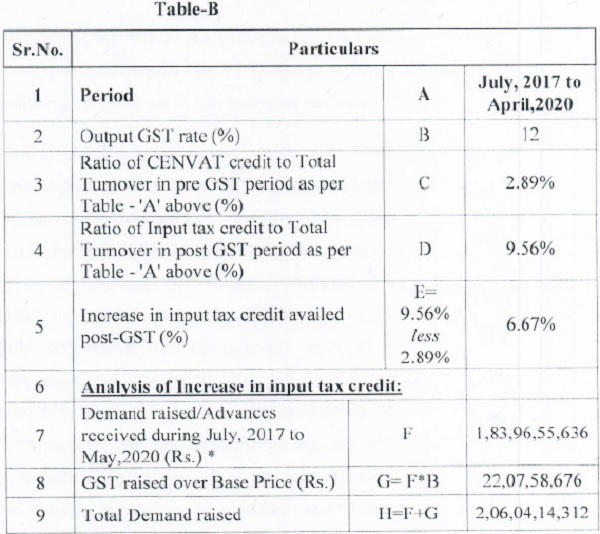
n) From the above Table-A, it was clear that the ITC as a percentage of the turnover that was available to the Respondent during the pre-GST period (April, 2016 to June, 2017) was 2.89 % and during the post-GST period (July, 2017 to Apri1,2020), it was 9.56% for the project “Bollineni Silas”. This clearly confirms that in post-GST period, the Respondent had benefited from additional input tax credit to the tune of 6.67% [2.89% (-) 9.56%] of the turnover.
o) The Central Government, on the recommendation of the GST Council, had levied 18% GST (effective rate was 12% in view of 1/3rd abatement for land value) on construction service, vide Notification No. 11/2017-Central Tax (Rate) dated 28.06.2017. The effective GST rate was 12% for flats. Accordingly, on the basis of the figures contained in table- `13″ above, the comparative figures of the ratio of input tax credit to the turnover in the pre-GST and post-GST periods as well as the turnover, the recalibrated base price and the excess realization (profiteering) during the post-GST period, was tabulated in Table-B below.