Sh. Sumit Mansingka Vs E-Homes Infrastructure Pvt. Ltd. (NAA)
The Respondent E-Homes Infrastructure Pvt. Ltd. has made his detailed submissions regarding the fact that the credit of VAT for pre-GST era has been denied to him. He has also submitted copies of VAT returns and the UPVAT assessment orders for the relevant period in this regard. The perusal of the UP VAT assessment orders appears to indicate that the credit of the VAT for the relevant period has been allowed by the assessing authority in terms of state laws, prevalent at the time. It is claimed by the Respondent that assessment orders indicate that the Respondent had been collecting the VAT from his customers for the year 2013-14 to June 2017 on pro-rata basis and was also depositing the same in accordance with the extant rules. We find that, this documentary evidence in the form of VAT assessment orders passed by the competent authority needs to be carefully considered. Having gone through the clarifications of the DGAP, we find that they have not looked into the evidence on record inasmuch as the invoices submitted by the applicant along with the application itself appear to indicate that the VAT amount has been separately demanded by the Respondent in the pre-GST invoices. It would appear from such invoices that the Respondent had been charging VAT amounts from his homebuyers/recepients in the pre-GST period. We also find that certain orders of this authority have been cited by the DGAP in support of his finding that the credit of ITC paid on the purchase of inputs merits to be excluded from the computation of the profiteered amount. These orders are Order Number 38/2020, 31/2020, 8/2020 and 75/2019. We find that while it may be true that in these cases the Authority has held that the benefit of credit of VAT shall not be available to the respondents in those cases. However, the facts of the individual case has to be looked into while deciding the matter. We find that the Assessment Orders of UPVAT for the period from April 2016 to June 2017 issued by the statutory VAT Authorities in respect of the Respondent have either never been placed before the DGAP during the course of the investigation or no evidence was provided by the Respondent to suggest that VAT has been charged from their customers and hence the same has not been incorporated in the computation of profiteered amount. The Authority further finds that the ITC of VAT, as much as is allowed vide the said VAT Assessment Orders for the period from April 2016 to June 2017 (copies enclosed as Annexure I and II) shall be incorporated into the computation of profiteered amount by the DGAP subject to verification of the authenticity of the same. The Authority therefore directs the DGAP to ascertain the authenticity of the VAT Assessment Orders submitted by the Respondent for the period from April 2016 to June 2017 and if verified from the State GST Commissioner/Uttar Pradesh VAT Department, the DGAP shall incorporate the amounts, as allowed by the concerned statutory Authority on assessment, in the computation of profiteered amount by including the same as ITC in the pre GST period and recalculate the profiteered amount and submit his Report to this Authority.
28. The Respondent has also submitted that while computing the ratio of ITC to turnover for Project- 1 i.e. Phase I, for the post-GST period, DGAP had failed to consider the reversal ITC of GST amounting to Rs. 72,68,049.00 although the supporting challans and Form DRC -03 had been submitted. In this regard, we observe that the DGAP has also reported in its Report dated 19.02.2021 that the supporting documents that were needed to ascertain the nature of the reversal (whether it was the ineligible credit that was reversed or the credit that pertained to unsold flats) submitted by the Respondent was received only after the reinvestigation Report had already been finalized due to the time-bound nature of the same. We also observe that the Respondent has stated that although the reversals were made duly and promptly, the delay in submission of the same before the DGAP was due to the epidemic that had forced the closure of his office. Given the above, in the interest of justice, we observe that the documents submitted by the Respondent detailing the nature of the GST ITC that was reversed ought to be examined on merits and profiteering, if any, may be recalculated, if necessary, so that any reversal made on account of ineligibile ITC on account of incorrect GSTIN details as stated by the Respondent can be verified from the DRC 3 challans and their supporting documents which are already on record and available with the DGAP may be factored into the computation of profiteered amount in accordance with law and decisions of this Authority in similar cases, if any.
29. In the view of the above discussion and findings, this Authority directs the DGAP to recalculate the profiteered amount, in respect of Project-1 i.e Phase I, in line with paragraphs 27 and 28 of this Order under Rule 133(2A) of the CGST Act, 2017, and submit its report within four weeks of this Order.
FULL TEXT OF ORDER OF NATIONAL ANTI-PROFITEERING AUTHORITY
1. The instant Report dated 27.11.2020 was furnished by the Director General of Anti-Profiteering (DGAP) under Rule 133 (4) of the Central Goods & Services Tax (CGST) Rules 2017. The said Report was furnished by the DGAP in response to this Authority’s Interim Order 07/2020 dated 03.01.2020 deciding the first DGAP Report dated 01.07.2019. The brief facts of the case are that a complaint dated 18.12.2017 was filed before the Uttar Pradesh State level Screening Committee on Anti-Profiteering by Applicant No.1 alleging profiteering by the Respondent in respect of a flat purchased by him in the Respondent’s project “The Jewel of Noida” situated at Plot No. 14, Eco City, Sector-75, Noida, Gautam Budh Nagar, Uttar Pradesh. To elaborate, Applicant No. 1, in his complaint (Application), had alleged that the Respondent had not passed on the benefit of Input Tax Credit (ITC) to him in respect of the flat purchased by him in terms of Section 171 of the CGST Act, 2017. The Uttar Pradesh State Screening Committee examined the Application and opined that it did appear that the commensurate benefit of Input Tax Credit had not been passed on in this case and forwarded the Application to the Standing Committee on Anti-profiteering recommending further action in terms of Rule 128 of the Rules. Thereafter, the matter was examined by the Standing Committee on Anti-profiteering in its meeting held on 13.12.2018 which recommended a detailed investigation into the matter by the DGAP. The minutes of this meeting were received by the DGAP on 07.01.2019.
2. In his Report dated 01.07.2019, DGAP had reported that Applicant No. 1 had booked his flat in the Respondent’s project “The Jewel of Noida” on 27.04.2016 and had later filed an Application with the Uttar Pradesh State Screening Committee under Rule 128 of the CGST Rules 2017 alleging that no benefit of Input Tax Credit was passed on to him by the Respondent in terms of anti-profiteering provisions.
3. Accordingly, the DGAP issued a Notice under Rule 129 of the CGST Rules 2017 on 16.01.2019, calling upon the Respondent to reply as to whether he admitted that the benefit of Input Tax Credit had not been passed on to the Applicant No. 1 by way of commensurate reduction in price and if so, to suo-moto determine the quantum thereof and indicate the same in his reply to the Notice as well as furnish all supporting documents.
4. The DGAP has reported that the period covered by the current investigation is from 01.07.2017 to 31.12.2018 and that the time limit to complete the investigation was extended, on his request, up to 06.07.2019 by this Authority on 10.04.2019 in terms of Rule 129(6) of the said Rules.
5. The DGAP further stated that the Respondent submitted his response along with relevant documents vide his letters/e-mails dated 30.01.2019, 19.02.2019, 12.04.2019, 20.05.2019, 31.05.2019, 03.06.2019, 07.06.2019, 17.06.2019 and 21.06.2019. Further, the Respondent submitted copies of the Allotment Letter and the Agreement, both dated 27.04.2016, in respect of the Applicant No. 1, showing the details of the payment plan to the DGAP which is as below:-

6. In his report, while describing how the computation of the profiteered amount had been done, the DGAP interalia reported that –
a. Since the Respondent had been discharging his output VAT liability under the Uttar Pradesh VAT Scheme by paying VAT on a deemed 10% value addition to the purchase value of the inputs and since he was not charging the amount of VAT from his home buyers, there appeared no direct relation between the turnover reported in his VAT returns for the pre-GST period, the ITC of VAT was not be considered for the computation of profiteering.
b. Basis the information submitted by the Respondent, i.e. the details of the Input Tax Credit availed, his turnover from the project “Jewel of Noida” and a comparison of the ratios of Input Tax Credit to the Turnover in the pre and post-GST periods, the ITC as a percentage of the turnover available to the Respondent during the pre-GST period (April 2016 to June 2017) was 1.38% while it worked out to 4.09% for the period from July 2017 to December 2018, which implied that the Respondent had benefited from ITC by 2.71% [4.09% (-) 1.38%] of his turnover.
c. In terms of Notification No. 11/2017-Central Tax (Rate) dated 28.06.2017, the above computed additional Input Tax Credit of 2.71% of the turnover (the aggregate of all the demands raised by the Respondent), profiteering was worked out to ?3,93,85,763/- including 12% GST. Also that by not reducing the pre-GST price by 2.71%, the Respondent appeared to have contravened Section 171 of the CGST Act, 2017.
d. Since no demand had been raised on Applicant No. 1 in the post-GST period, the said Applicant was not amongst the 426 homebuyers found eligible to receive any benefit in the investigation that covered the period from 01.07.2017 to 31.12.2018.
e. That the services were being supplied by the Respondent in the state of Uttar Pradesh only.
7. The above DGAP report dated 01.07.2019 was considered by the Authority in its meeting held on 09.07.2019 and after hearing the Applicant No. 1 and the Respondent over numerous hearings, this Authority referred the matter back to the DGAP vide its 10 No. 07/2020 dated 03.01.2020 because:-
a. In response to the Respondent’s submissions before this Authority regarding this being a case of two distinct and separate projects that had been erroneously taken up as a single project by the investigation, the DGAP had, in his Reports dated 01.07.2019, 17.09.2019, and 06.12.2019, reported that several documents (such as the bifurcation of CENVAT Credit Ledger/ITC, reconciliation of homebuyer data with his statutory Returns, the Formal approval of Layouts as well as Commencement Certificate for projects issued by NOIDA Authority, etc) had not made available to him for proper investigation under Section 171 of the CGST 2017. This apart, no details related to demands raised by the Respondent on Applicant No. 1 were found to be a part of the DGAP report, although the said Applicant had attached a copy of the demand letter dated 04.10.2017 issued to him by the Respondent in his Application, was also found relevant as one of the grounds for ordering reinvestigation. Therefore this Authority directed the Respondent to provide the DGAP with all the relevant data/information/documents and evidence related to the said projects as requisitioned by the DGAP. Based on the evidence and submissions made before it, the DGAP was directed to undertake the investigation afresh by treating the two projects separately. While ordering the reinvestigation, the DGAP had been directed to also incorporate the details of the reversal of ITC made by the Respondent in respect of those towers/units of the two projects, wherein the Completion/ Occupancy Certificate had been received.
b. The other issue related to the Respondent’s averment that incorporation of the ITC of VAT was merited in the computation of profiteering since he fulfills the two conditions as mentioned in the DGAP Report dated 01.07.2019 i.e. a) UPVAT liability had been paid by him in the pre-GST period on the deemed value addition as per UP VAT laws and the same could not be treated as a composition levy, and b) VAT had been recovered from the home buyers as evidenced by the case records including the invoice/ demand raised by him on the Applicant No.1 which was an enclosure to the Application itself. In addition, this Authority also considered the content of the Assessment Orders passed by the UPVAT Authorities for several financial years and the certificate issued by the Deputy Commissioner (VAT) certifying that the Respondent had not availed composition scheme in any financial year after 2012-13. Taking into cognizance the earlier UPVAT Assessment Orders as also that for the financial year 2016-17 dated 04.11.2019, the relevant para of which is reproduced below:-
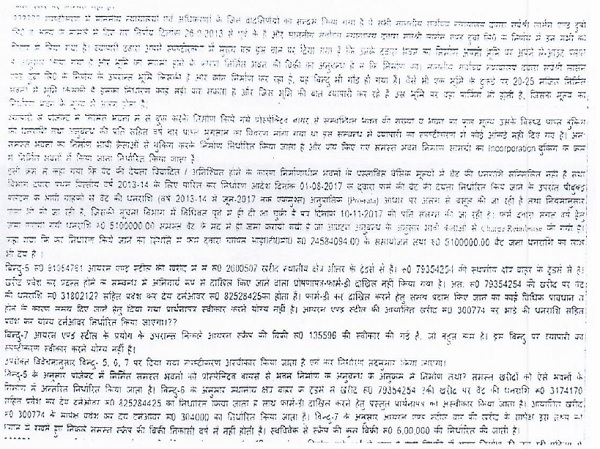
It was clear that the Respondent had been collecting VAT from his customers from the year 2013-14 to Jun-2017 on a pro-rata basis and was also depositing the same per the UP VAT laws. This documentary evidence being in the form of the VAT assessment order passed by the competent authority was found indisputable by this Authority and hence it was decided that this issue needs to be decided on the basis of the UPVAT Assessment Orders instead of merely following the manner in which this issue was handled previously since UPVAT Assessment Orders for the relevant period were now available. Given the above, the DGAP was directed to examine the said issue afresh.
c). DGAP was also directed to address, in the reinvestigation, the contentions of the Respondent ( and the citation relied upon by him, i.e. the similarly placed case of M/s Paramount Propbuilt Pvt. Ltd,) that the calculation of profiteered amount was worked out based on the ITC to turnover ratio for the pre-GST period by taking data of only the truncated period of 15 months from 01.04.2016 till 30.06.2017, whereas ITC to turnover of the pre-GST period should have been calculated based on all credit legally available in the total period of construction in the pre-GST regime.
d). This apart, the said Order I.O. 07/2020 dated 03.01.2020 of the Authority also directed that the Applicant No. 1 was at liberty to approach the appropriate forum for redressal of his grievance that the allotment of his flat had been cancelled because he had filed the instant Application since the mandate of the Authority was limited to implementation of the provisions of Section 171 of the CGST 2017.
8 The DGAP reinvestigated the matter and submitted his Report dated 27.11.2020 under Rule 133(4) of CGST Rules, 2017. The Report which is like a para-wise reply to the directions contained in the Authority’s Order 07/2020 dated 03.01.2020 also mentioned that another complaint dated 09.08.2018 had been filed by one Sh. Manish Kothary, G-1201, Royal Classic CHS Ltd, New Andheri Link Road, Near Citi mall, Andheri West Mumbai-400053 to the Standing Committee on Anti-profiteering under Rule 128 of the Central Goods and Services Tax Rules, 2017 in the said matter.
9. Vide his Report dated 27.11.2020, the DGAP reported that he had issued a Notice dated 18.02.2020 to the Respondent in reply to which the Respondent made his submissions and submitted requisite documents. The submissions made by the Respondent before the DGAP are inter-alia summed up as follows:-
a) Reversal of ITC:- The reversal of ITC was made by him as per recommendations of his Chartered Accountant at the time of finalization of the annual return for the financial year 201718 and that proof of the reversal (Form DRC 03) was submitted on 09.03.2020. Further, as per Rules 142 of the CGST Rules, the verification of such payment along with the issuance of approval in Form DRC-04 vests with the jurisdictional officer who was in the process of reviewing the said information.
b) Project-1 The Jewel of Noida Phase I” and Project-2 ‘The Jewel of Noida Phase I” are separate and distinct projects and the investigation should be limited to project-1 only since the complaint was only regarding that project.
c) Project 2 was approved by NOIDA (land development authority) only in the post-GST period. The building plan and layout of Project 2 were sanctioned only on 05.11.2018. Even the intended start date of the Project 2 is mentioned as 01.12.2017 in the documents available on the UP-RERA website. The actual construction work for Project 2 only started after 15.02.2019 after its work order was awarded to the contractor and this is the reason why the ITC for the Project 2 is Nil for the pre-GST period.
d) ITC of VAT merits to be incorporated while computing the profiteered amount in respect of Project 1 as the same has been allowed by the UPVAT Authorities and since he fulfills all the conditions that permit this incorporation.
e) ITC to the Turnover ratio for the pre-GST period merits to be calculated for the entire construction period, i.e. from the very inception of the project.
f) Without prejudice to his other arguments, he wishes to submit that he had already passed on the benefit of ITC by way of additional discounts and commensurate reduction of price to his homebuyers by issuing credit notes and this includes the 9 customers of Project 2 who had paid advances before 01.07.2017 much before the Project 2 was sanctioned and much before its layout was approved since it was just a proposed/ future project and that he had submitted the said credit notes before the DGAP.
g) The flats sold after 01.07.2017 cannot be a subject matter of the calculation of profiteering but he had been extending appropriate discounts, as GST benefit, to his homebuyers who had bought flats after 01.07.2017.
10. DGAP has further reported that reinvestigation was carried out in terms of the directions of the Authority’s 10 No.07/2020 dated 03.01.2020 and on basis of data and submissions made by the Respondent and the following emerged:-
(i) Since the issue of whether two projects were separate or not had already been decided by the Authority, the investigation had been done accordingly.
(ii) On the issue of incorporation of ITC of VAT and submissions of the Respondent that the same is merited based on the impugned 10 of the Authority and his following documents and submissions that Assessment Orders of UPVAT authorities for successive financial years have been submitted; certificate issued by the Deputy Commissioner (UPVAT) certifying that he had not availed composition scheme in any financial year after 2012-13 has been submitted, and his case fulfills the two conditions mentioned as requirements for such incorporation in the DGAP Report dated 01.07.2019 i.e. (a) VAT had been paid on deemed value addition: and (b) VAT had not been recovered from the home buyers.
(iii) Further the Respondent had not provided any Invoice to prove that he had been charging VAT from his customers on actuals and that there was no proof to substantiate the claim that the VAT had not been paid on the deemed value addition and that this particular assessment order was different from the Assessment order of other Assesses of that State. The DGAP also reported that the argument that VAT was being paid, as provided, was not relevant, since he was not charging VAT from his customers. Further, regarding the observation of the Authority that the UPVAT Assessment Orders clearly stated that the Respondent had collected VAT from his customers for the years from 2013-14 to June 2017, DGAP has submitted that this was only a submission made by the Respondent before the VAT authority and was not an Order passed by VAT Authority. DGAP has added that since there was no direct relation between the credit of VAT turnover shown in the VAT return of the Respondent during the period April 2016 and June 2017 with the amount collected from his home buyers, the said benefit will not be available to the Respondent as held by the Authority in its Order No. 38/2020 in respect of M/s Gaursons Realtech Pvt Ltd, Order No. 31/2020 in respect of M/s Radicon Infrastructure and Housing Pvt Ltd., Authority Order No. 08/2020 in respect of M/s Manas Vihar Sahikari Awas Samiti Ltd and Authority Order No. 75/2019 in respect of M/s Nirala Project Pvt Ltd. Therefore the credit of VAT of the pre-GST era was not incorporated in the computation of profiteered amount.
(iii) Regarding the Respondent’s submission that the ITC to Turnover of the pre-GST period should have been calculated based on all credit legally available to him in the total period of construction in the pre-GST regime instead of a truncated period of 15 months from 01.04.2016 to 30.06.2017 as followed in the case of M/s Paramount Prop built Pvt. Ltd, the DGAP has replied that this contention of the Respondent is incorrect in as much as there is no comparison of periods for the calculation of profiteering. The whole purpose of taking the period of 15 months in the pre-GST period was to cover a reasonable period just before the rollout of GST so that a proper comparison of the percentage of Input tax credit available to the Respondent in the pre and post-GST periods could be worked out. Further, during this period there was no variation in the rate of tax on services whereas before that there were several changes in the rate of service tax which would have resulted in a distorted picture of CENVAT credit. Thus, this period was taken to find out the average ratio of input tax credit availability with the turnover. The ratio of ITC and turnover in Pre-GST was compared with the ratio of ITC in the post-GST period. The period during the GST period may be one month or one year, depending upon the period of investigation. It did not mean that if the period was larger than the availability of ITC would increase or decrease but it only gives a ratio that represents the period for comparison. The DGAP also stated that it was a standard practice in DGAP to take the pre-GST period from 01.04.2016 to 30.06.2017 and the same has been followed in all similar cases and these cases have also been upheld by the Authority.
(iv) On the issue of cancellation of his allotment that was raised by Applicant No.1, the DGAP reported that the Authority had already addressed the issue and he had nothing more to add. As regards the issue related to profiteering concerning Applicant No.1, DGAP reported that his name did not figure in the Home-buyers list and accordingly the profiteering could not be computed in his case.
(v) The DGAP has further stated that, the issue relating to the reversal of credit concerning towers/units wherein the Completion Certificate had been received, had arisen when the Respondent claimed that their project was complete in the month of May 2017 and they had received the Occupancy certificate. The DGAP has added that this contention of the Respondent was not found in order as the Occupancy certificate was issued on 29.11.2017 for the project “the Jewel of Noida-1” (Project 1) and that there was no corroborative evidence that ITC had been reversed in terms of Section 17(2) & 17(3) of the CGST Act, 2017. The DGAP has further added that Para 5 of Schedule III of CGST Act, 2017 categorically mentions the words “after issuance of completion certificate or after its first Occupation, whichever was earlier” and this fact had already been elaborated in Para 18 of the DGAP Report dated 01.07.2019 and was also mentioned in Para 9 of NAA’s 1.0 07/2020 dated 03.01.2020. Hence the period for Project 1 had been considered up to the time of issue of the Occupation Certificate i.e. 29.11.2017. It was also noteworthy that the Respondent had taken credit of Rs 2,71,85,969/- from July 2017 to December 2017, which shows that the construction activity was not completed by May 2017. As regards the reversal of unutilized credit, DGAP has opined that the reversal pertains to those flats which remain unsold and these units were never a part of the profiteering calculation. Hence, despite the submission of the Respondent vide his letter dated 09.03.2020 had reported that he had reversed several Rs. 72,68,049/-(IGST Rs. 22,14,393/- + CGST Rs. 25,26,828/- + SGST Rs. 25,26,828/-) on account of unsold units, he was asked to provide a copy of the details submitted to the Range Superintendent concerning the said reversal. The Respondent did not submit that copy. Since the profiteering computation was not dependent upon the amount of reversal and since the investigation was time bound, the Report was prepared and it does not impact the amount of profiteering.
11. The DGAP further stated that to verify the correctness of the statement concerning RERA Registration claimed by the Respondent, the official website of Uttar Pradesh Real Estate Regulatory Authority was visited and it was observed that there were only four registrations in the name and address of the Respondent. In this context, it was relevant to mention that RERA Registration had been made mandatory for all projects which were operational after 30.06.2017 hence all registration would normally be shown in the GST era. The details of the Respondent’s project under RERA were as under: –

12. The DGAP further claimed that as per the direction issued by Authority vide Internal Order No. 07/2020 dated 03.01.2020 this investigation was done for two projects separately, namely “The Jewel of Noida (Phase-I)” and “The Jewel of Noida (Phase-I1)”. From the data submitted by the Respondent covering the period from April 2016 to December 2018, the ratio of input tax credit to turnover, during the pre-GST (April 2016 to June 2017) and post-GST (July 2017 to December 2018) periods, were furnished as Table 1 and Table-2 as below:-

* The turnover and total sold area considered for those flats which were sold before receiving the Occupation certificate. The Respondent received the Occupancy certificate in the month of 29.11.2017.
13. The DGAP further reported that from the above Tables, it was clear that the input tax credit as a percentage of the turnover that was available to the Respondent during the pre-GST period (April 2016 to June 2017) was 1.61% and during the post-GST period (July 2017 to November 2019), it was 5.04% for the Project “The Jewel of Noida (Phase-I)” and from the above Table-‘2’, it is apparent that the input tax credit as a percentage of the turnover that was available to the Respondent during the pre-GST period (April 2016 to June 2017) was 0.00% and during the post-GST period (July 2017 to November 2019), it was 16.90% Project “The Jewel of Noida (Phase-I1)”. This implies that post-GST, the Respondent had benefited from additional input tax credit to the tune of 3.43% [5.04% (-) 1.61%] of the turnover for the project “The Jewel of Noida (Phase-1)” and the Respondent had benefited from additional input tax credit to the tune of 16.90% [16.90% (-) 0.00%] of the turnover for the project “The Jewel of Noida (Phase-11)”. Further, given Notification No. 11/2017-Central Tax (Rate) dated 28.06.2017, the recalibrated base price and the excess realization (profiteering) during the post-GST period, were tabulated in Table-3 and Table- 4, as below:-

14. On the basis of Table- 3 and Table- 4 above, the DGAP reported that it was clear that the additional input tax credit of 3.43% for Project-1 and 16.90% for Project-II of the turnover should have resulted in the commensurate reduction in the base price as well as cum-tax price. Therefore, in terms of Section 171 of the Central Goods and Services Tax Act, 2017, the benefit of the additional input tax credit was required to be passed on to the recipients. The DGAP further stated that it was evident from the above Table- 3 and Table- 4 that the benefit of ITC that needed to be passed on by the Respondent to his homebuyers works out to Rs. 1,24,89,592/- inclusive of GST for the project “The Jewels of Noida-1” (Project 1) and Rs 2,22,46,713/- inclusive of GST for the project “The Jewels of Noida-II” (Project 2). The DGAP has annexed that homebuyer and unit no. wise break-up in Annex-16 of his Report.
15. The DGAP has also reported that the name of Sh. Manish Kothary, G-1201, Royal Classic CHS Ltd, New Andheri Link Road, Near Citi mall, and Andheri West Mumbai-400053 is not found in the list of homebuyers for the project “The Jewel of Noida-l” (Project- 1).
16. The DGAP further observed that the Respondent, vide his submission dated 09.03.2020, had submitted credits notes issued by him to 9 customers who had paid advances before 01.07.2017 and claimed that he had passed on the benefit of Rs 41,17,470/- to those 9 customers. It was observed from the Homebuyers’ list for the project “The Jewel of Noida-II” (Project- 2) that the Respondent had shown 11 buyers had booked the flat in the Pre-GST regime and out of 11 buyers that had booked the flat in the pre-GST regime; the Respondent had received the advance from 9 buyers. As regards the verification of input tax credit benefit claimed to have been passed on to 9 homebuyers, by the Respondent, it was observed that the Respondent had provided the details of the benefit passed for the project “The Jewel of Noida-II” to 9 customers. This list was matched with the soft copies of credit notes (issued to homebuyers) submitted by the Respondent. On verification of the soft copies of credit notes, it was apparent that the Respondent had passed on the ITC benefit of Rs 41,17,470/- to 9 homebuyers. A summary of the benefit of the input tax credit required to be passed on and the input tax credit benefit claimed to have been passed on 9 home buyers, was furnished in Table- 5 below:-