Director General of Anti-Profiteering Vs NY Cinema LLP (NAA)
The main issues to be examined was whether the GST rate on Services by way of admission to exhibition of cinematograph films where price of admission ticket was above one hundred rupees were reduced from 28% to 18% and “Services by way of admission to exhibition of cinematograph films where price of admission ticket was one hundred rupees or less” were reduced from 18% to 12% w.e.f. 01 01.2019 and if so, whether the benefit of such reduction in the rate of GST had been passed on by the Respondent to his recipients, in terms of Section 171 of the CGST Act, 2017.
On examining the various submissions placed on record, the Authority needs to determine as to whether there was any reduction in the GST rate and whether the benefit of reduction in the rate of tax was passed on or not to the recipients as provided under Section 171 of the CGST Act, 2017.
The Authority finds that, as per the details and calculations given in Tables ‘A’ & ‘B’ above, the Respondent has profiteered by way of increasing the base prices of the tickets (Services) by not reducing the selling price of the tickets (Services) commensurately, despite the rate reduction in GST rate on “Services by way of admission to exhibition of cinematograph films’ where price of admission ticket was one hundred rupees or above, from 28% to 18% and “Services by way of admission to exhibition of cinematograph films where price of admission ticket was one hundred rupees or less” were reduced from 18% to 12% w.e.f. 01.01.2019. It is evident that the base prices of the admission tickets were indeed increased, as a result of which the benefit of reduction in GST rate from 28% to 18% (w.e.f. 01.01.2019), was not passed on to the recipients by way of commensurate reduction in prices charged (including lower GST @ 18%). The total amount of profiteering covering the period of 01.01.2019 to 29.02.2020, comes to Rs. 2,66,99,340/,
This Authority based on the facts discussed above has found that the Respondent has resorted to profiteering by way of either increasing the base prices of the service while maintaining the same selling prices or by way of not reducing the selling prices of the service commensurately, despite a reduction in GST rate on “Services by way of admission to exhibition of cinematograph films where price of admission ticket is above one hundred rupees” from 28% to 18%” and “Services by way of admission to exhibition of cinematograph films where price of admission ticket was one hundred rupees or less” were reduced from 18% to 12% w.e.f. 01.01.2019 to 29.02.2020. On this account, the Respondent has realized an additional amount to the tune of Rs. 2,66,99.340/-from the recipients which included both the profiteered amount and GST on the said profiteered amount. Thus the profiteering amount is determined as Rs. 2,66,99,340/- as per the provisions of Rule 133 (1) of the CGST Rules, 2017. The Respondent is therefore directed to reduce the prices of his tickets as per the provisions of Rule 133 (3) (a) of the CGST Rules, 2017, keeping in view the reduction in the rate of tax so that the benefit is passed on to the recipients. The Respondent is also directed to deposit the profiteered amount of Rs. 2,66,99,340/- along with the interest to be calculated @ 18% from the date when the above amount was collected by him from the recipients till the above amount is deposited. Since the recipients, in this case, are not identifiable, the Respondent is directed to deposit the amount of profiteering of Rs. 1,33,49,670/- in the Central Consumer Welfare Fund (CWF) and Rs. 88,27,769/- in the Uttar Pradesh State CWF, Rs. 45,21,139/- in the Gujarat State CWF and Rs. 762/- in the Punjab State CWF respectively, as per the provisions of Rule 133 (3) (c) of the CGST Rules. 2017, along with 18% interest. The above amount shall be deposited within a period of 3 months from the date of this Order failing which the same shall be recovered by the Commissioner CGST/SGST as per the provisions of the CGST Act, 2017.
FULL TEXT OF ORDER OF NATIONAL ANTI-PROFITEERING AUTHORITY
1 The Present Report dated 31 03.2021 had been furnished by the Director General of Anti-Profiteering (DGAP), under Rule 129 (6) of the Central Goods & Services Tax (CGST) Rules, 2017 in compliance of the Order No. 15/2020 dated 12.03.2020, wherein this Authority had directed the DGAP under Rule 133(5) of the CGST Rules, 2017 (hereinafter referred to as “the Rules”) to conduct investigation of all the screens being operated by the Respondent which had not been investigated from the perspective of Section 171 of the CGST Act, 2017.
2. The DGAP in its report dated 31.03 2021 has inter alia, stated:-
a. That a Notice under Rule 129 of the Rules was issued by the DGAP on 15.05.2020, calling upon the Respondent to reply as to whether he admitted that the benefit of reduction in GST rate w.e.f. 01 01 2019, had not been passed on to his recipients by way of commensurate reduction in prices and if so, to suo moto determine the quantum thereof and indicate the same in his reply to the Notice as well as to furnish all documents in support of his reply Further, corrigendum to the NOI dated 15.05.2020 was issued on 28.12.2020. in which the words “July, 2017 to March, 2019′ were substituted by the words “October, 2018 to February. 2020” in para 3 of the NOI dated 15.05.2020
b. That in response to the Notice and several reminder letters, the Respondent did not submit all the requisite documents on the due date. Hence. Summons dated 29.10.2021 under Section 70 of the CGST Act, 2017 read with Rule 132 of the Rules, were issued to the Respondent to submit all the relevant documents. In compliance to said summons, the Respondent submitted the relevant documents.
c. That the period covered under investigation was from 01.01.2019 to 29 02.2020.
d. That the statutory time limit to complete the investigation in the case was extended up to 31.03.2021 by virtue of, Notification No. 65/2020-Central Tax dated 01.09.2020 and Notification No. 91/2020-Central Tax dated 14.12.2020 issued by the Central Government under Section 168A of the Central Goods and Service Tax Act, 2017 where it was provided that, ” any tune limit for completion or compliance of any action, by any authority, had been specified in, or prescribed or notified under Section 171 of the said Act, which falls during the period from the 20′ day of March. 2020 to the shall be extended up to the 31′ day of March. 2021″.
e. That in reply to the Notice dated 15.05.2020 and subsequent letters/emails the Respondent submitted his reply vide letters and e-mails dated 26.08.2020, 24.09.2020, 08.10.2020, 13.11.2020, 12.012021, 22.01.2021, 18.02.2021, 19.03.2021, 24.03.2021, 25.03.2021 and 30.03.2021. The reply of the Respondent received by the DGAP has been. inter-elle, summed up below:
ii) That he was engaged in the business of running chain of multiplexes in India. The Respondent during the relevant time had screens operational in Kotakpura district of Punjab. Hapur, Ghazipur, Raebareli, Kanpur and Pilkhuwa district of Uttar Pradesh and Surendranagar & Bhuj districts located in Gujarat where cinema penetration was still in its infancy.
(ii) That the Respondent had different ticket prices for the movies depending on the factors namely weekend and weekday show, morning and other than morning show in a day and class of ticket (i.e. Gold, Platinum, Silver etc.). Thus a same movie might be priced differently for the weekday evening show and a weekend evening show.
(iii) That the screen in Kotkapura (Punjab) was not operational for the period April, 2019 to February, 2020 and thus in respect of said screen he had not submitted relevant data for the period April, 2019 to February, 2020. Further, the Respondent had stated that screens in Sangrur (Punjab) and Ratlam (Madhya Pradesh) were not operational post 01.04.2019. The Respondent also submitted that the screen in Kanpur was closed w.e.f. 27.09.2019 and the screen in Surendranagar started operation in November, 2018.
f. That vide the aforementioned letters/e-mails, the Respondent submitted the following documents/information:-
(i) Copies of GSTR-1 and GSTR-3B returns for the period October, 2018 to February, 2020 for the State of Uttar Pradesh, Punjab, Madhya Pradesh and Gujarat.
(ii) Movie wise & rate wise data for the screens namely Bhuj, Surendranagar for the State of Gujarat and Ghazipur, Noida, Pilkhuwa and Raebareli for the State of Uttar Pradesh for the period October, 2018 to February, 2020.
(iii)Movie wise & rate wise data for all screen in Kotkapura (Punjab) for the period October, 2018 to March, 2019.
(iv)Movie wise & rate wise data for all screen in Kanpur DCR (Uttar Pradesh) for the period October, 2018 to September. 2019.
(v) Movie wise & rate wise data for all screen in Hapur (Uttar Pradesh) for the period April, 2019 to February, 2020.
(vi) Movie wise & rate wise data for the screens in Sangrur (Punjab) and Ratlam (Madhya Pradesh) for the period April, 2019 to February, 2020.
(viii) Reconciliation of turnovers (Box Office. F&B & other sales) with GST Returns for the period December. 2018 to February, 2020.
3. The reference received from the National Anti-Profiteering Authority, various replies of the Respondent and the documents/evidence on record had been examined in detail by the DGAP. The Findings of the DGAP are as under–
a. The main issues to be examined was whether the GST rate on “Services by way of admission to exhibition of cinematograph films where price of admission ticket was above one hundred rupees” were reduced from 28% to 18% and “Services by way of admission to exhibition of cinematograph films where price of admission ticket was one hundred rupees or less” were reduced from 18% to 12% w.e.f. 01 01.2019 and if so, whether the benefit of such reduction in the rate of GST had been passed on by the Respondent to his recipients, in terms of Section 171 of the CGST Act, 2017.
b. The Central Government. on the recommendation of the GST Council, reduced the GST rate on “Services by way of admission to exhibition of cinematograph films where price of admission ticket was above one hundred rupees” from 28% to 18% and “Services by way of admission to exhibition of cinematograph films where price of admission ticket was one hundred rupees or less” from 18% to 12% w.e.f. 01.01.2019, vide Notification No. 27/2018- Central Tax (Rate) dated 31.12.2018.
c. It was important to examine Section 171 of CGST Act, 2017 which governs the anti-profiteering provisions under GST. Section 171(1) reads as “Any reduction in rate of tax on any supply of goods or services or the benefit of ITC shall be passed on to the recipient by way of commensurate reduction in prices” Thus, the legal requirement was abundantly clear that in the event of a benefit of ITC or reduction in rate of tax, there must be a commensurate reduction in the prices of the goods or services. Such reduction could obviously be in money terms only, so that the final price payable by a consumer gets reduced.
d. Based on the Respondent’s submissions the 02 screens iri Sangrur (Punjab) and Rallarn (Madhya Pradesh) were excluded from the computation of profiteering as the operation in the said screens started post 01.04_2019 and there was no comparable data in respect of the said 02 screens for pre-rate reduction period i.e. prior to 01.01.2019 Further, the profiteering in respect of screen in Kotkapura (Punjab) was computed for the period 01.01.2019 to 31.03.2019 as the said screen was not operational during the further period 01.04.2019 to 29.02.2020 and the profiteering in respect of screen in Kanpur (Uttar Pradesh) was computed for the period 01.01.2019 to 27.09.2019 as the said screen was not operational during the further period i.e. 28.09.2019 to 29.02.2020. In respect of screen in Hapur (Uttar Pradesh), the profiteering for the period 01.01.2019 to 31.03.2019 was already computed by the DGAP and upheld by the Authority vide Order No 15/2020 dated 12.03.2020 Therefore. profiteering in respect of screen in Hapur was computed for the further period i e. 01.04 2019 to 29 02.2020 in the present report
e. The Respondent had submitted that he had different ticket prices for the movies depending on the factors namely Category of Movies, Movie Type (3D & Non-3D), Ticket type (DIAMOND, GOLD, PLATINUM and SILVER). Weekdays (Monday to Thursday). Weekends (Friday to Sunday). Show timings (Morning, Other than Morning Show) etc. In this regard it was submitted that the profiteering, if any, had been arrived at by comparing average selling prices for each of the ‘unique combination of the above factors’ such as “DIAMOND Weekdays Morning Show 3D” screened during the period 01.10.2018 to 31.12.2018 of pre-rate reduction period, and the prices post 01 01.2019 for the movies with the similar ‘unique combination of the above factors’ in each aspect.
f. For the purpose of determination of profiteering, the methodology adopted could be explained by illustrating the calculation in respect of a specific ‘unique combination of the above factors’ as listed in para-12 of the Report, by deriving an average base price (after discount) for each specific ‘unique combination of the above factors’ by taking the total collection during the period 01.12 2018 to 31.12.2018 (pre-GST rate reduction) for the unique category divided by the number of tickets sold during the period for the unique category. The average base price of the ticket was compared with the actual selling price of the tickets similar in each aspect sold during post- GST rate reduction i.e., on or after 01.01.2019 as illustrated in the table-
‘A’ below:
(Amount in Rupees)
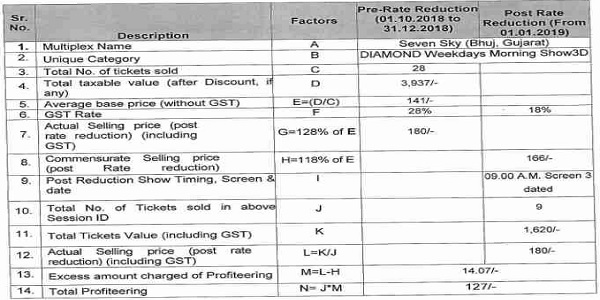
From the above table, it was clear that in the said instance, the Respondent had not reduced the selling prices commensurately for the “Movie Tickets”, when the GST rate was reduced from 28% to 18% w.e.f. 01.01.2019, vide Notification No. 27/2018 Central Tax (Rate) dated 31.12.2018 and hence profiteered an amount of Rs. 14.07/-per ticket and thus the benefit of reduction in GST rate had not been passed on to the recipients by way of commensurate reduction in the prices, in terms of Section 171 of the CGST Act, 2017. On the basis of above calculation as illustrated in table ‘A’ above, profiteering in case of all the screens being operated by the Respondent had also been arrived in similar way.
g. The issue that remains was the determination and quantification of profiteering by the Respondent for failing to pass on the benefit of the reduction in the rate of GST on the goods supplied to his recipients. in terms of Section 171 of the CGST Act. 2017 From the session wise sale register made available by the Respondent, it appeared that the Respondent had increased the base prices of the tickets when the rate of GST was reduced from 28% to 18% and from 18% to 12% w.e.f. 01 01.2019, so that the commensurate benefit of GST rate reduction was not passed on to the recipients. On the basis of aforesaid pre and post-reduction GST rates and the details of outward taxable supplies (other than zero rated, nil rated and exempted supplies) of the service by way of admission to exhibition of cinematograph films during the period 01.01.2019 to 29.02.2020, as furnished by the Respondent. the amount of net higher sales realization due to increase in the base prices of the impacted service, despite the reduction in the GST rate or in other words. the profiteered amount comes to Rs. 2,66,99,340/- in respect of all the screens (namely Bhuj, Ghazipur, Kanpur, Kotkapura. Noida, Pilkhuwa, Raebareli, Surendranagar and Hapur) which were operational during the period of investigation The screen wise details of the computation are given in Annexure-17 to the DGAP’s report dated 31.03.2021. The said profiteered amount in respect of all the screens had been arrived at by comparing the average of the base prices of the tickets having ‘unique combination of the various factors/categories’ sold during the period 01 12.2018 to 31.12.2018 with the actual prices of the tickets similar in each aspect (Irrespective of the name of Movie screened) sold during the period 01.01.2019 to 29.02.2020. If sale of any unique category was not found during this period, then in that case, the base price of that unique category was arrived at by taking the sales of that particular unique category of ticket during previous months in a sequential manner beginning from November. 2018, if the same was not found then previous month i.e. October, 2018 and then compared with the actual invoice-wise base prices of such tickets sold during the period 01.01.2019 to 29.02.2020. The excess GST so collected from the recipients, was also included in the aforesaid profiteered amount as the excess price collected from the recipients also included the GST charged on the increased base price.
The state wise profiteering for the period 01.01.2019 to 29.02.2020 has been given below in Table- ‘B’:-
Table — ‘B’
4. The DGAP further concluded that the allegation of profiteering by way of either increasing the base prices of the service while maintaining the same selling price or by way of not reducing the selling prices of the service commensurately, despite a reduction in GST rate on “Services by way of admission to exhibition of cinematograph films where price of admission ticket was above one hundred rupees” from 28% to 18% and “Sell/ices by way of admission to exhibition of cinematograph films where price of admission ticket was one hundred rupees or less” were reduced from 18% to 12% w.e.f. 01.01.2019, vide Notification No. 27/2018-Central Tax (Rate) dated 31.12.2018 stands confirmed against the Respondent. On this account, the Respondent had realized an additional amount to the tune of Rs. 2,66,99,340/- from the recipients in respect of all the screens operated by the Respondent during the period 01.01 2019 to 29.02.2020, which included both the profiteered amount and GST on the said profiteered amount.
5. The DGAP has also concluded that in view of the aforementioned findings, it appeared that Section 171 (1) of the CGST Act, 2017 requiring that “any reduction in rate of tax on any supply of goods or services or the benefit of ITC shall be passed on to the recipient by way of commensurate reduction in prices”, had been contravened by the Respondent in the present case
6. The above Report was carefully considered by this Authority and a Notice dated 17.06 2021 was issued to the Respondent to explain why the Report dated 31.03.2021 furnished by the DGAP should not be accepted and his liability for profiteering in violation of the provisions of Section 171 should not be fixed. The Respondent was directed to file written submissions which had been filed on 26.07.2021 wherein the Respondent had submitted–
a. He objected to the initiation of the anti- profiteering proceedings across India u/s 171 of the CGST Act vide his Notice dated 15.05.2020 It was submitted that the proceedings initiated were devoid of the powers of this Authority in as much as that the Notice dated 15.05.2020 was issued before the date of powers were vested with such initiation prospectively vide amendment to the Rule 133(5) of CGST Rules. 2017 only from June 28, 2020.
In support of the said submission, the Respondent has relied on the following case law:
(i) Abbott Healthcare Private Limited & Anr. Vs Union of India & Ors. (Delhi High Court) wherein the Petitioners had questioned the constitutional validity of Section 171 of the CGST Act and Chapter 15 of the CGST Rules and in particular Rule 126, 127 and 133.
(ii) Jubilant Foodworks Ltd. & Anr. v/s Union of India & Ors. (2019-VIL-183-DEL) with regard to the constitutional validity. Since profiteering was a nebulous/vague concept, not surprisingly, most of the orders passed so far had been stayed by various courts. The commentary from the courts staying the cases had primarily questioned the constitutionality of the anti-profiteering piece of the GST legislation. The courts also seem to be pointing out that there was a lack of a set of rules or methodology that could help determine what “profiteering” constitutes, and how the amount was to be calculated. In the Jubilant Foodworks case, for instance, the Delhi High Court stayed the Authority’s order against the company on the grounds that there was a ‘prima facie” case of lack of methodology to determine profiteering.
b. Supply of goods V. services — difference in the nature and it’s pricing.- the DGAP had alleged and worked out the amount profiteered based on the price of ticket charged to the cinema goers pre and post reduction of the rate of GST applicable. The methodology adapted by the DGAP was flawed and could not stand the test of rationality and balanced scrutiny. The calculations made by the DGAP were based on certain assumptions An average of prices for the month of December 2018 was taken based on “unique combination of certain factors”. The categories that had been created were not actually comparable. The approach adopted by the DGAP was flawed in as much as the attempt had been made to compare apples with oranges and the time frame chosen of long duration of 13 months being arbitrary.
c Period covered for working out the amount profiteered:- the amount of anti-profiteering had been calculated for all the movies post rate reduction until February 29, 2020. There were no rules to determine the ‘anti- profiteering’ amount and the time for which the pricing of supply is to be examined for the purposes. At the most in case the same movies had been screened pre and post rate reduction, and the benefit of the rate reduction had not been passed to the consumers one might had to examine the scope of anti-profiteering. However, the approach of comparing all the movies until February 29, 2020 post the reduction of rate was incorrect.
Further, the present proceedings had been subjected to unrealistically long period of time. This was in fact against the very norm set up internally by the DGAP and had been regularly applied and followed by this Authority as well. The Respondent referred to the DGAP’s supplementary report dated 22.01.2020 in relation to the Respondent’s earlier investigation for Hapur (UP) screen the finality of which was attained vide Order No. 15/2020 dated 12.03.2020.
Vide the said supplementary report of the DGAP dated 22.01.2020 at point E of para 5 (Annexure C), it had been clearly admitted and mentioned that:
As a practice, his reports on profiteering in GST rate reduction cases covered the period from the date of effect of change in the GST rate to the last day of the month preceding to the month in which the reference was received by him for initiation of investigation from the Standing Committee or this Authority”
If the above policy was taken into consideration, then in the present case, investigation must be undertaken only up to the month of February, 2019. Whereas the DGAP had considered the period up to February, 2020. This was flawed and unfair towards the Respondent.
d. Methodology for calculation:
(i) Even the calculations made by the DGAP were based on certain flawed / irrational assumptions. An average of prices for the month of December, 2018 was taken based on “unique combination of certain factors”. The categories that had been created were not actually comparable. The classes of movie tickets keep changing every week depending on the day. time, buzz around movie, star cast, budget of the movie etc. Also, inflation had not been considered while making these calculations. Hence. taking the base of December 2018 for the months up to February 2020 was devoid of any merit Therefore. the profiteered amount that had been calculated to the tune of Rs. 2,66.99,340/- was without a proper base.
(ii) The price to be charged to a customer was based on the demand and supply. The categories that existed in the month of December 2018, were in some cases non-existent in the period after the change in rate of tax. There were various reasons due to which the prices had changed in this period.
Example. If we look at the price rates during the prorate change and post-rate change period. there had been significant changes in the same. Some examples of the same were as follows:

As could be seen in the above table, there had been a reduction In prices in certain classes and categories of tickets. The calculation of the DGAP had missed sight of these very obvious findings. There had been case where there was slight increase in prices due to varied reasons.
(iii) Capital Expenditure incurred: The firm had incurred Capital expenditure on all the screens across India during the period 01.01.2019 to 29.02.2020 as below: