Director General of Anti-Profiteering Vs J. P. and Sons (National Anti-Profiteering Authority)
The brief facts of the present case are that the Standing Committee vide the minutes of it’s meeting dated 13.04.2018 had requested the DGAP to initiate investigation under Rule 129 (1) of the CGST Rules, 2017 on the allegation that the Respondent had not passed on the benefit of tax reduction from 28% to 18%, granted by the Central and the State Governments w.e.f. 15.11.2017 by maintaining the same Maximum Retail Prices (MRPs) which he was charging before the above date. in case of the two products namely (i) Johnson & Johnson Baby Shampoo 100 ml. and (ii) Johnson & Johnson Baby Powder 200 Gms. (here-in-after referred to as the products). It was also alleged that instead of reduction, the base prices of the above two products were increased on 15.11.2017 and thus the Respondent had indulged in profiteering in contravention of the provisions of Section 171 of the CGST Act, 2017 and hence appropriate action should be taken against him.
The Respondent has vehemently argued that he had no control on the fixing of the base prices as well as the MRPs as both of them were fixed by J & J through the software which he was bound to follow as per the terms of the agreement executed by him with the above Company. However, it is apparent from the record that the Respondent is duly registered under the CGST/SGST Act, 2017 and he was hence bound to follow the Notification dated 14 11.2017 mentioned above vide which the rate of GST was reduced from 28% to 18% on 130 products which he was selling. He cannot escape the legal obligation which was imposed upon him by the above Notification by shifting his accountability on this ground. The Respondent has himself admitted during the course of the hearing that he was aware that he was required to pass on the benefit of the reduced rate of tax to his customers and therefore also he cannot deny his legal liability. The Respondent has also not produced any evidence to show that he had made any correspondence with J & J to inform rt that he was bound to reduce the prices due to reduction in the rate of tax and J & J should either not increase the base prices or compensate him for the benefit he was bound to pass on to his customers, therefore. it is quite apparent that he had deliberately charged the enhanced prices with an intention to pocket the amount which he was bound to pass on to the recipients. Therefore, the above contention of the appellant cannot be accepted.
It is also apparent from the perusal of Annexure-8 that the DGAP has correctly calculated the amount of profiteering by taking in to account all the supplies made by the Respondent w.e.f. 15.11.2017 to 31.03.2018. Inspite of the claim made by the Respondent that he had purchased the goods on the increased prices from J & J after 14.11.2017 there is no denying the fact that he had charged the prices which he could not have charged in view of the reduction in the rate of tax. Mere charging of the tax @ 18% after 15.11.2017 cannot be construed to have resulted in passing on of the benefit when the base prices had been deliberately increased. Hence. this contention of the Respondent is not tenable and cannot be accepted.
Accordingly, the Respondent is directed to reduce the prices of all the above products as per the provisions of Rule 133 (3) (a) of the CGST Rules, 2017 by making commensurate reduction in their prices keeping in view the reduction in the rate of tax so that the benefit is passed on to the recipients. The Respondent is also directed to deposit the profiteered amount of Rs. 5,01,646/- along with the interest to be calculated @ 18% from the date when the above amount was collected by him from his customers till the above amount is deposited
FULL TEXT OF THE ORDER OF NATIONAL ANTI-PROFITEERING AUTHORITY
1. This report dated 31.07.2018, has been received from the Director General of Anti-Profiteering (DGAP) under Rule 129 (6) of the Central Goods and Service Tax (CGST) Rules, 2017. The brief facts of the present case are that the Standing Committee vide the minutes of it’s meeting dated 13.04.2018 had requested the DGAP to initiate investigation under Rule 129 (1) of the CGST Rules, 2017 on the allegation that the Respondent had not passed on the benefit of tax reduction from 28% to 18%, granted by the Central and the State Governments w.e.f. 15.11.2017 by maintaining the same Maximum Retail Prices (MRPs) which he was charging before the above date. in case of the two products namely (i) Johnson & Johnson Baby Shampoo 100 ml. and (ii) Johnson & Johnson Baby Powder 200 Gms. (here-in-after referred to as the products). It was also alleged that instead of reduction, the base prices of the above two products were increased on 15.11.2017 and thus the Respondent had indulged in profiteering in contravention of the provisions of Section 171 of the CGST Act, 2017 and hence appropriate action should be taken against him. In this connection, the details of 2 Tax Invoices issued by the Respondent in respect of the above two products were also enclosed by the DGAP with his Report as under:-
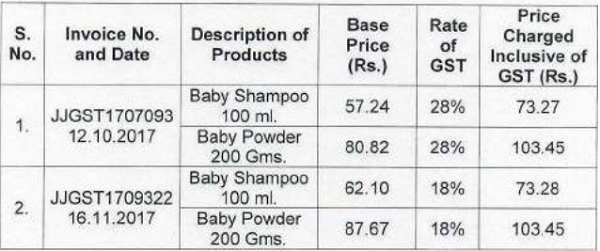
2. The DGAP had called upon the Respondent to submit his reply on the allegations levelled above and also to suo moto determine the quantum of benefit which he had not passed on during the period between 15.11.2017 to 31.03.2018 on the above products. The Respondent was also requested to provide a copy of the audited Balance Sheet, GST Returns, Tran-1 Returns and the details of the outward taxable supplies etc.
3. The Respondent had submitted replies to the notice issued by the DGAP on 24.05.2018 vide his letters dated 08.06.2018 and 22.06.2018. The DGAP has informed that the Central Government on the recommendations of the GST Council had reduced the GST rate on the above products from 28% to 18% w.e.f. 15.11.2017 vide Notification No. 41/2017-Central Tax (Rate) dated 14.11.2017 in consequence of which the Respondent was required to sell the above goods on the base prices which were being charged by him before 15.11.2017 and levy GST @18% so that the benefit of reduction in the rate of tax could be passed on to the customers. The DGAP has also observed that the Respondent had contended that he was a Distributor of M/s Johnson & Johnson Pvt. Ltd. (J & J) and the software which he was using for billing was provided and fully controlled by J & J and he couldn’t make any modifications in the billing software and he had sold the above products on the MRPs which were uploaded in the software. The DGAP has further informed that the Respondent had also contended that the GST rate was reduced w.e.f. 15.11.2017 but J & J had taken 3 to 4 days to make necessary changes in the billing software. The Respondent had also claimed that he had not charged more than the MRPs mentioned on the products. The Respondent had also stated that the invoices dated 12.10.2017 and 16.11.2017 were issued prior to the updation of software by J & J and hence he could not charge the reduced prices.
4.. The DGAP has also intimated that during the investigation it had been observed that the Respondent was required to sell the above products at the base prices which were prevalent before 15.11.2017 and he should have charged GST @ 18% on such base prices to pass on the benefit of reduction in the rate of tax from 28% to 18% w.e.f. 15.11.2017. He has further intimated that since the Respondent was a supplier registered under the CGST/SGST Act. 2017 vide GSTI No. 07AWPPK4676R1ZC, he was legally bound to pass on the benefit of reduction in the rate of GST to his customers immediately w.e.f. 15.11.2017.
5. The DGAP has also submitted that by increasing the base prices of the above products and having maintained the pre-GST rate reduction MRPs, the benefit of GST rate reduction was not passed on to the customers by the Respondent.
6. The DGAP has also stated that from the Price Lists submitted by the Respondent, it was revealed that he had raised the base prices of both the above products during the period between 15.11.2017 to 18.11.2017. He has also informed that the base price of Baby Shampoo 100 ml. was increased from Rs. 57.24/- to Rs. 62.10/- and the same was increased in respect of Baby Powder 200 Gms.. from Rs. 80.82/- to Rs. 87.67/-.
7. The DGAP has also observed that during the period from 19.11.2017 to 31.03.2018, the Respondent had re-fixed the base price of Baby Powder 200 Gms. from Rs. 80.82/- to Rs. 86.21/- which was slightly lower than the price prevalent between 15.11.2017 to 18.11.2017 and the base price of Baby Shampoo 100 ml. was re-fixed from Rs. 57.24/- to Rs. 58.44!- which was also slightly lower than the price between 15.11.2017 to 18.11.2017, however, still both the base prices were not commensurate with the reduction in the rate of tax and were higher than what they should have been.
8. The DGAP has further stated that after analysing the entire outward wst supplies made by the Respondent, it had been observed that during the period w.e.f. 15.11.2017 to 31.03.2018, the Respondent had sold 223 products comprising of 32 HSN codes out of which 134 products comprising of 14 HSN codes were affected by the reduction in the rate of GST from 28% to 18% w.e.f. 15.11.2017, the details of which have been mentioned in Annexure-8 by the DGAP. The DGAP has further observed that out of the above 134 products impacted by reduction in the rate of GST, 11 products were not supplied during the period between 01.11.2017 to 14.11.2017. He has also informed that out of the above 11 products, the prices for calculating the profiteered amount in the case of 9 products had been taken from the price list submitted by the Respondent whereas 2 products had been launched in December, 2017. The DGAP has further informed that in the case of rest 123 products, it was observed that the base prices of 121 products were increased after 15.11.2017 and in the case of 2 products, the base prices were reduced after 15.11.2017. Therefore the DGAP has concluded that in respect of the above 130 products, supplied by the Respondent during the period between 15.11.2017 to 31.03.2018, the amount of profiteering came to Rs. 5,01,646/- on account of increase in their base prices.
9. The above Report was considered by the Authority in its sitting held on 03.08.2018 and it was decided to hear the interested parties. The Applicant was represented by Sh. Akshat Aggarwal, Assistant Commissioner and Sh. Bhupender Goyal, Assistant Director (Costs). The Respondent was represented by Sh. Ankit Khandelwal, Proprietor and Shri Anand Kumar Garg.
10. The Respondent had filed his written submissions on 20.08.2018, 24.08.2018, 25.08.2018 and 06.09.2018. Vide his submissions dated 20.08.2018, the Respondent had supplied a copy of the ‘Distributor Agreement’ executed by him with J & J. The Respondent had submitted that as per the above agreement, he was appointed as Retail Distribution Stockist (RDS) by J & J and he was bound by the terms of this agreement to use the software Wave’ which included the Manual, any associated software components, any media, any printed materials other than the Manual, and any online or electronic documentation. He has also claimed that the contract also required him not to use the above software in case he did not agree to the terms of the above agreement. The Respondent has also maintained that the contract stated that the ownership of the licensed software at all times would be with J & J. He has further alleged that through this agreement, he had been given a very limited right of using the software solely for the business of the above company and take prior consent of the concerned officer in case he wanted to use this software for any other business. He has also claimed that the title and full ownership rights of the above software were with J & J and he was required to handover the above software to J & J in case of termination of the agreement. Therefore, he has claimed that once the base prices had been increased by J & J with effect from 15.11.2017 in the software, he had no option except to charge these prices and therefore, he was not liable for profiteering. He had also supplied copies of the invoices issued by J & J to him to establish that the base prices had been changed by the above Company with effect from 15.11.2017 and hence he was bound to charge the increased prices as per the terms of the above agreement.
11. In his submissions dated 24.08.2018, the Respondent has stated that the DGAP had wrongly calculated his excess margins on the total sales from the period w.e.f. 15.11.2017 to 31.0a2018 without considering his purchases which he had made after 14.11.2017 on the increased base prices for all the products as per the updated billing software provided by the above Company. Vide his submissions dated 25.08.2018, he had produced the list of MRPs and the Tax Invoices which he had issued to his customers after 15.11.2017 to prove that he had charged the same base prices which were fixed by the above company and had also charged tax at the rate of 18%.
12. The Respondent has also filed further submissions on 06.09.2018 in which he has stated that he had deposited the due tax which he had charged from the customers at the rate of 18% and had not misused the Input Tax Credit (ITC) availed off as had been calculated by the DGAP. He has further added that he was only an intermediatory between the Company and the customers and was ready to pay the difference of tax if any but no penalty should be imposed since the circumstances were beyond his control and he had no intention to retain the profit on revised rates. He has further submitted that the calculation of the profiteered amount should be done on the stock which was lying on 14.11.2017 only, instead of the total sales made from 15.11.2017 to 31.03.2018. The Respondent has also submitted that as per the calculation sheet prepared by him on the basis of the stock lying on 14.11.2017, the profiteered amount came out to be Rs. 47,333.03/- only.
13. Clarification was sought from the DGAP on the issues raised by the Respondent in respect of the submissions dated 06.09.2018 made by the Respondent, The DGAP vide his reply dated 10.09.2018 has intimated that the issues raised by the Respondent had already been covered in the Investigation Report itself.
14. During the course of the proceedings, J & J was also issued notice asking it to clarify the claims made by the Respondent in respect of the control on the software and increase in the base prices made by it after 14.11.2017.
15. J & J vide it’s submissions dated 28.09.2018 stated that it had in fact reduced the base prices after reduction in the rate of tax from 28% to 18%. It had also submitted the details of the base prices, tax and the invoice prices from J & J to the Distributor, from the Distributor to the Retailer and from the Retailer to the consumer upto 14.11. 2017, and from 17.11.2017 onwards as per the table given below:-