Summary: The Digital Personal Data Protection Act, 2023 (DPDP Act) introduces a comprehensive framework for processing digital personal data, irrespective of the turnover, size or sector of a business. Using the illustrative example of a pharmaceutical distributor collecting employee Aadhaar cards, PAN details and bank documents through WhatsApp, this article examines how ordinary businesses qualify as Data Fiduciaries. It compares the existing framework under Section 43A of the Information Technology Act, 2000 and the Sensitive Personal Data or Information Rules, 2011, with the broader applicability of the DPDP Act. The article explains five essential questions concerning identifiable personal data, digital records, processing activities, determination of processing purposes and means, and statutory exclusions. It distinguishes between Data Fiduciaries, Data Processors and Data Principals, highlighting that outsourcing payroll or other activities does not automatically transfer regulatory accountability. The statutory definitions have been effective since 13 November 2025, while the principal applicability and processing obligations discussed in the article become effective from 13 May 2027. Ordinary Data Fiduciaries are not required to register, whereas registration requirements apply to Consent Managers. The article also discusses potential exemptions for notified classes, joint processing arrangements, extraterritorial applicability and penalties for security failures. Businesses are advised to prepare comprehensive data inventories, restrict unauthorised access, remove former employees from communication groups, review vendor arrangements and designate responsibility for monitoring personal data. Early preparation can help businesses transition from the existing sensitive-data framework to the wider obligations governing digital personal data under the DPDP Act.
Forty Aadhaar Cards on WhatsApp: Is Your Business Already a Data Fiduciary Under the DPDP Act, 2023?
XYZ Pharma and the people in this article are illustrative; the provisions quoted are not.
- Introduction
- Earlier Position: Section 43A and the SPDI Rules
- The Applicability Test Under the DPDP Act
- Question 1 – Is it personal data?
- Question 2 – Is it digital?
- Question 3 – Is there processing?
- Question 4 – Who decides why and how?
- Question 5 – Does any exclusion apply?
- Who can be a Data Fiduciary?
- What follows?
- Comparison at a Glance
- Applicability and Points to Note
- Practical Checklist
- Back at XYZ Pharma
- Concluding Remarks
- References
Introduction
It was a routine audit visit to a pharma distributor in the Patancheru industrial area. I will call the company XYZ Pharma. While the accountant pulled out the ledgers, the HR executive, Divya, showed me how fast she completes joining formalities. A new employee sends photos of Aadhaar, PAN and a cancelled cheque on WhatsApp. She forwards them to the payroll vendor’s group. Done in ten minutes.
I scrolled up the group. It had 43 members, including two employees who had left the company last year. There were forty Aadhaar cards, a dozen cancelled cheques and one bank passbook photographed on a kitchen table.
The Managing Director, Ramesh, laughed when I raised it. “Sir, we are medicine distributors, not an IT company. This data protection law is for Google and Amazon.”
It is not. The Digital Personal Data Protection Act, 2023 (DPDP Act) has no turnover limit, no size threshold and no registration for ordinary businesses. If a person decides why and how digital personal data of individuals is used, that person is a Data Fiduciary.
The definitions that decide this question are in Section 2 and have been in force since 13-11-2025 under Notification G.S.R. 843(E). The duties that follow, including Sections 3 and 4, apply from 13-05-2027. This article runs the applicability test using XYZ Pharma as the example.
Earlier Position: Section 43A and the SPDI Rules
Before the DPDP Act, the only general rule on business handling of personal data was Section 43A of the Information Technology Act, 2000, read with the Information Technology (Reasonable security practices and procedures and sensitive personal data or information) Rules, 2011, notified by G.S.R. 313(E) dated 11-04-2011 (SPDI Rules).
- Who was covered: a “body corporate”, which the Explanation to Section 43A defines to include a company, a firm, a sole proprietorship or other association of individuals engaged in commercial or professional activities.
- What data mattered: Rule 3 of the SPDI Rules lists as sensitive personal data a password, financial information such as bank account or card details, physical, physiological and mental health condition, sexual orientation, medical records and history, and biometric information, along with related details received or processed by the body corporate.
- What triggered liability: negligence in reasonable security practices, causing wrongful loss or wrongful gain, leading to compensation to the person affected.
Under that framework, Divya’s WhatsApp group raised a narrow question. The cancelled cheques were clearly financial information. Whether a photo of an Aadhaar card was “sensitive” was argued both ways, and most businesses assumed the bulk of what they held was outside the Rules.
That argument ends with the DPDP Act. Section 44(2) omits Section 43A of the IT Act, but only from 13-05-2027. Until then, Section 43A and the SPDI Rules continue to apply.
THE DIGITAL PERSONAL DATA PROTECTION ACT, 2023
(No. 22 OF 2023) [11th August, 2023.]
Extract: Section 2 (clauses (i), (t) and (x)) and Section 3
2. In this Act, unless the context otherwise requires,-
. . . . .
(i) “Data Fiduciary” means any person who alone or in conjunction with other persons determines the purpose and means of processing of personal data;
. . . . .
(t) “personal data” means any data about an individual who is identifiable by or in relation to such data;
. . . . .
(x) “processing” in relation to personal data, means a wholly or partly automated operation or set of operations performed on digital personal data, and includes operations such as collection, recording, organisation, structuring, storage, adaptation, retrieval, use, alignment or combination, indexing, sharing, disclosure by transmission, dissemination or otherwise making available, restriction, erasure or destruction;
. . . . .
3. Subject to the provisions of this Act, it shall-
(a) apply to the processing of digital personal data within the territory of India where the personal data is collected-
(i) in digital form; or
(ii) in non-digital form and digitised subsequently;
(b) also apply to processing of digital personal data outside the territory of India, if such processing is in connection with any activity related to offering of goods or services to Data Principals within the territory of India;
(c) not apply to-
(i) personal data processed by an individual for any personal or domestic purpose; and
(ii) personal data that is made or caused to be made publicly available by-
(A) the Data Principal to whom such personal data relates; or
(B) any other person who is under an obligation under any law for the time being in force in India to make such personal data publicly available.
Illustration.
X, an individual, while blogging her views, has publicly made available her personal data on social media. In such case, the provisions of this Act shall not apply.
Source: Gazette of India, Extraordinary, Part II, Section 1, No. 25 dated 11-08-2023
Practical Headaches Seen in Practice
- WhatsApp as HR software: KYC images sit on the personal phones of every group member, including ex-employees who were never removed.
- The scanned almirah: paper files are outside the Act, but the day someone scans them “for safety”, they come in.
- “The vendor holds it, not us”: payroll processors, cloud accounting tools and even the CA’s office hold the data, yet the business decided why it was collected.
- Customer masters: a distributor’s customers are often pharmacies run by proprietors. A company’s details are not personal data. The proprietor’s name, mobile number, PAN and bank account are.
- CCTV and attendance devices: face images and fingerprint logs of staff and visitors are stored digitally every day, usually with nobody named as responsible.
The Applicability Test Under the DPDP Act
The Act does not ask whether a business is big or digital. It asks five questions, all answered by the Act itself.
Question 1 – Is it personal data?
Section 2(t) defines personal data as “any data about an individual who is identifiable by or in relation to such data”. There is no separate sensitive category. An employee’s name with a mobile number is enough. Data about a company is not personal data, but data about its directors, staff and proprietor customers is.
Question 2 – Is it digital?
Section 2(n) covers personal data in digital form. Section 3(a) applies the Act to such data collected in digital form, or collected in non-digital form and digitised subsequently. The paper attendance register in the almirah is outside. Its scanned copy on the office computer is inside.
Question 3 – Is there processing?
Section 2(x) defines processing very widely. It includes collection, recording, storage, use, sharing, disclosure by transmission, dissemination and even erasure. Forwarding an Aadhaar image to the vendor’s group is “disclosure by transmission”. Simply keeping the chat is “storage”.
Question 4 – Who decides why and how?
Under Section 2(i), a Data Fiduciary is any person who, alone or in conjunction with other persons, determines the purpose and means of processing. XYZ Pharma decided to collect KYC for payroll and chose WhatsApp to do it. XYZ Pharma is the Data Fiduciary. The payroll vendor processes on its behalf, so it is a Data Processor under Section 2(k). The employee is the Data Principal under Section 2(j).
Question 5 – Does any exclusion apply?
Section 3(c) keeps two things out:
- personal data processed by an individual for a personal or domestic purpose; and
- personal data made publicly available by the Data Principal, or by any other person who is under a legal obligation to make it public.
Divya’s own family photos on her phone fall within the first exclusion. Employee KYC forwarded for payroll does not, even though it sits on a personal phone. The purpose is the company’s business, not her domestic life.
Who can be a Data Fiduciary?
Section 2(s) defines “person” to include an individual, a Hindu undivided family, a company, a firm, an association of persons or body of individuals, the State and every artificial juristic person. A proprietorship, partnership firm, LLP, trust or society is therefore within the Act as much as a company.
What follows?
Section 4 says personal data may be processed only for a lawful purpose, either with the Data Principal’s consent or for certain legitimate uses under Section 7. Every later duty in the Act, from notice to security to erasure, flows from this one classification.
Comparison at a Glance
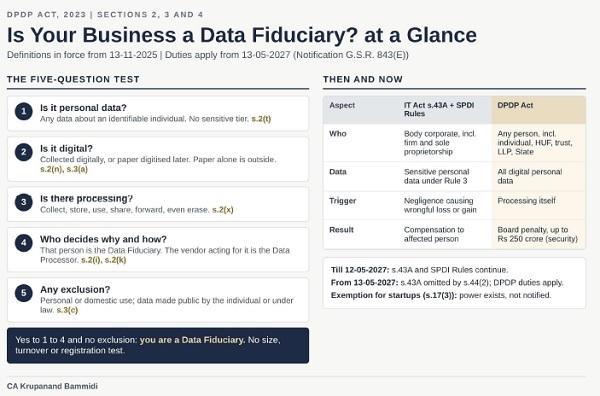
| Aspect | IT Act Section 43A and SPDI Rules (till 12-05-2027) | DPDP Act (from 13-05-2027) |
|---|---|---|
| Who is covered | Body corporate, including company, firm, sole proprietorship or association in commercial or professional activity | Any person, including individual, HUF, company, firm, AOP or BOI, State and artificial juristic person |
| Data covered | Sensitive personal data under Rule 3 (six named categories and related details) | All digital personal data, with no sensitive tier |
| Paper records | Information in a computer resource only | Outside the Act until digitised |
| Trigger | Negligence causing wrongful loss or gain | Processing itself, whether or not loss is caused |
| Consequence | Compensation to the affected person | Penalty imposed by the Data Protection Board, up to Rs 250 crore for security failures |
Applicability and Points to Note
- No registration: an ordinary Data Fiduciary does not register anywhere. Registration under Section 6(9), in force from 13-11-2026, is only for Consent Managers.
- Effective dates: Section 2 is in force from 13-11-2025. Sections 3 and 4 and the duties of Data Fiduciaries apply from 13-05-2027.
- No small business carve-out today: Section 17(3) allows the Central Government to notify classes of Data Fiduciaries, including startups, who will be exempt from certain duties. No such notification has been issued so far.
- Joint decisions: “alone or in conjunction” means group companies sharing one HR team can both be Data Fiduciaries for the same data.
- Outside India: under Section 3(b), the Act also reaches processing outside India if it is connected with offering goods or services to Data Principals in India.
Practical Checklist
1. List every place personal data sits: WhatsApp groups, e-mail, Tally, Excel, cloud drives, CCTV, attendance devices and vendor portals.
2. Against each, note whose data it is, which fields, why it is held, who can see it and who outside receives it.
3. Mark what is paper and what is digital. Stop scanning what nobody needs.
4. Remove ex-employees and vendors from groups. Move KYC to one access-controlled folder.
5. Identify every outsider who receives the data, such as the payroll vendor, cloud service and auditor, and record whether each processes on your behalf (Data Processor) or decides its own purpose.
6. Name one person in the business who owns this list and updates it quarterly.
Back at XYZ Pharma
Ramesh read Section 2(i) twice and said, “So the company is the Data Fiduciary, not Divya and not the vendor.” That was the right reading.
Within a week, Divya moved all KYC to a single folder with access for two people. The old group was exited and its media deleted from the office phones. The bigger question, what the payroll vendor’s contract should say, became the next agenda point.
Concluding Remarks
Applicability under the DPDP Act is settled by definitions that are already law. Size, sector and turnover do not enter the test. A small distributor with forty employees on a WhatsApp group is as much a Data Fiduciary as a large platform.
The 18-month window ends on 13-05-2027. A data inventory is the cheapest step a business can take now, and every later step depends on it. The law does not ask how big you are. It asks what you hold, and why.
References
- Digital Personal Data Protection Act, 2023 (No. 22 of 2023) – Sections 2(i), 2(j), 2(k), 2(n), 2(s), 2(t), 2(x), 3, 4, 6(9), 17(3) and 44(2)
- Notification G.S.R. 843(E) dated 13-11-2025 – commencement of the DPDP Act
- Digital Personal Data Protection Rules, 2025 – Notification G.S.R. 846(E) dated 13-11-2025
- Information Technology Act, 2000 – Section 43A
- Information Technology (Reasonable security practices and procedures and sensitive personal data or information) Rules, 2011 – Notification G.S.R. 313(E) dated 11-04-2011, Rule 3
******
Disclaimer: The views expressed are based on the provisions of the Digital Personal Data Protection Act, 2023, the Digital Personal Data Protection Rules, 2025, the Information Technology Act, 2000 and the rules made thereunder, as notified.
For any query related to above article, or if you face any issue in Income Tax, GST, SEZ, STPI, MCA compliances etc., especially in cases involving legal proceedings, notices, litigation, or demand matters, please feel free to contact us at following details : Contact: +91-7842796315; Email: [email protected]