Summary: Notification No. 08/2026-Central Tax dated 25 November 2026 introduces a significant reform in the cancellation of GST registration by substituting sub-rules (5) and (6) of Rule 20 of the CGST Rules, 2017, with effect from 1 December 2026. Earlier, taxpayer-initiated cancellation applications required examination and approval by the proper officer, frequently resulting in delays and additional compliance difficulties. Notification No. 05/2026-Central Tax introduced electronic cancellation from 1 November 2026, subject to prescribed return-filing and payment conditions, together with a monthly B2B output tax liability limit of Rs 2.5 lakh or an alternative condition involving timely filing of GSTR-10. The latest amendment removes both additional conditions, enabling automatic cancellation through the common portal for compliant taxpayers irrespective of the size of their business. Cancellation will take effect from the date sought by the taxpayer and will be communicated electronically in FORM GST REG-38. Applications involving outstanding returns or unpaid dues will continue to be forwarded to the proper officer for examination. The amendment does not affect suo motu cancellation proceedings, existing tax liabilities or the obligation to furnish the final return under Section 45, wherever applicable. Taxpayers seeking cancellation should ensure timely filing of GSTR-1, GSTR-3B, IFF and CMP-08, as applicable, clear outstanding liabilities, discharge applicable input tax credit reversal obligations and furnish remaining returns within their prescribed timelines. The article compares the earlier officer-driven system with both phases of the reform and provides a practical checklist for filing FORM GST REG-16.
Automatic Cancellation of GST Registration from 01-12-2026: Rule 20 After Notification 08/2026-Central Tax
- Introduction
- Position up to 31-10-2026: Officer-Driven Cancellation
- The Practical Headaches
- Phase 1 from 01-11-2026: Rule 20 Substituted by Notification 05/2026-CT
- Pre-conditions for every application
- Automatic cancellation: Rule 20(5) as it stood
- Officer route: Rule 20(6) to (12)
- Phase 2 from 01-12-2026: Notification 08/2026-CT
- Effect of the change
- Comparison at a Glance
- Applicability and Points to Note
- Practical Checklist Before Filing REG-16
- Concluding Remarks
- References
Introduction
From 01-12-2026, a taxpayer who asks for cancellation of GST registration and is fully compliant will have the registration cancelled by the GST portal itself, without any order from the proper officer. Turnover or B2B tax liability will no longer matter.
The change is made by Notification No. 08/2026-Central Tax dated 25-11-2026 (G.S.R. 1006(E)). It notifies the Central Goods and Services Tax (Second Amendment) Rules, 2026, which substitute sub-rules (5) and (6) of Rule 20 of the CGST Rules, 2017. It is the second step of a reform that started on 01-11-2026 through Notification No. 05/2026-Central Tax dated 26-10-2026.
This article covers how cancellation worked earlier, what went wrong in practice, what changed on 01-11-2026, and what changes again on 01-12-2026.
THE GAZETTE OF INDIA : EXTRAORDINARY [PART II-SEC. 3(i)]
MINISTRY OF FINANCE
(Department of Revenue)
(CENTRAL BOARD OF INDIRECT TAXES AND CUSTOMS)
NOTIFICATION
New Delhi, the 25th November, 2026
No. 08/2026-Central Tax
G.S.R. 1006(E).– In exercise of the powers conferred by section 164 of the Central Goods and Services Tax Act, 2017 (12 of 2017), the Central Government on the recommendations of the Council, hereby makes the following rules further to amend the Central Goods and Services Tax Rules, 2017, namely:-
2. Short title and Commencement. – (1) These rules may be called the Central Goods and Services Tax (Second Amendment) Rules, 2026.
(2) They shall come into force on the 1st day of December, 2026.
3. In the Central Goods and Services Tax Rules, 2017, in rule 20, for sub-rules (5) and (6) respectively, the following sub-rule shall be substituted, namely: –
“(5) Where an application for cancellation of registration is filed under sub-rule (1) and the returns referred to in sub-rule (2) and sub-rule (3) have been furnished within the time specified therein and tax, interest, fee or penalty or any other amount which is liable to be paid, has been paid, the registration shall be cancelled electronically by the common portal with effect from the date from which the cancellation of registration is sought and the same shall be communicated electronically to the said person in FORM GST REG-38.
(6) Where the returns or statements in FORM GST CMP-08, where applicable, referred to in sub-rule (3) have not been furnished or tax, interest, fee or penalty or any other amount which is liable to be paid, has not been paid, the application shall be forwarded to the proper officer for examination.”
[F. No. CBIC-20001/1/2026-GST]
KRITI PANDEY, Under Secy.
Note: The principal rules were published in the Gazette of India, Extraordinary, Part II, Section 3, Sub-section (i), vide notification No. 3/2017-Central Tax, dated the 19th June, 2017, published vide number G.S.R. 610(E), dated the 19th June, 2017 and were last amended, vide notification No. 05/2026-Central Tax, dated the 26th October, 2026, vide number G.S.R. 919(E), dated the 26th October, 2026.
Position up to 31-10-2026: Officer-Driven Cancellation
Until 31-10-2026, every request for cancellation went through the proper officer. The process ran under Section 29(1) of the CGST Act, read with the then Rule 20 and Rule 22(3) of the CGST Rules.
- The registered person applied in FORM GST REG-16 within 30 days of the event that warranted cancellation, such as closure of business, transfer or a fall in turnover.
- Rule 22(3) required the proper officer to pass an order of cancellation in FORM GST REG-19 within 30 days of the application.
- The officer could issue a notice in FORM GST REG-03 seeking clarification or documents, and the taxpayer replied in REG-04.
- The final return in FORM GSTR-10 under Section 45 was due within three months of the date of cancellation or of the cancellation order, whichever was later.
The Practical Headaches
On paper the officer had 30 days. In practice, a closed business could stay registered for months. Practitioners regularly ran into the following:
- Applications pending indefinitely. REG-16 sat with the officer well beyond 30 days, while the registration stayed suspended.
- Repeated REG-03 queries. Officers asked for stock statements, bank statements, rent agreements and reconciliations, even where all returns were filed and nothing was due.
- Compliance after closure. While the application was pending, the taxpayer kept getting non-filing notices and late fee, and had to keep filing returns for a business that no longer existed.
- Missed GSTR-10. The GSTR-10 clock ran from the cancellation order. Small taxpayers often never noticed the order, missed the return and then faced late fee and notices.
- Dependence on jurisdiction. The time taken and the documents demanded varied from officer to officer, so the outcome could not be predicted.
Phase 1 from 01-11-2026: Rule 20 Substituted by Notification 05/2026-CT
Notification No. 05/2026-Central Tax dated 26-10-2026 (G.S.R. 919(E)) substituted Rule 20, titled “Cancellation of registration on request of taxpayer“, with effect from 01-11-2026. For the first time it gave the portal a role in deciding cancellation, but only for a limited class of taxpayers.
Pre-conditions for every application
- Rule 20(1): REG-16 must be filed within 30 days of the event, with details of stock of inputs, semi-finished and finished goods and capital goods, the tax on that stock and the payment made. The 30-day limit does not apply on the death of a sole proprietor.
- Rule 20(2): No application can be filed until all returns due up to the date of filing, for periods up to the date from which cancellation is sought, are furnished. This includes CMP-08 where applicable. Where GSTR-1 or IFF has been filed for a tax period, GSTR-3B for that period must also be filed.
- Rule 20(3): Returns for the remaining period, up to the date of application or the date from which cancellation is sought, must be filed by their due dates.
- Rule 20(4): Registration stays suspended from the date of application until the proceedings end.
Automatic cancellation: Rule 20(5) as it stood
The portal cancelled the registration electronically, from the date sought, and intimated it in the new FORM GST REG-38. This applied only where returns were filed on time and all dues paid, and in addition either:
- Clause (a): output tax declared in GSTR-1, GSTR-1A or IFF on supplies to registered persons did not exceed Rs 2.5 lakh in any month, from registration to the date of application; or
- Clause (b): the final return in GSTR-10 was filed within three days of the due date of the returns under Rule 20(3).
Officer route: Rule 20(6) to (12)
All other cases went to the proper officer, now with fixed timelines:
- Within 15 days, the officer either cancels by order in REG-19 or issues a deficiency notice in REG-03.
- The applicant replies in REG-04 within 15 days. Within 15 days of the reply, the officer approves (REG-19) or rejects (REG-05).
- No reply from the applicant means deemed rejection, intimated in REG-05A. No action by the officer within 15 days means deemed approval in REG-19.
What remained a problem. Any taxpayer whose B2B output tax crossed Rs 2.5 lakh in even one month since registration was outside clause (a), however compliant. That taxpayer had to file GSTR-10 within a tight three-day window, or wait in the officer route.
Phase 2 from 01-12-2026: Notification 08/2026-CT
Notification No. 08/2026-Central Tax dated 25-11-2026 removes both additional conditions. From 01-12-2026, compliance alone decides whether cancellation is automatic.
Substituted Rule 20(5) provides that where an application is filed under sub-rule (1), the returns under sub-rules (2) and (3) have been furnished within time, and tax, interest, fee, penalty or any other amount payable has been paid:
- the registration shall be cancelled electronically by the common portal;
- with effect from the date from which cancellation is sought; and
- the cancellation shall be communicated electronically in FORM GST REG-38.
Substituted Rule 20(6) provides that where the returns, or statements in FORM GST CMP-08 where applicable, under sub-rule (3) have not been furnished, or any amount payable has not been paid, the application shall be forwarded to the proper officer for examination. The officer route under the later sub-rules of Rule 20 then applies.
Effect of the change
- The Rs 2.5 lakh test on B2B output tax in clause (a) is gone.
- The GSTR-10-within-three-days test in clause (b) is gone.
- The officer now sees only cases with pending returns or unpaid dues, not compliant taxpayers above a turnover line.
The Note to the notification records that the CGST Rules were last amended by Notification No. 05/2026-Central Tax dated 26-10-2026, confirming that this amendment operates on the Rule 20 substituted by that notification.
Comparison at a Glance
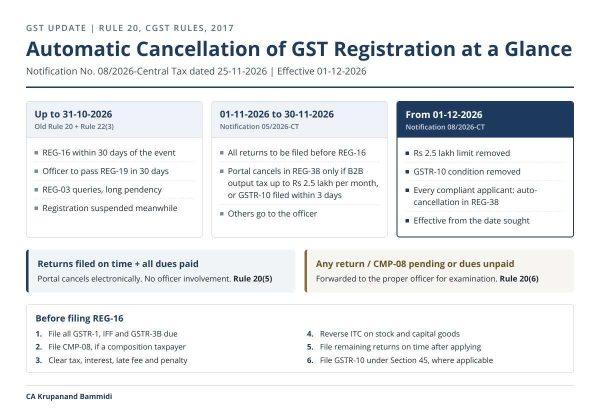
| Aspect | Up to 31-10-2026 | 01-11-2026 to 30-11-2026 (Notfn 05/2026) | From 01-12-2026 (Notfn 08/2026) |
|---|---|---|---|
| Who decides | Proper officer in every case | Portal for eligible cases, officer for the rest | Portal for every compliant case |
| Returns before applying | Not a pre-condition to file REG-16 | All returns due must be filed (Rule 20(2)) | Same |
| Rs 2.5 lakh B2B output tax test | Not applicable | Required for auto-cancellation, unless GSTR-10 route used | Removed |
| GSTR-10 within three days | Not applicable | Alternative route to auto-cancellation | Removed as a condition |
| Order / intimation | REG-19 by officer | REG-38 (portal) or REG-19 (officer) | REG-38 (portal); REG-19 only in officer cases |
| Timeline | 30 days, often not met | Immediate (portal); 15-day steps with deemed approval (officer) | Same as Phase 1 |
| Cases with the officer | All | Non-compliant cases and compliant cases above the threshold | Only cases with pending returns or unpaid dues |
Applicability and Points to Note
Who is covered. The amendment applies to registered persons who seek cancellation of their own registration under Section 29(1) by filing REG-16 under Rule 20(1). It is not linked to any registration scheme. The Rs 2.5 lakh figure in the old clause (a) was a liability test within Rule 20, not a reference to the Rule 14A option, so its removal benefits taxpayers of every size.
Effective date. 01-12-2026.
- Suo motu cancellation is untouched. Cancellation by the proper officer under Section 29(2), read with the rules on suo motu proceedings, is outside this amendment.
- The final return is still due. Removing the GSTR-10 condition from Rule 20(5) does not remove the obligation to file GSTR-10 under Section 45, where it applies.
- The effective date can still be revisited. Under sub-rules (14) to (20) of Rule 20, the officer may, after cancellation, propose an earlier effective date under Section 29(3) by notice in REG-34. The taxpayer replies in REG-35 within 30 days; the officer drops the proceedings (REG-36) or changes the date (REG-37). The forms REG-34 to REG-37 are inserted only from 01-04-2027.
- Liabilities survive cancellation. Section 29(3) keeps the person liable for tax and other dues for any period before cancellation, so automatic cancellation does not close past assessments or audits.
- Drafting quirk. Paragraph 3 of the notification substitutes “sub-rules (5) and (6)” with “the following sub-rule”, and the short-title paragraph is numbered 2 instead of 1. Neither affects the substance.
Practical Checklist Before Filing REG-16
Automatic cancellation now depends entirely on the state of the taxpayer’s returns and ledgers on the day of filing. Before filing REG-16:
1. File every GSTR-1, IFF and GSTR-3B due up to the date of filing. Where GSTR-1 or IFF is filed for a period, file the GSTR-3B for that period too.
2. For composition taxpayers, file every CMP-08 due.
3. Clear all tax, interest, late fee and penalty. Check the electronic liability register for old demands.
4. Work out the ITC to be reversed on inputs, semi-finished and finished goods and capital goods in stock, and pay it. The revised REG-16 from 01-12-2026 captures this in the form itself, with consequential changes to Rule 44.
5. Choose the date from which cancellation is sought with care. It becomes the effective date in REG-38 and can later be challenged under Section 29(3).
6. After filing, file the remaining returns under Rule 20(3) by their due dates. A default here sends the case to the officer under Rule 20(6).
7. Diarise the GSTR-10 due date under Section 45 and file it on time.
Concluding Remarks
Cancellation of GST registration has moved from discretion to a rule-based system in two steps within a month. From 01-12-2026, a compliant taxpayer of any size gets cancellation from the portal, effective from the date asked for. The burden shifts to the taxpayer to have every return filed and every rupee paid before and after applying, because any gap sends the case back to the officer.
For practitioners, the advice to clients closing a business is simple: clean up first, then apply.
References
- Section 29(1), 29(3) and Section 45, CGST Act, 2017
- Rule 20 and Rule 44, CGST Rules, 2017
- Notification No. 05/2026-Central Tax dated 26-10-2026, G.S.R. 919(E): CGST (Amendment) Rules, 2026
- Corrigenda to the CGST (Amendment) Rules, 2026, G.S.R. 1001(E) dated 18-11-2026
- Notification No. 08/2026-Central Tax dated 25-11-2026, G.S.R. 1006(E): CGST (Second Amendment) Rules, 2026
******
Disclaimer: The views expressed are based on Notification No. 05/2026-Central Tax, Notification No. 08/2026-Central Tax and the current GST portal disclosures. Field-level implementation may vary depending on portal functionality and jurisdictional officer discretion.
For any query related to above article, or if you face any issue in Income Tax, GST, SEZ, STPI, MCA compliances etc., especially in cases involving legal proceedings, notices, litigation, or demand matters, please feel free to contact us at the details mentioned below:
Contact: +91-7842796315; Email: [email protected]