
Dineshkumar And Co. Vs ITO (ITAT Rajkot)
Limited Scrutiny Cannot Travel Beyond the Notice: Rajkot ITAT Quashes Assessment and Deletes ₹12.45 Lakh Penalty
Summary: The Rajkot ITAT quashed an assessment in which the Assessing Officer made a ₹20.14 lakh disallowance under section 40(a)(ia) on an issue outside the scope of limited scrutiny. The Tribunal found a second defect. The draft assessment proposed an addition on a different issue, yet the final order introduced the TDS disallowance without a separate show-cause notice. Once the assessment was quashed, the Tribunal also deleted the ₹12.45 lakh penalty under section 270A.
Mining firm’s labour payments lead to TDS disallowance
Dineshkumar And Co., a partnership firm engaged in mining and quarrying, filed its return for AY 2018–19 declaring income of ₹64,845. During scrutiny, the Assessing Officer sought information about labour charges, labour mining charges and loading and unloading expenses. The firm explained that it had paid the amounts through labour sardars, who acted as intermediaries for disbursing wages to individual labourers. The firm contended that it had no contractual relationship with the sardars and that section 194C therefore did not apply.
The Assessing Officer rejected the explanation and disallowed ₹20,14,676, representing 30% of labour-related payments of ₹67,15,586, under section 40(a)(ia). The CIT(A) sustained the disallowance. Before the Tribunal, the firm challenged both the scope of the scrutiny and the procedure followed in making the disallowance.
The scrutiny notice determined the scope of the assessment
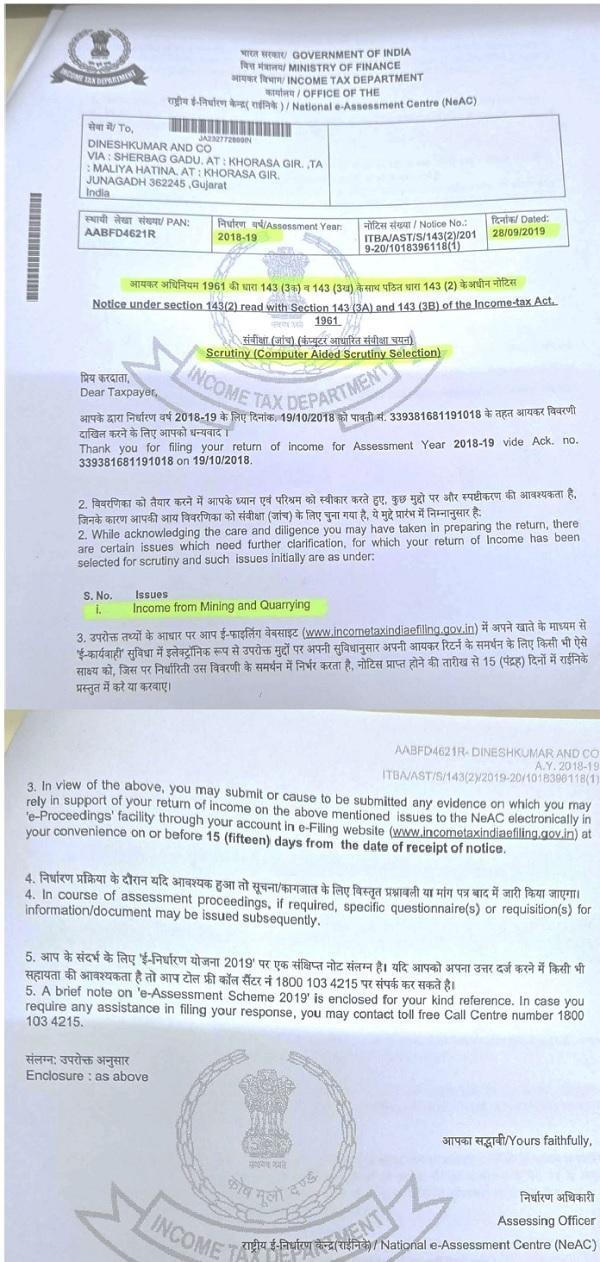
The assessment order described the case as one of complete scrutiny. The assessee produced the original scrutiny notice, which showed that the case had been selected for limited scrutiny on the issue of income from mining and quarrying.
The Tribunal accepted the assessee’s contention that the alleged failure to deduct tax on labour payments was a separate issue outside the scope of the selection. The fact that the labour expenditure related to the mining business did not bring the TDS issue within the scope of that particular notice. The Tribunal held that the assessment was liable to be quashed on this ground.
The final order introduced a fresh disallowance without notice
The draft assessment order dated 22 April 2021 had proposed an addition of ₹19,35,525 on the limited scrutiny issue. The final assessment order dated 27 April 2021 instead made a disallowance of ₹20,14,676 under section 40(a)(ia). The basis of the proposed addition had thus changed between the draft and the final order.
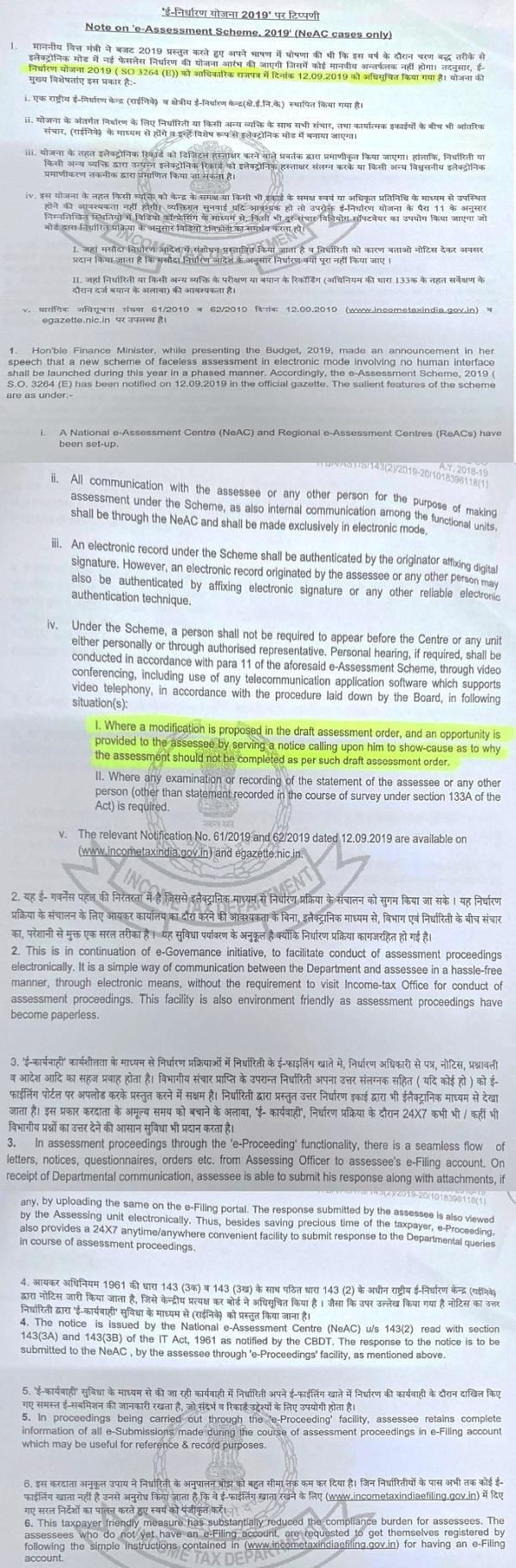
The Tribunal held that the E-assessment Scheme, 2019, notified through S.O. 3264(E) dated 12 September 2019, required a separate opportunity to show cause against the fresh disallowance. The assessee had furnished an explanation about the payments during the assessment proceedings, but the Tribunal found that the Assessing Officer had failed to issue the separate notice required for the new adverse proposal. It therefore quashed the assessment order.
Delay of 346 days condoned
The quantum appeal was delayed by 346 days. The firm explained on affidavit that its former tax consultant, who had handled the appellate proceedings, had failed to communicate the CIT(A)’s order in time. The Revenue opposed condonation, arguing that the firm had failed to show sufficient cause.
The Tribunal found the explanation in the affidavit convincing. Referring, among other authorities, to the Gujarat High Court decision in Gujarat State Fertilizers & Chemicals Ltd. (283 ITR 149), it adopted a liberal approach to condonation and admitted the appeal for disposal on merits.
Penalty under section 270A lost its foundation
In the connected appeal, the Assessing Officer had levied a ₹12,45,070 penalty at 200% under section 270A by treating the disallowance as under-reporting of income in consequence of misreporting. Since the Tribunal had quashed the very assessment on which the penalty rested, it held that the penalty had lost its foundation and deleted it. Both appeals were allowed.
Author’s Comments
For practitioners handling a limited scrutiny assessment, the original notice and the draft assessment order answer two different questions. The notice identifies which issue the Assessing Officer could examine. The draft and show-cause notice establish which adverse proposal the assessee had an opportunity to answer. Here, the final order failed on both counts. The description of the case as complete scrutiny in the assessment order could not override what the original notice showed.
The ruling also leaves the section 194C question open. The firm’s claim that the sardars merely distributed wages was its defence on merits. The Tribunal granted relief on the scope of scrutiny and the absence of a separate show-cause notice. Accordingly, the decision is directly relevant where a fresh TDS disallowance appears for the first time in the final order. Whether payments routed through a labour sardar attract section 194C continues to depend on the actual arrangement, including whether the sardar undertook to supply labour under a contract.
Cases Discussed
- Investment Trust Vs Ujagarsingh (Supreme Court). The Tribunal referred to this authority while examining the principles governing condonation of delay. Its relevance was confined to the preliminary issue of whether the belated appeal should be admitted. The complete case identification and citation require independent verification.
- Gujarat State Fertilizers & Chemicals Ltd. (Gujarat High Court); 283 ITR 149. The Tribunal relied on the liberal approach to condonation of delay while considering the assessee’s explanation concerning non-communication of the appellate order by its former consultant. The full case title, number and date require independent verification.
FULL TEXT OF THE ORDER OF ITAT RAJKOT
Captioned two appeals filed by the same assessee, pertaining to assessment year 2018-19, are directed against the separate orders passed under Section, 250 of the Income-tax Act, 1961 (hereinafter referred to as ‘the Act’) by the National Faceless Appeal Centre (NFAC), Delhi/Commissioner of Income Tax (Appeals) [in short ‘Ld. CIT(A)’], which in turn arise out of an assessment order passed by the Assessing Officer 143(3) r.w.s.144 of the Act and a penalty order passed by Assessing Officer u/s 270A of the Act.
2. Grounds of appeal in ITA No. 1196/RJT/2026 for A.Y. 2018-19 are as follows:
(1). The learned CIT(A) has erred in law and on facts in confirming the assessment order passed by the learned Assessing Officer u/s 143(3), which is bad in law and liable to be quashed because the notice u/s 143(2) was not served upon the assessee.
(2). The learned Assessing Officer as well as the learned CIT(A) have erred in law and on facts in sustaining the addition of Rs. 20,14,676/- made u/s 40(a)(ia) of the Act, on account of alleged non-deduction of TDS, without appreciating that the impugned payments were not made to any contractor and therefore the provisions of section 194C were not applicable.
(3). The authorities below failed to appreciate the fact that the payments were made to labour sardars (Head) only as a mode of convenient disbursement to individual labourers, thereafter, and that there existed no contractual relationship between the assessee and such labour sardars (Head).
(4). The assessee craves leave to add, alter, amend, delete or withdraw any of the above grounds of appeal, at or before the time of hearing, as may be deemed fit in the interest of justice.
3. The appeal filed by the assessee for Assessment Year 2018-19, is barred by limitation by 346 days. The assessee has moved a petition requesting the Bench to condone the delay. The learned Counsel has explained the delay stating that delay has occurred due to reasonable and sufficient cause. Initially, the appeal proceedings were handled by assessee’s previous tax consultant whose email ID was, [email protected], who was responsible for ensuring all legal compliances and taxation matters. However, tax consultant did not intimate about passing the order of learned CIT(A) on timely basis, therefore, because of the mistake of the tax consultant, the assessee should not be penalized. Hence, delay should be condoned in the interest of justice.
4. On the other hand, Learned DR for the revenue submitted that in this case no “sufficient cause” was shown by the assessee to explain the delay in filing of appeal, hence, delay should not be condoned.
5. I have heard both the parties on this preliminary issue. On professional advice, I note that the Courts and Tribunals have consistently held that in the matter of condonation of delay, pragmatic and liberal approach should be taken. The Hon’ble Supreme Court also held the same in case of Investment Trust v. Ujagarsingh observing that unless malafide or negligence writ large, delay should be condoned and appeals should not be rejected on technical ground of delay and they should be ordinarily decided on merits. The Hon’ble Gujarat High Court has also considered this aspect of condonation of delay in case of Gujarat State Fertilizers & Chemicals Ltd. (283 ITR 149) and held that…
“The position in law is well settled that an assessee should be granted due relief where it is due without standing on technicalities and the revenue must bear the established legal position in mind while dealing with applications seeking condonation of delay. It is necessary that liberal approach is adopted in such a matter so as to ensure that substantive rights are not defeated on the basis of technicalities or limitation. “
6. I note that the reasons given in the affidavit for condonation of delay were convincing and these reasons would constitute reasonable and sufficient cause for the delay in filing this appeal. Having heard both the parties and after having gone through the affidavit as well the delay condonation, application, I am of the considered opinion that in the interest of justice, the delay deserves to be condoned. I, accordingly, condone the delay.
7. The facts necessary for disposal of the appeal are stated in brief. The assessee’s case was selected for Complete Scrutiny assessment under the E-assessment Scheme, 2019 on the following issues:–
| S. No. | Issues |
|---|---|
| (i). | Income from Mining and Quarrying |
The assessee is a partnership- firm under name & style of DINESHKUMAR AND CO, is into the business of Mining and Quarrying deriving its income from income from Business and other sources. The assessee filed return income in Form ITR-5 for A.Y. 2018-19 declaring a total income of Rs.64,845/- on 19.10.2018. The assessee’s case was selected for Complete Scrutiny under CASS reason to verify the following issue,viz “Low income from TCS Receipts-Mining and Quarrying”. During the course of scrutiny proceedings, the assessee was asked to furnish the requisite information by issuance of multiple notices u/s142(1) of the Act.
8. In response to the notice of the assessing officer, assessee vide its submission dated 26.04.2021 submitted that it has not deducted TDS on the above payments made towards labour charges, labour mining charges and loading & unloading charges. The assessee, further stated that it has not deducted any TDS, since the payments were made to agent (Sardar) of Labour. However, the assessing officer rejected the above contention of the assessee and observed that since the assessee has not deducted the TDS on payments made towards labour expenses, hence Rs.20,14,676/-, that is, 30% of Rs. 67,15,586/- was disallowed u/s. 40(a)(ia) of the I.T Act, 1961.
9. Being aggrieved by the said order of the Assessing Officer, the assessee filed an appeal before the Ld.CIT(A), but remained unsuccessful. Therefore, assessee is left with no other alternative but to knock on the doors of the Tribunal with this appeal praying for justice. Learned Counsel for the assessee argued that case of the assessee was selected for “limited scrutiny” on the issue, “income from mining and quarrying”, however, the assessing officer made the addition on the different issue of TDS, which was not the subject matter of the limited scrutiny. The assessing officer, in assessment order wrongly stated that case of the assessee was selected for complete scrutiny assessment, however, the correct fact is that notice issued by the assessing officer, was only for limited scrutiny, as the assessing officer issued the notice only for “limited scrutiny”, which is reproduced below.
10. Therefore, ld.Counsel stated that since the case of the assessee was selected for “limited scrutiny” on the issue, “income from mining and quarrying”, however, the assessing officer made the addition on the different issue of TDS, which was not the subject matter of the “limited scrutiny” therefore, assessment order should be quashed.
11. Learned Counsel for the assessee also submitted that assessing officer made a draft assessment order dated 22.04.2021 and proposed an addition of Rs.19,35,525/-, vide para 8.7 of assessment order at page no.3. Thereafter, assessing officer also held that since the assessee had furnished the required information, therefore assessment was converted under section 143(3) of the Act, as against best judgement assessment under section 144 of the Act, vide para no. 8.10 of assessment order on page no.4. Then after, the assessing officer made disallowance under section 40(a) (ia) of the Act, on different issue, without issuing a separate notice to the assessee, as per the procedure laid down in e- assessment scheme 2019, vide e-assessment scheme, 2019, S.O.3264 (E ) which has been notified on 12.09.2019 in the official gazette. The provisions of the scheme which is applicable to the assessee under consideration, is reproduced below:
“Where a modification is proposed in the draft assessment order, and an opportunity is provided to the assessee by serving a notice calling upon him to show-cause, as to why the assessment should not be completed as per such draft assessment order”
12. In the assessee’s case, under consideration, the assessing officer proposed addition of Rs.19,35,525/- based on the “limited scrutiny”, however, later on, assessing officer decided to make the addition on different issue under section 40(a)(ia) of the Act at Rs.20,14,676/-, for which it was mandatory for the assessing officer to issue a separate notice as per e- assessment scheme 2019, vide e-assessment scheme, 2019, S.O.3264 (E ) which has been notified on 12.09.2019 in the official gazette, however, assessing officer failed to do so, therefore assessment order framed by the assessing officer under section 143(3) of the Act, dated 27.04.2021 should be quashed.
13. On the other hand, the Ld. DR for the Revenue has primarily reiterated the stand taken by the Assessing Officer, which we have already noted in our earlier para and is not being repeated for the sake of brevity.
14. I have heard both the parties and carefully gone through the submission put forth on behalf of the assessee along with the documents furnished and the case laws relied upon, and perused the fact of the case including the findings of the ld CIT(A) and other materials brought on record. I find merit in the submission of ld.Counsel for the assessee to the effect that the case of the assessee was selected for “limited scrutiny” on the issue, “income from mining and quarrying”, however, the assessing officer made the addition on the different issue of TDS, which was not the subject matter of the “limited scrutiny” therefore, assessment order should be quashed.
15. I further find that assessment order under section 143(3) of the Act, framed by the assessing officer, is in violation of the e- assessment scheme 2019, vide e-assessment scheme, 2019, S.O.3264 (E ) which has been notified on 12.09.2019 in the official gazette, which is reproduced below, for ready reference:
16. Therefore, I find merit in the submissions of learned Counsel for the assessee to the effect that in the assessee’s case, under consideration, the assessing officer proposed addition of Rs.19,35,525/- based on the “limited scrutiny”, however, later on, assessing officer decided to make the addition on different issue under section 40(a)(ia) of the Act at Rs.20,14,676/-, for which it was mandatory for the assessing officer to issue a separate notice as per e- assessment scheme 2019, vide e-assessment scheme, 2019, S.O.3264 (E ) which has been notified on 12.09.2019 in the official gazette, however, assessing officer failed to do so, therefore assessment order framed by the assessing officer under section 143(3) of the Act, dated 27.04.2021 should be quashed. Accordingly, I quash the same.
17. In the result, appeal filed by the assessee in ITA No.1196/RJT/2026, is allowed.
18. Now coming to the penalty appeal of the assessee in ITA No.1195/RJT/2026, for assessment year 2018–19. Brief facts of the case are that penalty proceedings under section 270A of the Act were initiated and the Assessing Officer levied penalty of 12,45,070/- at 200%, treating the disallowance as under-reported income in consequence of misreporting. Since, I have quashed the assessment order framed by the assessing officer under section 143(3) of the Act, dated 27.04.2021, hence, there is no foundation to levy penalty. Once, the foundation fails, the superstructure also fails, that is, the penalty should also be deleted. In this regard, I place reliance on the legal maxim “Sublato fundamento cadit opus” (meaning thereby that foundation being removed, structure /work falls). Hence, the initial action of the revenue itself is not in consonance with law, then all the subsequent and consequential proceedings would fall through for the reason that illegality strikes at the root of the order. Therefore, I delete the penalty.
19. In the combined result, both appeals of the assessee, (in ITA Nos. 1195 & 1196/RJT/2026), are allowed.
Order is pronounced in the open Court on 17/11/2026.



