Nao Spirits & Beverages Private Limited Vs Assessment Unit (ITAT Delhi)
PCIT cannot set aside an assessment merely to direct further inquiry where the AO has already made the inquiry required by the material on record
Brief: In M/s Nao Spirits & Beverages Private Limited v. Assessment Unit (ITA No. 3318/Del/2025, decided on 12 November 2026), the Income Tax Appellate Tribunal (ITAT), Delhi, set aside a revisionary order passed under Section 263 of the Income-tax Act, 1961. The Tribunal held that where the Assessing Officer conducted inquiries into share premium valuation and business expenditure during faceless scrutiny, mere silence in the assessment order does not render it erroneous or prejudicial to the Revenue.
Introduction
The Finance (No. 2) Act, 2024 abolished the “angel tax” under Section 56(2)(viib) with effect from A.Y. 2025-26 and the Income-tax Act, 2025 has not reintroduced it. The legacy scrutiny and Section 263 revision proceedings for earlier assessment years such as A.Y. 2021-22 remain active reasons for disputes. The Income Tax Appellate Tribunal (ITAT), Delhi, has answered this question again in M/s Nao Spirits & Beverages Private Limited v. Assessment Unit (ITA No. 3318/Del/2025, A.Y. 2021-22).
Facts
The assessee, M/s Nao Spirits & Beverages Private Limited, filed its return of income for A.Y. 2021-22 on 3 January 2022, declaring a loss of Rs. 5,60,133/-, accompanied by an audit report dated 29 December 2021. The case was selected for complete scrutiny through the Computer Assisted Scrutiny Selection (CASS) system to verify an audit-reported deficiency. Specifically, an abnormally low ratio of profit before depreciation, interest, and tax (PBDIT/RBDIT) to turnover for the assessee’s business code and turnover bracket.
During the faceless assessment proceedings, the Assessment Unit issued a series of notices under Sections 143(2), 142(1), and 133(6), alongside a show-cause notice dated 13 December 2022. In response, the assessee submitted detailed replies, financial statements, ledgers, and a share valuation report prepared by a SEBI-registered Merchant Banker (M/s Almond Global Securities Ltd.) and a registered valuer. Satisfied with the explanations, the Assessing Officer passed an assessment order under Section 143(3) read with Section 144B on 22 December 2022, accepting the returned loss.
Subsequently, the Ld. PCIT, Delhi-4, called for and examined the assessment records and issued a show-cause notice dated 12 December 2023 under Section 263. Despite the assessee’s detailed reply dated 22 January 2024, the PCIT passed an order dated 24 March 2025 setting aside the assessment order for a de novo assessment. The PCIT primarily alleged that the Assessing Officer had failed to examine the share premium of Rs. 15.32 crore and the underlying valuation report under Explanation (a)(ii) to Section 56(2)(viib), and had also failed to verify the sharp increase in legal, professional, selling, and business promotion expenses.
The Assessee’s Contentions
Before the ITAT, counsel for the assessee pressed Grounds 3 and 4. Drawing attention to the paper book, the assessee demonstrated that the Assessing Officer had issued pointed notices under Section 142(1) specifically probing both disputed areas. Relying on Malabar Industrial Co. Ltd. v. CIT (2000) 243 ITR 83 (SC), CIT v. Gabriel India Ltd. (1993) 203 ITR 108 (Bom), Asdhan Developers Pvt. Ltd. v. ITO (ITA No. 927/Pun/2018), and Fortis Hospital v. PCIT (ITA No. 3380/Del/2025), the assessee argued that this was neither a case of “no inquiry” nor an order unsustainable in law.
The Revenue’s Defence
Conversely, the Ld. CIT-DR defended the revision by invoking Explanation 2(a) to Section 263, which deems an order erroneous if passed without making inquiries or verification that should have been made. Placing reliance on CIT v. Amitabh Bachchan [2016] 69 taxmann.com 170 (SC) and Pr. CIT v. Paramount Propbuild Pvt. Ltd. [2024] 161 taxmann.com 85 (Del), the Revenue contended that merely issuing notices or collecting documents without carrying the verification to its logical conclusion justifies Section 263 revision.
ITAT’s Legal Analysis
Examining Ground 3, the Tribunal noted that the Assessing Officer had issued three successive Section 142(1) notices dated 16 November 2022, 1 December 2022, and 13 December 2022, seeking shareholder lists, allotment letters, ROC returns, Board resolutions, and granular Discounted Cash Flow (DCF) workings including free cash flows, terminal value, enterprise value, projections, and capital expenditure for FY 2020-21 and FY 2021-22. Furthermore, the record disclosed that the assessee had issued 47,850 preference shares to a sister concern (M/s Kumar Sinew Developers Pvt. Ltd.) at a premium aggregating Rs. 24,95,37,750/-, and 1,120 equity shares to an unrelated institutional investor (ICICI Asset Management Company Ltd.) at a premium of Rs. 24,140/- per share aggregating Rs. 2,70,36,800/-.
Following the Co-ordinate Bench decision in Asdhan Developers Pvt. Ltd. v. ITO, the ITAT held that silence in the assessment order does not negate the extensive inquiries documented in the order sheet and notice replies. Addressing the technical nature of share valuation, the Tribunal observed that neither the Assessing Officer nor the PCIT can summarily discard an expert’s valuation report without a contrary report from another expert, nor can Section 263 be used to initiate fishing and roving inquiries. Quoting the Supreme Court’s timeless caution in Parashuram Pottery Works Co. Ltd. v. ITO (1977) 106 ITR 1 (SC), as reiterated in Gabriel India Ltd.:
“The Commissioner cannot initiate proceedings with a view to starting fishing and roving enquiries in matters or orders which are already concluded. Such action will be against the well-accepted policy of law that there must be a point of finality in all legal proceedings…”
The Tribunal also cited CIT v. Sakthi Charities (2000) 244 ITR 226 (Mad) to underscore that revisionary power cannot be exercised to direct a fruitless inquiry where the final conclusion would remain unchanged, particularly when shares were also allotted to an unrelated party like ICICI Asset Management Company Ltd. at the same premium.
Turning to Ground 4, the Tribunal verified that the Assessing Officer had specifically called for Profit & Loss account details and profit justification via notice dated 26 July 2022, a detailed note on professional expenses of Rs. 1,78,50,578/- via notice dated 4 November 2022, and a note with ledgers on selling and business promotion expenses via notice dated 1 December 2022. Relying on Fortis Hospital v. PCIT (ITA No. 3380/Del/2025), the Bench held that the PCIT’s conclusion of “no inquiry” was factually contrary to the record and legally unsustainable.
At the heart of the decision lies the settled distinction articulated by the Delhi High Court in CIT v. Sunbeam Auto Ltd. (2011) 332 ITR 167 (Del), which the Tribunal extracted and applied:
“Learned counsel for the assessee is right in his submission that one has to keep in mind the distinction between ‘lack of inquiry’ and ‘inadequate inquiry’. If there was any inquiry, even inadequate, that would not by itself, give occasion to the Commissioner to pass orders under section 263…”
Because the twin cumulative conditions laid down in Malabar Industrial Co. Ltd. and CIT v. Max India Ltd. (2007) 295 ITR 282 (SC), that the assessment order must be both erroneous and prejudicial to the interests of the Revenue, were not satisfied, the PCIT’s order was quashed.
Conclusion
The ITAT Delhi’s ruling in M/s Nao Spirits & Beverages Pvt. Ltd. is a reaffirmation of procedural discipline in faceless tax administration. It draws a firm boundary around Section 263, while Explanation 2(a) empowers the Principal Commissioner to intervene where an Assessing Officer abdicates statutory duty through total non-inquiry, it does not convert revisional jurisdiction into a second innings of scrutiny whenever an assessment order is brief.
For tax professionals and corporate taxpayers, the takeaway is that in faceless assessments, the assessment order itself is often concise, consequently, the true record of “application of mind” resides in the sequence of Section 142(1) notices, order-sheet entries, and structured replies uploaded on the portal. When defending legacy Section 56(2)(viib) or expenditure claims for A.Y. 2024-25 and earlier years, mapping each PCIT allegation directly to specific assessment queries remains the one of the most decisive defence. Conversely, for the Revenue, invoking Section 263 requires demonstrating a genuine absence of inquiry or a legally unsustainable view, not merely a difference of opinion on valuation assumptions or commercial expediency.
Cases Discussed
- Malabar Industrial Co. Ltd. v. CIT, (2000) 243 ITR 83 (SC) — Twin conditions for revision.
- CIT v. Max India Ltd., (2007) 295 ITR 282 (SC) — Plausible view and limits of revision.
- Asdhan Developers Pvt. Ltd. (formerly KUL Developers Pvt. Ltd.) v. ITO, ITA No. 927/Pun/2018 (ITAT Pune), 16/12/2021 — Reproduced at length and followed on share valuation inquiry.
- CIT v. Sunbeam Auto Ltd., (2011) 332 ITR 167 (Delhi HC) — Distinction between lack and inadequacy of inquiry, quoted in Asdhan.
- CIT v. Gabriel India Ltd., (1993) 203 ITR 108 (Bombay HC) — Limits of revisional jurisdiction, quoted in Asdhan.
- Parashuram Pottery Works Co. Ltd. v. ITO, (1977) 106 ITR 1 (SC) — Finality of proceedings, quoted in Asdhan.
- CIT v. Sakthi Charities, (2000) 244 ITR 226 (Madras HC) — No fruitless revision, quoted in Asdhan.
- Fortis Hospital v. PCIT, ITA No. 3380/Del/2025 (ITAT Delhi) — Followed on expenses inquiry.
- CIT v. Amitabh Bachchan, [2016] 69 taxmann.com 170 (SC) — Cited by Revenue for requisite verification.
- Pr. CIT v. Paramount Propbuild Pvt. Ltd., [2024] 161 taxmann.com 85 (Delhi HC) — Cited by Revenue on insufficient verification.
- CIT v. Anil Kumar Sharma, (2011) 335 ITR 83 (Delhi HC) — Mentioned within quoted Asdhan ruling.
- Cinestaan Entertainment (P.) Ltd. v. ITO, 106 taxmann.com 300 (Delhi ITAT) — Mentioned within quoted Asdhan ruling.
- CIT v. Nirav Modi, 71 taxmann.com 272 (Bombay HC) — Mentioned within quoted Asdhan ruling.
- CIT v. Chemsworth (P.) Ltd., 119 taxmann.com 358 (Karnataka HC) — Mentioned within quoted Asdhan ruling.
- Smt. Shruti Rahul Mane v. Pr. CIT, ITA No. 1056/Pun/2016 (ITAT Pune) — Mentioned within quoted Asdhan ruling.
- PCIT v. Shreeji Prints (P.) Ltd., 130 taxmann.com 294 (SC) — Mentioned within quoted Asdhan ruling.
- Freedom Wealth Solutions Pvt. Ltd. v. ITO, ITA No. 7000/Mum/2019 (ITAT Mumbai) — Mentioned within quoted Asdhan ruling.
- Jalgaon People’s Co-op Bank Ltd. v. PCIT, 127 taxmann.com 243 (ITAT Pune) — Mentioned within quoted Asdhan ruling.
FULL TEXT OF THE ORDER OF ITAT DELHI
The appeal filed by the Appellant/assessee is against order dated 24.03.2025 of Ld. Principal Commissioner of Income Tax, Delhi-4 [hereinafter referred to as “the Ld. PCIT”] under section 263 of the Income Tax Act, 1961 (hereinafter referred to as “the Act”) arising out of assessment order dated 22.12.2022 of Ld. Assessing Officer/Assessment Unit (hereinafter referred to as ‘the AO’) u/s 143(3) read with Section 144B of the Act for A.Y. 2021-22.
2. Brief facts of the case are that, the Assessee company filed return of income of loss of Rs. 5,60,133/- on 03.01.2022. The Assessee also filed audit report dated 29.12.2021. The case was selected for complete scrutiny through CASS to verify a deficiency reported in audit report. Given specific business codes and turnover range, ratio of RBDIT (profit before deprecation interest and tax) to turnover is abnormally low. Notice under Section 143(2) dated 28.06.2022, notice under Section 142(1) dated 26.07.2021, letter dated 14.10.2022, notice under Section 133(6) to Director 02.11.2022 notice under Section 142(1) dated 04.11.2022, 1.12.2022, letter dated 06.12.2022 and show cause notice dated 13.12.2022 were issued. The Assessee filed reply and submissions. On completion of proceedings, Ld. AO vide order dated 22.12.2022 expected the return of income filed by the Assessee.
3. Assessment records of the company were called and examined. The Assessee filed copy of valuation report of Merchant Banker (M/s Almond Global Securities Ltd. and registered valuer during assessment proceedings). Show cause notice dated 12.12.2023 was issued. The Assessee submitted reply dated 22.01.2024. Ld. PCIT vide order dated 24.03.2205 set aside the assessment order dated 22.12.2022 for fresh assessment de-novo by Ld. AO.
4. Being aggrieved appellant/assessee preferred present appeal on following grounds:-
“1. That the Learned PCIT has erred in law and on facts in invoking jurisdiction under section 263 of the Income Tax Act, 1961, without satisfying the mandatory conditions of the order being both erroneous and prejudicial to the interest of revenue.
2. Ground 2 That the Learned PCIT failed to appreciate that the AO had made detailed inquiries during the assessment proceedings under section 143(3) of the Income Tax Act and accepted the assessee’s explanations after due verification; thus, the assessment order cannot be held as erroneous.
3. That the Learned PCIT erred in holding that the AO failed to examine the share premium received and the valuation report of the SEBI-registered merchant banker, when in fact, the AO had made detailed enquiries into the projections, assumptions, bank statements, and financials etc. which formed the basis of the valuation report, and also the AO had examined relevant judicial decisions before passing its order.
4. That the Learned PCIT erred on the facts and in law by holding that the AO had not examined the sharp increase in expenses related to legal, professional, selling and business promotion etc. when the AO had asked the assessee to submit the details of these expenses and these details were duly examined.
5. That the Learned PCIT erred on the facts and in law by holding that the assessment order was erroneous for non-examination of the squared off loans during the relevant financial year when details regarding these were submitted and the Learned PCIT has not brought out anything in the impugned order to reveal how this caused prejudice to the interests of the revenue.
6. That the Learned PCIT erred in concluding that there was no verification of legal and professional expenses or Capital Work In Progress (“CWIP”) when detailed ledgers, justification for expenses, and ledger accounts for CWIP were duly submitted and considered.
7. That the Learned PCIT erred in law by substituting his own opinion for that of the AO in matters of valuation and business expenditure, which is impermissible under the scope of section 263 of the Income Tax Act.
8. That the impugned order is based on a mere difference in opinion and/or alleged inadequacy of inquiry rather than total absence of inquiry, and therefore the invocation of section 263 of the Income Tax Act is invalid as per law laid down in Malabar Industrial Co. Ltd. v. CIT (2000) 243 ITR 83 (SC) and CIT v. Gabriel India Ltd (1993) 203 ITR 108 (Bom). The law laid down in both the judgments emphasizes that section 263 cannot be invoked to correct every mistake or error, but only when an order causes a loss of revenue due to an erroneous assessment.
9. That the PCIT’s finding of “prejudice to the revenue” is wholly speculative, especially when the AO accepted a declared loss and no tax evasion or misreporting has been demonstrated.
10. That the order u/s 263 of the Income Tax Act deserves to be quashed as it violates the principles of natural justice by failing to consider the detailed replies and evidence furnished by the Appellant.
11. That the Appellant craves leave to add, alter, amend or withdraw any of the above grounds at the time of hearing.
5. The Ld. Representative for appellant/assessee submitted that the Ground No. 3 and 4 are qua challenge to the conclusions of Ld. PCIT.
5.1. In written submissions it was pleaded as under:-
“The Ld. AO has conducted extensive enquiries on the valuation of shares during the original assessment proceedings. Therefore, invocation of revisionary power is bad
II. The conclusion of the Ld. PCIT that AO ought to have recorded a satisfaction as per clause (ii) of clause (a) of explanation to clause (vii) of Section 56 of the Income Tax Act is patently arbitrary as said clause (ii) is not even applicable in present case.
AO has conducted multiple extensive enquiries on the valuation of shares and expenses during the assessment proceedings
In this regard, the Appellant relies on the following notices issued during the scrutiny proceedings –
| Issue | PCIT’s directions | Enquiries made by AO during assessment |
|---|---|---|
| Ground 3 | The PCIT, in paras 6.2 has observed that AO has not examined share valuation and not recorded satisfaction as per explanation a(ii) of section 56(viib) |
Notice dated 16.11.2022 issued u/s 142(1) of the Act [@pg.299-301 of PB] query No.3 specifically asking Appellant to submit details of share premium of INR 15.32 cr., list of shareholders, mode of receipt of share premium with supporting evidences. Notice dated 01.12.2022 issued u/s 142(1) of the Act [at pg.323-325 of PB and Appellant’s reply at pg.327-332) queries No. 5 to 10 specifically calling upon the Appellant to submit allotment letters (query 5), valuation report of shares (query 6), prospectus for offer of shares (query 7), board resolution for shares allotment (query No.8), returns filed with ROC for share allotment (query 9), Note on applicability of provisions u/s 56(2)(vii) of Act on share application money (query 10) Notice dated 13.12.2022 (starts at pg. 229 of PB, relevant at pg.234-235 of PB) queries number 1 to 5 at pg. 234 of PB wherein Appellant was specifically asked to submit following details qua the valuation report working of free cash flows (query 1), working for computing terminal value (query 2), working on enterprise value (query 3), substantiate basis for projections, details of new projects and their status (query 4), details regarding incurring capital expenditure in FY 21 & FY 22 (query 5). |
| Ground No 4 the Ld. AO has examined the legal, professional selling and promotion expense | ||
| Ground 4 |
The PCIT, in Para 6.4 (internal pg.10), has held that AO has not examined the sharp increase in legal, professional, selling and business promotion expenses as to whether the same were incurred exclusively for the purpose of business. |
Notice dated 01.12.2022 issued u/s 142(1) of the Act [at Pg.323-325 of PB and Appellant’s reply at pg.327-332) – query No. 4 specifically calling upon the Appellant to submit note on selling and business promotion expenses with relevant ledger. Notice dated 26.07.2022 [@pg.654-666 of PB) queries no. 3 and 5 seeking Profit and loss account details (query 3) and justification of profit [query 5) Notice dated 04.11.2022 [@ pg. 725-727 of PB) query no. 6 seeking detailed note on professional expenses of INR 1,78,50,578/- [identical expenses as per PCIT order]. |
5.2. Reliance was placed on order dated 16.12.2021 in Ashdan Developers Pvt. Ltd. earlier known as KUL Developers Pvt. Ltd. Vs. PCIT, Pune-6, Fortis Hospital vs. PCIT ITA No. 3380/Del/2025.
6. The Ld. Departmental Representative in written submissions submitted as under:
“Issue: Validity of assumption of jurisdiction under Section 263 of the Income-tax Act, 1961 The assessee has challenged the assumption of jurisdiction under Section 263 on the ground that the Assessing Officer had conducted inquiries during the course of assessment proceedings and that the Learned PCIT has merely substituted his opinion on the basis of alleged inadequacy of inquiry. Reliance has been placed upon Malabar Industrial Co. Ltd. v. CIT, (2000) 243 ITR 83 (SC) and CIT v. Gabriel India Ltd., (1993) 203 ITR 108 (Bom.).
1. It is respectfully submitted that the present case is not one of mere difference of opinion. The Learned PCIT, upon examination of the assessment record, identified specific issues in respect of which the inquiry and verification warranted by the facts and material on record had not been carried out to the extent required. Explanation 2(a) to Section 263 specifically provides that an assessment order shall be deemed to be erroneous and prejudicial to the interests of the Revenue where it has been passed without making inquiries or verification which should have been made.
2. The Hon’ble Supreme Court in CIT v. Amitabh Bachchan, [2016] 69 com170 (SC), in para 21, considered the contention that where two views are possible, exercise of revisional jurisdiction under Section 263 would not be justified. The Hon’ble Court, while recognizing the said principle, held that the same would not apply where the circumstances of the case required further investigation and enquiry. The Court observed that an issue requiring further enquiry could not simply be dropped by the Assessing Officer. In para 22, the revisional order was restored and the appeal of the Revenue was allowed.
3. The Hon’ble Delhi High Court in Pr. CIT v. Paramount Propbuild Pvt. Ltd., [2024] 161 com85 (Delhi), has similarly held that mere issuance of notices or undertaking a limited inquiry does not preclude exercise of jurisdiction under Section 263 where the material on record warranted further verification. In para 21, the Court held that further inquiry was required in the light of the information available. In para 24, the Court observed that such further verification constituted the minimum inquiry expected from the Assessing Officer. In para 25, Explanation 2(a) to Section 263 was applied and the case was held fit for exercise of revisional jurisdiction. In para 26, the assumption of jurisdiction by the PCIT was upheld, and in para 28, the questions of law were answered in favour of the Revenue.
4. In the present case, the Learned PCIT has identified specific areas requiring further examination. including the assumptions and projections underlying the valuation report in respect of share premium, impairment/write-off of investment in the subsidiary, source and supporting evidence relating to squared-off unsecured loans, substantial legal, professional and business-promotion expenditure, stock valuation, foreign currency expenditure and expenditure relating to the Experience Centre/CWIP. The revisional order records that the supporting material and underlying aspects necessary for proper verification of these issues had not been adequately examined before the returned loss was accepted.
5. It is respectfully submitted that the fact that certain details were called for during the assessment proceedings does not, by itself, conclude the inquiry. What is required to be seen is whether the inquiry and verification warranted by the material available on record was carried out to its logical conclusion. The Hon’ble Delhi High Court in Paramount Propbuild Pvt. Ltd. (supra) has specifically held that even where notices under Section 133(6) had been issued, further inquiry was necessary in the light of the information available on record.
6. The principle laid down in Malabar Industrial Co. Ltd. (supra), that Section 263 cannot be invoked merely because the Commissioner prefers another possible view, is therefore not attracted to the present facts. Likewise, the decision in Gabriel India Ltd. (supra) does not assist the assessee where the revision is based not on substitution of a considered view of the Assessing Officer, but on failure to undertake the necessary inquiry and verification warranted by the facts of the case.
7. Thus, the present case falls within the ambit of Explanation 2(a) to Section 263. The Learned PCIT has identified the specific inquiries and verifications which, having regard to the material available on record, ought to have been undertaken before accepting the returned loss. The exercise of revisional jurisdiction is, therefore, within the statutory framework of Section 263.”
7. From examination of record, in light of aforesaid rival contentions, it is crystal clear that in Ground of Appeal No. 3 conclusion of Ld. PCIT in Para No. 6.2 that Ld. AO has examined share valuation and not recorded satisfaction as per Explanation A(ii) of Section 56 7(b) has been challenged.
7.1. Notice dated 16.11.2022 under Section 142(1) Page No. 299-301 of Paper Book mentions Query No. 3 asking assessee to submit details of share premium of Indian Rs. 15.32 Crore, list of share holders, mode of receipt of share premium which supporting evidence.
7.2. Notice dated 01.12.2022 issued under Section 142 of the Act, Page No. 323-325 of Paper Book queries No. 5 to 10 calling upon the Assessee to submit.
7.3. Notice dated 13.12.2022 page No. 229 of Paper Book relevant to Page No. 234-235 of Paper Book mention Query No. 1 to 5 asking the Assessee to submit details qua valuation report working of free cash flows query (query 1), working for computing terminal value (query 2), working on enterprise value (query 3), substantiate basis for projections, details of new projects and their status (query 4), details regarding incurring capital expenditure in FY 21 & FY 22 (query 5).
7.4. From above notices and reply it is evident that Ld. AO has examined all the aspects qua valuation of share and also conducted extensive enquiries.
7.5. A Co-ordinate Bench of the Tribunal in ITA No. 927/Pune/2018 titled as Asdhan Developers Pvt. Ltd. Vs. ITO in Para No. 6 to 23 observed as under:
“6. However, the Id. PCIT considering the contents of the report of valuation of shares furnished by the Chartered Accountant, namely, Sachin R. Bansal & Co. dated 26.09.2012 observed that :
(i) The valuation report was prepared by the Chartered Accountant solely based on the data provided by the promoters of the appellant company without independently verifying the veracity, accuracy and completeness of the information provided by the promoters of the appellant company.
(ii) There is a wide deviation between the actual performance and projected performance.
(iii) The valuer i.e. Chartered Accountant applied discount factor of 20% which is not based without any valid basis.
(iv) The valuer had not discussed anything as to how the key factor, namely, Cash Flow Project Discount Rate on term value while computing the Discounted Cash Flow Method.
7. Based on the above observations, the ld. PCIT came to conclusion that the Fair Market Value of shares determined by the valuer is not correct. According to the ld. PCIT, the Assessing Officer had failed to make enquiry into this. Therefore, the assessment order is erroneous and prejudicial to the interest of the revenue.
8. Similarly, the ld. PCIT was of the opinion that the expenditure of Rs.1,74,46,083/- came to be allowed as deduction without examining as to the satisfaction of the conditions laid down u/s 37(1) of the Act. Accordingly, he set-aside the assessment order with direction to the Assessing Officer to redo the same after conducting a detailed enquiry and verification of the valuation report, etc. after giving an opportunity of being heard to the appellant vide order dated 27.03.2018.
9. Being aggrieved by the above order of revision, the appellant is before us in the present appeal.
10. The ld. AR submitted that the issue of receipt of share premium and valuation of the shares was examined by the Assessing Officer during the course of assessment proceedings. He submitted that the Assessing Officer had issued a notice dated 19.10.2015 u/s 142(1) seeking details as to share premium received during the year vide Item No.8 of the notice, which is placed at page nos.42 to 45 of the Paper Book. The query raised by the Assessing Officer was duly answered by the appellant vide letter dated 06.12.2015, which is placed at page nos.46 to 108 of the Paper Book. He also filed copy of the order sheet entry of the Assessing Officer, wherein on 07.12.2015 the Assessing Officer recorded that the assessee had filed written submission as to the valuation of shares, valuation report, etc., which is placed at page no.113 of the Paper Book. Thus, it is submitted that the finding of the ld. PCIT that no enquiry was made by the Assessing Officer as to the valuation of equity shares is contrary to the material on record. The ld. AR further submitted that when the Income Tax Rules gives an option to adopt one of method of valuation of shares, either Fair Market Value of the shares or Discounted Cash Flow Method of the shares. The Assessing Officer cannot substitute his own method in place of method adopted by the assessee.
11. According to the ld. AR, the Assessing Officer had rightly accepted the method adopted by the assessee and the ld. PCIT cannot term the assessment order as “erroneous” merely because in the opinion of the ld. PCIT, the appellant should have adopted Fair Market Value for the purpose of valuation of the shares. It is also further submitted that the ld. PCIT cannot disregard the valuation report of shares furnished by the Chartered Accountant citing 6 ITA No.927/PUN/2018 that the valuation report was furnished by the Chartered Accountant based on the information furnished by the assessee company. The valuation report furnished by the Chartered Accountant cannot be tinkered with by the ld. PCIT, as the issue of valuation of shares is a technical complex problem which should be left for consideration to the expert in the field. In any event, he submitted that there is no material on record to indicate that the valuation was made on a fundamental erroneous basis. Even the valuation report is found to be wrong, the only course of action open to the assessing authority is to refer the valuation of shares to another expert in the field. In the absence of enabling the provisions for making reference to another expert in the field, the Commissioner cannot tinker with the valuation report submitted by the Chartered Accountant. He also placed reliance on the decision of the Delhi Bench of the Tribunal in the case of Cinestaan Entertainment (P.) Ltd. vs. ITO, 106 taxmann.com300 (Delhi – Trib.). Thus, it was submitted that the exercise of revision made by the ld. PCIT is invalid in law as the Assessing Officer after making proper enquiries took a view that no addition on account of receipt of share premium can be made placing reliance on the decisions of (i) Hon’ble Bombay High Court in the case of CIT vs. Nirav Modi, 71 taxmann.com272 (Bombay) and (ii) Hon’ble Karnataka High Court in the case of CIT vs. Chemsworth (P.) Ltd., 119 taxmann.com 358 (Karnataka).
12. Without prejudice to the above, it is contended that even assuming for a moment, the Assessing Officer made inadequate enquiry that would not by ipso facto confer power of revision with Commissioner u/s 263 merely because he has a different opinion on the issue. It is only in case of total lack of enquiries the power of revision u/s 263 can be exercised. He also placed reliance on the decision of the Hon’ble Delhi High Court in the case of CIT vs. Sunbeam Auto Ltd., 189 Taxman 436 (Delhi).
13. As regards to the applicability of Explanation 2 to section 263 of the Act, it is submitted that the Explanation 2 has no retrospective application placing reliance on the decision of Co-ordinate Bench of the Tribunal in the case of Smt. Shruti Rahul Mane vs. Pr.CIT in ITA No.1056/PUN/2016 order dated 27.06.2019. He also submitted that the Commissioner had not invoked the Explanation 2 to section 263 in the show-cause notice. It is submitted that in case where the Commissioner had failed to invoke the Explanation 2 to section 263 in the show-cause notice, the Explanation 2 cannot be pressed into service placing reliance on the decision of the Hon’ble Supreme Court in the case of PCIT vs. Shreeji Prints (P.) Ltd., 130 com294 (SC).
14. It is also contended that valuation of preference or equity shares cannot be termed as an excessive in view of the fact that the assessee company issued 1120 equity shares of face value of Rs.10 per share to ICICI Asset Management Company Ltd. at a premium of Rs.24,140/- per share and received share premium of Rs.2,70,36,800/- and the provisions of section 56(2)(viib) has no application in the case of genuine transactions as there is no allegation of money laundering and illegality of consideration received on allotment of shares placing reliance on the decision of Mumbai Bench of the Tribunal in the case of Freedom Wealth Solutions Pvt. Ltd. vs. ITO in ITA No.7000/Mum/2019 order dated 22.09.2021. Thus, it was contended that the ld. PCIT was not justified in exercising the power of revision u/s 263 of the Act and prayed for quashing of the order passed u/s 263 of the Act and in directing the Assessing Officer to make an enquiry into the issue of share premium and applicability of provisions of section 56(2)(viib) of the Act.
15. The grounds of appeal relating to the revision of allowability of expenditure of Rs.1,74,46,083/- are not pressed during the course of hearing of the appeal before us.
16. On the other hand, ld. CIT-DR submitted that the ld. PCIT was justified in exercising the power of revision in the facts of present case as the Assessing Officer had failed to enquire into the veracity of the valuation report of shares furnished by the Chartered Accountant. It is a case of total lack of enquiry on the part of the Assessing Officer placing reliance on the decision of the Co-ordinate Bench of the Tribunal in the case of Jalgaon People’s Co-op Bank Ltd. vs. PCIT, 127 com243 (Pune – Trib.).
17. We heard the rival submissions and perused the material on record. The issue in the present appeal relates to the validity of the revision exercised by the ld. PCIT u/s 263 of the Act in respect of issue of receipt of share premium. The Parliament had conferred the power of revision on the Commissioner of Income Tax u/s 263 of the Act in case the assessment order passed is erroneous and prejudicial to the interests of revenue. In order to invoke the power of revision, the above two conditions are required to be satisfied cumulatively. References in this regard can be made to the decision of the Hon’ble Supreme Court in the case of Malabar Industrial Co. Ltd. vs. CIT, 243 ITR 83 (SC) and in the case of CIT vs. Max India Ltd., 295 ITR 282 (SC). The error in the assessment order should be one that it is not debatable or plausible view. In a case where the Assessing Officer examined the claim took one of the plausible view, the assessment order cannot be termed as an “erroneous”. Therefore, the issue that is required to be examined is whether the Assessing Officer had carried out any enquiry or verification on the issue of receipt of share premium and applicability of provisions of section 56(2)(viib) during the course of assessment proceedings. In the present case, the Assessing Officer had called for the details of receipt of share premium as well as the report of valuation of shares from the Chartered Accountant and the assessee had duly responded to the above query raised by the Assessing 9 ITA No.927/PUN/2018 Officer by submitting all the requisite information as called for by the Assessing Officer. However, the assessment order is silent on this aspect but under scrutiny of the order sheet entry as well as the notices issued u/s 143(2), it would reveal that the Assessing Officer had enquired into the issue sought to be revised by the ld. PCIT. Therefore, it cannot be said that there is total lack of enquiry on the part of the Assessing Officer. As a matter of fact, it was specifically brought to the notice of the Assessing Officer that the appellant company issued 47850 preference shares of face value of Rs.10 per share at premium to M/s. Kumar Sinew Developers Pvt. Ltd., a sister concern of the appellant and received a share premium aggregating to sum of Rs.24,95,37,750/-. The appellant company also issued 1120 equity shares of face value of Rs.10 per share to ICICI Asset Management Company Ltd. at a premium of Rs.24,140/- per share and received share premium of Rs.2,70,36,800/- and report of valuation of shares given by the Chartered Accountant was also furnished. In these circumstances, we do not agree with the ld. CIT-DR that no enquiry was made into the issue of receipt of share premium and the very fact that the Assessing Officer had called for report of valuation of shares given by Chartered Accountant goes to show that Assessing Officer had enquired and had gone into issues of applicability of provisions of section 56(2)(viib) of the Act.
18. The courts have made a distinction between “lack of enquiry” and “inadequate enquiry”. If there was enquiry even an inadequate that would be itself give no occasion to the Commissioner to exercise the power of revision u/s 263 as held by the Hon’ble Bombay High Court in the case of CIT vs. Gabriel India Ltd., 203 ITR 108 (Bombay) and followed by the Hon’ble Delhi High Court in the case of CIT vs. Sunbeam Auto Ltd., 332 ITR 167 (Delhi) and in the case of CIT vs. Anil Kumar Sharma, 335 ITR 83 (Delhi). The relevant 10 ITA No.927/PUN/2018 paragraphs of the decision of the Hon’ble Delhi High Court in the case of Sunbeam Auto Ltd. (supra) are extracted hereunder :-
“We have considered the rival submissions of the counsel on the other side and have gone through the records. The first issue that arises for our consideration is about the exercise of power by the Commissioner of Income-tax under section 263 of the Income-tax Act. As noted above, the submission of learned counsel for the revenue was that while passing the assessment order, the Assessing Officer did not consider this aspect specifically whether the expenditure in question was revenue or capital expenditure. This argument predicates on the assessment order which apparently does not give any reasons while allowing the entire expenditure as revenue expenditure. However, that by itself would not be indicative of the fact that the Assessing Officer had not applied his mind on the issue. There are judgments galore laying down the principle that the Assessing Officer in the assessment order is not required to give detailed reason in respect of each and every item of deduction, etc. Therefore, one has to see from the record as to whether there was application of mind before allowing the expenditure in question as revenue expenditure. Learned counsel for the assessee is right in his submission that one has to keep in mind the distinction between “lack of inquiry” and “inadequate inquiry”. If there was any inquiry, even inadequate, that would not by itself, give occasion to the Commissioner to pass orders under section 263 of the Act, merely because he has different opinion in the matter. It is only in cases of “lack of inquiry”, that such a course of action would be open. In Gabriel India Ltd.’s case (supra), law on this aspect was discussed in the following manner :
“. . . From a reading of sub-section (1) of section 263, it is clear that the power of suo motu revision can be exercised by the Commissioner only if, on examination of the records of any proceedings under this Act, he considers that any order passed therein by the Income-tax Officer is ‘erroneous insofar as it is prejudicial to the interests of the revenue’. It is not an arbitrary or unchartered power. It can be exercised only on fulfilment of the requirements laid down in sub-section (1). The consideration of the Commissioner as to whether an order is erroneous insofar as it is prejudicial to the interests of the revenue must be based on materials on the record of the proceedings called for by him. If there are no materials on record on the basis of which it can be said that the Commissioner acting in a reasonable manner could have come to such a conclusion, the very initiation of proceedings by him will be illegal and without jurisdiction. The Commissioner cannot initiate proceedings with a view to starting fishing and roving enquiries in matters or orders which are already concluded. Such action will be against the well-accepted policy of law that there must be a point of finality in all legal proceedings, that stale issues should not be reactivated beyond a particular stage and that lapse of time must induce repose in and set at rest judicial and quasi-judicial controversies as it must in other spheres of human activity. [See : Parashuram Pottery Works Co. Ltd. v. ITO[1977] 106 ITR 1 (SC) at page 10].
19. In the present case, from the observation made by the ld. PCIT in 263 order, it is clear that had the ld. PCIT appraised the report of valuation of shares placed before the Assessing Officer, he would not have accepted the valuation report. This observation, in our considered opinion, cannot be accepted in view of the fact that the power of revision u/s 263 does not allow for supplanting or substituting the view of the Assessing Officer. The appreciation of material placed before the Assessing Officer is exclusively within his domain which cannot be interdicted by a superior officer while exercising powers u/s 263 of the Act on the ground that if he had appraised the said material, he would have come to a different conclusion in view of the law laid down by the Hon’ble Supreme Court in the case of Parashuram Pottery Works Co. Ltd. vs. ITO, 106 ITR 1 (SC). The relevant observation of the said decision of the Hon’ble Supreme Court in the case of Parashuram Pottery Works Co. Ltd. (supra) is reproduced hereunder :-
“From the aforesaid definitions it is clear that an order cannot be termed as erroneous unless it is not in accordance with law. If an Income-tax Officer acting in accordance with law makes a certain assessment, the same cannot be branded as erroneous by the Commissioner simply because, according to him, the order should have been written more elaborately. This section does not visualise a case of substitution of the judgment of the Commissioner for that of the Income-tax Officer, who passed the order unless the decision is held to be erroneous. Cases may be visualised where the Income-tax Officer while making an assessment examines the accounts, makes enquiries, applies his mind to the facts and circumstances of the case and determines the income either by accepting the accounts or by making some estimate himself. The Commissioner, on perusal of the records, may be of the opinion that the estimate made by the officer concerned was on the lower side and left to the Commissioner he would have estimated the income at a figure higher than the one determined by the Income-tax Officer. That would not vest the Commissioner with power to reexamine the accounts and determine the income himself at a higher figure. It is because the Income-tax Officer has exercised the quasi-judicial power vested in him in accordance with law and arrived at conclusion and such a conclusion cannot be termed to be erroneous simply because the Commissioner does not feel satisfied with the conclusion. . . . There must be some prima facie material on record to show that tax which was lawfully exigible has not been imposed or that by the application of the relevant statute on an incorrect or incomplete interpretation a lesser tax than what was just has been imposed.”…………
20. The Commissioner of Income Tax cannot exercise the power of revision with a view to initiate fishing and roving enquiry in the matters and orders which are already concluded as held by the Hon’ble Supreme Court in the case of Parashuram Pottery Works Co. Ltd. (supra).
21. Further, we are of opinion that valuation of shares is a technical, complex problem, which should be left to the consideration of expert in the field and is surrounded by a number of myths and is not an exact science and is driven, inter-alia, by the purpose of valuation, statutory requirements, business factors, etc.. Valuation, in practice, is guided by a number of approaches as suitably adjusted for subjective circumstances. The report of an expert can be found fault by another expert in the field. Neither the Assessing Officer nor the Commissioner is competent to examine the veracity or the completeness of the valuation report given by an expert. The ld. PCIT cannot come to the conclusion that the report of valuation of shares is unacceptable in the absence of report from another expert. The material on record does not suggest any error in the methodology adopted in the report. As held by the Hon’ble Supreme Court in the case of Parashuram Pottery Works Co. Ltd. (supra). The power of revision cannot be exercised with a view to causing roving enquiries.
22. Further, we are of the considered opinion that the power of revision cannot be exercised to set-aside the assessment order to enable Assessing Officer to conduct another fruitless enquiry to reach the same result which was arrived at earlier, even if the enquiries held that it would be empty formatting as the shares were also issued to unrelated parties i.e. 1120 equity shares of face value of Rs.10 per share to ICICI Asset Management Company Ltd. at a premium of Rs.24,140/- as held by the Hon’ble Madras High Court in the case of CIT vs. Sakthi Charities, 244 ITR 226 (Madras). The relevant observation of the Hon’ble Madras High Court in the case of Sakthi Charities (supra) is reproduced hereunder :-
“8. ………………. The revisional power is not meant to be exercised to correct every error of fact, but the error must be of such a nature that is erroneous and prejudicial to the interests of the revenue. We are of the view that the Commissioner would have no jurisdiction to revise an order of assessment, if the final conclusion arrived at by the ITO would not be different even after considering the particular fact which the Commissioner had directed the ITO to consider. Further, the power of revision is not meant to be exercised for the purpose of directing the ITO to hold another investigation when the order of the Assessing Officer was not found to be erroneous.”
23. Further, in our considered opinion, we need not go to the issue whether the Clause (a) and (b) of Explanation 2 inserted to section 263 of the Act have retrospective or prospective application since in the facts of the present case, we found that there was an enquiry by the Assessing Officer into the issues sought to be revised by the ld. PCIT, we also found that there is no material on record to show that there is error in the assessment order passed by the Assessing Officer. In these circumstances, we are of the considered opinion that in the facts of the present case, the ld. PCIT was not justified in exercising the power of revision in respect of issue of receipt of share premium. Thus, the ground of appeal nos.2 to 2.2 stands allowed in favour of the assessee.”
7.6. In view of above material facts apparent on record and well settled principle of law it is held that Ld. PCIT erred in invoking revisional powers under Section 263 of the Act on the Ground that ld. AO has failed to record satisfaction as per Clause a(ii) of Section 56(viib). Therefore, the impugned action of Ld. PCIT is set aside. Ground of Appeal No. 3 is allowed.
8. Ground of Appeal No. 4 is regarding conclusion of Ld. PCIT in Para No. 6.4 that Ld. AO has not examined the sharp increase in legal, professional, selling and promotion expenses as to whether same were incurred exclusively for the purpose of business.
8.1. Notice under Section 142(1) dated 26.07.2022 Page No. 654 to 666 of Paper Book mentioning query No. 3 & 5 seeking profit and loss account details.
8.2. Notice dated 04.11.2022 Page No. 725 to 727 of Paper Book mentioning Query No. 6 certain details no professional expenses.
8.3. Notice dated 01.12.2022 Page No. 323, 325 of Paper Book mentioning Query No. 4 calling assessee to submit not on selling and business promotion expenses with relevant such ledger.
8.4. A Co-ordinate Bench of the Tribunal in Fortis Hospital Vs. PCIT in ITA No. 3380/Del/2025 in Para No. 5 & 6 observed as under:-
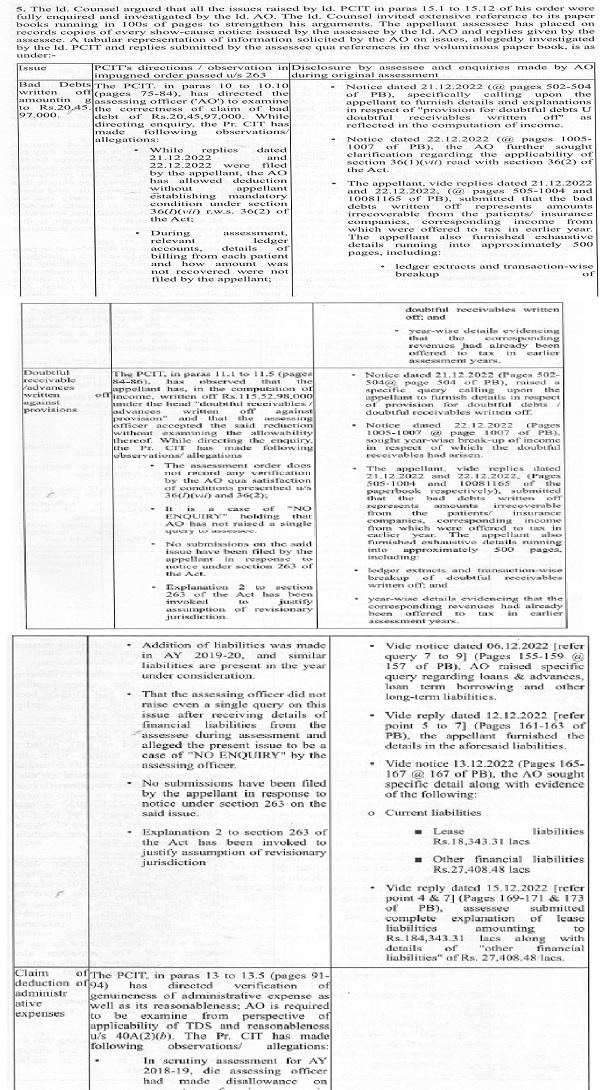
–
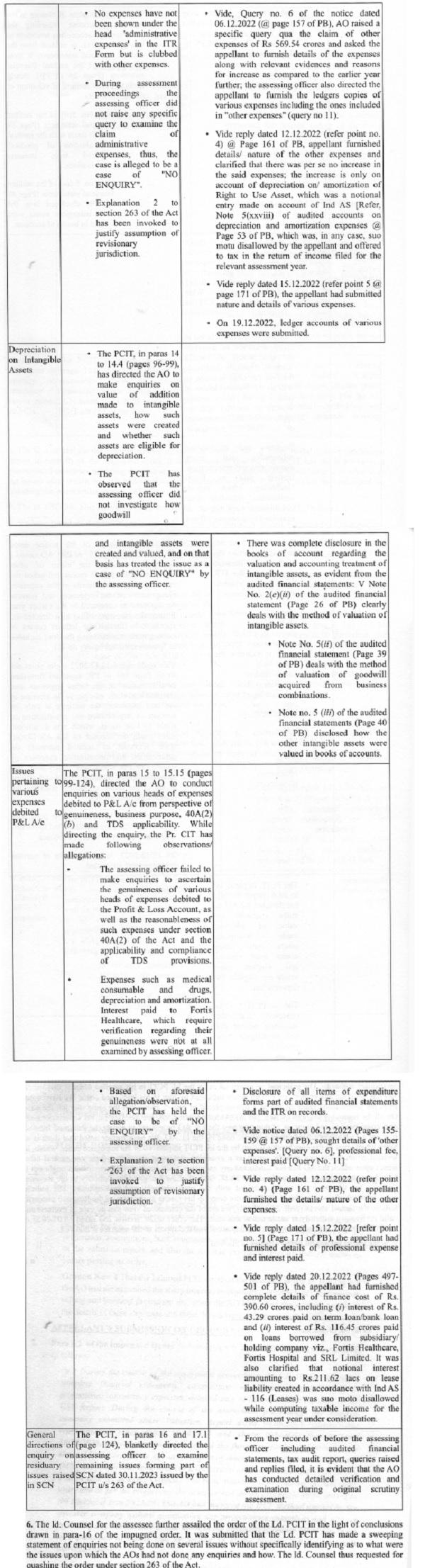
8.5. In view of above material facts by following the judicial precedents it is held that the findings of Ld. PCIT that the ld. AO has not examined legal, professional selling and business promotion expenses as to whether the same were incurred exclusively for the purpose of business being illegal are set aside. Ground of Appeal No. 4 is allowed.
9. Ground of Appeal No. 1 & 2, 5 to 11 being not pressed are left open.
10. In the result, appeal filed by the Assessee is allowed.
Order pronounced in the open court on 12thNovember, 2026