Summary: CTC optimisation involves much more than increasing the monthly salary credited to an employee’s bank account. An effective compensation structure should balance take-home salary, legitimate income-tax savings, statutory benefits and long-term wealth creation. Under the Income-tax Act, 2025, applicable from Tax Year 2026-27, employees should compare the old and new tax regimes after considering salary components, eligible exemptions, deductions, employer contributions and personal financial commitments. Basic salary, House Rent Allowance, Provident Fund, employer National Pension System contributions, taxable perquisites and reimbursements can significantly influence both current disposable income and future financial security. The article explains the distinction between Cost to Company, gross salary and net take-home salary, and examines how compensation can be structured within applicable legal and payroll requirements. It also discusses the tax treatment of employer NPS contributions, HRA eligibility, retirement benefits and the importance of selecting investments based on financial objectives rather than tax deductions alone. Three approaches to compensation planning are considered: cash-flow-oriented, retirement-oriented and balanced structures. The article additionally provides a practical CTC optimisation checklist, evaluates different employee profiles and identifies common mistakes, including assuming that higher CTC automatically means higher take-home salary, selecting a tax regime without calculations and ignoring future tax consequences. The central principle is that salary optimisation should be based on actual tax computations, cash-flow requirements, risk protection, retirement planning and the employee’s individual circumstances rather than generic salary percentages.
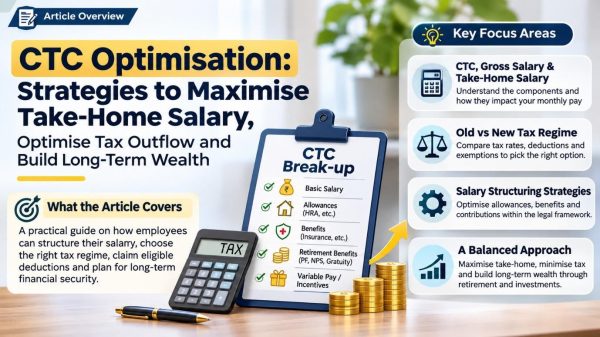
CTC Optimisation: Strategies adopted to Maximise Take-Home Salary, Optimise Tax Outflow and Build Long-Term Wealth
- Introduction
- 1. Understanding CTC, Gross Salary and Take-Home Salary
- 2. Comparing the Old and New Tax Regimes
- 3. Optimising the Basic Salary Component
- 4. House Rent Allowance
- 5. Employer Provident Fund and National Pension System
- 6. Evaluation of Perquisite and Employer Benefits
- 7. Tax-Saving Investments: Do Not Invest Only to Save Tax
- 8. Comparing Three Type of CTC Structures
- 9. A Practical CTC Optimisation Checklist
- 10. CTC Optimisation for Different Employee Profiles
- 11. Common Mistakes in CTC Optimisation
- 12. Frequently Asked Questions
- Conclusion
Introduction
Why two employees having same Cost to Company (CTC) may receive different monthly salaries in their bank accounts? Or
Why an employee with a higher salary package may not necessarily be better off financially than someone earning a lower package?
The answer lies in the various factors as provided below:
- structuring of compensation,
- the income-tax regime opted by the employee,
- statutory deductions and exemptions claimed,
- employer-provided benefits and individual financial planning.
Effective salary optimisation requires a broader approach. It should balance three objectives:
- Maximising monthly disposable income.
- Minimising income tax through legitimate and appropriate tax planning.
- Building long-term wealth through retirement benefits, insurance and suitable investments.
An employee who focuses exclusively on monthly take-home salary may miss valuable retirement benefits by not investing in tax saving or other investment instruments. Similarly, an employee who invests solely to claim tax deductions may unnecessarily block the monthly salary in unsuitable financial products.
1. Understanding CTC, Gross Salary and Take-Home Salary
Before restructuring a salary package, it is essential to understand the difference between CTC, gross salary, taxable salary and net take-home salary.
Cost to Company (CTC)
CTC represents the employer’s total cost of employing an individual. Depending on the employer’s compensation policy, it may include:
- Basic salary and allowances.
- Performance-linked incentives and bonuses.
- Employer’s contribution to the Provident Fund.
- Employer’s contribution to the National Pension System (NPS).
- Gratuity cost.
- Medical insurance premiums and other employee benefits.
- Other employment-related benefits included in the compensation package.
Not every item included in CTC is paid to the employee in cash and not every item is considered as a part of income of employee.
Gross salary
Gross salary generally represents the total salary (monetary and non-monetary) before deductions payable to an employee as per the offer letter signed and agreed between employer and employee. It is generally including Basic Salary, House Rent Allowance, Special Allowance etc.
Net take-home salary
Net take-home salary is the amount available to the employee after payroll deductions such as Employees Provident Fund, Withholding Tax / TDS, Professional Tax (where applicable) and other authorised deductions.
A simplified formula is:
CTC (−) employer costs not paid as monthly cash = cash compensation before employee deductions.
Cash compensation (−) employee deductions (−) applicable tax withholding = monthly take-home salary.
The reconciliation should be prepared annually and then translated into a monthly estimate. Variable pay, reimbursements and annual benefits should be shown separately rather than assumed to be paid evenly each month.
2. Comparing the Old and New Tax Regimes
The choice of tax regime can materially affect the benefits of salary restructuring.
For Tax Year 2026-27 onwards, the Income-tax Act, 2025 applies. The relevant tax rates, deductions, exemptions and procedural requirements should be evaluated under the law applicable to that tax year 2026-27 onwards.
New tax regime under section 202 of the Income-tax Act 2025
The new tax regime generally offers concessional slab rates but restricts several deductions and exemptions available under the old tax regime.
Its principal advantages may include:
- Lower tax rates across specified income slabs.
- Standard deduction for eligible salaried taxpayers.
- Potential deduction for eligible employer contributions to NPS.
- Reduced dependence on certain conventional tax-saving investments.
For an eligible resident individual, the rebate and marginal-relief provisions may also materially affect the final tax liability.
Old tax regime under section 123 read with Schedule-XV of the Income-tax Act 2025
The old tax regime may be beneficial for employees who qualify for substantial exemptions and deductions, subject to the applicable conditions.
These may include:
- House Rent Allowance (HRA) exemption for the rent paid.
- Eligible investments and contributions under section 123 read with Schedule-XV of the Income-tax Act, 2025 (section 80C of the Income-tax Act, 1961).
- Eligible health-insurance deductions.
- Certain eligible home-loan benefits.
- Eligible personal NPS contributions and other permitted deductions.
Further, the above tax deductions and exemptions are not available under the new tax regime.
Which tax regime should an employee choose?
Choosing a tax regime depends on various factors including deductions/exemptions claimed, actual net cash outflow, situation of the employee, investment approach to be adopted by the employee.
An employee with substantial eligible HRA exemption, qualifying investments and other deductions may find the old tax regime more beneficial than new tax regime. Another employee with limited deductions may find the new tax regime more efficient.
The appropriate method is to calculate the tax payable under both tax regimes using the same income assumptions and compare the final tax liability.
The employee should not choose a regime merely because it has lower headline tax rates or allows a particular deduction.
Further, opting a particular tax regime also affects your monthly cash outflow in the form of investments, expenses, taxes etc which is generally not considered by the employee while choosing a tax regime.
3. Optimising the Basic Salary Component
Basic salary is an important component because it can influence the calculation of other salary-related benefits.
Depending on the applicable rules and employment terms, Basic Salary may affect:
- Provident Fund contributions
- Gratuity calculations
- HRA exemption calculations
- Certain retirement benefits including leave encashment etc
A higher Basic Salary may increase employee PF contributions, thereby reducing monthly take-home salary, while potentially increasing certain retirement benefits.
Conversely, an artificially low Basic Salary may not be a viable solution because statutory requirements, applicable wage definitions, PF obligations, actual contractual compensation and the employer’s policies must be considered.
4. House Rent Allowance
HRA can be a significant component of salary structuring for employees who pay rent. Further, HRA is not automatically tax-free merely because it appears as a separate salary component. The employee must actually pay the rent and maintain appropriate supporting records including rent agreement, rent receipts, PAN of landlord etc. The exemption may be affected by a change in residence, rent, salary or HRA during the year.
Under the old tax regime, the eligible HRA exemption is generally determined by reference to the actual HRA received, eligible rent paid after the prescribed adjustment, and the applicable percentage of salary based on the employee’s place of residence.
Therefore, an employee paying rent should compare the actual tax impact under both regimes rather than assuming that HRA automatically reduces taxable salary.
5. Employer Provident Fund and National Pension System
Employer-funded retirement benefits can be an important part of a tax-efficient compensation package.
Employer Provident Fund
Employer PF contributions build retirement savings. However, the employer’s contribution may form part of CTC without being available as monthly cash.
The tax treatment of employer contributions and related annual accretions is subject to the applicable provisions under the Income-tax Act 2025.
Employee PF contributions, meanwhile reduce the current take-home salary but build retirement assets as well. Further, their tax treatment depends on the applicable tax regime.
Employer NPS contribution
Employer NPS contributions may provide an effective retirement-planning opportunity.
Subject to eligibility and the applicable statutory conditions, employer contributions may qualify for a deduction under section 124 of the Income-tax Act 2025 (section 80CCD(2) of the earlier Income-tax Act, 1961).
For employees under the new tax regime, eligible employer NPS contributions can be particularly relevant because many tax deductions are restricted under the said tax regime. However, employees should evaluate the long-term retirement objective, investment restrictions and withdrawal rules before choosing this option.
Further, the contribution limit and the tax deduction depend upon the category of employer and applicable tax regime.
Important: Employer NPS should be considered only after confirming that the employer permits it within the CTC structure and that the contribution is treated correctly for payroll and tax purposes.
Summary (NPS Deduction for Employer Contribution)
| Type of Employee | Tax Regime | Maximum Deduction Available (%) |
|---|---|---|
| Central Government or State Government | New Tax Regime | 14% |
| Central Government or State Government | Old Tax Regime | 14% |
| Other than Central Government or State Government | New Tax Regime | 14% |
| Other than Central Government or State Government | Old Tax Regime | 10% |
6. Evaluation of Perquisite and Employer Benefits
The salary optimisation should not stop at basic salary, HRA, PF and NPS. It will also include various benefits or reimbursements provided by the employer and it may include the below:
- Employer-provided accommodation or rent directly paid by the employer on behalf of employee;
- Company car or transport-related benefits and the applicable perquisite valuation;
- Meal facilities or vouchers, subject to the conditions and limits in force;
- Telephone, internet or other business-use reimbursements supported by appropriate records;
- Employer-paid insurance and other benefits;
- Home leave expenses reimbursed by the employer;
- Leave travel benefits where the statutory conditions are met;
- Reimbursement of genuine official expenditure, distinguished from personal expenses.
These items should not be considered as tax free merely they are reimbursements or employee benefits. It’s taxability and conditions for non-taxability needs to be carefully evaluated as per the provisions contained in Income-tax Act, 2025 read with Income-tax Rules, 2026.
7. Tax-Saving Investments: Do Not Invest Only to Save Tax
One of the most important principles of salary optimisation is that tax savings should support financial goals rather than dictate investment decisions.
Consider the following categories:
| Investment or benefit | Primary objective | Key consideration |
|---|---|---|
| Employee PF | Retirement savings | Reduced current cash flow and withdrawal conditions |
| Public Provident Fund (PPF) | Long-term savings | Lock-in and applicable contribution limits |
| Equity Linked Saving Scheme (ELSS) mutual funds | Equity-linked investment and potential eligible tax deduction | Market risk and statutory lock-in |
| Personal NPS | Retirement planning | Withdrawal restrictions and regime-specific tax treatment |
| Health insurance | Protection against medical expenses | Coverage requirements and eligible deduction conditions |
| Term Life insurance | Financial protection for dependants | Adequate cover, premiums and policy terms |
| Home-loan Repayment | Housing and debt reduction | Interest cost, liquidity and eligibility for tax benefits |
The tax benefit of a personal investment depends on the applicable tax regime and statutory provisions. A deduction available under the old tax regime should not be assumed to be available under the new tax regime.
Moreover, the value of an investment should be assessed by considering its purpose, expected return, risk, liquidity, charges and future tax treatment.
For example – Investing in an unsuitable insurance policy merely to claim a deduction may create a long-term financial commitment without adequately meeting the employee’s protection or investment needs.
The employee should first determine how much to allocate to emergency savings, insurance, retirement and other financial goals. Tax-efficient investment choices should then be made within that framework.
8. Comparing Three Type of CTC Structures
An effective analysis should compare alternative structures while keeping the total employer cost constant.
Structure A: Cash-flow oriented
A larger proportion of the package is allocated to fixed cash salary, subject to applicable statutory requirements. This may suit an employee who needs higher monthly disposable income, is managing debt or is building an emergency fund. However, the employee should separately plan for retirement, insurance and other financial goals.
Structure B: Retirement oriented
The package includes greater eligible employer-funded retirement contributions, where permitted by the employer and applicable law. This can support long-term wealth accumulation and may provide tax benefits. The trade-off is that some compensation is directed towards retirement rather than current spending.
Structure C: Balanced structure
The package combines fixed cash compensation, statutory benefits, eligible employer contributions, appropriate insurance and personal investments. This structure aims to balance current financial needs with long-term financial security. It is not necessarily the best choice for every employee. The outcome depends on the individual’s income, age, financial commitments, retirement horizon, tax regime and investment preferences.
Here is the summary of three structure that may be adopted by employees according to their current requirements and long term investment planning:
| Component | Structure A | Structure B | Structure C |
|---|---|---|---|
| Cash Salary | Higher | Lower | Moderate |
| Employer NPS | NIL | Higher | Moderate |
| Employer PF | NIL / As Applicable | As applicable | As applicable |
| Other Investments | NIL | Higher | Moderate |
| Monthly cash flow | Higher | Lower | Balanced |
| Retirement accumulation | Lower | Higher | Moderate |
9. A Practical CTC Optimisation Checklist
Before accepting an offer or requesting a restructuring, an employee should:
- Obtain a detailed annual CTC breakup.
- Identify guaranteed salary, variable pay and deferred compensation separately.
- Reconcile employer contributions and non-cash benefits.
- Calculate taxable salary under the applicable law.
- Compare tax liability under the available tax regimes.
- Check eligibility for HRA, standard deduction and employer NPS benefits.
- Evaluate the impact of PF and other statutory contributions.
- Calculate annual and monthly take-home salary.
- Consider emergency funds, insurance, retirement and other financial goals.
- Review liquidity, lock-in periods and future tax consequences of investments.
- Confirm that the proposed salary structure complies with applicable employment, payroll and statutory requirements.
- Revisit the calculation when salary, tax rules, financial commitments or employer policies change.
10. CTC Optimisation for Different Employee Profiles
| Employee profile | Likely priority | Review focus |
|---|---|---|
| Early-career employee with education/personal loan | Liquidity and debt reduction | Cash salary, mandatory PF, emergency reserve; avoid locking excess funds |
| Employee in a higher marginal tax bracket | Tax efficiency plus wealth accumulation | Regime comparison between tax regimes, eligible employer NPS, perquisites and retirement horizon |
| Employee approaching retirement | Retirement adequacy and protection | PF/NPS accumulation, retirement benefits, insurance and post-retirement cash flow |
These are the overview of employee profile which are segregated into three profiles. However, there can be more categories of employee profile. The same employee may move from a cash-flow priority to a retirement priority as debt, family commitments and career stage change.
11. Common Mistakes in CTC Optimisation
Mistake 1: Assuming that higher CTC means higher take-home salary – Employer contributions, variable pay and non-cash benefits can reduce the proportion of CTC available as monthly cash.
Mistake 2: Choosing a tax regime without calculation – The correct choice depends on the employee’s actual taxable income and eligible exemptions and deductions.
Mistake 3: Treating every allowance as tax-free – The tax treatment depends on the nature of the payment and the applicable provisions. Merely changing the name of a salary component does not make it exempt.
Mistake 4: Ignoring retirement benefits – Maximising cash today without considering retirement accumulation may create a future savings gap.
Mistake 5: Investing only to claim deductions – A tax deduction does not automatically make an investment suitable or profitable.
Mistake 6: Ignoring future tax implications – Withdrawals, maturity proceeds, capital gains and pension receipts may have their own tax treatment.
Mistake 7: Confusing TDS with final tax liability – Tax deducted by the employer is a withholding mechanism. The employee’s final liability depends on total taxable income, eligible claims and applicable law.
12. Frequently Asked Questions
1. Is the highest take-home salary always the best option?
No. A higher take-home salary may provide greater immediate flexibility, but it should be balanced against retirement benefits, insurance, liquidity and long-term financial goals.
2. Is the new tax regime always better for salaried employees?
No. It may be advantageous for employees with limited eligible deductions, but the outcome should be established by comparing the final tax liability under both regimes.
3. Can salary restructuring reduce income tax?
It can, where the revised structure legitimately qualifies for exemptions, deductions or tax-efficient employer benefits under the applicable law. Restructuring cannot create an exemption where the law does not provide one.
4. Should employees choose employer NPS contributions?
Employer NPS may be beneficial for eligible employees, particularly when the applicable deduction is available under their tax regime. However, the employee should consider retirement objectives, contribution limits, withdrawal restrictions and the reduction in available cash compensation.
5. Should employees invest in every tax-saving instrument available?
No. Investment decisions should be based on financial goals, risk tolerance, liquidity requirements, insurance needs and expected returns. Tax benefits should be one consideration, not the sole reason for investing.
Conclusion
CTC optimisation is not simply a salary-breakup exercise. It is a combination of compensation planning, tax analysis, cash-flow management and long-term financial planning.
A well-designed salary structure should enable employees to understand what they receive today, what they contribute towards future security and how much tax they legitimately pay under the applicable law.
The most effective approach is to compare alternative structures using actual calculations, rather than relying on generic salary percentages or assumptions about tax-free allowances.
Ultimately, the ideal CTC structure is the one that provides an appropriate balance between monthly take-home salary, legitimate tax efficiency, financial protection and long-term wealth creation.
********
Author can be reach out for any queries at email ID – [email protected]
Disclaimer: This article serves an educational purpose and should not be considered as professional advice. Consultation with a qualified individual is recommended before making any decisions based on the content provided. The author bears no responsibility for any actions taken based on this article.