In re Ramasamy Yogasundari (Sri Kumaran Paper Bags) (GST AAR Tamil Nadu)
Summary: The Tamil Nadu Authority for Advance Ruling examined the GST classification and tax treatment of kraft paper bags, greaseproof paper bags and glassine paper bags manufactured by Sri Kumaran Paper Bags. The applicant manufactured plain or printed, uncoated and unbranded paper bags without handles, plastic content or lamination, using paper and adhesive glue. These products were supplied for packaging goods by pharmaceutical stores, grocery shops, small traders and sweet shops. The applicant sought clarification on whether the products qualified for the concessional 5% GST rate introduced following the 56th GST Council meeting.
The applicant initially referred to HSN 48193000, covering sacks and bags having a base width of 40 cm or more, and argued that its biodegradable products should qualify under Serial No. 319 of Schedule I to Notification No. 9/2025-Central Tax (Rate), dated 17 September 2025. During the proceedings, physical samples and supporting biodegradability test reports were submitted. The Authority examined the materials, manufacturing process and relevant tariff descriptions and concluded that the products were appropriately classifiable under HSN 48194000, covering other sacks and bags, including cones.
On the applicable GST rate, the Authority held that the products were not exempt under Notification No. 10/2025-Central Tax (Rate). However, they qualified as paper bags covered by Serial No. 319 of Schedule I to Notification No. 9/2025-Central Tax (Rate), which prescribed a concessional rate of 2.5% CGST. Accordingly, kraft, greaseproof and glassine paper bags attracted 5% GST in total, comprising 2.5% CGST and 2.5% SGST. Their classification under HSN 48194000 did not prevent application of the specific concessional entry for paper bags.
The Authority also considered the applicant’s entitlement to input tax credit. Since the manufactured products constituted taxable outward supplies, it held that the applicant was eligible to claim ITC on inputs and input services used in their manufacture, subject to satisfying the conditions prescribed under Section 16 of the CGST and TNGST Acts, 2017. The ruling therefore confirmed the classification, applicable GST rate and conditional ITC eligibility for all three categories of paper bags.
FULL TEXT OF ORDER OF AUTHORITY OF ADVANCE RULING, TAMIL NADU
M/s Sri Kumaran Paper Bags, having place of business at 53, VOWWAL KADU, CHENNIMALAI, ERODE- 638051 Tamil Nadu (hereinafter called as the `Applicant’) is registered under the Goods and Service Tax Act, with GSTIN 33AAHPY6199H1Z1. They have filed an application for Advance Ruling under Sec.97 of the CGST Act, 2017 and the corresponding provision of the TNGST Act, 2017. The Applicant has made the payment of Rs.10,000/- towards application fees, under sub rule (1) of Rule 104 of CGST Rules, 2017 and TNGST Rules, 2017.
2.1 Statement of relevant facts having a bearing on the questions raised:
The Applicant states that they are engaged in the business of manufacturing Kraft paper bags, Greaseproof paper bags and Glassine paper bags (impugned products), used for the purpose of packaging. They state that the above said paper bags are made using Kraft/Greaseproof/Glassine paper and that they use adhesive glue for the same; that, the paper bags are either plain/printed, uncoated, without lamination or plastic content, unbranded and without handles.
They state that the kraft paper bags are primarily used for packaging, in pharmaceutical stores, grocery shops and by small traders; that the greaseproof and glassine paper bags are used in sweet shops for packaging sweets etc. and they offer a range of practical benefits including durability, versatility and health advantages in food handling.
They further state that these bags are eco friendly with no harmful ingredients and provide a more sustainable alternative to plastic bags by decomposing naturally, reducing landfill waste and being compostable. They also mention that manufacture of these bags are carried out as a cottage industry, across the country and a large section of the small scale workers depend on the same for their livelihood.
2.2 The Applicant state that, their products fall under the Chapter 48 of the Customs tariff, more specifically, under “CSH 4819 3000- Sacks and bags having a base of a width of 40 cm or more”;
That, however, pursuant to the recommendations of the 56th GST Council held in September, 2025, ‘paper bags and biodegradable bags’ under Chapter 48, were notified to attract 5% GST as per S.No. 319 of Schedule I of Notification 9/2025-CT (R) dated 17.09.2025;
That, S.No. 185 of Schedule II of the said Notification covers goods falling under the CSH 4819 (except 481910, 4819 20) attracting 18% GST;
That, their products, falling under 4819 3000, though covered by S.No.185 of Schedule II (18% GST), are biodegradable and hence should attract GST @ 5% as per S.No. 319 of Schedule I.
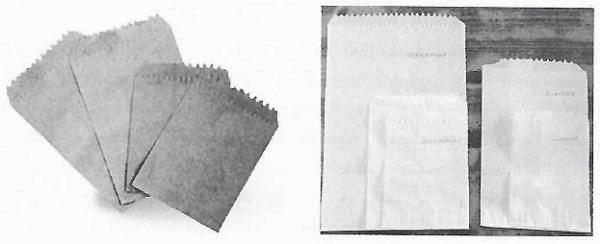
In this context, they seek clarification as to whether their products would be covered under S.No. 319 of Schedule I to Notification 9/2025- CT (R). The applicant also shared the following pictures of their products.
3. The applicant has therefore, sought an Advance Ruling, under Sec.97(2) (a), (b) and (d) of the CGST Act, 2017, on the following questions:
Classification & applicability of Notification
Whether the applicant’s products, Kraft paper bags, Greaseproof paper bags and Glassine Paper bags are exempt from GST or classifiable under Chapter 48 Paper sacks/Bags and Biodegradable bags, attracting 2.5% as per Schedule I of the Notification. 9/2025-CT (R) dated 17.09.2025?
Rate of tax
If not, what is the appropriate rate of tax?
ITC
If the products are exigible to GST, whether the applicant is eligible to avail ITC?
4.1 Applicant’s interpretation of law:
The Applicant states that the Kraft paper bags, Greaseproof paper bags and Glassine paper bags manufactured by them are made with Kraft paper, Greaseproof paper and Glassine Paper, respectively, using adhesive glue. They state that the paper bags are uncoated, without lamination or any plastic content and without handles.
4.2 As per the recommendation of the 56th GST Councils Meeting, GST rate for paper sacks and biodegradable bags was reduced to 5%. Accordingly, S.No. 319 of Schedule I of Notification 9/2025-CT (R) dated 17.09.2025, notified 5% GST on ‘paper bags and biodegradable bags’ falling under Chapter 48 and S.No. 185 of Schedule II of the said Notification covered goods falling under the CSH 4819 (except 481910, 4819 20) @18% GST.
The Applicant states that, though their products fall under “CSH 4819 3000 – Sacks and bags having a base of a width of 40 cm or more”, they are compostable, eco-friendly with no harmful ingredients and provide a more sustainable alternative to plastic bags by decomposing naturally and reducing landfill waste. Hence, they state that, even though their products (4819 3000) are covered by Schedule II (18% GST), as they are biodegradable, they should attract GST cJ 5% only, as per S.No. 319 of Schedule I of the said notification.
5. The applicant is under the administrative control of State. The concerned authorities of the Centre and State were addressed to report if there are any pending proceedings against the applicant on the issues raised by the applicant in the ARA application and for comments on the issues raised. The Assistant Commissioner, (ST) (FAC), Chennimalai Asst. circle, Erode vide letter in Rc.No.683/2025/A2 dated 27.02.2026, has submitted a report on the same. This report, limited to the verification of the manufacturing process and product characteristics, has been submitted based on the physical verification conducted at the premises of the applicant.
It has been reported that the applicant uses Kraft/Greaseproof/Glassine paper to manufacture the paper bags; that, the above raw materials are cut to size and converted to bags using adhesive gum and as such no plastic content or lamination or synthetic lining are used in the manufacture; that, the applicant uses own machinery and printing materials for the said manufacture. Further, the Assistant Commissioner, inter alia, submitted copies of tax invoices issued in the month of June/July 2026, by the applicant to various customers, for supply of their products that were classified under HSN 4819 with GST @ 5%. Since there has been no mention on any pending proceedings, it is presumed that there are no pending proceedings against the applicant on the issues raised by the applicant in the Advance Ruling application.
6. Personal Hearing
The applicant was given an opportunity to be heard in person on 21.07.2026. Shri D.Siva Shanmugam, GSTP, appeared for the personal hearing as the authorized representative (AR) of M/s. Kumaran Paper Bags. He submitted that the applicant manufactures paper bags made of kraft/greaseproof/glassine paper, using adhesive gum; that inputs- paper rolls are purchased from various manufacturers; that, the paper bags are plain and/or printed, uncoated, unbranded and without handles and are primarily used for packaging of goods in pharmaceutical stores, grocery shops, small traders as well as for packaging of sweets. Physical samples of all the three products were produced before the Authority at the time of the personal hearing on 21.07.2026.
The AR further stated that, at present, the applicant classified their product under HSN 4819 3000 attracting GST @ 18% and had sought clarification on the classification and applicable rate of GST on the paper bags supplied by the applicant, in the light of reforms introduced in GST 2.0, vide Notification 9/2025-CT (R) (refer S.no. 319).
The AR reiterated the submissions made in their application for advance ruling. They further stated that their product was made from pulp which is a biodegradable material and sought three week time to submit additional necessary documents – (i) proof of biodegradability of the inputs used from their suppliers; (ii) chartered engineer’s certificate certifying the process of manufacture and (iii) copy of invoices of their output supply as well as a list of their suppliers.
Post PH, a mail dated 07.08.2026 was received from the applicant, wherein they had submitted a test report, indicating that the impugned products are bio degradable. Apart from this, another identical certificate dated 05.08.2026 from an Associate Professor, Department of Microbiology of the PSG College of Arts &, Science, Coimbatore, was also submitted. Both of these documents reported that the test was conducted to find out the Biodegradability of the samples and the parameters included weight loss (%), visual changes (Colour, fragmentation) and Microbial growth.
7. Discussions and Findings:
7.1 We have carefully examined the submissions made by the applicant in their advance ruling application and the submissions made during the personal hearing and additional documents submitted thereafter. We have also considered the issue involved, the relevant facts and the applicant’s submission/interpretation of law in respect of question on which the advance ruling is sought.
7.2 We find that the query is liable for admission as it gets covered under Section 97(2)(a), Section 97(2)(b) and Section 97(2)(d) of CGST/TNGST Act, 2017, under,
(a) Classification of any goods or services or both;
(b) Applicability of a notification issued under the provisions of the CGST/
TNGST Act, respectively and
(d) Admissibility of input tax credit of tax paid or deemed to have been paid.
7.3 We find that the applicant, M/s Sri Kumaran Paper Bags, having place of business at 53, VOWWAL KADU, CHENNIMALAI, ERODE- 638051 Tamil Nadu, is registered under the Goods and Service Tax Act, with GSTIN 33AAHPY6199H1Z1. The Applicant is engaged in the business of manufacturing Kraft/ Greaseproof/ Glassine paper bags made of such paper using adhesive glue. We find that these paper bags are either plain/printed, uncoated, without lamination or plastic content, unbranded and without handles. They are largely supplied to pharmaceuticals/ groceries/ sweet shops for packaging the goods. The questions that require ruling in the instant application, are,
1. Whether the manufactured product – Kraft paper bags are exempt from GST or is it classifiable under Chapter 48 – Paper sacks/Bags and Biodegradable bags, attracting 2.5% as per Schedule I of the Notification 9/2025-CT (R) dated 17.09.2025?
- If not, what is the appropriate rate of tax?
- If the above product is exigible to GST, whether the applicant is eligible to avail ITC?
2. Whether the manufactured product – Greaseproof paper bags are exempt from GST or is it classifiable under Chapter 48 – Paper sacks/Bags and Biodegradable bags, attracting 2.5% as per Schedule I of the Notification. 9/2025-CT (R) dated 17.09.2025?
- If not, what is the appropriate rate of tax?
- If the above product is exigible to GST, whether the applicant is eligible to avail ITC?
3. Whether the manufactured product – Glassine Paper bags are exempt from GST or is it classifiable under Chapter 48 – Paper sacks/Bags and Biodegradable bags, attracting 2.5% as per Schedule I of the Notification. 9/2025-CT (R) dated 17.09.2025?
- If not, what is the appropriate rate of tax?
- If the above product is exigible to GST, whether the applicant is eligible to avail ITC?
We shall now proceed to analyse the facts on hand with the provisions of law and answer each one of the above questions on Classification, Rate of tax and ITC availability.
7.4.1 Classification of Kraft paper bag, Greaseproof paper bag, Glassine paper bag:
We find that, the applicant’s products, for which advance ruling has been sought are, ‘bag’ made out of (i) kraft paper, (ii) greaseproof paper and (iii) glassine paper. The applicant submits that these bags are manufactured using kraft paper, greaseproof paper and glassine paper, respectively, using glue. They also state that the bags are unbranded, without handles and also do not have a base width of more than 40 cm. Further, we find that,
- ‘Kraft paper’ used in the manufacture of Kraft paper bag, is a strong, durable paper made from wood pulp. It is mainly used for packaging, wrapping-parcel wrapping/food wrapping and also in the manufacture of heavy-duty industrial sacks, grocery bags, corrugated box liners, eco-friendly carryout bags.
- ‘Grease Proof Paper’ used in manufacture of Greaseproof paper bag, is an impermeable paper, specially engineered to prevent oils and fats from seeping through. This property makes it an ideal choice for cooking, baking, and food packaging. The grease-resistant properties, durability, and adaptability makes it an essential and convenient constituent in food preparation/packaging. Greaseproof paper is made by compressing cellulose fibers through a process called calendering, which creates a dense, low-porosity surface.
- ‘Glassine paper’ used in the manufacture of Glassine paper bags, is a smooth, glossy, dense, semi-transparent paper, made from highly refined pulp. It is a specialty paper that is air/water/ grease-resistant and is widely used for packaging, art protection, food wrapping etc. Glassine paper is made by highly refining cellulose pulp and then super-calendering the dried sheet through alternating steel and fiber rolls to increase density and to create the smooth, dense, translucent, and grease-resistant finish. Glassine paper is used widely for protective, archival, food-safe, and specialty packaging.
These basic facts that the impugned products are made out of natural plant fibers, establish that the impugned products are goods made out of Paper. Chapter 48 of the HSN covers ‘Paper and paperboard; articles of paper pulp, of paper or of paperboard’ and the Chapter Sub Heading-4819 covers within its scope, `Cartons, boxes, cases, bags and other packing containers of paper, paperboard, cellulose wadding or webs of cellulose fibres; box files, letter trays and similar articles, of paper or paperboard of a kind used in offices, shops or the like.’ Thus, it is seen that the impugned products on hand, being paper bags, are covered under this CSH. For ease of reference, the relevant portion of Chapter 48 and the connected HSN notes is extracted here.
| 4819 | Cartons, boxes, cases, bags and other packing containers of paper, paperboard, cellulose wadding or webs of cellulose fibres; box files, letter trays and similar articles, of paper or paperboard of a kind used in offices, shops or the like | |
|---|---|---|
| 4819 10 | – | Cartons, boxes and cases, of corrugated paper or paperboard: |
| 4819 1010 | — | Boxes |
| 4819 1090 | — | Other |
| 4819 20 | – | Folding cartons, boxes and cases, of non-corrugated paper or paperboard: |
| 4819 2010 | — | Cartons, boxes, cases, intended for packing of match sticks |
| 4819 2020 | — | Boxes |
| 4819 2090 | — | Other |
| 4819 3000 | – | Sacks and bags, having a base of width of 40 cm or more |
| 4819 4000 | – | Other sacks and bags, including cones |
| 4819 50 | – | Other packing containers, including record sleeves: |
| 4819 5010 | — | Made of corrugated paper or paperboard |
| 4819 5090 | — | Other |
| 4819 6000 | – | Box files, letter trays, storage boxes and similar articles, of a kind used in offices, shops or the like |
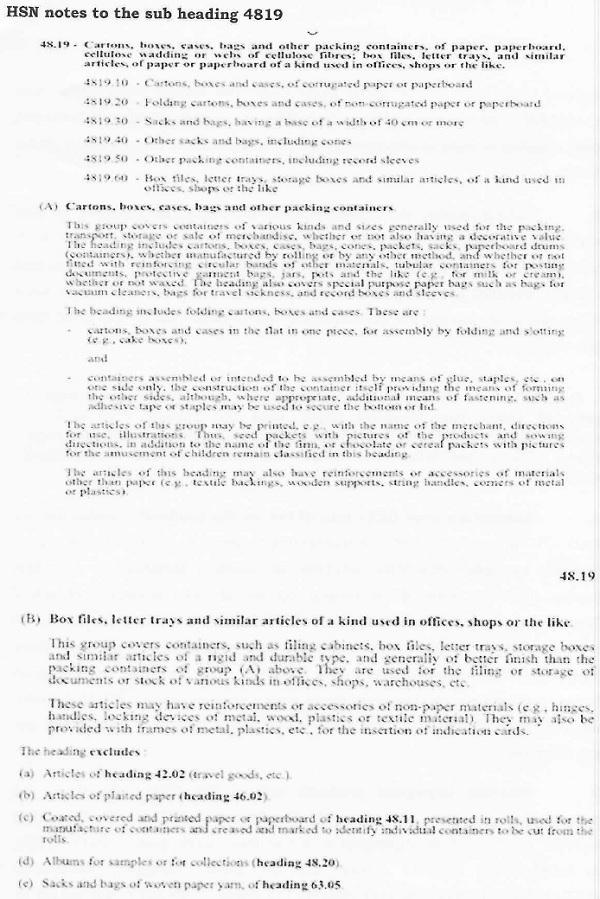
Corelating the characteristics of the impugned products with the HSN notes to sub heading of 4819, we find that the impugned products, `kraft paper bags’ `greaseproof paper bags’ and glassine paper bags’ find specific entry under HSN Code ‘48194000- Other sacks and bags, including cones, made of paper, paperboard, cellulose wadding or webs of cellulose fibres’ and therefore, we classify them under 48194000.
7.4.2 Having decided the classification of the impugned products, we now proceed to answer the three questions raised in respect of the three products- ‘Kraft paper bags’, ‘Greaseproof paper bags’ and ‘Glassine paper bags’. It is seen that each of this question has three similar sub-divisions. Therefore, in order to avoid repetition, we shall examine the queries in the sub divisions, for all the three types of bags, together.
7.5 Query 1: Whether the manufactured product – Kraft paper bags / Greaseproof paper bags/Glassine paper bags are exempt from GST or classifiable under Chapter 48 – Paper sacks/Bags and Biodegradable bags, attracting 2.5% as per Schedule I of the Notification. 9/2025-CT (R) dated 17.09.2025?
7.5.1 Exemption from GST/ rate of tax on the product: Notification No. 10/2025 -CT (R) dated 17.09.2025, (superseding Notification. 2/2017-CT (R) dated 28.06.2017) exempts intra-State supplies of goods mentioned in the said notification, from the whole of the central tax leviable thereon under section 9 of the Central Goods and Services Tax Act, 2017 (12 of 2017). Correspondingly, the TN state government has also issued a parallel notification to exempt intra-State supplies of goods, mentioned therein, from State tax. It is seen that the impugned products, kraft/grease proof/glassine paper bags classified under CSH 4819 4000, do not find entry in the above notification and hence we rule that they are not exempt from GST.
7.5.2 Whether impugned products attract 5% GST: Based on the recommendations of the GST Council, Notification 9/2025- CT (R) dated 17.09.2025, was issued in supersession of the Rate notification 1/2017- CT(R), which notifies the rate of central tax on goods. Similarly, Notification II(2)/CTR/1016(b-1)/2025 vide G.O. (Ms) No.132 dated 17.09.2025, was issued by the State Government of Tamil Nadu, notifying the state tax on goods, under seven schedules, specifying CGST/SGST rates of 2.5%, 9%, 20%, 1.5%, 0.125%, 0.75% and 14%, respectively.
On a plain reading of the above notification, we find that paper sacks/bags falling under Chapter 48, is covered under S.no. 319 of Schedule I, attracting GST @ 5% (extracted below).
Schedule I -2.5%
| S. No. | Chapter/Heading/ Sub-heading/Tariff item |
Description of goods | |
| 11) | (2) | (3) | |
| 319. | 39, 48 | Paper Sacks/Bags and bio-degradable bags | |
The rate of 5% GST, extended to paper sacks/bags and biodegradable bags falling under Chapter 39/48 vide entry 319, takes into account the taxability of both paper bags/sacks and biodegradable bags. The Government’s push towards promoting ecofriendly and environmentally friendly alternatives to plastics is evident from this reduced tax rate on paper bags and biodegradable bags falling under chapter 39.
- Paper bags made from natural plant fibers, biodegrades through the action of microorganisms such as fungi and bacteria and breaks down into organic matter, water and carbon di oxide, without leaving toxic microplastics in the environment.
- Biodegradable plastic bags manufactured from renewable plant-based materials or specialized polymers rather than fossil fuels, are eco-friendly and also break down naturally through microorganisms into water, carbon dioxide and biomass without leaving toxic or microplastic residues.
In view of the discussions and findings above, we hold that the impugned products, kraft/grease proof/ glassine paper bags classified under CSH 4819 4000, manufactured using `Kraft/Greaseproof/Glassine paper’ and adhesive glue, qualify as ‘Paper bags’, mentioned under S.No. 319 of Schedule I of the Notification 9/2025-CT (R) dated 17.09.2025, attracting 5% GST.
7.6 Query 2: If not, what is the appropriate rate of tax?
The impugned goods, Kraft/Greaseproof/Glassine paper bags attract GST (c–e.) 5% as per S.No. 319 of Schedule I of the Notification 9/2025-CT (R) dated 17.09.2025.
7.7 Query 3: Eligibility to avail ITC
The applicant’s next query is that, if the above products are exigible to GST, whether they are eligible to avail ITC? The eligibility and conditions to avail Input tax credit is specified under Section 16 of the CGST /TNGST Act, 2017. In as much as the impugned products are taxable at 5% GST, the applicant is eligible to avail input tax credit on the inputs/input services used in the manufacture of their outward supply, subject to satisfying all the conditions prescribed under Sec. 16 of the CGST/TNGST Act, 2017.
8. In view of the above, we rule as under:
RULING
1. Whether the manufactured product – Kraft paper bags are exempt from
Ans. GST or is it classifiable under Chapter 48 – Paper sacks/Bags and Biodegradable bags, attracting 2.5% as per Schedule I of the Notification. 9/2025-CT (R) dated 17.09.2025?
Ans. Kraft paper bags are not exempt from GST; they are classifiable under HSN 48194000 and attract GST at 5% (CGST 2.5% + SGST 2.5%)
- If not, what is the appropriate rate of tax?
Ans. Kraft paper bags, attract GST @ 5% as per S.No. 319 of Schedule I of the
Notification 9/2025-CT (R) dated 17.09.2025.
- If the above product is exigible to GST, whether the applicant is eligible to avail ITC?
Ans. Yes. The applicant is eligible to avail input tax credit on the inputs/input services used in the manufacture of their outward supply, subject to satisfying all the conditions prescribed under Sec. 16 of the CGST/TNGST Act, 2017.
2. Whether the manufactured product – Greaseproof paper bags are exempt from GST or is it classifiable under Chapter 48 – Paper sacks/Bags and Biodegradable bags, attracting 2.5% as per Schedule I of the Notification. 9/2025-CT (R) dated 17.09.2025?
Ans. Greaseproof paper bags are not exempt from GST; they are classifiable under HSN 48194000 and attract GST at 5% (CGST 2.5% + SGST 2.5%)
- If not, what is the appropriate rate of tax?
Ans. Greaseproof paper bags, attract GST @ 5% as per S. No. 319 of Schedule I of the Notification 9/2025-CT (R) dated 17.09.2025.
- If the above product is exigible to GST, whether the applicant is eligible to avail ITC?
Ans. Yes. The applicant is eligible to avail input tax credit on the inputs/input services used in the manufacture of their outward supply, subject to satisfying all the conditions prescribed under Sec. 16 of the CGST/TNGST Act, 2017.
3. Whether the manufactured product – Glassine Paper bags are exempt from GST or is it classifiable under Chapter 48 — Paper sacks/Bags and Biodegradable bags, attracting 2.5% as per Schedule I of the Notification. 9/2025-CT (R) dated 17.09.2025?
Ans. Glassine paper bags are not exempt from GST; they are classifiable under HSN 48194000 and attract GST at 5% (CGST 2.5% + SGST 2.5%)
- If not, what is the appropriate rate of tax?
Ans. Glassine paper bags, attract GST @ 5% as per S.No. 319 of Schedule I of
the Notification 9/2025-CT (R) dated 17.09.2025.
- If the above product is exigible to GST, whether the applicant is eligible to avail ITC?
Ans. Yes. The applicant is eligible to avail input tax credit on the inputs/input services used in the manufacture of their outward supply, subject to satisfying all the conditions prescribed under Sec. 16 of the CGST/TNGST Act, 2017.