Summary: The 57th GST Council, at its meeting on 8 October 2026, recommended the complete omission of Section 69 of the CGST Act, 2017, withdrawing the statutory power of GST officers to arrest persons for specified offences. The proposal accompanies significant changes to Section 132, including increasing the prosecution threshold to ₹5 crore, narrowing certain offences, rationalising imprisonment and removing the presumptive minimum sentence. While these measures seek to establish a progressive, trust-based tax administration, they raise important questions about enforcement against organised fake-invoice networks, fraudulent input tax credit claims and deliberate retention of tax collected from customers. The Supreme Court’s decision in Radhika Agarwal v. Union of India upheld the constitutional validity of GST arrest powers while insisting on strict safeguards against coercion, arbitrary arrest and forced recovery. This article examines the existing statutory framework, judicial safeguards, historical precedents and competing considerations of personal liberty and effective tax enforcement. It evaluates five alternative enforcement models, including complete abolition, restricted departmental arrest, committee-controlled authorisation and judicially approved arrest. The central issue is whether misuse requires eliminating the power altogether or retaining it under substantially stronger institutional and judicial controls. As on 23 October 2026, the Council’s recommendations had not become operative law, and Section 69 continued to apply.
Should GST Lose Its Power of Arrest?
A balanced look at the 57th GST Council’s proposal to omit Section 69 of the CGST Act — position as on 23 October 2026
- 1. The Proposal That Changes the Architecture
- 2. A Caveat: Section 69 Is Still the Law
- 3. What Section 69 Actually Does
- 4. Why Now? The Radhika Agarwal Backdrop
- 5. A Precision on the ₹1 Crore Threshold
- 6. Safeguards That Already Exist
- 7. Lessons from History and Sister Statutes
- 8. Will Deterrence Fall?
- 9. The Two Cases, Side by Side
- 10. Misuse Versus Necessity: The Real Question
- 11. Five Models, Not Two
- 12. Redesigning Section 69: A Practical Blueprint
- 13. Deterrence Cannot Rest on Fear of Arrest Alone
- 14. Conclusion: Weapon or Lock?
1. The Proposal That Changes the Architecture
On 8 October 2026, the 57th GST Council recommended what may be the most fundamental change yet to GST enforcement: complete withdrawal of the power of arrest, by omitting section 69 of the CGST Act, 2017.
It is not a stand-alone move. It sits inside a wider package to rationalise section 132, the prosecution provision:
| Subject | Present position | 57th Council proposal |
|---|---|---|
| Arrest by GST officers | Section 69 exists | Section 69 omitted entirely |
| Lowest prosecution threshold | ₹1 crore (limited category; see Part 5) | ₹5 crore |
| ₹5–10 crore | Existing higher bands | Up to 2 years, or fine, or both |
| Above ₹10 crore | Up to 5 years in the >₹5 crore band | Up to 5 years, or fine, or both |
| Minimum imprisonment | Six months, unless special reasons recorded | Removed |
| Section 132(1)(i) | An offence | Omitted |
| Section 132(1)(e) | Includes “evades tax” | “Evades tax” deleted |
| Section 132(1)(h) | Includes “any other manner deals with” | Wider expression deleted |
| Section 132(1)(c) | Wide ITC formulation | Narrowed to fraudulent ITC without receipt of goods/services or without invoice |
The stated aim is a “progressive and trust-based tax regime” that still retains deterrence against fraud. The implied bargain: deterrence will come from courts, not from the investigating officer.
Two questions collide here. Liberty: should an officer administering a tax law be able to deprive a person of freedom before adjudication or conviction, especially amid allegations that arrest is used to extract payment? Enforcement: if fake-invoice masterminds can never be arrested by the GST agency, has the law lost a vital investigative weapon?
Neither question can be answered in isolation. The better inquiry is whether the problem lies in the existence of the power or in its design, authorisation and exercise.
2. A Caveat: Section 69 Is Still the Law
The Council has only recommended omission. Section 69 survives until Parliament amends the CGST Act and the amendment is notified, with matching State GST amendments. The official announcement and the Government’s FAQs both call these “proposed” amendments. For every investigation running today, section 69 continues to govern arrest. The policy can be debated; the provision cannot be ignored.
3. What Section 69 Actually Does
Section 69 is not a general licence to arrest defaulters. The machinery is narrow:
| Step | Requirement |
|---|---|
| 1. Material | Investigation produces evidence |
| 2. Satisfaction | Commissioner has reasons to believe an offence under s.132(1)(a)–(d) is made out |
| 3. Category | The offence falls in the specified punishment bands (or repeat-offender provision) |
| 4. Authorisation | Written order authorising a named officer |
| 5. Arrest | Carried out with memo, written grounds, production before Magistrate within 24 hours |
The offences in play:
| Clause | Offence |
|---|---|
| 132(1)(a) | Supply without invoice, intending to evade tax |
| 132(1)(b) | Invoice without actual supply, leading to wrongful ITC/refund |
| 132(1)(c) | Availing ITC on such invoices, or fraudulently without invoice |
| 132(1)(d) | Collecting tax but not paying it to Government beyond three months |
In practice, this means fake-invoice rings, shell registrations, circular billing, fraudulent refunds and tax collected but pocketed. CBIC’s own instructions say arrest should not be used in technical cases involving a difference of opinion on interpretation of law.
Only offences under clauses (a)–(d) in the highest monetary band are cognizable and non-bailable (s.132(5)); everything else is non-cognizable and bailable. So the debate should not assume every GST demand carries a real threat of arrest. It does not.
4. Why Now? The Radhika Agarwal Backdrop
The Council’s official reasons are ease of living, trust-based administration and rationalised criminal consequences. It would be going too far to say the Council acted because courts found misuse. But the legal background is unmistakable.
In Radhika Agarwal v. Union of India (27 February 2025), the Supreme Court examined allegations that taxpayers were pressured into paying during investigation under the shadow of arrest. It noted that the Government’s own data gave some force to the contention, and held that voluntary-payment provisions cannot become a tool for recovery through force, coercion or threat of arrest.
Crucially, the Court did not strike down section 69. It upheld Parliament’s competence to provide for arrest, summons and prosecution as powers incidental to levying and collecting GST. It then “constitutionalised” the process:
- Reasons to believe must rest on material, not ipse dixit or suspicion.
- Arrest cannot be made to find out whether the conditions for arrest exist.
- Written grounds, D.K. Basu compliance and judicial scrutiny are required.
- Anticipatory bail is available even before an FIR where there is reasonable apprehension of arrest.
So deleting section 69 is a policy choice, not a constitutional compulsion. The judiciary’s message was: the power is permissible, but its exercise must be strictly controlled.
5. A Precision on the ₹1 Crore Threshold
The Council papers speak of raising the threshold “from ₹1 crore to ₹5 crore.” That is correct for the lowest band, but the ₹1–2 crore band applies specifically to the fake-invoice offence under clause (b), not to every section 132 offence. Other bands are ₹2–5 crore (up to 3 years and fine) and above ₹5 crore (up to 5 years and fine). Section 69 itself refers to the punishment categories in s.132(1)(i) and (ii), not (iii). So the ₹5 crore threshold affects the reach of prosecution more widely than it affects section 69’s present starting point. The cumulative impact is what matters.
6. Safeguards That Already Exist
Before calling section 69 either draconian or indispensable, consider what already surrounds it:
| Layer | Safeguard |
|---|---|
| Authority | Commissioner’s recorded satisfaction; “reasons to believe”, not suspicion |
| Scope | Limited to s.132(1)(a)–(d), specified bands |
| CBIC test | Evidence of mens rea; necessity for investigation; risk of tampering, absconding, non-cooperation; mastermind/key-operator role |
| Negative factors | Interpretational disputes; cooperation with summons |
| Procedure | Arrest memo, written grounds (Instruction 01/2025-GST), family informed, medical examination, minimal force and publicity |
| Judicial | Magistrate within 24 hours; bail; anticipatory bail; judicial review |
| Prosecution | Separate Commissioner’s sanction under s.132(6) |
The foundational idea comes from Siddharth v. State of Uttar Pradesh, now embedded in CBIC instructions: the power to arrest is not a duty to arrest. Legality of arrest and necessity of arrest are different questions.
7. Lessons from History and Sister Statutes
Arrest was not invented by GST, and India has never treated it as all-or-nothing.
| Law | Arrest power | Philosophy |
|---|---|---|
| Central Excise (pre-GST) | Retained (s.13) | Administrative restraint: by Sept 2016, arrest/prosecution generally only for evasion of ₹2 crore or more, never for technical interpretational cases |
| Service Tax (just before GST) | Very narrowly retained | Confined to tax collected but not paid for over six months, above ₹2 crore |
| Customs (s.104) | Retained | Border, smuggling, prohibited goods, flight risk justify immediate physical intervention |
| PMLA (s.19) | Retained, stringent | Proceeds of crime; recorded reasons to believe guilt; written grounds; twin-condition bail under s.45 |
| CGST (present) | s.69, with safeguards | Fiscal-fraud enforcement plus liberty controls |
| CGST (proposed) | None | Trust-based; courts decide above the threshold |
Three takeaways. First, Excise followed a pattern of retain the power, restrict its use. Second, Service Tax shows an indirect-tax law can distinguish a disputed liability from appropriating tax actually collected from customers; the latter is qualitatively different. Third, Customs and PMLA show Indian economic law has never accepted that fiscal administrators must never arrest, though Customs’s border context means GST cannot be justified by simple analogy. The 57th Council’s proposal is a real departure from the wider enforcement landscape.
8. Will Deterrence Fall?
Arrest before conviction is not punishment. It is an investigative measure, and arresting someone merely to “send a message” would be hard to defend. Real deterrence is a product:
Probability of detection × probability of successful prosecution × speed × certainty of recovery × severity after conviction
On this view, abolition need not destroy deterrence. High detection, quick blocking of credit, attachment, strong digital evidence and fast prosecution may deter better than sporadic arrests followed by decade-long trials. That is the strongest case for the Council’s direction.
But the Council has not proposed “remove arrest, keep everything else.” It proposes a cumulative softening:
Delete arrest + raise prosecution threshold to ₹5 crore + narrow offences + rationalise imprisonment + allow fine alone + remove six-month minimum
It is this combined effect, not section 69 alone, that deserves scrutiny. In practice:
| Amount | GST arrest | Prosecution |
|---|---|---|
| Up to ₹5 crore | No | Generally none (subject to final text) |
| ₹5–10 crore | No | Up to 2 years, or fine, or both |
| Above ₹10 crore | No | Up to 5 years, or fine, or both |
A ₹50 crore fraud and a ₹500 crore fraud remain prosecutable, but the GST officer can no longer arrest the alleged mastermind during investigation. Any imprisonment would flow only from judicial conviction.
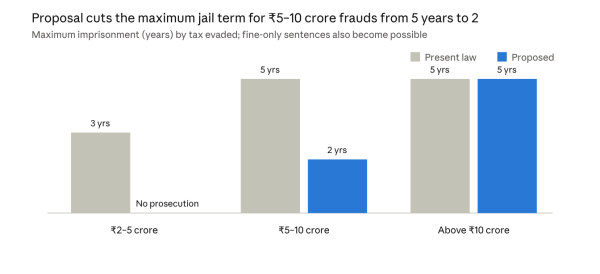
Figures as summarised in the 57th Council proposal and s.132 · maximum term only; the ₹1–2 crore clause (b) band is omitted
The drop is sharpest in the ₹2–5 crore band, where prosecution disappears altogether, while the top band keeps its five-year ceiling.
9. The Two Cases, Side by Side
| For removal | For retention (in some form) |
|---|---|
| GST is a tax statute; the line between aggressive interpretation, error and fraud can be blurry. Liberty should not be collateral in an interpretational dispute. | A fake-invoice syndicate is nothing like a classification dispute. Masterminds run hundreds of dummy GSTINs through labourers and drivers; phones are destroyed, funds dispersed, witnesses influenced. |
| Arrest inflicts reputational, business and family harm long before guilt is determined. | In exceptional cases, custody can prevent flight, intimidation, destruction of records and continuation of the fraud. |
| The Supreme Court has recorded concerns about payments made under arrest pressure. | Raising prosecution to ₹5 crore and removing arrest sharply lowers perceived consequences for fraud below that level. |
| Evidence is increasingly digital: e-invoices, e-way bills, bank records, returns. It does not vanish if the accused is free. | Customs and PMLA retain arrest. An organised, hundred-crore ITC fraud having no departmental arrest mechanism would be anomalous. |
| Summons, search, seizure, attachment, adjudication and prosecution remain. Independent BNS offences (e.g. cheating, forgery) can still be pursued, though GST evasion does not become a BNS offence automatically. | Tax collected and deliberately retained is a different moral category; even pre-GST Service Tax kept a narrow arrest power for it. |
10. Misuse Versus Necessity: The Real Question
Misuse of a power and the need for it are separate inquiries. If every power were abolished upon misuse, search, seizure and summons would be next. Equally, “the power is useful, so tolerate misuse” is unacceptable when personal liberty is at stake.
The sharper question: can the legitimate investigative need be preserved while removing the possibility of unilateral or coercive use? Misuse can justify redesigning a power even where it does not justify abolishing it. Radhika Agarwal reasoned exactly this way.
The ladder of seriousness should drive the design:
| Conduct | Consequence |
|---|---|
| Error, interpretational dispute, negligence | Civil: tax, interest, penalty |
| Deliberate evasion | Civil + prosecution (above threshold) |
| Organised fraud / tax collected and retained, with demonstrable necessity of custody | Civil + prosecution + possible custody |
A regime treating all five of error, interpretation, negligence, deliberate evasion and organised fraud alike becomes oppressive; one treating them all leniently becomes ineffective.
11. Five Models, Not Two
The debate is usually framed as “arrest or no arrest.” It should not be.
| Model | Description | Trade-off |
|---|---|---|
| A. Present s.69 | Departmental arrest, with statutory, judicial and CBIC safeguards | Misuse risk persists despite Radhika Agarwal |
| B. Council proposal | No GST arrest; court-based prosecution only | Maximum liberty; possible enforcement gap against organised fraud |
| C. Restricted s.69 | Arrest only for the highest band of organised fraud and tax collected-but-retained, with strict necessity test | Preserves a narrow weapon; still departmental |
| D. Committee-controlled arrest | Approval by a high-level multi-member body, not a single authority | Reduces confirmation bias; slower |
| E. Judicially authorised arrest | Investigator must obtain a Magistrate/Special Court warrant except in defined emergencies | Liberty decision leaves the investigating hierarchy; needs new legislative design |
12. Redesigning Section 69: A Practical Blueprint
If Parliament retains the power, these safeguards (drawn from Radhika Agarwal, Siddharth, Pankaj Bansal and CBIC Instruction 01/2025-GST) deserve consideration:
| Theme | Suggested safeguard |
|---|---|
| Who decides | An Arrest Review Committee (Principal Chief/Chief Commissioner as chair, a Commissioner unconnected with the case, a senior legal/prosecution officer). The investigating officer must never be the final approver. |
| What they decide | Three separate questions: Is the offence prima facie established? Is the monetary threshold objectively satisfied? Why is arrest necessary today? |
| When arrest is allowed | Only for flight risk, evidence destruction, witness intimidation, obstruction or continuing organised fraud, never merely for tax quantum. |
| Notice first | Notice-to-cooperate as default; surprise arrest only for recorded exigency. |
| Individual nexus | No arrest merely because someone is a director or partner; individual role and mens rea must be shown. |
| Hard prohibitions | No arrest for interpretational disputes; no arrest as a tool for recovery. |
| Judicial oversight | Magistrate must test legality and necessity, not remand mechanically; full record (authorisation, reasons, grounds, material index) produced, with redaction only for genuine investigative need. |
| During custody | Periodic review of continued custody; prosecution complaint preferably within 60 days if bail is denied. |
| Accountability | Departmental action for coercive or unlawful arrest; annual anonymised arrest statistics with reason codes. |
The Council itself endorses this philosophy elsewhere: interception of conveyances is to occur only on specific intelligence and with authorisation of an officer not below Joint Commissioner. If objective information plus higher approval is right for stopping a truck, it is logically stronger for depriving a person of liberty.
The most radical variant is Model E: for non-emergency cases, the GST investigator approaches a designated Magistrate and must establish a serious specified offence, the monetary threshold, prima facie material and necessity of custody, a judicial warrant rather than an internal authorisation. It answers the objection that the same hierarchy that investigates, quantifies evasion and seeks payment should not also decide on arrest.
And a retained power need not track the prosecution threshold. Prosecution asks, “is this serious enough for a trial?” Arrest asks something more, “is custody before trial actually necessary?” Confining arrest to the top seriousness band is more defensible than making it follow automatically from quantum.
13. Deterrence Cannot Rest on Fear of Arrest Alone
If compliance depends mainly on fear of arrest, enforcement is structurally weak. A mature GST system deters because detection is likely, evidence is digital, fraudulent credit is blocked quickly, assets can be secured, adjudication is timely and conviction is realistic. Certainty of consequence deters more than theoretical severity. Pre-GST experience supports this: the Government repeatedly raised prosecution thresholds and even withdrew old low-value cases that consumed resources without public benefit.
The corollary is equally important. If section 69 goes, the State cannot say “courts are enough” while serious GST prosecutions sit unresolved for years. Decriminalisation must come with fewer but better-investigated prosecutions, specialised prosecutors, early complaints, digital evidence packages, designated courts and monitoring of serious fraud trials. Otherwise the law becomes less coercive and less credible.
14. Conclusion: Weapon or Lock?
The 57th Council’s proposal is a philosophical shift. Its strongest justification is that personal liberty must not become an instrument of tax recovery, that honest businesses should not work under a shadow of coercion, and that deliberate fraud can be met with financial consequences and prosecution before a competent court. These concerns are real; Radhika Agarwal, Siddharth and D.K. Basu are not procedural niceties, because arrest touches Article 21 at its core.
But GST fraud today can involve networks of non-existent entities, fake invoices running into hundreds of crores, identity misuse and rapid dissipation of funds. A legislature may reasonably conclude that even such persons should be handled only through prosecution. It may equally conclude that an exceptional, institutionally controlled arrest power remains necessary. The Constitution compels neither: the Supreme Court has upheld Parliament’s competence to keep the power while insisting on stringent safeguards.
So the harder question is not whether section 69 can exist. It is this:
Does the experience of misuse require abolishing the weapon, or putting it behind a far stronger lock?
The Council has chosen the first answer. The alternative is to keep section 69 only for the most serious organised fraud, place the decision before a high-level committee or a court, add a separate statutory test of necessity, bar its use for recovery or interpretational disputes, require written grounds and individual nexus, and punish misuse.
Either course can be defended. What cannot be defended is a system where arrest substitutes for adjudication, or one where the consequences of organised tax fraud become so remote that criminal enforcement loses credibility.
The goal of GST enforcement should remain: maximum certainty against fraud, minimum coercion against the compliant taxpayer, and deprivation of liberty only through a process whose necessity can withstand independent scrutiny.
This article reflects the 57th GST Council recommendations as publicly reported; final statutory language may differ once Parliament and State legislatures act.