Singapore Airlines Ltd Vs Commissioner of CGST & CE (GSTAT Ernakulam)
Summary: The Goods and Services Tax Appellate Tribunal, Ernakulam Bench, allowed eight appeals filed by Singapore Airlines Ltd concerning GST refund claims totalling ₹45,92,528 for October 2019 to March 2020, January 2021 and March 2021. The airline had collected and deposited GST on air tickets but subsequently refunded the entire fares, including GST, following flight cancellations during the COVID-19 pandemic. It issued corresponding credit notes and reported them in GSTR-1. However, insufficient outward supplies and the inability to report negative amounts in GSTR-3B prevented full adjustment of the credit notes. It therefore sought refunds under the category “Excess payment of Tax”.
The original authority rejected the claims for want of evidence establishing excess payment and actual reimbursement to passengers. The Joint Commissioner (Appeals) also referred to the time restriction under Section 34(2) and the alleged absence of a one-to-one correlation between travel agents and passengers. Before the Tribunal, the Revenue maintained that invoices, credit notes and Billing Settlement Plan (BSP) statements did not establish that the tax component had actually reached the ultimate passengers. It sought dismissal or a remand for verification. The airline submitted that ticket numbers and passenger names connected the tax invoices, credit notes, refund vouchers and BSP records, and that refunds were processed through the original booking agent and payment channel.
The Tribunal examined the BSP mechanism and the supporting documents. It found that the common ticket number and passenger name provided an identifiable connection between each invoice, refund voucher and credit note. The documents had already been placed before the lower authorities, which had failed to appreciate them. The Tribunal found that the entire amounts, including GST, had been returned to passengers and that the airline had retained no amount, thereby excluding unjust enrichment. It also considered the Supreme Court’s directions in Pravasi Legal Cell Vs Union of India concerning refunds for flights affected by the lockdown.
Relying on Circular No. 137/07/2020-GST dated 13.04.2020, the Tribunal held that the airline had correctly sought a refund through Form GST RFD-01 where no output liability was available against which the credit notes could be adjusted. It rejected the appellate authority’s reasoning that the claim did not qualify as excess payment of tax.
On the objection concerning reversal of input tax credit by recipients, the Tribunal observed that tickets issued to individual passengers represented B2C transactions. It also considered the amendment to the proviso to Section 34(2), effective from 1 October 2025, and held that the specific condition concerning recipient reversal introduced by that amendment did not apply to the disputed period. It accepted the airline’s evidence and declaration concerning the return of the tax incidence to passengers. Setting aside the common appellate order, the Tribunal allowed all eight appeals with consequential relief and directed the respondent to process the claims within two weeks of the order and pay the refund with applicable interest from the date of the original refund application until actual payment.
Cases Discussed
- Pravasi Legal Cell Vs Union of India, 2020 SCC OnLine SC 799 (Supreme Court); W.P. (C) D. No. 10966 of 2020; decided on 01.10.2020. The Tribunal considered the Supreme Court’s directions concerning refunds of airfares for flights affected by COVID-19 restrictions while examining the airline’s repayment of fares, including GST, to passengers.
FULL TEXT OF THE ORIGINAL GSTAT JUDGMENT/ORDER
1.0 Mr Rajiv Puri, Ld CA appeared for the appellant and Mr Baiju Daniel, Ld Assistant Commissioner, appeared as AR for the Revenue (Centre). All the appeals nos. APL/3/ERN/2026, APL/4/ERN/2026, APL/5/ERN/2026, APL/6/ERN/2026, APL/7/ERN/2026, APL/8/ERN/2026, APL/9/ERN/2026, APL/30/ERN/2026, arise out of common order-in-appeal no: COC-GST-000-APP-197-204-2022-JC dated 8-12-2022 issued on 12-12-2022 passed by the Joint Commissioner (Appeals), Kochi, and therefore are tagged and taken up for hearing together.
2.0 Ld CA appearing for the appellant submits that the appellant M/s. Singapore Airlines Limited is an international airline engaged in transportation of passengers and goods by air, with its head office in Singapore and have branch offices in India and one of the branch office in Keralam State at Kochi and are registered with GSTIN 32AAACS5269A1ZS. The appellants have been collecting and depositing the GST on the sale of tickets to their passengers for air travel.
2.1 During the period from Oct-2019 to March-2021, owing to the Covid-19 pandemic, the frequency of flights of Singapore Airlines embarking from India has declined drastically. On the other hand, an overwhelming number of requests for ticket cancellation for the tickets sold earlier on account of on-going travel restrictions were being received as there were no scheduled flight for the airline. Due to the unusual amount of cancellation requests being received from customers, the refunds had exceeded sales. Since GSTR 3B does not allow to report negative amounts, these unabsorbed credit notes were being carried forward and adjusted to the extent possible against sales being booked in subsequent months out of ITC balances.
2.2 He submits that owing to the restrictions in place by virtue of Proviso 1 to Section 37(3), these unabsorbed credit notes could only be adjusted with sale in GSTR 3B till the due date of filing the return for the month of September of the succeeding financial year. Since these unabsorbed credit notes could now no longer be adjusted against sales in the GST returns, the refund applications were filed as below:
| Application Ref. No. | Date | Period | Refund amount claimed (Rs.) |
|---|---|---|---|
| AA321121014003G | 17-11-2021 | Oct-2019 | 1,18,942/- |
| AA321121014545Y | 18-11-2021 | Nov-2019 | 3,68,574/- |
| AA321221002091D | 02-12-2021 | Dec-2019 | 5,14,816/- |
| AA3212210020939 | 02-12-2021 | Jan-2020 | 16,26,660/- |
| AA3212210020963 | 02-12-2021 | Feb-2020 | 13,89,464/- |
| AA3212210020971 | 02-12-2021 | Mar-2020 | 5,61,202/- |
| AA321221002098Z | 02-12-2021 | Jan-2021 | 5,110/- |
| AA321221005397S | 06-12-2021 | Mar-2021 | 7,760/- |
| Totals | 45,92,528/- |
2.3 On filing of refund claims, show case notice was issued proposing to reject the refund claim, in response to which the appellant had explained that majorly the sale of the airline is conducted through agent. He submits that IATA is a body where the Agents and the Airlines are registered. Any IATA agent in India can sell the tickets of any Airline in India who are its members. The payment of the tickets sold by the Agents are settled through Billing Settlement Plan (BSP) by IATA. BSP is the Billing Settlement Plan which handles the sale of tickets by all the IATA agents of all the airlines in India. This is like a Stock Exchange where the net sale/purchase of shares is settled to each broker by a net amount. Similarly, in BSP, any IATA agent in India can sell the ticket of any airline and the payment of these transactions is processed by BSP to various airlines by giving credit to the airlines for all the agents who have sold the ticket, on a weekly basis.
2.4 In the event of cancellation of flights, the refund of the ticket can be done only by that agent who has originally sold that ticket through the same mode of payment by which the ticket was purchased. For eg. a ticket sold by Agent A cannot be refunded by Agent B. Therefore, in the case of cancellation, the customer / passenger will go to that agent from whom it had purchased the ticket originally. He submits that the majority of sales of the airlines happen through IATA agents only. The BSP gives a settlement amount to the airline after incorporating the net amount for the sales and refunds of the tickets in that week.
2.5 He also submits that the supporting documents such as copies of Tickets, copies of Credit Notes and the corresponding BSP files corelating to these Tickets and Credit Notes were shared by the appellant for all the months. However, the said refund claims were rejected by the adjudicating authority, and subsequently the appeals before the first appellate authority was also rejected by the JC (Appeals). Hence, this appeals.
2.6 He further submits that they had booked air tickets for various passengers during the period Oct-2019 to March-2021 and due to COVID and unforeseen reasons, the flights were cancelled, due to which the entire amounts as charged to the passenger was automatically refunded to each one of them, and credit notes were issued against each ticket issued, and the name of the passenger was also mentioned in each credit note, Tax invoice and also in the refund note issued by the airline. These credit notes also contained the details of GST, which were also part of the refund paid to the passengers.
2.7 He submits that they had shown these credit notes in the GSTR1 return, but could not adjust the said credit notes in the GSTR3B Returns because there were no scheduled flights and hence there was also no outward supply of services so as to adjust the credit notes towards the outward GST liability, as there was very less amount or no amounts in the Credit register to absorb the impact of amounts of GST mentioned in the credit notes, and the GSTR3B would not allow negative balance during that period. Therefore, they had filed refund claim in terms of clause 3 of the Circular No.137/07/2020-GST dated 13.04.2020, before the jurisdictional Assistant Commissioner, as refund of excess paid tax, in form RFD-01 and the total amount of Refund claim of excess paid tax was Rs. 45,92,528/-.
2.8 He also submits that in other places they have received the identical refunds and submits a copy of the Refund Order no. ZD361221011732Z dated 4-12-2021 passed by the Deputy Commissioner, Saroor Nagar, STU-3, Telangana State.
2.9 He submits that the refund claims were rejected by the jurisdictional Assistant Commissioner on the grounds that the appellant had not filed any supporting documents to show that the tax was paid in excess, and also that they have not submitted any documents to show that the entire ticket amount was refunded to the passenger, in full through the billing settlement plan prescribed by IATA. He submits that they had submitted the copies of tax invoice, credit notes, and a statement showing the details of the amounts mentioned in the tax invoice including GST, and also submitted sample copies of the credit notes and tax invoices, for each period. He also submits that they had submitted all supporting documents before the first appellate authority, but the same was not considered and the appeals were rejected. He prays that the appeals may kindly be allowed and refund may be sanctioned.
3.0 Ld AR appearing for the Revenue (Centre) on the other hand defends the rejection of refund claim vide the impugned order in original, and submits that Ld AR for the respondent submits that the refund claims and the appeals were rejected as the appellant had failed to establish that they have paid excess GST during the said period and also they have failed to submit any documents which can show that they have refunded the amounts to the passengers in full. He also reiterates the findings of the JC (Appeals).
3.1 He further submits that the appellant had filed eight refund applications claiming a refund of ₹45,92,528/- for the tax periods from Oct-2019 to Mar-2020, Jan-2021, and Mar-2021 under the category “Excess payment of Tax” in terms of Section 54 of the CGST Act, 2017. The reason stated in the refund applications was that their customers had cancelled the air tickets booked by them during the COVID-19 pandemic. Consequently, the applicant had refunded the ticket amount, including GST, to the customers and issued corresponding credit notes against each of the tax invoices. Since there was insufficient output tax liability against which credit note can be adjusted, they filed the refund application which is in accordance with instruction issued in Circular No.137/07/2020-GST dated 13.04.2020. The Proper Officer rejected their entire refund claims vide Rejection Orders all dated 05.01.2022 on the grounds that the appellant have not furnished any supporting documents to prove that they have made excess payment of GST for the relevant months.
3.2 He submits that the Appellant preferred appeals before the first appellate authority, i.e. Joint Commissioner (Appeals), Kochi, against the said Refund Rejection Orders contending that they had refunded all the amount to their clients on cancellation of ticket including GST due to cancellation of flights during Covid-19 pandemic and prayed that refund amount rejected by the proper officer may be sanctioned. The First Appellate Authority, i.e JC (Appeals) while rejecting their appeals vide impugned OIA dated 8-12-2022 has categorically held that the unadjusted credit notes had become time barred under Section 34(2) of the CGST Act, 2017. JC (Appeals) further held that the credit notes had been issued in favour of the travel agent and that a one-to-one correlation between the travel agent and the passenger was not possible. Aggrieved by the said order-in-appeal, the Appellant has filed the present appeals before this Hon’ble Tribunal, contending that the credit notes were issued in the name of the passengers and not in the name of the travel agent, and that the settlement amounts between the travel agent and the Appellant in respect of the refunds are reflected in the BSP settlement sheets.
3.3 He submits that the issue in subject case appears to be one of the consequent action of decision of the Hon’ble Supreme Court in a Public Interest Litigation in Pravasi Legal Cell vs UOI on the issue of the refund of amounts in tickets of flights cancelled in wake of the lockdown and subsequent restrictions imposed by the Govt. of India to contain COVID-19, wherein Hon’ble Supreme Court issued a detailed guideline in the matter and the Ministry of Civil Aviation also issued set of guidelines in the matter.
3.4 He further submits the Section 54(4) of the CGST Act, 2017, provides that ‘the application shall be accompanied by
(a) such documentary evidence as may be prescribed to establish that a refund is due to the applicant; and
(b) such documentary or other evidence (including the documents referred to in Section 33) as the applicant may furnish to establish that the amount of tax and interest, if any, paid on such tax or any other amount paid in relation to which such refund is claimed was collected from, or paid by, him and the incidence of such tax and interest had not been passed on to any other person:
Provided that where the amount claimed as refund is less than two lakh rupees, it shall not be necessary for the applicant to furnish any documentary and other evidences but he may file a declaration, based on the documentary or other evidences available with him, certifying that the incidence of such tax and interest had not been passed on to any other person.’
3.5 He submits that the Appellant has failed to produce any cogent, credible, and documentary evidence, as required under Section 54(4) of the CGST Act, 2017, to substantiate its contention that the tax amount in respect of the cancelled tickets was actually refunded to the ultimate passengers. In the absence of such documentary evidence, there is no sufficient material on record to establish that the incidence of tax collected from the passengers was, in fact, passed back to the respective passengers and that the Appellant had not retained or otherwise recovered the said amount.
3.6 It is pertinent to note that the statutory requirement under Section 54(4) of the CGST Act, 2017 necessarily requires the claimant to substantiate the eligibility and admissibility of the refund claim with appropriate supporting evidence. Mere production of records relating to cancellation of tickets or the issuance of credit notes, without establishing the corresponding refund of the tax component to the ultimate passenger, cannot by itself be treated as sufficient evidence for granting the refund.
3.7 In the present case, the Appellant has not furnished any documentary evidence establishing a direct nexus between the cancelled ticket, the concerned passenger, the credit note issued, the amount allegedly refunded, and the corresponding tax component. In particular, the Appellant has failed to demonstrate, through reliable records such as passenger-wise refund details, proof of payment/refund, bank records, transaction statements, or any other contemporaneous documentary evidence, that the tax amount forming part of the refund claim was actually returned to the ultimate passenger.
3.8 The BSP settlement sheet produced by the Appellant does not reflect or account for the amounts actually refunded by the travel agents to the end-customers. This omission is material, as the BSP settlement statement, by itself, does not establish that the amounts in question were ultimately refunded to the end-customers. Significantly, the same aspect has also been specifically noted in the findings of the Appellate Authority, which observed that the BSP settlement sheet relied upon by the Appellant does not disclose the amounts refunded by the travel agents to the respective end-customers. Therefore, the mere production of the BSP settlement sheet cannot, in the absence of supporting evidence of actual refunds to the end-customers, be treated as conclusive proof of such refunds.
3.9 Furthermore, he submits that the Appellant has failed to produce, for verification, copies of the actual air tickets indicating the name of passenger, the date of intended travel, the destination, the actual charges levied which were subsequently cancelled, the date of cancellation of ticket and whether any charges were levied on such cancellation. In the absence of the cancelled air tickets or any other contemporaneous documentary evidence establishing such cancellation, the mere production of invoices does not, by itself, substantiate the Appellant’s claim. The invoices relied upon by the Appellant are incomplete and, without the corresponding air tickets, cancellation records, refund details, or other supporting documents, cannot be properly verified as to their authenticity, cancellation, or actual financial implication. Consequently, the documents produced by the Appellant are insufficient to establish the alleged transactions and the claim based thereon remains unsubstantiated without verification.
3.10 In these circumstances, the finding of the learned Appellate Authority that a one-to one correlation between the travel agent and the ultimate passenger was not possible is fully justified on the basis of the material available on record. Where the Appellant itself has failed to furnish the necessary documentary evidence establishing such a direct correlation, the absence of a verifiable one-to-one nexus cannot be attributed to any deficiency on the part of the Department or the Appellate Authority. Therefore, in the absence of passenger-wise and transaction-wise documentary evidence establishing that the corresponding tax amount was actually refunded to the ultimate passenger, the Appellant’s claim remains unsubstantiated. Accordingly, the finding of the Appellate Authority regarding the impossibility of establishing a one-to-one correlation between the travel agent, the cancelled ticket, the passenger, and the refund amount, is sustainable and warrants no interference.
3.11 Ld AR, in view of his submissions above prays that the appeal of the tax payer be rejected as non-maintainable or the case be remanded to the original authority for fresh examination and verification as the JC (Appeals) has rightly rejected the appeals at the first appeals stage.
4.0 Heard both sides. We have gone through the submissions made by both sides and also the relied upon documents submitted by them. We find that the only issue to be decided is,
Whether, in the facts and circumstances of the case, the appellant airline are eligible for the refund of GST collected from the passengers and paid by them to the GST Department, but subsequently refunded entire amount of fare including GST to the passengers, on account of cancellation of the flights due to the COVID-19 pandemic in terms of Hon’ble Supreme Court’s order?
4.1 We find that the brief facts of the case is that the appellant is an international airline providing the service of transportation of passengers from India to various places out side India. In the present case, the appellant has filed 8 refund claims seeking refund of GST collected and paid on sale of tickets and subsequently refunded to the clients. The refund amounts claimed are for months of October 2019 to March 2020 respectively and January 2021 and March 2021. The original adjudicating authority has rejected the refund claims on the ground that claimant has not furnished any supporting documents to substantiate that they have made excess payment of GST for the above said period. On going through the documents submitted by the appellant we find that the entire amount including GST has been refunded to the clients on cancellation of tickets and no amount has been retained by the Appellant and there is no unjust enrichment involved in the refunds claimed.
4.2 The appellant has illustrated how the sale invoice and credit note can be linked to the Billing details received from Billing Settlement plan of the IATA, with whom both the appellant airline and the ticket booking agent are registered members. It is also on record that most of the sales of the airline tickets is conducted through agents, any IATA agent in India can sell the tickets of any Airline in India who are its members, payment of tickets sold by them is settled through the Billing Settlement Plan (BSP) by IATA, BSP handles the sale of tickets by all the IATA agents to different airlines in India.
4.3 We find that as per the BSP settlement plan, any IATA agent in India can sell the ticket of any airline and payment of these transactions is processed by BSP to various airlines by giving credit to the airlines for all the agents who have sold the ticket, on a weekly basis. We also find that the refund of the ticket can be done only by that agent who had originally sold the ticket; a ticket sold by Agent A cannot be refunded by Agent B and in the event of cancellation, the customer would go to that particular agent from whom he purchased the ticket originally and majority of the sales are happening through IATA Agents only and the BSP gives a settlement amount to the airline after incorporating net amount for the sales and refunds of tickets in that week. Finally, the Appellant has refunded all the amount to their clients on cancellation of tickets including GST collected and prayed that refund amount rejected by the proper officer may be sanctioned by the Appellate Authority.
4.4 We also find that the appellant has submitted the supporting documents such as sample copies of Air Tickets, Tax invoices and copies of Credit Notes and the corresponding BSP files correlating to these Tickets and Credit Notes were shared by the appellant before the original adjudicating authority as well as the JC (Appeals). But the same was not at all appreciated. The JC (Appeals), in the impugned order dated 8-12-2022 has observed that, “I reject the Appeals viz. A. Nos. 18-25/GST/CHNIADC-JC/2022 (R) filed by the Appellant against the following Orders on the grounds of time-bar as per Section 34(2) of the CGST Act, 2017 and failure to establish that the Appellant has made excess payments and/or that the refund amounts claimed by them have been reimbursed to the concerned passengers subsequent to the airline ticket cancellations.”
4.5 Before getting into further detail, we would like examine how does the billing and settlement plan work for the airlines and the airlines agents of IATA.
Billing and Settlement Plan (BSP) : This plan is made to simplify financial relations between airlines and accredited-agents with a trusted framework and intelligent solutions. Global air travel is a complex business, with thousands of airlines and tens of thousands of travel agents transacting every second. In this high-volume, high-risk environment, a trusted financial system is essential. The IATA Billing and Settlement Plan (BSP) provides a standardized global framework that simplifies sales reporting, remittance, and settlement between airlines and IATA-accredited travel agents. For over 50 years, BSP has been the trusted backbone of airline distribution, helping airlines and accredited travel agents simplify reporting, remittance, and settlement while enhancing financial control, transparency, cash flow, and risk management through ‘BSPlink’, and supporting modern retailing and new payment methods. To have a glimpse of the BSP, there are 400+ participating airlines, 59,000+ accredited travel agents, US$242 Billion+ settled annually, and 99.99% on-time settlement rate. Therefore, either for an airline or an accredited travel agent, BSP provides a trusted framework for simplifying sales reporting, remittance, and settlement. Combined with tools that enhance financial control, transparency, cash flow, and risk management, BSP helps them operate more efficiently. We see that the BSP is a robust trustworthy billing settlement plan and all the airlines and IATA agents are using it for their settlement of amounts collected from the passengers, and also for settlement of refunds in case of the cancellations.
4.6 As regards the refund claim made by the appellant, we find that the due to the Covid-19 pandemic there were no scheduled flights of the appellant, during the relevant period Oct-19 to March-2021. The tickets which were booked in advance were also getting cancelled for the said period. Since there was cancellation of flights, the entire amount of the ticket had to be refunded to each of the passenger, as an appellant’s airline policy. In the tickets, GST amount was also charged and collected.
4.7 We are also aware that in the case of Pravasi Legal Cell vs Union Of India (WP (C) D.No.10966 of 2020) dated 1-10-2020, the Hon’ble Supreme Court had held that
‘For these reasons we are not inclined to delve any further on any of the contentions and deem it appropriate to dispose of this batch of cases with the following directions:
1. If a passenger has booked a ticket during the lockdown period (from 25th March, 2020 to 24th May, 2020) for travel during lockdown period and the airline has received payment for booking of air ticket for travel during the same period, for both domestic and international air travel and the refund is sought by the passenger against that booking being cancelled, the airline shall refund the full amount collected without any cancellation charges. The refund shall be made within a period of three weeks from the date of cancellation.
2. If the tickets have been booked during the lockdown period through a travel agent for a travel within the lockdown period, in all such cases full refund shall be given by the airlines immediately. On such refund, the amount shall be passed on immediately by the agent to the passengers.
3. Passengers who booked tickets at any period of time but for travel after 24th May, 2020 – refund of fares to the passengers covered under this category shall be governed by the provisions of Civil Aviation Requirements (CAR).
4. Even for international travel, when the tickets have been booked on an Indian carrier and the booking is exIndia, if the tickets have been booked during the lockdown period for travel within the lockdown period, immediate refund shall be made.
5. If the tickets are booked for international travel on a foreign carrier and the booking is exIndia during the lockdown period for travel within the lockdown period, full refund shall be given by the airlines and said amount shall be passed on immediately by the agent to the passengers, wherever such tickets are booked through agents. In all other cases airline shall refund the collected amount to the passenger within a period of three weeks.
6. In all other cases, the airlines shall make all endeavours to refund the collected amount to the passenger within 15 days from today. If on account of financial distress, any airline / airlines are not able to do so, they shall provide credit shell, equal to the amount of fare collected, in the name of passenger when the booking is done either directly by the passenger or through travel agent so as to consume the same on or before 31st March, 2021. It is open to the passenger either to utilize such credit shell upto 31st March, 2021 on any route of his choice or the passenger can transfer the credit shell to any person including the travel agent through whom he / she has booked the ticket and the airlines shall honour such a transfer.
8. In all cases where credit shell is issued there shall be an incentive to compensate the passenger from the date of cancellation upto 30th June, 2020 in which event the credit shell shall be enhanced by 0.5% of the face value (the amount of fare collected) for every month or part thereof between the date of cancellation and 30th June, 2020. Thereafter the value of the credit shell shall be enhanced by 0.75% of the face value per month upto 31st March, 2021. Further, the second respondent Directorate, shall ensure strict compliance of the directions referred above, by issuing necessary instructions to the all concerned.
20. With the above directions, these writ petitions are disposed of.”
4.8 As per the instructions given by the Hon’ble Supreme Court, and also the directions given to the Directorate of Civil Aviation, the refunds were processed by the appellant airline, and without any delay the refund were sanctioned and given to the respective passengers, through their agents. Since it is an automated process, the refund is credited to the respective passenger, in the same account from where the original payment was made.
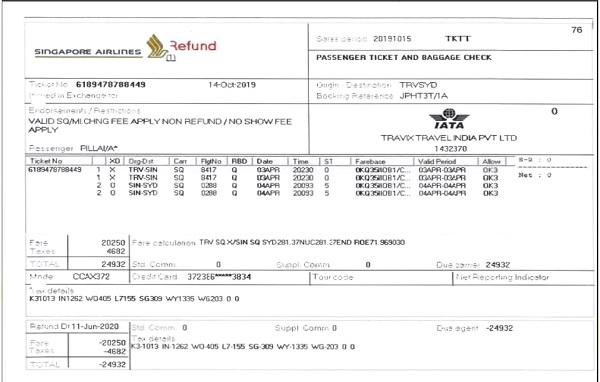
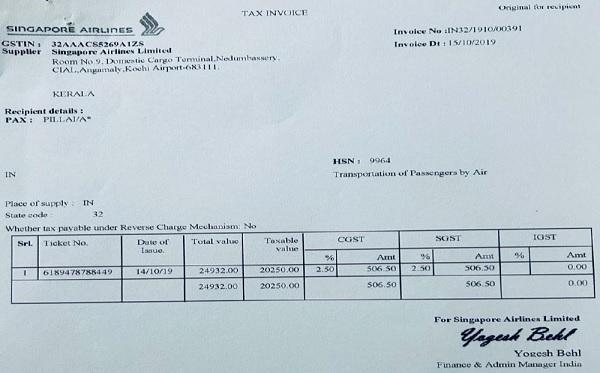
4.9 We find that the process is very simple, and understandable. On cancellation of the flight schedule, the booked tickets are cancelled. Now to give refund to the each and every passenger, each passenger is identified through the ticket number. As per the tax invoice, a refund voucher is issued by the appellant, and subsequently, a credit note is issued. We find that the ticket number is the connection between the entire chain of documents and seamlessly connects the refund voucher, tax invoice and the credit note. A sample image of Refund Voucher, Tax Invoice and a Credit note issued for the same ticket number 6189478788449 dated 14-10-2019 is placed here for understanding:
(1) Sample Refund Voucher
(2) Sample Tax Invoice:
(3) Sample Credit Note:
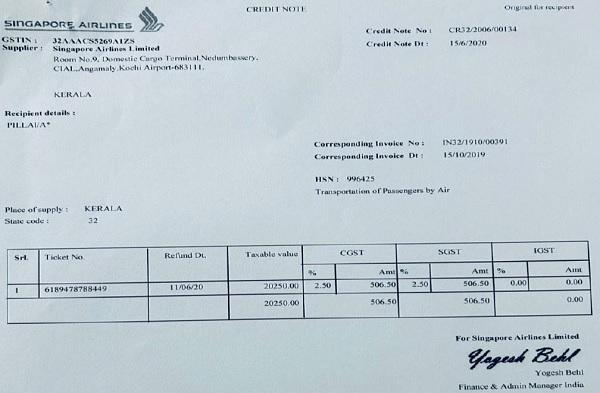
4.10 We find that all the three documents are connected to each other and the most common factor is the ticket number and the passenger’s name. The basic details in all the three above documents are as below:
| Refund Voucher | Tax Invoice | Credit Note |
|---|---|---|
| Ticket Number | Ticket Number | Ticket Number |
| Passenger Name | Passenger Name | Passenger Name |
| Ticket date | Invoice No & Date | Credit Note No & Date |
| Origin & Destination | Taxable value | Corresponding Invoice No & Date |
| Booking Reference | CGST & SGST | Refund Date |
| Charged: Fare and Taxes | Taxable value | |
| Refund: Fare & Taxes | CGST & SGST |
4.11 We also find that the common factors in all these documents are Ticket Number, and Passenger Number. Looking into these documents, it can be seen that the ticket number and the Passenger’s name, are reflected in each of the document and it is an undeniable connection between the tax invoice and the credit note issued for refund of the fare collected, to each of the respective passenger. It is also seen that the mode of payment for purchasing the ticket i.e. Credit Card number is also reflecting in the Refund voucher. Since all these documents were already submitted before the adjudicating authority as well as the first appellate authority, it is surprising that both of them have failed to examine this glaringly visible information, and simply rejected the refund on flimsy grounds.
4.12 Now coming to the observation of JC (Appeals) that the appellant had wrongly claimed the refund as ‘excess payment of tax’ and as such there was no excess payment of tax, and the refund claim was made only because the appellant had no outward supply due to cancellation of flights and they could not adjust the credit notes against outward supply GST liability, and hence they have claimed the present refund claims.
4.13 We find that the appellant has correctly followed the procedure by claiming the present refund claims. Ld AR has mentioned in his submission that since there was insufficient output tax liability against which credit note can be adjusted, they (the appellant) filed the refund application which is in accordance with instruction issued in Circular No.137/07/2020-GST dated 13.04.2020, but the JC (Appeals) has not applied the Circular in letter and spirit. The point no. 3 of the circular reads as,
Subject: Clarification in respect of certain challenges faced by the registered persons in implementation of provisions of GST Laws-reg.
Circular No.136/06/2020-GST, dated 03.04.2020 had been issued to clarify doubts regarding relief measures taken by the Government for facilitating taxpayers in meeting the compliance requirements under various provisions of the Central Goods and Services Tax Act, 2017 (hereinafter referred to as the “CGST Act”) on account of the measures taken to prevent the spread of Novel Corona Virus (COVID-19). It has been brought to the notice of the Board that certain challenges are being faced by taxpayers in adhering to the compliance requirements under various other provisions of the CGST Act which also need to be clarified.
2. The issues raised have been examined and in order to ensure uniformity in the implementation of the provisions of the law across the field formations, the Board, in exercise of its powers conferred under section 168(1) of the CGST Act hereby clarifies as under:
| 3. | Goods supplied by a supplier under cover of a tax invoice are returned by the recipient. Whether he can claim refund of tax paid or is he required to adjust his tax liability in his returns ? | In such a case where the goods supplied by a supplier are returned by the recipient and where tax invoice had been issued, the supplier is required to issue a “credit note” in terms of section 34 of the CGST Act. He shall declare the details of such credit notes in the return for the month during which such credit note has been issued. The tax liability shall be adjusted in the return subject to conditions of section 34 of the CGST Act. There is no need to file a separate refund claim in such a case.
However, in cases where there is no output liability against which a credit note can be adjusted, registered persons may proceed to file a claim under “Excess payment of tax, if any” through FORM GST RFD-01. |
4.14 The clarification issued by the CBIC is self explanatory, and has clarified that where there is no output liability against which a credit note can be adjusted, registered persons may proceed to file a claim under “excess payment of tax, if any” through Form GST RFD-01. Therefore, the procedure followed by the appellant is correct and the reasoning given by the JC (Appeals) for rejecting the appeals is not at all sustainable.
4.15 We also find that one more issue which is raised is that the refunds and credit notes are valid only if the recipient of the supply reverses the ITC claimed and further held that since the appellant issues credit notes to agents and not to the ultimate passengers/customers, the appellant must ensure that such agents/customers have reversed the ITC before reducing its GST liability which appellant has failed to do so.
4.16 In the present case, we find that all the tickets are issued in the name of individual passengers only, and all such transactions are B2C transactions, and therefore there is no question of availing ITC and subsequently reversing the same.
4.17 However, we notice that there is one B2B agent i.e. Balmer Lawrie & Co Ltd to whom the credit note was issued. With regard thereto, Appellant hereby submits that Section 34 of CGST Act, 2017 permits a supplier to issue a credit note where tax liability is reduced due to cancellation, return, or discount. Once a credit note is issued and reported in GSTR-1, the supplier’s liability is reduced accordingly. The law does not require the supplier to first ensure that the recipient has reversed ITC before reducing its liability. The obligation of reversal lies with the recipient under Section 16(2) read with Rule 37 of CGST Rules. 2017.
4.18 We also find that the appellant has filed an undertaking to the effect that they have not received any request from any of the passenger that their refund of cancelled ticket is pending or not received.
4.19 We also find that the Section 34 (2) which deals with the issuance of credit notes, reads as,
(2) Any registered person who issues a credit note in relation to a supply of goods or services or both shall declare the details of such credit note in the return for the month during which such credit note has been issued but not later than 5[the thirtieth day of November] following the end of the financial year in which such supply was made, or the date of furnishing of the relevant annual return, whichever is earlier, and the tax liability shall be adjusted in such manner as may be prescribed:
Provided that no reduction in output tax liability of the supplier shall be permitted, if the––
(i) input tax credit as is attributable to such a credit note, if availed, has not been reversed by the recipient, where such recipient is a registered person; or
(ii) incidence of tax on such supply has been passed on to any other person, in other cases.
We find that the above Proviso (i) was inserted on wef 1-10-2025, vide Section 126 of the Finance Act, 2025. Before that the proviso read as,
Provided that no reduction in output tax liability of the supplier shall be permitted, if the incidence of tax and interest on such supply has been passed on to any other person.
4.20 Therefore, the question of reversal of ITC during the period Oct-2019 to March-2021 will not apply as there was no such provision. As regards, the earlier proviso, to check the incidence of tax and interest on such supply has not been passed on, the appellant has submitted a self declaration in terms of Rule 89(2)(l). Moreso, most of the customers are falling under B2C category, and having refunded the entire amount to each respective passenger, the question of passing the incidence of tax and interest does not arise. Even otherwise as an abundant caution, the GST framework ensures matching of credit notes in the recipient’s GSTR-2A/2B, thereby automatically triggering ITC reversal at the recipient’s end, if there is any such B2B buyer. But in the present case we do not find any such B2B customer nor the Revenue has brought forward any such evidence. The appellant has satisfied the conditions of Section 34 (2) while issuing the credit notes.
5.0 In view of the above, to answer the issue raised, we conclude that,
The appellant-airline is eligible for the refund of GST collected from the passengers and paid by them to the GST Department, but subsequently refunded entire amount of fare including GST to the passengers, on account of cancellation of the flights due to the COVID-19 pandemic in terms of Hon’ble Supreme Court’s order. We also find that the appellant has provided sufficient evidence to ensure that the refund of the cancelled tickets have reached the respective passenger directly and there is no passing of the incidence of tax.
6.0 Accordingly, we pass the following order.
ORDER
The impugned OIA No. COC-GST-000-APP-197-204-2022-JC dated 8-12-2022 issued on 12-12-2022, is hereby set aside, and all the eight appeals nos. APL/3/ERN/2026, APL/4/ERN/2026, APL/5/ERN/2026, APL/6/ERN/2026, APL/7/ERN/2026, APL/8/ERN/2026, APL/9/ERN/2026 and APL/30/ERN/2026 are allowed with consequential relief. The respondent is directed to process all the refund claims within two weeks from the date of this order and make payment to the appellant along with applicable interest from the date of original refund application till the date of actual payment.
(Order pronounced in open court)