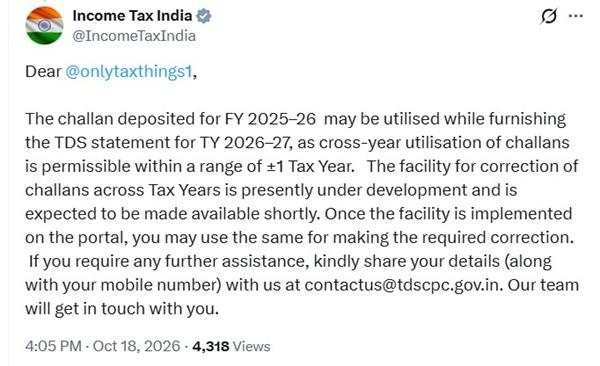
Summary: The Income Tax Department, replying to a taxpayer’s question on X, stated that a TDS challan deposited for FY 2025–26 may be utilised while furnishing a TDS statement for Tax Year (TY) 2026–27 because cross-year challan utilisation is permissible within a range of ±1 Tax Year. The taxpayer had selected AY 2026–27 instead of TY 2026–27 and wanted to know when cross-tax-year challan correction would become available on TRACES. The Department’s reply stated that the separate correction facility was under development and expected shortly, without giving a launch date. The distinction is important: tagging or utilising an eligible challan against a TDS statement is not necessarily the same as changing the tax year recorded in the underlying challan. Existing TRACES guidance describes ±1-year eligibility for certain challan-tagging and addition functions, subject to available balance and portal validation. Further, the Income Tax Department has enabled TDS/TCS correction statements for TY 2026–27, but that general facility does not itself prove that the particular cross-tax-year challan correction described in the X reply is operational. Deductors should check the payment’s statutory regime, TAN, challan identification details, year, available balance, statement period and the current portal options before making a duplicate payment or assuming that a wrong-year challan has been automatically corrected.
- Background: Challan Deposited Under AY 2026–27 Instead of TY 2026–27
- What the ±1-Year Rule Means for TDS Challans
- Legal Framework and the 2026 Transition
- Earlier TDS Statement and Correction Rules
- Income-tax Act, 2025 and Tax Year 2026–27
- Cross-Year Utilisation Is Different From Challan Correction
- Correction Statements for TY 2026–27 Are Already Enabled
- Practical Example: ₹75,000 TDS Paid for the Wrong Year
- Step-by-Step Checklist for Deductors
- What If the Challan Cannot Be Tagged?
- Frequently Asked Questions
- Can a FY 2025–26 TDS challan be used for TY 2026–27?
- Does cross-year utilisation change the original challan year?
- Is the cross-tax-year correction facility available now?
- Are TY 2026–27 TDS/TCS correction statements enabled?
- Can the same challan amount be claimed twice?
- Does the ±1-year rule cover advance tax and self-assessment tax?
- Does correction remove interest or late fees?
- Key Takeaway
Background: Challan Deposited Under AY 2026–27 Instead of TY 2026–27
A taxpayer asked the Income Tax Department when the facility for correction of FY/TY 2025 and 2026 would be enabled on TRACES. The taxpayer said a payment had mistakenly been made under AY 2026–27 instead of TY 2026–27. In its reply reproduced in the supplied screenshot, the Department stated that a challan deposited for FY 2025–26 may be used for the TDS statement for TY 2026–27, subject to the ±1-year range. It also stated that the dedicated cross-tax-year challan correction functionality was being developed. The screenshot does not supply a definite activation date.
What the ±1-Year Rule Means for TDS Challans
Under existing TRACES procedures, eligible challans with an available balance can be selected for certain tagging or replacement of TDS/TCS challans within a ±1-year range. The official portal’s guidance on adding and tagging challans contains similar conditions. These are operational validation rules; they should not be described as unrestricted statutory permission to use any challan for any year or any tax-payment category.
A challan must also satisfy the applicable identification, status and balance requirements. If the amount is already fully consumed, it cannot be consumed again. A deductor should not infer from the one-year rule that a payment under a different statutory regime will automatically be accepted without validation.
Legal Framework and the 2026 Transition
Earlier TDS Statement and Correction Rules
For periods governed by the Income-tax Act, 1961, Section 200(3) addresses furnishing TDS statements and correction statements. The six-year restriction introduced for correction statements under that provision is explained in Correction of TDS Statements: Key Changes in Section 200(3). That rule concerns statement correction and does not, by itself, establish that a challan may be transferred between tax years.
Income-tax Act, 2025 and Tax Year 2026–27
The Income-tax Act, 2025 applies from 1 April 2026. AY 2026–27 under the earlier law relates to FY 2025–26, whereas TY 2026–27 relates to FY 2026–27 under the new law. The official Income Tax Department guidance identifies ITNS 281N for TDS/TCS payments under the new Act, compared with ITNS 281 under the earlier regime. Consequently, the selected year and the payment’s statutory regime both matter.
TaxGuru’s TDS/TCS Correction Statements for Tax Year 2026-27 Enabled: Practical Compliance Guide explains the changed reporting architecture and the need to reconcile original statements, deductee records and challans before correction.
Cross-Year Utilisation Is Different From Challan Correction
| Issue | Cross-year utilisation | Challan year correction |
|---|---|---|
| Purpose | Apply an eligible challan to a permitted statement or demand | Change the year recorded against the challan |
| Typical procedure | Tag/Replace or Add Challan, where available | Applicable challan correction functionality |
| Year range | ±1-year rule under specified TRACES functions | Subject to the correction facility’s own rules |
| Current clarification | Permissible in the Department’s example | Specific cross-tax-year facility described as under development |
The existing processes are described in e-Tutorial on Online TDS/TCS Challan Correction, Procedure to Corrections in TDS Challan and How to Apply for Correction in Income Tax TDS Payment Challan. Older procedural descriptions must be read subject to the current portal and the 2025 Act transition.
Correction Statements for TY 2026–27 Are Already Enabled
The Income Tax Department has separately announced that TDS/TCS correction statements for TY 2026–27 are enabled. That allows correction of supported statement particulars but does not establish that the specific cross-tax-year correction of the original challan is live. A deductor must select the correct operation rather than treating every correction option as interchangeable. See FAQs on Correction of TDS/TCS Statements Online for the distinction between statement and challan corrections.
Practical Example: ₹75,000 TDS Paid for the Wrong Year
Suppose ABC Private Limited deducts ₹75,000 during TY 2026–27 but makes the payment using AY 2026–27, corresponding to FY 2025–26 under the earlier regime. The Department’s response suggests that an eligible FY 2025–26 challan may be utilised in a TY 2026–27 TDS statement. However, ABC must first verify the challan’s TAN, identification number, balance, year, regime and acceptance by the relevant system. The company should not treat the example as confirmation that the original challan’s year has been changed.
Step-by-Step Checklist for Deductors
- Verify challan details: Check CIN, BSR code, serial number, deposit date, amount, TAN and selected year.
- Confirm the correct regime: Determine whether the liability belongs to the 1961 Act or the 2025 Act and identify the correct payment form.
- Reconcile available balance: Check whether the challan is unclaimed, partly utilised or fully consumed.
- Check ±1-year eligibility: Review the applicable TRACES tagging or addition functionality and its validation conditions.
- Choose the appropriate correction: Distinguish between correcting the original challan and correcting the TDS statement.
- Retain evidence: Preserve bank payment confirmation, challan receipt, original statement, correction acknowledgement and error screenshots.
- Resolve short-payment defaults: If a statement shows a mismatch, use the appropriate challan-tagging or correction route described in How to Solve Short TDS Payment Defaults and Download of Conso Files Without Correcting Unmatched Challans in TDS Statements?.
- Verify the result: After processing, reconcile the statement, challan consumption and deductee tax-credit information.
Where deductee rows were associated with the wrong challan, the older TRACES process is illustrated in CPC (TDS) Guidance on Moving Deductee Rows From Unmatched Challans. Actual availability under the new tax-year system must be checked before use.
What If the Challan Cannot Be Tagged?
If the challan is not visible or fails validation, check the year range, available balance, TAN, payment details and whether a correction request is already pending. Older TDS correction guidance and deductee-detail correction procedures may help identify the nature of a mismatch, but should not be used to assume that a newly introduced portal option exists.
The Department’s response asks taxpayers needing assistance to contact [email protected] with relevant details. Sensitive information should be shared only through verified official channels. If an applicable filing or payment deadline is approaching, the deductor should separately evaluate potential interest, fee and default exposure; a pending correction does not automatically suspend statutory consequences.
Frequently Asked Questions
Can a FY 2025–26 TDS challan be used for TY 2026–27?
The Department’s reply says eligible cross-year utilisation is permissible within ±1 Tax Year. Actual use remains subject to the applicable portal and challan validations.
Does cross-year utilisation change the original challan year?
Not necessarily. Utilisation or tagging and correction of the original year are different operations.
Is the cross-tax-year correction facility available now?
The supplied response described it as under development and did not announce a launch date. The latest status must be checked on the official portal.
Are TY 2026–27 TDS/TCS correction statements enabled?
Yes, the Income Tax Department’s portal has announced their availability. This does not prove that every separate challan-year correction option is enabled.
Can the same challan amount be claimed twice?
No. The remaining available challan balance and consumption details must be reconciled before any additional use.
Does the ±1-year rule cover advance tax and self-assessment tax?
The Department’s response concerns TDS challans. It should not be extended automatically to other payment types.
Does correction remove interest or late fees?
Not automatically. The consequences of late deduction, late payment or delayed statements must be examined independently.
Key Takeaway
The Income Tax Department has clarified that an eligible TDS challan deposited for FY 2025–26 may be utilised against a TY 2026–27 TDS statement within the permitted ±1-year range. This is different from changing the year recorded in the challan. Deductors should verify the statutory regime, challan balance, portal validation and available correction option before depositing the amount again.
Source Links
- TRACES official challan correction FAQs: https://traces61contents.tdscpc.gov.in/en/faq-dedu-oc-challan-correction.html
- TRACES official Add Challan FAQs: https://traces61contents.tdscpc.gov.in/en/faq-deduc-oc-add-challan.html
- Income Tax Department e-filing portal: https://www.incometax.gov.in/iec/foportal/
****
Disclaimer: This article is for general educational purposes and reflects the Department’s response reproduced in the supplied screenshot and procedural guidance reviewed for this article. The availability of portal utilities, the applicable law, payment forms and validation rules may change. Readers should verify current official instructions and obtain appropriate professional advice for their facts. TaxGuru, its owners, editors and authors accept no responsibility or liability for any loss, interest, fee, penalty, demand or other consequence arising from reliance on this material.