V. P. Sugathan Vs Travancore Devaswom Board (Kerala High Court)
Summary: The Kerala High Court dismissed V.P. Sugathan’s writ petition seeking permission to collect ₹50 plus 18% GST from artists performing Chendamelam during Pettathullal at Erumeli, and reimbursement from the Travancore Devaswom Board for tax he was prevented from collecting. The petitioner had obtained the tender right to collect the prescribed fee and stated that he had paid ₹8,40,261 towards GST to the Board.
He contended that this entitled him to recover an additional ₹9 from each artist. The Board maintained that the scheduled ₹50 fee included all taxes and that the tender conditions prohibited collection above the prescribed rate. The tax authority’s counter-affidavit distinguished the supplier’s statutory obligation to pay GST from the contractual right to recover it from the recipient, explaining that tax-inclusive consideration required computation under Rule 35 of the GST Rules. The Court held that statutory GST liability did not itself confer a corresponding right to recover tax separately.
Having participated in the tender, the petitioner remained bound by its conditions, which fixed a tax-inclusive fee and contained no provision authorising an additional GST charge. The artists’ asserted status as ultimate recipients could not override those conditions. The Court also found no statutory or contractual basis requiring the Board to reimburse the petitioner. It therefore rejected both reliefs and dismissed the petition without costs.
FULL TEXT OF THE JUDGMENT/ORDER OF KERALA HIGH COURT
The petitioner states that he is the successful bidder in the auction conducted by the Travancore Devaswom Board for the collection of fees from artists who perform Chendamelam during the Pettathullal at Erumeli for the Mandalam-Makaravilakku season of 1200 ME. He has produced before this Court Ext. P1 tender notification and submits that the item in respect of which he was the successful bidder is included as B-1 in the said notification. It is stated that, as per the terms of the notification, the successful bidder was entitled to collect a fee of ₹50/- from each artist for each performance.
2. The petitioner asserts that, by Ext. P3 notice dated 07.11.2024 issued by the Devaswom, he was informed that he had been granted the right to collect fees from the artists performing Chendamelam and that he had been awarded the tender for a sum of ₹46,68,117/-. Pursuant to the said communication issued by the Travancore Devaswom Board, the petitioner states that he paid a sum of ₹46,98,117/- towards the quoted amount for the tender. He further states that he paid a sum of ₹8,40,261/- towards GST at the rate of 18% on the aforesaid amount, which was payable to the Government. Exts. P4 and P5 are the challans produced by the petitioner evidencing the payment of ₹46,98,117/- towards the tender amount and ₹8,40,261/- towards GST, respectively.
3. The petitioner states that, in exercise of the right granted to him under the tender, he collected ₹50/- as the prescribed fee and an additional amount of ₹9/- towards GST at the rate of 18%, thereby collecting a total amount of ₹59/- from each artist for each performance. According to the petitioner, such collection was permissible under the terms of the tender and the applicable tax provisions. However, the petitioner states that, on 18.11.2024, a notice was affixed to the wall at the premises informing the artists that they were required to pay only ₹50/- as the fee and that the said amount was inclusive of GST.
4. According to the petitioner, he is entitled to pass on the GST liability borne by him to the ultimate recipient of the service, namely, the customer. It is the specific contention of the petitioner that the artists who perform the Chendamelam are the ultimate recipients or users of the service for the purposes of the applicable tax law and, therefore, restricting the petitioner from collecting the GST component from them is illegal and unsustainable. The petitioner points out that he has already paid a sum of ₹8,40,261/- towards GST to the Devaswom Board at the time of acceptance of the tender, while the Devaswom Board is now not permitting him to recover or pass on the corresponding tax component to the artists from whom the fee is collected. According to the petitioner, this would effectively cast the entire tax burden upon him, despite the fact that the tax is liable to be borne by the ultimate recipient of the service.
5. It is on these assertions that the petitioner has approached this Court by filing the present writ petition, seeking the following reliefs:
(a) Issue a writ of mandamus or such other writ or order or direction permit the petitioner to collect fees as per Ext.P1, P2 and P3 for chendamelam at the rate of Rs.50/- plus 18% GST from the melam artists.
(b) To direct the Devaswom Board to refund the amount of tax which was not permitted to be collected by the Devaswom Board from 17.11.2024 by the issue of a writ of mandamus or such other writ or order or direction.”
6. The counter-affidavit has been filed by the 1st respondent. It is stated that the Travancore Devaswom Board has published Ext. P1 notification inviting tenders for various items including the Kuthaka item B1 for the right to collect fee for ‘Chendamelam’. As per Ext. P1 notification, the security deposit for the amount is ₹30,000/-. It is also stated in Ext. P1 that the collection of fees from melakkar is Kuthaka item B1, which was awarded to the petitioner, as per which he is entitled to collect ₹50/- for one performance from the ‘Melakkars’. The amount that can be collected by the Kuthaka holder from one group of pilgrims is ₹250/-. Out of which, the Kuthaka holder is entitled to take ₹50/- and the balance amount of ₹200/- is to be paid to the Mela artists.
7. It is stated that the petitioner by quoting ₹46,68,117/- has become the highest bidder and he has secured the contract for the above amount plus the GST component. He took over and conducted the Kuthaka from 15.11.2024. It is stated that the petitioner is not entitled to collect ₹59/- from devotees by adding Rs.9/- under the guise of 18% GST to the scheduled rate of ₹50/-. When the Devaswom received the complaints, the Administrative Officer intervened and the petitioner was informed that he is entitled to obtain only ₹50/- per person and the same is inclusive of all taxes and he is not entitled to charge any amount over and above the rate fixed by the Court from the pilgrims.
8. It is further stated that the Sabarimala, Pamba, Nilakkal and Erumeli auctions are conducted through e-tenders and the fees chargeable from the pilgrims for various items like parking, use of toilets, clock room, chenda melam etc. have been included in the Kuthaka schedule. Apart from the fees specified in the schedule, no Kuthaka holder can collect any higher amount from the pilgrims. It is also stated that the charges specified in the schedule stipulated for collection from pilgrims is inclusive of all taxes.
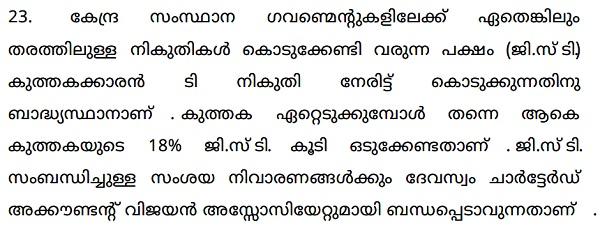
9. It is further stated that the Kuthaka holders are liable to pay statutory charges/GST as per clause 23 of General Conditions of Ext. P1 tender notification and the entire GST amount has to be paid at the time of entering into the contract itself. It is further stated that for paying the statutory taxes, the Kuthaka holder is not entitled to collect any higher amount above the rate fixed by the Board/District Collector for the particular item.
10. In the course of proceedings, the 5th respondent was impleaded. A counter-affidavit has been filed by the 9th respondent. It is stated that the supplier of service is liable to pay tax on the taxable services supplied, irrespective of the fact whether the tax is collected from the recipient or not. The liability of the supplier to pay tax to the Government is imposed as per the statute. However, the right to collect tax from the recipient is governed by the terms and conditions of the contract that the supplier of services enters with the recipient. The supplier of services and the recipient are free to enter into contracts providing for payment of consideration of the taxable services either inclusive or exclusive of tax. The liability to pay tax is statutory whereas the passing over the burden of tax to the recipient is contractual.
11. It is further stated that the contracting parties are free to decide whether to enter into a contract including or excluding GST liability. However, in case the contracts that are entered into for consideration inclusive of GST, then GST has to be paid by considering the total amount of contract as inclusive of GST and working out the taxable value and tax as per Rule 35 of the GST Rules. The passing over of liability of tax by the petitioner as supplier to the recipients is not a matter coming within the ambit of the respondents herein.
12. We have carefully considered the submissions advanced. Clause (23) of Ext.P1 reads as under:
13. Insofar as the Chendamelam is concerned, Ext.B1 deals with the amount that can be realised from the Melakkar. It reads as under:
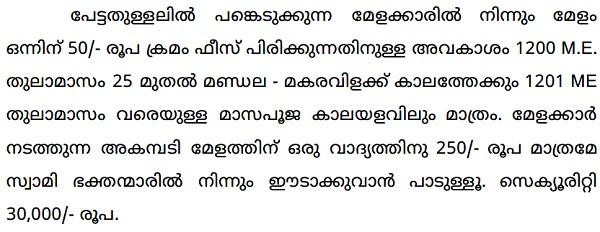
14. Thus, the Kuthaka right to collect charges for Chendamelam is awarded to the petitioner subject to the tender conditions. The kuthaka holders are liable to pay statutory charges/GST as per clause 23 of the General conditions of Ext.P1 tender notification. The entire GST amount has to be paid at the time of entering the contract itself. The stand of the Devaswom is that for paying the statutory taxes, the kuthaka holder is not entitled to collect any higher amount over and above the rate fixed by the Board/District Collector for the particular item. The Board has also taken the stand that apart from the fees specified in the schedule, no kuthaka holder can collect any higher amount from the pilgrims.
15. The contention of the petitioner is that having paid the GST component in respect of the tender amounts, he is entitled to recover the corresponding GST from the persons from whom he is authorized to collect the fees for the Chendamelam. According to the petitioner, the amount prescribed under the tender is Rs. 50/- and if that be the case, he is entitled to collect Rs. 50/- towards the prescribed fee and a further sum of Rs. 9/- towards GST.
16. We find that the said contention proceeds on the premise that the statutory liability to pay GST carries with it a corresponding right to recover the tax separately from the recipient of the service. We are afraid that the said contention cannot be accepted. The liability of a supplier to discharge the tax payable under the statute and the question as to whether the supplier is entitled to pass on the burden of such tax to the recipient are distinct and separate matters. As rightly pointed out by the 5th respondent in their counter, the liability to pay GST is a statutory liability. The supplier of a taxable service is liable to discharge the tax payable in accordance with the provisions of the tax and statute irrespective of whether the tax component is separately recovered from the recipient. However, the right of the supplier to recover the tax component from the recipient would depend upon the terms governing the transaction between them or in other words, the contractual terms.
17. In the case on hand, the petitioner secured his right to collect the fee only by virtue of the tender awarded to him by the 1st respondent. His entitlement to collect any amount from the pilgrims can only be as per the terms and conditions of the tender.
18. Having gone through Ext.P1, we find that as per kuthaka item B1, the petitioner was entitled to collect Rs. 50/- for one performance from the Melakkars and that the amount prescribed in the kuthaka schedule for collections from pilgrims is inclusive of all taxes. The petitioner having participated in the tender and obtained the right is bound by the terms and conditions of the tender. Furthermore, the petitioner has not been able to point out any provision in Exts.P1 to P3 which confers on him a right to collect over and above the prescribed fee of Rs.50/-, an additional amount towards GST. The contention of the petitioner that the artists are the ultimate recipients of the service and the GST can be passed on to them does not mean that such status would confer upon the petitioner an independent right to recover an additional amount contrary to the terms of the contract. In other words, the question boils down to the question as to whether the petitioner has a contractual right to recover an additional sum of Rs. 9/-.
19. The petitioner has also sought for a direction to the 1st respondent to refund the tax, which according to him, he was prevented from collecting from 17.11.2024. The petitioner has not been able to point out any provisions of Ext.P1 to P3 or any provision of law under which the 1st respondent becomes liable to reimburse the petitioner. The petitioner’s statutory obligation to discharge GST cannot in the absence of statutory or contractual basis be converted into a corresponding liability on the part of the 1st respondent to reimburse the petitioner.
20. In view of the discussion above, we hold that the petitioner has failed to establish any enforceable legal or contractual right to collect Rs. 50/- + 18% GST from the artists. He is also not entitled to claim any reimbursement from the Devaswom as prayed for.
This Writ Petition is dismissed. There will be no order as to costs.