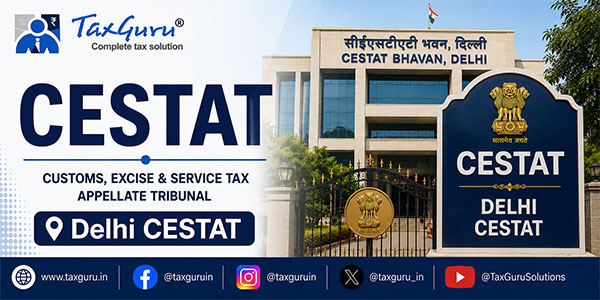
Agribiotech Industries Ltd. Vs Commissioner (CESTAT Delhi)
Summary: CESTAT Delhi, in Agribiotech Industries Ltd. v. The Commissioner, Central Goods & Service Tax & Central Excise, Alwar, dismissed five connected service tax appeals by a common order dated 8 October 2026. The appellant manufactured liquor in Rajasthan under an agreement with Allied Blenders & Distillery Pvt. Ltd., whose brand name it used on a revenue-sharing basis. Raw materials were procured in accordance with the brand owner’s instructions from approved vendors at approved rates. Two show cause notices, dated 17 November 2017 and 18 April 2018, covered April 2010 to March 2015 and April 2015 to June 2017, respectively. The Department alleged that the appellant provided bottling and packing services on a job-work basis. The adjudicating authorities confirmed service tax demands and imposed penalties, and the Commissioner (Appeals) upheld those orders.
The appellant argued that its activity amounted to manufacture and was excluded from business auxiliary service or protected under the negative-list regime. It relied on Maa Sharda Wine Traders and three Tribunal decisions concerning manufacturing activities. The Revenue relied on Carlsberg India Pvt. Ltd. v. Union of India, 2016 (44) STR 349 (Delhi). Examining section 66D of the Finance Act, 1994, the Tribunal referred to the change effective from 1 June 2015 excluding alcoholic liquor for human consumption from the manufacturing entry in the negative list. It reproduced the Delhi High Court’s distinction between manufacture for oneself and contract manufacture for another person for consideration.
The Tribunal treated Carlsberg India as binding and declined to apply Maa Sharda Wine Traders, observing that the latter had not examined the negative-list regime. It also declined to apply the Tribunal decisions cited by the appellant, which had followed the Madhya Pradesh High Court decision. Following Carlsberg India, it held that the appellant’s manufacture of liquor on behalf of others attracted service tax and dismissed all the appeals.
Cases Discussed
- M/s A to Z Security Company and other services v. Commissioner, CGST & Central Excise, Kanpur, 2026(7) TMI 837 (CESTAT Allahabad) — Cited by the appellant in support of its manufacturing-exclusion argument; the Tribunal declined to apply it because it followed the Madhya Pradesh High Court’s decision in Maa Sharda Wine Traders.
- Commissioner of Central Excise and Service Tax, Bhubaneswar I v. M/s. High-Tech Bottling Private Limited, 2022(8) TMI 62 (CESTAT Kolkata) — Relied upon by the appellant; the Tribunal declined to apply it on the same basis.
- M/s. Daurala Sugar Works v. Commissioner of Central Excise & Service Tax, Meerut, 2018(12) TMI 793 (CESTAT Allahabad) — Cited by the appellant in support of non-taxability of manufacturing activities; the Tribunal held it inapplicable.
- Carlsberg India Pvt. Ltd. v. Union of India, 2016 (44) STR 349 (Delhi High Court) — Followed for the distinction between manufacturing liquor for oneself and undertaking contract manufacture for another person, and for the service tax consequences of the 2015 amendments.
- Maa Sharda Wine Traders v. Union of India, 2008(3) TMI 319 (Madhya Pradesh High Court) — Relied upon by the appellant but distinguished because it had not examined the negative-list regime relevant to the dispute.
FULL TEXT OF THE CESTAT DELHI ORDER
All the appeals are having common issue therefore all are disposed of by a common order.
2. Two show cause notices were issued to the appellant for the period April 2010 to March 2015 and April 2015 to June, 2017 vide dated 17.11.2017 and 18.04.2018 respectively.
3. The facts of the case are that the appellant is engaged in manufacturing of liquor and have facility to blenders and distillery packing and required manpower in Rajasthan. Since the appellant does not own a brand name whereas it sell liquor.
3.1 In the State of Rajasthan, a brand name is required and Rajasthan State Privilege Corporation Ltd (RSBCL) recognize a brand name. The appellant entered into an agreement with M/s Allied Blenders & Distillery Pvt Ltd (ABDPL) to manufacture and sale liquor under their brand name on revenue sharing basis. The necessary raw material is procured by the appellant in accordance with instructions of the brand owner from the vendors approved by the brand at the rate approved by brand owner. The appellant received show cause notice alleging that appellant is providing business auxiliary service i.e. bottling and packing on job work basis to M/s ABDPL and therefore liable to pay service tax on the said activity.
3.2 Both the matters were adjudicated, the demand of service tax were confirmed and various penalties were imposed on the appellant. The said orders were carried out by the appellant before the learned Commissioner (Appeals) who affirmed the order of adjudication, therefore, the appellants are before us.
3.3 The learned counsel for the appellant submits that appellant being a manufacture was excluded from business auxiliary service and later there as per negative list regime for processed amounting to manufacture and products of the goods are exempt from payment of service tax. Therefore, the appellant is not liable to pay service tax under business auxiliary service in the negative list. To support this contention, the appellant relied on the decision of the Madhya Pradesh High Court in the case of Maa Sharda Wine Traders vs. Union of India 2008(3) TMI 319 MP which were followed by this Tribunal in the case of M/s A to Z Security Company and other services vs. Commissioner, CGST & Central Excise, Kanpur, 2026(7) TMI 837- CESTAT Allahabad and Commissioner of Central Excise and Service Tax, Bhubaneswar I vs M/s. High-Tech Bottling Private Limited 2022(8) TMI 62 CESTAT Kolkata and M/s. Daurala Sugar Works Vs. Commissioner of Central Excise & Service Tax, Meerut 2018(12) TMI 793-CESTAT Allahabad. Therefore, it is prayed that appellant is not liable to pay service tax.
4. On the other hand learned A.R. for the Revenune, drew our attention to the decision of the Hon’ble Delhi High Court in the case of Carlsberg India Pvt Ltd vs. Union of India 2016 (44) STR 349 Delhi to say that the activity undertaken by the appellant being a process of manufacture but the same is not excluded from the payment of service tax in terms of Notification No.25/2012-ST dated 20.06.2012.
5. Heard the parties considered submissions.
6. We find that the issue involved in this matter is whether the activity of manufacturing of liquor by the appellant on behalf of the brand owner is liable to pay service tax or not.
7. The claim of the appellant is that the appellant is entitled for benefit of exemption Notification No. 12/2012-ST dated 17.03.2012 as the activity undertaken by the appellant amounts to manufacture, therefore no service tax is payable by the appellant.
8. We find that section 66D of Finance Act, 1994 deals with the negative list of the services. The sub clause act effectively upto 31.05.2015 which described as “any process amounting to manufacture for production of goods w.e.f. 01.06.2015 it stipulates that service by way of carrying out any process amounting to manufacture for production of goods excluding liquor in human consumption which means that the manufacture of production of goods of alcoholic liquor for human consumption is outside the ambit of the exemption from payment of service tax”. The same view was taken by the Hon’ble Delhi High Court in the case of Carlsberg India Pvt Ltd (Supra) wherein Hon’ble High Court examine the issue and observed as under:
“22. The expression „process amounting to manufacture or production of goods‟ has been defined under Section 65B (40) of the FA 1994 to mean as under:
40. “process amounting to manufacture or production of goods”
means a process on which duties of excise are leviable under Section 3 of the Central Excise Act, 1944 (1 of 1944) or any process amounting to manufacture of alcoholic liquors for human consumption, opium, Indian hemp and other narcotic drugs and narcotics on which duties of excise are leviable under any State Act for the time being in force.”
23. A Negative list regime of Service Tax came to be introduced only by FA 2012 with effect from 1st July 2012. Prior to 1st July 2012, under Section 65 (19) of FA 1994 “business auxiliary service”, a taxable service, included within its ambit production or processing of goods for, or on behalf of the client but did not include any activity that amounts to “manufacture” of excisable goods. However with effect from 1st July 2012, “any process amounting to manufacture or production of goods” which included manufacture of alcoholic liquors for human consumption was put in the newly introduced negative list of services. Therefore, till 30th June 2012 on the strength of the abovementioned provisions it is possible to levy service tax on this type of work, i.e., manufacture of alcoholic liquors fit for human consumption under the head of business and auxiliary services.
24. The effect of the further changes in 2015 by amendment to the FA was to inter alia bring within the net of service tax, the activity of manufacture ‘for another person’ of alcoholic liquor for human consumption.”
2. Further the Hon’ble High Court observed as under:
“38. The essential feature as far as Section 65B (44) of the FA 1994 is concerned is the rendering of a service i.e. any activity carried out by a person for another person for consideration. Therefore, a manufacturing activity undertaken by an entity for itself cannot be said to be a service provided to anyone and definitely not to itself. Therefore, that activity of manufacture by the brand owner who is also a licence holder could not be said to be amenable to service tax. However, where manufacturing of alcoholic liquor for human consumption is not manufactured by the entity holding licence/brand owner, but by another entity holding such licence and the cost of manufacture is to be reimbursed by the principal manufacturer/brand owner and that activity by one person for another would therefore be „service‟ within the meaning of Section 65B (44) of the FA 1994. For these reasons, the challenge to the validity of Section 113(A) (1) of the FA, 2009 by which Section 65(19) of the FA 1994 stood amended and whereby the expression ‘business auxiliary service’ did not exclude the activity of manufacture of alcoholic liquor for human consumption, when undertaken by one entity for another, is negatived.
39. There is a marked change in the position that the FA 2015 and the amendment it brought about to Section 65B of the FA 1994. Under Section 107 (f) of FA 2015, Clause (40) of Section 65B of FA 1994 would no longer contain the word „alcoholic liquors for human consumption‟. Section 109 (2) of FA 2015 further substitutes clause (f) of Section 66D of FA 1994 with “services by way of carrying out any process amounting to manufacture or production of goods excluding alcoholic liquor for human consumption.” In other words this commodity was removed from the negative list.
40. As already noticed, by the Notification dated 19th May 2015 the appointed date on which the abovementioned provisions of FA 2015 would become effective was 1st June 2015. On that said date the manufacture of alcoholic beverage for human consumption on contract basis has to be viewed as services rendered by one party to another and therefore, amenable to service tax. It is traceable to Entry 97 of List I as it does not fall within the ambit of any of the taxing entries in List II.
49. It is not possible to agree with the above submission when a clear distinction is discernible between manufacture of such alcoholic liquor by oneself and for another. The latter partakes the character of rendition of a service which is not possible to be accommodated within the act of manufacture by oneself. The act of manufacturing for another by way of job work answers the plain definition of service under Section 66B (44) of the FA which begins with: ” ‘service’ means any activity carried out by a person for another for consideration and includes a declared service, but shall not include…”. Therefore it is a fallacy to equate the two activities viz., manufacture of such alcoholic liquor by and for oneself and undertaking manufacture for another. The changes brought about in 2015 was intended to capture the latter aspect which is unique to job work for the purposes of levy of service tax. In his budget speech on 28th February 2015, the Finance Minister explained, inter alia, that service tax was “to be levied on service by way of carrying out any processes as job work for production or manufacture of alcoholic liquor for human consumption” It is significant that the Respondents in their written submissions have confirmed that “service tax is only being imposed on the value of the services provided by the job worker/contract manufacturer and not on the whole sale price of alcohol.”
Conclusion
50. Consequently, in the present case the Court is satisfied that what is sought to be made amenable to service tax is the activity of contract manufacturing of alcoholic liquors fit for human consumption by one entity for another. Such provision of service which is in pith and substance not covered under Entry 51 of List II of the Seventh Schedule to the Constitution of India is certainly amenable to levy of service tax by Parliament which is competent to legislate on that aspect with reference to Entry 97 of List I.”
9. The reliance made by the learned counsel for the appellant are not relevant. The decision in the case of Carlsberg India Pvt. Ltd. (supra) which is jurisdictional Hon’ble High Court, we are bound to follow the same and in the case of Maha Sharda Wine Traders vs Union of India (supra), the Hon’ble High Court had no occasion to examine the negative list regime for demand of service tax, therefore, the said decision is not applicable to the facts of the case. The decisions of this Tribunal relied upon by the appellant are passed by this Tribunal following the decision of Hon’ble High Court of Madhya Pradesh High Court in the case of Maa Sharda, therefore, the said decisions are not applicable.
10. Now following the decision of the Hon’ble High Court of Delhi in the case of Carlsberg India Pvt. Ltd. (supra), we hold that the activity [i.e. manufacturing of liquor (which is not an excisable goods) on behalf of others] undertaken by the appellant falls under negative list as taxable service, therefore, the appellant is liable to pay service tax.
11. In view of this, we do not find any merit in the appeals filed by the appellants, accordingly, the same are dismissed.
(Order pronounced in the Open Court on 08.10.2026)