Dhanraj Builders Vs Dhanraj Buildwell Private Limited (NCLT Allahabad)
Summary: The National Company Law Tribunal, Allahabad Bench, partly allowed a petition filed by Dhanraj Builders through its proprietor Rakesh Sharma against Dhanraj Buildwell Private Limited and two directors, involving financial assistance advanced between December 2014 and March 2016. The petitioner stated that it had advanced Rs. 2,33,75,000 to facilitate the respondent company’s acquisition of land and business operations and had received only Rs. 5,00,000 in repayment. It sought recovery of an outstanding principal of Rs. 2,28,75,000 and interest of Rs. 2,49,03,119, besides penal and investigative action. The respondent disputed maintainability, claimed discharge through an undertaking dated 08.02.2018, and argued that the petitioner, being a non-member, was not entitled to invoke the deposit-repayment provisions.
The Tribunal framed three issues: whether the loan constituted a deposit under Section 2(31) of the Companies Act, 2013; whether repayment had been established; and whether the non-member status of the lender defeated relief under Section 73. It held that a loan received by a company falls within the inclusive definition of a deposit unless covered by prescribed exclusions, and found that the amount did not fall under the exclusions in Rule 2(1)(c) of the Companies (Acceptance of Deposits) Rules, 2014. The company’s financial statements classified the liability as long-term borrowings, supporting the existence of the loan.
The alleged repayment undertaking was treated as inadequate by itself: it specified no date, mode, bank account or supporting bank transaction. The petitioner challenged its authenticity, while the respondent produced neither corroborative proof of payment nor revised financial statements or an application under Section 131 correcting the balance sheets. The Tribunal also held that receipt of deposits contrary to statutory restrictions could not entitle the company to retain the money merely because the depositor was not a member. Sections 9 and 10 of the Indian Contract Act, 1872 were considered in rejecting the argument that the lack of a written agreement was fatal.
Accordingly, the Tribunal directed the respondent company to repay the outstanding deposit with interest under Section 73(4), read with Rule 17, within 30 days. It observed that the Registrar of Companies could consider action under Section 76A in accordance with law. However, non-payment alone did not prove fraud, and the material on record did not warrant penal directions sought under the petition’s prayer (C) or an SFIO investigation under prayer (D). The petition was thus partly allowed and disposed of. The order did not separately adjudicate a fresh calculation of interest beyond directing payment as claimed.
FULL TEXT OF THE ORDER OF NCLT ALLAHABAD
1. This petition has been filed on 05.01.2023, by M/s Dhanraj Builders (hereinafter referred to as “Petitioner”) under section 73, 74 and 75 of the Companies Act, 2013 read with Rule 17 of the Companies (Acceptance of Deposit) Rules, 2014 against Dhanraj Buildwell Private Limited (hereinafter referred to as “Respondent No.1/Respondent Company”), Mr. Vijay Kumar Agarwal (hereinafter referred to as “Respondent No. 2”) and Mr. Ankit Agarwal (hereinafter referred to as “Respondent No. 3”), seeking inter alia the following reliefs:
“(A) Direct the Respondent Company to make repayment of the aforesaid principal amount of Rs. 2,28,75,000/- and interest of Rs. 2,49,03,119/- to the respective Depositor accrued on late payment of Deposit(s) in accordance with Section 73 (4) of the Companies Act, 2013 read with Rule 17 of the Companies (Acceptance of Deposits) Rules, 2014 and the terms and conditions of the deposits;
(B) Direct the payment of outstanding deposit of Rs. 2,28,75,000/- and interest of Rs. 2,49,03,119/- be made within 30 days from the date of Hon’ble Tribunal’s order;
(C) To direct an appropriate action be taken under Section 74 (3) and 75 (2) of the Companies Act, 2013;
(D) To direct the Serious Fraud Investigation Officer to investigate the affairs of the Company and report be filed before this Hon’ble Tribunal;
(E) Pass any other or further order(s) as this Hon’ble Tribunal deem fit and proper in the facts and circumstances of the matter.”
2. It is stated that both the Petitioner as well as the Respondent Company have their Registered offices at Bareilly, thus, being well-within the jurisdiction of this Tribunal.
3. As per the averments made by the Petitioner, the Respondents (collectively referred to Respondent No.1, 2 and 3) had approached the Petitioner in December 2014 for providing huge financial assistance/loan to purchase the lands to initiate the business operations of the Respondent Company. At that relevant time of seeking financial assistance Respondent No.2 and 3 were having cordial relations with Petitioner firm’s Proprietor i.e., Mr. Rakesh Sharma.
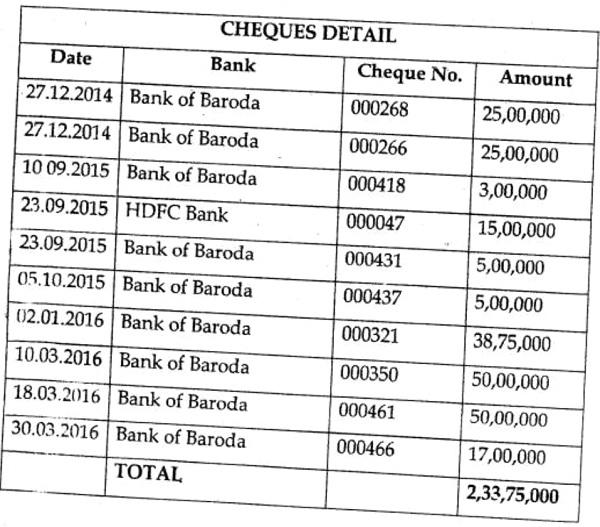
4. In lieu of the assistance sought, the Petitioner agreed to extend a loan of Rs.2,33,75,000/- on the oral terms and conditions mutually agreed between the parties, whereby the Respondent Company agreed to pay interest on the loan amount at the rate charged by the bank and repay the loan amount on demand. The details of the cheques for extending the aforesaid loan are reproduced below:
5. Thereafter, the purpose for which the loan stood availed stood fulfilled as submitted by the Petitioner that the Respondent Company had purchased two lands in Bareilly. In support, sale deeds dated 06.01.2015 have also been annexed as Annexure 6 with present petition. Further, with respect to repayment of the loan sanctioned, it has been submitted by the Petitioner that only an amount of Rs.5,00,000/- stand repaid as on 27.01.2016.
6. The Petitioner subsequently submits that despite making constant follow up with the Respondent Company as well as Respondents No.2 & 3, initially promises were made to be paid in time, however no repayment of deposit money has been made. Consequently, the Petitioner through letter dated 29.11.2022 called upon Respondent Company to pay the outstanding deposit amount of Rs.2,12,34,200/-, within 15 days from the receipt of the notice. However, neither any response nor repayment was made constraining the Petitioner to file the present petition.
7. It is the case of the Petitioner that the disbursed loan amount falls within the definition of “deposits” as stated under Section 2(31) of the Companies Act, 2013, hence Section 73(3) of the Companies Act, 2013, stands invoked. Further as per Section 74(1)(b) of the Companies Act, 2013, the repayment of the deposit should be within three years; however, the same stands non-complied and hence the Respondent Company should be liable for punishment as prescribed under Section 74(3) including Section 75 of the Companies Act, 2013.
8. The Petitioner also relies on the applicability of Rule 17 of the Companies (Acceptance of Deposit) Rules, 2014 and submits that as the Petitioner has extended the loan of Rs.2,33,75,000/- from 27.12.2014 to 30.03.2016 (out of which Rs.5,00,000/- has been received on 27.01.2016) and interest amount would be Rs.2,49,03,119/- @ 18% per annum from 27.12.2014 to 30.11.2022, therefore, total outstanding deposit is Rs.4,77,78,119/-with interest.
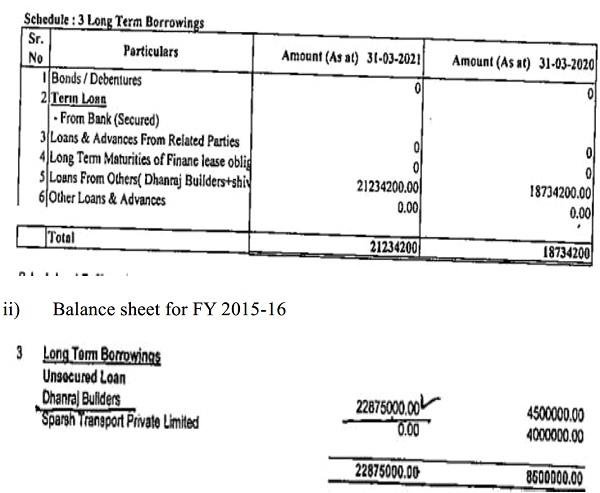
9. The Petitioner has also filed a supplementary affidavit on 09.02.2023, bringing on record the balance sheet for FYs 2015-16 and 2020-21 wherein the loan amount entered under the head of “long-term borrowings” shows its subsistence and also a copy of FIR filed by Respondent No.2 & 3 against the Petitioner firm’s proprietor Mr. Rakesh Sharma. The relevant entries of balance sheet brought on record are reproduced below for ready reference:
10. The Respondent No. 2 has filed his reply on 02.09.2024, denying and countering all submissions of the Petitioner on the following grounds:
a. At the outset, Respondent No. 2 contends that the entire financial assistance availed by the Respondent Company has been duly discharged. In support of the said contention, he relies upon a stamped undertaking dated 08.02.2018 furnished by Mr. Rakesh Sharma, Proprietor of the Petitioner Firm. The relevant excerpts of the English translation copy of the said undertaking are reproduced below:
“1. Rakesh Sharma R/o B-1, Ekta Nagar, Bareilly, proprietor of the firm Dhanraj Builders, would like to say that the firm Dhanraj Builders had given some money to the company, namely Dhanraj Buildwell (P) Ltd which was received by the firm from, time to time & no money is due on the part of the borrower namely Dhanraj Buildwell (P) Ltd.
I have signed the acknowledgement receipt on 08/02/2018. So, that it may be useful in case of need.”
b. Respondent No. 2 states that the present petition is not maintainable since the transaction in question does not fall within the definition of “deposits” and, therefore, the provisions of the provisions of Sections 73(4) and 74 of the Companies Act, 2013 are not applicable and that the remedy, if any, available to the Petitioner lies before the competent civil court or any other appropriate forum.
c. Respondent No. 2 also contends that there is no agreement for making any repayment in terms of Section 73 of the Companies Act, 2013, and therefore, no date of default can be determined. It is further submitted that the Respondent Company has not committed any default in making repayment of the amount claimed in the present petition. The present petition is also stated to be barred by limitation.
d. With respect to the reliance of Petitioner’s on Section 74 of the Companies Act, 2013 in the present petition, the Respondent No. 2 contends that Section 74 of the said Act, which came into force with effect from 01.04.2014, specifically provides for repayment of deposits accepted by a company before the commencement of the Act. Since the transactions in the present case took place after 01.04.2014, the provisions of Section 74 of the said Act are stated to be not applicable to the present case.
e. It is further contended that the Petitioner does not fall within the definition of “depositor” as provided under Rule 2(1)(d) of the Companies (Acceptance of Deposits) Rules, 2014. In this regard, reliance has been placed upon the following provision:
“Rule 2(1)(d) depositor as under: – Depositor’ means-
i. any member of the company who has made a deposit with the company in accordance with sub-section (2) of section 73 of the Act, or
ii. any person who has made a deposit with a public company in accordance with section 76 of the Act.”
f. In view of the aforementioned definition, the Respondent No. 2 further submits that Section 73(3) of the Companies Act, 2013 specifically deals with repayment of deposits accepted under Section 73(2) of the said Act, which, in turn, provides for prohibition on acceptance of deposits from the public except from its members. It is thus contended that, since the Petitioner does not fall within the definition of “depositor” under Rule 2(1)(d) of the aforesaid Rules, the Petitioner cannot invoke the provisions of Section 73(4) of the said Act. Accordingly, the present petition is stated to be not maintainable for want of locus of the Petitioner under Sections 73(4) and 74 of the said Act.
g. The Respondent No.2 submits that, at the time of incorporation of the Respondent Company, Mr. Rakesh Sharma, along with his son, was a Director of the Respondent Company. It is submitted that Mr. Rakesh Sharma had approached Respondent Nos. 2 and 3 for taking over the business of the Respondent Company and thereafter resigned from the Respondent Company on 13.12.2014. Respondent Nos. 2 and 3 were appointed as Directors of the Respondent Company on the same date. It is further submitted that Respondent Nos. 2 and 3 subsequently resigned from the Respondent Company on 29.12.2022, whereafter Mr. Ankish Tripathi and Mr. Kartikey Tripathi were appointed as new Directors of the Respondent Company.
h. Respondent No. 2, based on the above narration of facts, contends that the present petition has been filed with mala fide intent, only to pressurise the Respondents to part with the property of the Respondent Company by raising illegal demands.
REJOINDER FILED BY THE APPLICANT
11. The Petitioner filed its rejoinder, wherein it refuted the submissions made by Respondent No. 2 and, in response thereto, submitted as follows:
a. The Petitioner submits that the undertaking dated 08.02.2018, enclosed as Annexure No. 1 with the Respondent’s Reply, is a forged, manufactured and fabricated document, which is evident from a bare perusal thereof. It is further submitted that the balance sheet for the FY 2020–21 clearly reflects a long-term borrowing, i.e., a loan from the Petitioner amounting to Rs. 2,12,34,200/-, as outstanding against the Respondent.
b. It is also submitted that, while the said undertaking records that the amount advanced by the Petitioner had been received back, the Respondents have failed to disclose either the date of such payment or the mode through which the alleged repayment was made. The Petitioner further seeks forensic verification of the signatures appearing on the said undertaking and submits that it is willing to bear the cost thereof.
c. The Petitioner further submits that the present petition is maintainable and that its case is duly established from the material evidence placed on record. It is submitted that the absence of an agreement does not preclude initiation of proceedings under Sections 73, 74 and 75 of the Companies Act, 2013. Moreover, the requirement of an agreement is not mandatory but directory in nature. The Petitioner relies upon Section 73(4) of the Companies Act, 2013 and submits that where a company fails to repay the deposit or any part thereof, or any interest due thereon, the concerned depositor may apply to the Tribunal for an order directing the company to make payment of the amount due, along with the loss or damage incurred.
d. The Petitioner further submits that the present petition is not barred by limitation and that the Respondent No. 2 has raised baseless technical objections merely to avoid their liability.
e. The Petitioner further submits that the Respondent Company has failed to repay the financial assistance/loan availed by it and that, with a view to avoiding the aforesaid liability, Respondent Nos. 2 and 3 resigned from the Respondent Company after serving the notice dated 29.12.2022, despite the present company petition having already been filed. It is further submitted that, thereafter, two of their employees were appointed as Directors of the Respondent Company.
f. The Petitioner denies the contention of Respondent No. 2 that the present petition involves any illegal demand and submits that the petition is duly supported by proper evidence and genuine documents.
g. The Petitioner vehemently submits that the Respondent Company had filed its financial statements before the concerned authorities, wherein under the head of “long-term borrowing” the loan given by the Petitioner was consistently being reflected for the period from FYs 2015 -2021, i.e., six years. It is submitted that the Respondents’ present contention that incorrect balance sheets were filed by the Respondent Company for the preceding eight years is also baseless.
12. In Pursuance to the directions passed by this Tribunal vide order dated 13.08.2026, the Petitioner as well as the Respondent No.2 have filed their written submission on 19.08.2026, which has been taken on record and not reproduced herein for the sake of brevity.
FINDINGS
13. We have heard the submissions of the Ld. Counsels appearing on behalf of both the parties and the perused the material documents placed on record.
14. Considering the present petition and the submissions made therein, we observe that the determination of the present petition requires examination of the nature of the transaction between the parties, the effect of the alleged repayment relied upon by Respondent No. 2, and the applicability of the statutory provisions governing acceptance and repayment of deposits under the Companies Act, 2013. Accordingly, the following issues arise for determination:
a. Whether the loan amount of Rs. 2.28 crores fall within the definition of deposits as per Section 2(31) of the Companies Act?
b. Whether the alleged outstanding loan amount stands repaid by relying on the undertaking dated 08.02.2018?
c. Whether a deposit accepted from a non-member can be sought to be repaid by invoking the section 73 of the Companies Act?
d. With respect to Issue (a), we first examine the definition of “deposit” as provided under Section 2(31) of the Companies Act, 2013, which reads as under:
“(31) “deposit” includes any receipt of money by way of deposit or loan or in any other form by a company, but does not include such categories of amount as may be prescribed in consultation with the Reserve Bank of India;”
16. A plain reading of the aforesaid provision makes it evident that the expression “deposit” is not restricted to money received strictly by way of deposit, but expressly includes money received by a company by way of loan or in any other form. At the same time, the said definition is subject to the categories of amounts prescribed for exclusion under Rule 2(1)(c) of the Companies (Acceptance of Deposits) Rules, 2014 (“Deposit Rules”).
17. Applying the aforesaid statutory framework to the transaction in question, we find that the outstanding amount of Rs. 2.28 crores were disbursed to the Respondent Company by the Petitioner by way of loan, in December 2014, when the Respondents approached the Petitioner for financial assistance for carrying out the business operations of the Respondent Company. The character of the said amount as a loan is further borne out from the balance sheets of the Respondent Company for the financial years 2015-16 and 2020-21, wherein the outstanding amount has been reflected under the head “Long Term Borrowings”, as already observed and reproduced in the preceding paragraphs.
18. Significantly, the fact that the Respondent Company had availed financial assistance in the form of a loan has not been disputed by Respondent No. 2. The defence of Respondent No. 2 is instead premised on the assertion that the said loan amount had subsequently been repaid based on a purported undertaking dated 08.02.2018 claimed to have been signed by the proprietor of the petitioner but the authenticity of the same has been disputed by the petitioner firm by questioning the genuineness of the signature on it. Thus, the nature of the transaction as a loan and the receipt of the amount by the Respondent Company are not in dispute.
19. In view of the express language of Section 2(31) of the Companies Act, 2013, the receipt of money by a company by way of loan falls within the statutory ambit of “deposit”, subject to the exclusions prescribed under Rule 2(1)(c) of the Deposit Rules. Upon examination of the said exclusions, we also find that the outstanding amount of Rs. 2.28 crores do not fall within any of the categories excluded thereunder. Accordingly, the said amount falls within the definition of “deposit” under Section 2(31) of the Companies Act, 2013. Issue (a) is, therefore, answered in favour of the Petitioner.
20. With respect to Issue (b), Respondent No. 2 has vehemently contended that the outstanding amount claimed by the Petitioner stands repaid and, in support thereof, has relied upon the undertaking dated 08.02.2018 purportedly given by Mr. Rakesh Sharma, Proprietor of the Petitioner Firm.
21. Upon examination of the said undertaking, we find that the same is a standalone self-serving document and does not disclose any specific particulars regarding the alleged repayment, such as the date on which the repayment was made, the mode of payment, the bank account from where the payment was allegedly made, or any corresponding bank statement evidencing such payment. Further, no independent receipt or other supporting document evidencing actual repayment of the outstanding amount has been placed on record.
22. On the contrary, the balance sheets of the Respondent Company for the FY 2020-2021 continue to reflect the amount in question as an outstanding liability under the head of “Long Term Borrowings”. Respondent No. 2 has sought to contend that the said financial statements were incorrectly filed and, therefore, cannot be relied upon. However, apart from making such a submission, Respondent No. 2 has not placed on record any material or documentary evidence to substantiate the contention that the financial statements reflecting the outstanding loan liability were incorrectly filed. No revised financial statements evidencing discharge of the liability have been produced before us. Even no remedial action has been taken by the respondent company by filing any application u/s 131 of the Companies Act, 2013 seeking rectification of the said financial statements claimed to be incorrectly filed.
23. We have also considered the fact that Mr. Rakesh Sharma, Proprietor of the Petitioner Firm, was previously a Director of the Respondent Company and had resigned from the said position on 13.12.2014. However, the mere fact of his previous association with the Respondent Company does not, by itself, establish repayment of the amount claimed by the Petitioner. The undertaking dated 08.02.2018, when considered in the absence of any supporting and corroborating evidence demonstrating the actual payment or discharge of the liability, cannot, by itself, be treated as sufficient proof of repayment of the outstanding amount, especially when the said undertaking is being challenged by the proprietor of the petitioner firms disputing his signature on it and therefore requiring the respondent no. 2 to prove its authenticity, which he failed to do so.
24. In the absence of any independent evidence demonstrating that the amount of Rs.2.28 crores were actually repaid, and particularly in view of the Respondent Company’s own financial statements continuing to reflect the said amount as an outstanding liability, we are unable to accept the contention of Respondent No. 2 that the alleged outstanding loan amount stood discharged pursuant to the undertaking dated 08.02.2018. Therefore, the issue (b) is accordingly answered against the Respondent No. 2 and in favour of the Petitioner.
25. With respect to Issue (c), Respondent No. 2 has questioned the maintainability of the present petition on one of the grounds that the remedy under Section 73(4) of the Companies Act, 2013 is available only in respect of deposits accepted from members, whereas the Petitioner herein is admittedly not a member of the Respondent Company.
26. In this regard, upon perusal of Section 73(2) of the Companies Act, 2013, we observe that although the said provision provides for acceptance of deposits by a company from its members, subject to the conditions prescribed therein; however, the statutory scheme does not make the status of the depositor as a member the sole determinative factor for examining the remedy available in respect of an amount which has otherwise been received by the company and falls within the statutory definition of “deposit”. Subsequently, section 73(4) of the Companies Act, 2013 contemplates a remedy to the “depositor concerned” where the company fails to repay the deposit or any part thereof or the interest thereon. Further, Section 76 of the said act separately provides for acceptance of deposits from persons other than members by an eligible public company, subject to the statutory requirements.
27. In the present case, the Respondent Company admittedly received the amount of Rs.2.28 crores from the Petitioner. As already held while dealing with Issue (a), the said amount falls within the definition of “deposit” under Section 2(31) of the Act and does not fall within any of the exclusions prescribed under Rule 2(1)(c) of the Companies (Acceptance of Deposits) Rules, 2014. Having accepted the amount from the Petitioner and having reflected the same as a loan liability in its financial statements, the Respondent Company cannot, at the stage of repayment, seek to defeat the claim merely by contending that the Petitioner was not its member.
28. If the Respondent Company seeks to contend that the acceptance of the amount from a non-member was contrary to the statutory scheme, the consequence of such alleged non-compliance cannot, in the facts of the present case, be used as a ground to deny repayment of an amount admittedly received and otherwise falling within the statutory definition of “deposit”. The statutory provisions governing acceptance of deposits regulate the conduct of the company in accepting such amounts and cannot be construed, in the facts of the present case, as conferring upon the Respondent Company a right to retain the amount received by it in case the said amount has been received by it in contravention of the extant provision of Section 73, merely on the ground that the person from whom the amount was received was not a member. For such contravention of provision of Section 73, the defaulting company is liable for punishment as per Section 76 A of the Companies Act, 2013. Therefore, the ROC may examine for taking any penal action as per Section 76 A of the Companies Act, 2013 against the respondent company in accordance with law.
29. We also find no merit in the contention of Respondent No. 2 that the absence of a formal written agreement, by itself, defeats the claim of the Petitioner. Section 10 of the Indian Contract Act, 1872 recognises the validity of agreements which are entered into with the free consent of parties competent to contract, for a lawful consideration and lawful object, and which are not otherwise expressly declared void. Further, Section 9 of the said Act recognises that promises may be express or implied. Thus, the absence of a formal written agreement, by itself, cannot be treated as determinative of the existence of a legally enforceable transaction, particularly where the advancement and receipt of the amount are otherwise established from the material on record.
30. In the present case, the parties admittedly had a financial transaction pursuant to which the amount was advanced by the Petitioner and received by the Respondent Company. The balance sheet of the Respondent Company for FY 2020-21 reflects the said amount as a long-term borrowing, while the Respondent Company has also made a repayment of Rs. 5,00,000/- towards the said liability. These circumstances corroborate the existence of the underlying transaction of disbursing the amount as loan in form of deposit despite the absence of a formal written agreement.
31. Accordingly, the objection of Respondent No. 2 that the present petition is not maintainable merely because the Petitioner is a non-member of the Respondent Company cannot be accepted. The question of compliance by the Respondent Company in accepting deposits with the statutory requirements governing acceptance of deposits as per Section 73 is distinct from its obligation to repay the amount received by it. Issue (c) is accordingly answered in favour of the Petitioner.
32. In light of the foregoing discussion, we are of the considered opinion that the amount of Rs. 2.28 crores received by the Respondent Company from the Petitioner constitutes a “deposit” within the meaning of Section 2(31) of the Companies Act, 2013. Since the Respondent Company has failed to establish repayment of the said deposit, the Petition deserves to be allowed as to the reliefs sought under Prayer Clauses (A) and (B) for repayment of said deposit alongwith interest.
33. Accordingly, the Respondent Company is directed to repay the outstanding deposit amount together with the interest payable thereon in accordance with the Section 73(4) of the Companies Act, 2013 read with Rule 17 of the Companies (Acceptance of Deposits) Rules, 2014, as claimed by the Petitioner, within the stipulated period of 30 days time.
34. In so far as the reliefs sought under Prayer Clauses (C) and (D) are concerned, we are of the view that the mere fact that the deposit remains outstanding and that there has been no repayment thereof does not, by itself, establish an element of fraud on the part of the Respondent Company. Further, no sufficient material has been brought on record to establish an element of fraud warranting the grant of the aforesaid reliefs. Therefore, we are not inclined to issue any direction as prayed in prayer clause (C) and (D).
35. In view of our forgoing discussions, the petition is liable to be allowed as to the reliefs sought under prayer clauses (A) and (B). Thus, CP No. 4 of 2023 stands partly allowed in view of the aforesaid terms and stands disposed off.
36. Ordered accordingly.