Challani Raanka Jewellers Vs DCIT (ITAT Chennai)
Audited Books and a Stock Register Did Not Explain ₹11.31 Crore Cash Deposits: Chennai ITAT Upholds Demonetisation Addition
Summary: Cash sales recorded in audited books may explain subsequent bank deposits when the sales, stock movement and cash trail are supported by credible evidence. In Challani Raanka Jewellers, however, the Chennai ITAT found that the jewellery trader had not established that its ₹11,31,05,600 deposited during demonetisation came from genuine sales of silver articles. It therefore upheld the addition under section 68. The decision did not rest on the increase in deposits alone. The Tribunal considered the absence of purchaser particulars for substantial cash sales, the inability to verify the corresponding stock through purchase invoices during remand proceedings, the unusual accumulation of cash and the pattern of subsequent withdrawals. It held that these circumstances, taken together, left the firm’s explanation unsubstantiated.
The Firm’s Explanation: Cash From Silver Sales
Challani Raanka Jewellers was a partnership firm trading in silver utensils, articles, leg chains and other silver items. It filed its return for AY 2017-18 declaring income of ₹3,55,020. During scrutiny, the AO found cash deposits of ₹11.31 crore in the firm’s bank account during the demonetisation period.
The firm maintained that the deposits represented business sale proceeds, particularly from silver articles, and said that the transactions had been reported on the Cash Transaction 2016 portal. The AO asked for details of the specified bank notes and other denominations deposited. The firm replied that it had not maintained a record identifying the nature of the currency.
The AO also noticed a marked increase in cash deposits in November 2016 compared with November 2015. On examining the cash book and bill book, he found substantial cash sales between 28 October and 2 December 2016. According to the assessment record, purchaser names were ordinarily recorded, but entries for sales aggregating to ₹9,57,01,240 in the disputed period described the purchaser merely as “CASH”. Finding the explanation inadequate, the AO added the entire ₹11,31,05,600 under section 68. The CIT(A) confirmed the addition.
Tribunal Ordered a Specific Verification
Before the ITAT, the firm said that extensive records had been furnished, including paper books exceeding 670 pages before the Tribunal and 450 pages before the CIT(A). The Department pointed out that the AO had found no stock register supporting the alleged sales. The firm responded that its original books, including the stock register, had been produced before the jurisdictional AO before the Covid period and remained with that office.
Rather than decide the appeal on those competing assertions, the Tribunal gave the firm a further opportunity. It directed the AO to submit a remand report on the central factual claim: whether the cash deposited during demonetisation represented proceeds from the sale of silver articles out of available stock.
In the remand proceedings, the firm produced two paper books containing 455 and 679 pages, including an item register for FY 2016-17. The AO sought purchase invoices to verify the purchases shown in that register and the availability of stock for the disputed sales. The firm said the invoices and other documents had already been submitted during assessment and had not been returned. The invoices were not furnished again during the remand verification.
Why the ITAT Rejected the Explanation
The Tribunal acknowledged that the firm had produced substantial material, including an item register. The question, however, was whether that material established genuine sales giving rise to the deposited cash. The remand report pointed out that, for the disputed block of sales, the records did not contain purchaser particulars despite the firm’s usual practice of recording them.
The ITAT held that, once these transactions were specifically questioned, entries in the books alone did not settle their genuineness. The firm had not furnished satisfactory particulars of those who allegedly made the substantial cash purchases. Nor had the stock position been verified to the Tribunal’s satisfaction through the purchase invoices requested in remand proceedings.
The Tribunal also considered the surrounding pattern. The firm’s closing cash balances in the preceding three financial years had been comparatively low, while its records showed a substantial build-up of cash immediately before and around demonetisation. Deposits were followed by withdrawals, including withdrawals by a partner, for which the Tribunal found no satisfactory business explanation. It expressly considered these matters cumulatively, rather than treating any one circumstance as conclusive.
The firm argued that its books had been audited under section 44AB. The ITAT held that an audit was an important compliance requirement, but did not prevent scrutiny of particular entries whose nature and source were disputed. The CIT(A)’s order, it added, had considered the merits and the firm’s written submission; it was not merely a dismissal for non-prosecution. The Tribunal also noted that the firm had received a specific opportunity through the remand proceedings to substantiate its explanation.
Finding no basis to displace the AO’s and CIT(A)’s conclusions, the ITAT dismissed the appeal and sustained the ₹11,31,05,600 addition under section 68.
Author’s Comments
The important feature of this case is the specific remand directed by the Tribunal. The firm was asked to demonstrate a verifiable link between available silver stock, actual sales and the cash deposited. Its extensive paper books and audited accounts did not persuade the Tribunal because it found gaps in the evidence supporting that link.
The decision should be read on its facts. It does not establish that every retail cash sale must carry the purchaser’s full identity, or that a sharp rise in demonetisation deposits automatically attracts section 68. Here, the Tribunal regarded the absence of purchaser details as significant partly because the firm ordinarily recorded such particulars, and considered it alongside the unresolved stock verification and cash pattern. The case illustrates the evidentiary difficulty when a substantial block of recorded sales is relied upon to explain bank deposits, but the underlying transactions cannot be adequately corroborated.
Cases Discussed/Relied Upon
- A. Govindarajulu Mudaliar v. CIT (Supreme Court); (1958) 34 ITR 807 (SC) — Relied upon by the Revenue for the proposition that where an assessee fails satisfactorily to prove the source and nature of a receipt, the Department may treat it as taxable income.
- Kale Khan Mohammad Hanif v. CIT (Supreme Court); (1963) 50 ITR 1 (SC) — Relied upon by the Revenue on the assessee’s burden to prove the source of money received.
- CIT v. Precision Finance Pvt. Ltd. (Calcutta High Court); (1994) 208 ITR 465 (Cal) — Relied upon by the Revenue concerning identity, capacity and genuineness in examining unexplained credits.
- PCIT v. NRA Iron & Steel (P) Ltd. (Supreme Court); (2019) 412 ITR 161 (SC) — Relied upon by the Revenue regarding the obligation to substantiate identity, creditworthiness and genuineness and the need for careful scrutiny of transactions alleged to mask unaccounted money.
FULL TEXT OF THE ORDER OF ITAT CHENNAI
This appeal filed by the assessee is directed against the order of the learned Commissioner of Income Tax (Appeals), [hereinafter referred to as “the CIT(A)”], pertaining to Assessment Year 2017-18. The assessee is aggrieved by the confirmation of addition of Rs.11,31,05,600/- made by the Assessing Officer under section 68 of the Income Tax Act, 1961 (“the Act”).
2. The assessee has raised the following grounds:
1 For that the order of the learned Commissioner of Income tax (Appeals) is contrary to law, facts and circumstances of the case and in any case is opposed to the principles of equity, natural justice and fair play.
2 For that the learned Commissioner of Income tax (Appeals) has erred in not considering the written submissions made under the facts and circumstances of the case.
3 For that the learned Commissioner of Income tax (Appeals) has erred in disposing the appeal for “non-prosecution” under the facts and circumstance of the case.
4 For that the learned Commissioner of Income tax (Appeals) has erred in not disposing of all the Grounds of Appeal under the facts and circumstance of the case.
5 For that the Assessing Officer has erred in not uploading the entire set of assessment order including the annexures to the Assessment order under the facts and circumstance of the case.
6 For that the Assessing Officer has erred in not following the Standard Operating Procedures issued by the Central Board of Direct Taxes for verification of demonitised currency under the facts and circumstance of the
7 For that the Assessing Officer has erred in making addition inspite of the fact that books of accounts have been subject to audit under section 44AB under the facts and circumstance of the case.
8 For that the Assessing Officer has erred making the addition without considering the submissions made under facts and circumstance of the case.
9 For that the Assessing Officer has erred in invoking section 68 under the facts and circumstance of the case.
10 For these grounds and such other grounds that may be urged before or during the hearing of the appeal it is most humbly prayed that the Honourable Income Tax Appellate Tribunal may be pleased to
a. To hold that the addition made under section 68 is bad in law and quash the assessment.
b. To hold that the Commissioner of Income tax (Appeals) ought to have not disposed of the appeal for non prosecution.
c. To delete the addition made on account of Unexplained Credits of Rs. 113,105,600/-
d. Pass such other orders as the HonourableAppeallate Tribunal may deen fit.
3. Brief facts of the case are that the assessee, M/s Challani Ranka Jewellers, is a partnership firm consisting of two partners, namely, Shri R.J. AnandmulChallani and Smt. Sumthi A. Challani. The assessee is engaged in the business of trading in silver utensils, articles, legchains, hipchains, metti, etc.For Assessment Year 2017-18, the assessee filed its return of income on 08.03.2018 admitting income of Rs.3,55,020/-. The case was selected for complete scrutiny through CASS and notice under section 143(2) of the Act was issued on 24.09.2018. Thereafter, notice under section 142(1) was issued on 31.01.2019 calling for various details. A show-cause notice was subsequently issued on 06.12.2019, to which the assessee filed submissions on 18.12.2019, 23.12.2019 and 24.12.2019.During the course of assessment proceedings, the Assessing Officer noticed that the assessee had deposited cash aggregating to Rs.11,31,05,600/- in its bank account during the demonetisation period. The assessee explained that the cash deposits represented sale proceeds from its business, particularly sale of silver articles, and reported the transactions in the Cash Transaction 2016 portal. The Assessing Officer called upon the assessee to furnish details regarding the specified bank notes (“SBNs”) and other denominations forming part of the cash deposits. In its letter dated 24.12.2019, the assessee stated that it had not maintained any record regarding the nature of currency deposited, namely, whether the currency was new currency or otherwise. The Assessing Officer also noticed a substantial increase in cash deposits during November 2016 as compared with the corresponding month of the preceding year. It was further noticed that the assessee had maintained comparatively low cash balances in the earlier three financial years. The Assessing Officer examined the cash book and bill book and noticed substantial cash sales during the period from 28.10.2016 to 02.12.2016. According to the Assessing Officer, while the assessee had ordinarily recorded the names of purchasers in the cash book and bill book, in respect of substantial sales during the relevant period the entries merely described the purchaser as “CASH”. Cash sales aggregating to Rs.9,57,01,240/- were accordingly treated by the Assessing Officer as unsupported by proper identification of the purchasers. The Assessing Officer further noticed cash deposits followed by withdrawals by one of the partners, Smt. Sumthi A. Challani. On the basis of the above circumstances, the Assessing Officer concluded that the assessee had failed to satisfactorily explain the nature and source of the cash deposited in the bank account and treated the entire sum of Rs.11,31,05,600/- as unexplained credit under section 68 of the Act.
4. Against the assessment order, assessee filed appeal before the CIT(A). Before the CIT(A), the assessee raised, inter alia, the issue that certain annexures referred to in the assessment order had not been furnished to it. The CIT(A) called upon the Assessing Officer to provide the relevant annexures. The Assessing Officer informed the CIT(A) that the assessee had been given an opportunity to obtain the documents. It was stated that the assessee appeared before the Assessing Officer and, considering the voluminous nature of the documents, was offered the option of scanning the documents. According to the Assessing Officer, the assessee agreed to the arrangement but did not subsequently return to complete the scanning process. The CIT(A), after considering the material, held that adequate opportunity had been provided to the assessee and that there was no violation of the principles of natural justice. On merits, the CIT(A) noted, inter alia, the substantial increase in cash deposits during November 2016, the absence of details regarding the nature of currency, the substantial cash sales during the relevant period and the absence of purchaser details in respect of cash sales aggregating to Rs.9.57 crores. The CIT(A) further observed that the assessee had not furnished adequate evidence to explain the source of the cash deposited during the demonetisation period. The CIT(A), therefore, confirmed the addition of Rs.11,31,05,600/- made under section 68 of the Act and dismissed the appeal.
Now, aassessee is in appeal before the Tribunal.
5. At the hearing before the Tribunalon 06.04.2026, the learned AR submitted that relevant documents had been filed to substantiate the nature and source of the SBNs and that a paper-book containing more than 670 pages had been filed. It was also submitted that a paper-book containing more than 450 pages had been filed before the CIT(A).The learned DR, on the other hand, pointed out that the Assessing Officer had recorded a finding that the assessee had not furnished the stock register to substantiate the sale of silver articles corresponding to the cash deposits.The learned AR submitted that the original books, including the stock register, had been produced before the jurisdictional Assessing Officer prior to the Covid period and were still lying in the office of the Assessing Officer.
6. In these circumstances, the Tribunal (vide order-sheet entry dated 06.04.2026) considered it appropriate, in the interest of justice and fair play, to call for a remand report from the Assessing Officer regarding the assessee’s claim that the SBNs deposited in the bank represented sale proceeds from sale of silver articles out of the stock-inventory during the demonetisation period.
The relevant order-sheet entry dated 06.04.2026 is reproduced verbatim below:
Assessee represented by: Mr. Uttamchand Jain, CA
Department represented by: Mr.C.Sivakumar, CIT
“During the Preliminary hearing, the Ld.AR asserted that the assessee has filed relevant documents to substantiate the nature and source of SBN’s which paper-book runs more than 670 pages as well as filed before CIT (A) a paper book running than 450 pages. The Ld.DR pointed out that the AO has given a finding of fact that the assessee didn’t file the stock register for substantiating the sale of silver articles to the tune of Rs.11.31 Crores, which was shown as received in SBN’s In his rejoinder, the Ld.AR submits that he had filed the original books including stock register before the JAO (before Covid) and it is still lying in his/her office. Hence, in the interest of Justice and fairplay, we are inclined to direct the JAO to submit a remand report in respect of claim of the assessee that it received SBNs as sale proceeds from sale of silver articles to the tune of Rs.11.31 crores out of its stock-inventory during the demonetisation period. The Ld.AR is directed to appear before JAO on 15th April 2026 along with the relevant documents to substantiate his claim. The Assessing Officer is directed to file a report before this Tribunal by 08th May 2026. This appeal is adjourned to 13.05.2026. Both parties are informed in the open court.”
7. Pursuant to the aforesaid directions, the assessee’s representative appeared before the Assessing Officer and submitted two spiral-bound paper-books containing 455 pages and 679 pages, respectively. The material submitted included, inter alia, the assessment order, audit form and item register for the period from 01.04.2016 to 31.03.2017.
The Assessing Officer examined the material and sought copies of purchase invoices corresponding to purchases reflected in the stock/item register. The assessee, in response dated 30.04.2026, stated that the copies of invoices and other documents had already been submitted during the assessment proceedings and had not been returned.
The Assessing Officer thereafter submitted the remand report dated 20.05.2026.Since the assessee has specifically relied upon the remand proceedings, the remand report is reproduced verbatim:
F.N.: AACFC8272A/2026-27
Date: 20.05.2026
To,
The Hon’ble ITAT,
A Bench, Chennai
Sir,
(THROUGH PROPER CHANNEL)
Sub: Submission of Remand Report in the case of ChallaniRaankaJewellers (PAN-AACFC8272A)-AY:2017-18-Reg.
Ref: E-mail received from [email protected] for submission of remand report in Appeal Number: ITA 3307/CHNY/2025 in the case of M/s Challani Ranka Jewellers.
Please refer to the above.
2. The assessee M/s Challani Ranka Jewellers is a partner-ship firm, engaged in the business of trading Silver Utensils, articles, legchains, Hipchains, Metti etc. Assessee filed e-Income Tax Return on 08.03.2018 admitting total income of Rs.3,55,020/- for the AY 2017-18. The case of the assessee was selected for scrutiny u/s CASS.
3. During the course of the assessment proceedings, it was found that the assessee has deposited cash of Rs.11,31,05,600/- in the Bank A/c No. 00860200000, maintained with Indian Overseas Bank, Washermenpet Branch, Chennai during the demonetization period, i.e. 09.11.2016 to 30.12.2026.
4. The assessee was requested to furnish the details of SBNs and other denominations with respect to the cash deposits made during the demonetization period from 9.11.2016 to 30.12.2016 through various notices. However, the assessee did not fumish the details requested vide various notices.
5. The assessee filed a letter dated 24.12.2019 at the end of assessment proceedings stating that the assessee firm has not maintained any record of nature of currency, namely whether new currency or otherwise which was deposited during the demonetization period. The assessee failed to provide any information on the SBNs. The details submitted by the assessee was verified carefully during the course of the assessment. Since, the assessee was not able to explain the source of the cash deposit, the cash deposited of Rs.11,31,05,600/- was treated as unexplained credit under section 68 of the I.T Act 1961.
6. The assessee filed appeal before the ld. CIT(A), wherein, the appeal filed by the assessee was dismissed vide ITA No.171/CIT(A)/2025-26 dated: 28.07.2025.
7. Further, the assessee filed appeal before the Hon’ble ITAT. The Hon’ble ITAT has pointed a finding of the assessment order that the AO has given a finding fact that the assessee did not file the stock register for substantiating the sale of silver articles to the tune of Rs.11.31 crores, which was shown as received as SBN.
8. The Hon’ble ITAT has directed the Ld. AR to appear before the AO and to submit the details. The assessee representative appeared on 15.05.2026 and submitted the details. The assessee submitted 2 spiral binding paper book containing 455 pages and 679 pages. The paper books contains the copy of the assessment order, Audit form, Item Register for the period from 01.04.2016 to 31.03.2017. The details submitted by the assessee was verified carefully. Further, the assessee was requested to submit the invoices copy in support of the purchases made as mentioned in the stock register/Item register submitted by the assessee. In response, the assessee replied on 30.04.2026 stated that “With reference to the same I am informed that the said copies of invoices as well as other documents have been submitted during the assessment proceedings and the same have not been returned till date though the same has been requested for to be returned”.
9. The details submitted by the assessee has been verified carefully and the following inference has been drawn regarding the SBNs:
-
- There was huge jump in cash deposits during the month of November 2016 amounting to Rs.14.10 crores as against the cash deposit of Rs.6.85 crores in the month of November 2015. The increase of cash deposit in percentage works out to 105.81% which is very abnormal.
- On perusal of cash book for the last three financial years, the assessee reported very low cash balances which are given as below:-
- Closing cash balance for earlier three finanacial years l.e 2013-14, 2014-15 and 2015-16
| Month | Total cash Inflow including cash sales/cash drawn from bank | Total out flow Including cash transferred to the bank | Closing cash balance |
|---|---|---|---|
| April 2013 to March 2014 | 15.67 | 15.51 | 0.15 |
| April 2014 to March 2015 | 54.61 | 54.49 | 0.12 |
| April 2015 to March 2016 | 58.23 | 58.05 | 0.17 |
On further analysis of the cash book, the assessee had made hefty cash sales on daily basis starting from 28.10.2016 to 02.12.2016. The details of the same is produced as under:
| Sr. No | Date | Amount |
|---|---|---|
| 1 | 28.10.2016 | 1,79,03,556 |
| 2 | 29.10.2016 | 53,92,668 |
| 3 | 30.10.2016 | 15,54,678 |
| 4 | 31.10.2016 | 49,11,016 |
| 5 | 01.11.2016 | 31,30,975 |
| 6 | 02.11.2016 | 34,89,382 |
| 7 | 03.11.2016 | 46,45,008 |
| 8 | 04.11.2016 | 40,36,964 |
| 9 | 05.11.2016 | 5,42,564 |
| 10 | 06.11.2016 | 41,29,915 |
| 11 | 07.11.2016 | 64,40,080 |
| 12 | 08.11.2016 | 3,22,30,371 |
| 13 | 29.11.2016 | 70,86,514 |
| 14 | 02.12.201 | 62,07,549 |
| Total | 9,57,01,240 |
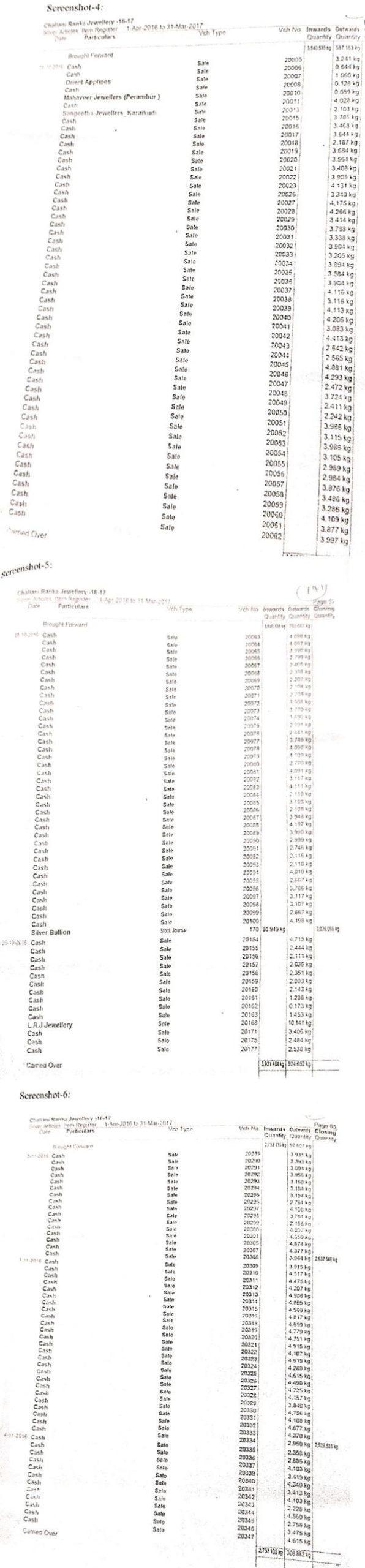
S. On perusal of details submitted by the assessee it is found that the assessee maintains the name of parties to whom the sales has been made on the relevant dates. The cash to the tune of Rs.9.57 crores were found effected without identification of persons. The relevant screenshot from the submission of the assessee is produced as under:

–
-
- In view of the above, it can be seen that as per the sample screenshot number 1 & 2, the details of the buyer/customers are available in maximum sales transactions, whereas, as per the other screenshot number 3,4,5 and 6, no details available for the customer. It is observed that for regular business transactions, the assessee has maintained the propercustomer details in ordinary course of the business. However, in respect of the inflated cash sales recorded in the books for the period of demonetization, no proper details of customers/buyers are available.
- Further, on perusal of bank accounts during the relevant demonetization period, the cash deposits were followed by withdrawals by one Sumiti A Challani on various dates during the financial year, which has not been explained by the assessee. This indicates that the assessee has merely converted unaccounted old notes under the guise of bogus sales. It is very clear that the assessee pumped his own unaccounted cash into his business.
- The Cash book and bill book showed that in earlier months i.e before 26.11.2016, the assessee has been in the habit of booking cash sales in the bill books and cash book mentioning the purchaser’s name. Suddenly, after 26.11.2016, the assessee skipped details of purchasers and has mentioned only as “CASH”.
- Further, in order to verify the availability of the items for the sale, the assessee was requested to furnish the copy of the purchase invoices. However, the assessee has failed to do so.
9. The onus of the proving the identities of the parties, genuineness of transactions and creditworthiness of the sales is on the part of the assessee, which the assessee has failed to do so during the course of the assessment and Remand report proceedings. Hence, it is evident that the assessee simply inflated its cash sales in order to justify the availability of the unaccounted cash. Hence, the details submitted by the assessee are not acceptable. In view of the above facts and circumstances, the cash deposit of Rs.11,31,05,600/- is to be treated as unexplained cash credit u/s 68 of the Act.
7. The ld.AR for the assessee reiterated the submissions which were taken before the AO and CIT(A). The assessee’s case, as emerging from the grounds and the submissions recorded in the appellate proceedings and before us, is that the impugned cash deposits represented business receipts from sale of silver articles during the demonetisation period. It was submitted that the assessee had maintained books of account which had been subjected to audit under section 44AB.It was further submitted that the relevant books and stock register had been produced before the Assessing Officer and that extensive paper-books had been filed before the appellate authorities. The assessee also contended that the relevant annexures to the assessment order had not initially been supplied and that its written submissions had not been properly considered by the CIT(A).The assessee’s principal contention before the Tribunal was that the cash deposits were supported by its books, stock records and sale transactions and that the addition of the entire amount under section 68 was therefore not justified.
8. Written submissions of the Revenue dated 03.09.2026 before the Tribunal are as under:
The facts of the case are as follows:
1. The Assessee ChallaniRaankaJewellers is a partnership firm consisting of two partners Shri. R.J. Anandmul Challani and Smt. Sumthi A Challani. The assessee is into the business of trading in silver utensils, articles, leg chains, hip chains, metti, etc., The assessee filed the return of income for the year belatedly on 08.03.2018 admitting total income of Rs.3,65,020/-. The case was selected for scrutiny and CASS for the reason of cash deposits made during the demonetization period between 09.11.2016 – 30.12.2016 to an extent of Rs.11,31,05,600/-. During the course of scrutiny proceedings, the Assessee was asked to explain the source of cash deposits made into the bank during demonetization period.
2. In response assessee filed written submissions stating that after demonetization the public at large had ventured into getting the notes converted, whichever way possible and they made lot of purchases and one of the major items was silver articles. As they tried to close their financial outstanding and had paid in the old currency. It is submitted by the assessee that the turnover of the firm has been increasing for the last 3 financial years and only for the AY 2017-2018, the turnover has not been on the higher side due to the demonetization. Accordingly, the assessee made a plea to accept the returned income.
3. The AO after considering the material available on record made a detailed analysis of the month wise cash deposits made in the bank account, the closing cash balance held for the earlier 3 financial years, hefty cash sales made on daily basis starting from 28.10.2016 – 02.10.2016 and the submissions of the Assessee, concluded the assessment treating the entire cash deposit of Rs.11,31,05,600/- to be unexplained credit u/s.68 of the Act for the reason of failure on the part of the Assessee to explain he nature and source of such cash deposit.
4. Before the Ld. CIT(A) the Assessee failed to appear in spite of number of opportunities granted but for making a submission on 24.06.2022. The Ld. CIT(A) considering the huge jump in the cash deposit during the month of November 2016 amounting to Rs.14.1 Crores as against that of Rs.6.85 Crores in the earlier year, the sales made without identification of the purchaser, upheld the order of assessment.
5. Before the Hon’ble ITAT, the Assessee submitted that the AO erred in making addition in spite of the fact that the books of account for the assessee has been audited under S.44AB of the Act. In this regard the submissions of the revenue are as under:
-
- While assessee submitted that post demonetization there was a rush to buy silver articles, in case of assessee. It is seen that sales without the name of the buyers have been booked to the extent of Rs.9.57 Crores even before demonetization period within a short span of 10 days, in order to build opening cash balance.
- With regard to the claim of the assessee that the books of accounts have been audited, it is submitted that in spite of the same the assessee has failed to furnish the details of the parties to whom the sales have been effected for a part of the year. Audited books do not guarantee the genuineness of the sales made in cash.
- Perusal of cash book and bill book showed that prior to 28.10.2016 the assessee has been making cash sales mentioning the purchasers name in the bill book and cash book. However, suddenly and peculiarly after 28.10.2016 the assessee skipped the details of the purchasers and has mentioned only the cash in bill book and cash book. In respect of cash sales made between 28.10.2016 and 02.12.2016 to an extent of Rs.9.57 Crores the AO found that the said cash sales have been effected without identification of persons.
- The Assessee hence, failed to establish the identity of the person from whom the cash was received, the genuineness of the sale transaction and the creditworthiness for the cash brought into the books under the guise of sale.
- Also, in respect of the sales made accepting the SBNs during the period 08.11.2016 to 31.03.2016 the assessee failed to establish the availability of the stock with reference to the stock register on the respective date of cash sales.
- There are vast differences between the various figures explaining the availability of cash as follows:
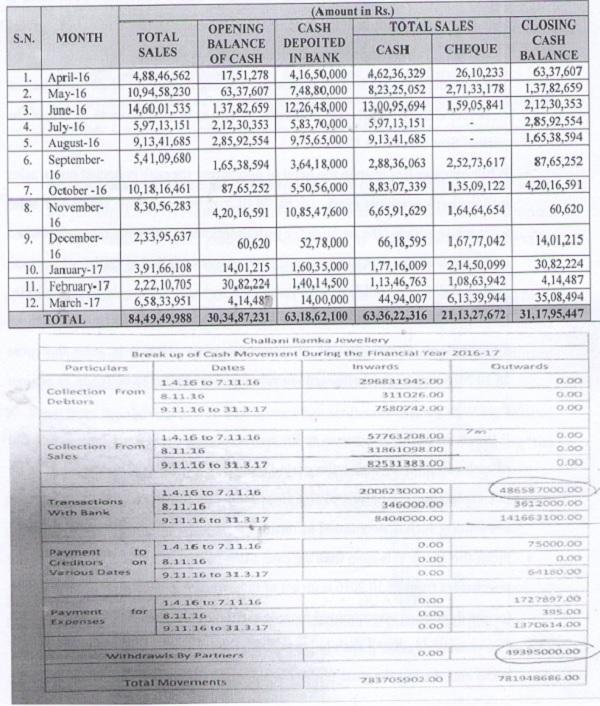
1. From the table above it is seen that there is no cash available as on 08.11.2016.
2. While the cash sales are shown at Rs.63.36 Crores as in table above, in the table explaining cash flow below collection from sales is shown only at Rs.17,21,55,689/-. There is no detail of debtors given.
3. Table 1 shows cash deficits in various months.
-
-
- The cash deposits made by the Assessee during the period of demonetization were found to be withdrawn immediately and in many instances by one of the partner Smt. Sumthi A Challani.
- While assessee has been in the habit of depositing the cash collected out of sales into the bank accounts every day till 28.10.2016 post that date when cash sales were made without the name of the purchasers such cash were never deposited in the bank till the date of demonetization. Assessee failed to explain the reason and modalities for holding such huge cash in hand to be only deposited into bank post demonetization. It appears that the cash was accumulated to be deposited on announcement of demonetization. Also it is seen that post 28.10.2016 no payments towards purchases were found to be made as against the earlier practice.
- If the claim of the assessee as to the nature of cash deposits to have arisen out of cash sales made during the period commencing 28.10.2016, the assessee by not explaining the details of the purchasers has prevented the revenue from unearthing such unaccounted incomes.
- From the above it is seen that the cash sales booked without the names of the purchasers from 28.10.2016 is an act of the assessee to account / accommodate for the deposit of unaccounted income earned by the firm.
- The consistent closing cash balance available for earlier years is around Rs.17 lakhs and during the year under consideration, the assessee has shown huge cash balances.
- Thus, assessee has unsuccessfully tried to build cash availability on the date of demonetization.
- Hence, the assessee has failed to explain the source of cash deposits in terms of the identity, genuineness and the creditworthiness of the persons to whom such cash sales were made.
- The reliance is placed on the following judgments:
-
A. Govindarajulu Mudaliar v. CIT(1958) 34 ITR 807 (SC) – Where the assessee fails to prove satisfactorily the source and nature of a receipt, the Department is entitled to treat it as taxable income.
Kale Khan Mohammad Hanif v. CIT(1963) 50 ITR 1 (SC) – The onus of proving the source of a sum of money found to have been received by the assessee is on him.
CIT v. Precision Finance Pvt. Ltd (1994) 208 ITR 465 (Cal) – The three ingredients in the words “identity, capacity and genuineness” were laid down by the Calcutta High Court.
PCIT v. NRA Iron & Steel (P) Ltd. (2019) 412 ITR 161 (SC)– The assessee is under a legal obligation to prove the identity, creditworthiness of the investor and genuineness of the transaction. The practice of conversion of unaccounted money through masquerade of investment must be subjected to careful scrutiny.
6. However, the onus rests on the assessee to furnish the details of persons who have made cash purchases during the period 28.10.2016 which assessee miserably failed to furnish and hence it is proved that the amounts deposited in cash during demonetization represent unaccounted income of the assessee.
7. Thus, from the above it is seen that assesse has artificially created opening balance of cash availability in order to explain the cash deposits made during the demonetization. The claim of cash sales is not supported by any evidence.
8. Hence, it is requested that the order of AO and CIT(A) be upheld.
9. Submitted for consideration.
8. In sum & substance, the learned Departmental Representative relied upon the assessment order, the order of the CIT(A) and the remand report. It was submitted that the assessee had failed to establish the nature and source of the cash deposits. The Revenue specifically relied upon the discrepancy between the historical cash balances and the cash allegedly accumulated during the relevant period. It was also submitted that the assessee had recorded substantial cash sales without mentioning the names or particulars of the purchasers. The Revenue further submitted that the fact that the books of account had been audited under section 44AB does not, by itself, establish the genuineness of each individual cash transaction. According to the Revenue, the assessee had failed to substantiate the availability of stock corresponding to the alleged cash sales and had also failed to furnish purchase invoices when specifically called upon to do so during remand proceedings.Reliance was placed by the Revenue on the decisions in Govindarajulu Mudaliar v. CIT (1958) 34 ITR 807 (SC), Kale Khan Mohammad Hanif v. CIT (1963) 50 ITR 1 (SC), CIT v. Precision Finance Pvt. Ltd. (1994) 208 ITR 465 (Cal) and PCIT v. NRA Iron & Steel (P) Ltd. (2019) 412 ITR 161 (SC).The Revenue accordingly submitted that the addition made under section 68 was justified and prayed that the orders of the Assessing Officer and CIT(A) be upheld.
9. We have heard the rival submissions and perused the material available on record, including the assessment order, the order of the ld.CIT(A), the paper-books referred to before us, the order-sheet entry dated 06.04.2026 and the remand report dated 20.05.2026.At the outset, we note that the Tribunal had afforded the assessee a specific opportunity to substantiate its principal factual claim, namely, that the cash deposits of Rs.11.31 crores represented sale proceeds received against sale of silver articles out of the stock-inventory during the relevant period. The matter was therefore remanded to the Assessing Officer for verification of this specific claim.The assessee did avail the opportunity and furnished substantial material, including an item register for the period from 01.04.2016 to 31.03.2017. Thus, the issue before us is not merely whether the assessee had produced books of account, but whether the material produced satisfactorily establishes that the impugned cash deposits arose from genuine business sales and represented explained business receipts.
10. The remand report records that substantial cash sales aggregating to Rs.9,57,01,240/- were recorded on various dates between 28.10.2016 and 02.12.2016.Significantly, the remand report points out that the assessee ordinarily maintained particulars of customers in its sales records, whereas in respect of the disputed cash sales the particulars of the customers were not recorded and the entries were described merely as “CASH”.
11. The distinction assumes significance because the assessee’s explanation is that the cash subsequently deposited into the bank represented genuine sale proceeds. Once the Revenue identified a substantial block of sales for which purchaser particulars were absent, it was incumbent upon the assessee to furnish independent and cogent material establishing the genuineness of those transactions. The assessee has not, either during the assessment proceedings or during the remand proceedings, furnished satisfactory particulars of the persons who allegedly purchased the goods in these transactions. The mere recording of a transaction in the books cannot, in the facts of the present case, conclude the matter when the very genuineness of the underlying transactions is in dispute and the surrounding circumstances give rise to serious doubt regarding the source of the corresponding cash.
12. The Tribunal had specifically directed verification of the assessee’s claim that the SBNs represented sale proceeds from sale of silver articles out of the stock-inventory. The assessee produced the item register/stock register during the remand proceedings. However, when the Assessing Officer sought the purchase invoices to verify the availability and movement of the stock corresponding to the disputed sales, the assessee did not furnish those invoices during the remand proceedings. Instead, it stated that the invoices and other documents had already been furnished during the assessment proceedings and had not been returned.
13. We have considered this explanation. However, the issue before us is whether the material ultimately available on record establishes the stock position and corresponding genuine sale transactions with sufficient certainty. The remand report records that the relevant purchase invoices were not furnished to the Assessing Officer despite a specific request. The assessee’s explanation regarding the earlier production of documents cannot, by itself, establish the genuineness of the disputed sales, particularly when the assessee was afforded a specific opportunity by the Tribunal to substantiate precisely this aspect.
14. The remand report further records that the assessee’s closing cash balances in the three immediately preceding financial years were comparatively low. Against such historical cash balances, the assessee claimed substantial cash accumulation in the relevant year, particularly in the period surrounding demonetisation. The Revenue has also pointed out that the cash sales without purchaser particulars commenced substantially before the date of demonetisation. The cash book therefore does not merely reflect deposits of ordinary business collections but records a substantial build-up of cash immediately preceding and around the demonetisation period. The assessee was required to establish through contemporaneous evidence that such substantial accumulation of cash was the normal consequence of genuine business activity. The evidence placed on record, as examined in the remand proceedings, does not satisfactorily discharge that burden.
15. The Revenue has further relied upon the fact that the cash deposits during the relevant period were followed by withdrawals, including withdrawals by one of the partners. The assessee has not furnished a satisfactory explanation for the pattern of withdrawals or established that such withdrawals were connected with ordinary business purposes. This circumstance, when considered along with the absence of purchaser particulars and the failure to substantiate the corresponding stock movement, constitutes an additional circumstance relevant to the examination of the assessee’s explanation. We make it clear that no individual circumstance is being considered in isolation. The conclusion is based upon the cumulative effect of the material available on record.
16. The assessee has raised a specific ground contending that the addition could not have been made because its books of account were audited under section 44AB.We are unable to accept this proposition in the facts of the present case. An audit of books of account is an important statutory compliance; however, the fact of audit does not preclude the Assessing Officer from examining the genuineness and source of particular entries when the same are specifically subjected to scrutiny. The question before us is not whether the assessee maintained books or whether the books were audited, but whether the impugned cash credits have been satisfactorily explained with reference to the material available on record. Therefore, the mere fact that the books were audited cannot, by itself, discharge the assessee’s burden in respect of the disputed cash deposits.
17. Section 68 applies where any sum is found credited in the books of an assessee and the assessee either offers no explanation about the nature and source thereof or the explanation offered is not, in the opinion of the Assessing Officer, satisfactory. In the present case, the assessee has offered an explanation that the cash deposits represented sale proceeds. Therefore, the relevant question is whether the explanation is supported by credible evidence.The assessee’s explanation has to be examined in the light of the totality of circumstances, including:
- the substantial increase in cash deposits during the relevant period;
- the comparatively low historical cash balances;
- the substantial cash sales recorded immediately before and around the demonetisation period;
- the absence of purchaser particulars in respect of the disputed sales;
- the failure to satisfactorily substantiate the corresponding stock availability through the purchase invoices sought during remand proceedings; and
- the unexplained pattern of subsequent withdrawals from the bank account.
18. The remand proceedings were specifically intended to give the assessee an opportunity to establish the nexus between the alleged sales, stock availability and cash deposits. On examination of the material furnished pursuant to the Tribunal’s direction, the Assessing Officer has continued to find that the explanation remains unsubstantiated. We find no material before us which would enable us to hold that the findings recorded by the Assessing Officer and affirmed by the CIT(A) stand displaced by the additional material produced during the remand proceedings.
19. The assessee has also raised grounds concerning non-furnishing of annexures to the assessment order. The CIT(A) has recorded that the issue was taken up with the Assessing Officer and that the assessee was provided an opportunity to obtain the documents. The record further indicates that the assessee appeared before the Assessing Officer and was offered the facility of scanning the voluminous documents, but did not thereafter complete the process or make a further request to the Assessing Officer. More importantly, the Tribunal itself subsequently granted a specific opportunity to the assessee to substantiate its case by producing the relevant material before the Assessing Officer in remand proceedings. The assessee did produce substantial material pursuant to that direction, and the same has been considered in the remand report. Accordingly, even assuming that there had been some earlier difficulty regarding access to the annexures, the same cannot, in the circumstances of the present case, result in deletion of the addition when the assessee was subsequently afforded an effective opportunity to substantiate the very basis of its explanation and the remand verification did not support its claim.
20. The assessee has challenged the disposal of the appeal on the ground of non-prosecution and contended that its written submissions were not considered. On examination of the order of the CIT(A), however, it is evident that the CIT(A) dealt with the issue relating to the annexures, considered the assessee’s written submission dated 24.06.2022 and also examined the merits of the addition under section 68.The CIT(A) recorded specific findings regarding the cash deposits, cash sales, absence of purchaser details and failure to explain the source of the deposits. Thus, irrespective of the terminology employed in the grounds of appeal, the order of the CIT(A) cannot be treated as one which merely dismissed the appeal without considering the merits.The assessee has also been unable to demonstrate before us that consideration of any particular written submission would materially alter the factual position established during the assessment and remand proceedings.
21. The burden in the present case was upon the assessee to establish that the substantial cash deposits of Rs.11,31,05,600/- were genuine business receipts arising from identifiable and genuine sale transactions. The assessee has relied substantially upon its books of account, audit report and stock/item register. However, when the underlying sales themselves were specifically questioned, the assessee did not furnish satisfactory particulars of the purchasers in respect of the disputed cash sales. Further, when purchase invoices were sought during the remand proceedings for verification of stock availability, the assessee did not produce them before the Assessing Officer, instead stating that they had been furnished earlier. The Tribunal had granted the assessee a specific opportunity to establish the source of the SBNs by demonstrating that they arose from sale of silver articles out of available stock. After considering the material furnished pursuant to that opportunity, the remand report does not support the assessee’s explanation. We also find that the explanation offered by the assessee has to be considered against the background of the substantial and unusual cash accumulation, the absence of purchaser particulars in respect of a significant volume of cash sales and the absence of satisfactory corroborative material establishing the corresponding stock movement. In these circumstances, the assessee has failed to satisfactorily explain the nature and source of the impugned cash credit. We therefore find no infirmity in the action of the Assessing Officer in making the addition of Rs.11,31,05,600/- under section 68 of the Act and in the CIT(A)’s decision to confirm the same. The grounds raised by the assessee are accordingly dismissed.
22. In the result, the appeal filed by the assessee is dismissed.
Order pronounced in the open Court on the 22nd day of September 2026 at Chennai.