S Sephulohniam Vs Hotel Radhaprasad Private Limited (NCLT Chennai)
Summary: NCLT Chennai admitted a Section 7 IBC petition filed by S. Sephulohniam against Hotel Radhaprasad Private Limited, which had furnished a guarantee for a ₹12 crore loan advanced to partnership firm Hotel Radhaprasad. The Tribunal held that insolvency proceedings could be maintained directly against a corporate guarantor even though the principal borrower was a partnership firm. Relying on the statutory treatment of guarantee liabilities as financial debt and the co-extensive liability of a surety, it rejected the objection that proceedings first had to be initiated against the principal borrower. The record included the 16.07.2018 Guarantee Agreement, acknowledgment dated 22.04.2019, bank records, repayments, dishonoured cheques and the demand notice invoking the guarantee. The Tribunal found the existence of financial debt and default established.
It also rejected the contention that the guarantee was void for uncertainty under Section 29 of the Indian Contract Act, noting that the parties had acted upon the transaction for several years. On Section 10A, it distinguished the principal borrower’s initial default from the enforceability of the guarantee upon invocation. Regarding limitation, the Tribunal treated cheques issued by a guarantor in 2023 and 2024 as acknowledgment and concluded that the Section 7 petition was within limitation. Accordingly, CP(IB)/185(CHE)/2025 was admitted, CIRP was initiated against Hotel Radhaprasad Private Limited, Palanigounder Eswaramoorthy was appointed IRP and the statutory moratorium was imposed.
Cases Discussed
- Laxmi Pat Surana v. Union Bank of India & Anr., (2021) 8 SCC 481 (Supreme Court) — relied upon for the proposition that Section 7 proceedings can be initiated against a corporate person that furnished a guarantee for a loan taken by a principal borrower that is not itself a corporate person, and that the guarantor’s liability is co-extensive with that of the principal borrower.
- Innovative Industries Ltd. v. ICICI Bank & Anr., AIR 2017 Supreme Court 4084 (Supreme Court) — relied upon on the scope of inquiry at the admission stage under Section 7, particularly whether financial debt exists and default has occurred.
- Pooja Ramesh Singh v. State Bank of India, Company Appeal (AT) (Insolvency) No. 329 of 2023 (NCLAT) — considered on determining the date of default of a corporate guarantor where the guarantee requires invocation, including the application of Section 10A to such default.
- Asset Reconstruction Company (India) Ltd. v. Bishal Jaiswal, (2021) 6 SCC 366 (Supreme Court) — relied upon regarding the applicability of Section 18 of the Limitation Act, 1963 to IBC proceedings and renewal of limitation through a qualifying written acknowledgment of liability.
- United Bank of India v. Naresh Kumar, (1996) 6 SCC 660 (Supreme Court) — cited by the petitioner in support of the contention concerning corporate authority and execution of documents by a director.
- SBI v. Mula Sahakari, (2006) 6 SCC 293 (Supreme Court) — cited by the petitioner while relying upon the parties’ conduct, servicing of interest, repayments, loan confirmation and subsequent cheques as demonstrating acceptance of liability.
- Syndicate Bank vs. Channaveerappa Beleri & Ors., [(2017) in 1195 SC] (Supreme Court) — relied upon for the principle that a guarantor’s liability depends upon the terms of the guarantee and that the dates of default of the principal borrower and guarantor may differ depending upon those terms.
FULL TEXT OF THE NCLT JUDGMENT/ORDER
1. This Petition has been filed under Section 7 of the Insolvency and Bankruptcy code, 2016 (“IBC”) read with Rule 4 of the Insolvency and Bankruptcy (Application to Adjudicating Authority) Rules, 2016 by Sephulohniam, (hereinafter referred to as ‘Financial Creditor’) seeking to initiate Corporate Insolvency Resolution Process against HOTEL RADHA PRASAD PRIVATE LIMITED (hereinafter referred to as ‘Corporate Debtor’).
2. Part-I of the Petition sets out of the details of the Financial Creditor. It is averred that S. Sephulohniam, is the Financial Creditor and his address is No. 600, Murugan Koil Road, A. Mathur, M. Kulavaipatti Panchayat, Pudukottai Taluk – 622 203.
3. Part-II of the Petition sets out the details of the Corporate Debtor, Hotel Radha Prasad Private Limited, with Identification No. U55101TN2006PTC060772, incorporated on 26.07.2006, with a Nominal Share Capital of Rs. 2,50,00,000/- and the Paid-up Share Capital of Rs. 2,00,00,000/- having its registered office at No. 70, First Floor, Rangasamy Street, Kadambaadi Amman Nagar, Nerkundram, Tiruvallur, Chennai – 600 107 within the jurisdiction of this tribunal
4. In Part-III of the Petition, the Financial Creditor has proposed Mr. P. Eswaramoorthy, bearing Registration No. IBBI/IPA-002/IP-N00284/2017-18/10842 to act as Interim Resolution Professional.
5. Part-IV of the Petition states that the total outstanding Debt is Rs. 11,45,00,000/- (Rupees Eleven Crores Forty Five Lakhs Only) towards the Loan disbursed. However, the same was amended pursuant to the Order dated 05.06.2026 in IA(IBC)/857(CHE)/2026. It is stated that the Outstanding debt is Rs. 15,30,00,000/- (Rupees Fifteen Crores Thirty Lakhs Only). The Date of Default is 06.08.2024.
6. Part-V of the Petition describes the particulars of the Financial Debt, documents, records and evidence of the default as below:
- Guarantee Agreement executed between S.Sepulohniam, Hotel Radha Parasd, R. Radha, R.R. Prasad and Hotel Radha Prasad Private Limited.
- Confirmation of Loan Accounts issued by Hotel Radha Prasad
- Bank Statement of Financial Creditor
- Ledger Account of the Hotel Radha Prasad
- Cheques Issued towards the Disbursement of Loan
- Return Memo issued by City Union Bank, Pudukottai Branch
- Demand Notice invoking Personal Guarantee for payment along with Postal Receipt
7. The Financial creditor vide Document dated 22.07.2026 submitted an amended Form 1 pursuant to the order dated 05.06.2026 in IA(IBC)/857(CHE)/2026.
8. The total outstanding Debt is amended as Rs. 15,30,00,000/- (Rupees Fifteen Crores Thirty Lakhs Only). It is clarified that the demand notice dated 20.07.2024 issued to the Corporate Debtor gives 15 days’ time from the date of receipt of notice, to repay the outstanding amount. As the notice was received by the Corporate Debtor on 22.07.2024, the outstanding amount ought to have been repaid on or before 06.08.2024. Since the Corporate Debtor failed to pay the same, the date of default falls on 06.08.2024.
SUBMISSIONS OF PETITIONER:
9. It is stated that the Hotel Radha Prasad is a Partnership Firm, with Mr. Radha and Mr. Prasad as the partners. The partners had approached the petitioner seeking loan for an amount of Rs. 12,00,00,000/- for developing the business. The amount was disbursed vide cheques drawn through ICICI Bank as per details below:
| S. No. | Date | Mode | Amount |
|---|---|---|---|
| 1. | 16.07.2018 | Cheque No. 000001 | Rs. 1,95,00,000 |
| 2. | 17.07.2018 | Cheque No. 000002 | Rs. 1,95,00,000 |
| 3. | 17.07.2018 | Cheque No. 000003 | Rs. 1,90,00,000 |
| 4. | 17.07.2018 | Cheque No. 000004 | Rs. 1,90,00,000 |
| 5. | 02.08.2018 | Cheque No. 051433 | Rs. 2,15,00,000 |
| 6. | 02.08.2018 | Cheque No. 051437 | Rs. 2,15,00,000 |
| Total | Rs. 12,00,00,000 |
10. It is stated that the Partners had entered into a Deed of Guarantee dated 16.07.2018 for the loans availed by the Partnership Firm. An interest at the rate of 7% was agreed between the parties for the loan disbursed.
11. It is stated that the payment was acknowledged by the firm vide letter dated 22.04.2019.
12. It is stated that the loan was agreed to be repaid within 5 years from the date of Guarantee Agreement in instalments. In furtherance of the same, the firm made the repayments, as detailed below:
| Date | Amount | Mode of Payment |
|---|---|---|
| 18.11.2019 | Rs. 25,00,000/- | Cheque No. 327201 drawn on Axis Bank from Bank A/c No. 915020000002991 of Mr. R. Radha |
| 02.09.2020 | Rs. 25,00,000/- | Cheque No. 327261 drawn on Axis Bank from Bank A/c No. 915020000002991 of Mr. R. Radha |
| 25.01.2021 | Rs. 5,00,000/- | Cheque No. 327854 drawn on Axis Bank from Bank A/c No. 915020000002991 of Mr. R. Radha |
| Total | Rs. 55,00,000/- |
13. It is stated that the Mr. Prasad issued a Cheque dated 31.05.2023 for an amount of Rs. 50,00,000/- towards part payment of the debt, but the same was dishonoured for want of funds.
14. It is stated that Mr. Prasad issued 11 cheques dated 07.06.2024 drawn on Karur Vysya Bank and sought the petitioner to present the cheques on 12.06.2024. Upon presentation with City Union Bank, the cheques were returned with a Memo dated 13.06.2024 with the remarks ‘Funds Insufficient’.
15. It is stated that the petitioner initiated the proceedings under Section 138 of Negotiable Instruments Act, 1881 before the Judicial Magistrate, Court – I, at Pudukottai bearing S.T.C No. 488 of 2024.
SUBMISSIONS OF RESPONDENT:
16. It is stated in the reply dated 08.12.2025 that the petition is not maintainable as the Tribunal does not have justification to try the case in relation to Partnership Firm as per Section 79 of IBC, 2016.
17. It is stated that the respondent is only a partner of the firm and the petitioner cannot initiate the proceedings against the partner without initiating the insolvency proceedings against the firm.
18. It is stated that a dispute exists between the parties before the Judicial Magistrate – I, Pudukottai qua Dishonour of Cheque. The cheques attached by the petitioner were signed by Radha Ramalingam, not in the capacity of director of the company, and no cause of action arose for filing the petition.
19. A bare perusal of the document reveals that although the Deed describes two lenders, the individual guarantors, and the Corporate Debtor as guarantor, but the execution of the document is materially incomplete and legally invalid. Only one of the lenders has signed the instrument. The other lender has admittedly not executed the document.
20. It is stated in the reply dated 21.07.2026 that the Corporate Guarantee is ex facie incomplete, uncertain and incapable of enforcement as the repayment period is omitted. Section 29 of the Indian Contract Act, 1872 provides that the agreements which are not certain or capable of being certain, are void. Further, Section 7 of the Act provides that the financial debt necessitates the obligation to repay, but the same is not discussed in the agreement.
21. It is stated that the Principal Borrower discontinued the regular servicing of interest from April 2020 onwards. This constitutes a clear and unequivocal admission that the alleged default in servicing the debt first occurred in April 2020, which is expressly agreed by the petitioner in the Demand Notice.
22. It is an admitted position that April 2020 falls squarely within the statutory suspension period prescribed under Section 10A of the Code, i.e., 25.03.2020 to 24.03.2021. The proviso to Section 10A is couched in the widest possible terms and expressly mandates that
“no application shall ever be filed for initiation of corporate insolvency resolution process of a corporate debtor for the said default occurring during the said period.”
23. It is stated that the legislative bar is absolute, permanent and jurisdictional in nature.
24. It is stated that the petitioner has sought a new “Date of Default” as 06.08.2024 in Part IV of Form 1 by placing reliance upon a NeSL Form C Certificate dated 09.09.2025, which is impermissible, as he seeks to manufacture an artificial date of default solely to overcome the statutory embargo under Section 10A of the Insolvency and Bankruptcy Code, 2016, as well as the bar of limitation. The statement of account produced by the Financial Creditor demonstrates that the last payment towards the alleged loan was made on 25.01.2021. Even assuming, without admitting, that such payment could extend limitation, the period prescribed under Article 137 of the Limitation Act, 1963 expired on 25.01.2024. Consequently, by the time the alleged guarantee was invoked on 20.07.2024, the remedy to enforce the underlying debt had become barred by limitation.
25. It is stated that the Financial Creditor’s own ledger reveals the interest Payments up to March 2020 and the three instalments dated 18.11.2019, 02.09.2020, and 25.01.2021 remitted exclusively from the personal bank account of R. Radha and not through the bank account of the Principal Borrower, Hotel Radha Prasad. The Respondent Corporate Debtor is an independent juristic person, distinct from its directors, shareholders and the partners of the Principal Borrower. Consequently, payments made by an individual from his personal bank account, without any evidence of corporate authority or agency, cannot extend the period of limitation against the Respondent Corporate Guarantor.
26. It is stated that the petitioner was first required to establish that the liability of the Principal Borrower had become due and payable in accordance with the contractual terms. In this case, no Loan Recall Notice or Demand Notice was ever issued to the Principal Borrower, namely M/s. Hotel Radha Prasad, requiring repayment of the alleged outstanding dues before proceeding against the Corporate Guarantor. In the absence of such recall or demand, the Financial Creditor has failed to demonstrate that the liability of the Principal Borrower lawfully crystallised in accordance with the contractual stipulations.
REJOINDER BY PETITIONER:
27. It is stated in the rejoinder dated 13.02.2026 that the Financial Creditor was approached by Radha and RR Prasad for a loan of Rs. 12,00,00,000/- in order to develop their partnership business M/s. Hotel Radha Prasad, M/s. Hotel Radha Prasad was the principal borrower and there are 3 partners in the firm, namely, Mr. Radha, Mr. RR Prasad and M/s. Hotel Radha Prasad Private Limited (Corporate Guarantor).
28. It is stated that a Guarantee Agreement dated 16.07.2018 was executed between the petitioner and the Partners of the Firm. The Petitioner had issued cheques amounting to Rs. 12 crores, which were acknowledged by the Borrower vide letter dated 22.04.2019.
29. It is stated that the Principal Borrower paid the monthly interest till March 2020 and an amount of Rs. 55,00,000/- towards the principal amount. Thereafter, cheques issued by RR Prasad dated 31.05.2023 and 07.06.2024 for an amount of Rs. 50,00,000/- and Rs. 1,00,00,000/- each were dishonoured with an endorsement “Funds insufficient”.
30. It is stated that the petitioner issued a Demand Notice dated 20.07.2024 invoking the personal guarantee of the Guarantor.
31. It is stated that the petitioner has filed the present petition against the Respondent being the Corporate Guarantor rather than that of partner. The Hon’ble Supreme Court in plethora of judgements has laid down that if a corporate person extends guarantee for the loan concerning a principal borrower, on default of the said loan, such corporate guarantor would fall within the purview of corporate debtor as defined in Section 3(8) of IBC 2016.
32. It is stated that the Guarantee Agreement signed by the Respondent/Corporate Debtor states as follows:
“WHEREAS the lenders referred to herein have given a loan of Rs, 12,00,00,000/- (Rupees twelve crores only) to the Borrower, a partnership firm wherein Guarantors referred to herein are partners, for the purpose of business activities of Hotel Radha Prasad, Hotel Radha Prasad (P) Ltd and other business activities.
Wherein the guarantors have agreed to guarantee the repayment of the amount borrowed by the borrower together with interest and other charges, if any, charged on the loan availed by the borrower;
4. The guarantors extend their personal guarantees to the lenders for the repayment of the principal amount outstanding, interest and other dues if the borrower commits default in repayment of loan, payment of interest or other dues as agreed.”
33. It is stated that the Respondent extended its personal guarantee to repay the outstanding dues if the principal borrower commits default. This guarantee as per Section 128 of Indian Contact Act 1872, makes the liability of the Guarantor co extensive with that of the Principal Borrower. It is stated that the scope and nature of both the proceedings are entirely different and do not overlap.
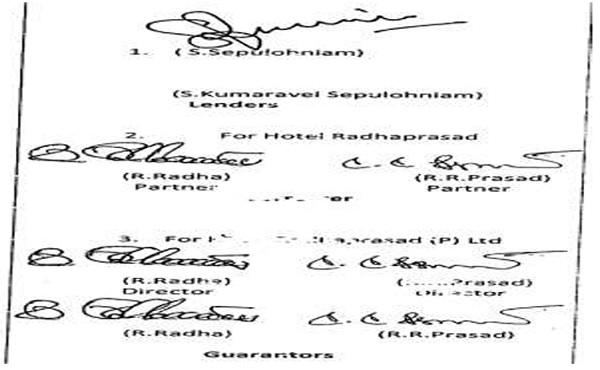
34. It is stated that the Board resolution passed by the Respondent is an internal document of the Respondent and was unavailable with the petitioner. All the partners are the signatories to the Guarantee Agreement. This shows the implied consent as derived from the Board of Directors of the Respondent.
35. In the Memo dated 30.07.2026, it is stated that the contention that the Deed of Guarantee is defective or unenforceable is baseless. The Corporate Debtor’s Director, R. Radha, has affirmed in his verifying affidavit that he is “duly authorized,” which is a binding admission of corporate authority, and in law, a Director’s execution binds the company unless lack of authority is proved as held in the case of ‘United Bank of India v. Naresh Kumar, (1996) 6 SCC 660.’
36. It is stated that the conduct of the Principal Borrower for over five years servicing monthly interest from August 2018 to March 2020, making principal repayments in 2019, 2020, and 2021, issuing a loan confirmation letter dated 22.04.2019, and issuing eleven cheques totalling ₹11.0 crore on 07.06.2024 clearly establishes acceptance of liability, consistent with the case ‘SBI v. Mula Sahakari, (2006) 6 SCC 293.’
37. It is stated that the respondent’s reliance on Section 29 of the Indian Contract Act, 1872 is wholly misplaced, as in this case, repayment obligation was unquestionably capable of being made certain and was, in fact, acted upon by the parties for years. The Agreement fixed interest at 7%, which the Respondent regularly serviced from August 2018 to March 2020, and the Respondent made principal repayments in 2019, 2020, and 2021 and issued a loan confirmation letter dated 22.04.2019 acknowledging the debt. This continuous performance demonstrates that the repayment terms were understood, accepted, and implemented, thereby satisfying the statutory requirement of certainty. A contract cannot be declared void for uncertainty when the parties themselves have performed it without ambiguity.
38. It is stated that the default of the Corporate Debtor did not occur in April 2020. It only arose upon invocation of the corporate guarantee through the Demand Notice dated 20.07.2024. Under settled law, a guarantor’s default crystallises on the date of demand, not on the date of the borrower’s default. The Corporate Debtor’s liability is independent and arose only when the guarantee was invoked in 2024, well outside the suspension window of 25.03.2020 to 24.03.2021. Therefore, bar under Section 10A is neither attracted nor applicable.
WRITTEN SUBMISSIONS OF PETITIONER:
39. It is stated that financial creditor had given a loan amounting to Rs. 12 crores to Hotel Radha Prasad, a partnership firm. A guarantee agreement dated 16.07.2018 was executed between the petitioner and Mr. Radha, Mr. Prasad and Hotel Radha Prasad Private Limited as Guarantors.
40. The guarantors were the partners of the Borrower Firm.
41. It is stated that 6 cheques were issued to the borrower as reflected in the bank statements of the Financial Creditor and the transfer was acknowledged by the borrower vide letter dated 22.04.2019 which clearly establishes the existence of debt.
42. It is stated that the borrower made the timely payments towards the interest till March 2020 but later it stopped. As agreed between the parties, the debt was to be repaid within a period of 5 years. In furtherance of same, an amount of Rs. 55,00,000/- was made towards the principal amount as upto 25.01.2021.
43. It is stated that certain cheques were issued to the petitioner for an amount of Rs. 50,00,000/- as a part payment vide cheques dated 07.06.2024 instructing the petitioner to present the cheques on 12.06.2024. However, the said cheques were returned with an endorsement “Funds Insufficient” on 13.06.2024.
44. It is stated that a complaint was filed under Section 138 of Negotiable Instruments Act, 1881 against the Borrower vide case numbered S.T.C. No. 488 of 2024 before Judicial Magistrate Court – I, Pudukottai.
45. It is stated that Section 128 of Indian Contracts Act. 1872 defines the coextensive liability of guarantors, thereby making the respondent liable for the debt of the Borrower firm.
46. It is stated that the petitioner vide notice dated 20.07.2024 invoked the personal guarantee against the guarantors to repay the amount of Rs. 14,68,00,000/-.
WRITTEN SUBMISSIONS OF RESPONDENT:
47. It is stated that the purported Guarantee Deed does not stipulate any definite repayment period or maturity date. Section 29 of the Indian Contract Act, 1872 provides that agreement, the meaning of which is not certain, or capable of being made certain, is void for uncertainty. In the present case, Clause 3 of the Guarantee Deed states ‘as agreed between the parties’ thus quotes uncertainty.
48. It is stated that the first default occurred in April 2020 as averred in the petition, however, later 06.08.2024 has been stated as the date of default for which no explanation was given.
49. It is stated that April 2020 squarely falls within the period protected under Section 10A of the Code, i.e., the period commencing from 25.03.2020 and extending up to 24.03.2021. Section 10A was enacted as a specific statutory prohibition against initiation of CIRP in respect of defaults occurring during the protected period. It expressly provides that no application shall be filed for initiation of CIRP for such default.
50. It is stated that the Applicant has failed to place on record satisfactory evidence demonstrating that the purported guarantee was executed pursuant to a valid Board Resolution or other competent corporate authority of the Respondent.
51. It is stated that the material relied upon, however, indicates that the cheques and payments were issued or made by individuals from their personal bank accounts and not by the Respondent-Corporate Guarantor. The Applicant has not produced any material showing that such individuals were acting as duly authorised agents of the Respondent, or that the Respondent had authorised, adopted or ratified such payments.
FINDINGS OF THIS TRIBUNAL:
52. We have heard Ld. Counsel for the parties and perused the record.
53. The present petition has been filed by the Financial Creditor under Section 7 of the Insolvency and Bankruptcy Code, 2016 (“the Code”) seeking initiation of Corporate Insolvency Resolution Process (“CIRP”) against the Respondent, on the basis of a Guarantee Agreement executed dated 16.07.2018 by the Respondent in respect of credit facilities extended to M/s. Hotel Radha Prasad, a partnership firm (hereinafter referred to as “Principal Borrower”).
54. Petitioner contends that the Financial Creditor had advanced a sum of ₹12,00,00,000/- to the Principal Borrower for development of its business. The Principal Borrower defaulted in the repayment of the loan owed. The Guarantee Agreement dated 16.07.2018, letter acknowledging debt dated 22.04.2019, dishonoured cheques dated 31.05.2023 denote the liability of the respondent. A demand notice dated 20.07.2024 was issued by the Financial Creditor invoking the Guarantee of the Respondent.
55. Per Contra, the respondent contends that the Guarantee Agreement dated 16.07.2018 is defective. The repayment terms contained in the Guarantee Agreement are uncertain and are hit by Section 29 of the Indian Contract Act, 1872. It is also stated that the Financial Creditor’s own pleadings establish that the Principal Borrower committed its first default in April 2020, which falls within the period protected under Section 10A of the Code, which provides a permanent bar on the initiation of CIRP against for default arisen during the period from 25.03.2020 to 24.03.2021.
56. Respondent contends that the payments, relied upon by the Financial Creditor were made from the personal account of Mr. R. Radha and not from the account of the Corporate Debtor for which no Board Resolution or other valid corporate authorisation authorising the Respondent to furnish the guarantee has been produced.
57. The issues for consideration that lie before this Tribunal are:
i. Whether the present petition under Section 7 of the Insolvency and Bankruptcy Code, 2016 (“IBC/Code”) is maintainable against the Respondent, who stood as a corporate guarantor for the loan availed by the partnership firm, M/s. Hotel Radha Prasad?
ii. Whether the Financial Creditor has established the existence of a “financial debt” and “default” within the meaning of Sections 3(11), 3(12), 5(8) and 7 of the Code?
iii. Whether the alleged Guarantee Deed is unenforceable on account of uncertainty under Section 29 of the Indian Contract Act, 1872 or for want of proof of proper corporate authorisation?
iv. Whether the petition is hit by the embargo contained in Section 10A of the Code and whether the claim is barred by limitation under Section 238A of the Code read with Article 137 of the Limitation Act, 1963?
v. Whether the cheques were issued in the personal capacity or as a representative of the Principal Borrower and whether such act constitutes as an Acknowledgement for extending the limitation period?
Issue -1
58. The present petition has been filed against the Corporate Guarantor of the Principal Borrower. Section 79 of IBC governs the insolvency resolution and bankruptcy of individuals and partnership firms, which provides that the Adjudicating Authority for the individuals is Debt Recovery Tribunal. The respondent’s contention that the petitioner cannot initiate the proceedings against the partner is not maintainable, as the petition herein has been filed against the Corporate Guarantor.
59. It is relevant to discuss Section 5(8), Section 5(5A) and Section 60 of IBC:
“(5A) “corporate guarantor” means a corporate person who is the surety in a contract of guarantee to a corporate debtor;
5(8) “financial debt” means a debt along with interest, if any, which is disbursed against the consideration for the time value of money and includes— .
(i) (i) the amount of any liability in respect of any of the guarantee or indemnity for any of the items referred to in sub-clauses (a) to (h) of this clause; 60(1). Adjudicating authority for corporate persons.—(1) The Adjudicating Authority, in relation to insolvency resolution and liquidation for corporate persons including corporate debtors and personal guarantors thereof shall be the National Company Law Tribunal having territorial jurisdiction over the place where the registered office of the corporate person is located.”
60. Section 60(1) of IBC provides the jurisdiction for adjudication of insolvency resolution against Corporate Debtors and Personal Guarantors. While Section 5(8) of the Code includes within the expression “financial debt” a liability in respect of a guarantee in sub-clause (i). Thus, the liability undertaken by a corporate person under a guarantee securing a financial debt falls within the statutory framework of financial debt.
61. The Respondent contends that the Financial Creditor has bypassed the Principal Borrower and directly proceeded against the Corporate Guarantor. This contention is contrary to the settled principles governing a contract of guarantee.
62. Section 128 of the Indian Contract Act, 1872 provides that the liability of the surety is co-extensive with that of the principal debtor unless otherwise provided by the contract, which is extracted as follows:
“128. Surety’s liability.—
The liability of the surety is co-extensive with that of the principal debtor, unless it is otherwise provided by the contract.”
63. The very purpose of a guarantee is to provide the creditor with an additional remedy in the event of default by the principal debtor. The creditor is not ordinarily required to exhaust the remedy against the principal debtor before proceeding against the surety. Consequently, the mere fact that the Financial Creditor has not initiated CIRP against the partnership firm does not constitute a bar to the present proceedings against the Corporate Guarantor.
64. In the case of ‘Laxmi Pat Surana Vs. Union Bank Of India & Anr., (2021) 8 SCC 481, the Hon’ble Supreme Court considered whether proceedings under Section 7 could be instituted against a corporate person which had guaranteed the loan of a principal borrower who was not a corporate person. It was held as under;
“25. Notably, the expression “corporate guarantee” is not defined in the Code. Whereas, expression “corporate guarantor” is defined in Section 5(5A) of the Code. If the legislature intended to exclude a corporate person offering guarantee in respect of a loan secured by a person not being a corporate person, from the expression “corporate debtor” occurring in Section 7, it would have so provided in the Code (at least when Section 5(5A) came to be inserted defining expression “corporate guarantor”). It was also open to the legislature to amend Section 7 of the Code and replace the expression “corporate debtor” by a suitable expression. It could have even amended Section 3(8) to exclude liability arising from a guarantee given for the loan account of an entity not being a corporate person. Similarly, it could have also amended expression “financial debt” in Section 5(8) of the Code, “claim” in Section 3(6), “debt” in Section 3(11) and “default” in Section 3(12). There is no indication to that effect in the contemporaneous legislative changes brought about.
26. The expression “corporate debtor” is defined in Section 3(8) which applies to the Code as a whole. Whereas, expression “corporate guarantor” in Section 5(5A), applies only to Part II of the Code. Upon harmonious and purposive construction of the governing provisions, it is not possible to extricate the corporate person from the liability (of being a corporate debtor) arising on account of the guarantee given by it in respect of loan given to a person other than corporate person. The liability of the guarantor is coextensive with that of the principal borrower. The remedy under Section 7 is not for recovery of the amount, but is for reorganisation and insolvency resolution of the corporate debtor who is not in a position to pay its debt and commits default in that regard. It is open to the corporate debtor to pay off the debt, which had become due and payable and is not paid by the principal borrower, to avoid the rigours of Chapter II of the Code in general and Section 7 in particular.
27. In law, the status of the guarantor, who is a corporate person, metamorphoses into corporate debtor, the moment principal borrower (regardless of not being a corporate person) commits default in payment of debt which had become due and payable. Thus, action under Section 7 of the Code could be legitimately invoked even against a (corporate) guarantor being a corporate debtor. The definition of “corporate guarantor” in Section 5(5A) of the Code needs to be so understood.
28. A priori, we find no substance in the argument advanced before us that since the loan was offered to a proprietary firm (not a corporate person), action under Section 7 of the Code cannot be initiated against the corporate person even though it had offered guarantee in respect of that transaction. Whereas, upon default committed by the principal borrower, the liability of the company (corporate person), being the guarantor, instantly triggers the right of the financial creditor to proceed against the corporate person (being a corporate debtor). Hence, the first question stands answered against the appellant.”
65. Therefore, this tribunal is of view that the present petition is maintainable against the Respondent in the capacity of Corporate Guarantor for the loans availed by the Principal Borrower.
Issue – 2:
66. It is relevant to discuss Section 7(5) which deals with the factors to be considered by this Tribunal while considering a petition under Section 7 of IBC, 2016. Section 7(5) of IBC reads as under:
“7. Initiation of corporate insolvency resolution process by financial creditor.
(5) Where the Adjudicating Authority is satisfied that—
(a) a default has occurred and the application under sub-section (2) is complete, and there is no disciplinary proceedings pending against the proposed resolution professional, it may, by order, admit such application; or
(b) default has not occurred or the application under sub-section (2) is incomplete or any disciplinary proceeding is pending against the proposed resolution professional, it may, by order, reject such application:
Provided that the Adjudicating Authority shall, before rejecting the application under clause (b) of sub-section (5), give a notice to the applicant to rectify the defect in his application within seven days of receipt of such notice from the Adjudicating Authority.”
67. In the case of Innovative Industries Ltd. v. ICICI Bank & Anr.(AIR 2017 SUPREME COURT 4084), the Hon’ble Supreme Court held that at the stage of admission of an application under Section 7 of the Insolvency and Bankruptcy Code, 2016, the Adjudicating Authority is only required to ascertain the existence of a financial debt and the occurrence of default. It was held as under:
“28. … It is at the stage of Section 7(5), where the adjudicating authority is to be satisfied that a default has occurred, that the corporate debtor is entitled to point out that a default has not occurred in the sense that the “debt”, which may also include a disputed claim, is not due. A debt may not be due if it is not payable in law or in fact. The moment the adjudicating authority is satisfied that a default has occurred, the application must be admitted unless it is incomplete, in which case it may give notice to the applicant to rectify the defect within 7 days of receipt of a notice from the adjudicating authority. Under subsection (7), the adjudicating authority shall then communicate the order passed to the financial creditor and corporate debtor within 7 days of admission or rejection of such application, as the case may be.
30. On the other hand, as we have seen, in the case of a corporate debtor who commits a default of a financial debt, the adjudicating authority has merely to see the records of the information utility or other evidence produced by the financial creditor to satisfy itself that a default has occurred. It is of no matter that the debt is disputed so long as the debt is “due” i.e. payable unless interdicted by some law or has not yet become due in the sense that it is payable at some future date. It is only when this is proved to the satisfaction of the adjudicating authority that the adjudicating authority may reject an application and not otherwise.”
68. Section 5(8) defines Financial Debt. It is a debt, which is disbursed against the consideration for the time value of money. The Financial Creditor in the present petition has placed the following materials:
- Guarantee Agreement dated 16.07.2018;
- Written acknowledgment dated 22.04.2019;
- Bank records evidencing disbursement of Rs. 12 crores;
- Records evidencing payment of interest and repayment towards principal ;
- Cheques dated 31.05.2023 and 07.06.2024 for ₹50,00,000/- and Rs. 11 Crores respectively;
- Demand notice dated 20.07.2024 invoking the guarantee;
69. It is clear from the averments of the petitioner that the loan was granted for the development of business of the partnership firm. The materials placed on record show that money was advanced against the consideration for the time value of money. Therefore, the transaction falls within the definition of financial debt under Section 5(8) of the Code. The issuance of cheques towards discharge of the liability, followed by their dishonour, further supports the Financial Creditor’s assertion that the liability remained outstanding.
70. Section 3(12) of the Code defines “default” as non-payment of debt when the whole or any part or instalment of the amount of debt has become due and payable and is not paid.
71. As per the Account Statements submitted by the Petitioner, the last payment towards interest was made on 25.01.2021. Certain cheques were issued by one of Guarantors for the repayment of loan, which clearly establish that the principal borrower had defaulted in the repayment of loan.
72. The Financial Creditor has also submitted the NeSL record of default in Form D which reflects the default amount as Rs. 15,30,00,000/-. The status of authentication in the RoD reflects as “DEEMED TO BE AUTHENTICATED”.
73. In light of the documentary evidence on record, and admission of liability by the Respondent, the existence of a financial debt and the occurrence of default stand satisfied.
Issue – 3:
74. It is observed that the Guarantee Deed dated 16.07.2018 was entered between S. Sepulohniam and Kumaravel Sepulohniam with M/s. Hotel Radhaprasad (Principal Borrower) and R.Radha, R.R.Prasad and Hotel Radhaprasad Private Limited for an amount of Rs. 12,00,00,000/-.
75. The Respondent has contended that the Guarantee Agreement is defective since two lenders are referred to the agreement but, only one lender executed the instrument.
76. At the stage of admission under Section 7, the Adjudicating Authority is required to determine whether there is a financial debt and whether a default has occurred. The proceeding is not intended to finally adjudicate every possible contractual defence which may be raised in an appropriate civil proceeding, unless such defence goes to the root of the existence of the debt or guarantee.
77. The Respondent contends that the Guarantee Agreement does not contain a definite repayment period or maturity date and is consequently void under Section 29 of the Indian Contract Act, 1872.
78. Section 29 renders an agreement void only where its meaning is uncertain and is incapable of being made certain. The statutory provision distinguishes between an agreement which is inherently incapable of ascertainment and one whose terms can be determined from the agreement and surrounding circumstances.
79. In the present case, the contention that the terms of the agreement are vague thereby, making the contract void does not hold good. In this case, the parties were acting in line with the credit facilities availed by the principal borrower. Certain repayments were also made in furtherance of same. The respondent thereof cannot claim that the deed is incomplete while acting on the terms.
80. The Respondent’s conduct subsequent to execution of the guarantee also assumes significance. Where a corporate entity permits the transaction to remain acted upon for several years and does not demonstrate any contemporaneous repudiation of the guarantee, the subsequent plea of absence of authority requires stronger evidentiary support.
81. The documents prima facie demonstrate as follows:
AND WHEREAS the parties herein above have decided to reduce the terms of the agreement of guarantee into writing:
1. The Lenders have given a loan of Rs.12,00,00,000/- (Rupees Twelve Crores only) to the Borrower.
2. Interest @ 7% p.a. (Net of Tax Deducted at Source under the provisions of Income tax Act, 1961 at the rates as applicable from time to time) is payable monthly by the borrower on the balance of loan amount outstanding.
3. The borrower has agreed to repay the loan in instalments / lumpsum on or before or within such date as may be agreed upon by the lenders and borrower.
4. The guarantors extend their personal guarantees to the lenders for the repayment of the principal amount outstanding, interest and other dues if the borrower commits default in repayment of loan, payment of interest or other dues as agreed.
82. This is not a case where the parties were incapable of identifying either the subject matter, consideration, debt or repayment obligation. On the contrary, the parties appear to have acted upon the transaction for several years, thereby making the objection untenable.
Issue – 4:
83. Section 10A was introduced by the Insolvency and Bankruptcy Code (Second Amendment) Act, 2020 as a special measure in relation to defaults arising during the COVID-19 period. The statutory period under Section 10A commenced on 25.03.2020 and extended up to 24.03.2021.
84. The proviso to Section 10A expressly provides that no application shall ever be filed for initiation of CIRP in respect of a default occurring during the said period. The words “no application shall ever be filed” demonstrate that the prohibition is not merely a temporary suspension of proceedings. The legislature has permanently excluded such defaults from the ambit of Section 7.
85. However, the crucial question is: What is the relevant default for the purpose of the present petition against the Corporate Guarantor?
86. The present proceedings are not against the Principal Borrower. They are against the Corporate Guarantor. A corporate guarantee is an independent contractual obligation, though co-extensive with the liability of the principal debtor. Where the terms of the guarantee contemplate invocation/demand upon the guarantor, the liability of the guarantor becomes enforceable in accordance with those terms.
87. In Pooja Ramesh Singh v. State Bank of India, NCLAT, Company Appeal (AT) (Insolvency) No.329 of 2023 Hon’ble NCLAT considered the precise issue of the date of default of a Corporate Guarantor for the purposes of Section 10A. The Tribunal held that where the guarantee required invocation of guarantee, the default of the Corporate Guarantor was to be reckoned with reference to invocation of the guarantee and subsequent failure to honour the demand. The same is extracted as follows;
“32. In view of the foregoing discussion, we arrive at following conclusions:
(i) The Corporate Guarantee Deed dated 17.05.2019 is on demand guarantee deed and the default shall arise on the part of the Guarantor only when demand notice is issued as contemplated in the Deed of Guarantee. When the State Bank of India invoked the guarantee vide notice dated 01.10.2020, demand on the part of the Corporate Guarantee shall arise only subsequent to the notice dated 01.10.2020 i.e. non-payment of the amount within seven days i.e. default arise on 08.10.2020.
(ii) Default on the part of the Guarantor having arisen on 08.10.2020 i.e. within the period which is covered as prohibited period under Section 10A, application under Section 7 was clearly barred by Section 10A. Issues No. II, III and IV are answered accordingly.
(iii) The Adjudicating Authority in the impugned order has not adverted to the relevant clauses of the Deed of Guarantee as noted above. The date of default on part of the Guarantor being subsequent to 01.10.2020 when guarantee was invoked, the application was barred by Section 10A and the Adjudicating Authority committed error in admitting the Section 7 application.”
88. The Respondent further contends that the last payment towards the loan was made on 25.01.2021 and the three-year period expired on 25.01.2024. Consequently, the invocation dated 20.07.2024 and the present petition are barred by limitation.
89. It is settled that Article 137 of the Limitation Act, 1963 applies to applications under Section 7 of the Code. The limitation period is three years from the date when the right to apply accrues. Section 238A of the Code makes the provisions of the Limitation Act applicable to proceedings before the Adjudicating Authority, as far as may be applicable.
90. The Hon’ble Supreme Court in Laxmi Pat Surana and Asset Reconstruction Company (India) Ltd. v. Bishal Jaiswal, (2021) 6 SCC 366, recognised the applicability of Section 18 of the Limitation Act to proceedings under the Code. It was held that an acknowledgment of liability made in writing and signed by the party against whom the right is claimed may give rise to a fresh period of limitation, provided such acknowledgment is made before expiry of the existing limitation period. It was held as under:
“37. Ordinarily, upon declaration of the loan account/debt as NPA that date can be reckoned as the date of default to enable the financial creditor to initiate action under Section 7 of the Code. However, Section 7 comes into play when the corporate debtor commits “default”. Section 7, consciously uses the expression “default” — not the date of notifying the loan account of the corporate person as NPA. Further, the expression “default” has been defined in Section 3(12) to mean non-payment of “debt” when whole or any part or instalment of the amount of debt has become due and payable and is not paid by the debtor or the corporate debtor, as the case may be. In cases where the corporate person had offered guarantee in respect of loan transaction, the right of the financial creditor to initiate action against such entity being a corporate debtor (corporate guarantor), would get triggered the moment the principal borrower commits default due to non-payment of debt. Thus, when the principal borrower and/or the (corporate) guarantor admit and acknowledge their liability after declaration of NPA but before the expiration of three years therefrom including the fresh period of limitation due to (successive) acknowledgments, it is not possible to extricate them from the renewed limitation accruing due to the effect of Section 18 of the Limitation Act. Section 18 of the Limitation Act gets attracted the moment acknowledgment in writing signed by the party against whom such right to initiate resolution process under Section 7 of the Code enures. Section 18 of the Limitation Act would come into play every time when the principal borrower and/or the corporate guarantor (corporate debtor), as the case may be, acknowledge their liability to pay the debt. Such acknowledgment, however, must be before the expiration of the prescribed period of limitation including the fresh period of limitation due to acknowledgment of the debt, from time to time, for institution of the proceedings under Section 7 of the Code. Further, the acknowledgment must be of a liability in respect of which the financial creditor can initiate action under Section 7 of the Code.”
91. Section 18 of Limitation Act provides as under:
“18. Effect of acknowledgment in writing.—
(1) Where, before the expiration of the prescribed period for a suit of application in respect of any property or right, an acknowledgment of liability in respect of such property or right has been made in writing signed by the party against whom such property or right is claimed, or by any person through whom he derives his title or liability, a fresh period of limitation shall be computed from the time when the acknowledgment was so signed.
(2) Where the writing containing the acknowledgment is undated, oral evidence may be given of the time when it was signed; but subject to the provisions of the Indian Evidence Act, 1872 (1 of 1872), oral evidence of its contents shall not be received.
Explanation.—
For the purposes of this section,—
(a) an acknowledgment may be sufficient though it omits to specify the exact nature of the property or right, or avers that the time for payment, delivery, performance or enjoyment has not yet come or is accompanied by a refusal to pay, deliver, perform or permit to enjoy, or is coupled with a claim to set-off, or is addressed to a person other than a person entitled to the property or right;
(b) the word “signed” means signed either personally or by an agent duly authorised in this behalf; and
(c) an application for the execution of a decree or order shall not be deemed to be an application in respect of any property or right.”
92. Hence, it is clear that the Limitation for the petition filed under Section 7 is three years from the accrual of date of default. Section 18 of Limitation Act provides that acknowledgement of debt within the limitation period gives a fresh limitation period to the debt. In the present case, although the initial default occurred in April 2020 but, the cheques issued by one of guarantors dated 31.05.2023 and 07.06.2024 for an amount of Rs. 50,00,000/-and Rs. 11,00,00,000/- constitute a valid acknowledgement.
93. Based on the above observations, this tribunal is of view that the present petition has been filed within the limitation period.
Issue – 5:
94. The Respondent contends that payments were made from the personal bank account of R. Radha and not from the account of the Corporate Debtor and, therefore, such payments cannot extend limitation against the Corporate Guarantor.
95. The objection proceeds upon the assumption that every payment relied upon by the Financial Creditor is required to be treated as a payment made by the Corporate Guarantor.
96. The Financial Creditor relies upon the payments as evidence of the subsistence and acknowledgment of the underlying debt and the performance of the loan arrangement. The question here is whether a particular payment was made on behalf of Principal Borrower, by one of its partners, or pursuant to the guarantee, constitutes a valid acknowledgement for extension of limitation period herein.
97. At the stage of Section 7, the Adjudicating Authority is required to ascertain whether the record demonstrates the existence of a financial debt and default. The fact that a partner or person connected with the Principal Borrower made payment from a personal account does not extinguish or disprove the underlying debt. Nevertheless, a payment by an individual cannot mechanically be treated as an acknowledgment by the Corporate Guarantor for purposes of Section 18 of the Limitation Act unless the requisite legal relationship, authority or agency is established.
98. In the present case, the person making the payment is a director of the firm or the principal borrower per se. The payments were made by Radha. Radha is also one of the Guarantors of the debt owed by the Principal Borrower, as seen from the Guarantee Deed dated 16.07.2018 duly signed by the parties, which is extracted as follows:
Guarantee agreement
This agreement of guarantee is entered into at Tiruchengode on 16th July 2018 between:
1. Mr. S. Sepulohniam s/o. Somu aged about 70 years and Mr. Kumaravel Sepulohniam s/o. Mr. S. Sepulohniam aged about 30 years both residing at No.600, Murugan Koil Road, A. Mathur, M. Kulavaipatti Panchayat, pudukkottai Taluk, PIN- 622203 (hereinafter referred to as the Lenders);
2. M/s. Hotel Radhaprasad, a partnership firm having its office at 344, Brough Road, Erode – 638 001 and engaged in the business of running hotels (hereinafter referred to as the Borrower);
3. (i) Mr.R.Radha s/o Late D.M.Ramalingam aged 61 years residing at Sri Rajarajeswari Bhavan, OA-13, Kumaresapuram 7th Street, Rajiv Nagar, Tiruchengode – 637211 ; (ii) Mr.R.R.Prasad s/o R.Radha aged 35 years residing at Sri Rajarajeswari Bhavan, OA-13, Kumaresapuram 7th Street, Rajiv Nagar, Tiruchengode – 637211 and (iii) Hotel Radhaprasad Private Limited, a company incorporated under the Companies Act, 1956 having its office at No.150, Teppakulam Street, Near Anna Statue, Tiruchengode – 637 211.(hereinafter referred to the Guarantors);
WHEREAS the Lenders referred to herein have given a loan of Rs.12,00,00,000/- (Rupees Twelve Crores only) to the Borrower, a partnership firm wherein Guarantors referred to herein are partners, for the purpose of business activities of Hotel Radhaprasad, Hotel Radhaprasad (P) Ltd and other business activities.
Wherein the guarantors have agreed to guarantee the repayment of the amount borrowed by the borrower together with the Interest and other charges, if any, charged on the loan availed by the borrower;
99. The scheme of I&B Code clearly indicates that both the Principal Borrower and the Guarantor become liable to pay the amount when the default is committed. When default is committed by the Principal Borrower the amount becomes due not only against the Principal Borrower but also against the Corporate Guarantor, which is the scheme of the I&B Code. When we read with as is delineated by Section 3(11) of the Code, debt becomes due from both on Principal Borrower and the Guarantor, as noted above. The definition of default under Section 3(12) in addition to expression ‘due’ occurring in Section 3(11) uses two additional expressions i.e “payable” and “is not paid by the debtor or corporate debtor”. The expression ‘is not paid by the debtor’ has to be given some meaning.
100. As laid down by the Hon’ble Supreme Court in “Syndicate Bank vs. Channaveerappa Beleri & Ors. [(2017) in 1195 SC]”, a guarantor’s liability depends on terms of his contract. There can be default by the Principal Borrower and the Guarantor on the same date or date of default for both may be different depending on the terms of contract of guarantee. It is well settled that the loan agreement with the Principal Borrower and the Bank as well as Deed of Guarantee between the Bank and the Guarantor are two different transactions and the Guarantor’s liability has to be read from the Deed of Guarantee.”
101. Thus, in lieu of Section 128 of Indian Contract Act, 1872 which signifies the co-extensive liability of Principal Debtor and the Guarantor, the repayment by one guarantor does not absolve the other guarantors till the loan is fully settled.
102. As regards Board Resolution, mere non-production of a Board Resolution by the Financial Creditor, particularly when such internal corporate document would ordinarily remain in the custody of the Corporate Guarantor, cannot by itself establish that no authority existed.
CONCLUSION:
103. In view of the facts as stated supra and also in view of the ‘financial debt’ which is proved by the Financial Creditor, the ‘default’ being committed on the part of the Corporate Guarantor and petition filed within limitation period, this Tribunal admits the present petition and initiates the Corporate Insolvency Resolution Process against to the Corporate Guarantor viz., Hotel Radha Prasad Private Limited.
104. The Financial Creditor has proposed the name Palanigounder Eswaramoorthy with Registration Number: IBBI/IPA-002/IP-N00284/2017-18/10842, (email- [email protected]) as the Interim Resolution Professional (IRP). He has also filed his consent in Form – 2 and also upon verification from the IBBI website, it is seen that the Authorization for Assignment is granted to the said IRP till 31.12.2026. We therefore appoint Mr. Palanigounder Eswaramoorthy as the IRP. The proposed IRP who is appointed shall take forward the process of Corporate Insolvency Resolution of the Corporate Guarantor. The IRP shall take in this regard such other and further steps as are required under the Statute, more specifically in terms of Section 15,17,18 of the Code and file his report within 20 days before this Bench. The powers of the Board of Directors of the Corporate Debtor shall stand superseded as a consequence of the initiation of the CIRP in relation to the Corporate Guarantor in terms of the provisions of IBC, 2016. (The consent of the Interim Resolution Professional in Form 2 is annexed as Annexure A-4 of the Petition typeset)
105. The Financial Creditor is directed to pay a sum of 3,00,000/- (Rupees Three Lakhs Only) to the Interim Resolution Professional to meet out the expenses and to perform the functions assigned to him in accordance to Regulation 6 of Insolvency and Bankruptcy Board of India (Insolvency Resolution Process for Corporate Persons) Regulations, 2016.
a. As a consequence of the Petition being admitted in terms of Section 7 of the Code, the moratorium as envisaged under the provisions of Section 14(1) and as extracted hereunder shall follow in relation to the Corporate Debtor:
b. The institution of suits or continuation of pending suits or proceedings against the respondent including execution of any judgment, decree or order in any court of law, tribunal, arbitration panel or other authority;
c. Transferring, encumbering, alienating or disposing of by the respondent any of its assets or any legal right or beneficial interest therein; Any action to foreclose, recover or enforce any security interest created by the respondent in respect of its property including any action under the Securitization and Reconstruction of Financial Assets and Enforcement of Security Interest Act, 2002;
d. The recovery of any property by an owner or lessor where such property is occupied by or in the possession of the respondent.
Explanation.-For the purposes of this sub-section, it is hereby clarified that notwithstanding anything contained in any other law for the time being in force, a licence, permit, registration, quota, concession, clearance or a similar grant or right given by the Central Government, State Government, local authority, sectoral regulator or any other authority constituted under any other law for the time being in force, shall not be suspended or terminated on the grounds of insolvency, subject to the condition that there is no default in payment of current dues arising for the use or continuation of the license or a similar grant or right during moratorium period;
107. However, during the pendency of the moratorium period in terms of Section 14(2) (2A) and 14(3) as extracted hereunder:
(2) The supply of essential goods or services to the Corporate Guarantor as may be specified shall not be terminated or suspended or interrupted during moratorium period.
(2A) Where the interim resolution professional or resolution professional, as the case may be, considers the supply of goods or services critical to protect and preserve the value of the Corporate Guarantor and manage the operations of such Corporate Guarantor as a going concern, then the supply of such goods or services shall not be terminated, suspended or interrupted during the period of moratorium, except where such Corporate Guarantor has not paid dues arising from such supply during the moratorium period or in such circumstances as may be specified.
(3) The provisions of sub-section (1) shall not apply to
(a) such transactions, agreements or other arrangement as may be notified by the Central Government in consultation with any financial sector regulator or any other authority;
(b) a surety in a contract of guarantee to a corporate debtor.
108. The duration of the period of moratorium shall be as provided in Section 14(4) of the Code and for ready reference reproduced as follows:
(4) The order of moratorium shall have effect from the date of such order till the completion of the Corporate Insolvency Resolution Process:
Provided that where at any time during the Corporate Insolvency Resolution Process period, if the Adjudicating Authority approves the Resolution Plan under sub-Section (1) of Section 31 or passes an order for liquidation of Corporate Guarantor under Section 33, the moratorium shall cease to have effect from the date of such approval or Liquidation Order, as the case may be.
109. Based on the above terms, the CP(IB)/185(CHE)/2025 stands admitted in terms of Section 7 (5) of IBC, 2016 and the moratorium shall come in to effect as of this date. A copy of the Order shall be communicated to the Financial Creditor as well as to the Corporate Guarantor above named by the Registry. In addition, a copy of the Order shall also be forwarded to IBBI for its records. Further, the Interim Resolution Professional above named who is figuring in the list of Resolution Professionals forwarded by IBBI be also furnished with copy of this Order forthwith by the Registry, who will also communicate the initiation of the CIRP in relation to the Corporate Guarantor to the Registrar of Companies concerned.