Aphidalin Syiemlieh Vs ITO (ITAT Guwahati)
Mere Work from Home in Meghalaya Does Not Make Salary Exempt under Section 10(26): Guwahati ITAT
The Guwahati Bench of the Income Tax Appellate Tribunal has held that merely working from home from a notified tribal area is not sufficient to claim exemption under Section 10(26). The assessee must establish through cogent evidence that the salary income actually accrued or arose from a source situated within the specified area.
The ruling was rendered in the case of Aphidalin Syiemlieh v. ITO, Ward-1, Shillong, ITA No. 359/GTY/2026, relating to Assessment Year 2024-25, order dated 11 September 2026.
Facts of the case
The assessee was an individual employed with Dell Technologies. She filed her return of income declaring a total income of merely ₹11,450 under the head “Income from Other Sources”, after claiming exemption of salary income under Section 10(26).
The case was selected for scrutiny under CASS on the ground of “large exemption claimed from Schedule Salary in the new tax regime.”
During the assessment proceedings, the Assessing Officer examined whether the assessee satisfied all the conditions prescribed under Section 10(26). The Assessing Officer ultimately rejected the exemption and made an addition of ₹15,41,264, representing the salary income claimed as exempt.
The first appellate authority, namely the NFAC, confirmed the assessment. The assessee therefore approached the Guwahati ITAT.
Contention of the assessee
The assessee contended that she satisfied the conditions for exemption under Section 10(26). In support of her claim, she produced a letter issued by Dell Technologies showing that her address in the company’s records had been updated to an address at Nongrah, Mawlynnrei, Shillong, Meghalaya.
On the basis of this letter, the assessee argued that she was working from home from Shillong and that her salary income should consequently be treated as income accruing or arising from a source situated in Meghalaya.
Conditions prescribed under Section 10(26)
Section 10(26) provides exemption in respect of certain income earned by a member of a Scheduled Tribe residing in specified areas. Broadly, the following conditions must be satisfied:
- The individual must be a member of a Scheduled Tribe as defined under Article 366(25) of the Constitution;
- The individual must be residing in one of the areas specified in Section 10(26); and
- The income must accrue or arise either:
- from a source situated in the specified area or State; or
- by way of dividend or interest on securities.
Thus, membership of a Scheduled Tribe and residence in a specified area are not, by themselves, sufficient. Where salary income is involved, the assessee must additionally demonstrate that such income accrued or arose from a source situated within the notified area.
Findings of the Tribunal
The Tribunal observed that the letter issued by Dell Technologies merely confirmed that the assessee had updated her residential address in the records maintained by the company.
The letter did not certify that:
- the assessee had been employed in the State of Meghalaya;
- her designated place of employment was situated in Meghalaya;
- Dell Technologies had any office, establishment or source of employment situated in the notified area; or
- the salary income accrued or arose from a source situated in Meghalaya.
The Tribunal also noticed that the assessee had not produced her appointment letter or any other employment document demonstrating that her employment or place of posting was situated within the notified area.
In the absence of such evidence, the employer’s letter showing the assessee’s updated residential address could not establish the situs or location of the source of salary income.
Burden of proving the exemption is upon the assessee
The ITAT reiterated the settled principle that where an assessee claims the benefit of an exemption, the initial burden lies upon the assessee to establish that her case falls within the four corners of the exemption provision.
Every statutory condition and eligibility requirement must be demonstrated by appropriate evidence. The benefit of an exemption cannot be extended merely on the basis of assumptions, presumptions or an excessively liberal interpretation where the prescribed conditions remain unfulfilled.
Since the assessee failed to produce material showing that her salary accrued or arose from a source situated in the notified area, the Tribunal held that she was not entitled to the exemption under Section 10(26). The addition of ₹15,41,264 was accordingly sustained and the assessee’s appeal was dismissed.
Author’s comments
This decision draws an important distinction between the place from which an employee performs her work and the location of the source of her salary income. In the case of remote employment, the employee’s residence or work-from-home location may not automatically become the source of salary.
Merely updating the residential address in the employer’s records does not establish that the employment itself is situated in the notified area. The assessee should ideally produce the appointment letter, transfer or posting order, work-from-home approval, payroll records, employer’s certificate specifying the designated place of work and other material demonstrating the connection between the employment and the notified area.
At the same time, the ruling should not be understood as laying down an absolute proposition that salary earned through work performed from home in a specified area can never qualify for exemption. The Tribunal primarily rejected the claim because of insufficient evidence. It did not comprehensively examine whether, in a genuine and formally documented remote-working arrangement, the place where the employee actually renders services could itself constitute the source of salary income.
Therefore, in appropriate cases, the issue may still depend upon the employment agreement, nature of duties, designated workplace, employer’s establishment, control and supervision, and the place where the services giving rise to the salary are actually performed.
Conclusion
The ruling makes it clear that residence in Meghalaya and performance of work from home from Shillong are not, without supporting employment documents, sufficient to secure exemption under Section 10(26). The decisive requirement is proof that the income accrued or arose from a source situated within the notified area. A letter merely confirming the employee’s residential address does not discharge that burden.
FULL TEXT OF THE ORDER OF ITAT MUMBAI
This Appeal is filed by the Assessee against the order of the NFAC, Delhi (‘Ld. CIT(A)’ for short) dated 21.05.2026 passed u/s 250 of the Income Tax Act, 1961 (“the Act”, for short) pertaining to the Assessment Year 2024-25.
2. Brief facts of the case are that, Assessee is an individual filing her return of income for the year under consideration declaring total income at Rs.11,450/- under the head ‘Income from other Sources’. The case of the Assessee was selected for scrutiny under CASS to examine the ‘Large exemption claimed from schedule salary in new Tax Regime’. An Assessment Order came to be passed on 31.12.2025 by making an addition of Rs.15,41,264/-, wherein the Assessing Officer disallowed the claim of exemption of the Assessee u/s 10(26) of the Act. Aggrieved by the Assessment Order dated 31.12.2025, Assessee preferred an Appeal before the Ld. CIT(A). The Ld. CIT(A) vide Order dated 21.05.2026, dismissed the Appeal of the Assessee. As against the order of the Ld. CIT(A), Assessee preferred the present Appeal.
3. The Learned Counsel for the Assessee submitted that, Assessee has satisfied all the pre-conditions for claiming exemption u/s 10(26) of the Act, however, the Authorities below erroneously disallowed the claim of the Assessee. Thus, sought for allowing the Appeal.
4. Per contra, the Ld. DR vehemently submitted that the conditions for claiming exemption u/s 10(26) of the Act have been fulfilled by the Assessee as the salary income does not arises from a ‘source situated in the specified area or state’. Further by relying on the orders of the Lower Authorities, sought for dismissal of the Appeal.
5. We have heard the parties and perused the material available on record. In the present case, Assessee is an employee of the M/s Dell Technologies and claimed exemption u/s 10(26) of the Act. In order to satisfy one of the conditions to claim the exemption, i.e., income of the Assessee arises from a ‘source situated in the specified area or state’, Assessee has produced a letter issued by the employer of the M/s Dell Technologies and claimed that Assessee is doing work from home at Shillong, Meghalaya, therefore, the salary income of the Assessee is exempt u/s 10(26) of the Act. The copy of the letter issued by M/s Dell Technologies is reproduced as under:-
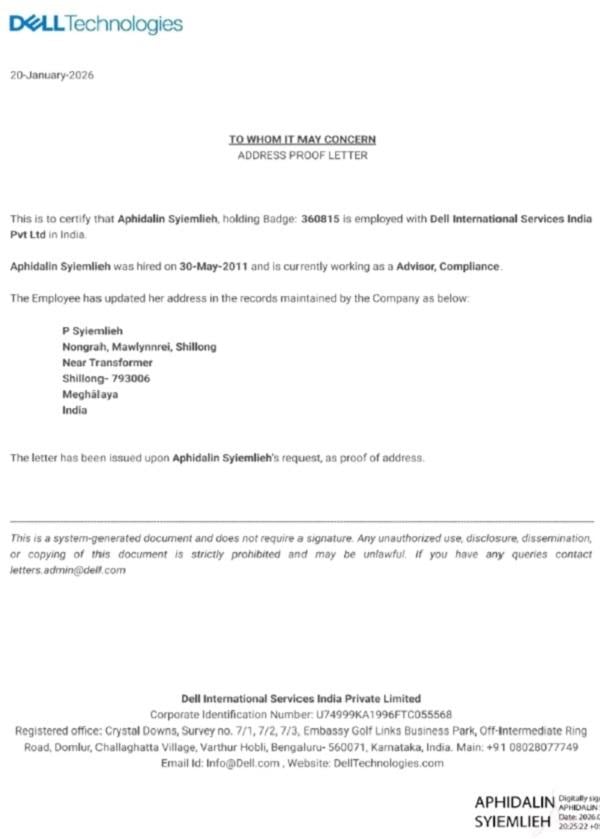
6. As per the above letter issued by M/s Dell Technologies, it has been mentioned that Assessee had ‘updated her address’ in the record maintained by the company i.e.:-
‘P Syiemlieh
Nongrah, Mawlynnrei, Shillong
Near Transformer
Shillong-793006
Meghalaya, India’
In the above letter issued by the employer it has not been clarified or certified that Assessee has been employed in the State of Mehgalaya and the income of the Assessee in question has been ‘accrued’ or ‘arise’ from a source situated in such specified area. Further, Assessee has also not produced the appointment letter issued by her employer in support of claiming exemption u/s 10(26) of the Act.
7. It is well-settle law that when an Assessee claims exemption, it is for the Assessee to establish that case of the Assessee falls within the four corners of the exemption provisions and the notification and satisfied each of the conditions and eligibility criteria prescribed therein. The burden of demonstrating such entitlement rest upon the Claimant/Assessee and the benefit cannot be extended on the basis of a liberal or presumptive construction when prescribed conditions remain unfulfilled. The pre-requisite conditions for claiming exemption u/s 10(26) of the Act, are that the Assessee should be a member of Scheduled Tribe and resident in the specified area and the income of the Assessee has accrued or arise from the source situated in the notified area or state. In the present case, Assessee has not furnished any such materials before the Assessing Officer and before the CIT(A) or before us to come to a conclusion that the income of the Assessee has accrued or arise from the source situated in the notified area or state. In view of the same, we find no merit in the Grounds of Appeal of the Assessee. Accordingly, the Grounds of Appeal of the Assessee is dismissed.
8. In the result, Appeal of the Assessee is dismissed.
Order pronounced on 11.09.2026.