Summary: MCA Annual Filing is a mandatory annual compliance requirement for companies registered under the Companies Act, 2013 and primarily involves filing financial statements through Form AOC-4 and annual returns through Form MGT-7 or MGT-7A, as applicable. Financial statements are filed under Section 137, while annual returns are filed under Section 92. AOC-4 contains financial information and applicable documents including the balance sheet, statement of profit and loss, cash flow statement, Board’s Report and Auditor’s Report, while MGT-7 contains corporate information relating to the registered office, share capital, shareholding, shareholders, directors, key managerial personnel, meetings and other statutory particulars. The supplied article explains the purpose and importance of annual filing, different types of AOC-4 forms, the prescribed 30-day filing timeline for AOC-4, the 60-day filing timeline for MGT-7, the simplified MGT-7A framework for small companies and One Person Companies, and the distinction between financial-statement filing and annual-return filing. It also discusses the importance of maintaining accurate corporate and financial records and timely filing to avoid additional fees, penalties and compliance difficulties. The article further explains the documents generally associated with AOC-4, information required in MGT-7, the difference between AOC-4 and MGT-7, and answers frequently asked questions concerning MCA annual filing, applicability, due dates, documents and filing requirements.
- Introduction
- What is MCA Annual Filing?
- Form AOC-4: Filing of Financial Statements
- What is Form AOC-4?
- Purpose and Importance of Filing AOC-4
- Documents Required for AOC-4 Filing
- Balance Sheet
- Statement of Profit and Loss Account
- Cash Flow Statement
- Board’s Report
- Auditor’s Report
- Different Types of AOC-4 Forms
- AOC-4
- AOC-4 CFS
- AOC-4 XBRL
- Due Date for Filing AOC-4
- Form MGT-7: Filing of Annual Return
- What is Form MGT-7?
- Purpose and Importance of MGT-7 Filing
- Information Required in MGT-7
- Company Details
- Share Capital and Shareholding Details
- Directors and Key Managerial Personnel Details
- Details of Meetings
- MGT-7A: Simplified Annual Return
- Due Date for Filing MGT-7
- Difference Between AOC-4 and MGT-7
- Conclusion
- Frequently Asked Questions (FAQs)
- Q1. What is MCA Annual Filing?
- Q2. Is MCA Annual Filing mandatory for every company?
- Q3. What is Form AOC-4?
- Q4. What is Form MGT-7?
- Q5. What is the difference between AOC-4 and MGT-7?
- Q6. What is the due date for filing AOC-4?
- Q7. What is the due date for filing MGT-7?
- Q8. Is AOC-4 required if a company has no business activity?
- Q9. Is MGT-7 mandatory for private limited companies?
- Q10. What documents are required for AOC-4 filing?
Introduction
MCA Annual Filing is a mandatory compliance requirement for companies registered under the Companies Act, 2013. Every company incorporated in India, whether active or operational, is required to submit certain documents and information to the Ministry of Corporate Affairs (MCA) every financial year. These filings help the Registrar of Companies (ROC) maintain updated records of companies and ensure transparency in corporate operations.
Annual filing mainly consists of two major forms: Form AOC-4 and Form MGT-7. While AOC-4 is related to filing the company’s financial statements, MGT-7 is related to filing the annual return containing details about the company’s management, shareholders, directors, and other statutory information. Timely completion of MCA annual filing ensures that the company remains compliant with legal requirements and avoids additional fees, penalties, and regulatory difficulties.
What is MCA Annual Filing?
MCA Annual Filing refers to the process through which companies submit their yearly financial and corporate information to the Registrar of Companies (ROC) through the MCA portal. The purpose of annual filing is to maintain transparency and provide stakeholders, regulators, investors, and the public with access to important company information.
Under the Companies Act, 2013, companies are required to file their financial statements under Section 137 and annual returns under Section 92. These filings provide details regarding the financial performance, ownership structure, directors, shareholders, and overall compliance status of the company. Even if a company has not conducted any business activity during the financial year, it is still required to complete annual filing unless it has been legally closed or struck off from the register of companies.
TaxGuru has also published detailed material on annual filing under Sections 137 and 92 and Section 92 and annual return.
Form AOC-4: Filing of Financial Statements
What is Form AOC-4?
Form AOC-4 is a statutory form used by companies to file their financial statements with the Registrar of Companies. The financial statements prepared by the company after the end of every financial year must be approved by the Board of Directors and adopted by shareholders during the Annual General Meeting (AGM).
After approval, these financial statements are submitted to the MCA through Form AOC-4 within the prescribed time limit. The form provides financial information about the company, including its assets, liabilities, revenue, expenses, profits, losses, and other accounting details. It allows the government and stakeholders to understand the financial position and performance of the company.
Form AOC-4 is prescribed pursuant to Section 137 of the Companies Act, 2013. TaxGuru has also published the relevant Companies (Accounts) framework and AOC-4 forms.
Purpose and Importance of Filing AOC-4
The primary purpose of AOC-4 filing is to ensure that companies disclose their financial performance in a transparent manner. Financial statements provide a clear picture of how a company has performed during a particular financial year. AOC-4 filing helps maintain accountability because companies are required to submit audited financial information verified by statutory auditors.
This ensures that the financial data submitted to the MCA is accurate and prepared according to applicable accounting standards. For investors, creditors, and government authorities, AOC-4 provides important information about the company’s financial stability and compliance status.
Documents Required for AOC-4 Filing
Balance Sheet
The balance sheet is one of the most important documents attached with AOC-4. It provides information about the financial position of the company at the end of the financial year. It includes details of the company’s assets, liabilities, share capital, reserves, and other financial obligations. The balance sheet helps stakeholders understand the resources owned by the company and the financial commitments it needs to fulfil.
Statement of Profit and Loss Account
The Statement of Profit and Loss shows the financial performance of the company during the financial year. It contains details of income earned, expenses incurred, and the final profit or loss generated by the company. This statement helps evaluate whether the company has grown financially, maintained profitability, or faced losses during the year.
Cash Flow Statement
A cash flow statement provides details about the movement of cash and cash equivalents within the company. It explains how cash has been generated and utilised during the financial year. The statement is generally required for specified classes of companies and provides information regarding cash generated from operating activities, investing activities, and financing activities.
Board’s Report
The Board’s Report is prepared by the directors of the company and provides an overview of the company’s performance and activities during the financial year.
It includes information regarding business operations, future plans, financial performance, compliance matters, directors’ responsibilities, and other disclosures required under the Companies Act, 2013.
Auditor’s Report
The Auditor’s Report is issued by the statutory auditor after examining the company’s financial statements. The auditor provides an independent opinion regarding whether the financial statements present a true and fair view of the company’s financial position. The auditor’s report increases the reliability of financial information submitted through AOC-4.
Different Types of AOC-4 Forms
AOC-4
AOC-4 is the standard form used by companies for filing their standalone financial statements with the ROC. Most private companies and public companies use this form for their annual financial statement filing.
AOC-4 CFS
AOC-4 CFS is used when a company is required to prepare consolidated financial statements. Consolidated financial statements combine the financial information of the company and its subsidiaries, associate companies, or joint ventures. This form provides a combined view of the financial position of the entire group.
AOC-4 XBRL
Certain specified companies are required to file financial statements in XBRL format. XBRL (Extensible Business Reporting Language) allows financial information to be submitted in a structured digital format that can be easily analysed and compared.
TaxGuru has also covered the MCA V3 migration and the applicable AOC-4 CFS, AOC-4 XBRL, MGT-7 and MGT-7A forms.
Due Date for Filing AOC-4
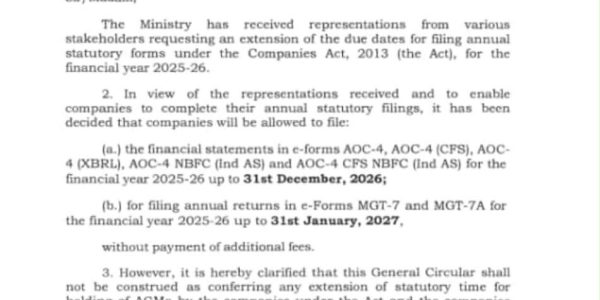
Companies are required to file Form AOC-4 within 30 days from the date of the Annual General Meeting (AGM). For example, if a company conducts its AGM on 30 September, the company must generally file AOC-4 on or before 30 October. Failure to file AOC-4 within the prescribed timeline results in additional filing fees and may attract penalties under the Companies Act.
Form MGT-7: Filing of Annual Return
What is Form MGT-7?
Form MGT-7 is an annual return form filed by companies with the Registrar of Companies under Section 92 of the Companies Act, 2013. Unlike AOC-4, which focuses on financial information, MGT-7 provides details about the company’s corporate structure, ownership pattern, directors, shareholders, meetings, and other statutory information. The annual return gives a complete overview of the company’s activities and management during the financial year.
TaxGuru has published detailed material on annual return filing under the Companies Act, 2013 covering MGT-7, MGT-7A and MGT-8.
Purpose and Importance of MGT-7 Filing
The purpose of MGT-7 filing is to maintain updated corporate records with the MCA. It ensures that information relating to the company’s directors, shareholders, and management is available in public records.
MGT-7 promotes transparency by allowing stakeholders to understand the ownership structure and governance practices followed by the company. It also helps regulatory authorities monitor compliance with corporate laws and identify changes in company management or ownership.
Information Required in MGT-7
Company Details
MGT-7 requires basic company information such as Corporate Identification Number (CIN), registered office address, company classification, principal business activities, and other details. This information ensures that MCA records remain updated and accurately represent the current status of the company.
Share Capital and Shareholding Details
The company must provide details regarding authorised capital, paid-up capital, equity shares, preference shares, and changes in shareholding during the financial year. Details regarding shareholders, promoters, and transfer of shares are also disclosed through the annual return.
Directors and Key Managerial Personnel Details
MGT-7 contains information about directors and key managerial personnel of the company. The company must disclose details regarding directors appointed, resigned, removed, or continuing during the financial year along with their identification details.
Details of Meetings
Companies must provide information regarding Board Meetings, Committee Meetings, and Annual General Meetings conducted during the year. This ensures compliance with corporate governance requirements and provides transparency regarding decision-making processes.
MGT-7A: Simplified Annual Return
MGT-7A is a simplified annual return form introduced for small companies and One Person Companies (OPCs). Since these companies have fewer compliance requirements compared to larger companies, MGT-7A contains fewer disclosure requirements and simplifies the annual filing process.
Due Date for Filing MGT-7
Companies must file Form MGT-7 within 60 days from the date of the Annual General Meeting. For example, if the AGM is held on 30 September, the due date for filing MGT-7 will generally be 29 November. Delayed filing results in additional fees and may impact the company’s compliance record.
Difference Between AOC-4 and MGT-7
AOC-4 and MGT-7 are both annual compliance forms but serve different purposes. AOC-4 focuses on the financial statements of the company, whereas MGT-7 focuses on corporate information and governance details.
AOC-4 provides information regarding financial performance, including balance sheets and profit and loss statements. On the other hand, MGT-7 provides information about shareholders, directors, company meetings, and ownership structure. Both forms are mandatory and must be filed within their respective timelines to ensure complete MCA compliance.
TaxGuru has also published an earlier detailed article on Company Annual Filing – Form MGT-7 & AOC-4, as well as an article specifically addressing Annual Filing under the Companies Act, 2013.
Conclusion
MCA Annual Filing is an essential compliance requirement for every company registered under the Companies Act, 2013. Forms AOC-4 and MGT-7 help maintain transparency by ensuring that accurate financial and corporate information is submitted to the Ministry of Corporate Affairs (MCA). While AOC-4 provides details about the company’s financial performance, audited statements, and financial position, MGT-7 contains information related to directors, shareholders, shareholding structure, and corporate governance. Timely and accurate filing of these forms helps companies avoid penalties, additional fees, and compliance issues.
Businesses should carefully prepare financial statements, corporate details, and statutory disclosures before submission to the MCA. Professional guidance ensures smooth filing and helps companies remain compliant with applicable corporate laws.
Frequently Asked Questions (FAQs)
Q1. What is MCA Annual Filing?
Ans. MCA Annual Filing is a mandatory compliance requirement for companies registered under the Companies Act, 2013. It involves submitting financial statements and annual return details to the Registrar of Companies (ROC) through prescribed forms like AOC-4 and MGT-7.
Q2. Is MCA Annual Filing mandatory for every company?
Ans. Yes, every company incorporated under the Companies Act, 2013 must complete annual filing every financial year. This requirement applies regardless of business activity, profit, or loss. Timely filing helps maintain compliance and avoids penalties or additional fees.
Q3. What is Form AOC-4?
Ans. Form AOC-4 is used by companies to file their financial statements with the Registrar of Companies. It includes documents such as balance sheet, profit and loss statement, auditor’s report, and board’s report after approval during the Annual General Meeting.
Q4. What is Form MGT-7?
Ans. Form MGT-7 is an annual return filing form submitted by companies to the ROC. It contains details about shareholders, directors, shareholding pattern, registered office, meetings, and other corporate information required under Section 92 of the Companies Act.
Q5. What is the difference between AOC-4 and MGT-7?
Ans. AOC-4 relates to filing financial statements of a company, including financial performance and audited reports. MGT-7 relates to annual return filing, providing details about shareholders, directors, capital structure, and corporate activities during the financial year.
Q6. What is the due date for filing AOC-4?
Ans. A company must file Form AOC-4 within 30 days from the date of the Annual General Meeting. The financial statements approved by shareholders during the AGM must be submitted to the ROC within the prescribed timeline.
Q7. What is the due date for filing MGT-7?
Ans. Form MGT-7 must generally be filed within 60 days from the date of the Annual General Meeting. Companies must ensure accurate disclosure of corporate details, ownership information, and management details before submitting the annual return.
Q8. Is AOC-4 required if a company has no business activity?
Ans. Yes, companies must file AOC-4 even if there is no business activity during the financial year. The company must prepare financial statements and submit them to the ROC as required under the Companies Act, 2013.
Q9. Is MGT-7 mandatory for private limited companies?
Ans. Yes, private limited companies are required to file MGT-7 annually with the ROC. However, eligible small companies and One Person Companies (OPCs) can file the simplified annual return form MGT-7A instead of MGT-7.
Q10. What documents are required for AOC-4 filing?
Ans. Documents required for AOC-4 filing generally include financial statements, balance sheet, profit and loss account, cash flow statement, auditor’s report, board’s report, and other applicable documents approved during the company’s Annual General Meeting.