Taxpayers should exercise extreme caution before acting on emails claiming to be “Tax Recovery and Penalty Notices” from the Income Tax Department, particularly where the communication threatens penalties, prosecution or imprisonment and asks the recipient to urgently download a document or make payment.
A suspicious email received on 3 September 2026 provides a useful example of how phishing communications may imitate the appearance and terminology of official Government correspondence. The email uses the names “Government of India”, “Income Tax Department” and “Central Board of Direct Taxes”, presents a supposed reference number, alleges under-reporting of income and undisclosed foreign assets, and warns the recipient to respond or pay within 72 hours.
However, several features of the communication raise serious red flags.
- Suspicious Sender Address Is the First Major Warning
- Fake Government Branding and Official-Looking Language
- Suspicious Download Link Is a Critical Red Flag
- Threat of Tax, Penalty and Criminal Proceedings Creates Artificial Urgency
- DIN Authentication Is an Important Safeguard
- Do Not Confuse a Reference Number With an Authenticated DIN
- Check the Notice Directly on the Income Tax Portal
- Income Tax Department Itself Warns Against Fraud Emails
- Eight Red Flags Visible in This Fake Notice
- What Should You Do If You Receive Such an Email?
- What If You Have Already Clicked the Link?
- Never Verify a Suspicious Email Through the Email Itself
- How Taxpayers Can Authenticate an Income Tax Notice
- Conclusion
Suspicious Sender Address Is the First Major Warning
The email identifies its sender in the following form:
श्री राजेश कुमार <[[email protected]](mailto:[email protected])>
At first glance, a recipient scanning the address quickly may notice the words “incometax.gov.in” and assume that the message has originated from the Income Tax Department.
That conclusion would be incorrect.
The actual domain after the “@” symbol is:
cdshlb.com
The text “itd.complianceincometax.gov.in” merely forms part of the mailbox name appearing before the @ symbol. It does not make the sender an `incometax.gov.in` email account.
This is a common social-engineering technique: place familiar government or corporate words prominently in an email address so that a hurried recipient mistakes them for the actual domain.
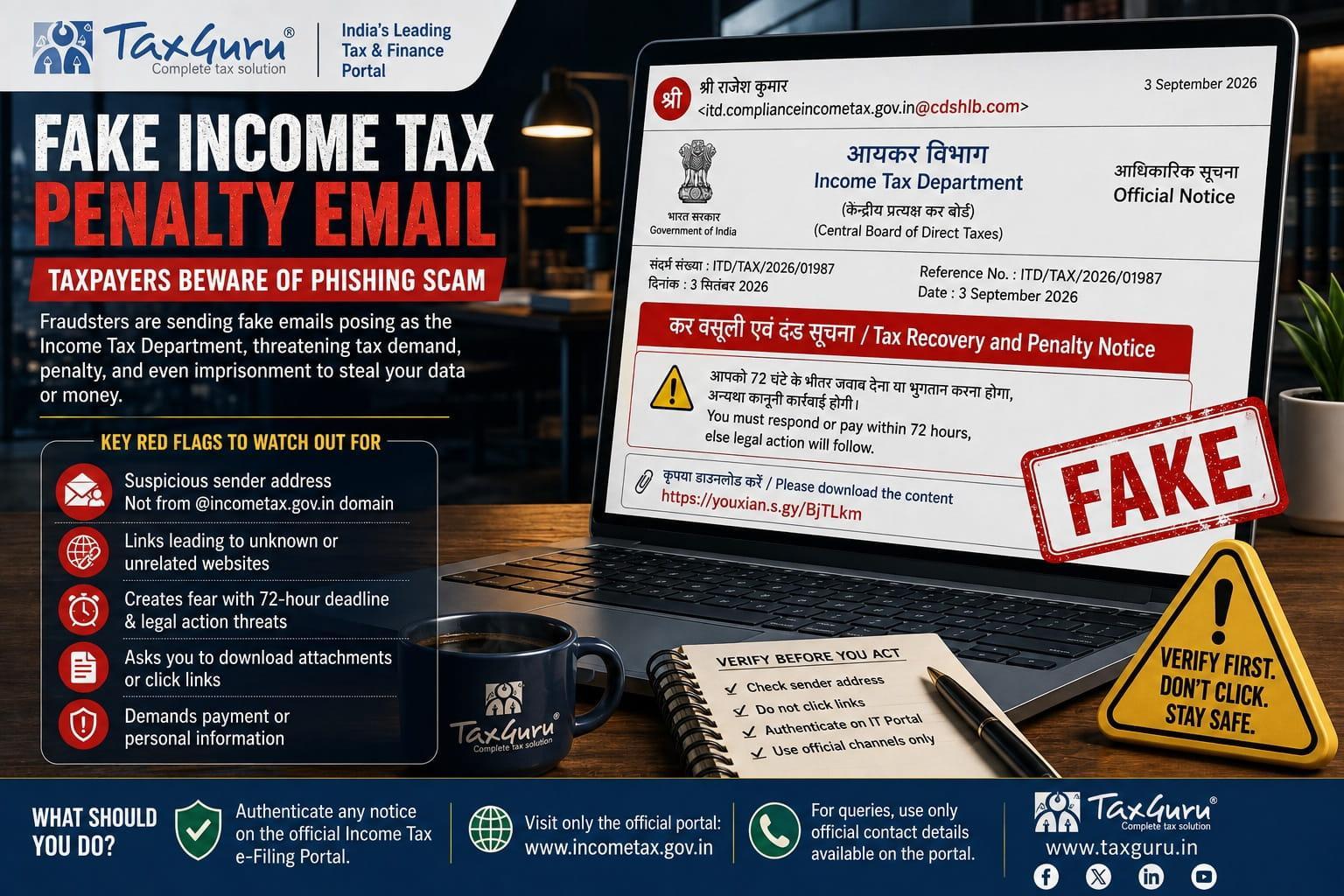
Fake Government Branding and Official-Looking Language
The suspicious communication is presented bilingually in Hindi and English and prominently uses:
भारत सरकार / Government of India
आयकर विभाग / Income Tax Department
केंद्रीय प्रत्यक्ष कर बोर्ड / Central Board of Direct Taxes
It then labels itself an “Official Notice” and provides the purported reference:
ITD/TAX/2026/01987
Government branding, formal language, names of departments and an impressive-looking reference number do not by themselves establish that an electronic communication is genuine.
A fraudulent email can reproduce text and branding that resembles an official communication.
Suspicious Download Link Is a Critical Red Flag
Near the beginning of the message, the recipient is instructed:
“कृपया डाउनलोड करें / Please download the content”
The hyperlink supplied with that instruction leads to a non-Income Tax Department domain:
youxian.s.gy
This is a significant warning sign.
A taxpayer should not open such a link merely because the surrounding email carries Income Tax Department branding.
Other hyperlinks in the message are displayed as though they point to `incometax.gov.in`. Even in such circumstances, taxpayers should not assume that a hyperlink is safe simply because its visible text resembles an official URL. Email hyperlinks can be constructed so that the displayed text and actual destination differ.
The safer practice is to independently open the official Income Tax e-Filing portal in the browser rather than entering through an unsolicited email link.
Threat of Tax, Penalty and Criminal Proceedings Creates Artificial Urgency
The email claims that review of the taxpayer’s return has revealed:
• under-reported income; and
• undisclosed foreign assets.
It then claims that outstanding tax, interest and penalty are payable.
The communication escalates the pressure by stating:
“Non-payment within the deadline may lead to imprisonment and fine.”
It further imposes an alleged deadline of:
72 hours
This combination—large or unspecified tax liability, penalties, possible imprisonment and an extremely short deadline—is capable of creating fear and prompting a recipient to click before independently checking the communication.
Urgency should instead be treated as a reason for greater verification.
DIN Authentication Is an Important Safeguard
The Income Tax Department provides an official facility for taxpayers to authenticate notices, orders, summons, letters and other correspondence issued by Income Tax Authorities.
According to the Department, communications issued on or after 1 October 2019 are required to bear a unique Document Identification Number (DIN), subject to the prescribed framework. The Department’s authentication facility allows a taxpayer to verify whether a purported communication was actually issued by the Income Tax Authority.
A taxpayer can use the “Authenticate Notice / Order issued by ITD” facility available on the Income Tax e-Filing portal.
The Department permits authentication using either:
1. PAN, document type, relevant year, date of issue and mobile number; or
2. Document Identification Number (DIN) and mobile number.
Where the details do not correspond to an Income Tax Department communication, the authentication facility can indicate that no record has been found.
Therefore, an impressive-looking “Reference No.” in an email should not be treated as a substitute for independently authenticating the communication through the official system.
Do Not Confuse a Reference Number With an Authenticated DIN
The suspicious email mentions:
Reference No.: ITD/TAX/2026/01987
Taxpayers should not assume merely from this description that the number is a valid DIN issued by the Income Tax Department.
A reference number typed into an email can be fabricated as easily as the remainder of the email.
The appropriate question is not whether the number “looks official”, but whether the purported communication can be independently authenticated through the Income Tax Department’s official system.
Check the Notice Directly on the Income Tax Portal
Instead of clicking a link contained in the suspicious email, taxpayers should independently access the official Income Tax e-Filing portal and check the relevant services and pending proceedings.
The portal provides facilities relating to notices, including authentication of notices/orders, compliance with notices and e-Proceedings.
The Department describes e-Proceedings as its electronic platform for conducting proceedings through the e-Filing portal.
This provides a substantially safer verification route than following an unfamiliar link received through email.
Income Tax Department Itself Warns Against Fraud Emails
The Income Tax Department’s current “Do’s & Don’ts” guidance specifically advises taxpayers not to reply to fraudulent emails, phone calls and SMS messages and not to share personal information.
CBDT has also historically cautioned taxpayers regarding phishing emails impersonating the Department. Its anti-phishing guidance states that the Income Tax Department does not seek PINs, passwords or similar access information relating to credit cards, banks or other financial accounts through email.
The underlying principle remains important: an email carrying Income Tax Department branding should never be trusted solely on appearance.
Eight Red Flags Visible in This Fake Notice
The communication demonstrates several characteristics taxpayers should watch for:
1. Misleading sender identity: The sender contains “incometax.gov.in” before the @ symbol, while the actual sender domain is `cdshlb.com`.
2. Unrelated download domain: At least one prominent download instruction points to `youxian.s.gy`, not the official Income Tax portal.
3. Government impersonation: The communication prominently reproduces Government of India, Income Tax Department and CBDT terminology.
4. Fear-based allegations: It alleges under-reported income and undisclosed foreign assets without providing independently verifiable particulars in the email itself.
5. Threat of imprisonment: Criminal consequences are prominently mentioned to pressure the recipient.
6. Artificial urgency: The recipient is given only 72 hours to respond or pay.
7. Repeated download prompts: Almost every substantive section directs the recipient to download a purported document.
8. Official-looking reference number: A number styled as “ITD/TAX/2026/01987” is displayed prominently, potentially encouraging the recipient to assume authenticity without DIN verification.
What Should You Do If You Receive Such an Email?
Do not click any link merely because the email displays `incometax.gov.in`.
Do not download an attachment or executable file from an unsolicited tax email until the communication has been independently verified.
Do not make payment on the strength of an email threatening immediate tax recovery, penalty or prosecution.
Do not reply with PAN, Aadhaar, banking credentials, passwords, OTPs, card information or other confidential information.
Instead, independently type the official Income Tax e-Filing portal address into your browser and log in through the normal process.
Check Pending Actions, e-Proceedings, outstanding demand and other relevant sections, depending upon the nature of the alleged communication.
Most importantly, use the Department’s official “Authenticate Notice / Order issued by ITD” service to verify the purported notice.
What If You Have Already Clicked the Link?
Merely opening an email is different from entering credentials or installing/downloading malicious content. The appropriate response depends upon what happened after the link was opened.
If you entered your Income Tax portal credentials, banking credentials, card details or other passwords on a suspicious website, change the affected credentials immediately through the genuine service.
If an OTP was disclosed, contact the relevant financial institution or service provider immediately where financial access may have been compromised.
If a suspicious attachment or executable file was downloaded or opened, the affected device should be checked using updated security software and appropriate cybersecurity assistance should be considered.
Bank and card transactions should also be monitored where any financial information may have been exposed.
Never Verify a Suspicious Email Through the Email Itself
An important cybersecurity principle is to use an independent channel for verification.
If an email says “click here to verify your tax notice”, do not use that same link to determine whether the email is genuine.
Likewise, do not rely upon a telephone number or email address appearing inside a suspicious communication.
Open the Income Tax Department’s official portal independently and use the contact details and verification facilities published there.
How Taxpayers Can Authenticate an Income Tax Notice
The Income Tax Department’s authentication service is available even as a pre-login service to registered as well as unregistered users.
The taxpayer can independently visit the e-Filing portal and select:
Quick Links → Authenticate Notice / Order issued by ITD
The taxpayer can then verify the communication using the prescribed details.
This is one of the most effective ways of separating a genuine tax communication from a fabricated notice.
Conclusion
The fake “Tax Recovery and Penalty Notice” dated 3 September 2026 demonstrates how sophisticated phishing emails can combine Government branding, bilingual presentation, official-sounding designations, tax terminology, apparent reference numbers, allegations of undisclosed income, threats of imprisonment and urgent deadlines to induce taxpayers to click a malicious link.
The strongest warning sign in this example is visible in the sender itself: despite prominently containing the words “incometax.gov.in”, the actual email domain after the @ symbol is `cdshlb.com`. The communication also contains a prominent download link leading to an unrelated domain.
Taxpayers should therefore follow one simple rule:
Do not click, download, reply or pay first. Verify first.
Any purported Income Tax notice should be independently checked through the official Income Tax e-Filing portal and, wherever applicable, authenticated using the Department’s “Authenticate Notice / Order issued by ITD” facility.
A few minutes spent independently verifying a tax communication can prevent disclosure of passwords and personal information, malware infection and potentially significant financial loss.