
Summary: Section 69 of the CGST Act empowers the Commissioner to authorize arrest where there are reasons to believe that a person has committed specified offences under Section 132. The article examines the conditions for exercising this power, including offences under clauses (a) to (d) of Section 132(1), the applicable punishment provisions, and the requirement of reasons to believe based on evidence. It also refers to Section 132(6), requiring prior approval of the Commissioner for prosecution. The article states that arrest may be authorized for offences punishable under Section 132(1)(i) or (ii), or Section 132(2), involving substantial tax evasion, and discusses the stated ₹5 crore prosecution threshold and treatment of habitual offenders. Procedural safeguards discussed include communication of grounds of arrest, preparation of the arrest memo, production before the nearest Magistrate within 24 hours excluding travel time, proper authorization, and compliance with bail provisions. The article refers to Article 21 and Article 22(1) and (2) of the Constitution, Section 57 of the CrPC, and the Supreme Court’s decision in D.K. Basu v. State of West Bengal (1997) 1 SCC 416. It further discusses Section 69(3), bail bonds, sureties and the obligations of an arrested person. The article concludes that arrest measures are intended to discourage significant tax evasion and fraudulent activity and states that authorities remain subject to judicial review and legal protections.
Arrest under GST: Legal Provisions, Procedure, Rights and Updates
- 1. Introductory Paragragh
- 2. Condition for exercising arresting power under GST
- 3. Monetary terms for arresting under GST i.e Quantum of arresting power
- 4. Procedural safeguards and obligation in case of arresting under GST
- (A) Grounds of arrest must be communicated
- (B) Production before Magistrate
- (C) Proper authorization is mandatory
- (D)Bail provisions must be followed
- 5. Conclusion
1. Introductory Paragragh
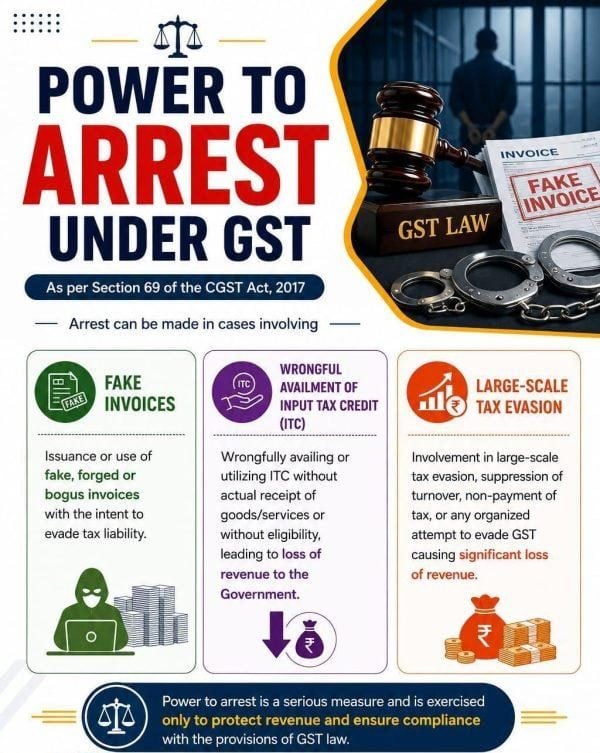
Section 69 of the CGST Act empowers the Commissioner to authorize the arrest of a person where he has reasons to believe that such person has committed specified offences under Section 132 of the Act. The provision is intended to deter serious economic offences such as the issuance of fake invoices, wrongful availment of Input Tax Credit (ITC), and large-scale tax evasion. However, given that an arrest directly affects the personal liberty of an individual protected under Article 21 of the Constitution of India, the exercise of such power has been subjected to judicial scrutiny and constitutional safeguards.
This article examines the statutory framework governing arrest under GST, the conditions precedent for its invocation, the procedural safeguards available to taxpayers, and the significant judicial pronouncements that have shaped the contours of this extraordinary power.
2. Condition for exercising arresting power under GST
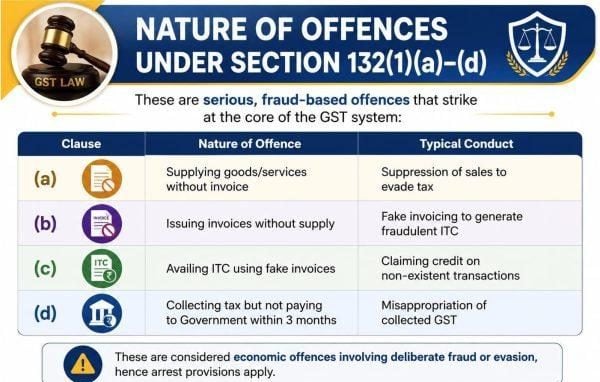
According to Sections 69 and 132 of the CGST Act, the Commissioner can issue an authorization for arrest only when the person has committed:
- The offences mentioned in clauses (a) to (d) of Section 132(1).
- The offence is punishable under clause (i) or (ii) of Section 132(1), or under Section 132(2).
- The Commissioner has “reasons to believe,” based on evidence, that such offences have been committed.
It is also important to note that, as per Section 132(6), no person can be prosecuted for an offence under Section 132 without the prior approval of the Commissioner.
3. Monetary terms for arresting under GST i.e Quantum of arresting power
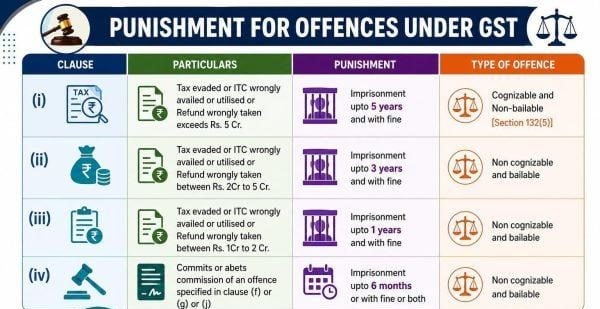
Arrest can be authorized only for cases punishable under clause (i) or (ii) of Section 132(1) or under Section 132(2), which involve substantial tax evasion: Prosecution should normally be launched where amount of tax evasion, or misuse of ITC, or fraudulently obtained refund in relation to offences specified under sub- section (1) of section 132 of the CGST Act, 2017 is more than Five Hundred Lakh rupees. However, in case of habitual offender who was involved in 2-3 cases with total confirmed demand of tax evasion exceeding Rs. Five Crores and cases in which arrest has been made during investigation, prosecution complaint can be filed irrespective of the monetary limit of tax evasion.
4. Procedural safeguards and obligation in case of arresting under GST
(A) Grounds of arrest must be communicated
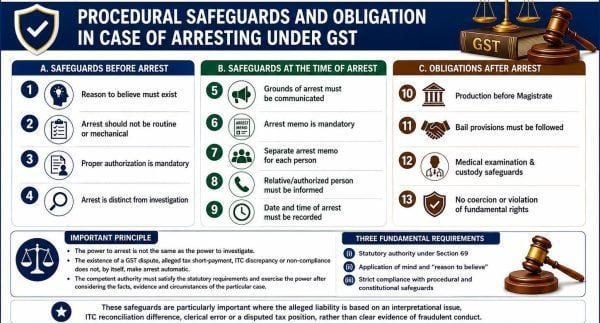
The arrested person must be informed of the grounds of arrest. CBIC specifically requires that the fact that the grounds of arrest have been explained should be recorded in the arrest memo.
- This ensures transparency and prevents misuse of power
- Supported by constitutional and judicial precedents:
- Article 22(1) of the Constitution,
- D.K. Basu v. State of West Bengal (1997) 1 SCC 416 — Supreme Court mandated that reasons of arrest must be communicated, and arrest memo must be prepared.
(B) Production before Magistrate
- The arrested person must be produced physically before the nearest Magistrate within 24 hours of arrest, excluding travel time.
- The Magistrate then decides whether to remand, release on bail, or grant custody.
- Any detention beyond this period without judicial authorization violates Article 22(2) and Section 57 of CrPC, rendering the arrest unlawful.
(C) Proper authorization is mandatory
The Commissioner must authorize the concerned Central Tax officer to make the arrest under Section 69. The authorization should follow consideration of the material available on record and the role of the person proposed to be arrested.
(D)Bail provisions must be followed
The nature of the offence—whether cognizable/non-bailable or otherwise— determines the applicable bail procedure. In appropriate cases, the person arrested is entitled to seek bail in accordance with law.
Section 69(3) of the CGST Act lays down the procedure for granting bail when an arrest is made under GST law. It ensures that the process of bail or custody follows the principles of the Code of Criminal Procedure (CrPC).
The arrested person may be required to execute a bail bond, along with surety wherever required, in accordance with the applicable criminal-procedure provisions. CBIC’s guidelines specifically prescribe following the applicable bail- bond procedure and maintaining appropriate records of bail and sureties.
The bail bond generally contains an undertaking that the person shall:
- appear before the investigating officer/court whenever required;
- comply with the conditions imposed for release; and
- cooperate with the investigation/proceedings.
5. Conclusion
The purpose of the arrest measures under the GST regime is to discourage significant tax evasion and fraudulent activity. To avoid abuse, these authorities are subject to judicial review and legal protections. Before exercising the power of arrest, courts have consistently emphasized the necessity of well- reasoned justification and adherence to procedural protections. If the offence is non-cognizable and bailable then bail must be granted on furnishing of bail bond and surety and in such the Deputy Commissioner or the Assistant Commissioner shall release the accused.
*******
The author can be contacted at [[email protected]](mailto:[email protected]) His mobile number is +91-8368353016.
DISCLAIMER : This publication serves as a general guide for informational purposes only. The references and content provided are for educational purposes and should not be considered as legal advice.








Useful article. A few practitioner observations on the safeguards that matter most in practice:
First, the bail provisions under Section 69(3) are often overlooked. For most GST offences (other than those punishable with more than 5 years), the person arrested has the right to bail. The arrested person should immediately contact a CA or legal counsel and seek bail at the earliest , do not wait for the DGGI/state officer to offer it.
Second, the jurisdictional distinction between DGGI (Central) and state GST officers matters significantly. DGGI has national jurisdiction and tends to handle larger evasion cases. State officers operate under their respective State GST Acts, which may have slightly different procedural rules. The advice given and the authorities to approach differ.
Third, voluntary disclosure before arrest is underutilized. Section 74(5) allows a taxpayer to pay the ascertained amount with interest and a 15% penalty before the SCN is issued , this stops the escalation path toward Section 132 criminal proceedings. Once a criminal complaint is filed, it becomes much harder to resolve through the civil GST machinery.
Finally, the right to be informed of grounds of arrest (which must be given in writing) is non-negotiable under Article 22 of the Constitution and has been upheld in multiple HC judgments. If this is not provided, the arrest itself is challengeable.