Subhash Chandra Personal Insolvency: What NCLT’s ₹6.5 Crore Repayment Plan Actually Means
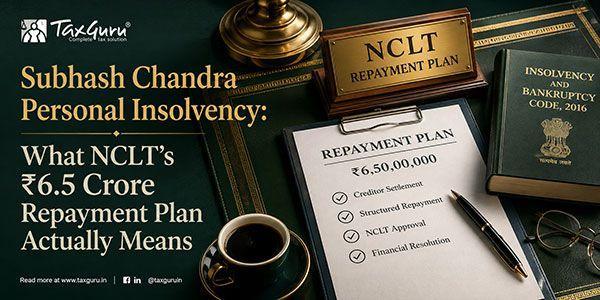
Summary: The National Company Law Tribunal, New Delhi, through a Third Member opinion pronounced on 25 August 2026, has favoured approval of the repayment plan submitted in the personal insolvency proceedings concerning Dr. Subhash Chandra, subject to exclusion of certain claims, revision of the creditor list and consequential redistribution. The proceedings arise against Chandra as a personal guarantor under Part III of the Insolvency and Bankruptcy Code, 2016 and should not be understood as proceedings concerning ₹22,006 crore personally borrowed by him. While recording the objections of LIC Housing Finance Limited, the order notes its submission that admitted claims were approximately ₹22,006.57 crore and that the repayment plan proposed ₹6.25 crore for creditors and ₹25 lakh towards process costs. The Third Member held that approval by 80.814% in value of creditors was important but did not dispense with judicial scrutiny under Section 114. The Tribunal recorded non-compliance with Sections 106(4)(a) and 107(1), found a lapse in admission of unsupported claims submitted through Anil Kumar and Sunil Jain, preserved STCI Finance’s security-enforcement rights and held that an approved repayment plan binds assenting as well as dissenting creditors under Section 115. The order also discusses a stated market value of approximately ₹31.79 crore for the Personal Guarantor’s assets and records that the ₹6.5 crore offer was worked out after leaving out a residential property at Jolly Maker valued at ₹25 crore. Separately, Chandra subsequently stated that the ₹22,006 crore figure represented claims filed in the personal-guarantor proceedings and not money personally borrowed by him.[1][2]
- The Proceedings Concern a Personal Guarantor, Not a ₹22,000 Crore Personal Loan
- How the Personal Insolvency Proceedings Reached the Repayment-Plan Stage
- Why the 25 August 2026 Decision Is a Third Member Opinion
- The ₹22,006.57 Crore and ₹6.5 Crore Figures Need Careful Attribution
- Does This Mathematically Amount to a 99.97% Reduction?
- What the Order Records About Chandra’s Assets
- Historical Net-Worth Certificates Raised Questions but Did Not Establish Concealment
- Why the Third Member Declined to Make a Forensic Audit Mandatory
- Approval Does Not Give Immunity From Subsequently Established Fraud
- Creditor Approval Was 80.814% in Value
- NCLT’s Role Under Section 114 Is Not Merely Formal
- The Tribunal Recorded Procedural Non-Compliance
- Unsupported Claims Through Anil Kumar and Sunil Jain Were a Proven Lapse
- The Entire Repayment Plan Was Not Invalidated by Those Claims
- The Controversy Over Alleged “Associate” Creditors
- What Paragraph 72 of the Order Actually Says
- The Voting Result Was Therefore Not Invalidated
- Section 115 Makes the Approved Plan Binding on Dissenting Creditors
- The Order Recognises Dilution of Dissenting Creditors’ Claims
- Independent Remedies Outside the Plan May Still Survive
- STCI Finance’s Mortgage Rights Were Preserved
- A Secured Creditor Does Not Automatically Have a Veto Under Section 110(5)
- Canara Bank’s Bhagwan Das Road Application
- Why the Repayment Plan Was Ultimately Found Approvable
- Conditions Attached to Approval
- The Operative Order of the Third Member
- What Subhash Chandra Subsequently Clarified
- Does the ₹3,992 Crore Figure Replace ₹22,006 Crore?
- NCLT Findings and Chandra’s Subsequent Clarification Can Be Reported Together
- Does the Order Amount to a ₹22,000 Crore Personal Loan Waiver?
- What the Decision Means for Banks and Financial Creditors
- What the Decision Means for Personal Guarantors
- What the Decision Means for Dissenting Creditors
- Conclusion
- Reference Materials
- Disclaimer
The Proceedings Concern a Personal Guarantor, Not a ₹22,000 Crore Personal Loan
The starting point for understanding the controversy is the legal capacity in which Dr. Subhash Chandra is before the NCLT.
The main proceeding is Indiabulls Housing Finance Limited Vs Dr. Subhash Chandra in Company Petition No. (IB)-97(ND)/2022. The NCLT order itself identifies Chandra as the Respondent/Personal Guarantor and records that the original proceeding was instituted under Section 95 of the Insolvency and Bankruptcy Code, 2016.[1]
This distinction is fundamental. References to claims of approximately ₹22,006 crore in the personal insolvency proceedings should not be converted into a statement that the NCLT found that Chandra personally received ₹22,006 crore in bank loans.
The proceedings concern liabilities asserted against him as a personal guarantor for obligations connected with corporate borrowings. The liabilities of the principal borrowers, securities and other recovery rights have to be considered separately according to the relevant contracts and proceedings.
How the Personal Insolvency Proceedings Reached the Repayment-Plan Stage
The NCLT records that Indiabulls Housing Finance Limited instituted CP(IB)-97/ND/2022 in 2022 seeking initiation of the Insolvency Resolution Process against Chandra as Personal Guarantor.
A Resolution Professional was initially appointed on 30 May 2022. Thereafter, following an interim order of the Supreme Court dated 5 August 2022, the Section 99 report was kept in abeyance.
The Section 95 petition was subsequently admitted on 22 April 2024. The Resolution Professional was replaced by Shiv Nandan Sharma on 27 May 2024. After carrying out the process contemplated under the IBC, the RP filed IA-5505/2024 seeking approval of the repayment plan.[1]
The proposed plan was opposed by several creditors and supported by others, resulting in extensive proceedings over creditor voting, verification of claims, alleged associates, asset disclosures, secured-creditor rights, statutory timelines and the scope of the NCLT’s jurisdiction.
Why the 25 August 2026 Decision Is a Third Member Opinion
The decision dated 25 August 2026 was pronounced by Judicial Member Nilesh Sharma sitting as the Third Member.
The reference arose because Judicial Member Ashok Kumar Bhardwaj and Technical Member Reena Sinha Puri had differed on substantial issues concerning the repayment plan. The President of the NCLT therefore referred the points of difference to the Third Member under Section 419(5) of the Companies Act, 2013.[1]
The Third Member expressly clarified that the exercise was not an appeal against either of the earlier opinions and was not a fresh adjudication of every factual controversy. His task was to independently determine the points on which the original members had differed.
The 25 August 2026 decision should therefore be described as the Third Member opinion resolving the split and producing the majority position. The final operative direction was that the matter be placed before the Original Division Bench for appropriate orders in terms of the majority opinion.[1]
The ₹22,006.57 Crore and ₹6.5 Crore Figures Need Careful Attribution
One of the most discussed portions of the case concerns the contrast between approximately ₹22,006.57 crore and ₹6.5 crore.
Importantly, the Third Member’s order records the ₹22,006.57 crore figure while summarising the objections of LIC Housing Finance Limited.
The order records LICHFL’s submission that, against admitted claims of approximately ₹22,006.57 crore, the repayment plan proposed:
- ₹6.25 crore for distribution to creditors; and
- ₹25 lakh towards insolvency resolution process costs.
LICHFL’s own admitted claim was stated to be approximately ₹1,322.39 crore, against which the proposed payment was ₹38,09,294, or approximately 0.028% of its admitted dues.[1]
Accordingly, the overall ₹6.5 crore figure includes ₹25 lakh of process costs. The amount identified for creditor distribution was approximately ₹6.25 crore.
Does This Mathematically Amount to a 99.97% Reduction?
If ₹6.25 crore is compared purely mathematically with ₹22,006.57 crore, the proposed recovery is approximately 0.028%, corresponding to a reduction of roughly 99.97%.
That arithmetic explains why the expression “99.97% haircut” has appeared in public discussion.
But the description needs legal context.
A precise formulation is:
The amount proposed for creditors under Chandra’s personal-guarantor repayment plan represents approximately 0.03% of the approximately ₹22,006.57 crore claims figure referred to in the proceedings.
A materially different and potentially misleading formulation would be:
Subhash Chandra personally borrowed ₹22,000 crore and the NCLT allowed him to repay only ₹6.5 crore.
The latter formulation conflates the liability of a Personal Guarantor with direct borrowing by the principal debtor.
What the Order Records About Chandra’s Assets
The Third Member’s discussion of the asset position provides important context to the ₹6.5 crore proposal.
The order records that, according to the asset details as on 31 July 2024 forming part of the repayment plan, the total market value of the Personal Guarantor’s assets was approximately ₹31,79,49,981, or ₹31.79 crore.[1]
The Tribunal specifically noted that this amount included:
- jewellery amounting to ₹9,81,329; and
- current assets relating to Subhash Chandra and Sons amounting to ₹9,85,033.
The Third Member further recorded that the repayment plan had computed the ₹6.5 crore offer after leaving out a residential property at Jolly Maker valued at ₹25 crore. The ₹6.5 crore included ₹25 lakh towards IRP costs.[1]
It would therefore be inaccurate to state simply that the NCLT found that Chandra possessed assets worth only ₹6.5 crore.
The order instead discusses total stated assets of approximately ₹31.79 crore and the manner in which the repayment-plan offer was computed after treatment of the ₹25 crore residential property.
Historical Net-Worth Certificates Raised Questions but Did Not Establish Concealment
Several objecting creditors relied upon historical net-worth certificates to question the present asset position disclosed in the repayment plan.
The Third Member records that a certificate dated 30 June 2018 issued by MPJ & Co., Chartered Accountants, assessed Chandra’s net worth at approximately ₹40,562 crore. The certificate was based upon provisional financials and information furnished by management.
The order also records that a net-worth certificate furnished to RBL Bank in 2017 reflected net worth of USD 7.17 billion, stated to be approximately ₹45,888 crore.[1]
The Tribunal held that the dramatic difference between those historical figures and the present figure of approximately ₹31.79 crore legitimately gave creditors reason to seek clarification.
However, the Third Member drew a clear distinction between a historical discrepancy and proof of fraud or concealment.
The order states that the earlier certificates did not, by themselves, establish that the assets reflected therein continued to exist in the same form or value, or that they had subsequently been concealed or diverted by Chandra.[1]
The Third Member therefore did not make a finding that Chandra had concealed assets representing the difference between the historical and current net-worth figures.
Why the Third Member Declined to Make a Forensic Audit Mandatory
Several dissenting creditors argued that approval should be deferred until Chandra’s assets and financial affairs were subjected to a detailed forensic audit and asset-tracing exercise.
The Third Member rejected the proposition that a forensic audit is a mandatory precondition for approval of every personal-guarantor repayment plan.
The order draws an important distinction between the Personal Insolvency Resolution Process under Chapter III of Part III and the subsequent bankruptcy process.
During personal insolvency resolution, the Personal Guarantor continues to remain in possession and control of his assets and financial affairs. The Resolution Professional’s functions are principally directed towards verification of claims, obtaining information, facilitating negotiations, convening the meeting of creditors and submitting the statutory reports.
By contrast, once bankruptcy commences, the Bankruptcy Trustee receives considerably wider statutory powers. The estate of the bankrupt vests in the trustee, who may take control of property and records, investigate the affairs of the bankrupt and administer and realise the bankruptcy estate.[1]
The Third Member held that this distinction was deliberate and that investigative powers specifically conferred on the Bankruptcy Trustee could not simply be imported into the role of the Resolution Professional conducting the personal insolvency resolution process.
The order therefore concluded that neither the IBC nor the applicable Regulations make an independent forensic audit or asset-tracing exercise a mandatory condition for consideration of a repayment plan under Section 114.[1]
Approval Does Not Give Immunity From Subsequently Established Fraud
The Third Member’s refusal to order a forensic audit did not amount to immunity from subsequently established fraud or concealment.
The order states that where credible material later establishes deliberate concealment of assets, systematic diversion of funds, fabrication of financial records or fraudulent conduct, creditors are not without remedies.
The Tribunal observed that judicial orders obtained through fraud, deception or concealment of material facts can be recalled because fraud vitiates judicial proceedings.
The order also refers to Section 184(1) of the IBC, which provides penal consequences where a debtor or creditor knowingly furnishes false information in a material particular to the Resolution Professional.[1]
What the Third Member rejected was the proposition that mere suspicion, speculation or the possibility that additional assets might be discovered in future should indefinitely prevent consideration of the repayment plan.
Creditor Approval Was 80.814% in Value
The repayment plan was approved by 80.814% in value of the creditors.
This exceeded the statutory threshold of three-fourths in value required for approval by creditors.
However, the Third Member expressly rejected the proposition that creditor approval automatically required the NCLT to approve the plan irrespective of statutory defects.
The order states:
“Approval by the requisite statutory majority is an important consideration, but it is not conclusive where the process by which that majority approval is obtained is itself legally defective.”[1]
In the facts of this case, however, the Third Member found no violation sufficiently material to nullify the approval of the plan by 80.814% in value of creditors.
NCLT’s Role Under Section 114 Is Not Merely Formal
The Third Member undertook a detailed examination of the scope of the Adjudicating Authority’s jurisdiction under Section 114.
The order makes clear that the NCLT cannot simply place a judicial stamp on whatever the creditor majority approves.
The Adjudicating Authority must examine whether the repayment plan and the process leading to its approval comply with the IBC and applicable Regulations.
The Third Member stated:
“The role of the AA is neither to substitute its commercial wisdom for that of the creditors nor to mechanically endorse their decision.”[1]
The Tribunal must ensure that the creditor decision arose through a process that was lawful, fair and compliant with the statutory framework.
At the same time, once the statutory requirements have been followed, the NCLT cannot sit in appeal over the commercial attractiveness of the plan merely because one or more creditors believe a different repayment arrangement would have been more beneficial.
The Tribunal Recorded Procedural Non-Compliance
The Third Member did not find that every procedural requirement had been perfectly followed.
The order expressly records non-compliance with the timelines prescribed under Sections 106(4)(a) and 107(1) of the IBC.
The Third Member observed that creditors’ consent could not override a statutory requirement and that the non-compliance therefore had to be formally recorded.[1]
However, the Tribunal separately considered the consequence of that non-compliance.
The order noted that:
- creditors had unanimously consented to the shorter-notice mechanism;
- creditors representing approximately 4.10% of the voting share who did not ultimately vote were nevertheless present at the second meeting;
- the voting period had been extended until 31 October 2024; and
- no creditor demonstrated actual prejudice caused by the shortened timeline.
The Third Member therefore held that, although Sections 106(4)(a) and 107(1) had not been strictly complied with, that irregularity did not, in the peculiar facts and circumstances of the case, justify rejection of the repayment plan.[1]
Unsupported Claims Through Anil Kumar and Sunil Jain Were a Proven Lapse
The Third Member made an affirmative finding of irregularity concerning claims submitted through Anil Kumar on behalf of 960 individuals and Sunil Jain on behalf of 300 individuals.
The order found that those claims had been admitted despite the absence of adequate supporting documentary material.
The Third Member held that the subsequent explanation that the claims were admitted to avoid litigation or facilitate an early resolution could not substitute for statutory verification.
The order therefore found that the RP committed a lapse in discharge of his statutory functions by admitting those claims without adequate supporting material.[1]
This was a finding of the Third Member and not merely an allegation made by dissenting creditors.
The Entire Repayment Plan Was Not Invalidated by Those Claims
Although the claims represented through Anil Kumar and Sunil Jain were found unsupported, the Third Member concluded that the defect was not sufficiently material to invalidate the entire Personal Insolvency Resolution Process.
The Tribunal directed that both individuals, along with the persons represented through them, be excluded from the final list of creditors.
The amount originally allocated to those excluded claims was directed to be redistributed among the remaining eligible creditors in accordance with the methodology of the approved repayment plan.[1]
The revised creditor list and consequential calculation were to be placed before the Regular Bench for implementation directions.
The Controversy Over Alleged “Associate” Creditors
One of the most significant challenges to the repayment plan concerned the participation of:
- Veena Investments Private Limited;
- Direct Media Distribution Ventures Private Limited;
- World Crest Advisors LLP;
- Lemonade Capital Advisors LLP; and
- Corpcall Capital Advisors LLP.
Objecting creditors contended that these entities were “associates” of the Personal Guarantor and were therefore disqualified from participating in voting under Section 109(4)(b).
The Third Member examined the statutory definition in Section 79(2)(g).
He held that the provision is based upon objective criteria of ownership and legal control. Mere commercial influence, business proximity, family relationship or alleged indirect influence does not by itself satisfy the statutory test.
What Paragraph 72 of the Order Actually Says
Paragraph 72 contains an important nuance that should be preserved.
The Third Member recorded that no material had been produced showing that Chandra, either individually or together with his associates as statutorily defined, owned more than 50% of the share capital of the concerned entities or exercised legal control over their Boards or governing bodies.
At the same time, the order recorded that those entities were directly or indirectly controlled by individuals related to the Personal Guarantor.[1]
The Third Member nevertheless held that Parliament had adopted legal ownership and control—not general commercial or familial influence—as the relevant statutory standard.
Accordingly, it would be inaccurate to describe the NCLT as having found that the entities were completely “unrelated” to Chandra in every factual sense.
The legally precise conclusion is that the statutory ingredients necessary to treat the disputed entities as “associates” of Chandra under Section 79(2)(g) and thereby exclude their votes were not established on the material before the Tribunal.
The Voting Result Was Therefore Not Invalidated
The Third Member consequently held that the participation of the disputed entities in the Meeting of Creditors could not be treated as contrary to Section 109(4)(b).
The principal challenge to the voting process based upon their alleged associate status therefore failed.
Section 115 Makes the Approved Plan Binding on Dissenting Creditors
Another important legal issue was whether dissenting creditors could remain outside the repayment plan and independently recover the original amount of their personal-guarantee claims from Chandra.
The Third Member rejected that approach.
The order states:
“Section 115 does not contemplate selective application of an approved Repayment Plan.”[1]
The Third Member held that once the plan is approved under Section 114, its binding effect is governed by Section 115 and extends to creditors covered by the plan whether assenting or dissenting.
Allowing dissenting creditors to recover their full original claims independently from the Personal Guarantor while consenting creditors remain bound by the restructuring would, according to the Tribunal, defeat the statutory scheme and create unequal treatment.
The Order Recognises Dilution of Dissenting Creditors’ Claims
The Third Member expressly considered the argument that approval would dilute the claims of creditors who had voted against the plan.
The order observed that the debt of all creditors, whether assenting or dissenting, would be diluted because the Personal Guarantor had insufficient assets to repay all claims.
However, the Tribunal held that such dilution did not permit dissenting creditors to be excluded from the statutory effect of Section 115.
Independent Remedies Outside the Plan May Still Survive
The binding effect under Section 115 does not mean that every conceivable legal right against every person or asset is automatically extinguished.
The Third Member’s final directions expressly preserve independent remedies that are not barred, extinguished or otherwise dealt with by the approved repayment plan.
The order also preserves the remedy of approaching the Adjudicating Authority for recall if it is subsequently established that material assets belonging to the Personal Guarantor had been fraudulently concealed.[1]
STCI Finance’s Mortgage Rights Were Preserved
The dispute involving STCI Finance Limited provides a concrete example of the distinction between personal-guarantee liability and independent security rights.
The Third Member recorded that STCI held a mortgage over certain immovable property of the Personal Guarantor.
However, it was undisputed that Chandra had not furnished a personal guarantee in relation to the financial facilities extended by STCI to the principal borrowers.
The Third Member therefore held that the STCI claim did not constitute a debt due from Chandra in the absence of a personal guarantee.
At the same time, STCI remained entitled to enforce its mortgage in accordance with law.[1]
A Secured Creditor Does Not Automatically Have a Veto Under Section 110(5)
The Third Member further held that Section 110(5) did not require STCI’s concurrence because the repayment plan did not extinguish, harm or otherwise impair STCI’s right to enforce its security.
The Tribunal observed that Section 110(5) does not confer a veto upon an individual secured creditor where the repayment plan otherwise complies with Part III and does not affect that creditor’s security-enforcement rights.[1]
STCI’s application was therefore considered liable to dismissal, but with an express clarification that it remained at liberty to enforce its security interest over the mortgaged property and recover its dues in accordance with law.
Canara Bank’s Bhagwan Das Road Application
The Third Member separately considered an application by Canara Bank concerning a reported sale of property situated at 4, Bhagwan Das Road, New Delhi.
Chandra’s position before the Tribunal was that the property belonged to Greatway Estates Private Limited, was mortgaged with JC Flowers Asset Reconstruction Company Limited, and that he neither sold the property nor received any sale consideration.
The Third Member held that a newspaper or media publication, unsupported by independent documentary or reliable material establishing ownership, sale, receipt of consideration or connection with Chandra, could not by itself justify an enquiry or adverse inference.
The order states that an insolvency enquiry requires an evidentiary foundation and cannot be founded merely upon a media report.[1]
On the material before him, the Third Member concluded that no further enquiry was warranted in that application.
Why the Repayment Plan Was Ultimately Found Approvable
After considering the statutory framework, the RP’s report, the creditor vote, the objections and the findings on the various issues, the Third Member concluded that the repayment plan met the requirements for approval under Section 114.
The order states that the objections raised by creditors did not disclose a statutory infirmity, material irregularity or other circumstance sufficiently serious to warrant rejection of the plan.
The requisite creditor majority had approved the proposal, and the Third Member found no sufficient ground for the Tribunal to interfere with that collective decision.[1]
Conditions Attached to Approval
The Third Member’s approval was subject to important corrective directions, including:
- exclusion of Anil Kumar and Sunil Jain from the creditor list;
- exclusion of the 960 and 300 persons represented through them;
- preparation of a revised and final list of eligible creditors;
- redistribution of the repayment amount allocated to the excluded claims amongst the remaining eligible creditors;
- placement of the revised creditor list and consequential distribution statement before the Regular Bench; and
- binding effect of the approved repayment plan on assenting as well as dissenting creditors in accordance with Section 115.
The order also preserved such independent remedies as might otherwise remain available in matters not barred, extinguished or otherwise dealt with by the plan.[1]
The Operative Order of the Third Member
The final operative portion of the 144-page opinion states that the repayment plan submitted by the Personal Guarantor was required to be approved under Section 114, subject to exclusion of the claims submitted through Anil Kumar on behalf of 960 individuals and Sunil Jain on behalf of 300 individuals.
The Resolution Professional was directed to prepare a revised and final list of creditors and take consequential steps for redistribution of the approved repayment-plan value.
The Third Member further stated that the approved plan would be binding upon all creditors, whether assenting or dissenting, in accordance with Section 115.
Finally, the matter was directed to be placed before the Original Division Bench for appropriate orders in terms of the majority opinion under Section 419(5) of the Companies Act, 2013.[1]
What Subhash Chandra Subsequently Clarified
After the Third Member opinion attracted extensive public discussion, Dr. Subhash Chandra’s office issued a clarification dated 27 August 2026.
According to that clarification, Chandra had not personally borrowed the amounts represented by the ₹22,006 crore claims figure and the proceedings arose from personal guarantees furnished in relation to corporate borrowings.[2]
According to Chandra’s stated position:
- approximately ₹22,006 crore represented total claims filed in the proceedings;
- approximately ₹21,696 crore were admitted by the Resolution Professional;
- creditors opposing the repayment plan accounted for claims of approximately ₹3,992 crore;
- approximately ₹620 crore out of those claims had already been settled; and
- borrowing entities had offered approximately ₹1,113 crore to multiple lenders, with discussions continuing.
These figures are statements attributed to Dr. Chandra/his office and are not findings made by the NCLT.
Does the ₹3,992 Crore Figure Replace ₹22,006 Crore?
No.
According to Chandra’s clarification, the ₹3,992 crore amount concerns claims of creditors who opposed the repayment plan.
The approximately ₹22,006 crore figure relates to the broader claims filed in the Personal Guarantor insolvency process.
The figures therefore describe different categories and should not be treated as competing measurements of exactly the same thing.
NCLT Findings and Chandra’s Subsequent Clarification Can Be Reported Together
The NCLT order and Chandra’s subsequent clarification serve different purposes.
The NCLT order records and adjudicates matters relating to claims, voting, creditor objections, statutory compliance, the repayment plan and the legal effect of approval.
Chandra’s subsequent clarification gives his explanation of the economic background of the guarantees, corporate borrowings, settlements and the interpretation of the headline figures.
The judicial order should not be rewritten on the basis of a subsequent public clarification.
Conversely, the ₹22,006 crore figure appearing in the proceedings should not be transformed into an assertion that Chandra personally received ₹22,006 crore of bank loans.
Does the Order Amount to a ₹22,000 Crore Personal Loan Waiver?
No. That would not accurately describe the legal nature of the proceedings.
A more precise description is that personal insolvency proceedings against Dr. Subhash Chandra, arising from his position as a Personal Guarantor, involved claims stated at approximately ₹22,006.57 crore in the proceedings, while the repayment plan contemplated approximately ₹6.25 crore for creditors and ₹25 lakh towards process costs.
The plan obtained 80.814% approval in value and the Third Member favoured approval under Section 114, subject to exclusion of unsupported claims, revision of the creditor list and consequential redistribution.
That is materially different from saying that ₹22,006 crore was personally borrowed by Chandra and then written off by the NCLT for ₹6.5 crore.
What the Decision Means for Banks and Financial Creditors
The case illustrates a practical distinction between the nominal value of a personal guarantee and the amount that may ultimately be realisable from the guarantor personally.
The practical value of a guarantee can depend upon:
- the Personal Guarantor’s asset base;
- existing encumbrances;
- independent security available to lenders;
- competing creditor claims;
- recoveries and settlements involving principal borrowers;
- enforceability of the guarantees;
- the personal insolvency framework; and
- the guarantor’s financial position when enforcement occurs.
The decision therefore reinforces the importance of assessing the continuing economic value and asset coverage behind promoter guarantees rather than relying only upon their face amount.
What the Decision Means for Personal Guarantors
The case demonstrates the operation of Part III of the IBC as a mechanism for restructuring personal-guarantee liabilities through a repayment plan considered by creditors and scrutinised by the NCLT.
However, it does not establish a general rule that promoters or personal guarantors are entitled to settle large guarantee claims for a nominal percentage.
The result depended upon the particular asset position, creditor vote, statutory threshold, verification of claims, alleged irregularities, applicable provisions and the Third Member’s conclusion that the defects established were not sufficiently material to invalidate the entire process.
What the Decision Means for Dissenting Creditors
The Section 115 finding may be among the most consequential aspects of the opinion.
The Third Member held that dissenting creditors cannot simply remain outside the approved repayment plan and pursue Chandra personally for the entire original guarantee claim as though the plan did not apply to them.
Once approved, the repayment plan has statutory binding consequences for assenting and dissenting creditors covered by it.
At the same time, independent rights genuinely outside the plan, unaffected security interests and remedies relating to subsequently established fraud or concealment may continue according to law.
Conclusion
The Subhash Chandra personal insolvency proceedings are significant because they bring into focus several developing questions under Part III of the IBC: the scope of judicial scrutiny under Section 114, creditor voting, treatment of dissenting creditors under Section 115, verification of claims, the meaning of “associate” under Section 79(2)(g), the investigative responsibilities of the Resolution Professional, historical and current asset disclosures, and the preservation of independent security rights.
The headline figures of approximately ₹22,006.57 crore and ₹6.5 crore are striking, but they do not by themselves describe the legal position.
The approximately ₹22,006.57 crore figure is recorded in the Third Member opinion while setting out LICHFL’s submission regarding admitted claims. The plan contemplated ₹6.25 crore for creditors and ₹25 lakh towards process costs.[1]
The order also records an asset value of approximately ₹31.79 crore and states that the repayment-plan offer of ₹6.5 crore was computed after leaving out a residential property at Jolly Maker valued at ₹25 crore.[1]
The Third Member found actual irregularities. Sections 106(4)(a) and 107(1) had not been strictly complied with, and unsupported claims submitted through Anil Kumar and Sunil Jain had been wrongly admitted. However, those defects were not considered sufficiently material to invalidate the entire repayment process.[1]
The Third Member also held that the disputed creditor entities had not been proved to satisfy the statutory definition of “associate” under Section 79(2)(g), that creditor approval by 80.814% remained valid, and that an approved plan would bind assenting and dissenting creditors alike.[1]
Dr. Chandra’s later clarification supplies additional context from his perspective, particularly his assertion that ₹22,006 crore was not money personally borrowed by him and that the claims arose out of personal guarantees for corporate borrowings.[2]
The legally accurate characterisation is therefore that this is a personal-guarantor insolvency resolution involving very large claims and a comparatively small personal repayment proposal, rather than a simple ₹22,000 crore personal bank-loan waiver.
The procedural status should also remain clear: the 25 August 2026 decision is the Third Member opinion producing the majority position, and the matter was directed to be placed before the Original Division Bench for appropriate consequential orders under Section 419(5) of the Companies Act, 2013.[1]
Reference Materials
[1] National Company Law Tribunal, New Delhi — Third Member Opinion dated 25.08.2026, Indiabulls Housing Finance Limited Vs Dr. Subhash Chandra, IA-5505/ND/2024, IA-134/ND/2025, IA-246/ND/2025, IA-6125/ND/2024, IA-6124/ND/2024, IA-6014/ND/2024, IA-274/ND/2025, IP-5/ND/2024 and IA-2806/ND/2026 in CP(IB)-97/(ND)/2022, National Company Law Tribunal, New Delhi, Special Bench. This 144-page judicial opinion is the primary judicial source for this article.
[2] Clarification attributed to the Office of Dr. Subhash Chandra dated 27.08.2026 as appearing onVarious Media Reports. Figures concerning total claims, objecting-lender claims, stated settlements and offers referred to in this article from the clarification are reproduced strictly as statements attributed to Dr. Chandra/his office and not as findings of the NCLT.
Disclaimer
Disclaimer: This article is an independent legal-news analysis prepared primarily from the National Company Law Tribunal’s Third Member opinion dated 25 August 2026 and, where expressly identified, the subsequent publicly reported clarification attributed to Dr. Subhash Chandra/his office. It is intended solely for informational and educational purposes and does not constitute legal, financial, investment or other professional advice.
The article seeks to distinguish between findings and observations of the NCLT; submissions, objections and allegations made by creditors or other parties; statements of the Resolution Professional or Personal Guarantor recorded in the proceedings; and subsequent public statements attributed to Dr. Subhash Chandra or his office. A contention, allegation or submission reproduced or summarised from a judicial order should not be understood as an independently established fact unless the Tribunal has expressly accepted or recorded it as a finding.
References to approximately ₹22,006.57 crore relate to the claims figure referred to in the personal insolvency proceedings and should not be understood as an assertion by this publication that Dr. Subhash Chandra personally borrowed ₹22,006.57 crore from the creditors concerned.
References to approximately 0.03% recovery or a 99.97% reduction/haircut, where used, are mathematical comparisons between the relevant claims figure and the amount proposed for creditor distribution under the Personal Guarantor’s repayment plan. They should not be understood as an assertion that 99.97% of ₹22,006.57 crore of loans personally borrowed by Chandra were written off, or that all rights and recoveries against underlying borrowers, securities, guarantors or other obligors have necessarily been extinguished.
Figures including approximately ₹3,992 crore, ₹620 crore and ₹1,113 crore, insofar as they arise from Dr. Chandra’s subsequent clarification, are reproduced only as statements attributed to him/his office and are not presented as independent findings of the NCLT.
The 25 August 2026 decision is a Third Member opinion arising from a difference of opinion in the Original Division Bench. The matter was directed to be placed before the Original Division Bench for appropriate orders in terms of the majority opinion. Readers should verify any consequential NCLT order and any subsequent NCLAT, High Court or Supreme Court proceedings before relying upon this article as stating the final or current legal position.
This publication expresses no independent opinion on the truth or merits of disputed factual allegations concerning any party and does not intend by publication of this analysis to impute misconduct, fraud, wrongdoing or liability beyond what has been expressly found by a competent judicial authority.