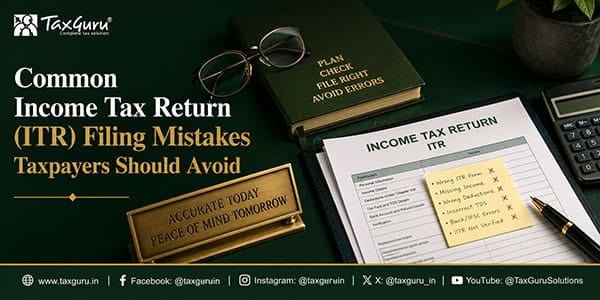
Summary: Filing an Income Tax Return requires taxpayers to ensure that all information is complete and accurate despite the availability of pre-filled data, AIS, TIS and Form 26AS. Common errors include selecting the wrong ITR form or Assessment Year, failing to reconcile income and tax credits with Form 26AS, AIS and TIS, omitting interest, salary from previous employers, capital gains, capital losses, freelance income, foreign assets or other taxable receipts, and claiming the same or ineligible deductions twice. Taxpayers should also compare available tax regimes, correctly report house property and business or professional income, pay self-assessment tax where applicable, verify personal and bank details, complete ITR verification and monitor return status and departmental notices. Reliance solely on pre-filled information is discouraged, and supporting records should be maintained. If an error is discovered after filing, the applicable corrective mechanism should be considered within the prescribed conditions and timelines. A relevant TaxGuru publication discusses 25 practical errors found during ITR filing, including issues concerning personal details, ITR form selection, income reporting, deductions, TDS reconciliation and procedural compliance. 25 Practical Errors Found During ITR Filing that every Taxpayer should avoid
Introduction: Filing an Income Tax Return (ITR) is an important annual compliance responsibility for taxpayers in India. Although the Income Tax Department has simplified the process through pre-filled information, the Annual Information Statement (AIS), Taxpayer Information Summary (TIS), Form 26AS and online filing utilities, taxpayers are still responsible for ensuring that every detail reported in the return is complete and accurate.
Even a small error, such as selecting the wrong ITR form, missing interest income, entering incorrect bank details or claiming an ineligible deduction, may result in delayed processing, reduction of refund, additional tax liability, a defective return notice or further communication from the Income Tax Department. Therefore, taxpayers should carefully review their financial information and supporting documents before submitting their return.
- Selecting the Wrong ITR Form
- Selecting the Wrong Assessment Year
- Not Reconciling Form 26AS, AIS and TIS
- Failing to Report Interest Income
- Not Reporting Income from All Employers
- Claiming the Same Deduction Twice
- Claiming Deductions Without Checking Eligibility
- Choosing the Tax Regime Without Proper Comparison
- Ignoring Capital Gains
- Not Reporting Capital Losses
- Ignoring Income from Old Investments
- Claiming Incorrect TDS Credit
- Not Paying Self-Assessment Tax Before Filing
- Entering Incorrect Personal Information
- Providing Incorrect Bank Account Details
- Not Disclosing Foreign Assets or Foreign Income
- Incorrect Reporting of House Property Income
- Not Reporting Freelance or Side Income
- Failing to Maintain Proper Business or Professional Records
- Waiting Until the Last Day to File the ITR
- Filing the ITR but Forgetting to Verify It
- Ignoring a Defective Return Notice
- Not Checking the Return Status After Filing
- Ignoring Errors Discovered After Filing
- Relying Completely on Pre-Filled ITR Information
- Important Checks Before Filing an Income Tax Return
- Penalties of Incorrect Income Tax Return Filing
- What to Do If You Have Already Made a Mistake in Your ITR
- Conclusion
- Frequently Asked Questions (FAQs)
Selecting the Wrong ITR Form
Selecting an incorrect ITR form is one of the most common mistakes taxpayers make while filing their income tax return. Different ITR forms apply depending on the nature of the taxpayer, sources of income, residential status and other financial activities. A taxpayer may have salary income, capital gains, business income, professional income, foreign assets, rental income or income from other sources, and the appropriate ITR form must be selected accordingly.
For example, ITR-1 is generally designed for eligible resident individuals having relatively simple sources of income, whereas taxpayers earning income from business or profession may have to file ITR-3 or ITR-4, depending upon their eligibility. Similarly, an individual earning capital gains or holding certain foreign assets may not be eligible to use ITR-1. Taxpayers should therefore identify all their sources of income before selecting the return form. They should not automatically use the same ITR form that was used in the previous year because their financial situation or the applicable eligibility rules may have changed.
Selecting the Wrong Assessment Year
Taxpayers often confuse the Financial Year with the Assessment Year. The Financial Year refers to the period during which the taxpayer earns income, whereas the Assessment Year is the following year in which the income is assessed and the return is filed.
For example, income earned during Financial Year 2025-26 is generally reported in Assessment Year 2026-27. Selecting the wrong Assessment Year may result in the taxpayer filing information for an incorrect period, which can create problems in tax credit matching, return processing and compliance records. Before filing, taxpayers should verify the relevant Financial Year and choose the corresponding Assessment Year on the Income Tax e-filing portal.
Not Reconciling Form 26AS, AIS and TIS
A taxpayer should not file an income tax return only on the basis of Form 16 or personal records. Form 26AS, the Annual Information Statement and the Taxpayer Information Summary contain important information that may already be available with the Income Tax Department. The AIS may include information relating to salary, bank interest, dividends, securities transactions, property transactions and various other financial activities. Form 26AS generally contains details of taxes deducted or collected at source, advance tax, self-assessment tax and other relevant tax information.
If the income reported in the ITR is substantially different from the information appearing in AIS, TIS or Form 26AS, it may create a mismatch. For example, if TDS has been deducted on a particular payment but the corresponding income is not disclosed in the return, the Department may seek clarification. Taxpayers should therefore compare Form 16, Form 16A, bank statements, investment statements, capital gain reports and other relevant financial documents with AIS, TIS and Form 26AS before filing the return.
Failing to Report Interest Income
Many taxpayers correctly report their salary income but forget to disclose interest earned during the financial year. Interest may arise from savings accounts, fixed deposits, recurring deposits, bonds, post-office deposits and other financial instruments. A common misunderstanding is that interest income does not need to be disclosed if the bank has already deducted TDS.
However, deduction of TDS does not remove the taxpayer’s responsibility to report the underlying income. TDS represents tax deducted at source, while the actual interest income must still be included under the appropriate head of income. For example, if a taxpayer earns Rs. 50,000 as fixed deposit interest and the bank deducts TDS, the taxpayer should report the entire taxable interest amount while also claiming the eligible TDS credit.
Not Reporting Income from All Employers
Taxpayers who change jobs during a financial year sometimes make the mistake of reporting income only from their current or latest employer. However, salary earned from every employer during the relevant financial year must generally be considered while computing total taxable income.
For example, if a person worked with one company for the first six months of the year and another company for the remaining six months, salary from both employers should be included in the return. Ignoring salary received from the previous employer may result in under-reporting of income and incorrect tax computation. Taxpayers should therefore obtain Form 16 from all employers and reconcile the salary and TDS details with Form 26AS and AIS before filing.
Claiming the Same Deduction Twice
Another common mistake is claiming the same tax deduction more than once. This may happen when a taxpayer’s employer has already considered a deduction while calculating taxable salary and the taxpayer unintentionally adds the same amount again while preparing the ITR.
For instance, if an eligible investment has already been considered under the relevant deduction in Form 16, the taxpayer should ensure that the final amount claimed in the return represents the total eligible deduction and does not include the same investment twice. Before submitting the return, taxpayers should compare deductions shown in Form 16 with their own investment and payment records.
Claiming Deductions Without Checking Eligibility
Tax deductions are subject to prescribed eligibility conditions and monetary limits. A taxpayer cannot claim a deduction merely because a particular payment or investment has been made. Eligibility may depend on the nature of the expenditure, the person to whom payment was made, applicable statutory limits and the tax regime selected by the taxpayer. For example, deductions relating to investments, health insurance, education loan interest and donations are subject to different conditions.
Taxpayers should verify whether the expenditure qualifies for deduction, whether the amount claimed is within the permitted limit and whether the deduction is available under the tax regime selected for the relevant year. Supporting documents such as payment receipts, investment proofs, insurance receipts and donation certificates should also be preserved.
Choosing the Tax Regime Without Proper Comparison
Taxpayers should carefully compare the available tax regimes before filing the return. Selecting a tax regime merely because the tax rates appear lower may not always result in lower overall tax liability. The final tax burden depends on several factors, including salary structure, exemptions, deductions, housing benefits, investments and other sources of income.
A taxpayer who is eligible for several deductions may find that one regime produces a different result from another taxpayer with fewer deductions. Therefore, taxpayers should calculate their estimated tax liability under the legally available alternatives before making the final choice. Individuals earning business or professional income should be particularly careful because additional conditions may apply to changing the tax regime.
Ignoring Capital Gains
Capital gains are another area where taxpayers frequently make reporting errors. Capital gains may arise from the sale or transfer of shares, mutual funds, land, buildings, bonds and other capital assets. Taxpayers sometimes assume that because a broker, mutual fund platform or other financial institution has already reported the transaction, they do not need to disclose it separately. This assumption is incorrect. The taxpayer is responsible for calculating and reporting the taxable capital gain or loss accurately.
Errors may occur when the taxpayer reports the entire sale value instead of the actual gain, uses an incorrect acquisition cost, wrongly classifies a transaction as short-term or long-term, or forgets transactions carried out through another broker. Taxpayers should obtain capital gain statements from their brokers, depository participants or investment platforms and compare the information with AIS before filing.
Not Reporting Capital Losses
Taxpayers may also ignore transactions where they have suffered a loss because they believe only profitable transactions need to be disclosed. However, reporting eligible capital losses can be important for determining the correct taxable income.
Certain losses may be adjusted against specified gains or carried forward to subsequent years subject to applicable provisions and filing conditions. Failure to properly report an eligible loss may result in losing a valuable tax benefit. Therefore, both gains and losses arising from capital asset transactions should be correctly reported.
Ignoring Income from Old Investments
Taxpayers often focus only on their current investments and overlook income generated by older deposits or investments. An old fixed deposit, bond, post-office account or inactive investment account may continue to generate taxable interest or dividend income.
Since financial institutions may already have reported such income to the Income Tax Department, failing to disclose it may create a mismatch with AIS. Taxpayers should review all bank accounts and investment accounts, including those that are not regularly used, before finalising the return.
Claiming Incorrect TDS Credit
TDS credit should be claimed only after checking the amount appearing in Form 26AS and ensuring that the corresponding income has been correctly reported. A mismatch may arise if the deductor has entered the wrong PAN, failed to file the TDS statement correctly or reported the amount in the wrong financial year.
Similarly, a taxpayer may accidentally claim a tax credit without including the related income. Before claiming TDS, taxpayers should match the credit with Form 26AS and AIS. If a legitimate TDS amount does not appear, the taxpayer may need to contact the deductor and request correction.
Not Paying Self-Assessment Tax Before Filing
After considering TDS, TCS, advance tax and other available credits, a taxpayer may still have some tax payable. This remaining amount is generally required to be paid as self-assessment tax before completing the filing process.
Some taxpayers wrongly assume that submitting the ITR itself will automatically take care of the outstanding tax. However, tax payment and return filing are separate processes. Taxpayers should calculate their final tax liability, pay the applicable self-assessment tax and ensure that the payment information has been correctly considered in the return before submission.
Entering Incorrect Personal Information
Errors in basic personal information can also create difficulties in return processing. Taxpayers should verify their PAN, name, date of birth, Aadhaar details, residential status, address, email address and mobile number.
Even a mismatch between the taxpayer’s name in the ITR and the PAN database may create complications. Residential status should also be selected carefully because it can affect the scope of taxable income and disclosure requirements. All personal details should therefore be reviewed before final submission.
Providing Incorrect Bank Account Details
Correct bank account information is especially important for taxpayers expecting an income tax refund. If the taxpayer enters an incorrect account number or IFSC, provides details of a closed account or selects an account that has not been properly validated, the refund may be delayed.
Taxpayers should ensure that the bank account selected for receiving the refund is active and that the account number and IFSC are entered correctly. The relevant bank account should also be pre-validated wherever required on the income tax portal.
Not Disclosing Foreign Assets or Foreign Income
Taxpayers having foreign assets or foreign income may be subject to additional reporting requirements depending on their residential status and the applicable tax provisions. Foreign assets may include overseas bank accounts, investments in foreign companies, foreign brokerage accounts, foreign immovable property or other financial interests outside India. Foreign income may include salary earned abroad, investment income or income from overseas business activities.
Failure to make a required disclosure can have serious consequences. Taxpayers who have international income or assets should therefore carefully examine their reporting obligations and seek professional guidance where necessary.
Incorrect Reporting of House Property Income
House property income can also lead to mistakes where taxpayers do not understand the prescribed method of computation. Rental income, municipal taxes, housing loan interest and the status of the property may all affect the final taxable amount.
Different treatment may apply to self-occupied property, let-out property and co-owned property. A taxpayer should therefore not simply report the gross rent received without considering the deductions and computational rules applicable to income from house property. Maintaining rent agreements, property documents, municipal tax receipts and housing loan certificates can help taxpayers calculate and support the amounts reported.
Not Reporting Freelance or Side Income
Many salaried taxpayers also earn additional income through freelancing, consulting, online platforms, content creation, commissions or part-time assignments. Such income should not be ignored merely because it was received in a personal bank account.
Depending on the nature of the activity, the income may need to be reported as business income, professional income or income under another appropriate head. Taxpayers engaged in freelance or professional activities should maintain proper records of receipts and eligible expenses and report the income under the correct category.
Failing to Maintain Proper Business or Professional Records
Taxpayers carrying on a business or profession may have more detailed reporting responsibilities than ordinary salaried taxpayers. Depending on the nature of the business and applicable provisions, they may need to disclose turnover, expenses, assets, liabilities, capital, debtors, creditors, profit and loss information or presumptive income.
Incomplete business schedules may result in the return being treated as defective or may lead to further clarification. Therefore, financial records should be prepared and reconciled before filing rather than trying to recreate them at the last moment.
Waiting Until the Last Day to File the ITR
Waiting until the filing deadline significantly increases the possibility of errors. Taxpayers may discover missing documents, differences in AIS, incorrect TDS information or additional tax payable when very little time remains to correct the issue.
Last-minute filing may also make it difficult to obtain clarification from employers, banks, deductors or tax professionals. Taxpayers should therefore begin collecting their documents in advance and complete the reconciliation process well before the applicable due date.
Filing the ITR but Forgetting to Verify It
Filing the return online is not necessarily the final step. The return also needs to be verified through one of the permitted verification methods. Taxpayers may complete electronic verification using the options available on the Income Tax e-filing portal or use another permitted verification method.
If the return is filed but not properly verified within the prescribed period, it may not be treated as valid. After filing, taxpayers should confirm that the return status shows successful verification and should retain the acknowledgement for future reference.
Ignoring a Defective Return Notice
An ITR may sometimes be treated as defective because essential information is missing, inconsistent or incorrectly reported. The Income Tax Department may provide the taxpayer with an opportunity to correct the defect within the prescribed period.
Ignoring such a notice can lead to serious consequences, including the return being treated as invalid in certain circumstances. Taxpayers should regularly check their registered email, SMS alerts and the Pending Actions section of the Income Tax portal and respond to any notice within the permitted time.
Not Checking the Return Status After Filing
Tax compliance does not end immediately after verification. Taxpayers should periodically check the processing status of their return. The status may indicate that the return is being processed, a refund has been determined, additional tax is payable, a defective return has been identified or further action is required. Monitoring the return status helps taxpayers respond promptly if the Department raises any issue.
Ignoring Errors Discovered After Filing
If a taxpayer discovers an error after filing the return, it should not simply be ignored. Depending on the nature of the error and the applicable statutory timeline, the taxpayer may be able to file a revised return or use another legally available corrective mechanism.
Errors may include missing income, incorrect deduction claims, unreported interest, wrong capital gain figures, incorrect tax credit or inaccurate personal information. Correcting a known mistake voluntarily is generally preferable to waiting until it is detected during processing or assessment.
Relying Completely on Pre-Filled ITR Information
Pre-filled information has made tax filing much easier, but taxpayers should not assume that every pre-filled figure is automatically complete or accurate. Information may be missing, duplicated or require classification under the correct income head.
Therefore, taxpayers must compare the pre-filled return with Form 16, Form 16A, AIS, Form 26AS, bank statements, investment reports and other supporting records. Ultimately, the responsibility for submitting an accurate return remains with the taxpayer.
Important Checks Before Filing an Income Tax Return
Before submitting the return, taxpayers should conduct a comprehensive review of their personal information, sources of income, tax credits, deductions and bank details. They should confirm that salary from all employers, bank interest, rental income, capital gains, dividends, business income, professional income and other taxable receipts have been appropriately considered. Tax information should also be reconciled with Form 16, Form 16A, Form 26AS, AIS and TIS. TDS, TCS, advance tax and self-assessment tax amounts should be checked carefully to ensure that the tax computation is correct.
Taxpayers claiming deductions should verify the eligibility conditions, applicable monetary limits and documentation requirements. They should also confirm that the deductions are permitted under the tax regime selected for the relevant year. Bank details must be reviewed, particularly where a refund is expected. The taxpayer should ensure that the selected account is active and correctly entered and complete any required pre-validation. Finally, taxpayers should carefully review the tax computation, pay any outstanding tax, submit the correct ITR form, complete verification and save the filing acknowledgement for their records.
Penalties of Incorrect Income Tax Return Filing
Incorrect filing of an Income Tax Return can result in several financial and compliance consequences. A return containing inaccurate bank information or mismatched income may take longer to process, which can also delay the issue of an eligible refund. Where mandatory information is incomplete or inconsistent, the taxpayer may receive a defective return notice requiring correction. Unreported income or excessive deductions can result in additional tax liability along with applicable interest.
In certain cases, failure to file accurately or within the prescribed period may also affect the taxpayer’s ability to claim specific benefits or carry forward certain losses. Significant discrepancies between the return and information available with the Income Tax Department may result in further communication, verification or proceedings. More serious cases involving inaccurate reporting, under-reporting or non-disclosure may also attract penalties or other consequences under the applicable provisions of tax law.
What to Do If You Have Already Made a Mistake in Your ITR
If a taxpayer discovers an error after filing an ITR, the first step should be to determine the nature and impact of the mistake. The taxpayer should identify whether the error relates to income, deductions, tax credits, capital gains, bank information, refund details, personal information or required disclosures.
After identifying the error, the taxpayer should determine which corrective mechanism is legally available for the relevant Assessment Year. Depending on the circumstances and statutory timelines, it may be possible to file a revised return. In some situations, an updated return or another prescribed mechanism may also be relevant, subject to applicable conditions. However, these mechanisms are not interchangeable, and taxpayers should carefully determine which option applies to their particular case.
Conclusion
Filing an Income Tax Return is more than simply entering financial figures on the online portal. Taxpayers must carefully report all sources of income, reconcile details with AIS, TIS and Form 26AS, select the correct ITR form, claim only eligible deductions and complete the verification process. Common mistakes such as missing interest income, incorrect bank details, wrong deduction claims or unreported capital gains can lead to delayed refunds, notices and additional tax liabilities.
To avoid such issues, taxpayers should prepare documents in advance, review tax calculations carefully and maintain proper supporting records. Those having multiple income sources, business or professional income, foreign assets, property transactions or capital gains may benefit from professional guidance. Compliance Calendar LLP can assist taxpayers with accurate and timely Income Tax Return filing, helping reduce errors and ensure smoother compliance. For professional assistance, contact Compliance Calendar LLP at [[email protected]](mailto:[email protected]) or call 9988424211.
Frequently Asked Questions (FAQs)
Q1. What are the most common mistakes while filing an ITR?
Ans. Common mistakes include choosing the wrong ITR form, selecting the incorrect Assessment Year, missing interest income, claiming wrong deductions, not checking AIS or Form 26AS, entering incorrect bank details, and forgetting to verify the return. These errors may delay refunds or result in notices.
Q2. What happens if I select the wrong ITR form?
Ans. Using the wrong ITR form may make the return defective or require correction. Taxpayers should select the form based on their income sources, residential status, capital gains, business income, and other applicable conditions before submitting the return.
Q3. Should bank interest be reported if TDS is already deducted?
Ans. Yes. Interest earned from savings accounts, fixed deposits, recurring deposits, and other investments must be reported even if TDS has already been deducted. TDS is only a tax credit and does not remove the requirement to disclose the corresponding income.
Q4. What should I do if AIS contains incorrect information?
Ans. Taxpayers should compare AIS information with bank statements, Form 16, investment records, and other documents. If any information is incorrect or duplicated, appropriate feedback can be submitted on the Income Tax portal while reporting the correct income in the ITR.
Q5. Can I correct mistakes after filing my ITR?
Ans. Yes. Eligible taxpayers may correct certain mistakes by filing a revised return within the prescribed time limit. Errors involving missed income, incorrect deductions, capital gains, or TDS details should be corrected as soon as they are identified.
Q6. What happens if I forget to verify my ITR?
Ans. An ITR must be verified within the prescribed period after filing. If verification is not completed, the return may not be treated as valid. Taxpayers should complete e-verification or another permitted verification method and confirm the return status.
Q7. Can incorrect bank details delay my tax refund?
Ans. Yes. Incorrect account numbers, IFSC codes, closed accounts, or validation issues may delay the refund. Taxpayers should provide an active and correct bank account and ensure that it is properly pre-validated on the Income Tax portal where required.
Q8. Is freelance or side income required to be reported?
Ans. Yes. Income from freelancing, consulting, commissions, online services, content creation, or other side activities should be reported under the appropriate income head. Taxpayers should also maintain proper records of receipts and eligible expenses.
Q9. Should capital losses be reported in the ITR?
Ans. Yes. Reporting eligible capital losses is important because certain losses may be adjusted against specified gains or carried forward to future years, subject to applicable conditions. Proper reporting can help taxpayers claim available tax benefits.
Q10. What documents should be checked before filing an ITR?
Ans. Taxpayers should check Form 16, Form 16A, Form 26AS, AIS, TIS, bank statements, interest certificates, investment proofs, capital gain statements, home loan certificates, and other relevant financial documents before filing their return.