Specified Person vs. Designated Person under Income-tax Act, 2025 – A Comprehensive Analysis of New TDS Framework
The article analyses the expressions “Specified Person” and “Designated Person” under the Income-tax Act, 2025, explaining that they determine the categories of deductors responsible for complying with various TDS provisions. It states that “Designated Person” under Section 402(11) applies for Section 393(1), Table Sl. No. 6(i) relating to payments to contractors and includes specified entities, while Individuals, HUFs, AOPs and BOIs qualify only if their turnover exceeds ₹1 crore for business or ₹50 lakh for profession in the preceding tax year. “Specified Person” under Section 402(37) includes every person other than an Individual or HUF, while Individuals and HUFs qualify only after crossing the same turnover thresholds. The article highlights that AOPs and BOIs are automatically Specified Persons but become Designated Persons only upon satisfying the prescribed turnover limits, and that the Central and State Governments are expressly included only within the definition of Designated Person. It concludes with illustrative examples showing how these definitions apply to different entities and emphasises that understanding these distinctions is important for identifying the applicable TDS provisions under the Income-tax Act, 2025.
Introduction
The Income-tax Act, 2025 has introduced a new drafting approach for the Tax Deducted at Source (TDS) provisions by using defined expressions such as “Specified Person” and “Designated Person.” These terms determine the category of deductors responsible for complying with various TDS provisions and, therefore, play a vital role in the administration of the TDS mechanism.
Although the two expressions appear similar, they differ in their scope, applicability and purpose. An incorrect understanding of these definitions may result in non-compliance with the TDS provisions. Accordingly, it is essential for taxpayers, deductors and tax professionals to clearly understand the distinction between “Specified Person” and “Designated Person.”
This article examines the statutory definitions of these expressions under the Income-tax Act, 2025, highlights the key differences between them, and discusses their practical implications for TDS compliance through a comparative analysis.
Designated Person [Section 402(11)]
Section 402(11) of the Income-tax Act, 2025 defines the term “Designated Person” for the purpose of Section 393(1), Table Sl. No. 6(i) relating to TDS on payments made to contractors.
A Designated Person includes the Central Government, State Government, local authorities, statutory corporations, companies, co-operative societies, development authorities, registered societies, trusts, universities, foreign Governments, foreign enterprises, partnership firms and certain other specified entities.
Further, an Individual, Hindu Undivided Family (HUF), Association of Persons (AOP) or Body of Individuals (BOI) will also be treated as a Designated Person if they are not covered under the above categories and their total sales, gross receipts or turnover in the preceding tax year exceeds ₹1 crore in the case of business or ₹50 lakh in the case of profession.
In simple terms, all specified entities such as Government departments, companies and firms are automatically treated as Designated Persons, whereas an Individual, HUF, AOP or BOI becomes a Designated Person only when the prescribed turnover limits are exceeded.
Specified Person [Section 402(37)]
Section 402(37) of the Income-tax Act, 2025 defines the term “Specified Person” for the purposes of the TDS provisions where this expression is used.
A Specified Person includes every person other than an Individual or Hindu Undivided Family (HUF). Accordingly, companies, firms, LLPs, co-operative societies, local authorities, associations of persons (AOPs), bodies of individuals (BOIs), trusts, artificial juridical persons and other entities are treated as Specified Persons, irrespective of their turnover.
However, an Individual or HUF will be regarded as a Specified Person only if the total sales, gross receipts or turnover from the business or profession carried on by such Individual or HUF exceeded ₹1 crore in the case of business or ₹50 lakh in the case of profession during the tax year immediately preceding the tax year in which the income or sum is credited or paid.
In simple terms, all persons other than Individuals and HUFs are automatically treated as Specified Persons, whereas an Individual or HUF becomes a Specified Person only after crossing the prescribed turnover limits in the preceding tax year.
2(77) “person” includes— (a) an individual; (b) a Hindu undivided family; (c) a company; (d) a firm; (e) an association of persons or a body of individuals, whether incorporated or not; (f) a local authority; and (g) every artificial juridical person, not falling within any of the preceding sub-clauses, whether or not such an association of persons or a body of individuals or a local authority or an artificial juridical person was formed or established or incorporated with the object of deriving income, profits, or gains;
Important Interpretational Distinction: “Specified Person” vs. “Designated Person”
A careful reading of Section 402(37) and Section 402(11) reveals an important distinction in the scope of the expressions “Specified Person” and “Designated Person”.
Under Section 402(37), an Association of Persons (AOP) and a Body of Individuals (BOI) are treated as Specified Persons irrespective of their turnover. This is because clause (a) includes “any person, not being an individual or Hindu undivided family”, and the definition of “person” under Section 2(77) expressly includes an AOP and a BOI. Consequently, an AOP or BOI automatically qualifies as a Specified Person, irrespective of its turnover.
However, the position is different under Section 402(11). An AOP or BOI is treated as a Designated Person only if it satisfies the prescribed turnover limits, namely, total sales, gross receipts or turnover exceeding ₹1 crore in the case of business or ₹50 lakh in the case of profession during the immediately preceding tax year. Thus, unlike the definition of Specified Person, turnover is a mandatory condition for an AOP or BOI to become a Designated Person.
Another significant distinction is that the Central Government and State Governments are expressly included in the definition of “Designated Person” under Section 402(11). In contrast, Government is not expressly included in the definition of “Specified Person” under Section 402(37). The definition of Specified Person is based on the expression “any person, not being an individual or Hindu undivided family”, whereas the definition of Designated Person specifically enumerates the Central Government, State Governments, local authorities and certain other statutory bodies.
Accordingly, the scope of “Specified Person” and “Designated Person” is not identical. While a Specified Person is determined by the general definition of “person” read with Section 402(37), a Designated Person is a special category comprising only the entities specifically listed in Section 402(11). These distinctions are significant for determining the applicability of the TDS provisions under the Income-tax Act, 2025.
Conceptual Framework of “Specified Person” and “Designated Person” under the Income-tax Act, 2025
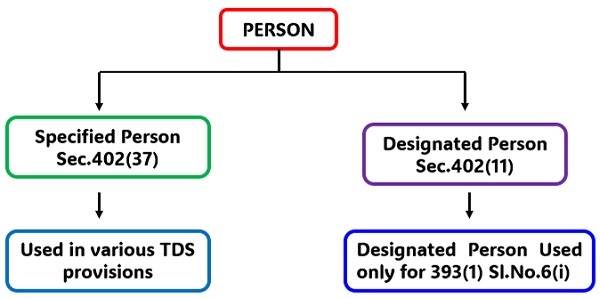
The above chart provides a conceptual overview of the two important statutory expressions introduced under the Income-tax Act, 2025, namely “Specified Person” and “Designated Person”. It highlights that while both expressions originate from the broader concept of a “Person”, they have been defined separately for different purposes. “Specified Person” is a general expression used in various TDS provisions, whereas “Designated Person” is a special category applicable exclusively to Section 393(1), Table Sl. No. 6(i) relating to payments made to contractors. Accordingly, the applicability of a TDS provision depends upon the specific definition adopted by the legislature.
Practical implications
| Ex | Person | Turnover in Preceding Tax Year |
Specified Person |
Designated Person |
Remarks |
|---|---|---|---|---|---|
| 1 | Central Government | Not
Applicable |
X | J | Specifically included only in the definition of Designated Person. |
| 2 | State Government | Not
Applicable |
X | J | Specifically included only in the definition of Designated Person. |
| 3 | ABC Pvt. Ltd. | Not Relevant | J | J | Company is covered under both definitions. |
| 4 | XYZ Partnership Firm | Not Relevant | J | J | Firm is covered under both definitions. |
| 5 | ABC Trust | Not Relevant | J | J | Trust is covered under both definitions. |
| 6 | Madurai Municipal Corporation | Not Relevant | J | J | Local Authority is covered under both definitions. |
| 7 | XYZ AOP (Turnover ₹40 lakh) | ₹40 lakh | J | X | AOP is automatically a Specified Person but not a Designated Person due to turnover below the prescribed limit. |
| 8 | XYZ AOP (Turnover ₹2 crore) | ₹2 crore | J | J | AOP satisfies the turnover condition and qualifies under both definitions. |
| 9 | ABC BOI (Turnover ₹25 lakh) | ₹25 lakh | J | X | BOI is a Specified Person irrespective of turnover but not a Designated Person. |
| 10 | ABC BOI (Turnover ₹1.50 crore) | ₹1.50 crore | J | J | BOI qualifies as both after satisfying the turnover condition. |
| 11 | Mr. A (Individual – Business Turnover ₹80 lakh) | ₹80 lakh | X | X | Turnover below ₹1 crore. |
| 12 | Mr. B (Individual – Business Turnover ₹2 crore) | ₹2 crore | J | J | Turnover exceeds ₹1 crore; covered under both definitions. |
| 13 | Mr. C (HUF – Professional Receipts ₹40 lakh) | ₹40 lakh | X | X | Professional receipts below ₹50 lakh. |
| 14 | Mr. D (HUF – Professional Receipts ₹75 lakh) | ₹75 lakh | J | J | Professional receipts exceed ₹50 lakh; covered under both definitions. |
Conclusion
The expressions “Specified Person” and “Designated Person” are fundamental to the TDS framework under the Income-tax Act, 2025. Although they appear similar, their scope and applicability differ significantly. A clear understanding of these definitions is essential for correctly identifying the deductor and ensuring compliance with the relevant TDS provisions. It is hoped that this article provides readers with a simple and practical understanding of these important statutory expressions.