#AD
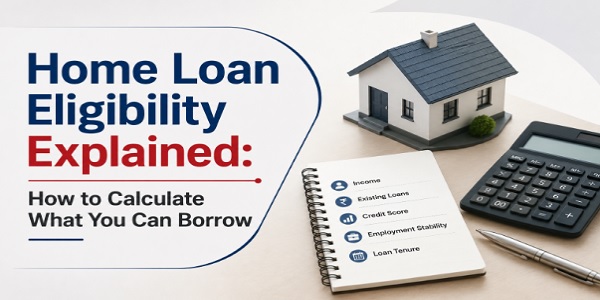
Before you shortlist a property, it helps to know how much a bank will lend you. Eligibility isn’t just about your salary — it’s a mix of income, existing debt, age, credit history, and the loan tenure you choose. Here’s how each piece works, and how to calculate home loan eligibility yourself before you apply.
What Decides Your Home Loan Eligibility
Banks don’t look at income in isolation. They look at how much of it is already spoken for, how long you have left to repay, and how reliably you’ve handled credit in the past.
Income and Employment Type
Your take-home salary (or net profit, if you’re self-employed) sets the ceiling. Salaried applicants usually get a slightly higher eligible amount than self-employed applicants with the same income, since salary is treated as more predictable. Most lenders ask for the last 3-6 months of salary slips or 2-3 years of income tax returns to verify this.
Existing Obligations (FOIR)
FOIR — Fixed Obligation to Income Ratio — is the percentage of your monthly income already going toward EMIs, credit card dues, or other loans. Most banks cap total obligations, including the new home loan EMI, at around 50-60% of monthly income. A car loan or personal loan EMI you’re already paying directly reduces how much home loan you qualify for.
Age and Loan Tenure
Younger applicants get longer tenures, which lowers the EMI and raises eligibility. Lenders generally want the loan repaid before you turn 60-65 (salaried) or 65-70 (self-employed), so age effectively caps your maximum tenure.
Credit Score
A score above 750 usually gets you both a better interest rate and a higher eligible amount. Below 650, some lenders reduce the loan-to-value ratio or decline the application outright, regardless of income.
Co-Applicant Income
Adding a spouse or parent as a co-applicant combines both incomes for eligibility purposes, which can meaningfully increase the loan amount — useful if your individual income alone falls short of what the property needs.
How to Calculate Home Loan Eligibility
The actual math lenders use comes down to two checks, and the loan amount you’re offered whichever is lower.
The EMI-to-Income Method
Banks work out the maximum EMI you can afford (usually 50-60% of net monthly income, minus existing EMIs), then reverse-calculate the loan amount that EMI supports at the current interest rate and chosen tenure.
For example: if your net monthly income is ₹80,000 and you have no existing EMIs, a bank capping obligations at 55% would allow an EMI of roughly ₹44,000. At an 8.5% interest rate over 20 years, that EMI supports a loan of roughly ₹47-48 lakh.
The Loan-to-Value (LTV) Method
Separately, banks cap how much of the property’s value they’ll finance — typically 75-90%, depending on the property price bracket. Even if your income supports a bigger EMI, the loan can’t exceed this LTV cap.
Using an Online Calculator
Most lenders offer an online eligibility calculator where you enter income, existing EMIs, tenure, and interest rate, and it applies both checks instantly. It’s a quick way to calculate home loan eligibility before you start house-hunting, rather than finding out after you’ve picked a property.
How to Improve Your Eligibility
- Pay off or reduce existing loans before applying — this lowers your FOIR immediately.
- Add a co-applicant with a steady income.
- Choose a longer tenure to lower the EMI, if the higher total interest is acceptable.
- Improve your credit score by clearing dues and avoiding new credit enquiries in the months before applying.
- Make a larger down payment to reduce the loan amount needed relative to the property value.
Conclusion
Home loan eligibility comes down to a fairly mechanical calculation once you know the inputs: income, obligations, age, tenure, and credit score. Running the numbers yourself — using the EMI-to-income and loan-to-value checks above, or an online calculator — gives you a realistic budget before you start looking at properties, rather than after. It also puts you in a stronger position to negotiate, since you’ll know exactly where you stand before a lender tells you.