Kamlesh Pramod Gandhi Vs ITO (ITAT Pune)
Pune ITAT: Reassessment Invalid for Non-Issue of Notice under Section 143(2) Even Though Return in Response to Section 148 Was Filed Belatedly
The Pune ITAT quashed the reassessment proceedings, holding that issuance of a notice under section 143(2) is a mandatory jurisdictional requirement once an assessee files a return in response to a notice under section 148, even if such return is filed beyond the time specified in the notice. The Tribunal rejected the Revenue’s contention that the return was “invalid” merely because it was filed belatedly and observed that the issue was squarely covered by its own earlier decision in the assessee’s case for AY 2014-15 on identical facts.
The Tribunal relied on the decisions of the Patna High Court in Nagendra Prasad, the Delhi High Court in Jai Shiv Shankar Traders and Draft Infrabuild Pvt. Ltd., and the Supreme Court rulings in Hotel Blue Moon and Laxman Das Khandelwal, reiterating that failure to issue a notice under section 143(2) after the filing of a return under section 148 renders the reassessment proceedings a nullity. It also held that the subsequent amendments introduced by the Finance Act, 2022 regarding the time for filing returns under section 148 could not be retrospectively applied to AYs 2015-16 and 2016-17.
Accordingly, the Tribunal set aside the order of the CIT(A) and declared the reassessment orders for AYs 2015-16 and 2016-17 as invalid and without jurisdiction. Since the reassessments were quashed on this legal ground, the Tribunal did not adjudicate the additions on merits, treating them as infructuous.
FULL TEXT OF THE ORDER OF ITAT PUNE
These appeals filed by the assessee are directed against the separate orders dated 15.01.2026 passed by Ld. CIT(A)/NFAC for the assessment years 2015-16 and 2016-17 respectively.
2. Since the facts are identical and involving similar issues in both the above captioned appeals of the assessee, therefore, we proceed to dispose of the same by this common order.
3. First, we shall take up the appeal of the assessee in ITA No.1596/PUN/2026 for A.Y. 2015-16 for adjudication as the lead case.
ITA No.1596/PUN/2026, A.Y. 2015-16 :
4. The appellant has raised the following grounds of appeal :-
“On facts and in law,
1. General Ground
1.1. The learned CIT(A) has erred in confirming the assessment at Rs. 41,80,140/- as against returned income of Rs.4,90,990/- without appreciating the facts and evidences on record.
2. Invalid Reassessment Proceedings u/s 147
2.1. The learned CIT(A) erred in upholding the reopening u/s 147, which is bad in law, without jurisdiction and void ab initio, as the same is based merely on borrowed information and suspicion of cash deposits without any independent application of mind.
2.2. The learned CIT(A) failed to appreciate that mere cash deposits do not constitute “income escaping assessment”, and there existed no live nexus or tangible material to form a valid “reason to believe” as required under law.
2.3. The reopening is therefore liable to be quashed as being based on conjectures and surmises, contrary to settled law.
3. Non-Issuance of Mandatory Notice u/s 143(2)
3.1. The learned CIT(A) erred in holding that non-issuance of notice u/s 143(2) is not fatal.
3.2. The CIT(A) failed to appreciate that:
a. Return in response to notice u/s 148 was duly filed
b. Issuance of notice u/s 143(2) is mandatory and jurisdictional
3.3. The finding that return was “invalid” cannot override the statutory mandate, and such reasoning is contrary to settled law laid down by Hon’ble Supreme Court.
3.4. Accordingly, the reassessment order is void ab initio and liable to be quashed.
4. Violation of Mandatory Procedure u/s 144B:
4.1. The learned CIT(A) erred in holding that procedure u/s 144B was complied with.
4.2. The CIT(A) failed to appreciate that:
a. No proper draft assessment order was served as mandated
b. Inadequate time was provided to respond to show cause notice
c. Effective opportunity of hearing was denied
4.3. The entire faceless assessment is therefore non-est in law u/s 144B(9) of the Act
5. Violation of Principles of Natural Justice
5.1. The learned CIT(A) erred in ignoring that:
a. Proceedings were concluded in undue haste
b. Requests for adjournment and additional evidence were not considered
c. Personal hearing was effectively denied
5.2. The impugned order is thus passed in gross violation of natural justice and liable to be set aside.
GROUNDS ON MERITS:
6. Addition u/s 69A – Rs. 34,88,033/-
6.1. The learned CIT(A) erred in confirming addition u/s 69A treating cash deposits as unexplained money, without appreciating that:
a. The Appellant is engaged in regular business activity
b. Deposits are business receipts
c. Transactions are recorded in audited books u/s 44AB
6.2. The CIT(A) failed to appreciate that:
a. Section 69A applies only when money is not recorded in books
b. Once entries exist in books, provisions of 69A cannot be invoked
6.3. The learned CIT(A) erred in placing undue reliance on absence of certain documents while ignoring:
a. Nature of retail business
b. Practical impossibility of maintaining complete third party documentation
c. Commercial realities of cash-based trade
7. Arbitrary Rejection of Explanation
7.1. The learned CIT(A) erred in upholding the action of AO in:
a. Selectively accepting part explanation (counter sales)
b. Rejecting balance explanation (intercity sales)
7.2. Such “pick and choose approach” is arbitrary, perverse and contrary to settled law.
8. Addition Based on Presumption
8.1. The learned CIT(A) erred in confirming addition purely on:
a. Presumptions and suspicion
b. Without any independent inquiry or evidence
8.2. It is settled law that:
Suspicion, however strong, cannot take the place of evidence
9. Burden of Proof Misapplied
9.1. The learned CIT(A) failed to appreciate that:
a. Initial burden stood discharged by explaining business nature and books
b. Thereafter, burden shifts on the department 9.2. The addition is therefore unsustainable.
10. Addition of Rs. 2,01,120/- u/s 69A
10.1. The learned CIT(A) erred in confirming addition merely on account of difference in returned income.
10.2. The addition is arbitrary as:
a. No independent finding of unexplained money
b. No evidence brought on record
11. Applicability of Section 115BBE
11.1. The learned CIT(A) erred in confirming application of section 115BBE.
11.2. The said provision is not applicable where:
a. Income is explained as business receipts
b. Addition itself is unsustainable
12. Ignoring Audited Books of Account
12.1. The learned CIT(A) erred in disregarding:
a. Books audited u/s 44AB
b. Regular accounting records
12.2. Without rejecting books u/s 145, addition u/s 69A is unsustainable.
13. Interest u/s 234B
13.1. The learned CIT(A) erred in confirming levy of interest u/s 234B.
13.2. The same is:
– Consequential, and
– Without prejudice, incorrectly computed
14. Penalty Proceedings
14.1. The learned CIT(A) erred in not adjudicating legality of initiation of penalty.
14.2. The initiation is bad in law as:
– No concealment or furnishing of inaccurate particulars exists
15. The Appellant prays that:
a. The reassessment proceedings u/s 147 be quashed as void ab initio
b. Additions of Rs. 36,89,153/- be deleted in full
c. Interest u/s 234B be deleted/recomputed
d. Any other relief deemed fit be granted.
16. The Appellant craves leave to add, amend, alter or withdraw any ground at the time of hearing.”
5. Facts of the case, in brief, are that the assessee is an individual engaged in the business of automobile spare parts under the name and style of ‘M/s. Gandhi Tempo’ and has filed his return of income on 11.20.2016 declaring income of Rs.6,92,110/- after claiming deduction of Rs.1,17,891/- under Chapter VI-A. On the basis of information available with the Department that during the year under consideration the assessee has entered into financial transaction of Rs.34,88,033/- in the form of cash deposit in account with Shri Renukamata Multi State Urban Co-operative Society Limited, the case of the assessee was reopened u/s 147 of the IT Act and notice u/s 148 of the IT Act dated 31.03.2021 was issued to the assessee after taking necessary approval from the competent authority. The assessee filed its return of income on 27.01.2022 declaring income of Rs.4,90,990/- (which is less than the income disclosed in the original return) after claiming deduction of Rs.1,11,931/- under Chapter VI-A in response to above notice u/s 148 of the IT Act, however, it is mentioned in the assessment order that this return was treated as invalid return by the system. Subsequently, notice u/s 142(1) of the IT Act was issued to the assessee. After considering the reply and submissions of the assessee, the Assessing Officer vide order dated 27.03.2022 completed the assessment proceedings u/s 147 r.w.s. 144B of the IT Act by determining the income of the assessee at Rs.41,80,140/-as against the income of Rs.4,90,990/- returned by the assessee in response to notice u/s 148 of the IT Act. The above assessed income includes addition of Rs.2,01,120/- on account of difference in original return and in the return filed in response to notice u/s 148 of the IT Act and addition of Rs.34,88,033/- on account of unexplained money deposited in bank account u/s 69A of the IT Act.
6. Being aggrieved with the above assessment order, the assessee preferred an appeal before Ld. CIT(A)/NFAC. After considering the reply and submissions of the assessee, Ld. CIT(A)/NFAC dismissed the appeal filed by the assessee.
7. It is the above order against which the assessee is in appeal before this Tribunal.
8. We have heard Ld. Counsels from both the sides and perused the material available on record including the paper book and copy of case laws furnished by the assessee as well as written submissions/rejoinder furnished by Ld. DR & Ld. AR. In this regard, we find that Ld. Counsel of the assessee at the outset submitted before the bench that identical issue had come up before this Tribunal in the case of assessee itself for assessment year 2014-15 in ITA No.1567/PUN/2026 wherein the Tribunal vide order dated 07.07.2025 allowed the appeal of the assessee by holding that the order passed by the Assessing Officer without following the mandatory requirement of issue of notice u/s 143(2) makes the re-assessment order an invalid assessment. Accordingly, Ld. AR prayed before the Bench to allow the appeal of the assessee by following the above order of the Tribunal passed in the case of assessee itself (supra).
9. Ld. DR appearing from the side of the Revenue submitted that the order passed by Ld. CIT(A)/NFAC is justified and requested to dismiss the appeal filed by assessee. In this regard, Ld. DR furnished detailed written submission, which reads as under :-
1. “Issue Involved:
In this case, the assessee has raised following jurisdictional ground:
a. The learned CIT(A) erred in holding that non-issuance of notice u/s 143(2) is not fatal.
b. The CIT(A) failed to appreciate that: return in response to notice u/s 148 was duly filed. Issuance of notice u/s 143(2) is mandatory and jurisdictional.
c. The finding that return was “invalid’ cannot override the statutory mandate, and such reasoning is contrary to settled law laid down by Hon’ble Supreme Court.
d. Accordingly, the reassessment order is void ab initio and liable to be quashed.
2. Decision of ld.CIT(A)
The Ld.CIT (A) has held that (Page 23 of the order)
a. The assessment order specifically records that:” The return filed in response to notice u/s 148 is treated as an Invalid Return by System.”
b. Once the return itself was treated as invalid, the AO was justified in proceeding with reassessment by issuing notices u/s 142(1). Issuance of notice u/s 143(2) presupposes a valid return, which was absent in the present case. Therefore the non-issuance of notice u/s 143(2) does not vitiate the reassessment proceedings. Accordingly Ground 2(b) is dismissed.
3. Contention of the Revenue
3.1 The present appeal raises the issue whether the reassessment is liable to be quashed for non-issuance of notice under section 143(2) despite the Assessing Officer having recorded that the return filed in response to notice under section 148 was invalid and having completed reassessment on the basis of the original return. The Revenue respectfully submits that the assessee’s contention proceeds on an erroneous reading of the assessment order and the statutory scheme. Notice under section 148 dated 31.03.2021 required the assessee to furnish a return within thirty days. The assessee uploaded a return only on 27.01.2022 and completed e-verification on 02.03.2022. The Assessing Officer specifically recorded that the return was filed beyond the period stipulated in the notice and therefore treated it as invalid.
3.2 Section 148, after the retrospective amendment by the Finance (No.2) Act, 1996, authorizes the Assessing Officer to require the assessee to furnish a return within the period specified in the notice. The amendment was enacted to remove the controversy regarding the expression ‘not less than thirty days’ and confirms the legislative importance of compliance with the period prescribed in the notice. The subsequent amendments brought by the Finance Acts, 2021 and 2022 demonstrate that reassessment is a self-contained statutory code. Though prospective, the 2022 amendment is relied upon only as an interpretative aid to understand the legislative scheme and not as governing AY 2015-16.
3.3 The Assessing Officer is the statutory authority entrusted with conducting reassessment proceedings. Upon examination of the facts, he recorded that the return filed in response to notice under section 148 was invalid being filed beyond given time. Mere uploading and e-verification on the portal cannot override this statutory finding. The scheme of sections 147 and 148 does not contemplate an unrestricted or indefinite period for compliance with a notice issued under section 148. Parliament has consciously authorised the Assessing Officer to prescribe the period for furnishing the return. The reassessment mechanism is intended to proceed in a sequential and time-bound manner, as recognised in GKN Driveshafts (India) Ltd. v. ITO (259 ITR 19) (SC). Acceptance of the assessee’s contention would render the words ‘within such period as may be specified in the notice’ ineffective and permit an assessee to postpone reassessment proceedings until the verge of limitation while still insisting upon recommencement of the statutory process.
3.4 Parliament has consciously created a statutory regime for belated returns under section 139(4), prescribing the time within which such returns may be filed. No corresponding provision exists under the erstwhile section 148 permitting an assessee to furnish a return at any time before completion of reassessment. On the contrary, section 148 expressly authorises the Assessing Officer to require the return to be furnished within the period specified in the notice. The absence of a provision analogous to section 139(4) indicates that Parliament did not intend the concept of a “belated return” to apply to reassessment proceedings.
3.5 The assessee places reliance upon paragraph 9 of the assessment order containing the words ‘Income as per return filed in response to notice u/s 148’. The assessment order, however, has to be read as a whole. The operative computation, which determines the assessed income and tax liability, proceeds on the original return filed under section 139 and not on the invalid return. Paragraph 9 merely records a comparative reference. It is a settled principle that the operative portion of an order prevails over incidental or explanatory observations. The computation sheet forms an integral part of the assessment order and reflects the actual basis on which tax liability was determined. The screenshot of computation sheet is as under and the whole computation sheet annexed as Annexure 1 to the submission.
Computation Sheet
| General Details | |||
| PAN | AGGPG1481R | Assessment Year | 2015-13 |
| Name | KAMLESH PRAMOD GANDHI | Address | GANDHI TEMPO ,KOTHI ROAD NEAR MARKET YARD AHMEDNAGAR 414001, Maharashtra India |
| Residential Status | Resident | Order Section | 147 r.w.s 144 |
| DIN & Document Number | ITBA/AST/S/114/2021-22/1041736143(1) | Order Date | 27/03/2022 |
—
| SI. No. |
Reporting Heads | Amount as per Current Order (in Rs.) |
|---|---|---|
| HEADS OF INCOME | ||
| 1. | INCOME FROM SALARY | 0 |
| 2. | INCOME FROM HOUSE PROPERTY | 0 |
| 3. | INCOME FROM BUSINESS OR PROFESSION | 6,92,110 |
| 4. | INCOME FROM CAPITAL GAINS | 0 |
| 5. | INCOME FROM OTHER SOURCES | 34.88,033 |
| 6. | INTRA HEAD ADJUSTMENTS | 0 |
| 7. | TOTAL (AFTER INTRA HEAD ADJUSTMENT) 7=(1+2+3.4+5)-6 | 41,80,143 |
| 8. | LOSSES OF CURRENT YEAR SETOFF AGAINST 7 | 0 |
Computation Sheet
| General Detail | |||
| PAN | AGGPG1481R | Assessment Year | 2016-17 |
| Name | KAMLESH PRAMOD GANDHI | Address | GANDHI TEMPO, KOTHI ROAD NEAR MARKET YARD, AHMEDNAGAR – 414001, Maharashtra, India |
| Residential Status | Resident | Order Section | 147 r.w.s. 144 |
| DIN & Document Number | ITBA/AST/S/114/2021-22/1042010883(1) | Order Date | 29/03/2022 |
—
| Sl. No. | Reporting Heads | Amount as per Current Order (₹) |
|---|---|---|
| 1 | Income from Salary | 0 |
| 2 | Income from House Property | 0 |
| 3 | Income from Business or Profession | 10,13,760 |
| 4 | Income from Capital Gains | 0 |
| 5 | Income from Other Sources | 31,22,300 |
| 6 | Intra Head Adjustments | 0 |
| 7 | Total (After Intra Head Adjustment) = (1+2+3+4+5)−6 | 41,36,060 |
| 8 | Losses of Current Year Set Off Against 7 | 0 |
| 9 | Brought Forward Losses Set Off Against (7−8) | 0 |
| 10 | Gross Total Income = 10 = 7 − (8 + 9) | 41,36,060 |
3.5.2 The Income-tax e-filing portal is only an electronic platform for filing and authentication of returns. It neither adjudicates upon the legal validity of a return nor substitutes the statutory satisfaction of the Assessing Officer while exercising jurisdiction under sections 147 and 148. Acceptance of an electronic filing by the portal cannot override the statutory determination recorded by the Assessing Officer in the course of reassessment proceedings. The facts of the present case further demonstrate that the Assessing Officer never acted upon the return filed on 27.01.2022 as the basis of reassessment. Although paragraph 9 of the assessment order refers to the income disclosed in the return filed in response to notice under section 148 for the limited purpose of comparison, the operative computation, which forms an integral part of the assessment order and alone determines the assessed income and tax liability, proceeds on the basis of the original return filed under section 139. The assessment order, when read as a whole, therefore establishes that the Assessing Officer consistently treated the return filed on 27.01.2022 as invalid and did not accept it as the statutory return on which reassessment was framed.
3.6 Accordingly, the assessee cannot derive any legal advantage merely from the fact that the return was electronically uploaded and e-verified. The legal consequences under the Act depend upon whether the return was validly filed in accordance with the statutory notice under section 148 and accepted by the Assessing Officer for the purposes of reassessment, which, on the facts of the present case, was expressly answered in the negative.
3.7 The ld AR has relied upon the coordinated bench decision in case of Hemlata Kamal Bhatia Vs DCIT, Circle-7,Pune in ITA No 2092/PUN/2025.The fact of the case and in the instant case are distinguishable. In referred order, the assessee filed the letter with Assessing Officer requesting to be treated the original return filed as return filed in response to notice u/s 148 of the Income-tax Act, 1961.The Hon’ble bench has given categorical finding in para 13 of the order which is reproduced as below
“ ……We are of the view that if the Assessing Officer was not convinced with the request of the assessee he could have rejected the request made by the assessee and asked the assessee to file return however nothing of that sort was acted upon by the Assessing Officer, therefore we can not accept the contention of Ld.DR that the assessee has not filed the return in response to the notice issued u/s 148 of the IT Act.”
Under the doctrine of stare decisis, the ratio decidendi given in above referred case is also being followed in this coordinated bench decision in case of Raja Bashumiya Maniysr vs The Income-tax Officer in ITA No 455/PUN/2025 order dt. 27-05-2025. and another referred case of Ld AR in case of Hon’ble Delhi High Court in case of Pr.CIT vs Shri Jai Shiv Shankar Traders (P) Ltd, 282 CTR 435 (Del) dt. 14.10.2015. The reliance placed by the assessee on the decisions in CIT v. Jai Shiv Shankar Traders (P.) Ltd. and PCIT v. Draft Infrabuild Pvt. Ltd.(Para 15 of the order) is misconceived and misplaced. In both those cases, the Assessing Officer proceeded on the footing that the return filed in response to the notice under section 148 (or the original return treated as such) was a valid return and completed the reassessment on that basis. It was in those circumstances that the Courts held that issuance of notice under section 143(2) was mandatory before framing the reassessment. Neither judgment considered a case where the Assessing Officer had expressly recorded a finding that the return furnished in response to notice under section 148 was invalid on account of non-compliance with the period specified in the notice and consciously declined to act upon such return while completing the reassessment. In Dart Infrabuild (supra), the court gave benefit of late filing to assessee being 148 notice issued by department on wrong address.
3.7.2 In the present case, the factual position is materially different. The Assessing Officer has categorically recorded that the return filed on 27.01.2022 in response to the notice under section 148 was invalid. Further, although paragraph 9 of the assessment order refers to the income disclosed in the said return for the limited purpose of comparison, the operative computation, which forms an integral part of the assessment order and determines the assessed income and tax liability, has proceeded on the basis of the original return of income filed under section 139. Therefore, the foundation on which Jai Shiv Shankar Traders and Draft Infrabuild were decided is absent in the present case, rendering those decisions clearly distinguishable on facts as well as on the statutory scheme governing the reassessment.
3.8 The reliance placed on the judgments of the Patna High Court in Nagendra Prasad and Chand Bihari Agrawal is misplaced. Firstly, Nagendra Prasad does not contain an independent analysis of the statutory provisions governing reassessment under sections 147 and 148. The Court expressly held that the issue stood concluded by its earlier decision in Chand Bihari Agrawal and disposed of the appeal on that basis. Consequently, the ratio of Nagendra Prasad is entirely dependent upon the reasoning adopted in Chand Bihari Agrawal. Secondly, Chand Bihari Agrawal arose under the special provisions of Chapter XIV-B governing block assessments under section 158BC and not under the reassessment provisions of sections 147 and 148. The decision turned on the language of section 158BC, under which the Court held that the prescribed period of 15 to 45 days regulated only the time to be granted in the notice and did not constitute a statutory limitation for filing the return. The present case is materially different. Here, the Assessing Officer has, in exercise of the power conferred by section 148 as amended by the Finance (No. 2) Act, 1996, recorded a categorical finding that the return filed on 27.01.2022 was invalid for non-compliance with the period specified in the notice. Further, unlike Chand Bihari Agrawal, the operative computation forming part of the assessment order proceeded on the original return and not on the return filed on 27.01.2022. Therefore, the factual and statutory foundation on which the Patna High Court proceeded is absent in the present case.
3.9 The foundational fact on which Bharat Kantilal Chengde proceeds is absent in the present appeal. Here, the very validity of the return filed in response to notice under section 148 is in dispute and has been decided by the Assessing Officer against the assessee. Therefore, before applying the ratio of Bharat Kantilal Chengde, the Hon’ble bench earnestly requested to first determine whether the return dated 27.01.2022 was a valid return capable of being acted upon under the statutory scheme of section 148. Unless that foundational issue is answered in favour of the assessee, the question of mandatory issuance of notice under section 143(2) does not arise.
3.10 The reliance placed on the decisions of the Hon’ble Supreme Court in ACIT v. Hotel Blue Moon [(2010) 188 Taxman 113 (SC)] and CIT v. Laxman Das Khandelwal [(2019) 108 taxmann.com 183 (SC)] is misplaced. Those decisions undoubtedly lay down that where the Assessing Officer proceeds to scrutinise a return which is validly before him, issuance of notice under section 143(2) is mandatory and the defect cannot be cured by section 292BB. However, neither decision considered a situation where the Assessing Officer had, in the reassessment proceedings themselves, recorded a categorical finding that the return furnished in response to notice under section 148 was invalid for non-compliance with the statutory notice and consciously declined to act upon such return while framing the reassessment. In the present case, the operative computation forming part of the assessment order proceeds on the original return filed under section 139 and not on the return filed on 27.01.2022. Therefore, the foundational fact on which Hotel Blue Moon and Laxman Das Khandelwal proceed, namely the existence of a valid return forming the basis of assessment, is absent in the present case. Consequently, the ratio of the aforesaid judgments is not attracted to the peculiar facts of the present appeal.
3.11 The reliance is placed on the Special bench of Delhi Tribunal-F bench judgement in the case of Raj Kumar Chawla vs ITO [2005] 1 SOT 934 (DELHI)(SB) dt.31.01.2005. The Hon’ble special bench has given finding that
‘The proviso to section 143(2) is applicable to a valid return and not to an invalid return. Whenever a notice is issued under section 148 calling for a return, a time-limit of filing return will be prescribed. The Assessing Officer will never issue a notice granting the assessee unlimited period to file the return. If he does so, he would be doing so at his own peril. If the return is not filed within that period, that would not amount to a return pursuant to notice under section 148…. ’
4. The legal maxim nullus commodum capere potest de injuria sua propria dictates that no person or entity can take advantage of their own wrong to gain favorable legal treatment. This legal maxim is squarely applicable to the case of the assessee. First, the assessee does not file a valid return then when consequential action fails, it seeks to declare the complete proceedings null and void.
Pray:
In view of the above, it is prayed that the appeal of the assessee for AY 15-16 and AY 16-17 is on distinguishable facts that no valid return is filed in response to 148 notice and income escaped proceedings completed on the basis of original return filed as if no return filed in response to notice u/s 148 of the Act. Apropos, the appeal for AY 15-16 and AY 16-17 may kindly be dismissed and order of the AO may be upheld.”
10. Ld. AR appearing from the side of the assessee in rebuttal furnished rejoinder, which reads as under :-
“REJOINDER TO THE SUBMISSIONS MADE ON BEHALF OF
THE LEARNED DEPARTMENTAL REPRESENTATIVE
With reference to the written submissions dated 14.07.2026 filed on behalf of the Appellant on the jurisdictional ground relating to non-issuance of notice under Section 143(2) of the Income Tax Act, 1961, and in response to the oral submissions made across the Bar by the Learned Departmental Representative (“Ld. DR”) relying upon the decision of the Special Bench of the Delhi Tribunal in Raj Kumar Chawla v. ITO, reported at 1 SOT 934 (Del) [also reported at (2005) 94 ITD 1 (Del)(SB) and 92 TTJ (Del)(SB) 1245], the Appellant respectfully submits the following Rejoinder for the kind consideration of this Hon’ble Bench.
1. THE DEPARTMENT’S RELIANCE ON RAJ KUMAR CHAWLA (SPECIAL BENCH) IS MISCONCEIVED — THE DECISION, ON A FAIR READING, SUPPORTS THE APPELLANT AND NOT THE REVENUE
1.1. It is respectfully submitted, at the very outset, that the decision of the Special Bench in Raj Kumar Chawla (supra), far from assisting the case of the Revenue, in fact affirmatively lays down the proposition canvassed by the Appellant. The two questions framed for the Special Bench, and the answers rendered thereto, were:
i. Whether the proviso to Section 143(2) of the Act, mandating service of notice within the prescribed period from the end of the month in which the return is filed, also applies to a return filed pursuant to notice under Section 148 of the Act; and
ii. If the answer to the above is in the affirmative, what is the effect of non-service of such notice within the prescribed time.
1.2. The Special Bench answered the first question in the affirmative, holding in unambiguous terms that a return furnished under Section 148 of the Act must be assumed and treated as a return filed under Section 139 of the Act, and that the assessment thereafter has to be made under Section 143 or 144 of the Act after complying with all mandatory provisions — including the mandatory issuance of notice under Section 143(2) of the Act. On the second question, the Special Bench held that where the notice under Section 143(2) is not served within the prescribed time, the return filed is deemed to have been accepted, and no assessment can thereafter be made. The ratio of Raj Kumar Chawla (supra), therefore, squarely reinforces — rather than displaces — the settled proposition that issuance of notice under Section 143(2) is a mandatory, jurisdictional prerequisite once a return is furnished in response to a notice under Section 148 of the Act.
1.3. Section 147 of the Act empowers the Assessing Officer to reopen an assessment where income has escaped assessment. Section 148 provides the mechanism for doing so by requiring the Assessing Officer to serve a notice on the assessee requiring the filing of a return. The legislative mandate is clear: the return filed in response to a Section 148 notice is statutorily deemed to be a return filed under Section 139. As a consequence, all provisions of the Act that apply to a return under Section 139 apply with equal force to a return filed under Section 148. This includes, centrally and mandatorily, Section 143(2), which provides the mechanism through which the Assessing Officer scrutinises the return.
1.4. The combined effect of the deeming provision in Section 148 and the mandate of Section 143(2) is that once a return is filed in response to a Section 148 notice, the Assessing Officer must issue notice under Section 143(2) within the prescribed period if he wishes to scrutinise the return and make additions. This is not optional, discretionary, or a mere formality. It is a jurisdictional sine qua non.
1.5. It is respectfully submitted that reliance placed by the Ld. DR appears to proceed on an incomplete or selective reading of the said decision, possibly seeking to extend an observation regarding non-filing of a return within the specified time to the wholly distinct facts of the present case, where a return was, in fact, filed and duly e-verified. Any such extension is factually and legally unsustainable for the reasons set out hereinafter.
2. THE AO’S OWN CONDUCT CONCLUSIVELY DEMONSTRATES THAT THE RETURN WAS ACTED UPON — THE REVENUE CANNOT NOW DISOWN IT
2.1. Without prejudice to the submission at Part 1 above, and even assuming for the sake of argument (without conceding) that a return filed beyond the time specified in a Section 148 notice could, in a given case, be treated as if no return had been filed at all — thereby permitting the Assessing Officer to proceed to best-judgment assessment under Section 144 without issuing notice under Section 143(2) — such a proposition has no application whatsoever to the facts of the present case.
2.2. It is an admitted position, borne out from the chronology tabulated at Paragraph 1.4 of the Appellant’s written submissions, that:
a. The return in response to the Section 148 notice was filed on 27.01.2022 and duly e-verified on 02.03.2022;
b. The Learned Assessing Officer thereafter issued a further notice under Section 142(1) of the Act on 02.03.2022 — that is, after the return stood filed and e-verified;
c. The Show Cause Notice dated 23.03.2022 and the assessment order dated 27.03.2022 proceed on the basis of, and compute the addition with express reference to, the very return so filed — the first addition itself being described in the assessment order as one “on account of difference in income”, a computation that is only possible by reference to the income already returned; and
d. The assessment was framed under Section 147 read with Section 144B of the Act in the ordinary course, and not as a best-judgment assessment under Section 144 of the Act for non-filing of return.
2.3. It is respectfully submitted that the aforesaid conduct of the Learned Assessing Officer is wholly inconsistent with any suggestion that the return was treated as non-est or invalid. The Assessing Officer cannot be permitted to approbate and reprobate — he cannot base the very computation of the addition upon the return filed by the Appellant, and simultaneously contend that the said return does not exist in the eyes of law for the purpose of avoiding the mandatory safeguard of notice under Section 143(2). Once the Assessing Officer has, in substance, acted upon and utilised the return for framing the assessment, he is bound to have followed the procedure mandatorily attached to the scrutiny of such a return, including the issuance of notice under Section 143(2).
2.4. That on the facts and in the circumstances of the case, the Assessing Officer, having acted upon the return filed on 27.01.2022 in the following manifest ways, is estopped from contending that the said return does not exist in the eyes of law:
a. It is further and respectfully submitted that the Learned Assessing Officer, in the assessment order itself, has considered and acted upon the income disclosed in the return filed in response to the notice under Section 148 of the Act
b. The very first addition of Rs. 2,01,120/-, described in the assessment order as being “on account of difference in income”, having been computed by the Learned Assessing Officer as the difference between the income originally returned under Section 139(1) and the income disclosed in the return filed in response to the notice under Section 148.; Such a computation is possible, and could only have been arrived at, on the footing that the Learned Assessing Officer himself treated the return filed in response to the Section 148 notice as a valid and subsisting return of income.
c. Having thus relied upon and used the said return for the very purpose of computing the addition, the Learned Assessing Officer cannot, in the same breath, contend that the said return is not a valid return of income. It is further submitted that the said return, filed on 27.01.2022, had already been processed by the CPC as a valid return well before the assessment order came to be passed on 27.03.2022 — that is, almost two months thereafter.
d. When the return had thus been accepted and processed as valid by the CPC itself long prior to the framing of the assessment, and when the Learned Assessing Officer has himself used the very same return as the basis for computing the addition, the submission now sought to be raised on behalf of the Revenue — that the return is not a valid return of income — is factually incorrect and legally unjustified.
e. By framing the assessment under Section 147 read with Section 144B (and not under Section 144 for non-filing of return, which is the provision that would have applied if the return were truly non-est); and
f. By including the return’s figures in the computation in the assessment order while simultaneously characterising the return as “invalid” — an internal contradiction that is itself evidence of non-application of mind.
g. That the principle that a party cannot be permitted to approbate and reprobate — to blow hot and cold simultaneously and to resile from a position adopted in its own official act — is a well-settled principle of law and equity, and applies with particular force to a statutory authority that has acted on the basis of a document before the same authority seeks to disown that document.
2.5. It is further submitted that the solitary observation in the assessment order — that the return “is treated as an Invalid Return by System” — is, on its own language, no more than an automated, system-generated tag reflected on the e-filing/AST portal. It does not reflect any considered, reasoned finding by the Learned Assessing Officer applying his mind to the validity of the return, nor is it founded on any statutory provision. A jurisdictional fact of this magnitude — going to the very root of the assessment — cannot be established by an unexplained computer-generated annotation, more so when the Learned Assessing Officer’s own subsequent conduct in the very same proceedings runs contrary to it.
3. THE STATUTORY CONCEPT RELIED UPON BY THE LD. DR — THAT A RETURN NOT FILED WITHIN THE TIME ALLOWED UNDER A SECTION 148 NOTICE IS NOT A VALID RETURN — HAS NO APPLICATION TO AY 2015-16 AND AY 2016-17, AND IS SOUGHT TO BE IMPERMISSIBLY APPLIED RETROSPECTIVELY
3.1. It is respectfully submitted that even independent of the foregoing, the very premise of the Ld. DR’s submission is unsustainable in law when tested against the statutory provision as it stood at the relevant time.
3.2. Section 148(1) of the Act, as it stood prior to its substitution by the Finance Act, 2021 (with effect from 01.04.2021) — and it is this unamended provision that governs the present proceedings — merely required the Assessing Officer to serve a notice “requiring him to furnish within such period, as may be specified in the notice, a return of his income…; and the provisions of this Act shall, so far as may be, apply accordingly as if such return were a return required to be furnished under section 139”. The unamended provision did not prescribe any fixed statutory period for furnishing the return, nor did it contain any deeming fiction or consequence to the effect that a return furnished beyond the period specified in the notice would cease to be a valid return, or would be treated as non est.
3.3. The critical features of the unamended Section 148 are:
-
- The section did not prescribe any fixed statutory period within which the return was to be filed — it left the period to the specification of the Assessing Officer in the notice itself.
- The section contained no deeming fiction or consequence to the effect that a return filed beyond the period specified in the notice would cease to be a valid return, would be treated as non-est, would be treated as not having been filed, or would attract any other adverse consequence.
- The section specifically provided that the provisions of the Act shall apply to a return filed in response to the notice as if such return were a return required to be furnished under Section 139 — thereby extending the full statutory framework (including the Section 143(2) notice requirement) to reassessment returns.
3.4. It was only by the Finance Act, 2022, with effect from 01.04.2022, that the substituted Section 148 of the Act (itself introduced by the Finance Act, 2021 with effect from 01.04.2021, as part of the new reassessment regime under Sections 147 to 151 read with Section 148A) came to prescribe, for the first time in the text of the section, a defined period of three months from the end of the month in which the notice is issued (or such further period as may be allowed by the Assessing Officer on application) within which the return is to be furnished, and it was in the same Finance Act, 2022 that a further proviso came to be inserted in Section 148 of the Act. No such statutory time-frame, or any consequence attached thereto, existed in the provision as it stood for Assessment Years 2015-16 or 2016-17.
3.5. It is pertinent to note that in the present case, the notice under Section 148 of the Act was issued on 31.03.2021 — that is, prior even to the substitution of Section 148 by the Finance Act, 2021, which came into force only with effect from 01.04.2021. A fortiori, the concept sought to be invoked by the Ld. DR, which owes its statutory existence to an amendment brought about by the Finance Act, 2022 with effect from 01.04.2022, is doubly inapplicable — both in point of time and in point of the text of the provision actually governing the notice issued to the Appellant.
3.6. The inescapable legal consequence is:
The Revenue’s argument that the return filed on 27.01.2022 — in response to a Section 148 notice dated 31.03.2021 — is “invalid” because it was filed beyond the period specified in the notice, is an argument that requires the importation into the present case of a statutory proviso that came into existence only on 01.04.2022 — after the notice was issued, after the return was filed, and after the assessment was completed. This is an impermissible retrospective application of a subsequent substantive amendment.
3.7. It is a well-settled principle of interpretation of taxing statutes that an amendment which alters the character of a provision, imposes a new condition, or creates a disability that did not exist earlier, operates prospectively unless the Legislature has expressly, or by necessary implication, given it retrospective effect. Reference in this regard may be made to the decision of the Hon’ble Supreme Court in CIT v. Vatika Township (P.) Ltd. (2014) 367 ITR 466 (SC), wherein the Constitution Bench reaffirmed the general presumption against retrospectivity of a provision that affects substantive rights or imposes a new burden. Reading the deeming fiction of “invalid return” — which owes its existence, if at all, to the statutory amendment effective 01.04.2022 — into an assessment year governed by the unamended provision would amount to an impermissible retrospective application of a subsequent substantive amendment, and cannot be countenanced.
3.8. A fundamental principle of procedural and substantive law is that once proceedings are initiated under a particular statutory provision, the law as it stood at the time of initiation governs those proceedings unless the Legislature has expressly (and with constitutional validity) provided otherwise. This principle — sometimes expressed as the rule that vested rights are not divested by subsequent amendments absent express legislative intent.
3.9. In the present case:
i. The notice under Section 148 was issued on 31.03.2021 under the unamended Section 148;
ii. Under the unamended Section 148, there was no provision treating a late-filed return as non-est;
iii. The Finance Act, 2021 substituted Section 148 with effect from 01.04.2021 — one day after the notice in the present case was issued;
iv. Even the substituted Section 148 (as introduced by the Finance Act, 2021) did not, in its original form, contain the proviso treating late-filed returns as non-est — this proviso was introduced only by the Finance Act, 2022 with effect from 01.04.2022;
v. At every relevant point in the chronology — the date of the notice (31.03.2021), the date of filing the return (27.01.2022), the date of e-verification (02.03.2022), and the date of the assessment order (27.03.2022) — the statutory framework applicable was the unamended Section 148 (for the notice) and the Finance Act, 2021 substituted Section 148 (for the return filing and assessment), neither of which contained the proviso treating late-filed returns as non-est;
vi. The Finance Act, 2022 proviso came into force on 01.04.2022 — six days after the assessment was completed on 27.03.2022.
To apply the Finance Act, 2022 proviso to proceedings that had already been completed by 27.03.2022 would be to give the amendment a retrospective effect that the Legislature did not express and that could not be implied. This would be unconstitutional.
4. CPC HAS ITSELF VALIDLY PROCESSED THE RETURN —THE DEPARTMENT’S CONTENTION THAT IT IS NOT A VALID RETURN IS UNJUSTIFIED, AND THE ISSUE STANDS COVERED BY A CATENA OF BINDING PRECEDENT
4.1. It is further and respectfully submitted that the return of income filed by the Appellant in response to the notice under Section 148 of the Act has, as a matter of record, been validly processed by the Centralized Processing Centre (CPC). Once the CPC — the very authority entrusted with the processing of returns under the Act — has itself processed the said return as a valid return, the submission now sought to be advanced by the Ld. DR, that the return is not a valid return of income, is factually incorrect and is not justified in law.
4.2. This Hon’ble Bench has also had occasion to consider the decision of the Hon’ble Patna High Court in CIT v. Nagendra Prasad (156 taxmann.com 19) (Patna HC), which further reinforces the settled legal position that non-issuance of notice under Section 143(2) of the Act after the filing of a return in response to notice under Section 148 of the Act renders the resultant reassessment invalid and bad in law.
4.3. In this regard, the Appellant has relied upon, and reiterates reliance upon, the following decisions, which consistently and uniformly hold that failure to issue notice under Section 143(2) of the Act after filing of return in response to notice under Section 148 of the Act renders the reassessment invalid and bad in law:
a. Assistant Commissioner of Income-tax v. Hotel Blue Moon (188 Taxman 113) (Supreme Court)
b. Commissioner of Income-tax v. Laxman Das Khandelwal (108 com 183) (Supreme Court)
c. Principal Commissioner of Income-tax v. Shri Jai Shiv Shankar Traders (P.) Ltd. (64 com 220) (Delhi HC)
d. Principal Commissioner of Income-tax v. Staunch Marketing (P.) Ltd. (81 com 482) (Delhi HC)
e. PCIT v. Dart Infrabuild (P.) Ltd. (166 com 4) (Delhi HC)
f. CIT v. Nagendra Prasad (156 com 19) (Patna HC)
g. Raja Bashumiya Maniyar v. The Income Tax Officer-1, Latur (ITA 455/PUN/2025) (Pune ITAT)
h. Bababhai Sadarbhai Shaikh v. ITO Ward 1, Ahmednagar (ITA 144/PUN/2025) (Pune ITAT)
i. Bharat Kantilal Chengede v. ITO, Ward 6(3), Pune (ITA No. 1902/PUN/2025) (Pune ITAT)
j. Hemlata Kamal Bhatia v. DCIT, Circle-7, Pune (ITA No. 2092/PUN/2025) (Pune ITAT)
k. ACIT v. Logic Control Pvt. Ltd. (ITA 3974/DEL/2025) (Delhi ITAT)
l. Kamlesh Pramod Gandhi v. ITO Ward-1 Ahmednagar (ITA 1567/PUN/2026) (Pune ITAT) (Appellant’s Own Case for AY 14-15 where Hon’ble Bench has decided the appeal of the appellant in favour of the assessee by holding that in the reassessment proceedings, non-issuance of notice u/s 143(2) of the validly processing of return by the CPC is bad in law.)
5. RAJ KUMAR CHAWLA (SPECIAL BENCH) IS, IN ANY EVENT, NOT BINDING ON THIS HON’BLE BENCH AND STANDS SUPERSEDED BY LATER, MORE DIRECTLY APPLICABLE AUTHORITIES
5.1. It is respectfully submitted that the decision in Raj Kumar Chawla (supra) is a decision of the Special Bench of the Delhi Tribunal and is, at best, of persuasive value before this Hon’ble Bench, particularly where — as demonstrated above — it does not, on a fair reading, support the proposition for which it is sought to be cited.
5.2. Without prejudice to the above, the issue stands directly and conclusively covered in the Appellant’s own case for Assessment Year 2014-15, by the order of this Hon’ble Tribunal in ITA No. 1567/PUN/2026 dated 07.07.2026, wherein it has been held, at Paragraphs 16 to 22, that an assessment order passed without following the mandatory requirement of issuance of notice under Section 143(2) of the Act renders the reassessment invalid. The said decision, being a coordinate decision in the Appellant’s own case on identical facts and for a proximate assessment year, is directly binding and ought to be followed as a matter of judicial discipline and consistency. This is further fortified by the binding decisions of the Hon’ble Supreme Court in ACIT v. Hotel Blue Moon (2010) 188 Taxman 113 (SC) and CIT v. Laxman Das Khandelwal (2019) 108 taxmann.com 183 (SC), both of which affirm the mandatory and jurisdictional character of notice under Section 143(2) of the Act, and which — being decisions of the Hon’ble Supreme Court — prevail over any contrary Special Bench view in any event.
6. That the Special Bench decision of the Delhi Tribunal in Raj Kumar Chawla v. ITO [2] — (2005) 94 ITD 1 (Delhi)(SB) — does not support the Revenue’s position, for the following reasons
6.1. The ratio of Raj Kumar Chawla (Supra) is that Section 143(2) is mandatory and applies to returns filed under Section 148 — this is entirely consistent with the Appellant’s position and contrary to the Revenue’s
6.2. Raj Kumar Chawla was decided in 2005, well before the Finance Act, 2022 proviso was introduced in 2022. The decision necessarily deals with the law as it stood before the Finance Act, 2022 proviso — a law that contained no provision treating late-filed returns as non-est.
6.3. Even assuming that the Delhi Special Bench made some observation about returns filed beyond the specified period (which the Appellant does not concede), such observation cannot extend beyond what the statute as it stood at the time of the decision permitted, and the statute as it stood at that time contained no such provision.
6.4. The Delhi Tribunal’s Special Bench decision, being a decision of another Bench, is only of persuasive value before this Hon’ble Pune Bench. Where it conflicts with the subsequent Supreme Court decisions in Hotel Blue Moon (2010) and Laxman Das Khandelwal (2019), the Supreme Court decisions prevail; and
6.5. Any attempt to apply Raj Kumar Chawla to manufacture a “non-est return” consequence that the Legislature introduced only by the Finance Act, 2022 would be to permit the judiciary to legislate — which is impermissible
6.6. That even under the subsequently substituted Section 148 (introduced by the Finance Act, 2021 with effect from 01.04.2021, which is also not applicable to the notice dated 31.03.2021 but which governed the period of return filing and assessment in the present case), the proviso treating late-filed returns as non-est was not present in the Finance Act, 2021 version of Section 148 — it was introduced only by the Finance Act, 2022. This further reinforces that the concept of a “non-est late return” is a creature of the Finance Act, 2022 alone and cannot be applied to the present proceedings.
7. SUMMARY AND PRAYER
7.1. For the reasons set out above, it is respectfully submitted that:
a. the decision in Raj Kumar Chawla (Special Bench) does not support the Revenue’s contention and, if anything, affirms the mandatory nature of notice under Section 143(2) once a return is filed in response to a Section 148 notice;
b. the Assessing Officer’s own conduct in acting upon, and computing the addition by reference to, the return filed by the Appellant is wholly inconsistent with any claim that the return was treated as invalid or non-est;
c. the return has, in fact, been validly processed by the CPC, further belying the claim that it is not a valid return of income;
d. the statutory concept of a return filed beyond the time allowed under a Section 148 notice being treated as invalid has no basis in the law as it stood for AY 2015-16 / AY 2016-17, having found statutory expression, if at all, only by the Finance Act, 2022 with effect from 01.04.2022 — long after the notice dated 31.03.2021 issued in the present case; and
e. applying the post-01.04.2022 statutory position to AY 2015-16 would amount to an impermissible retrospective application of a substantive amendment, and is in any event contrary to the catena of decisions cited at Paragraph 4.3 above.
7.2. It is, therefore, most respectfully prayed that the submission made by the Ld. DR based on Raj Kumar Chawla (Special Bench) be rejected, and the ground of appeal relating to non-issuance of mandatory notice under Section 143(2) of the Act be allowed, and the reassessment order be quashed as void ab initio, in the interest of justice.”
11. After considering the written submission filed by the Revenue and the rejoinder filed by the assessee, we find that under identical facts similar issue has already been decided by a coordinate bench of this Tribunal in the case of assessee itself for assessment year 2014-15 in ITA No.1567/PUN/2026 order dated 07.07.2025 wherein the Tribunal followed the judgement of Hon’ble High Court of Patna in the case of Commissioner of Income-tax – 11 vs. Nagendra Prasad [2023] 156 taxmann.com 19 (Patna) [02-08-2023] and held the assessment order invalid which was passed without issue of notice u/s 143(2) of the IT Act by observing as under :-
“6. So far as the validity of the order in absence of issue of notice u/s 143(2) is concerned, he held that the return in response to the notice u/s 148 has been treated as invalid return by the system. Therefore, once the return itself is treated as invalid, the Assessing Officer was justified in proceeding with the re-assessment by issuing notice u/s 142(1) of the Act. He held that the issuance of notice u/s 143(2) pre-supposes a valid return which was absent in the present case. Therefore, non-issue of notice u/s 143(2) of the Act does not vitiate the re-assessment proceedings.
7. So far as the merit of the case is concerned, he held that the assessee was unable to discharge the burden cast on him. The assessee in the instant case failed to produce the primary evidences such as sale bills, vouchers, stock registers or VAT returns to substantiate the sales corresponding to the specific dates and amounts of the cash deposits. Without a verifiable trail linking the cash deposits to specific commercial transactions, the claim of business sales remains a bald assertion. He accordingly upheld the addition on merit also.
8. Aggrieved with such order of the Ld. CIT(A) / NFAC the assessee is in appeal before the Tribunal.
9. The Ld. Counsel for the assessee at the outset submitted that the assessee in response to the notice u/s 148 of the Act dated 31.03.2021 filed its return of income on 27.01.2022 which was subsequently e-verified on 02.03.2022 which is evident from the screenshot of the return filed on income tax portal, copy of which is placed at pages 5 to 8 of the paper book. Therefore, the finding of the Ld. CIT(A) / NFAC that the return was treated as invalid by the system is incorrect. He submitted that a return which has been e-verified and is appearing as filed return on the income tax portal cannot be characterized as invalid return. He submitted that it is an undisputed fact that no notice u/s 143(2) of the Act was ever issued by the Assessing Officer after filing of the return in response to the notice u/s 148 of the Act. He has only issued notice u/s 142(1) of the Act. Relying on the decision of the Hon’ble Patna High Court in the case of CIT vs. Nagendra Prasad reported in (2023) 156 com 19 (Patna), he submitted that the Hon’ble High Court in the said decision has held that where notice was issued by the Assessing Officer under section 148 requiring the assessee to file a return within thirty days but return was filed after eight and a half months, since return was filed by the assessee in response to the said notice though delayed, there should have been a notice issued under section 143(2) as requirement to issue notice could not be dispensed with.
10. Referring to the decision of the Co-ordinate Bench of the Tribunal in the case of Bababhai Sadarbhai Shaikh vs. ITO vide ITA No.144/PUN/2025 order dated 23.10.2025 for assessment year 201516, he submitted that in that case also notice u/s 148 of the Act was issued on 31.03.2021 and the assessee vide letter dated 14.03.2022 requested the Assessing Officer to consider the original return as return filed in response to notice u/s 148. Since no notice u/s 143(2) of the Act was issued, the Tribunal, following the decision of the Hon’ble Patna High Court in the case of CIT vs. Nagendra Prasad (supra), held that there should have been a notice issued u/s 143(2) which is a requirement and which cannot be dispensed with.
11. Referring to the decision of the Co-ordinate Bench of the Tribunal in the case of Bharat Kantilal Chengede vs. ITO vide ITA No.1902/PUN/2025 order dated 13.01.2026 for assessment year 2012-13, he submitted that in that case also notice u/s 148 was issued on 25.03.2019 and the assessee filed his return in response to the said notice on 11.12.2019 which is after the statutory period of 30 days given by the Assessing Officer. The notice u/s 143(2) was not issued and the assessment order was passed on 20.12.2019. When the assessee challenged the assessment in absence of notice u/s 143(2), the Tribunal, following various decisions held that the failure by the Assessing Officer to issue notice to the assessee u/s 143(2) after the assessee filed his return in response to the notice u/s 148 is fatal to the order of re-assessment. Relying on various other decisions, he submitted that since admittedly the Assessing Officer has not issued notice u/s 143(2) after the assessee filed return in response to the notice u/s 148, though, belatedly, such assessment order is invalid being not in accordance with law.
12. The Ld. DR on the other hand submitted that the assessment record and assessment order clearly indicate that the return filed in response to the notice u/s 148 was not accepted by the system as a valid return and was reflected as an invalid return. The Assessing Officer has specified this fact in the assessment order. Therefore, there is no requirement of issue of notice u/s 143(2).
13. So far as the contention of the assessee that the return subsequently stood e-verified on 02.03.2022 is concerned, he submitted that the matter requirs verification from the assessment record. He submitted that mere production of a screenshot at the appellate stage cannot automatically displace the contemporaneous record relied upon by the Assessing Officer while framing the assessment. He submitted that this screenshot or the fact that the return subsequently stood e-verified was not on the record of the file of the Ld. DR.
14. So far as the various decisions relied on by the Ld. Counsel for the assessee are concerned, he submitted that these decisions are distinguishable and not applicable to the facts of the present case. In all these cases, there existed a valid return on record and the Hon’ble Courts found complete absence of notice u/s 143(2) despite such valid return. However, in the present case, the assessment order itself records that the return filed in response to notice u/s 148 was treated as invalid by the system and the re-assessment proceedings were continued through statutory notices u/s 142(1).
15. Without prejudice to the above, the Ld. DR submitted that the matter may be restored to the file of the Assessing Officer for examination of the assessment records and portal records regarding the exact status, date of validation and processing of the return purportedly filed in response to the notice u/s 148 of the Act. Further, the assessee has not challenged the validity of reopening on merits before the Tribunal. He submitted that the reopening was based on specific information relating to substantial cash deposits and therefore, re-assessment proceedings were initiated on a valid foundation. He accordingly submitted that the order of the Ld. CIT(A) / NFAC be upheld and the grounds raised by the assessee be dismissed.
16. We have heard the rival arguments made by both the sides, perused the orders of the Assessing Officer and the Ld. CIT(A) / NFAC and the paper book filed on behalf of the assessee. We have also considered the various decisions cited before us. The only issue to be decided in the instant appeal is regarding the validity of assessment in absence of issue of notice u/s 143(2) of the Act. It is an admitted fact that the Assessing Officer in the instant case issued notice u/s 148 on 31.03.2021. It is also an admitted fact that the assessee filed its return of income in response to the notice u/s 148 of the Act on 27.01.2022. It is also an admitted fact that no notice u/s 143(2) was issued to the assessee. It is also an admitted fact that the Assessing Officer passed the order on 25.03.2022 u/s 147 r.w.s. 144B of the Act. Under these circumstances, we have to see as to whether the assessment order can be held as null and void in absence of any notice u/s 143(2).
17. It is the submission of the Ld. DR that since the return was treated as invalid by the system, therefore, there was no valid return filed and therefore, there was no requirement of issuing any notice u/s 143(2). However, a perusal of the assessment order shows that the Assessing Officer has proceeded to compute the income on the basis of the return filed in response to the notice u/s 148 by observing as under:
9. Considering the above the income of the assessee is recomputed as under-
Income as per return filed in response to notice u/s 148: Rs. 1,78,652/-
Addition made-
1. On a/c of difference in income : Rs. 1,55,598/-
2. On a/c of unexplained money : Rs. 30,70,470/-
3. Total Income : Rs. 34,01,720/-
Assessed u/s 143(3)/147 r.w.s. 144B of the Income-tax Act, at Rs. 34,01,720/-. Issue necessary forms.
Penalty u/s 271(1)(c): As the assessee filed an Invalid return, therefore penalty u/s 271F of the Act is also initiated.
18. A perusal of the paper book shows that the return filed by the assessee has been e-verified by the system and the same reads as under:
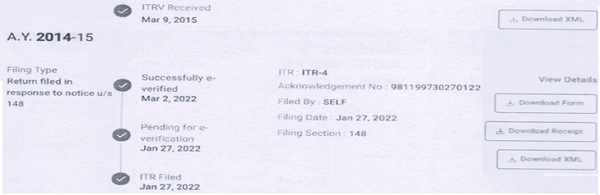
19. Once the system shows that the return has been e-verified, therefore, merely because the Assessing Officer mentions in the order that the return was treated as invalid return by the system, the same in our opinion cannot be accepted. We, therefore, hold that the return filed by the assessee is not an invalid return.
20. Once the return is treated as a valid return, the next question that arises for our consideration is as to whether the assessment order can be held as valid in absence of any notice issued u/s 143(2) when the assessee files the return in response to the notice u/s 148, though, belatedly.
21. We find an identical issue had come up before the Co-ordinate Bench of the Tribunal in the case of Bharat Kantilal Chengede vs. ITO (supra). In that case, notice u/s 148 of the Act was issued to the assessee on 25.03.2019 and the assessee filed his return of income in response to the same on 11.12.2019 which was after the statutory period of 30 days given by the Assessing Officer. No notice u/s 143(2) of the Act was issued by the Assessing Officer before completion of the assessment. The Tribunal relying on various decision quashed the assessment order by observing as under:
“14. We have heard the rival arguments made by both the sides, perused the orders of the Assessing Officer and the Ld. CIT(A) / NFAC and the paper book filed on behalf of the assessee. We have also considered the various decisions cited before us. We find the Assessing Officer in the instant case issued notice u/s 148 of the Act on 25.03.2019. We find the assessee in the instant case filed his return of income on 11.12.2019 which is after the statutory period of 30 days given by the Assessing Officer. It is also an admitted fact that the assessment order was passed on 20.12.2019 and no notice u/s 143(2) of the Act has been issued and served on the assessee before completion of the assessment. Under these circumstances, we have to see as to whether non-issue of notice u/s 143(2) of the Act renders the assessment proceedings invalid when the assessee filed the return in response to the notice issued u/s 148 of the Act belatedly.
15. We find an identical issue had come up before the Hon’ble Delhi High Court in the case of PCIT vs. Draft Infrabuild (P.) Ltd. (supra). We find the Hon’ble High Court, following its earlier order in the case of PCIT vs. Shri Jai Shiv Shankar Traders (P.) Ltd. (supra) and various other decisions, has held that the failure by the Assessing Officer to issue a notice to the assessee u/s 143(2) of the Act after the assessee files his return of income in response to the notice u/s 148 of the Act is fatal to the order of re-assessment proceedings. The relevant observations of Hon’ble High Court read as under:
15. This brings us to the second aspect of the matter, i.e., the consequences of the failure of the appellant/revenue to issue notice under Section 143(2) of the Act before framing the assessment order. Concededly, the appellant/revenue did not issue a notice under Section 143(2) of the Act, although it had on record the ROI filed by the respondent/assessee for the AY in issue, i.e., 2010-11. The return was, concededly, filed on 04.12.2015. This return was considered while framing the assessment under Section 147/144 of the Act. The only reason furnished for not issuing a notice under Section 143(2) of the Act is that the ROI was not filed within the thirty (30) days provided via the notice dated 30.03.2015 issued under Section 148. This argument does not impress us because if we were to hold [as we have], that the said notice was directed towards the wrong address, the respondent/assessee could have not adhered to the timeline provided in the said notice.
15.1 The respondent/assessee became aware of the Section 148 notice being issued after it received the notice dated 12.06.2015 under Section 142(1) of the Act. The fact that the respondent/assessee had filed an ROI on 04.12.2015 is not disputed. The fact that this ROI, as noticed above, was taken into account is also not in dispute. Therefore, in our opinion, before framing an assessment order, the AO ought to have issued a notice under Section 143(2) of the Act. The submission advanced on behalf of the appellant/revenue that, while it could consider the invalid return while framing the assessment order, it was not obliged to issue a notice under Section 143(2) of the Act because it was not filed within the timeframe given in the Section 148 notice is untenable in law, since the ROI, which was belated, was considered by the AO while carrying out the assessment.
15.2 The absence of notice, under Section 143(2), impregnates the proceedings with a jurisdictional defect and, hence, renders it invalid in the eyes of the law. This position is no longer res Integra, as demonstrated by the observations made in Principal Commissioner of Income-tax v. Shri Jai Shiv Shankar Traders (P.) Ltd. [2015] 64 taxmann.com 220/383 ITR 448 (Delhi) :
“12. The narration of facts as noted above by the court makes it clear that no notice under section 143(2) of the Act was issued to the assessee after December 16,2010, the date on which the assessee informed the Assessing Officer that the return originally filed should be treated as the return filed pursuant to the notice under section 148 of the Act.
13. In DIT v. Society for Worldwide Interbank Financial Telecommunications [2010] 323 ITR 249 (Delhi), this court invalidated a reassessment proceeding after noting that the notice under section 143(2) of the Act was not issued to the assessee pursuant to the filing of the return. In other words, it was held mandatory to serve the notice under section 143(2) of the Act only after the return filed by the assessee is actually scrutinised by the Assessing Officer.
14. The interplay of sections 143 (2) and 148 of the Act formed the subject matter of at least two decisions of the Allahabad High Court in CIT v. Rajeev Sharma [2010] 192 Taxman 197/336 ITR 678 (Allahabad) it was held that a plain reading of section 148 of the Act reveals that within the statutory period specified therein, it shall be incumbent to send a notice under section 143(2) of the Act. It was observed (page 687):
“The provisions contained in sub-section (2) of section 143 of the Act is mandatory and the Legislature in its wisdom by using the word „reason to believe’ had cast a duly on the Assessing Officer to apply mind to the material on record and after being satisfied with regard to escaped liability, shall serve notice specifying particulars of such claim.
In view of the above, after receipt of return in response to notice under section 148, it shall be mandatory for the Assessing Officer to serve a notice under sub-section (2) of Section 143 assigning reason therein . . .
in absence of any notice issued under sub-section (2) of section 143 after receipt of fresh return submitted by the assessee in response to notice under section 148, the, entire procedure adopted for escaped assessment, shall not be valid.”
15. In a subsequent judgment in CIT v. Salarpur Cold Storage (P.) Ltd. [2014] 50 taxmann.com 105/228 Taxman 48 (Allahabad), it was held as under:
“10. Section 292BB of the Act was inserted by the Finance Act, 2008 with effect from April 1, 2008. Section 282BB of the Act provides a deeming fiction. The deeming fiction is to the effect that once the assessee has appeared in any proceeding or cooperated In any enquiry relating to an assessment or reassessment, it shall be deemed that any notice under the provisions of the Act, which is required to be served on the assessee, has been duly served upon him in time in accordance with the provisions of the Act The assessee is precluded from taking any objection in any proceeding or enquiry that the notice was (i) not served upon him ; or (ii) not served upon him in time ; or (iii) served upon him in an improper manner. IN other words, once the deeming fiction comes into operation, the assessee is precluded from raising a challenge about the service of a notice, service within time or service in an improper manner. The proviso to section 292BB of the Act, however, carves out an exception to the effect that the section shall not apply where the assessee has raised an objection before the completion of the assessment or reassessment. Section 292BB of the Act cannot obviate the requirement or complying with a jurisdictional condition. For the Assessing Officer to make an order of assessment under section 143(3) of the Act, it is necessary to issue a notice under section 143(2) of the Act and in the absence of a notice under section 143(2) of the Act, the assumption of jurisdiction itself would be invalid.”
16. In the same decision in Salarpur Cold Storage (P.) Ltd. (supra), the Allahabad High Court noticed that the decision of the Supreme Court in Hotel Blue Moon (supra) where in relation to block assessment, the Supreme Court held that the requirement to issue notice under Section 143(2) was mandatory. It was not “a procedural irregularity and the same is not curable and, therefore, the requirement of notice under Section 143(2) cannot be dispensed with.”
17. The Madras High Court held likewise in Sapthagiri Finance & Investments v. ITO [2012] 25 taxmann.com 341/210 Taxman 78 (Madras) (Mag.). The facts of that case were that a notice under Section 148 of the Act was issued to the Assessee seeking to reopen the assessment for AY 2000-01. However, the Assessee did not file a return and therefore a notice was issued to it under Section 142 (1) of the Act. Pursuant thereto, the Assessee appeared before the AO and stated that the original return filed should be treated as a return filed in response to the notice under Section 148 of the Act. The High Court observed that if thereafter, the AO found that there were problems with the return which required explanation by the Assessee then the AO ought to have followed up with a notice under Section 143(2) of the Act. It was observed that:
“Merely because the matter was discussed with the Assessee and the signature is affixed it does not mean the rest of the procedure of notice under Section 143(2) of the Act was complied with or that on placing the objection the Assessee had waived the notice for further processing of the reassessment proceedings. The fact that on the notice issued u/s 143(2) of the Act, the assessee had placed its objection and reiterated its earlier return filed as one filed in response to the notice issued u/s 148 of the Act and the Officer had also noted that the same would be considered for completing of assessment, would show that the AO has the duty of issuing the notice under Section 143(3) to lead on to the passing of the assessment. In the ‘circumstances, with no notice issued u/s 143(3) and there being no waiver, there is no justifiable ground to accept the view of the Tribunal that there was a waiver of right of notice to be issued u/s 143(2) of the Act.
18. As already noticed, the decision of this Court in Vision Inc. (supra) proceeded on a different set of facts. In that case, there was a clear finding of the Court that service of the notice had been effected on the Assessee under Section 143(2) of the Act. As already further noticed, the legal position regarding Section 292BB has already been made explicit in the aforementioned decisions of the Allahabad High Court. That provision would apply insofar as failure of “service” of notice was concerned and not with regard to failure to “issue” notice. In other words, the failure of the AO, in re-assessment proceedings, to issue notice under Section 143(2) of the Act, prior to finalising the re-assessment order, cannot be condoned by referring to Section 292BB of the Act.
19. The resultant position is that as far as the present case is concerned the failure by the AO to issue a notice to the Assessee under Section 143(2) of the Act subsequent to 16th December 2010 when the Assessee made a statement before the AO to the effect that the original return filed should be treated as a return pursuant to a notice under Section 148 of the Act, is fatal to the order of re-assessment.
[Emphasis is ours]
IV. Conclusion:
16. On both aspects, the Tribunal is right. The Tribunal has returned findings of fact on the two issues adverted to hereinabove.
17. Thus, for the foregoing reasons, which are (i) that notice under Section 148 of the Act was improperly served, and (ii) that notice under Section 143(2) should have been issued before framing of assessment order under Section 147/144 of the Act, we are not inclined to interfere with the impugned order passed by the Tribunal.
18. Accordingly to us, no substantial question of law arises for our consideration.
19. The appeal is, accordingly, closed.
16. We find Hon’ble Patna High Court in the case of CIT vs. Nagendra Prasad (supra) has held that where notice was issued by the Assessing Officer under Section 148 requiring the assessee to file a return within thirty days but return was filed after eight and a half months, since return was filed by the assessee in response to said notice though delayed, there should have been a notice issued under section 143(2) as requirement to issue notice could not be dispensed with. The relevant observations of Hon’ble High Court read as under:
“4. The only question of law arising in the facts and circumstances of the case is whether notice should have been issued under section 143(2) of the Income-tax Act?
5. Admittedly, the notice was issued by the Assessing Officer under section 148 of the Act on 14-7-2008 requiring the assessee to file a return within thirty days. A return was filed much later on 31-3-2009, after eight and a half months.
6. On identical facts, in M.A. No. 239 of 2011 titled as Chand Bihari Agrawal v. Commissioner of Income Tax, Central, Patna decided on 25-7-2023, this Court considered the issue and held against the revenue.
7. We find that the question of law has to be answered in favour of the assesee and against the revenue. Hotel Blue Moon (supra) governs the issue which has been followed in Chand Bihari Agrawal (supra).
8. The Miscellaneous Appeal stands dismissed.”
17. The various other decisions relied on by the Ld. Counsel for the assessee also supports his case to the proposition that when the assessee files return in response to the notice u/s 148 of the Act, though, belatedly, non-issue of notice u/s 143(2) of the Act makes the re-assessment proceeding a nullity.
18. So far as the decision relied on by the Ld. DR is concerned, no doubt, the Hon’ble Delhi High Court on an earlier occasion has taken a view that non-issue of notice u/s 143(2) of the Act does not make the re-assessment proceedings invalid where the assessee files the return in response to the notice u/s 148 of the Act. However, it is to be noted that subsequent to this decision, the Hon’ble High Court recently in three other decisions has held that when the assessee files return in response to the notice u/s 148 of the Act, though, belatedly, the issue of notice u/s 143(2) of the Act is a mandatory requirement and non-issue of the same makes the re-assessment proceedings invalid. In any case, it is the settled position of law that when two views are possible on an issue, the view which is favourable to the assessee has to be adopted. Since the Assessing Officer in the instant case has admittedly not issued any notice u/s 143(2) of the Act after the assessee filed the return in response to the notice u/s 148 of the Act, though, belatedly, therefore, respectfully following the decisions cited (supra), we hold that the order passed by the Assessing Officer without following the mandatory requirement of issue of notice u/s 143(2) of the Act makes such reassessment order a nullity. Since the assessee succeeds on this legal ground, the grounds challenging the addition on merit are not being adjudicated.”
22. Since the facts of the in the instant case are identical to the facts of the case already decided by the Co-ordinate Bench of the Tribunal cited (supra), therefore, we hold that the order passed by the Assessing Officer without following the mandatory requirement of issue of notice u/s 143(2) makes the re-assessment order an invalid assessment. We, therefore, set aside the order of the Ld. CIT(A) / NFAC and the grounds raised by the assessee on this issue are allowed.
23. In the result, the appeal filed by the assessee is allowed.”
12. Respectfully following the above decision of the Tribunal passed in the case of assessee itself for assessment year 2014-15 in ITA No.1567/PUN/2026 order dated 07.07.2025, wherein the facts & issues involved are exactly identical to the instant case in hand of Asstt Year 2015-16, we are of the considered opinion that the order dated 27-03-2022 passed by the Assessing Officer without following the mandatory requirement of issue of notice u/s 143(2) makes the re-assessment order invalid & without jurisdiction. We, therefore, are not inclined to take a different view than what has already been taken by the Tribunal in the case of the assessee itself for Asstt Year 2014-15 in ITA No.1567/PUN/2026 order dated 07.07.2025 & accordingly deem it appropriate to set-aside the order passed by Ld. CIT(A)/NFAC and declare the impugned assessment order dated 27.03.2022 as bad in law. Thus, the grounds raised by the assessee on this issue are allowed.
13. Since we have allowed the appeal of the assessee on the ground of non-issuance of notice u/s 143(2) of the IT Act and declare the assessment order as bad in law, the other grounds raised by the assessee becomes infructuous hence not adjudicated.
14. In the result, the appeal filed by the assessee in ITA No.1596/PUN/2026 for A.Y. 2015-16 is allowed.
ITA No.1597/PUN/2026, A.Y. 2016-17 :
15. Since the facts and issues involved in the appeal of the assessee in ITA No.1596/PUN/2026 for A.Y. 2015-16 are identical to the appeal of the assessee in ITA No.1597/PUN/2026 for A.Y. 2016-17 therefore, our decision in ITA No.1596/PUN/2026 for A.Y. 2015-16 shall apply mutatis mutandis to the appeal of the assessee in ITA No.1597/PUN/2026 for A.Y. 2016-17. Accordingly, the appeal of the assessee in ITA No.1597/PUN/2026 for A.Y. 2016-17 is also allowed.
16. In the result, the appeal filed by the assessee in ITA No.1597/PUN/2026 for A.Y. 2016-17 is allowed.
17. To sum up, both the above captioned appeals filed by the assessee are allowed, as indicated above.
Order pronounced on this 31st day of July, 2026.