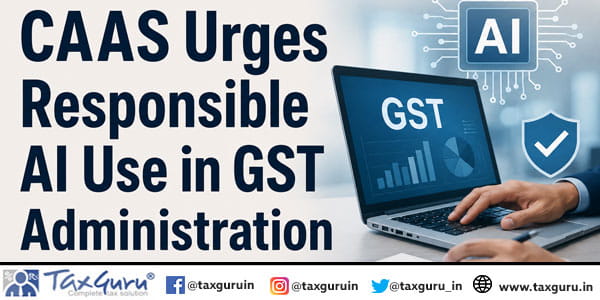
The Chartered Accountants Association, Surat (CAAS), addressed a representation to the Prime Minister advocating the deployment of Artificial Intelligence in tax administration to reduce corruption, improve efficiency, and safeguard taxpayer rights. Referring to its earlier representations, CAAS highlighted concerns relating to delays in GST registrations, alleged demands for illegal gratification in refunds and assessments, prolonged pendency of appeals, and the reported availability of confidential GST data in the open market. The Association argued that structural issues arise from the combination of discretion, opacity, and direct human intervention in tax administration. It proposed AI-driven processing for registrations, refunds, cancellations, and routine verifications, while recommending that adverse decisions continue to require accountable human oversight. CAAS also suggested enhanced data security mechanisms, algorithmic audits, standardized appellate procedures, co-service of notices to authorized representatives, and a one-time window for time-barred appeals. The representation emphasized that technological reforms should complement transparency, accountability, and taxpayer convenience.
Chartered Accountants Association, Surat
Ref: CAAS/Representations/2026-27/05 | Date: 11-06-2026
To,
The Hon’ble Prime Minister,
Prime Minister’s Office,
South Block, New Delhi – 110 011.
Sub: From Alms to Algorithms
Deployment of Artificial Intelligence in Tax Administration,so that the seekers of “Alms” finally meet an officer who has no hands
Ref: Our Representations dt. 20-01-2024, dt 21-08-2024 and dt.31-05-2025
Hon’ble Pradhan Sewak Mahoday,
There is a kind of letter no association enjoys writing: the fourth letter on the same subject. The first letter carries hope. The second carries patience. The third carries documents. The fourth, by the laws of nature, must carry a mirror – and a new idea. This is that fourth letter And because nobody in the Prime Minister’s Office should be expected to have read the previous three episodes before watching this one, we shall do what every good sequel does begin with a recap, so complete that a first-time reader needs no prequel, and so factual that no character in the story can object to his own portrayal.
EPISODE ONE (20-01-2024): We Inform the Commissioner SGST, that His Department Runs a Side-Business
On 20th January 2024 (Ref: CAAS/Representations/2023-24/04), we wrote to the Commissioner of State Tax, Gujarat, describing – politely, with section numbers – a business model flourishing inside the GST machinery of the State. The model is simplicity itself: every power to delay is a power to charge for speed; every power to question is a power to charge for silence; and every power to reject is a power to charge for approval. The currency of this business is what we have throughout called “Alms” – the small, regular, expected offerings without which Government files develop arthritis.
We showed where the collection counters operate. A new GST registration – which is nothing but a citizen asking the State for routine acknowledgement to do business and pay taxes – is made to ripen on the officer’s table until the thirtieth and last statutory day, whereupon it is either bombarded with irrelevant queries or rejected on vague ones; the applicant, whose shop opening and the bank account both wait on this number, learns quickly that the file moves on wheels of a particular metal. A refund – which is the taxpayer’s own money being returned to him – was being released at a market-discovered toll of 1% to 1.5% of the refund amount; the taxpayer pays it because his working capital is suffocating and litigation breathes slower than business. Assessment orders running into lakhs and crores were being passed without reading the replies the taxpayer had already uploaded on the portal – and when confronted, the officers’ advice was breathtaking in its serenity: “file an appeal.” File an appeal, that is, before a First Appellate Authority which, years after GST began, had not commenced hearing even its first batch of appeals. It is like advising a drowning man to complain to a lifeguard who is yet to be born. And the cruellest counter of all: a businessman who has closed his business and applied for cancellation of his registration – a man asking for nothing except to be let go – finds his cancellation rejected, so that the meter of return-filing and late fees restarts on a dead business, until the file is suitably nourished.
Lest anyone suspect us of theatre, we conducted a small scientific experiment and recorded it in that very letter. A member of our association, summoned to “visit the office” for the petty task of cancellation, arranged a telephone call with the officer concerned, with the Vice-President of our association listening. The officer, unaware of his audience, delivered the doctrine of the department in one immortal sentence: “Without your member visiting the office, how shall the task get accomplished?” Note the grammar carefully – not “the law requires”, not “the rules provide”, but “visiting the office”, that ancient ritual of Indian administration in which files are blessed in person.
The letter produced a meeting. On 5th February 2024, at Bahumali Bhavan, Surat, the Additional Commissioner – chairing on behalf of the Commissioner of State Tax – heard us patiently for two and a half hours and assured us that corrective steps, including an “aging mechanism” to track delayed files, were being implemented across Gujarat. We left the meeting with assurances. The assurances, as far as we can tell, left the meeting with us – for they were never sighted in the field again.
EPISODE TWO (21-08-2024): Since Generalities Are Easy to Deny, We Publish the Rate Card
Seven months passed. The registrations still ripened till day thirty; the refunds still paid their toll; the appeals still slept. So, on 21st August 2024 (Ref: CAAS/Representations/2024-25/02) we sent Reminder-I, and this time we did what accountants do when adjectives fail: we compiled a schedule. Based on a survey across Gujarat, we published the prevailing region-wise rates of Alms – an actual price list of corruption, in writing, under our letterhead, with our office-bearers’ names and mobile numbers printed on top. An extract:
| Region | New Registration | Assessment with zero issues | Regular Refund |
|---|---|---|---|
| Bharuch / Ankleshwar | Rs. 3,000 | Rs. 15,000 – 25,000 per year | 2% of refund amount |
| Surat | Rs. 2,000 – 3,000 | Nil – Rs. 15,000 per year | 0.75% – 1.5% |
| Vapi | Rs. 3,000 – 5,000 | Rs. 15,000 – 25,000 per year | 1.25% – 2% |
| Vadodara | Min. Rs. 7,500 | Rs. 10,000 – 15,000 per year | 5% – 7% |
| Palanpur | Rs. 5,000 – 10,000 | Min. Rs. 25,000 per year | 1% – 2% |
(Extract from our representation dt. 21-08-2024; the full schedule covers ten regions, besides appeal-stage rates of 10% of the disputed amount in refund matters and 20% in goods-detention matters.)
Now observe what happened next, because it is the most eloquent fact in this entire letter: nothing. This table was not denied. It was not disputed. Our profession knows precisely why truth makes a poor plaintiff. No vigilance enquiry was communicated to us. No region wrote in to protest that its rates had been overstated. In accountancy there is an old saying: figures that go unchallenged are figures admitted. The Government of Gujarat’s tax machinery has, by twenty-two months of unbroken silence, admitted its own rate card.
EPISODE THREE (31-05-2025): “Alms and Apathy” – We Discover the Taxpayer’s Data is on Sale
On 31st May 2025 (Ref: CAAS/Representations/2024-25/05), we escalated the chronicle to the Hon’ble Finance Minister under the title “Alms and Apathy under GST Regime” – eighteen pages covering the registration gauntlet, the refund “packages”, the penalty bazaar, the two-father problem of CGST and SGST, the officers who discover their chairs at 11:30 AM and observe lunch breaks of banking proportions, and the Tribunal that took eight years to be born. But the chapter that should have detonated alarm bells in every corner of North Block was the first one: The Great GST Data Bazaar.
Let us explain this in words a first-time reader will not need to decode. Under GST law, every business in India is compelled to upload its complete commercial DNA to the Government’s portal, GSTN: every sale (GSTR-1), every movement of goods (e-way bills), every individual invoice (e-invoice). Who buys from you, who sells to you, in what quantity, at what price, in which month – the entire bloodstream of a business, surrendered under compulsion of law, on the solemn understanding that the State will guard it. We discovered that this data was available for purchase in the open market. By “vendors” we do not mean vegetable sellers. We mean professional data brokers – enterprising gentlemen who telephone businessmen across India with a product catalogue, offering to deliver the confidential GST data of any taxpayer of the customer’s choosing. Including, naturally, the customer’s competitors. The price list we reported:
| Private GST data item, sold as a package | Retail rate |
|---|---|
| GSTR-1 sales data of any taxpayer, for 3 months | Rs. 8,000 |
| E-way bill data of any taxpayer, for 3 months | Rs. 15,000 |
| A single e-invoice | Rs. 3,000 |
Pause on what this means in a bazaar like Surat’s textile market or Bharuch’s chemical belt. A businessman’s customer list – built over a generation of relationships, credit risks and midnight deliveries – can be bought by his rival for less than the price of a wedding dinner. The taxpayer surrenders his trade secrets to the State at gunpoint of penalty, and somewhere between his upload and the Government’s vault, those secrets acquire a price tag and a sales force.
EPISODE FOUR (TODAY): The Bazaar Sends Its Regards
That was a year ago, addressed to the Finance Minister of India. Here is the status report as on the date of this letter: the bazaar is open, fully stocked, and doing brisk business. Our members – practising Chartered Accountants – and their clients continue to receive these sales calls to this day, from numbers across India. The pitch has not even bothered to evolve: “Sir, month-wise sales data of any GST number you want. Competitor ka bhi milega. Rate list bhej dete hain.” Some callers, in the finest traditions of Indian retail, offer festival discounts.
Permit us one professional observation on these calls. In our line of work, when an auditor concludes that an organisation’s books cannot be trusted at all, he issues what the Standards call an “adverse opinion” – the harshest verdict in the audit dictionary, reserved for the hopeless. Every one of these sales calls is the open market issuing an adverse opinion on the Government’s custodianship of taxpayer data. The only differences are that this opinion is delivered by telephone, requires no appointment, and is available with a discount.
So let us total the ledger of three representations: two and a half years; one meeting; one rate card published and admitted by silence; data bazaar reported to the Finance Minister and still ringing our members’ phones; zero consequences for anybody. The chain of command from Commissioner to Finance Minister stands fully exhausted, which is why this fourth episode is addressed to the apex of the executive – and why it is written with a different pen. We are no Longer suggesting that the officers be treated. We are suggesting that the disease be retired.
THE DIAGNOSIS: Why Thirty Months of Treatment Failed (Hint: We Were Massaging a Severed Nerve)
Every remedy attempted so far – representations, meetings, assurances, aging mechanisms, circulars, transfers – rests on one assumption: that the human being sitting at the chokepoint can be reformed. Thirty months of evidence say the assumption is wrong, and not because Gujarat breeds uniquely wicked officers. The reason is structural. A bribe is not a cultural mystery; it is a market transaction that requires exactly three ingredients: a discretionary power (the legal right to say yes slowly, or no creatively); an opaque process (a file whose movement nobody outside can see); and a reachable human (a name, a cabin, a chair, and an “understanding”). Wherever the three sit together – the registration desk, the refund queue, the assessment file, the highway checkpoint at 2 AM – a counter opens. Remove any one ingredient and the market collapses on its own, without a Lokpal, without a sting operation, without a single arrest.
Circulars cannot delete discretion; they merely decorate it. Transfers do not remove the reachable human; they introduce him to a new clientele. Training the unwilling – and we say this having formally offered in 2024 to train SGST officers free of cost, an offer that was declined – is watering a plastic plant. There is exactly one intervention known to mankind that removes the ingredient itself: replace the discretionary human at the repetitive chokepoint with a machine that has no discretion to sell.
THE INCONVENIENT DEVELOPMENT: The Judiciary Has Overtaken the Executive on the Technology Highway
Before anyone in the corridors murmurs that handing Government work to Artificial Intelligence is too radical, too risky, too futuristic for India – we place on record an event of 3rd June 2026 that deserves to be read twice. On that date, the Supreme Court of India – yes, the institution of black robes, Latin maxims and two-hundred-year-old precedents; the branch of the State that everyone assumed would be the very last to befriend a machine – published its draft Regulations for Use of Artificial Intelligence in Courts, 2026, and invited public comments. And these are not regulations of fear. They declare, in so many words, a presumption in favour of responsible Al adoption – meaning a court must look for reasons to use AI, and record reasons in writing if it refuses. One regulation is literally titled innovation over Restraint.” Under that framework, the judges of this country have volunteered to have every Al tool entered in a public register, audited every year, its errors logged in an incident database shared across High Courts, and the whole affair published in annual transparency reports – while the human judge remains supreme and signs every order.
Sit with the irony for a moment. The branch of Government that interprets the Constitution has agreed to work under algorithmic registers and annual audits. The branch that merely matches GSTR-1 with GSTR-3B – arithmetic that a school spreadsheet performs without tea breaks pleads that it cannot possibly be assisted, audited or automated. One struggles to identify the trauma being protected here, unless what is being protected is not the Constitution but the counter. The judiciary has lapped the executive on the technology highway; this letter is the executive’s invitation to rejoin the race, while the choice of pace is still its own.
THE CURE, PART ONE: A Database Must Remember Who Touched It
Begin where the bleeding is: the Data Bazaar. Today, when a taxpayer’s GSTR-1 walks out of the Government’s system and into a broker’s sales pitch, nobody can say which login, which terminal, which download, at which hour. The leak has no fingerprints, because nobody dusts for fingerprints. Meanwhile the taxpayer who reports every invoice to the last paisa enjoys less privacy than a teenager’s social media account.
Our Suggestions:
- Encrypt all taxpayer data on GSTN, at rest and in transit, and convert officer access to view-only – no bulk downloads in the discharge of any “sacred duty” of assessment or refund. An officer needs to see a return the way a bank teller needs to see a balance: on screen, logged, and without a photocopier.
- Install an Al-driven access-audit layer: every query, view and export logged immutably; anomaly detection that develops a healthy curiosity when an officer views five hundred taxpayers outside his jurisdiction at midnight; and tracer records seeded through the database, so that any dataset surfacing in the bazaar names its own point of leakage like dye in water. The watchman we are suggesting does not blink, does not sleep, and cannot be invited to the wedding.
- Publish quarterly data-access audit summaries and leakage investigations. The data belongs to the taxpayer; the accountability for its custody belongs in public view.
THE CURE, PART TWO: Automate the “Yes,” Humanise the “No” – The Design That Bankrupts the Alms Economy
Now the heart of the matter, and the simplest idea in this letter. Ask yourself: why does any businessman pay Alms? Not out of affection for the officer. Not from religious sentiment. He pays because the officer holds a power to hurt him – to delay his registration while his shop rent runs, to sit on his refund while his working capital gasps, to “spoil the case” with a shocking demand if the standard rate is not honoured, to reject his cancellation so the late-fee meter restarts on a dead business. The entire Alms economy stands on this one pillar: the threat of an adverse outcome. Demolish the pillar, and the economy falls without a single arrest, enquiry or suspension.
So here is the demolition plan. Let Artificial Intelligence autonomously grant every favourable outcome that satisfies objective criteria – registrations, refunds, rectifications, cancellations on closure of business – instantly, uniformly, and without the file ever meeting a discretionary eye. And let every adverse action – rejection, demand, penalty, detention – require the signature of a named human officer with recorded reasons, reviewable in appeal and attributable forever. The honest applicant never meets an officer at all; the dishonest one meets an officer who must write down why, in a file the machine remembers. Nobody ever again gets to ask our members the question recorded on that 2024 phone call – “without your member visiting the office, how shall the task get accomplished?” – because there is no task left that requires a visit, a cabin, or an understanding.
Our Suggestions:
- Registration on trust, verification by machine. In our 2025 letter we suggested that a GST registration should be as effortless as opening an e-mail account – the Income Tax Department issues PAN on trust, the MCA incorporates companies on trust, but a GST number apparently requires an inquisition worthy of a medieval witch hunt. We now fortify that suggestion with an Al document-forensics layer: every application cross-verified within seconds, through APIs, against Aadhaar, PAN, electricity records, property registries, MCA filings and banking KYC. Mark the beautiful symmetry: fabricated documents are caught regardless of consideration paid, and genuine documents pass regardless of consideration withheld. Both counters of the present racket – the one that approves fakes for a fee and the one that rejects genuine papers for want of a fee – close on the same day, permanently. And the mysterious “High Risk” club, into which almost every applicant in India is presently inducted on parameters guarded like nuclear codes, is disbanded by publishing those parameters to independent audit.
- Refunds without faces, packages without customers. Refunds of verified exporters and inverted-duty claimants to be machine-processed within days against Al-verified documentation, with only genuinely doubtful cases escalated to senior human review with recorded reasons. The cottage industry of refund “packages” – Regular, Max, Pro, Ultra-Pro and Ultra-Max-Pro, the actual menu we reported to the Hon’ble Finance Minister in 2025 – shuts down for want of inventory: nothing remains to expedite when expedition is the default setting.
- A right to a human before a Lawyer. Every machine decision to carry a statutory right of human reconsideration, time-bound, before any first appeal – so that the machine’s errors are corrected where they are born, at zero cost, instead of being exported to constitutional courts. The Hon’ble High Courts of this country are not the janitorial staff of the executive’s software.
THE CURE, PART THREE: A Machine That Writes Its Reasons – The End of “Submissions Considered But Not Found Acceptable”
Our representations documented assessment orders in lakhs and crores passed without reading the replies lying on the portal, their entire intellectual labour compressed into the one deathless sentence of Indian tax administration: “submissions considered but not found acceptable.” Here is the structural truth behind that sentence: an officer’s mind is a sealed room. No appellate authority has ever cross-examined a state of mind; the officer may have applied his mind, misapplied it, or left it at home – the order reads the same. A machine’s decision, by contrast, is a glass room: every input weighed, every rule invoked, every step logged in a reasoning trail that can be produced before any appellate forum, reconstructed line by line, and challenged on merits. The machine, properly regulated, is more accountable than the man – it cannot claim the file was “under process,” it does not discover its chair at 11:30 AM, it observes no lunch break of banking proportions, and it has no “earning season” in the last week before an assessment deadline.
Our Suggestions:
- Every AI-assisted decision to carry a mandatory machine-readable reasoning log; every adverse human decision to record why the machine’s recommendation, if any, was departed from. Discretion may survive – but from now on it keeps a diary.
- Decouple the algorithm from collection targets. This is the safeguard on which everything else depends. Teach the machine our present target culture and the nation will have built the world’s first incorruptible extortionist – high-pitched assessment at industrial scale, twenty-four hours a day. The machine’s objective function must be legal correctness alone: the right tax, from the right person, at the right time, and not a rupee of headline decoration. Our 2024 letter showed how mindless demands quietly inflate the monthly collection trumpets, only to be reversed in appeal years later; a correctly instructed machine would make the monthly press release describe revenue rather than describe ambition.
- Screen the Department’s own appeals before they are born. Section 107(13) of the CGST Act commands that appeals be decided within one year “wherever it is possible”; our letters record First Appeals unheard five years after filing, and the Tribunal arriving fashionably late by the better part of a decade. Let Al merit-screen every proposed departmental appeal against settled law before filing and assist in disposing the existing mountain. Every frivolous demand the machine declines to raise is a hearing that never happens, a High Court board that shortens, and a GSTAT docket reserved for disputes that actually deserve a judge. The fastest judicial reform available to India is not in the courts at all; it is in the quality of the orders that reach them.
THE TWO FRESH WOUNDS OF THE FIRST APPEAL: The Bus That Never Returns, and the Counsel Kept in the Dark
First, the taxpayers who missed the bus. Under Section 107 of the CGST Act, a taxpayer aggrieved by an order has ninety days to file his First Appeal, and the Appellate Authority may condone a delay of thirty days more – one hundred and twenty days in all, and not a sunrise beyond. Every forum in the land – the First Appellate Authority, the GSTAT, the High Courts and the Hon’ble Supreme Court – has held, with impeccable legal correctness, that this limitation is the command of the legislature and cannot be stretched by judicial kindness. We do not quarrel with the law of limitation; we quarrel with its arithmetic of irony. The taxpayer who arrives on day one hundred and twenty-one loses his right to be heard forever – while the Tribunal to which Parliament itself promised him a second appeal arrived roughly eight years behind its own schedule, and nobody’s limitation ran against the Government. The depot was eight years late; the passenger’s one day is unpardonable.
Now follow the money, because that is where the irony stops being amusing. Thousands of orders – many of them passed “without application of mind,” as the earlier episodes of this chronicle have recorded – have attained finality not because they were right, but because the calendar said so. Recoveries are being made under such orders from taxpayers whose cases carry admitted merit, and who knock on forum after forum only to be told, correctly and unhelpfully, that limitation has consumed their remedy. Article 265 of the Constitution disposes of the matter in eleven words: “No tax shall be levied or collected except by authority of law.” A demand that is wrong on merits, but which no forum on earth can any longer examine, is being collected by authority of the calendar, not by authority of the law – and the difference between the two is precisely the difference Article 265 was written to mark.
Our Suggestion:
- Let the Policy Wing announce a short, one-time amnesty-cum-condonation window permitting time-barred First Appeals – and the appeals that fell into the void between an Appellate Authority that would not hear and a Tribunal that was not born – to be filed and heard on merits, subject to the usual pre-deposit. The State delayed the Tribunal by the better part of a decade and forgave itself without ceremony; it can spare the citizen one window of one season. And Artificial Intelligence makes the consequence manageable: machine triage of the incoming flood by dispute type, merit category and amounts involved would dispose in months what manual registries would nurse into the next decade.
Secondly, the appeals that have at Last begun – and begun in a manner only Government can manage: simultaneously everywhere and uniformly nowhere. We record our acknowledgement that the hearing of First Appeals has commenced; our August 2024 letter had, after all, supplied both the deadline and the motivation. But the process is an orchestra without a conductor. There is no structured SOP. Each Appellate Authority improvises his own ritual: one demands papers that already lie on the portal; another demands papers of an altogether different kind; a third, presumably in pursuit of completeness, demands documents bearing no relation to the dispute at all. The taxpayer’s file thus becomes a moving target – what satisfied the officer in Surat invites a deficiency memo in Vadodara, and the appeal is decided as much by the officer’s stationery preferences as by the law.
And then the crowning design flaw, small enough to escape a policy review and large enough to manufacture a fresh generation of litigation: notices of hearing travel only to the registered e-mail ID of the taxpayer. The taxpayer, let us remember, is a businessman – a gentleman who checks his inbox the way most of us check our blood pressure: occasionally, and with dread. The Chartered Accountant or Advocate who actually conducts the matter – whose letter of authority sits inside the very appeal file the notice relates to – is kept in ceremonial oblivion. The predictable harvest: hearings missed, matters decided ex parte, orders discovered months later, and condonation battles fought over delays the system itself manufactured through its own postal habits. The Department then reports the disposal as an achievement; the taxpayer reports to the High Court.
Our Suggestions:
- A national SOP for First Appeals under GST, with an Al-generated standard checklist of documents per category of dispute, published on the portal – so that what an officer may ask for is known before he asks, and what is irrelevant to the matter is never asked at all. Uniformity is not a luxury; it is the minimum rent the State pays for the word “system.”
- Mandatory co-service of every notice, hearing date and order upon the authorised representative on record – a dedicated e-mail and mobile field for the AR in the appeal form itself, auto-notified by the system at every stage. A machine, whatever its other limitations, never forgets to mark a copy; that single virtue already places it above the present practice.
THE CURE, PART FOUR: Swadeshi Silicon – The First Officer in History With No Nephew, No Posting, and No UPI ID
Build all of this on Indian soil: NIC, C-DAC, and the IndiaAl Mission. Sovereign infrastructure, indigenous models, taxpayer data never transiting a foreign cloud. In 2025 we offered the Government GSTCoin – a blockchain rail that would make the invoice trail incorruptible – and were not summoned even for a cup of tea. We repeat that offer today with its elder sibling: Artificial Intelligence, which makes the decision trail incorruptible. Together they constitute the first officer cadre in the history of public administration that is structurally incapable of seeking Alms. This officer has no nephew needing accommodation, no daughter’s wedding to finance, no transfer to dread, no retirement to fund, no chai-pani custom, and no account into which gratitude can be deposited. This officer reads every page of every reply, applies the same rule to the millionaire and the micro-trader, treats a midnight truck on the Bharuch highway exactly as it treats a noon consignment on Ashram Road, and works on Diwali without claiming a festival advance.
Our Suggestions:
- Independent algorithmic audit published annually. Every deployed system audited each year by independent technical auditors, with findings tabled and published – the same discipline of registers, incident databases and transparency reports that the Supreme Court’s draft cheerfully imposes on its own courtrooms. We submit this as the profession of auditors, standing on the first principle our members sign beneath every day of their working lives: no entity audits itself. Parliament does not let a company’s accounts department certify its own books; the same logic applies, with greater force, to software that touches the liberty and property of citizens.
- Redeployment, not retrenchment – and a word about the Lunch breaks. Let no employee federation lose sleep: not one post need be abolished. The clerical, repetitive, discretion-laden functions migrate to the machine; the human capital – whose high skill the service rules so confidently presume – is redeployed to investigation, intelligence, appellate disposal and taxpayer education, the very functions our letters show are starved of sincere hands. Officers who, even after redeployment, find honest work beneath their considerable talents will doubtless be absorbed by a private sector eager for such experience; the exchequer wishes them a heartfelt farewell in advance. And the legions of genuinely needy, qualified young Indians waiting outside deserve to join a service, not a syndicate – to serve the public, rather than be served Alms.
- A pilot in Gujarat, with published scorecards. Begin with AI-driven registration and refund processing in two or three States. Gujarat volunteers herewith, for a reason no other State can match: thanks to our letter of August 2024, Gujarat is the only State in the Union whose bribe rates stand documented in writing, region by region – which means the pilot arrives with a ready-made “before” column. Publish error rates, turnaround times and grievance statistics every quarter, and scale on evidence. Governments rightly distrust revolutions; this is merely an experiment that comes with its own control group.
- A standing seat for the people at the counter. Whatever AI-governance body is constituted for tax administration must include the professional associations whose members stand at the counters where the system actually lives. Even the Supreme Court’s draft contemplates consulting stakeholders about its own machinery; the executive should not remain the only establishment in India that designs counters without once consulting the people processed at them.
IN CONCLUSION: We Would Prefer Not to Write Episode Five
For two and a half years, this Association has done everything a responsible stakeholder is supposed to do. We documented. We represented. We attended the meeting. We waited the seven months. We sent the reminder. We escalated to the Finance Minister. And to every single complaint we stapled a solution – aging dashboards, faceless refunds, outsourced manpower, GSTCoin. The system, for its part, has done everything an entrenched system is supposed to do: it assured, it deferred, and it continued. The rate card aged twenty-two months without a denial. The data bazaar survived a letter to the Finance Minister and now offers festival discounts.
This letter breaks the cycle, because it suggests the one reform whose success does not depend on the reformation of those who profit from the present arrangement. The Supreme Court has already shown the nation what institutional self-confidence looks like: doors opened to the machine, lights kept on, a register on every wall, and a human signature on every order. The executive’s tax administration – which touches more citizens in a month than the courts do in a year – now has the opportunity to walk through the same door voluntarily, while the pace of the walk is still its own to choose. History is rarely so polite as to knock twice.
CAAS does not complain; it computes. The computation above arrives, as all four episodes have, with the solution stapled to it. We await tangible action – and, as the previous episodes demonstrate, we keep excellent records.
Jai Hind.
Regards,
For Chartered Accountants Association, Surat.
President I Secretary
Copy to: –
(1) The Revenue Secretary, Ministry of Finance, North Block, New Delhi – 110001 – for information and appropriate action
(2) The Chairman, Central Board of Indirect Taxes & Customs, North Block, New Delhi 110001 – for information and appropriate action
(3) The Secretary, Ministry of Electronics and Information Technology, New Delhi – for information and appropriate action
(4) The CEO, NITI Aayog, Sansad Marg, New Delhi – 110001 – for information and appropriate action
(5) The Commissioner of State Tax, Rajya Kar Bhawan, Ashram Road, Ahmedabad 380009 – for information; episodes one and two refer