From ASMT‑10 to Section 73/74/74A: How Scrutiny of Returns Escalates into Full GST Demands – What Every Taxpayer Must Know
1. Why taxpayers must understand this escalation
Many businesses treat an ASMT‑10 scrutiny notice under section 61 as “just a letter”, because it does not itself create a demand. In law, section 61 only empowers the officer to scrutinise returns and seek an explanation; adjudication happens later under sections 73, 74 or 74A.taxguru+1
However, if your reply in ASMT‑11 is weak, delayed or not backed by documents, the very same issues can smoothly migrate into a detailed show cause notice (SCN) under 73/74/74A, with full tax, interest and penalty exposure. For a compliant business, this is not an academic issue – it hits working capital, cash‑flows, bank limits, ratings, vendor relationships and even reputation with departments.
2. Legal framework: Section 61 vs 73/74 vs 74A
Section 61 – Scrutiny of returns
Officer scrutinises your GSTR‑3B, GSTR‑1, 2A/2B, e‑invoices, e‑way bills and related data and issues ASMT‑10 pointing out discrepancies, giving you 30 days (extendable) to reply in ASMT‑11.
If satisfied with your explanation or payment, he issues ASMT‑12 and scrutiny ends there.
Section 73 (for periods up to 31‑03‑2024)
Demand in non‑fraud cases – tax not paid/short‑paid, wrong refund/ITC, but without allegation of fraud, wilful misstatement or suppression.
Lower penalty slabs and more beneficial voluntary payment options, with shorter limitation than fraud cases.
Section 74 (for periods up to 31‑03‑2024)
Demand in fraud‑type cases – involving fraud, wilful misstatement or suppression of facts; higher penalty (up to 100%) and extended limitation.
Section 74A (for FY 2024‑25 onwards)
New unified demand section; from FY 2024‑25, all SCNs must be issued under 74A, with both non‑fraud and fraud consequences built into a single provision.
Old sections 73 and 74 will continue only for periods up to 31‑03‑2024; for 2024‑25 onwards, notices under 73/74 are not legally sustainable and must be aligned to 74A.taxscan+1
Courts and commentators have clarified that scrutiny under section 61 and demand under 73/74 are separate tracks – scrutiny is not a legal pre‑condition for issuing a demand notice, though in practice it is often the first step.
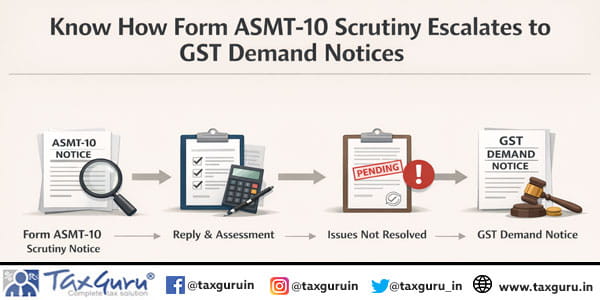
3. Step‑by‑step path: from ASMT‑10 to SCN under 73/74/74A
Step 1 – Notice in ASMT‑10 (scrutiny stage)
The department selects your GSTIN for scrutiny based on risk parameters, analytics and SOPs. Common discrepancies flagged in ASMT‑10 include:
ITC in GSTR‑3B exceeding GSTR‑2A/2B.
Outward tax in GSTR‑3B lower than GSTR‑1 / e‑invoice / e‑way bill data.
RCM not paid or not disclosed.
Ineligible ITC (blocked credits, exempt inputs, non‑business use).
Rate/classification mismatches, reverse charge mistakes, refund anomalies.
You must reply in ASMT‑11 within 30 days of service (or within any extended time the officer allows), either explaining the mismatch or accepting and paying the differential tax with interest.
Step 2 – Your ASMT‑11 becomes “Exhibit‑A”
A clear, reconciled and document‑backed ASMT‑11 reply often leads to closure through ASMT‑12, and the matter ends. But if:
You do not reply at all, or
You file a vague or unsubstantiated reply (“all ITC is genuine”) without reconciliations, or
You accept discrepancies in words but do not actually pay,
then your ASMT‑11 and your silence become the starting evidence for later demand under 73/74/74A. Rule 99(2) expressly allows the officer, if not satisfied with your reply, to move to audit, inspection or determination of tax under sections 73 or 74.
Step 3 – Escalation routes
If discrepancies remain unresolved after scrutiny, the officer may:
Order audit under section 65 or special audit under section 66.
Initiate inspection/search under section 67.
Directly issue a show cause notice under section 73, 74 or 74A, annexing ASMT‑10 and ASMT‑11 as part of the record.
High Court decisions (summarised in recent articles) have confirmed that the department can trigger section 73/74 demands even without section 61 scrutiny, because the phrase “where it appears” in 73/74 allows reliance on any credible information. At the same time, if the same issues were fully explained and accepted during scrutiny, a fresh demand on identical material can be attacked as arbitrary or a mere change of opinion, depending on facts.
4. Where section 74A changes the game from FY 2024‑25
For periods up to 31‑03‑2024:
The SCN must still choose between section 73 (non‑fraud) and section 74 (fraud), and wrong selection can itself be a strong defence in appeal or writ.
For FY 2024‑25 onwards:
All SCNs must be issued only under section 74A; 73/74 cannot be used for these periods once 74A is effective.
Within 74A, the adjudicating authority decides at the order stage whether the case is “fraud limb” or “non‑fraud limb”, which governs penalty level and limitation.
Penalty slabs broadly mirror the old 73/74 pattern but are embedded inside 74A; limitation is unified (for example, a single 42‑month outer limit is being discussed in commentary).
For business, this means: one consolidated section, but more discretion at adjudication. Your early replies – ASMT‑11, any DRC‑01A (pre‑notice intimation) response – will heavily influence whether the case is treated as genuine error or painted as fraud‑like conduct.
5. Illustrative business examples
Example 1 – Non‑fraud ITC mismatch going into section 73
A medium‑sized trader receives ASMT‑10 for FY 2022‑23: ITC in GSTR‑3B exceeds 2B by ₹10 lakh. He files a one‑line ASMT‑11: “All ITC is genuine; details will be produced at the time of hearing”, without any reconciliation, vendor‑wise working, or proof that suppliers have paid tax.
The officer notes that explanation is unsatisfactory, does not issue ASMT‑12, and after some months issues an SCN under section 73, annexing ASMT‑10 and ASMT‑11 and alleging “wrong availment of ITC” with tax + interest + 10% penalty.
Business lesson: Treat ASMT‑10 as seriously as a pre‑SCN. A casual reply becomes part of the department’s file and can be used against you when the case escalates.
Example 2 – Fraud‑suspected ITC moving into section 74 / 74A
A manufacturer’s returns show large ITC from a supplier later found non‑existent during investigation. Scrutiny through ASMT‑10 begins; the taxpayer simply relies on tax invoices and does not substantiate movement of goods, e‑way bills or banking trail.
For FY 2021‑22, based on investigation and your weak response, the officer issues a section 74 SCN alleging “fraudulent ITC”, claiming tax + interest + 100% penalty. For similar patterns noticed in FY 2024‑25, the officer now issues SCN under section 74A, reciting the same facts and proposing higher 74A‑fraud‑limb penalties and longer limitation.
Business lesson: Once the narrative shifts from “mismatch” to “fake ITC/fraud”, you move from 73‑type exposure to 74/74A zone. Robust documentation and early rebuttal at scrutiny stage are critical.
6. Important case‑law ideas you can use
Recent High Court rulings, as discussed in professional commentaries, highlight some key principles:
Scrutiny under section 61 and adjudication under sections 73/74 are independent mechanisms; absence or dropping of 61 scrutiny does not bar 73/74 action if other credible material emerges (e.g., Mandarina Apartment Owners Welfare Association, Madras HC).
However, where the department relies entirely on discrepancies which were already explained and accepted during scrutiny, a fresh 74 demand without new material can be assailed as arbitrary or a change of opinion, especially when there is a clear ASMT‑12 closure on record.
New commentary on section 74A warns that officers may be tempted to skip meaningful pre‑SCN consultation; taxpayers should insist on fair hearing and use voluntary payment windows in the section to mitigate penalty where the case is genuinely non‑fraud.
You can weave these strands into arguments both to explain why escalation is legally possible, and to show why taxpayers must manage each stage intelligently.
7. Practical compliance strategy: what you should tell taxpayers
In your usual direct advisory style, you can emphasise:
Take ASMT‑10 seriously
It is not a demand, but it is the first draft of your case file. An emotional or evasive reply can hurt you later in 73/74/74A proceedings.
Maintain live reconciliations
Keep regular reconciliations between books, GSTR‑3B, GSTR‑1, 2B, e‑invoices and e‑way bills, so that scrutiny can be answered with ready, system‑generated reports rather than ad‑hoc Excel workings.
Use DRC‑03 wisely and record non‑fraud
Where there is a clear error, pay tax and interest early through DRC‑03, refer it specifically in ASMT‑11 and record that the issue is a bona fide mistake, not fraud; this helps keep the case within the non‑fraud track even under 74A.
Watch the section and period in the SCN
For 2017‑18 to 2023‑24, check if the officer has correctly invoked 73 or 74 and whether limitation and penalty limb fit the facts. For 2024‑25 onwards, insist that the SCN is framed under 74A and that the order clearly records whether your conduct is treated under the fraud limb or non‑fraud limb, with reasons.
Preserve all correspondence and hearing records the backbone of your defence in appeal/writ and do not rely only on portal snapshots. -Author