Lok Sabha Passes Bill Amending Section 10A of Payment and Settlement Systems Act: What It Means for UPI, MDR and Digital Payments
The Lok Sabha has passed the Taxation and Other Laws (Amendment) Bill, 2026, which amends Section 10A of the Payment and Settlement Systems Act, 2007 by replacing the reference to electronic payment modes prescribed under Section 269SU of the Income-tax Act with a provision empowering the Central Government to notify eligible electronic payment modes. The amendment sparked controversy after Congress alleged it removes the statutory guarantee of zero-fee UPI transactions and could enable the introduction of Merchant Discount Rate (MDR). However, Finance Minister Nirmala Sitharaman clarified that MDR applies only to merchants, not customers, and that no decision has yet been taken on imposing MDR, which will be considered separately by the NPCI-led UPI and Services Steering Committee after the Bill is enacted. The article examines the legal amendment, the Government’s clarification, the political debate, and explains that UPI transactions continue to remain free for customers unless a separate policy decision is taken in the future.
- Introduction
- What Does the Bill Actually Amend?
- What Changes?
- Why Has the Amendment Become Controversial?
- Finance Minister Nirmala Sitharaman's Response
- 1. MDR Does Not Apply to Customers
- 2. No Decision on MDR Has Been Taken
- 3. Parliamentary Debate
- What is Merchant Discount Rate (MDR)?
- Does the Amendment Mean UPI Will Become Chargeable?
- Legal Position
- Conclusion
Introduction
The Lok Sabha has passed the Taxation and Other Laws (Amendment) Bill, 2026, which proposes several amendments to tax and allied laws. One of the amendments attracting significant public attention relates to Section 10A of the Payment and Settlement Systems Act, 2007 (PSS Act).
The amendment has sparked a political debate after Congress leader Jairam Ramesh alleged that it removes the statutory guarantee keeping UPI transactions free and opens the door for the levy of Merchant Discount Rate (MDR) on digital payments.
The Government, however, has strongly rejected these claims, stating that the amendment merely provides legislative flexibility and does not impose any charge on UPI users.
What Does the Bill Actually Amend?
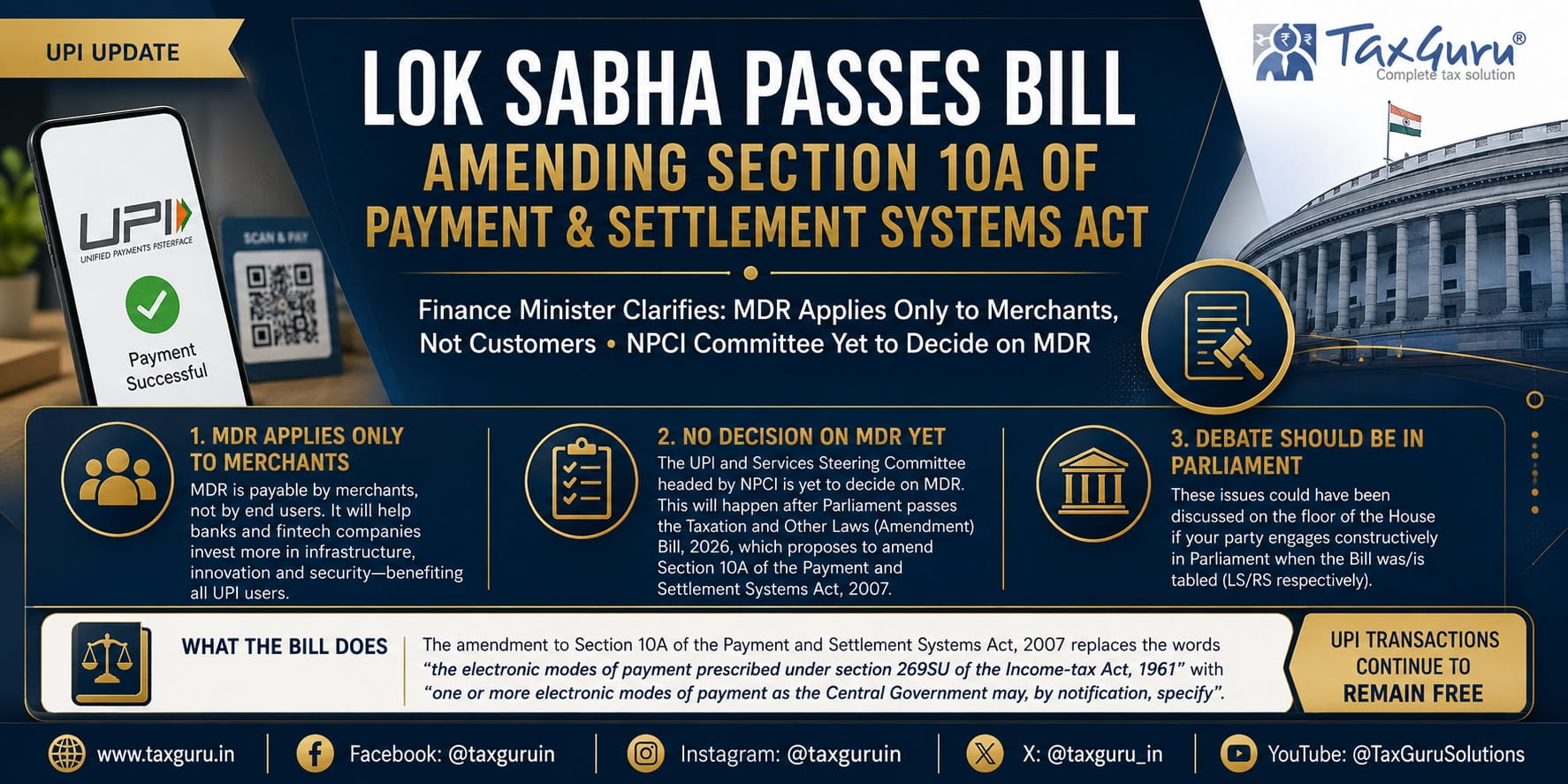
Chapter II of the Taxation and Other Laws (Amendment) Bill, 2026 proposes to amend Section 10A of the Payment and Settlement Systems Act, 2007.
The Bill substitutes the existing reference to:
“the electronic modes of payment prescribed under section 269SU of the Income-tax Act, 1961”
with:
“one or more electronic modes of payment as the Central Government may, by notification, specify.”
What Changes?
Under the existing law, Section 10A referred specifically to electronic payment modes prescribed under Section 269SU of the Income-tax Act, 1961.
The proposed amendment removes this statutory linkage and instead authorises the Central Government to notify one or more electronic modes of payment for the purposes of Section 10A.
Accordingly, the amendment provides greater flexibility to the Government in specifying covered electronic payment modes without requiring changes to the Income-tax Act.
Importantly, the amendment itself does not prescribe any charges, fees or Merchant Discount Rate (MDR).
Why Has the Amendment Become Controversial?
Congress leader Jairam Ramesh claimed that by replacing the existing statutory reference, the amendment removes the legal guarantee that currently keeps UPI transactions free and could facilitate the future introduction of MDR.
According to the Opposition, once the statutory framework changes, the Government may subsequently notify payment modes and decide the applicable MDR policy.
These remarks led to widespread discussion on social media, with many users expressing concern that customers may soon be charged for making UPI payments.
Finance Minister Nirmala Sitharaman’s Response
Union Finance Minister Nirmala Sitharaman responded to the allegations and described them as a “canard”. She made three important clarifications.
1. MDR Does Not Apply to Customers
The Finance Minister clarified that Merchant Discount Rate (MDR) applies only to merchants and not to end users or customers.
According to her, MDR enables banks and fintech companies to invest in:
- Payment infrastructure
- Technology and innovation
- Cybersecurity
- Digital payment security
She stated that all UPI users would ultimately benefit from these investments.
2. No Decision on MDR Has Been Taken
The Finance Minister further clarified that the UPI and Services Steering Committee headed by the National Payments Corporation of India (NPCI) has not yet taken any decision regarding MDR.
According to her statement, the issue will be considered only after Parliament passes the Taxation and Other Laws (Amendment) Bill, 2026, which proposes the amendment to Section 10A of the PSS Act.
Thus, the legislative amendment should not be construed as an immediate introduction of MDR.
3. Parliamentary Debate
The Finance Minister also stated that these issues could have been debated during the Parliamentary proceedings if the Opposition had constructively participated in the discussion on the Bill.
What is Merchant Discount Rate (MDR)?
Merchant Discount Rate is the fee paid by a merchant for accepting digital payments.
Typically:
- Customers do not pay MDR directly.
- The charge is borne by merchants.
- The amount is shared among acquiring banks, payment service providers, and payment networks.
However, businesses may indirectly factor payment acceptance costs into the prices of goods and services.
Does the Amendment Mean UPI Will Become Chargeable?
No.
The amendment does not itself impose any fee on UPI transactions.
It simply changes the legislative wording in Section 10A by empowering the Central Government to notify the electronic payment modes covered under that provision instead of referring specifically to payment modes prescribed under the Income-tax Act.
Whether MDR is introduced in the future will depend upon:
- Government policy;
- Decisions of the NPCI-led UPI and Services Steering Committee;
- Future notifications, if any.
As of now:
- UPI transactions remain free for customers.
- No notification has been issued imposing charges on end users.
- No MDR framework has yet been approved.
Legal Position
From a legal perspective, the amendment:
- Does not levy MDR;
- Does not mandate charges on UPI users;
- Does not prescribe any payment fee.
Instead, it provides an enabling framework allowing the Central Government to specify electronic payment modes by notification rather than by reference to Section 269SU of the Income-tax Act.
Any future decision introducing or modifying MDR would require separate policy action after the amended provision comes into force.
Conclusion
The controversy surrounding the Taxation and Other Laws (Amendment) Bill, 2026 illustrates the distinction between an enabling legislative amendment and a substantive policy decision.
While the amendment broadens the Central Government’s authority to specify electronic payment modes under Section 10A of the Payment and Settlement Systems Act, 2007, it neither introduces Merchant Discount Rate nor imposes any charge on UPI users.
The Finance Minister has clarified that no decision on MDR has yet been taken and that the matter will be considered separately by the NPCI-led UPI and Services Steering Committee after the legislative process is complete. Until any such decision is formally notified, UPI transactions continue to remain free for customers.
Editorial Note: The amendment creates the legal framework for future policy flexibility but should not be interpreted as an immediate decision to levy charges on UPI transactions. Whether any MDR regime is introduced will depend on subsequent Government and NPCI decisions, not merely on the passage of the Amendment Bill.