Shahi Exports Pvt. Ltd. Vs PCIT (ITAT Delhi)
Summary: 1. Background of search assessments and revision proceedings: The Income Tax Appellate Tribunal, Delhi Bench ‘G’, comprising Judicial Member Shri Bhavnesh Saini and Accountant Member Shri N.K. Billaiya, decided two appeals filed by Shahi Exports Pvt. Ltd. against separate revisionary orders dated 21 March 2017 passed under Section 263 of the Income-tax Act, 1961. The appeals related to Assessment Years 2008-09 and 2010-11. The controversy arose following a search and seizure operation under Section 132 conducted in the Shahi Exports Group on 16 January 2013. Assessments were subsequently completed on 30 March 2015 under Sections 153A read with 153C and 143(3). The Principal Commissioner considered these assessments erroneous and prejudicial to the interests of the Revenue and exercised revisionary jurisdiction. The assessee challenged the revision orders and raised an additional legal ground questioning the jurisdictional validity of the underlying search assessments themselves.
2. Admission of additional ground challenging jurisdiction: The assessee contended that the Principal Commissioner could not exercise revisionary powers under Section 263 over assessment orders that were themselves illegal and without jurisdiction under Sections 153A and 153C. The Tribunal admitted this additional ground because it went to the root of the controversy and required no further verification of facts. For this purpose, the Tribunal relied upon the Supreme Court decision in National Thermal Power Co. Ltd. Vs CIT, 229 ITR 383, recognising the Tribunal’s authority to entertain a legal question arising from facts already on record. Since the additional ground directly affected the validity of the revision proceedings, the Bench considered it before examining the other grounds of appeal.
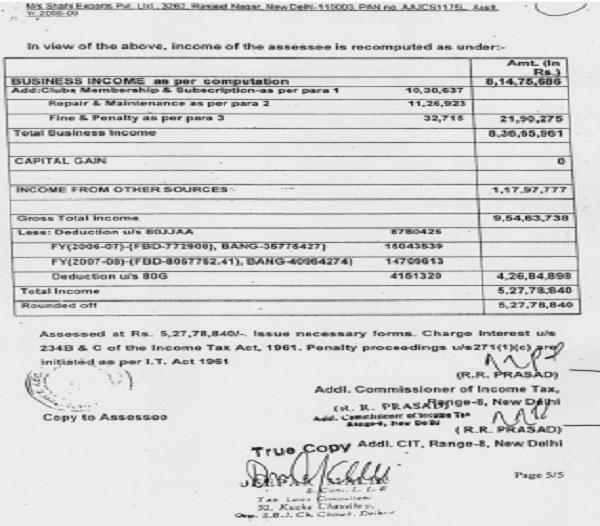
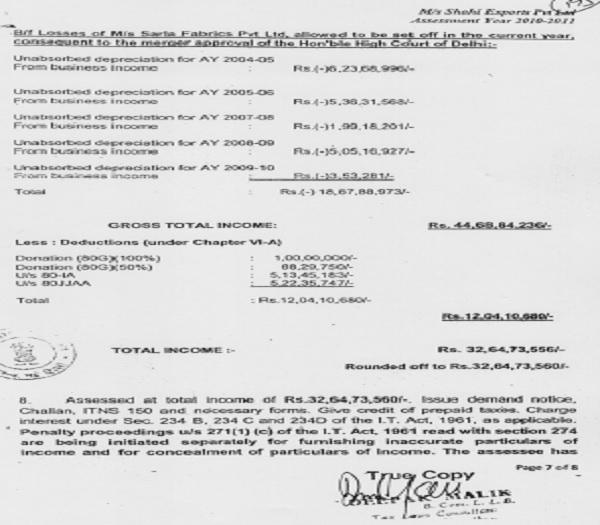
3. Earlier assessments and absence of fresh additions: The Tribunal examined the original assessments completed under Section 143(3) and compared them with the subsequent assessments framed under Sections 153A and 153C. For Assessment Year 2008-09, the previously assessed income was Rs.5,27,78,840, while for Assessment Year 2010-11 it was Rs.32,64,73,560. The Tribunal observed that the income determined in the search assessments was identical to the income already assessed under Section 143(3). Consequently, no fresh addition in the search assessments could be linked to incriminating material discovered during the search. The Principal Commissioner had nevertheless invoked Section 263 on the ground that, following the merger of M/s Sarla Fabrics Pvt. Ltd. with the assessee company, additions made in the hands of the former should have been assessed in the hands of Shahi Exports Pvt. Ltd.
4. Jurisdiction under Section 153C and judicial precedents: The Tribunal applied the principles laid down by the Delhi High Court in CIT Vs Kabul Chawla, 380 ITR 573, regarding additions in search assessments in the absence of incriminating material. It also relied upon the Supreme Court judgment in CIT Vs Sinhgad Technical Education Society, 397 ITR 344, concerning jurisdiction under Section 153C. Applying these decisions to the facts before it, the Tribunal concluded that the assessments framed under Section 153C for Assessment Years 2008-09 and 2010-11 were without jurisdiction and therefore null and void. The absence of any addition attributable to incriminating material was central to its conclusion that the foundational assessments could not legally survive.
5. Invalid assessment cannot sustain Section 263 revision: The Tribunal further relied upon the Supreme Court decision in Kiran Singh & Others Vs Chaman Paswan & Others, [1955] 1 SCR 117, which establishes that an order passed without jurisdiction is a nullity and that the jurisdictional defect may be raised even in collateral proceedings. Applying this principle, the Tribunal held that a non-existent or legally invalid assessment cannot be treated as an erroneous order prejudicial to the interests of the Revenue for purposes of Section 263. It invoked the maxim Sublato Fundamento Cadit Opus, meaning that when the foundation is removed, the superstructure falls. Since the underlying Section 153C assessments were held invalid, the revision orders founded upon them necessarily failed. Accordingly, the Tribunal quashed both Section 263 revision orders and allowed the assessee’s appeals for Assessment Years 2008-09 and 2010-11.
Cases Discussed
1. National Thermal Power Co. Ltd. Vs CIT (Supreme Court); (1998) 229 ITR 383. Relied upon for admitting an additional legal ground that went to the root of the matter and required no further factual verification.
2. CIT Vs Kabul Chawla (Delhi High Court); (2016) 380 ITR 573. Relied upon regarding the requirement of incriminating material for additions in search assessments under Sections 153A and 153C.
3. CIT Vs Sinhgad Technical Education Society (Supreme Court); (2017) 397 ITR 344. Relied upon regarding the jurisdictional requirements for assessment under Section 153C and the relevance of incriminating material.
4. Kiran Singh & Others Vs Chaman Paswan & Others (Supreme Court); [1955] 1 SCR 117. Relied upon for the principle that an order passed without jurisdiction is a nullity and its invalidity may be raised even in collateral proceedings.
FULL TEXT OF THE ORDER OF ITAT DELHI
The above captioned two appeals by the assessee are preferred against two separate orders dated 21.03.2017 framed u/s 263 of the Income tax Act, 1961 [hereinafter referred to as ‘The Act’ for short] of the Commissioner of Income Tax [Appeals], Central -1, New Delhi pertaining to Assessment Years 2008-09 and 2010-11 respectively. Since both these appeals involve common issues, they are being disposed off by this common order for the sake of convenience and brevity.
2. In both the appeals, the assessee has raised the following additional ground of appeal in addition to the grounds taken in Form No. 36:
“That the Pr. CIT has no jurisdiction u/ s 263 of the Act to review and revise an order passed by the Assessing Officer u/s 153C/153A of the Act dated 30.03.2015 which itself was illegal and bad in law due to invalid assumption of jurisdiction as contemplated u/s 153C/ 153A of the Act.”
3. Since the additional ground goes to the root of the matter and requires no verification of any fact, the same is admitted for adjudication in light of the ratio laid down by the Hon’ble Supreme Court in the case of NTPC 229 ITR 383.
4. Since the additional ground goes to the root of the matter, the same is taken up first for adjudication.
5. Representatives of both the sides were heard at length. Case records carefully perused.
6. Assessment order dated 30.03.2015 for A.Y 2008-09 was framed u/s 153A r.w.s 153C and 143(3) of the Act for A.Y 2008-09 and 2010-11 separately. Assessment for A.Y 2008-09 was previously framed u/s 143(3) of the Act and assessed income was computed as under:
7. Assessment for A.Y 2010-11 was previously framed u/s 143(3) of the Act and assessed income was computed as under:
–
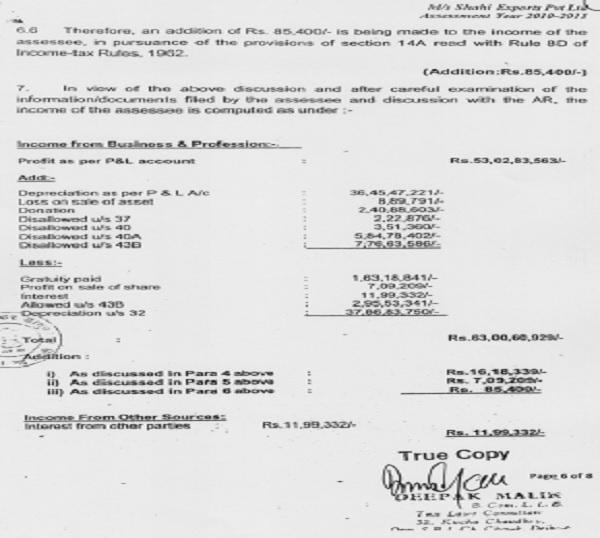
9. A search and seizure action u/s 132 of the Act was conducted on Shahi Exports Group of cases on 16.01.2013 and in response to notice u/s 153A and 153C of the Act, returns of income were filed. Assessment was completed u/s 153A r.w.s 153C and 143(3) of the Act for A.Ys 2008-09 and 2010-11 by making the following observations:
A.Y 2008-09
“Perusal of the submissions filed by the Assessee and information available in the record shows that the case of the Assessee for Assessment Year under consideration was taken up u/s^ 143(3). The Addl. Commissioner of Income Tax, Range-8, New Delhi vide Order dated 20.12.2010 has assessed the income of the Assessee at Rs. 5,27,78,840/-.”
A.Y 2010-11
“Perusal of the submissions filed by the Assessee and information available in the record shows that the case of the Assessee for Assessment Year under consideration was taken up u/s^ 143(3). The Addl. Commissioner of Income Tax, Range-8, New Delhi vide Order dated 20.12.2010 has assessed the income of the Assessee at Rs. 32,64,73,560/-.”
10. The ld. PCIT invoked the provisions of section 263 of the Act and set aside the assessment order dated 30.03.2015 holding that because after the merger of M/s Sarla Fabrics Pvt Ltd with M/s Shahi Exports Pvt Ltd, whatever additions were made in the hands of M/s Sarla Fabrics Pvt Ltd were to be assessed in the hands of M/s Shahi Exports Pvt Ltd and accordingly, order of M/s Shahi Exports Pvt Ltd, as passed by the Assessing Officer u/s 153C of the Act, amounts to erroneous and prejudicial to the interest of the Revenue.
11. As per the facts mentioned hereinabove, additions made u/s 143(3) of the Act were repeated in the assessment order framed/s 153A r.w.s 153C of the Act. This means that no additions had any link with any incriminating material found at the time of search as assessed income u/s 143(3) of the Act is the assessed income u/s 153C of the Act.
12. The Hon’ble High Court of Delhi in the case of Kabul Chawla in 380 ITR 573 has held that “if no incriminating material was found during the course of search in respect of an issue, then no additions in respect of any issue can be made to the assessment under Section 153A and 153C of the Act.”
13. The Hon’ble Supreme Court in the case of Singhad Technical Educational Society 397 ITR 344 has also held that in the absence of any incriminating material, no jurisdiction can be assumed by the Assessing Officer u/s 153C of the Act.
14. In light of the above binding decisions, assessment framed u/s 153C of the Act in A.Ys 2008-09 and 2010-11 are without jurisdiction and, therefore, bad in law and deserve to be quashed as null and void.
15. The Supreme Court in the case of Kiran Singh & Others vs Chaman Paswan & ors [1955] 1 SCR 117 has held as under:
“ It is a fundamental principle well established that a decree passed by a Court without jurisdiction is a nullity, and that its invalidity could be set up whenever and wherever it is sought to be enforced or relied upon, even at the stage of execution and even in collateral proceedings. A defect of jurisdiction, whether it is pecuniary or territorial, or whether it is in respect of the subject-matter of the action, strikes at the very authority of the Court to pass any decree, and such a defect cannot be cured even by consent of parties. “
16. In light of the aforesaid ratio laid down by the Hon’ble Supreme Court, we are of the considered opinion that the assumption of jurisdiction u/s 263 of the Act in respect of an assessment which is non-est is also bad in law as a non-est order cannot be erroneous and prejudicial to the interest of the Revenue. An order framed u/s 263 of the Act for both the A.Ys 2008-09 and 2010-11 are accordingly quashed on the principle of Sublato Fundamento Cadit Opus, meaning thereby, that in case the foundation is removed, the super structure falls. Since the foundation, i.e. the order u/s 153C has been removed, the super structure i.e. the order u/s 263 must fall.
13. In the result, both the appeals filed by the assessee in ITA Nos. 2170 & 2071/DEL/2017 are allowed.
The order is pronounced in the open court on 24.03.2021.