DCIT Vs Nilachal Iron and Power Limited (ITAT Kolkata)
Sections 145(3) and 68: Books Cannot Be Rejected on Vague Comparisons, Nor Reconciled Sales Taxed Again as Cash Credits
Background of the Dispute
The assessee, a company belonging to the Jai Balaji Group, was engaged in manufacturing and selling sponge iron. It filed its return declaring a loss of ₹24,91,49,420.
During scrutiny, the Assessing Officer rejected the books of account and made several additions concerning raw-material consumption, alleged unrecorded sales, stock valuation, interest and other expenses.
The Commissioner (Appeals) held the rejection of books invalid and deleted the disputed additions. The Revenue challenged that relief before the Tribunal.
After condoning the Department’s delay of 72 days, the Tribunal examined the grounds and dismissed the Revenue’s appeal in its entirety.
Books Cannot Be Rejected Without Specific Defects
The Assessing Officer questioned the financial results because production costs exceeded sales realisations, the assessee’s selling price differed from that of a group company, and certain stock and consumption figures appeared inconsistent to him.
However, the Tribunal found that no specific defects or deficiencies in the books had been identified. The conclusions supporting estimated turnover, stock adjustments and inflated expenditure were vague and ambiguous.
The Commissioner had also noted the absence of a meaningful examination of the primary records, including invoices and bills.
The Tribunal upheld the finding that rejection under section 145(3) was invalid. Unfavourable results and broad comparisons could not replace identification of material accounting defects.
₹6.95 Crore Sales Already Accounted for Could Not Be Added Again
The Assessing Officer treated iron ore sales of ₹6,95,35,221 as unexplained cash credits under section 68, questioning their absence as a separate item in the tax audit reporting.
The assessee explained that iron ore and iron ore pellets had been grouped together in the tax audit report. The sales were already included in revenue from operations in the audited accounts.
It also furnished purchase and sales bills and a quantitative reconciliation. Of 14,786 MT purchased, 9,857 MT had been sold directly at the port, 2,992 MT remained in transit and 1,937 MT reached the plant.
The Tribunal accepted the Commissioner’s factual finding that the quantities were reconciled and the sales were already accounted for. It upheld deletion of the section 68 addition, which would otherwise duplicate the revenue already recognised.
Grouped Reporting Did Not Establish Unrecorded Pellet Sales
The Assessing Officer also disallowed approximately ₹15.45 crore of iron ore pellet consumption and made a further addition of approximately ₹16 crore towards alleged unrecorded sales.
The assessee explained that pellet consumption was separately reflected in the audited accounts but included with iron ore in the tax audit report. It furnished the movement of opening stock, purchases, closing stock and consumption.
The Commissioner considered the explanations, the remand report and the assessee’s rejoinder before deleting the additions. The Tribunal upheld the relief.
A difference in the grouping of raw materials did not establish that the materials had remained unconsumed or had been sold outside the books.
Imported Coal Could Not Be Compared Mechanically with Local Coal
The Assessing Officer disallowed ₹7,15,17,281 of coal consumption expenditure by comparing the assessee with Jai Balaji Jyoti Steels Limited. He also estimated alleged outside-book coal sales of ₹7,86,69,009.
The Tribunal noted that the assessee used imported coal, while the comparable group company mainly used lower-grade indigenous coal. Their costs and consumption characteristics differed.
The comparison ignored these material differences. Further, the quantity consumed was not disputed, undermining the inference that coal had instead been sold outside the books.
Both deletions were upheld. The Tribunal similarly sustained deletion of ₹17,54,596 concerning coal-dust sales, where the estimate lacked corroborative evidence and no defect had been established in the supporting bills.
Different Product Quality Defeated Estimated Sales Addition
An addition of ₹6,01,43,629 arose from applying the group company’s average selling price to the assessee’s sales and using that rate to derive an alleged closing-stock shortage.
However, the products were materially different. The group company manufactured sponge iron with metallic iron content of approximately 85% ±2%, while the assessee’s product had content of approximately 60% ±2%.
The Tribunal upheld deletion because the comparison ignored product quality and there was no evidence of higher sale realisations or disposal of the alleged stock difference.
It also upheld deletion of ₹1,33,43,354 relating to interest, accepting that the advances concerned supplies of raw materials, expenses and sundry items. The ad hoc disallowance of ₹1,18,32,970 from manufacturing and other expenses was likewise rejected.
Author’s Comments
The decision demonstrates the importance of commercial comparability and quantitative reconciliation in manufacturing assessments.
A group relationship does not make two manufacturers automatically comparable. Raw-material quality, consumption efficiency and finished-product specifications can materially affect costs and selling prices.
Equally, a presentation difference between audited accounts and tax audit disclosures requires reconciliation before an adverse inference is drawn.
The ruling does not prevent rejection of defective books or evidence-based estimation. It establishes that specific accounting defects and supporting material must precede additions; assumptions cannot supply the missing evidence. Here, the detailed factual explanations defeated the Revenue’s estimates, and the relief was upheld on merits.
Cases Discussed
Jai Balaji Jyoti Steels Limited (CIT(A); AY 2015-16; appeal number and order date not specified): The Tribunal referred to the appellate proceedings involving this group company while examining the comparison of coal consumption and production costs. The distinction between imported coal and indigenous coal was relevant to rejecting the Assessing Officer’s estimates. This was a factual comparison involving a related assessee, not a judicial precedent relied upon for a legal proposition.
FULL TEXT OF THE ORIGINAL JUDGMENT/ORDER OF ITAT KOLKATA
This is an appeal preferred by the Revenue against the order of the Commissioner of Income-tax (Appeals), Kolkata-20, (hereinafter referred to as the “Ld. CIT(A)”] dated 21.07.2025 for the AY 2015-16.
2. At the outset, we observe from the appeal folder that there is a delay of 72 days in filing the appeal by the department and in support of which a condonation petition was filed. It was stated in the condonation petition that the delay has occurred due to obtaining the administrative approval from the competent authorities, which took quite a long time and accordingly, the delay may be condoned. The ld. AR, on the other hand, did not oppose the condonation of delay. Considering the reasons cited before us, we are inclined to condone the delay and admit the appeal for hearing.
3. The issue raised in Ground No. 1 by the revenue is against the order of Ld. CIT (A) holding the rejection of books of accounts u/s 145(3) of the Act made by the Learned AO as invalid.
3.1. The facts in brief are that the assessee filed the return of income on 28.09.2015 showing total loss of ₹24,91,49,420/-. The case of the assessee was selected for scrutiny. The assessee is a company belonging to Jai Balaji Group of Industries. Accordingly, the notice under section 143(2) and 142(1) of the Income-tax Act, 1961 (the Act) along with questionnaire were issued and duly served upon the assessee. The Learned Council of the assessee appeared from time to time who furnished all the details and evidences besides books of accounts maintained. The assessee is primarily engaged in the business of manufacturing and sales of sponge and iron. The Ld. AO, during the course of assessment proceedings after taking into account the evidences, reply of the assessee rejected the books of account under section 143(3) of the Act and made additions and disallowances on account of estimated turnover, undisclosed sales, valuation of stock and inflated expenditure made by the assessee.
3.2. Aggrieved assessee challenged the rejection of books of account before the Learned CIT (A) and Learned CIT (A) allowed the appeal of the assessee on this issue by upholding that the books of accounts have wrongly been rejected by the Learned AO after taking into account the reply and contention of the assessee by observing and holding as under;-
“7.2 Ground no.2
This ground relates to rejection of books of accounts u/s. 145(3) of the Act and addition/disallowance made in the assessment order on rejection of books of accounts. Facts, briefly, are that the appellant is engaged in the business of manufacturing sale of Sponge Iron. The return of income showed a total loss of Rs.24,91,49,420/- The present assessment was completed u/s 143[3)/145(3) of the Act. determining total Income of Rs.30,26,59,945/- by making various additions. In the context of the rejecting books of accounts AO has stated that the financial results disclosed by the assessee in respect of manufacturing activity cannot be relied upon on the basis of following reasons:
1. In the manufacturing activity the cost of production has been worked out at Rs.52,83,41,561/- @ Rs.31,827/- per M.T. & the sales of finished goods have been shown at Rs.31,34,10,075/- only, i.e. @ Rs.19,145.39/- per M.T.
2. While working out cost of production and showing revenue from sales of finished goods, arbitrary figures have been put.
3. Average sales price of sponge iron, shown by Jai Balaji Jyoti Steels Limited was Rs.22,604/- per M.T. while that shown by the assessee was Rs.19,145.39/- per M.T. convincingly prove that the assessee grossly understated the revenue from sale of finished goods.
4. Value of closing stock of raw material and of finished goods have not been correctly stated.
5. The trading sale of coal has been grossly understated.
6. The trading sale of iron ore is found to be dubious. For trading sale of coal, qty. of coal sold has been mentioned in the Return but for trading activity of iron ore, qty of iron ore sold was not mentioned in the Return.
7. Consumption of Iron ore pellet for manufacture of sponge iron is not supported by factual aspect of production and declaration in the Return as well.
On perusal of the assessment order, it is seen that the AO after rejection of books of accounts did not determine profit on basis of gross profit or net profit percentage of turnover but has made various addition and disallowances on the ground of estimated turnover, undisclosed sales, valuation of stock and inflated expenditure claimed by the assessee.
I have found, from a perusal of the impugned assessment order, that estimation of revenue provided by the AO is totally vague. There was no study or verification of the books of the appellant nor of the primary material including invoices, bills etc that was evident from the assessment order.
The basis or reasons for rejection of books, without a careful study of the book results and without bringing on record material defects supported by reasoning or material evidence produced by the AO, or without the pointing out of glaring inconsistencies in the books that were shown, by the AO, not to be resolvable within the framework of the books of the appellant, is not sustainable in law and nothing along the lines of the aforesaid discussions has been brought on record by the AO. The rejection of books is a serious business, to be undertaken with care. This is especially true in the case of an assessee where a proper audit has been taking place over several years and return are being filed and where the AO has accepted the books of accounts in all the years barring this assessment year.
The details of assessed income viz a viz returned income for AY 2006-07 to 2021-22 is given below:
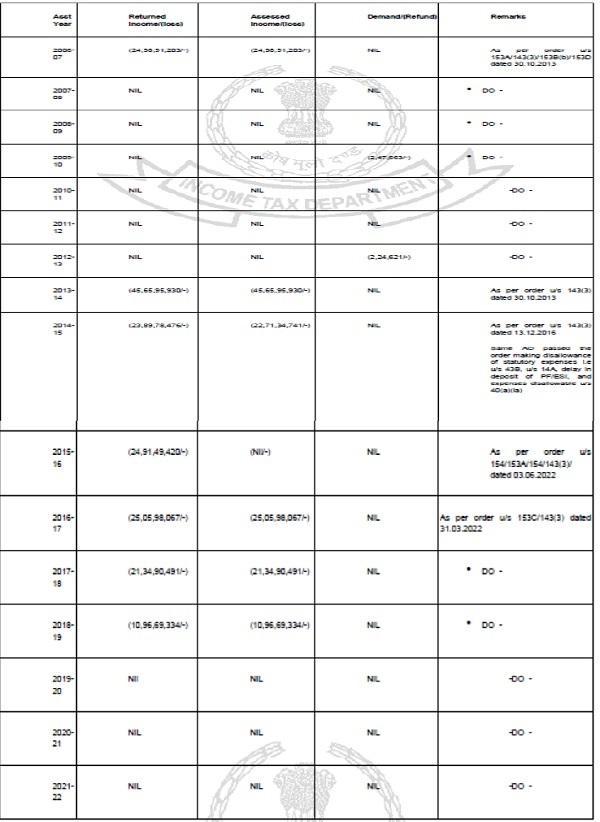
Further on perusal of details submitted by assessee in relation to consumption ratio of iron ore & pellets and sponge iron production it is seen that the same is minimum during the year FY 2014-15(AY 2015-16) in comparison to other years. The details for AY 2015-16 to AY 2020-21 is given
| Sl. No. | FY | AY | Iron Ore & Pellets | Sponge Iron | Ratio |
|---|---|---|---|---|---|
| 1 | 2014-15 | 2015-16 | 25418 | 16882 | 1.50 |
| 2 | 2015-16 | 2016-17 | 16512 | 8840 | 1.87 |
| 3 | 2016-17 | 2017-18 | 312051 | 106855 | 2.92 |
| 4 | 2017-18 | 2018-19 | 317657 | 110863 | 2.86 |
| 5 | 2018-19 | 2019-20 | 282128 | 132489 | 2.13 |
| 6 | 2019-20 | 2020-21 | 337845 | 153163 | 2.205 |
3.3. After hearing the rival contentions and perusing the materials available on record, we find that in this case the Ld. AO rejected the books of account without pointing out any defects or deficiencies in the books of accounts. We note that the Learned AO noted that financial results shown by the assessee cannot be relied for a series of reasons, as discussed above by the Learned CIT (A). We also note that the Ld. AO rejected the books of account and therefore made addition by estimating turnover and disclosed sales, value of stock, inflated expenditure in the order passed by the Learned AO while rejecting the books of accounts are totally vague and ambiguous as no specific defect was being pointed out. The Ld. CIT (A) has passed a very comprehensive order dealing with each and every aspect connected therewith. Accordingly, we uphold the order of the Ld. CIT (A) by dismissing the appeal of the Revenue. Ground number 1 of the Revenue’s appeal is dismissed.
4. The second issue raised by the revenue is against the deletion of addition on account of sales of iron of ₹6,95,35,221/- as made by the Ld. AO under section 68 of the Act.
4.1. The facts in brief are that the Ld. AO during the course of assessment proceeding noted that assessee has shown sales of iron at ₹6,95,35,221/- in the profit and loss account. The Learned AO noted from the audit report that the assessee has not reported any such sales. However, no sales of iron were reported in the audit report nor in the Form of 3 CD whereas the return of income disclosed the sales proceeds at ₹6,95,35,221 in the profit and loss account. Accordingly, the Ld. AO after analyzing the report data came to the conclusion that the assessee put this figure of sale arbitrarily in the manufacturing account as quantities of iron ore were not matching and reconciling. Therefore, the same was held to be a cash credit appearing in the books of accounts of the assessee and treated the same as undisclosed income. The Ld. CIT (A) after taking into account the reply and contention of the assessee allow the appeal of the assessee by holding and observing as under:-
“7.3 Ground No. 3:
Sale of Iron Ore amounting to Rs.6,95,35,221/- treated as unexplained cash credit:
AO in the assessment order has stated that the assessee has failed to explain as to how it was possible to sale iron ore when the same is not reflected in the tax audit report and added the same under section 68.
The assessee in its submission has stated that the Sale of Iron ore reflected in profit and loss account Note No 16.1 and is part of total revenue from operation. During the course of appellate proceedings, the assessee has stated that in the tax audit report the auditor has combined Iron Ore and Iron Ore Pellet as both were similar in nature and used for production of sponge iron. Further it stated that assessee had purchased 14,786 MT of Iron ore during the year. Out of the same 9,857 MT were sold for Rs.6,95,35,221 and submitted sale bills and purchase bills for the same. It also submitted that out of 14786 MT of Iron Ore, 2992 MT of Iron Ore was in transit and 9857 MT of Iron Ore were directly sold by the assessee in the port itself. Hence, out of purchase of 14,786 MT of Iron Ore, only 1937 MT (14786 MT – 2992 MT – 9857 MT) were received in assessee’s plant and same was shown by the tax auditor in its report. It furnished a reconciliation of quantity as per Tax Audit report and as per books of accounts and stated that AO has without understanding the facts has made addition of Rs.6,95,35,221/-. It also stated that Sale has already been offered in sales account as such addition u/s 68 is double addition.
On perusal of the details, documents and reconciliation of quantity of iron ore as per tax audit report and audited accounts it is seen that the assessee has shown the sale of iron ore in the Note No 16.1 (Sale of raw material) amounting to Rs.6,95,35,221/-. Assessee has reconciled the quantitative stock as per the Tax Audit report and audited accounts and also has submitted the bills of sales and purchases of the same. As such the addition of Rs.6,95,32,221/- by the AO without considering the fact that the same has already been taken in revenue of assessee leads to double addition. Further addition of sale under section 68 is not tenable as the same does not tantamount to cash credit. Therefore, addition of Rs.6,95,35,221/- being sales of Iron Ore u/s. 68 is deleted.”
4.2. After hearing the rival contentions and perusing the materials available on record, we find that the assessee has shown the sale of Iron ore in the Profit and Loss account in schedule no.16 which is part of the total revenue from operation. We note that in the tax audit report the auditor has combined the iron ore and iron ore pillets as both were similar in nature and used for production of sponge iron. The Ld. CIT (A) has comprehensively dealt with the issue by recording factual findings that the sales were fully reconciled with the tax audit report. The Ld. CIT (A) while deleting the addition taken cognizance of the reconciliation of quantity as per tax audit report vis-à-vis books of accounts and categorically recorded a finding that the Ld. AO without understanding the facts has made the addition of ₹6,95,35,221/-. Considering these facts and the observations of Ld. CIT (A) which are very reasoned and self-explanatory, we are inclined to uphold the order of Ld. CIT (A) on this issue by dismissing the ground no. 2 of the revenue appeal.
5. The issue raised in ground no.3 is against the deletion of disallowances of consumption of iron ore of ₹15,45,45,388/- and deletion of addition on account of sale of iron ore pellets amounting to ₹16,00,03,171/- added by the AO on account of being outside the books of accounts.
5.1. The facts in brief are that the Ld. AO during the course of assessment proceedings noted that the quantity of finished goods manufacture consumption of material were highly inflated. The Ld. AO noted that the iron ore pellets of the value of ₹15,45,48,338/- appearing in the profit and loss account was neither consumed nor accounted in the closing stock and the same must have been sold outside the books of accounts. The AO observed that the assessee has not shown the sale proceeds realized from sale of such items. The Ld. AO consequently disallowed the said claim on account of cost of iron ore pellets of the value of ₹15,45,48,338/- by adding the same to the income of the assessee. The Ld. AO also made addition of unaccounted sale proceeds by taking the GP at 10% thereby further made the addition of ₹16,00,03,171/- to the income of the assessee.
5.2. In the appellate proceedings, the Ld. CIT (A) after taking into account the submission and contention of the assessee also the remand report which is called by the Ld. CIT (A) and submitted by the Ld. AO and the rejoinder filed by the assessee allowed the appeal on this issue by observing and holding as under:-
“The assessee submitted that it has shown consumption of Iron Ore pellet amounting to Rs. 15,45,45,388/- in its profit & loss a/c (Note No 18 of the Audited A/cs). However, in the Tax Audit Report the consumption of Iron Ore pellet was not shown separately but was included with the figures of Iron Ore. It further stated that Iron Ore and Iron Ore pellet are basically same in nature as such same were grouped together in the Tax Audit Report as Iron Ore. Assessee further submitted that it has consumed 22,169 MT of iron ore pellet during the impugned assessment year. The cost of consumption of said Iron ore pellet have been duly shown in audited profit & loss account. It submitted consumption of iron ore pellet in the impugned assessment year as given below: –
| Particulars | Qty (MT) | Amount (Rs.) |
|---|---|---|
| Opening Stock | 1.35 | 11,453 |
| Purchases | 23084 | 16,09,22,745 |
| Closing Stock | 916 | 63,88,859 |
| Consumption | 22169 | 15,45,45,339 |
6. After hearing the rival contentions and perusing the materials available on record, we find that the d AO disallowed the consumption of iron ore plates amounting to ₹15,45,45,339/- besides adding the estimate sales by taking a SP rate of 10% and estimating the sale at ₹16,00,3171 and added the same to the income of the assessee. The Ld. CIT (A) during the appellate proceedings called for the remand report and after taking into account the said estimation and rejoinder of the assessee noted that the Ld. AO has not examined the submission of the assessee correctly. We note that the Ld. CIT (A) has extracted the details of consumption of iron ore and iron ore plates and production from F.Y. 2014-15 to 2019-20. The Ld. CIT (A) noted that the disallowances of iron ore plates consumption and addition of estimated sales by taking GP of 10% is nothing but based on conjunction and surmises and the addition is not based on fact. The Ld. CIT (A) noted that the Ld. AO has failed to substantiate his claim of sales outside the books of accounts neither in the assessment order nor in the remand report. Whereas, the assessee has substantiated his averment with the reconciliation statement of quantitative detail of consumption of purchases of iron ore pellets between the books of accounts vis-à-vis the tax audit report. The Ld. CIT (A) noted that even yearly computation iron ore and iron ore plates and production sponge and iron, monthly details of consumption of iron ore and iron ore plates is furnished by the assessee for all the preceding and succeeding years and thereafter the disallowance as well as the addition made by the Ld. AO in respect of estimates sales. Therefore, we are not inclined to interfere in the order of Ld. CIT (A) which is a very reasoned and speaking order. Consequently, we uphold the order of Ld. CIT (A) on this issue by dismissing ground no 3 of Revenue’s appeal.
7. The issue raised in ground nos. 4 is against the deletion of disallowance on account inflated coal expenses of ₹7,15,17,281/- and ground no.5 is against the deletion of addition of ₹7,86,69,009/- being alleged sale proceeds of coal etc outside the books of accounts which was arrived at by adding GP @ 10% to the alleged inflated coal expenses of ₹7,15,17,281/-.
7.1. Brief facts are that during the course of assessment proceedings, the ld. AO observed that the assessee has consumed 17,956 metric ton of coal valued at ₹13,06,56,719/- i.e. ₹7,642.53 per metric ton which is found to be too expensive. The ld. AO observed that while framing the assessment of Jai Balaji Jyoti Steels Limited, it was seen that the company belonging to the same group and manufacturing sponge and iron had declared cost of ₹1,67,759/- metric of coal at ₹58,03,23,000/- i.e. ₹3459.26 per metric ton, so by applying the same rate of cost of coal consumption to be ₹5,91,39,508/- (3459.26 x 17096) in place of 13,06,56,790/- as claimed by the assessee and consequently the difference was treated as inflated cost of coal by the ₹7,15,17,281/- by taking the cost of consumption of finished goods of coal at ₹5,91,39,508/-. The ld. AO also observed that the raw material of the value of ₹7,15,17,281/- was neither made nor accounted for in the closing stock and therefore, the most have been sold outside the books of accounts and estimated the unaccounted sales by applying GP rate 10% and thus estimated the sales of ₹17,86,69,009/- and added the same to the income of the assessee.
7.2. In the appellate proceedings, the ld. CIT (A) allowed the appeal of the assessee after taking into account the submission and contention made by the assessee and also remand proceedings and rejoinder filed by the assessee by observing and holding as under:-
7.5 Ground no.5
Disallowance of Rs.7,15,17,264/- on account of alleged inflated expenses of coal consumption.
AO in the assessment year has disallowed coal consumption to the tune of Rs. 7,15,17,281/- on the ground that average rate of coal consumption of Rs. 7642.53/MT in case of assessee is very high and has allowed coal Consumption @ Rs 3459.26/MT being rate of coal consumption of Jai Balaji Jyoti Steels Limited one of the sister concerns of the assessee.
The assessee submitted that impugned addition was made without giving any opportunity of being heard to the assessee to offer proper explanation. Further it stated that for the purpose of manufacturing the sponge iron, the assessee uses coal. During the year, assessee manufactured 16.881.5 MT of sponge iron by consuming 17096.6 MT of coal and the total value of the coal consumed by the assessee was Rs. 13,06,56,790/- @ 7642.53/ MT of coal. It also submitted that it mainly used imported coal having very high input output ratio whereas the group entity M/s Jai Balaji Jyoti Steels Ltd has mainly used indigenous coal of much lower grade/quality having very low output ratio. The AO failed to consider the fact that the imported coal is costly than the indigenous coal. It further stated that coal consumption viz a viz sponge iron production ratio in case of assessee is 1:1.01 as it uses imported coal whereas the coal consumption ratio of M/s Jai Balaji Jyoti Steels Ltd is 1:2 due to use of local coal meaning the assessee is using almost half of the coal used by the said group company.
It also stated that same A.O has made disallowance in case of Jai Balaji Jyoti Steels Limited for AY 2015-16on the ground that its quantitative consumption is very much high than that of assessee company and in case of assessee AO has taken stand that Cost of coal consumption is very high. This shows AO has taken two different stand in both the cases and has made addition. In one he has cited lower rate (in case of assessee) for making addition in case of Jai Balaji Jyoti Steels Limited he has cited lower quantitative consumption for making disallowance. It also stated that this show the fact that assessment was made to harass the assessee and were not based on any fact or material. It further provided copy of order of CIT(A) deleting the disallowance on account of coal consumption in case of M/s Jai Balaji Jyoti Steels Limited.
On perusal of CIT(A) order in case of M/s. Jai Balaji Jyoti Steels Limited it is found that in the remand report extracted in the appellate order passed the AO in the remand proceedings of has accepted the fact that assessee company i.e M/s. Nilachal Iron & Steel Ltd has used imported coal for its production. Relevant portion of appellate order in page 20 of same is given below :
The books of accounts of M/s Nilachal Iron & Steel Ltd has been perused and it is seen that M/s Nilachal Iron & Steel Ltd, which is also engaged in the manufacturing of sponge iron has made purchases of 17127.300 MT only of imported coal having price of Rs. 5262/- per MT and consumed 17096 MT of coal valued at Rs. 130656790/-. The details as per the TAR of M/s Nilachal Iron & Steel Ltd is as under:
| Opening Stock | Purchase | Consumption | Sale | Closing stock |
|---|---|---|---|---|
| (in MT) | (in MT) | (in MT) | (in MT) | (in MT) |
| 16562 | 17127 | 17096 | 1044 | 15649 |
Thus in the case of M/s Nilachal Iron & Steel Ltd the average price of coal consumed comes to Rs. 7642/- (130656790/17096) per MT. The AO has compared the finished goods to coal consumption ratio of the assessee company with that of M/s Nilachal Iron & Steel Ltd. But as per the above discussion it is seen that grades of coal used by both the companies are different. The assessee company has used 85% indigenous coal and 15% imported coal whereas M/s Nilachal Iron & Steel Ltd has used 100% imported coal and the same is also evident from the average price of coal consumption by both the companies. The average price of coal consumed by the assessee company is Rs. 3459/- per MT whereas the average price of coal consumed by M/s Nilachal Iron & Steel Ltd is Rs. 7642/- per MT. Therefore the two situations are incomparable and the AO has made comparison between two such incomparable situations for arriving at his decision that sponge iron produced to coal consumption ratio in the case of the assessee company is 1:1. In my opinion contention of the AO is incorrect and based on wrong assumption of facts.
I find that this disallowance is not based on any facts or material. The AO in the remand proceedings also have not given any basis on which such disallowance has been made. I also find that the AO, while comparing the consumption pattern of the appellant with that of M/s Jai Balaji Jyoti Steels Limited has ignored the crucial facts of the case. The basic ingredients that go into determining what would be the consumption of coal per MT that is, the various grades of coal – have been ignored by the AO. I find that this comparison made by the AO between the two aforementioned entities for arriving at his conclusion that the ratio of sponge iron produced and the coal consumption for this purpose in the case of the appellant company can be compared to the similar ratio in the case of M/s. Jai Balaji Jyoti Steels Limited and on this basis an addition can be made on account of inflated cost of consumption by taking the average rate of coal consumption on a gross misreading/non-appreciation of facts. Further the AO on one hand is alleging that rate of coal consumption of assessee is very high and on the other hand it has alleged that in case of M/s Jai Balaji Jyoti Steels Limited the ratio of coal consumption is very high in comparison to assessee shows that AO has made disallowance in case of assessee without application of mind and with a mindset to punish the assessee for reasons known to him.
In view of the above discussions, the disallowance made by the AO is not sustainable and is deleted.
7.3. As regards to the estimated sale the ld. CIT (A) held as under:-
“7.6 Ground no.6:
Addition of Rs. 7,86,69,009/- on account of alleged sale proceeds of coal, outside the books by applying G.P @ 10%.
This ground is very peculiar in the context of the previous disallowance made by the AO in his order. Briefly, the AO in the previous ground, estimated the coal consumption by the appellant at Rs.5,91,39,509/- and disallowed the balance amount of Rs. 7,15,17,281/- holding the same to be excess claim of expenditure made by the appellant. The AO has accepted the quantity of coal consumption and has made disallowance by disputing average rate of coal consumption. Therefore, the quantity consumed by the assessee is not in dispute.
I find that this addition is not based on any facts at all. Where the quantity consumed by assessee is not in dispute allegation of sale of coal at a gross profit of 10% of the cost of purchase is totally absurd and shows that the AO has not at all applied his mind while framing the assessment order. Also, where the disallowance on account of coal consumption has been allowed by me the consequential addition of Rs.7,86,69,009/- on account of alleged sale proceeds of coal is deleted.”
7.4. After hearing the rival contentions and perusing the materials available on record, we note that the ld. AO just by comparing the coal consumption with the related party Jai BalajiJyoti Steels Limited disallowed the cost of consumption. We note that the assessee used the imported coal which was having a very high input whereas, the group entity M/s Jai BalajiJyoti Steels Limited has mainly used coal of much lower grade quality having low input / output ratio. We note that the ld. AO has failed to consider this fact. We also note that the coal consumption vis-à-vis sponge and Iron production ratio in the case of the assessee is 1:1.01 as it used imported coal and coal consumption ratio of M/s Jai Balaji Jyoti Steels Limited is 1:2 due to the used of local coal meaning there by that assessee using almost half of the coal used of the said group concern. We note that the ld. CIT (A) has rightly appreciated the fact and recorded a finding that the ld. AO in the assessment proceedings has accepted the fact that the assessee has used imported coal thus, the ld. CIT (A) after recording a very detail finding deleted the disallowances of coal to the tune of ₹7,15,17,281/-. Similarly, so far as the estimated sales are concerned, the ld. CIT (A) noted that the same is merely based upon the conjectures and surmises with no substantive basis. The ld. CIT (A) noted that since, the disallowance of consumption of coal was itself wrong therefore, the corresponding sales estimated by the ld. AO is also based on the surmises and conjectures and thus deleted the same. Considering these facts, we are in agreement with the conclusion that the conclusion drawn by the ld. CIT (A) on this issue and consequently upheld the order of ld. CIT (A) by dismissing the ground nos.4 and 5 of Revenue’s appeal.
8. The issue raised in ground no.6 is deletion of addition of ₹17,54,596/- on account of sale of coal dust.
8.1. Brief facts of the case are that in the assessment proceedings the ld. AO noted that the assessee has under stated the coal price and came to the conclusion that the sale of the said coal should be ₹36,11,464/- (1044×3459.26) and thus estimated the sales at ₹39,72,613/- by taking a GP rate of 10% and thus, made the addition of ₹17,54,596/-.
8.2. After hearing the rival contentions and perusing the materials available on record, we find that the ld. CIT (A) noted that the ld. AO has not disputed the quantity of coal (dust coal) sold by the assessee. The ld. CIT (A) also noted that in the assessment order stated that bill of such dust coal was produced before him for examination thus, the ld. CIT (A) noted that the ld. AO without pointed out any defect with the documents produced before the ld. CIT (A) just estimated the sale without any corroboration evidence and thus, deleted the addition. We observed from the facts before us that the addition made by the ld. AO was totally based on the presumption and surmises without any basis and so rightly deleted by the ld. CIT (A). Consequently, upheld the order of the ld. CIT (A) on this issue by dismissing the ground no.6 of Revenue’s appeal.
9. The issue raised in ground no.7 is against the deletion of addition of ₹6,01,43,629/- on account of under valuation of closing stock and unaccounted sales.
10. Facts in brief are that during the course of assessment proceedings the ld. AO noted that the value of the closing stock of the assessee as per the audited accounts was ₹86,12,320/-. The ld. AO derived the said amount of 22,604 MT and arrived at that closing stock was 382.77 MT instead of actual closing stock declared by the assessee of 539 MT. the ld. AO further noted that the so far as the group entity M/s Jai Balaji Jyoti Steels Limited is concerned was ₹22,604/- and thus, there is a difference in the closing stock as well as the sales disclosed by the assessee. Accordingly, the ld. AO estimated the undisclosed sales at ₹6,01,43,629/- and added the same to the income of the assessee. We further note that the ld. AO has blatantly taken the facts and figured all the sister concerns without taking into account the basic facts. The assessee submitted that M/s Jai Balaji Jyoti Steels Limited manufacturing sponge iron with Fe(m) 85±2% and assessee manufacture Fe(m) 60±2%, such comparison rate of both product is unacceptable.
11. The ld. CIT (A), after considering of the facts of the case and the submissions and arguments of the counsel for the assessee as also the documents furnished by the assessee, held that the addition made by the ld. AO was only on the assumption and surmises by observing and holding as under:-
“7.8 Ground Nos. 8 & 12:
Revenue from operation has been estimated at Rs.37,35,53,704/- in place of actual Rs. 31,34,10,075/- leading to addition of Rs. 6,01,43,629/-.
AO in assessment order has taken rate of average sales of finished goods of Jai Jyoti Balaji Steels Limited @ 22604/MT as rate of closing stock of assessee instead of Rate of Closing Stock @ Rs.16,500/- taken by assessee. The value of closing stock of assessee as per audited accounts is Rs.86,12,320/-. AO divided Rs.86,12,320/- by 22500 and arrived that closing stock is 382.77 MT instead of actual closing stock of 539 MT. AO, further applied average rate of sale of Jai Balaji Jyoti Steel Limited @22,604/- to total sales of assessee and also included 156 MT (539-382.77) being difference of closing stock arrived by him and of assessee as undisclosed sale.
Working of estimation of revenue from operation from Rs.37,35,53,704/- in place of actual Rs. 31,34,10,075/- is given below:
| Total quantity sold by assessee | 16370 MT |
| Quantity being difference in closing stock alleged to be sold by assessee | 156 MT |
| Total quantity sold as per AO | 16526 MT |
| Sales rate as per AO | 22604/MT |
| Total sales value as per AO | Rs. 37,35,53,704/- |
| Sales as per P & L Account | Rs. 31,34,10,075/- |
| Addition as undisclosed sales | Rs. 6,01,43,629/- |
Assessee in its submission has submitted that the AO has taken average rate of sale of Jai Jyoti Balaji Steels Limited without considering the fact that Jai Jyoti Balaji Steels Limited manufactures sponge iron with Fe(M) 85+-2 % and assessee manufactures Fe(M) 60+-2%. As such comparison of rate of both product is totally unacceptable. It further submitted that if rate of Fe(M) 85+-2% is converted to Fe(M) 60+-2% then rate of sales would come to Rs. 15,955/-(22604*60/85) as such valuation of closing stock @ 16000/MT is correct.
I find that the addition made by the AO is not based on any facts. It is also found that the AO in the assessment order has arrived at a conclusion that assessee has sold goods at a rate higher than recorded in books of accounts without any iota of evidence or material. Further, no evidence has been produced regarding sale of closing stock difference of 156MT arrived by AO. The assessment order made by the AO is totally vague in nature and merely made on assumption and presumptions. Therefore, the addition of Rs.6,01,43,629/- made by AO merely on assumption and presumptions is deleted.”
11.1. After hearing both the parties and taking into accounts the facts on records, we find that the addition was made by the AO without any basis and on presumptions and surmises. The Ld. CIT(A) after detailed analysis of the facts has rightly deleted the addition by holding that the addition was made by the on surmise only. Therefore we do not find any infirmity in the appellate order and are inclined to uphold the same on this issue by dismissing the ground no.7 of the Revenue’s appeal.
12. The issue raised in ground no.8 is against the deletion of disallowances of ₹1,33,43,354/- on account of interest.
12.1. The ld. AO during the course of assessment proceedings, noted that the assessee has given an interest on loans and advances to the tune of ₹7,31,14,269/- and has not furnished the details of the same as he applied a rate of 18.2% of the said amount and added the same to the income of the assessee by holding that these loans and advances were not for the purpose of business. The ld. CIT (A) deleted the disallowances by observing and holding as under:-
“7.10 Ground No. 10 & 11:
Estimating the production expenses including cost of consumption of coal to Rs. 6,14,90,448/- instead of actual production expenses on ad hoc basis and Estimating the Other Expenses to Rs.20,00,000/- instead of actual other expenses on ad-hoc basis;
The AO out of total manufacturing and other expenses other than finance cost and depreciation amounting to Rs.8,52,46,199/- has only allowed total expenditure of Rs. 7,34,13,229/- only on estimate basis by rejecting books of accounts of assessee.
Since the rejection of books of accounts has been held invalid as such disallowance of Rs. 1,18,32,970/- (Rs. 8,52,46,199/-7,34,13,229/-) being consequential in nature is hereby deleted.”
12.2. After hearing the rival contentions and perusing the materials available on record, we find that the ld. AO has completely misunderstood the fats that the ld. CIT (A) has given a table which is extracted above, which proved that the advances were given for supply of raw materials against expenses and sundry items, therefore, the very premises of the ld. AO in estimating the interest on the said advance was wrong and therefore, the ld. CIT (A) rightly deleted the addition. We accordingly upheld the order of ld. CIT (A) by dismissing the ground no.8.
13. The issue raised in ground no.9 is against the deletion of addition of ₹1,18,32,970/-, out of the total manufacture and other expenses.
13.1. The ld. AO during the course of assessment proceedings only allowed the total expenditure on account of cost od consumption of coal and other expenses at ₹7,34,13,229/- as against the claim of the assessee of ₹8,52,46,199/-, which was without any basis. The ld. AO has resorted to this allowance only on the ground that the books of accounts were rejected and books were not reliable. In our opinion, the disallowance made by the ld. AO was only whimsical basis on the presumption and surmises. Accordingly, we upheld the order of ld. CIT (A) by dismissing the appeal of the Revenue. The ground no. 9 of Revenue’s appeal is dismissed.
14. In the result, the appeal of the Revenue is dismissed.
Order pronounced on 13.10.2026.