Surekha Subhash Parve Vs ITO (ITAT Pune)
Summary: The Pune Bench of the Income Tax Appellate Tribunal allowed Surekha Subhash Parve’s appeal for assessment year 2016-17 and directed deletion of a ₹60 lakh addition under Section 69A of the Income-tax Act, 1961. The dispute arose from information regarding cash deposits of ₹60,07,500 in her Bank of Maharashtra savings account during financial year 2015-16. After initially receiving no response to notices, the Assessing Officer initiated reassessment proceedings. The assessee subsequently filed a return declaring income of ₹12,000 and explained that ₹60 lakh represented cash gifted by her husband to her and their two daughters. Her husband had died on 17 March 2023. The Assessing Officer rejected the explanation for want of documentary proof of the source and added ₹60 lakh. The CIT(A)/NFAC upheld the addition after the assessee did not participate in the appellate proceedings. The Tribunal first condoned a delay of 79 days in filing the appeal.
Before the Tribunal, the assessee’s counsel explained that she was a housewife without an independent source of income and that her husband, who was engaged in business, managed the family’s financial affairs. The evidence included her affidavit, confirmations from both daughters, her husband’s death certificate and PAN particulars, bank records and other documents. The reproduced reply stated that the gift was intended to benefit all three family members equally, with ₹20 lakh allocated to each, and referred to corresponding fixed deposits. Counsel submitted that the gift was excluded from taxation under Section 56(2)(vii) and that Section 69A did not require an automatic addition. He also relied on decisions concerning judicial discretion, evidentiary burdens and unrebutted affidavits. The Department relied on the orders of the lower authorities.
The Tribunal found that the assessee had discharged her initial burden by establishing the donor’s identity, her relationship with him, his PAN and the daughters’ confirmations regarding the gift. It noted that the husband was no longer alive to furnish a confirmation, affidavit or explanation. Referring to CIT v. Smt. P.K. Noorjahan, (1999) 237 ITR 570 (SC), the Tribunal emphasised that the word “may” in the deeming provision conferred discretion requiring consideration of the particular facts and circumstances. The assessee’s affidavit and the daughters’ confirmations had not been shown to be false or untrue. Considering the evidence and circumstances together, the Tribunal accepted that the ₹60 lakh deposit came from the husband’s gift to the assessee and their two minor daughters, set aside the CIT(A)/NFAC’s order and directed deletion of the addition. A separate ₹6,084 addition concerning the Section 80TTA deduction was not challenged and was expressly outside the Tribunal’s consideration.
Cases Discussed
- ITO v. Mohammed Farooq Kanana — (2025) 180 taxmann.com 479 (ITAT Bangalore). Cited by the assessee in support of deletion of the addition; the order does not separately discuss its facts or ratio.
- Ramesh Kumar v. ITO — (2025) 176 taxmann.com 913 (ITAT Jaipur). Included among the authorities relied upon by the assessee against the addition; no separate analysis of the decision is recorded.
- CIT v. Jawahar Lal Oswal — (2016) 382 ITR 453 (Punjab and Haryana High Court). Cited by the assessee in support of her challenge to the addition; the Tribunal did not separately analyse this precedent.
- Veena Gopichand Manjani — ITA No.1681/Del/2013; order dated 16.04.2014; assessment year 2008-09 (ITAT Delhi). Cited by the assessee among the authorities supporting deletion; the opposing party is not identified in the supplied order.
- CIT v. Suresh Kumar Kakar — (2010) 324 ITR 231 (Delhi High Court). Cited by the assessee in support of her appeal; the order records no separate discussion of its application.
- CIT v. Smt. P.K. Noorjahan — (1999) 237 ITR 570 (Supreme Court). Relied upon by the Tribunal for the principle that the word “may” confers discretion and that an addition under a deeming provision is not automatic merely because an explanation is considered unsatisfactory.
- Sumati Dayal v. CIT — (1995) 214 ITR 801 (Supreme Court). Cited by the assessee under the description “Human Probabilities”; the Tribunal did not record a separate application of that test.
- CIT v. Orissa Corpn. (P.) Ltd. — (1986) 159 ITR 78 (Supreme Court). Cited by the assessee among the authorities supporting her challenge; the order does not separately explain its application.
- CIT v. Daulat Ram Rawatmull — (1973) 87 ITR 349 (Supreme Court). Cited by the assessee in support of deletion; no separate discussion of its ratio appears in the order.
- Mehta Parikh & Co. v. CIT — (1956) 30 ITR 181; AIR 1956 SC 554; 1956 SCR 626; 10.05.1956 (Supreme Court). Relied upon by the assessee for the submission that an affidavit cannot be rejected merely on suspicion where the deponents are not cross-examined and no evidence disproving it is produced.
FULL TEXT OF THE ORDER OF ITAT PUNE
This appeal filed by the assessee is directed against the order dated 16.07.2025 of the Ld. CIT(A) / NFAC, Delhi relating to assessment year 2016-17.
2. There is a delay of 79 days in filing of the appeal before the Tribunal for which the assessee has filed a condonation application along with an affidavit explaining the reasons for such delay. After considering the contents of the condonation application filed along with the affidavit and after hearing the Ld. DR, the delay in filing of the appeal is condoned and the appeal is admitted for adjudication.
3. Facts of the case, in brief, are that the assessee is an individual and has not filed her return of income for the impugned assessment year. Information was available with the department that the assessee has made cash deposit of Rs.60,07,500/- in her savings bank account maintained with Bank of Maharashtra during the financial year 2015-16. The Assessing Officer issued a show cause notice u/s 148A(b) of the Income Tax Act, 1961 (hereinafter referred to as ‘the Act’) dated 17.01.2023. However, there was no compliance from the side of the assessee to the various notices issued by the Assessing Officer. The Assessing Officer, therefore, passed an order u/s 148A(d) of the Act on 13.03.2023 and a notice u/s 148 of the Act was also issued on the same day. Subsequently the Assessing Officer issued a notice u/s 142(1) of the Act to the assessee on 15.10.2023 and 20.01.2024 calling for information regarding the cash deposits in her bank account. In absence of any documentary evidence filed in support of the claim of the assessee, the Assessing Officer issued a show cause notice asking the assessee to explain as to why the assessment should not be completed u/s 144 of the Act based on the material available on record. The assessee in response to the same filed her return of income on 27.02.2024 declaring total income of Rs.12,000/-. Thereafter, she submitted her reply which has been reproduced by the Assessing Officer in his order and which reads as under:
“The assessee is unable to upload return in response to notice u/s 148 on account of Aadhar- PAN not linked. The assesse has generated the request for the same. The amount received of Rs.60,00,000/- deposited in saving bank account pertains to gift received from spouse. Spouse of the assesse is deceased, hence the assesse was unable to gather necessary documents. The assesse would like to state that the sum of Rs.60,00,000/- is not taxable in the hands of the assesse.”
4. The assessee subsequently submitted that her husband Shri Subhash Ashruba Parve who died on 17.03.2023 had deposited the amount in assessee’s bank account which is on account of gift to the assessee and their two minor daughters. The assessee filed Form 26AS, affidavit of the assessee and two daughters, death certificate of her husband Shri Subhash Ashruba Parve, computation sheet, bank statement of Bank of Maharashtra for transactions made between 24.08.2015 and 30.09.2015. Subsequently in response to the notice u/s 142(1) of the Act the assessee submitted that she is unable to obtain / locate the details of ITR of her deceased husband for assessment year 2016-17. However, she filed PAN numbers of her two daughters. It was submitted that the deposit of Rs.60,00,000/- in the account of the assessee was out of gift received from deceased spouse of the assessee which was for the entire family and should not be taxed in the hands of the assessee.
5. However, the Assessing Officer was not satisfied with the arguments advanced by the assessee. He noted that the assessee had unexplained credits of Rs.75,00,000/- in her bank account out of which Rs.60,00,000/- was cash deposit and others being Rs.15,00,000/- which was clearing cheque credits. Since the assessee did not submit any documentary proof explaining the source of cash deposit made into her bank account therefore, in absence of any valid explanation from the assessee, the Assessing Officer, invoking the provisions of section 69A of the Act made addition of Rs.60,00,000/- to the total income of the assessee. The Assessing Officer also made addition of Rs.6,084/- in absence of any documentary proof for the claim made under Chapter VI-A (80TTA). However, the same is not challenged in appeal and therefore we are not concerned with the same.
6. Before the Ld. CIT(A) / NFAC the assessee did not respond to any of the notices. The Ld. CIT(A) / NFAC however decided the appeal on merit and dismissed the appeal by observing as under:
“6. Decision
It is seen that the appellant has not furnished the requisite information during assessment proceedings, it has not filed any submission or supporting documents, whatsoever, during appellate proceedings and has not filed any supporting documents.
In her ground of appeal, the appellant has failed to adduce any evidence that the cash was deposited by her husband and also the source of such cash with her late husband. Accordingly, these grounds of appeal are hereby dismissed.
6.1 As noted from the facts of the case and material available on record, the appellant failed to append any submission or supporting documents, during appellate proceedings in favour of his grounds of appeal. The Assessing Officer has made the additions after considering the facts of the case, response of the appellant and after marshalling the facts in details, available on record and relying on the various judgments of different courts of law. There is no material before me to deviate from the order of the Assessing Officer. Therefore, it is held that the order of the Assessing Officer is based on proper examination and consideration of facts.
7. In the result, the appeal is dismissed.”
7. Aggrieved with such order of the Ld. CIT(A) / NFAC the assessee is in appeal before the Tribunal by raising the following grounds:
1. On the facts and in the circumstances of the case and in law, the honourable National Faceless Appeal Centre, New Delhi, erred in confirming the adding the amount of Rs.60,00,000/- treating the same as unexplained investment under section 69A of the Income Tax Act, 1961 without considering the facts of the case in proper perspective. The appellant hereby prays that the addition of Rs.60,00,000/- may please be deleted.
2. The appellant hereby reserves the right to add, amend, alter, or raise any additional ground or grounds of appeal or delete or withdraw any of the grounds of appeal.
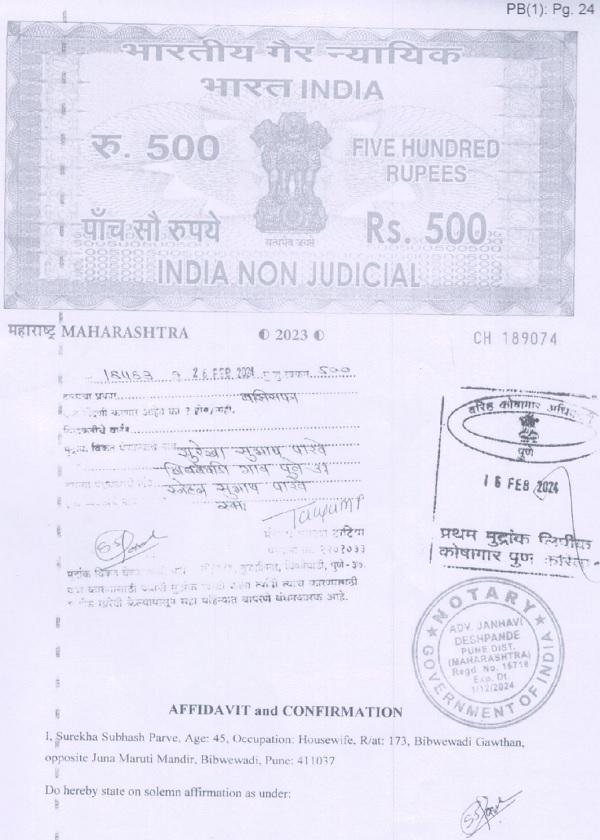
8. The Ld. Counsel for the assessee submitted that the assessee is a widow and having two daughters. Her husband died at the age of 45 years and there were genuine difficulties after the death of her husband. He submitted that her husband, who was into business, was looking after the financial matters of the family. The assessee is a housewife and she never filed her return of income either before or after the present proceedings as she had no independent source of income. The cash deposited of Rs.60 lakhs was the cash gift received from her husband for self and their 2 daughters. He submitted that the cash so deposited is not taxable u/s 56(2)(vii) of the Act. Referring to page 39 of the paper book, he drew the attention of the Bench to the deposit of cash on 10.09.2015. Referring to pages 24 and 25 of the paper book, he drew the attention of the Bench to the affidavit filed by the assessee which reads as under:
–
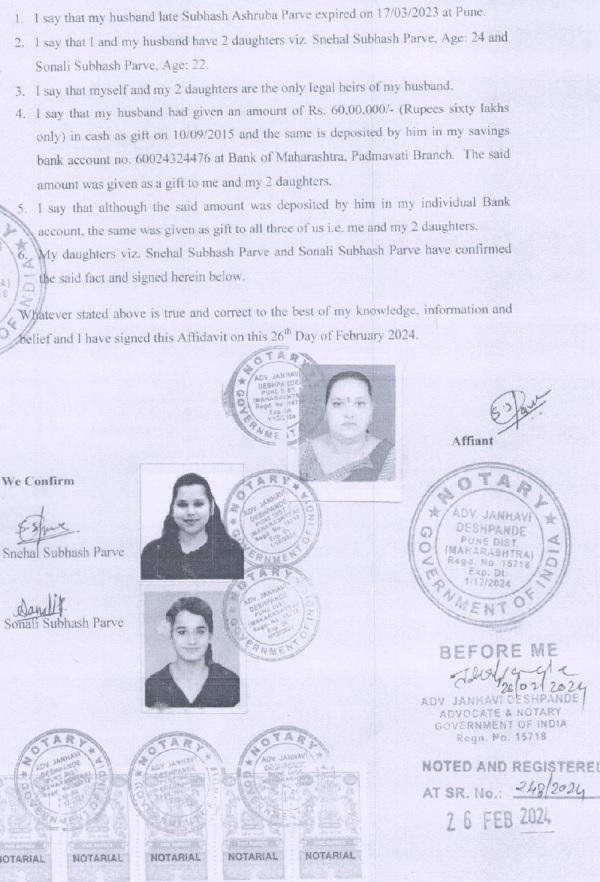
9. Referring to pages 13 to 15 of the paper book, he drew the attention of the Bench to the detailed reply given before the Assessing Officer to the notice u/s 148 of the Act dated 13.03.2023 and to the show cause notice dated 24.02.2024.
10. He submitted that section 69A of the Act employs the word ‘may’ and it is a deeming provision. Referring to the decision of Hon’ble Supreme Court in the case of CIT vs. Smt. P.K. Noorjahan reported in (1999) 237 ITR 570 he submitted that the Hon’ble Supreme Court in the said decision has held that the deeming provisions relating to unexplained investment do not compel an automatic addition in every case. The authority must exercise its discretion judicially after considering the surrounding circumstances. He submitted that since the assessee in the instant case has furnished positive explanation supported by documentary evidence and ownership of cash deposited has been rebutted with cogent evidence, therefore, the addition made by the Assessing Officer and sustained by the Ld. CIT(A) / NFAC is not justified.
11. Referring to the provisions of section 69A of the Act, he submitted that the said provision applies where money is found to belong to the assessee and the assessee either offers no explanation or the explanation is unsatisfactory. He submitted that the assessee in the instant case has furnished explanation that the money belongs to her husband who has gifted the same to her and 2 minor daughters and therefore, the provisions of section 69A of the Act are not applicable.
12. Referring to the decision of Hon’ble Supreme Court in the case of Mehta Parikh & Co vs. CIT (supra), he submitted that the Hon’ble Supreme Court in the said decision has held that where an assessee files an affidavit and the Assessing Officer neither cross-examines the deponents nor produces evidence to disprove it, the affidavit cannot be rejected merely on suspicion.
13. Relying on various decisions, he submitted that the addition made by the Assessing Officer and sustained by the Ld. CIT(A) / NFAC being not in accordance with law should be deleted. He also relied on the following decisions:
i) ITO vs. Mohammed Farooq Kanana reported in (2025) 180 taxmann.com 479 (Bangalore – Trib.)
ii) CIT vs. Daulat Ram Rawatmull reported in (1973) 87 ITR 349 (SC)
iii) Ramesh Kumar vs. ITO reported in (2025) 176 taxmann.com 913 (Jaipur – Trib.)
iv) CIT vs. Orissa Corpn. (P.) Ltd. reported in (1986) 159 ITR 78 (SC)
v) CIT vs. Jawahar Lal Oswal reported in (2016) 382 ITR 453 (P&H)
vi) CIT vs. Suresh Kumar Kakar reported in (2010) 324 ITR 231 (Del)
vii) Veena Gopichand Manjani vide ITA No.1681/Del/2013 order dated 16.04.2014 for assessment year 2008-09.
viii) Human Probabilities – Sumati Dayal vs. CIT reported in 214 ITR 801 (SC)
14. The Ld. DR on the other hand heavily relied on the orders of the Assessing Officer and the Ld. CIT(A) / NFAC.
15. We have heard the rival arguments made by both the sides, perused the orders of the Assessing Officer and the Ld. CIT(A) / NFAC and the paper book filed on behalf of the assessee. We have also considered the various decisions cited before us. We find the Assessing Officer in the instant case made addition of Rs.60 lakhs u/s 69A being the amount of cash deposited in the bank account on the ground that the assessee failed to explain the source of the same with documentary evidence. We find the Ld. CIT(A) / NFAC upheld the addition made by the Assessing Officer, the reasons of which have already been reproduced in the preceding paragraphs. It is the submission of the Ld. Counsel for the assessee that the amount of cash deposited in the bank account was out of the cash gift received from her husband Shri Subhash Ashruba Parve as a gift for herself and her two minor daughters and therefore, the same is outside the purview of the addition u/s 69A of the Act being not taxable u/s 56(2)(vii) of the Act. We find the assessee had given a detailed reply before the Assessing Officer on 27.01.2024 in response to notice u/s 148 of the Act which reads as under:
SUREKHA SUBHASH PARVE
1ST FLOOR FLAT NO 1 ,BIBWEWADI GAONTHAN
NR OLD MARUTI MANDIR ,PUNE 411037 , Maharashtra
PAN NO:AYCPP7398A
27th January, 2024.
To,
Income Tax Department
Assessment Unit,
SUBJECT: REPLY TO NOTICE UNDER SECTION 148 OF THE INCOME TAX ACT,1961 DATED 13/03/202 and SCN dated 24/02/2024
Reference : ITBA/AST/F/144(SCN)/2023-24/1061466422(1)
Honorable Madam,
The assessing officer had assessed that income to the tune of Rs 60,07,500’ has escaped assessment as per order under sub-section (d) of section 148A of the Income Tax Act ,1961 (herein after referred to as ‘the Act’) vide DIN ITBA/AST/F/148A/2022-23/1050685849(1) dated 13/03/2023 which has been referenced by you in your above mentioned notice.
In response to notice u/s 148 dated 13th March 2023, the assessee has filed return vide acknowledgement no 125877150270224. A copy of the same is attached herewith for your honour’s reference. (Refer Annexure ‘A’). The assessee would like to state that, during the year under consideration, the assessee’s income is below the maximum amount chargeable to tax, and hence there was no need to file the return. Neither the assessee has earned any income apart from bank interest nor the assessee is carrying any business activity. During the year under consideration the assessee is a housewife and unaware of income tax laws as she is not supposed to file income tax returns.
The order under section 148A of the Act has been passed on account of cash deposit for an amount of Rs.60,07,500 during the year under consideration. The assessee would like to state that the cash of Rs 60,00,000/- has been deposited on 10th September 2015 in saving bank account of the assessee having number 60024324476 with Bank of Maharashtra. In this regard the assessee would like to bring to your honour’s notice that the said money was received from the assessee’s spouse, i.e. late Mr Subhash Ashrubha Parve having Pan No.AYCPP7399B on the same date. Further the assessee would like to state that all the transactions in the family were carried out by the spouse of the assessee, and the assessee was not involved in financial aspects / transaction. Late Mr. Subhash Ashrubha Parve has deposited the amount of Rs.60,00,000/- in the assessee’s bank account, the said amount is on account of gift to the assessee and their two daughters, namely, Miss Snehal Subhash Parve and Miss Sonali Subhash Parve. As per the tradition and out of love and affection the spouse of the assessee was of the view that the amount of Rs.20,00,000/- should gifted to each of the dependent of the spouse of the assessee. This is evident from the bank statement that as soon as Rs.60,00,000/- was deposited on 10th September 2015, amount of Rs.20,00,000/- was transferred to Fixed deposit in the name of the assessee on 10/09/2025, Rs.20,00,000/- in the name of Snehal Subhash Parve on 24th September 2015 and Rs.20,00,000/- for the younger child Miss Sonali Subhash Parve in the name of Subhash Ashrubha Parve (As the younger child was minor at that point). It is clearly evident that although the said amount of Rs.60,00,000/- was deposited in the assessee’s bank account the same was never intended to be gifted to her alone. Gift of Rs.20,00,000/- was for the assessee. A copy of relevant extract of bank statement has been attached herewith for your honour’s reference. (Refer Annexure ‘D’).
Further, the assessee would like to state that the said gift is received from relative being spouse of the assessee , As the amount received from relative is excluded from computing income as per the provisions of section 56(2)(vii) of the Income Tax Act ,1961, the assessee requests your honour not to add the said amount in the hands of the assessee. Out of the amount of Rs.60,00,000/- the amount of Rs.40,00,000/- is already distributed to family members as per the instructions of the spouse. Hence the said amount is not to be included in the hands of the assessee. The assesse would also like to state that the spouse of the assesse is deceased, hence affidavit cum confirmation from legal heir for the amount deposited by the spouse of the assessee is furnished for your honour’s reference. Please refer annexure ‘B’ for death certificate alongwith Gift confirmation for the same.
Hence the assessee requests your honour not to add income for the said amount in the hands of the assessee for the year under consideration. The assessee has offered to tax interest on deposits in its return of income filed in response notice under section 148 of the Act. The computation sheet of the said return is attached herewith for your honour’s reference. Refer Annexure C.
Your honour has issued show cause notice as to why the amount of Rs.60,07,500/- shall not be considered as income under section 69A of the Act. In this regard the assessee would like to state that out of the said amount of Rs.60,00,000/- is received from spouse of the assessee as gift, late Mr. Subhash Ashrubha Parve. The gift confirmation letter along with pan card of the spouse has been attached herewith for your honour’s reference. It would be unjust and unwarranted to pay tax on such a huge amount which on death of the Spouse were repaid for paying liabilities borne by him.
As the assessee has provided supporting evidence of the nature and source of the income the assesse requests your honour not consider the said money as income under section 69A of the Act.
The assessee would further like to requests your honour to grant time for any clarification required by issuing a notice or granting a video conference hearing if your honour is of the adverse opinion.
Thanking you.
16. A perusal of the above would show that the assessee had explained before the Assessing Officer that the amount of cash deposited in the bank account was on account of gift to the assessee and their two daughters namely Miss Snehal Subhash Parve and Miss Sonali Subhash Parve. It is an admitted fact that the husband of the assessee, who had given cash gift to the assessee and two minor daughters, is no more to give confirmation or affidavit or explanation of such gift. The assessee in the instant case has discharged the initial burden cast on her by proving the identity of the donor, her relationship with donor, PAN of the donor, confirmation by two daughters regarding the gift etc.
17. We find the provisions of section 69A of the Act read as under:
“Unexplained money, etc.
69A. Where in any financial year the assessee is found to be the owner of any money, bullion, jewellery or other valuable article and such money, bullion, jewellery or valuable article is not recorded in the books of account, if any, maintained by him for any source of income, and the assessee offers no explanation about the nature and source of acquisition of the money, bullion, jewellery or other valuable article, or the explanation offered by him is not, in the opinion of the Assessing Officer, satisfactory, the money and the value of the bullion, jewellery or other valuable article may be deemed to be the income of the assessee for such financial year.”
18. A perusal of the above would show that the said provision is applicable where the money is found to belong to the assessee and the assessee either offers no explanation or the explanation is unsatisfactory. We find the assessee in the instant case has furnished the explanation that the money does not belong to her but was given as a gift by her husband to herself and two minor daughters. Further, section 69A of the Act employs word ‘may’ and it is a deeming provision. We find the Hon’ble Supreme Court in the case of CIT vs. Smt. P.K. Noorjahan (supra) has observed as under:
“3. Shri Ranbir Chandra, the learned Counsel appearing for the Revenue, has urged that the Tribunal as well as the High Court were in error in their interpretation of Section 69 of the Act. The submission is that once the explanation offered by the assessee for the sources of the investments found to be non-acceptable the only course open to the Income-tax Officer was to treat the value of the investments to be the income of the assessee. The submission is that the word ‘may’ in Section 69 should be read as ‘shall’. We are unable to agree. As pointed out by the Tribunal, in the corresponding clause in the Bill which was introduced in Parliament, the word ‘shall’ had been used but during the course of consideration of the Bill and on the recommendation of the Select Committee, the said word was substituted by the word ‘may’. This clearly indicates that the intention of Parliament in enacting Section 69 was to confer a discretion on the Income-tax Officer in the matter of treating the source of investment which has not been satisfactorily explained by the assessee as the income of the assessee and the Income-tax Officer is not obliged to treat such source of investment as income in every case where the explanation offered by the assessee is found to be not satisfactory. The question whether the source of the investment should be treated as income or not under Section 69 has to be considered in the light of the facts of each case. In other words a discretion has been conferred on the Income-tax Officer under Section 69 of the Act to treat the source of investment as the income of the assessee if the explanation offered by the assessee is not found satisfactory and the said discretion has to be exercised keeping in view the facts and circumstances of the particular case.
4. In the instant case, the Tribunal has held that the discretion had not been properly exercised by the Income-tax Officer and the Appellate Assistant Commissioner in taking into account the circumstances in which the assessee was placed and the Tribunal has found that the sources of investments could not be treated as income of the assessee. The High Court has agreed with the said view of the Tribunal. We also do not find any error in the said finding recorded by the Tribunal. There is thus no merit in these appeals and the same are accordingly dismissed. No order as to costs.”
19. Since in the instant case, as mentioned earlier, the assessee is a widow and was having two minor daughters at the relevant time. The husband of the assessee who has given the cash gift is no more. The affidavit of the assessee and the confirmations of two minor daughters have already been filed before the lower authorities which have not been proved to be false or untrue. Under these circumstances and considering the totality of the facts of the case, we are of the considered opinion that the explanation of the assessee that the source of cash deposit of Rs.60 lakhs in the bank account is out of the cash gift given by her late husband Shri Subhash Ashruba Parve to the assessee and her two minor daughters cannot be simply rejected. Accordingly, we accept the contention of the Ld. Counsel for the assessee that the source of the said cash deposit in the bank account is out of the gift received by the assessee and her two minor children from her late husband Shri Subhash Ashruba Parve and therefore, no addition u/s 69A of the Act should be made. We, therefore, set aside the order of the Ld. CIT(A) / NFAC and direct the Assessing Officer to delete the addition. The grounds raised by the assessee are accordingly allowed.
20. In the result, the appeal filed by the assessee is allowed.
Order pronounced in the open Court on 13th October, 2026.