Anil Kumar Nigam And 8 Other Vs State of U.P. and Another (Allahabad High Court)
Summary: The Allahabad High Court allowed a writ petition filed by Anil Kumar Nigam and eight others, quashing an interim injunction dated 7 September 2021 passed by the Deputy Director of Consolidation, Hapur, in Revision No. 23 of 2021. The High Court held that the revisional authority had acted illegally by granting an injunction in a revision filed approximately six years beyond limitation without first deciding the application for condonation of delay. The Court emphasised that, unless the delay was condoned, the revision could not proceed and no interim order could lawfully be passed on the stay application.
The dispute concerned land situated in Village Asoda, District Hapur. The State had instituted revision proceedings on 6 September 2021 challenging orders passed in consolidation proceedings, including an order dated 3 September 2015. Although the revision was accompanied by an application seeking condonation of delay, the Deputy Director of Consolidation immediately registered the matter and issued notices to the parties. The proceedings were fixed for the following day, 7 September 2021, without specifying any period for service of notice.
On 7 September 2021, the revisional authority passed an interim injunction restraining alienation of the disputed land, changes to its character and construction activities, while directing the parties to maintain the status quo. The petitioners challenged this order before the High Court, questioning the legality of granting interim relief before the delayed revision had been admitted and before the concerned parties had received a proper opportunity to participate.
Justice J.J. Munir examined the original revision records produced before the Court. The High Court observed that the revisional authority had neither admitted the revision for hearing nor summoned the relevant records. The notices issued on 6 September 2021 could not reasonably have been served on all concerned parties by the following day. The record also did not establish that all approximately 25 respondents in the revision were present or represented through caveats. These circumstances raised serious concerns regarding the procedural validity of the injunction proceedings.
The Court further found that the injunction order contained no meaningful reasons justifying the grant of temporary relief. It was described as cryptic and unsupported by judicial reasoning. More importantly, the application for condonation of the six-year delay remained undecided. The High Court held that the revisional authority could not proceed with the revision or grant interim relief without first deciding whether the delay should be condoned. The order was consequently found to be manifestly illegal and an improper exercise of revisional jurisdiction.
Accordingly, the High Court quashed the injunction dated 7 September 2021 and directed the Deputy Director of Consolidation to first decide the delay-condonation application after providing an opportunity to all respondents. Only if the delay was condoned could the revision be admitted, records summoned and interim relief considered after hearing the concerned parties. The Court further directed that the injunction application be decided on affidavits, whereas the revision itself must be decided on the records obtained from the subordinate consolidation authorities.
Pending determination of the delay-condonation application, the High Court imposed a limited protective restriction. The parties were prohibited from raising constructions on the disputed land or changing its nature or character. However, the petitioners were expressly permitted to continue agricultural activities on the land. Thus, the Court set aside the procedurally defective injunction while maintaining limited protection of the disputed property until the preliminary limitation issue was decided.
FULL TEXT OF THE JUDGMENT/ORDER OF ALLAHABAD HIGH COURT
1. Admit.
2. Notice on behalf of both the respondents is accepted by Mr. Girijesh Kumar Tripathi, learned Additional Chief Standing Counsel. Looking to the short point that is involved, he waives his right to file a return.
3. Heard forthwith.
4. Heard Mr. Lalit Kumar, learned Counsel for the petitioners and Mr. Girijesh Kumar Tripathi, learned Additional Chief Standing Counsel on behalf of the State.
5. This petition is directed against the order dated 07.09.2021, passed by the Deputy Director of Consolidation, Hapur in Revision No. 23 of 2021, granting temporary injunction absolute against the petitioner in terms that the petitioner would stand restrained from dissipating the land in dispute or raising constructions thereon and both parties shall maintain status quo on the spot.
6. Perused the original records of Revision No. 0023 of 2021 produced in Court. A perusal of the revision shows that it has been filed against the orders dated 03.09.2015, 03.05.2003 and 03.09.2015 passed by the Settlement Officer of Consolidation, Ghazibad and the Settlement Officer of Consolidation, Hapur in Appeal No. 49 of 2003. Even reckoning the limitation from the last of the two orders, that is to say, the one dated 03.09.2015, the revision presented on 06.09.2021, would be six years beyond time. An application for condonation of delay has also been filed along with the revision, and rightly so, on behalf of the State. But, in much error, the Deputy Director of Consolidation, Hapur, before whom the revision came up on 06.09.2021, has directed it to be registered and issued notice to the parties. There is no period of service of notice indicated there. Instead, it has been directed to come up on 07.09.2021 for hearing (sunwai). Giving all the possible allowance for the Deputy Director of Consolidation being a lay Court unacquainted with the law, the word ‘sunwai’ can be read as ‘admission’ because possibly it cannot be ‘hearing’. He has neither admitted the revision to hearing nor called for records by this order. It is, therefore, to be recorded that the matter was directed to come up for admission. This leaves one to wonder that notice, that was issued to the parties, was obviously pending admission and, if it was issued on 06.09.2021, how could the revision come up for admission on the following day i.e. 07.09.2021.
7. On 07.09.2021, the following order was passed:
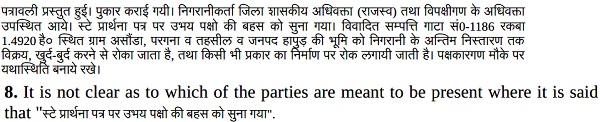
9. Apparently, the notice issued on 06.09.2021 could not be served on 07.09.2021. There is no mention that the petitioner or the respondents to the revision, who number some 25, were all present on caveat. More important than that is the fact that the Deputy Director of Consolidation has not passed any order on the revision admitting it to hearing or summoning the record on 07.09.2021. He has simply passed an order of injunction after hearing parties on the stay application, as he says.
10. On the revision, notice had already been issued the previous day. The order of injunction also does not carry the slightest of reasons for the grant of it. It is absolutely cryptic and no more than an ipse dixit of the Officer passing it. Above all is the fact that the revision, which is apparently belated by six years, and there is a delay condonation application pending that has not been disposed of at all. There is no order on the delay condonation application. Unless the delay condonation application were allowed, the revision would not come into existence. Unless the revision was in existence, neither notice could be issued on the revision nor any order made on the stay application. Ex facie, the order dated 07.09.2021, passed by the Deputy Director of Consolidation is utterly flawed and manifestly illegal. It is an instance of the most atrocious exercise of jurisdiction by a Court of revision. The Deputy Director of Consolidation has thrown to the winds the essentials of procedural law regarding the hearing of a revision. Much of where he has faltered we have already indicated herein above. We need not repeat.
11. In the circumstances, this petition succeeds and is allowed. The impugned order dated 07.09.2021 is quashed. The Deputy Director of Consolidation shall first proceed to decide the delay condonation matter with opportunity to all the respondents before him. After the delay condonation application is decided and subject to the event there, that is to say, if the delay is condoned, he will proceed to admit the revision to hearing and summon records fixing a date for hearing. At that stage, he may consider passing ad interim orders on the application for temporary injunctions, also granting parties opportunity to file a return to the temporary injunction application. The interim injunction application would then be disposed of after hearing all parties. The temporary injunction application would be heard on affidavits. Thereafter, as soon as may be the revision shall be heard and decided. Needless to say that the revision shall be heard not on affidavits but on the basis of records summoned from the Authorities below.
12. Considering the totality of circumstances, until the delay condonation matter is decided, the parties shall not raise constructions on the land in dispute or change its nature or character but the petitioners are free to carry on agriculture thereon.
13. Let the records be returned.
14. Let this order be communicated to the Deputy Director of Consolidation, Hapur through the learned Civil Judge (Senior Division), Hapur by the Registrar (Compliance).