Reckitt Benckiser (India) Limited Vs State of Tamil Nadu through Its Principal Commissioner of GST (Madras High Court)
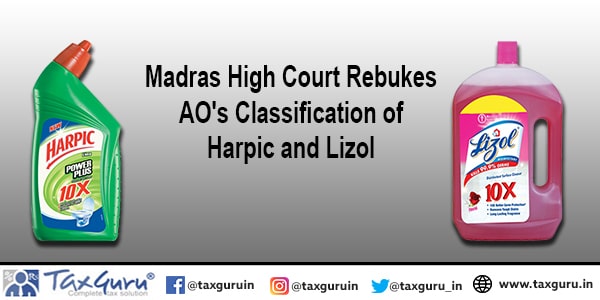
In a significant ruling, the Madras High Court addressed a contentious issue concerning the Goods and Services Tax (GST) classification of two popular household cleaning products: Harpic Disinfectant Toilet Cleaner and Lizol Disinfectant Floor Cleaner. The judgment, Reckitt Benckiser (India) Limited Vs State of Tamil Nadu through Its Principal Commissioner of GST, is a noteworthy case that explores the nuances of tax classification under the GST regime, showcasing the challenges businesses face and the legal recourse available to them.
Background of the Dispute
The crux of the dispute revolved around the classification of Harpic and Lizol under the Tamil Nadu Goods and Services Tax Act, 2017 (TNGST Act). The state authorities classified these products under Item 31 of the Fourth Schedule to the TNGST Act, imposing a tax rate of 14%. Reckitt Benckiser (India) Limited, the petitioner, contested this classification, arguing that these products are disinfectants and should be taxed at 9% under Item 87 of the Third Schedule to the TNGST Act for the period from July 1, 2017, to November 13, 2017.
The Legal Tussle
The dispute began when the Tamil Nadu GST authorities issued a notice proposing to tax the sale of Harpic and Lizol at 28% (combining CGST and SGST), contrary to the 18% tax rate (9% CGST and 9% SGST) applied by Reckitt Benckiser based on their classification as disinfectants. The authorities argued that these products fell under the categories of preparations not elsewhere specified or included, thereby justifying the higher tax rate.
Reckitt Benckiser submitted a detailed objection, emphasizing that both Harpic and Lizol had been recognized as disinfectants under various legal and regulatory frameworks, including the previous VAT regime in Tamil Nadu, the Drugs and Cosmetics Act, 1940, and by technical authorities. They argued for a tax rate reflective of their classification as disinfectants.
Madras High Court’s Observations and Ruling
The High Court identified two primary issues with the impugned order: a lack of consideration for the objections raised by Reckitt Benckiser and the non-disclosure of the enforcement wing’s involvement in the proposal for reclassification. The judgment highlighted the necessity for the assessing authority to consider all relevant factors and objections before making a decision. The failure to do so, as in this case, resulted in the order being set aside due to non-application of mind and procedural lapses.
The Court’s decision to set aside the GST classification by the state authorities underscores the importance of a thorough and reasoned approach in the tax assessment process. It mandates that authorities must engage with the objections and arguments presented by taxpayers, ensuring that decisions are not only fair but also transparent.
Implications for Businesses and the GST Framework
This ruling has far-reaching implications for businesses operating under the GST regime. It reaffirms the judiciary’s role in resolving classification disputes, providing a legal avenue for companies to challenge arbitrary or unfounded tax determinations. For the broader GST framework, the judgment emphasizes the need for clear guidelines and a consistent approach to classification, reducing the scope for ambiguity and potential disputes.
Moreover, the case highlights the critical role of evidence and documentation in supporting classification claims. Businesses must meticulously document their products’ characteristics, regulatory approvals, and market perceptions to defend their classification under the GST.
Conclusion: A Victory for Clarity in GST Classification
The Madras High Court’s decision in favor of Reckitt Benckiser is a testament to the legal system’s capacity to correct misclassifications and ensure that tax laws are applied fairly and accurately. This case serves as a reminder of the complexities inherent in tax law, particularly under a multi-faceted regime like the GST. It calls for businesses, tax authorities, and the legal community to work collaboratively towards a more transparent and equitable tax environment.
In conclusion, the Harpic and Lizol GST classification dispute not only rectified an erroneous tax imposition on Reckitt Benckiser but also set a precedent for how similar cases should be approached in the future. By championing the principles of justice and reasoned decision-making, the Madras High Court has contributed significantly to the ongoing discourse on GST law in India, ensuring that the system remains both fair and functional.
FULL TEXT OF THE JUDGMENT/ORDER OF MADRAS HIGH COURT
The present writ petition is filed challenging the impugned order dated 12.03.2021 insofar as it treats “Harpic Disinfectant Toilet Cleaner” and “Lizol Disinfectant Toilet Cleaner” under Item 31 of the Fourth Schedule to the Tamil Nadu Goods and Services Tax Act,2017 (hereinafter referred to as “TNGST Act”) thereby levying tax at the rate of 14% under the TNGST Act, while rejecting the classification made by the petitioner that the above products viz., “Harpic Disinfectant Toilet Cleaner” and “Lizol Disinfectant Toilet Cleaner” are disinfectants liable to tax at 9% in terms of Item 87 of the Third Schedule to the TNGST Act for the period 01.07.2017 to 13.11.2017.
2.The petitioner is engaged in the manufacture and supply (sale) of floor cleaners, toilet cleaners, medicated soap, dish wash, hand wash etc. The petitioner is a registered dealer in the office of the 2nd Respondent herein. During the relevant period viz., July 2017 to November 2017 the petitioner had effected sales of Harpic and Lizol levying tax at 18% i.e. 9% SGST and 9% CGST on the supply (sale) of such goods and remitted the same.
3. Whileso, a notice dated 19.03.2020 was issued by the 2nd Respondent proposing to treat the sale of Harpic and Lizol at 28% i.e., 14% CGST and 14% SGST by treating the same as falling under Item 29 to 31 of the Fourth Schedule to the Goods and Service Tax Act, while rejecting the classification under Item 87 of the Third Schedule to the Goods and Service Tax Act. The relevant portion of the show cause notice reads as under :
“The goods which were old during the period from July, 2017 to 13-11-2017 were liable to tax rate at 28% GST under item S1 No. 29 to 31 of the Fourth Schedule of Goods and Service Tax Act 2017 is summarized as under.
29/3307
Pre shave, shaving or after shave preparations, personal deodorants, bath preparations, depilatories and other perfumery, cosmetic or toilet preparations, not elsewhere specified or included; prepared room deodorizers, whether or not perfumed or having droinfectant properties, such as Pre-shave, shaving or after-shave Preparations, Shaving cream, Personal deodorants and antiperspirants
30 3401 30
Organic surface-active products and preparations for washing the skin, in the form of liquid or cream and put up for retail sale, whether or not containing soap; paper, wadding, felt and nonwovens, impregnated, coated or covered with soap or detergent
31 3402
Organic surface-active agents (other than soap); surface- active preparations, washing preparations (including auxiliary washing preparations) and cleaning preparations, whether or not containing soap, other than those of heading 3401.
The tax payers had been adopted 18% tax rate by using the following HSN code as under (Up to 13-11-2017)