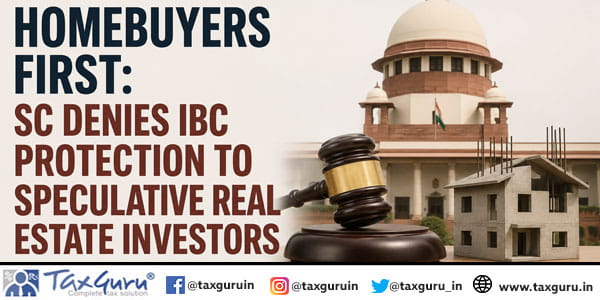
The Supreme Court, in Ms. Mansi Brar Fernandes v. Gayatri Infra Planner Private Limited, clarified the distinction between genuine homebuyers and speculative investors seeking to invoke the Insolvency and Bankruptcy Code, 2016 (IBC). The Court held that individuals entering real estate transactions primarily for assured returns, buy-back arrangements, or short-term profits cannot claim the status of financial creditors merely by portraying themselves as allottees. Emphasising that housing forms part of the fundamental right to shelter under Article 21 of the Constitution, the Court reaffirmed that the IBC is a collective resolution mechanism intended to revive distressed projects and protect bona fide homebuyers, rather than a debt recovery tool for speculative investments. It further recognised RERA as the primary forum for homebuyer grievances and directed greater scrutiny of insolvency petitions to prevent abuse. The judgment strengthens consumer protection while preserving the stability and viability of real estate projects.
Homebuyers First: Distinguishing Speculation investors and Genuine Allotees in a Real Estate Project – IBC and RERA
1. Introduction
a. The recent Supreme Court judgment in Ms. Mansi Brar Fernandes v/s Gayatri Infra Planner Private Limited once again highlights the delicate balance between the rights of genuine homebuyers and the claims of speculative investors in India’s real estate sector. While the Insolvency and Bankruptcy Code (IBC) has been interpreted to extend protection to homebuyers as financial creditors, the Court has clarified that such protection is not open ended.
b. Speculative arrangements designed for assured returns or buy back options cannot be allowed to derail viable real estate projects. Importantly, the Court reaffirms that the Real Estate (Regulation and Development) Act, 2016 (RERA) remains the primary forum for homebuyer redressal, with the IBC acting as a safeguard of last resort to ensure project revival and protection of the fundamental right to shelter.
c. The Insolvency and Bankruptcy Code, 2016 (IBC) was introduced as a transformative legislation to ensure timely resolution of distressed companies, maximise value, and balance stakeholder interests. For homebuyers, the 2018 amendment granting them the status of “financial creditors” under Section 5(8)(f) was a landmark recognition of their vulnerability. However, this protective mechanism has also been misused by speculative investors, who attempt to cloak commercial investments in real estate as “allotments” in order to trigger insolvency proceedings.
d. The recent Supreme Court judgment in the case of Ms. Mansi Brar Fernandes v/s Gayatri Infra Planner Private Limited reiterates the fine distinction between a genuine allottee seeking shelter and a speculative investor chasing returns. This article outlines the key principles and practical takeaways for professionals.
2. Background of the Case –
a. The Ms. Mansi Brar Fernandes (appellant) entered into a Memorandum of Understanding (MoU) in 2016 for the purchase of four flats in a Greater Noida project.
b. She paid ₹35 lakhs out of the total consideration of ₹03 crore.
c. The MoU included a buy-back clause at the discretion of the developer, whereby she could get back ₹1 crore within 12 months, or else obtain possession of the flats without any further payment.
d. The developer issued postdated cheques which were dishonoured.
e. The appellant sought recognition as a financial creditor under IBC, claiming her status as a homebuyer.
Both the NCLT and NCLAT found that the arrangement was speculative in nature, designed to yield abnormal returns rather than genuine possession. The Supreme Court upheld this reasoning, noting that speculative investors cannot misuse the IBC.
3. The Supreme Court has drawn a clear and principled distinction between a speculative investor and a genuine allottee in real estate transactions. By outlining the defining characteristics of each category, the Court has set an important precedent for how such transactions should be viewed and regulated in the future. This judicial interpretation not only supports the protective framework intended for bona fide homebuyers under laws such as the Real Estate (Regulation and Development) Act, 2016 (RERA) and the Insolvency and Bankruptcy Code, 2016 (IBC), but also sends a strong signal that speculative arrangements designed for assured returns or short-term gains cannot be allowed to undermine the stability of the real estate project / sector. The judgment, therefore, establishes guiding principles that shape the conduct of stakeholders, strengthen regulatory oversight, and provide clarity for future real estate transactions. Buy back / assured return clauses in the contract, viz.,
a. Speculative investor –
i. Post dated cheques or guaranteed refunds unrelated to possession.
ii. Purchase of multiple units purely for profit making.
iii. Unrealistic returns (20–25% or more in a short span).
iv. Own funds investment rather the housing loan borrowings
v. Lack of follow up on possession or project progress.
vi. Compensation / Payment of EMI till the possession of the property/limited period
vii. Agreements that deviate substantially from the RERA Model Agreement of sale
viii. Commercial intent rather than residential necessity / delivery
b. Genuine Allottee-
i. Seeks shelter for personal use or long-term ownership.
ii. Generally housing loan borrowed by the allottee.
iii. Pays instalments linked to construction progress.
iv. Actively monitors project timelines and possession schedules.
v. No preferential clauses, clauses align with RERA Model Agreement of sale
vi. Remedies sought are focused on delivery of possession rather than financial windfall.
vii. Housing is treated as a fundamental right, not an investment instrument.
4. Key Observations from the Supreme Court
a. Housing is a facet of the fundamental right to shelter under Article 21 of the constitution.
b. IBC is a collective resolution mechanism, not a recovery forum for speculative returns.
c. RERA is the primary platform for grievances of genuine homebuyers.
d. Speculative activity acts as a “slow poison” in the real estate sector, inflating prices and harming genuine end users.
e. Parliament’s 10% / 100 homebuyer threshold for filing Section 7 petitions ensures that isolated speculative investors cannot derail projects.
5. Practical Takeaways for Chartered Accountants and Professionals
a. Due Diligence of Agreements of sale – Examine whether clauses such as buy-back, assured returns, or PDCs exist before advising clients.
b. Classification of Advances received – Ensure correct disclosure in financial statements: advances from speculative investors should not be equated with genuine customer advances.
c. Regulatory Compliance – Verify that agreements adhere to RERA model agreement of sale.
d. Advisory Role – Educate clients that misuse of IBC as a debt recovery tool is likely to fail and may attract adverse observations.
e. Audit Trail – In RERA and IBC matters, proper documentation of intent (shelter vs. investment) is crucial for both promoters and allottees.
6. Key Directions of the Supreme Court on Real Estate & IBC
The Supreme Court has issued a comprehensive set of directions aimed at strengthening the regulatory, judicial, and financial ecosystem of the real estate sector while ensuring greater protection for homebuyers. The important measures include:
a. Strengthening NCLT/NCLAT Capacity – Vacancies to be filled on priority, with dedicated IBC benches and use of retired judges on an ad hoc basis. Infrastructure of NCLT/NCLAT to be upgraded, with a compliance report to be filed within three months.
b. Constitution of Expert Committee – A high level committee chaired by a retired High Court Judge, with representation from ministries, experts, and industry, to suggest systemic reforms for cleansing and restoring credibility in the sector.
c. Strengthening RERA – States to ensure RERA authorities are well staffed with experts, including legal professionals/consumer advocates. RERAs must conduct strict diligence before approving projects, failing which consequences will follow.
d. Real Estate in IBC – IBBI, in consultation with RERA, to frame guidelines for real estate insolvency, including project specific resolution, timelines, and mechanisms for handover of completed units.
e. Financial Support for Stressed Projects – Government to consider a revival fund under NARCL or expansion of the SWAMIH Fund, subject to CAG audits and strict safeguards to ensure intended use.
f. Homebuyer Protection –
i. Allottees to have meaningful representation in the CoC through independent authorized representatives.
ii. NCLTs to screen Section 7 applications to differentiate genuine homebuyers from speculative investors.
iii. Residential real estate transactions to be registered with revenue authorities on payment of 20% of property cost.
iv. Contracts with senior citizen allottees deviating from Model RERA Agreement to require an affidavit of consent.
g. Escrow & SOPs – Funds collected for early-stage projects must be placed in escrow and released in line with construction progress. Each RERA must notify SOPs within six months.
h. Technology in Adjudication – Emphasis on e-filing, video-conferencing, and case management systems in IBC proceedings before NCLTs to improve efficiency.
7. Suggestions for Future Reform
a. Early Warning Frameworks – IBBI may introduce preventive mechanisms (similar to Basel norms) such as pre bankruptcy mediation and mandatory restructuring before defaults escalate.
b. Uniform RERA Rules – The Union Government should harmonize RERA regulations across States to ensure clarity and consistency.
c. Institutional Role in Reviving Projects – Housing Boards, Urban Development Authorities, and CPSUs should set up dedicated wings to revive stalled projects through IBC, boosting affordable housing and buyer confidence.
d. Indigenous Consulting Capacity – Strengthen collaboration with Indian think tanks and academic institutions (IIMs, IITs, etc.) to develop domestic expertise in sectoral restructuring and improve ease of doing business.
e. Special Purpose Entity for Stalled Projects – Consider creating a PSU/PPP-led body (like NARCL) to acquire and complete stalled projects under IBC, with unsold inventory used for affordable housing or Government needs.
These reforms emphasize the Government’s constitutional obligation to safeguard homebuyers, the banking system, allied industries, and employment linked to the real estate sector.
Conclusion
The Supreme Court’s ruling in Mansi Brar Fernandes serves as a landmark reminder that the Insolvency and Bankruptcy Code (IBC) cannot be reduced to an exit route for speculative investors. Housing, unlike shares or debentures, is a basic human necessity and forms part of the fundamental right to life under Article 21 of the Constitution. RERA is a primary forum for the home buyers / Allottees in the real estate project.
By distinguishing genuine homebuyers from speculative actors, the Court has reinforced the constitutional obligation of the State and regulators to protect vulnerable stakeholders. Genuine allottees are the foundation of India’s urban growth, and their protection is central to both social justice and economic stability.
For professionals, particularly Chartered Accountants, the message is clear: beyond statutory compliance, there is a larger duty to uphold the integrity of the real estate and insolvency ecosystem. Accuracy in certification must go hand in hand with safeguarding the spirit of the law, so that the dream of home ownership does not turn into a nightmare for India’s citizens.
****
CA.Vinay Thyagaraj is a founder partner at M/s.Venu & Vinay Chartered Accountants, you can reach him at [email protected]