In re Curry House CoCo Ichibanya (A unit of Ichibanya India Pvt. Ltd.) (CCPA Delhi)
The Central Consumer Protection Authority (CCPA) examined a consumer complaint against Curry House CoCo Ichibanya, operated by Ichibanya India Pvt. Ltd., alleging that a 10% service charge was automatically added to a restaurant bill without prior consent. The complaint, registered on 5 May 2025, also alleged additional VAT alongside GST. Following preliminary inquiry, the CCPA investigated the restaurant’s software-generated billing practices and considered whether automatically imposed service charges affected consumers as a class.
The restaurant maintained that the charge was disclosed on its menu and invoice, could be removed on request, and was not intended to mislead customers. The Director General (Investigation) concluded that requiring customers to object at the billing stage did not amount to genuine voluntary consent and that the default charge, including its effect on GST calculation, was misleading. The CCPA relied on its service-charge guidelines dated 4 July 2022 and the Delhi High Court’s judgment dated 28 March 2025 in National Restaurant Association of India & Ors. v. Union of India & Anr.
During the proceedings, the restaurant produced evidence of a refund, an undertaking and notices stating that service charge was no longer levied. It reported discontinuing automatic service charges from 14 January 2026 and explained that it operated one dine-in restaurant and two food-court outlets. The CCPA nevertheless found that later corrective steps did not excuse the earlier default billing practice, which continued for months after the Authority’s initial notice.
The CCPA concluded that automatically adding a service charge violated consumer rights and constituted misleading and unfair trade practices under the Consumer Protection Act, 2019. It directed the restaurant to discontinue any automatic or default service charge under any name, imposed a penalty of ₹20,000, and required a compliance report within 15 days of receipt of the order.
Cases Discussed
1. National Restaurant Association of India & Ors. Vs Union of India & Anr. (Delhi High Court), judgment dated 28 March 2025
FULL TEXT OF THE ORDER OF CENTRAL CONSUMER PROTECTION AUTHORITY
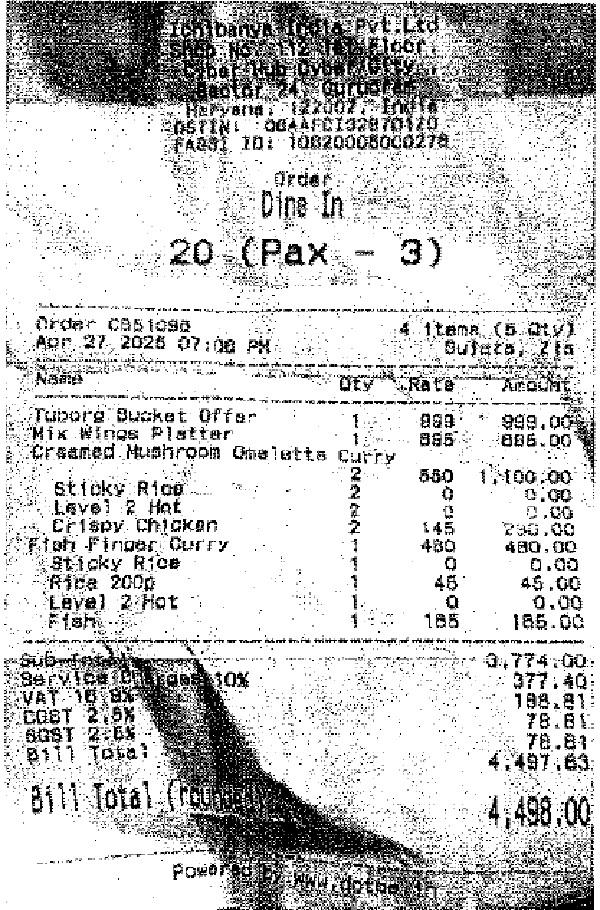
The Central Consumer Protection Authority (CCPA) has taken cognizance of grievance from Shubham Kumar registered at National Consumer Helpline 1915 (NCH) vide docket no. 7087513 dated 05th May, 2025 against Curry House CoCo lchibanya (A unit of lchibanya India Pvt. Ltd.) (The Restaurant). The consumer alleged that Service Charge of 10% extra was levied without his prior consent. Further, additional VAT of 18.9%, levied along with GST. The Consumer in support of his allegations had attached the bill, which is reproduced below:
2. It is pertinent to mention that vide judgement dated 28th March, 2025 the Hon’ble High Court of Delhi in National Restaurant Association of India & Ors. v. Union of India & Anr. had held that: “All restaurant establishments would have to adhere to the guidelines passed by the CCPA. If there is any violation of the same, action would be liable to be taken in accordance with law. CCPA is free to enforce its guidelines in accordance with law.” Further the Hon’ble High Court had upheld the applicability of the CCPA Guidelines which is in the interest of consumers and declaring the levy of any mandatory service charge as contrary to law and violates the guidelines.
3. The CCPA in exercise of power conferred under Section 18(2) and Section 19 of the Consumer Protection Act, 2019 (the Act, 2019) conducted a preliminary inquiry to examine the veracity of the claim made against the aforementioned Restaurant.
4. In the preliminary inquiry, CCPA prima facie found, that the Restaurant had levied 10% service charge on the bill despite the Hon’ble High Court of Delhi upholding the Guidelines to Prevent Unfair Trade Practices and Protection of Consumer Interest with regard to levy of service charge in Hotels and Restaurants, 2022 issued by CCPA (hereinafter referred to as Guidelines, 2022). Considering that the bill is software generated, the practice adopted by the Restaurant might have impacted a wider base of consumers visiting the restaurant thereby making it a fit case for class action as envisaged in section 10 of Consumer Protection Act 2019.
5. Based on the preliminary inquiry findings, CCPA directed the restaurant to furnish their response vide Notice dated 08th May, 2025 for violation of various provisions of the Act, 2019 and Guidelines to Prevent Unfair Trade Practices and Protection of Consumer Interest with Regard to Levy of Service Charge in Hotels and Restaurants issued on 0407.2022.
6. In response to the said notice, on 09th May, 2025 the restaurant submitted its reply which is as follows:
a. The restaurant stated that the guest reviewed the bill in detail, queried the price of an item (which was clarified by the manager), and completed the payment via card without raising any objection or requesting the removal of the service charge.
b. Prior Disclosure on Menu & Invoice: The restaurant highlighted that the 10% service charge is explicitly notified on the menu card and clearly reflected in the final generated bill.
c. Discretionary Removal Policy: It submitted that its operational policy permits guests to request the removal of the service charge, and such requests are routinely respected and honoured.
d. Willingness to Engage: The management affirmed its commitment to guest satisfaction and expressed readiness to attend a meeting or follow subsequent guidance to resolve the matter.
7. Upon examination of the response of the Restaurant, CCPA observed that the restaurant had contended that it is the consumer’s responsibility to actively request a waiver which imposes an undue burden on the consumer. Placing the onus on the consumers to opt out of an automatically levied service charge contradicts the CCPA’s Guidelines of 2022, which mandates that no hotel or restaurant shall add service charge automatically or by default in the bill. Also, the restaurant has not given any justification for its continued levy of service charge in the food bill. The Restaurant’s contention that the 10% service charge was prominently declared on the menu card and reiterated in the final invoice does not validate its levy as service charge is not a statutory tax or a government levy, nor is it part of the basic price of food and beverage ordered, thereby impacting a wider class of consumers as envisaged under Section 10 of the Act.
8. In light of the above observations, CCPA vide letter dated 30th June, 2025 directed Director General (Investigation) to conduct a detailed investigation.
9. 05th June, 2026 the Director General (Investigation) has submitted the Investigation Report. The findings in the Investigation report are as under:
a. The restaurant, Curry House, operated by lchibanya India Pvt. Ltd., contends that the levy of service charge was transparent and disclosed on the menu and bill. However, Section 2(46)(vi) of the Consumer Protection Act, 2019 defines an unfair contract as one that causes a significant imbalance in rights and obligations to the detriment of the consumer, such as demanding payment for unagreed additional charges. Here, the automatic 1377.40 service charge on a 3,774 subtotal imposed without explicit consumer opt-in shifts the burden to consumers to negotiate its removal amid power asymmetry at the billing stage, rendering it coercive and unenforceable.
b. M/s Curry House, operated by lchibanya India Pvt. Ltd., denies any violation. The restaurant, Curry House (operated by lchibanya India Pvt. Ltd.), claims no violation of Section 2(47) of the Consumer Protection Act, 2019, arguing that the service charge was optional, clearly listed on the menu, and that customers could request its removal at billing. Thereby, automatically including “Service Charges @10%” on the bill creates a false impression of obligation, shifting the burden to customers to opt out which undermines true voluntariness and fits the definition of an unfair trade practice under Section 2(47). Restaurant claims that customers could object simply by complaint underscores the coercive nature of the default levy, without resolving its illegality. Furthermore, by adding GST on the inflated amount and forcing customers to dispute the charge at the time of payment, restaurant created a false impression that the payment as unavoidable. Thus, the restaurant’s position lacks merit, also, misleading billing design and coerced payment, falling squarely within the scope of Section 2(47) of the Act, 2019.
c. M/s Curry House, operated by lchibanya India Pvt. Ltd., contends that the service charge was voluntary, disclosed on the menu, removable upon request, and unchallenged at billing— portraying the grievance as a post facto afterthought. This defence collapses under Section 2(9) of the Consumer Protection Act, 2019, which enshrines consumer rights to full disclosure, protection from unfair or deceptive practices, and effective redressal against unlawful charges.
d. In view of the findings on record, it is conclusively established that the automatic levy of Service Charge by M/s Curry House CoCo Ichibanya Restaurant, Gurugram amounts to indulgence in violation of Section 2(9), 2(46), 2(47), Consumer Protection Act, 2019
10.Thereafter, the Investigation Report submitted by DG (Investigation) was shared with the Restaurant vide letter dated 27th July, 2026 to furnish its comments and an opportunity of hearing was also provided to the Restaurant on 07th August, 2026 under Section 20 and 21 of the Act, 2019 before passing an order.
11.0n 7th August, 2026, Mr. Kartikey Nayyar, Advocate, accompanied by Mr. Marsh, authorized representative of the Restaurant, appeared on behalf of the Restaurant and made the following submissions:
a. The consumer did not approach the restaurant seeking a refund of the service charge prior to lodging a complaint on the National Consumer Helpline (NCH). Had the consumer requested the removal of the service charge at the time of billing, the restaurant would have promptly removed it, in line with its established past practice.
b. The restaurant is prepared to immediately refund the disputed service charge amount upon receipt of the consumer details.
c. The restaurant explicitly displays notices on its premises indicating that no service charge is levied:
d. Following the conclusion of the hearing, the CCPA provided the consumer’s details to the restaurant and directed it to furnish:
i. The total number and details of all its operating branches;
ii. The specific date from which the levy of service charge was discontinued, if applicable; and
iii. Written comments or objections on the investigation report, if any.
12.As directed during the hearing dated 07th August 2026, the Restaurant has submitted following documents vide email dated 08th September, 2026:
a. Undertaking on behalf of the Company towards discontinuing levying of service charge;
b. Photographs of the only dine-in facility of CoCo lchibanya declaring to the customers that service charge is not levied at the restaurant; and
c. Proof of Refund paid to the customer/complainant.
d. Response to the investigation report as follows:
i. The Restaurant submitted that the levy of service charge was not intended to deceive, mislead or unfairly prejudice any consumer. The service charge was disclosed in the menu and reflected separately on the bill. It has maintained its stand that the levying of such service charge was transparent, and the Restaurant always removed the service charge upon a consumer’s request.
ii. In line with CCPA guidelines, the restaurant discontinued the practice of automatically adding service charges to customer bills effective 14th January, 2026.
iii. From the above date, no service charge is included in the bill by default, nor is any consumer required to pay any service charge as a condition for entry into or provision of services by the Restaurant.
(iv)Instructions have been issued to staff and operations teams ensuring that service charge is not levied by default in the Consumer’s bill, payment is not mandatory, no entry or service restrictions are imposed for refusal to pay, and service charges are excluded from the taxable value for GST calculation.
(v) The prompt implementation of corrective measures establishes the Restaurant’s good faith and commitment to full compliance with consumer protection norms.
(vi)That the outlet/brand operated by the Restaurant presently has a total of three (3) restaurants/ outlets in India as on the date of signing this undertaking. The details of the outlets are provided below:
A. Dine-in Restaurant at Ambience Mall, Gurugram, Haryana
B. Food court outlet at Ambience Mall, Vasant Kunj,
C. Delhi Food court outlet at Select City Walk Mall, Saket, Delhi
13. Based on the response to the investigation report, another hearing was conducted on 12th October, 2026, wherein the restaurant was represented by Mr. Kartikey Nayyar, Advocate along with Mr. Marsh, Employee of the Restaurant and submitted as follows:
a. The restaurant previously removed the service charge whenever a customer requested it, as it was unaware whether levying the charge was entirely prohibited or merely voluntary.
b. The restaurant operates only one standalone dine-in restaurant with its other two setups functioning merely as food-court counters.
c. It is still an emerging brand establishing its presence in the Indian market.
d. The restaurant conceded that adding the service charge was an inadvertent operational oversight rather than a deliberate action.
e. Verifiable evidence demonstrating the refund of the disputed service charge to the consumer has been placed on record alongside the reply to the investigation report.
14. Before delving into the specifics of the case, it is pertinent to examine the relevant legal framework that governs such transactions.
a. Section 2(9) (ii) and (v) of the Act, 2019 includes- “the right to be informed about the quality, quantity, potency, purity, standard and price of goods, products or services, as the case may be, so as to protect the consumer against unfair trade practices” and “the right to seek redressal against unfair trade practices or restrictive trade practices or unscrupulous exploitation of consumers.”
b. From the bare reading of Section 2 (28) of the Act, 2019 it can clearly be concluded that when a restaurant displays a menu with specific prices, a component of service is inherent in the price of food and beverages offered by the restaurant, about which the consumer is duly informed. Pricing of the product thus covers both the goods and services component. However, if a mandatory service charge is added later, it conveys an express or implied representation that the restaurant, a service provider had deliberately concealed the actual price of the food and service thereof, constituting an unfair trade practice.
c. Section 2 (46) “unfair contract” means a contract between a manufacturer or trader or service provider on one hand, and a consumer on the other, having such terms which cause significant change in the rights of such consumer, and imposing on the consumer any unreasonable charge, obligation or condition which puts such consumer to disadvantage;
d. Furthermore, Section- 2(47) of the Consumer Protection Act, 2019 defines “Unfair Trade Practice” which includes deceptive or unethical methods used to promote the sale of goods, use or supply of any goods or provision of services.
e. CCPA had issued Guidelines to Prevent Unfair Trade Practices and Protection of Consumer Interest with Regard to Levy of Service Charge in Hotels and Restaurants, on 4th July, 2022. The extracts of which are given below:
“3. Service charge is being levied in addition to the total price of the food items mentioned in the menu and applicable taxes, often in the guise of some other fee or charge.
4. It may be mentioned that a component of service is inherent in price of food and beverages offered by the restaurant or hotel. Pricing of the product thus covers both the goods and services component. There is no restriction on hotels or restaurants to set the prices at which they want to offer food or beverages to consumers. Thus, placing an order involves consent to pay the prices of food items displayed in the menu along with applicable taxes. Charging anything other than the said amount would amount to unfair trade practice under the Act.
7. Therefore, to prevent unfair trade practices and protect consumer interest with regard to levying of service charge, the CCPA issues the following guidelines —
i. No hotel or restaurant shall add service charge automatically or by default in the bill.
ii. Service charge shall not be collected from consumers by any other name.
(ih) No hotel or restaurant shall force a consumer to pay service charge and shall clearly inform the consumer that service charge is voluntary, optional and at consumer’s discretion.
iv. No restriction on entry or provision of services based on collection of service charge shall be imposed on consumers.
v. Service charge shall not be collected by adding it along with the food bill and levying GST on the total amount”
f. The Hon’ble High Court of Delhi [National Restaurant Association of India & Ors. Vs Union of India & Anr.J passed the Judgment on 28th March, 2025 held in favor of CCPA wherein the Court held the following:
i. Service charge or TIP as is colloquially referred, is a voluntary payment by the customer. It cannot be compulsory or mandatory. The practice undertaken by the restaurant establishments of collecting service charge that too on a mandatory basis, in a coercive manner, would be contrary to consumer interest and is violative of consumer rights.
ii. it The collection of service charge and use of different terminologies for the said charge is misleading and deceptive in nature. The same constitutes an unfair trade practice under Section 2(47) of the CPA, 2019.
iii. The guidelines framed by the CCPA are thus valid and are in the interest of the consumers and the same are upheld.
iv. While this Court holds that the mandatory collection of service charge is contrary to law and violates the guidelines, it is also of the opinion that if consumers wish to pay any voluntary Tip for services which they had enjoyed, the same would obviously not be barred. The amount however, ought not to be added by default in the bill/invoice and should be left to the customer’s discretion.
v. All restaurant establishments would have to adhere to the guidelines passed by the CCPA. If there is any violation of the same, action would be liable to be taken in accordance with law. CCPA is free to enforce its guidelines in accordance with law.
15.The CCPA is empowered under Section 20 and 21 of the Consumer Protection Act, 2019 to issue directions to modify the advertisement or discontinue such advertisement and practices, if necessary, it may, by order, impose a penalty which may extend to ten lakh rupees and for every subsequent contravention may extend to fifty lakh rupees. Further, Section 21 (7) of the above Act, 2019 prescribes that following may be regarded while determining the penalty:
i. the population and the area impacted or affected by such offence;
ii. the frequency and duration of such offence;
Hi. the vulnerability of the class of persons likely to be adversely affected by such offence;
iii. the gross revenue from the sales effected by virtue of such offence
16.1n light of the above provisions and consideration of the investigation report of DG Investigation (CCPA) along with the submissions of the Restaurant, CCPA arrives at the following findings:
a. It is important to note that the genesis of the service charge in the bill is the command embedded in the billing software, leading to default addition of service charge 10% to every bill. The Restaurant’s argument that customers were free to request the removal of the service charge is fundamentally untenable as the mere absence of an on-site objection does not cure the underlying compulsion. The CCPA Guidelines and the Delhi High Court ruling establishes that default levy on the bill is void from the beginning, mandating that consumer consent must be affirmative (opt-in), rather than defensive (opt-out). Moreover, the collection of service charge and use of different terminologies for the said charge is misleading and deceptive in nature.
b. It is pertinent to note that when a restaurant displays menu prices, consumers are led to believe that those figures reflect the true, complete cost of the food offered. Consequently, introducing a mandatory service charge at the billing stage creates an express or implied representation that the restaurant concealed the actual cost of the food and services. By calculating GST on top of this inflated subtotal and shifting the burden onto consumers to dispute the charge at the time of payment, Restaurant created a false impression that the payment was unavoidable. This amounts to misleading billing design and coerced payment, falling squarely within the scope of Section 2(47) of CP, Act 2019.
c. The Restaurant’s contention that it was unaware whether service charges were prohibited or voluntary does not absolve it of liability. The CCPA Guidelines were notified on 4th July, 2022, and were re-affirmed by the Delhi High Court on 28th March, 2025. The Restaurant cannot plead ignorance of settled law to escape penalties for systemic, automated levy of service charge.
d. The Restaurant’s failure to update its automated billing software until 14th January 2026, despite the notice issued on 05th May, 2025 establishes that the service charge was routinely and mandatorily imposed on all consumers by default and no corrective measures to stop it, were taken immediately. Such an automatic levy directly violates the CCPA Guidelines, 2022, and provision of Consumer Protection Act, 2019 which conveys an express or implied representation, including deceptive methods that make non-mandatory charges appear compulsory and place an excessive burden on consumers to object through confusing bill formats.
e. Hence, the Restaurant is in violation of the following provisions of Consumer Protection Act 2019:
i. Consumer rights under section 2(9) (ii) of the Act, 2019.
ii. Consumer rights under section 2(9) (v) of the Act, 2019.
iii. Misleading advertisement under Section 2(28) (i) and (Hi) of the Act, 2019.
iv.Engaging in Unfair Trade Practice as defined in section 2(47) of Act, 2019 read with section 2(46) (vi) of Act, 2019;
v. Guidelines to Prevent Unfair Trade Practices and Protection of Consumer Interest with Regard to Levy of Service Charge in Hotels and Restaurants on 4th July, 2022.
17. Having regard to the findings, it is concluded that the mechanism of “opt-out” rather than “opt-in” fundamentally vitiates consumers’ free consent. According to the Guidelines, 2022, no hotel or restaurant shall add a service charge automatically or by default to the bill, and shifting the burden onto the consumer to identify, contest, and demand the removal of the levy at the time of payment undermines true voluntariness of the consumer. It is also pertinent to note that, the restaurant pleaded the levy of charge as an inadvertent oversight and stated it was fully discontinued only from 14th January, 2026 i.e., following the CCPA taking cognizance. Given that the restaurant operates a single dine-in outlet in a high-density commercial hub (Ambience Mall, Gurugram) with substantial consumer footfall across diverse demographics, its continued imposition of the service charge for at least seven (7) months even after notice from the CCPA adversely impacted consumers as a class, thereby attracting the applicability of Section 21(7) of the Consumer Protection Act, 2019.
18. Considering the observations and conclusions recorded above, the CCPA issues the following directions for compliance:
a. The Restaurant shall discontinue and refrain from levying or collecting any service charge automatically or by default, or under any other name, and shall ensure strict compliance with the Guidelines to Prevent Unfair Trade Practices and Protection of Consumer Interest with Regard to Levy of Service Charge in Hotels and Restaurants dated 04.07.2022.
b. Considering the established violations and consideration of facts stated in para 17 above, the Restaurant is directed to pay a penalty of 20,000/-only.
The Restaurant shall submit a compliance report of the above-mentioned directions to the CCPA within 15 days from the receipt of this order.