The Confluence Paradox: Does India’s Banking-Fintech M&A Framework Strike a Proportionate Balance Between Innovation and Systemic Stability?
Abstract
For the first time, commercial banks are allowed to finance strategic acquisitions of listed entities with appropriate financials, while unlisted companies with borrowings up to INR 200 crore can access merger approvals without NCLT intervention under the new 2025 RBI Acquisition Finance Directions and the expanded Fast-Track Merger regime under Section 233. The main argument of this paper is a structural asymmetry that the acquisition finance framework imposes eligibility criteria that exclude majority of Indian fintech startups from bank-financed acquisitions, while the fast-track merger framework simultaneously enables restructuring for unlisted companies but excludes listed transferors and NBFCs.
The analysis proceeds in three levels as at the inception it critiques how the acquisition finance eligibility criteria produce a false dichotomy between “bankable” and “unbankable” financial enterprises, ignoring the value proposition of high-growth, pre-profit fintechs. Followed by the mathematical analysis which reveals the compliance burden asymmetry. Thirdly, comparative study of the United Kingdom’s “fintech bridge” approach and Singapore’s hybrid licensing framework demonstrates how eligibility criteria can be replaced with flexible, risk-calibrated approaches that preserve systemic stability without excluding innovation and hence ultimately followed by recommended policies that would largely fix the gap which has been borne because of the amendment.
Keywords: Fintech M&A, acquisition finance, banking regulation, fast-track mergers, financial stability, regulatory arbitrage, Section 233, Deal Value Threshold, NBFC consolidation, cross-border mergers
- 1. INTRODUCTION
- 1.1 Regulatory Background
- 2. EVOLUTION OF BANKING-FINTECH M&A IN INDIA
- 2.1 Functions of Banking-Fintech Consolidation
- 2.2 The Acquisition Finance Deadlock
- 2.3 The Fast-Tracker Merger Aspect
- 2.3.1 Limitations of the Amendment.
- 3. CONFLUENCE FLUIDITY: A METRIC FOR MEASURING MULTIDIMENSIONAL M&A EFFICACY
- 3.1 Practical Impact of Confluence Fluidity
- 3.1.1 Confluence Fluidity (CF): A Multidimensional Metric
- 3.2 The Market Impact of Confluence Fluidity
- 4. COMPARATIVE ANALYSIS
- 4.1 The United Kingdom: The Fintech Bridge Approach
- 4.2 Singapore: The Hybrid Licensing Model
- 4.3 The European Union: The Harmonised Framework
- 4.4 India’s Valuation Doctrine
- 5. INSTITUTIONAL ALLOCATION OF RISK IN BANKING–FINTECH M&A
- 5.1 Role of Alternative Financing Structures
- 6. CONCLUSION: RECOMMENDATIONS FOR REGULATORS AND MARKET PARTICIPANTS
- 6.1 Recommendation 1: Replace Fixed Eligibility Criteria with a Risk-Calibrated Approach
- 6.2 Recommendation 2: Expand Fast-Track Merger Eligibility to Include Listed Transferors and NBFCs
- 6.3 Recommendation 3: Mandate Disaggregated Disclosure of Fintech M&A Data
- 6.4 Conclusion
- Notes:
1. INTRODUCTION
Consider a pre-profit fintech unicorn with INR 3500 Crore valuation seeking to acquire an RBI-registered NBFC to expand its regulated financial services. The actual asset that the platform holds is their intellectual property, user data, and network effects. (India ranks second globally in fintech deal volumes and ranks third in total fintech funding).
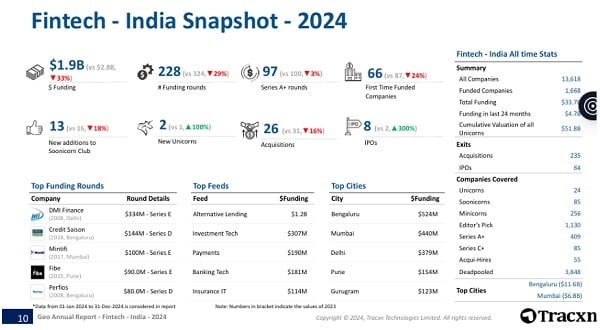
Figure 1
Figure 1 illustrates that India’s fintech ecosystem consists of 13,618 companies, including 1,668 funded companies, 24 unicorns, and has attracted US$33.7 billion in cumulative funding. The sector has also witnessed 235 acquisitions and 64 IPOs, reflecting need for efficient M&A framework.
Under the current RBI ‘s 2025 Acquisition Finance Directions, this fintech is ineligible for bank financing since this is neither a listed nor has three consecutive years of profitability,3 however the particular acquisition could create a market leader with genuine competitive significance , therefore the alternatives that exist would be that for the following transaction to succeed channels such as foreign venture debt, private credit, or equity dilutions exists all of which are more expensive, less regulated, and potentially less stable than bank financing. This is the confluence paradox which is a regulatory framework designed to enable banking-fintech consolidation systematically excludes the enterprises most in need of it.
1.1 Regulatory Background
The Reserve Bank of India (“RBI”), in its April 2025 Acquisition Finance Directions, and the Ministry of Corporate Affairs (“MCA”), through its September 2025 amendments to the Fast-Track Merger Rules under Section 233 of the Companies Act, 2013, have introduced a carefully calibrated set of reforms. Commercial Banks may subscribe loans to carefully documented set of metrics that being target is listed, has three-year profitability, with exposure capped at 10% of the bank’s Tier-1 capital and 70% of the acquisition value.
At the same time, the government has broadened the fast-track merger process so that more types of companies can use it including Unlisted companies that have borrowings of up to ₹200 crore, fellow subsidiaries and Certain cross-border reverse mergers, where an Indian company merges into its foreign parent or another foreign company in specific circumstances.
2. EVOLUTION OF BANKING-FINTECH M&A IN INDIA
2.1 Functions of Banking-Fintech Consolidation
Fintechs offers technology and data analytics; banks provide capital and regulatory licences. Their consolidation creates powerful synergies in digital financial services as with Slice and North East Small Finance Bank. In India, the absence of a formal framework has driven fintechs toward foreign venture debt (averaging 14-18% interest rates) and private credit often with onerous covenant such as maintaining certain financial ratios, restrictions on taking additional loans, limitations on selling assets, investor approval requirements for major business decisions while domestic banks remained reluctant to acquire or finance fintech acquisitions due to regulatory uncertainty.
2.2 The Acquisition Finance Deadlock
Commercial Banks may subscribe loans to carefully documented set of metrics mentioned in chapter 1.1, however the eligibility criteria excludes 95% of Indian fintech startups forcing them to costlier alternatives such as NBFCs (Non-Banking Financial Companies), FPIs (Foreign Portfolio Investors) or AIFs (Alternative Investment Funds). As a result of these restrictions, banks are willing to finance acquisitions only when the target company is Large, Well-established, Listed on a stock exchange, and financially stable and profitable. Banks consider these companies to be lower-risk borrowers.
2.3 The Fast-Tracker Merger Aspect
MCA’s September 2025 amendments to the Companies (Compromises, Arrangements and Amalgamations) Rules, 2016, have significantly expanded the scope of Section 233 fast-track mergers. The amendments allow more companies to use the fast-track merger procedure, which means they can obtain approval from the Regional Director (RD) instead of going through the slower NCLT process.
The expansion includes:
a) Start-up companies.
b) Section 8 (non-profit) companies merging with unlisted companies, provided they meet certain financial and legal requirements.
c) Holding companies and their subsidiaries, whether they are listed or unlisted, except where the company being merged into another (the transferor) is listed.
d) Fellow subsidiaries (companies owned by the same parent company), provided none of the transferor companies are listed.20
e) Certain cross-border reverse mergers, where a foreign holding company merges into its wholly owned Indian subsidiary.
Even though the process is faster, companies must still meet safeguards to protect creditors and shareholders. These include:
a) Their total outstanding loans, debentures, and deposits must not exceed ₹200 crore.
b) They must not have defaulted on repaying any of these borrowings.
c) An auditor must certify that these conditions are satisfied by filing Form CAA-10A.
d) Companies must submit a valuation report so that shareholders and creditors know the merger is fair.25
e) The deadline for filing merger documents has been increased from 7 days to 15 days after shareholder and creditor meetings.
2.3.1 Limitations of the Amendment.
Not every company benefits from this amendment, especially if the transferor company is listed, the fast-track route generally cannot be used & NBFCs (Non-Banking Financial Companies), which are heavily regulated by the RBI, generally cannot use this simplified process and must continue with the ordinary merger procedure. One objective of expanding Section 233 was to reduce the NCLT’s workload. However, because many financial-sector mergers remain ineligible, a substantial number of cases still require tribunal approval, limiting the reforms’ impact on reducing case backlogs.
It demonstrates that while the reforms improve procedural efficiency for many companies, they do not address the sectors where streamlined merger approvals could have the greatest economic impact. Because fintech acquisitions frequently involve RBI-regulated entities such as NBFCs, the continued exclusion of these entities means that one of the most dynamic areas of the economy cannot fully benefit from the fast-track regime.
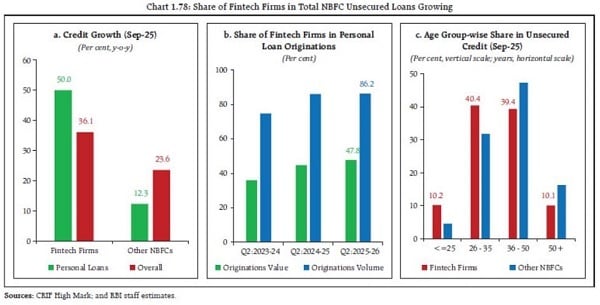
Figure 2
Figure 2 illustrates the increasing integration of fintech firms with the RBI-regulated NBFC sector. Credit growth in personal loans extended by fintech firms reached 50 per cent yearon-year in September 2025, substantially exceeding that of other NBFCs (12.3 per cent). Furthermore, fintech firms accounted for 47.8 per cent of the value and 86.2 per cent of the volume of personal loan originations by the second quarter of 2025–26. These trends demonstrate that a significant proportion of fintech activity is conducted through RBIregulated entities. Consequently, the continued exclusion of many such entities from the expanded fast-track merger framework under section 233 limits the practical benefits of the 2025 reforms for fintech mergers and acquisitions.
3. CONFLUENCE FLUIDITY: A METRIC FOR MEASURING MULTIDIMENSIONAL M&A EFFICACY
The evaluation metrics of banking-fintech M&A frameworks has long depended on two variables: the availability of financing (A) and the speed of approval (S). This assumption no longer reflects reality because businesses are very different from one another. For example: mature listed companies, startups, fintechs, & technology companies, all have different financial profiles and regulatory requirements.32
A financing system cannot be judged solely by how much money it makes available, and since the eligibility rules are so strict that most fintech startups cannot qualify, then only a small group of companies actually benefits. This creates a growing gap between companies that can obtain acquisition finance (bankable firms), and companies that cannot (unbankable firms).
3.1 Practical Impact of Confluence Fluidity
Consider two companies Fintech A which is a listed company, has been profitable for three years and has a net worth of Rs.1,200 crore and a Fintech B which is an unlisted unicorn and has not been profitable however possess high valuation because of technology and users. Suppose a traditional measure simply asks: “Does acquisition finance exist?” It would conclude: Both companies have access to acquisition finance under the same legal framework. But in reality, Fintech A can obtain a bank loan & Fintech B cannot obtain one at all. Therefore, the traditional measure treats both firms as if they have the same opportunity, when they clearly do not. This creates a false equivalence.
In the Fintech Sector over 70% of IP filings are by small and medium enterprises, yet the profitability threshold excludes early-stage fintechs (45% of filings), concentrating 70% of benefits in mature financial firms.
The RBI’s data shows every 1% tightening in eligibility cuts acquisition finance volumes by 3.2%. The fast-track framework, while expanded, excludes listed transferors and NBFCs, creating a bifurcated system.37
3.1.1 Confluence Fluidity (CF): A Multidimensional Metric
In the situation highlighted in 3.1 the question asked should be “Can the companies that actually need financing obtain it?” This can be termed as “Confluence Fluidity”. Confluence Fluidity measures how well the legal and regulatory system allows real businesses particularly those seeking to grow through acquisitions to access financing.
To bring this into action, this paper introduces a new composite measure Confluence Fluidity (CF). This measure combines traditional availability and speed metrics with the new dimension of regulatory exclusion. The formal specification is:
CF = (A×S)/E
A = Financing Availability (measures how many eligible companies access acquisition finance).
S = Approval Speed (measures how quickly financing or regulatory
approval is obtained).
E = Exclusion Intensity
This is the new element introduced in our model. It measures how many companies are effectively excluded because of restrictive eligibility rules. For example: profitability requirements, minimum net-worth conditions, listing requirements, restrictions applicable to NBFCs. The higher the exclusion, the larger the value of E.
The product (A × S) is the aggregate M&A accessibility for the target sector. Dividing by E gives a scalar figure representing the multidimensional constraint on actual consolidation.
Applying the Confluence Fluidity metric to empirical data quantifies India’s consolidation chasm. Under the RBI’s 2025 Acquisition Finance Directions, bank financing is available only to “listed Indian companies” with a profitmaking track record for the preceding three financial years, explicitly excluding NBFCs and AIFs as acquirers. With approximately 95% of Indian fintech startups being unlisted and pre-profit entities, only ~5% meet these eligibility criteria (A = 0.05). Fintech acquisitions involving NBFCs must use the NCLT route, averaging 7 months (S = 7), compared to the 2-3 month fast-track route.
India’s CF score of 0.37 derived from 5% availability, 7-month approval time, and 95% exclusion intensity is lower than Singapore’s 9.00 and 92% lower than the UK’s 4.67.
Adopting a risk-calibrated approach similar to Singapore would improve India’s CF to (5.57) comparable to the UK’s 4.67 by expanding availability to 65%, reducing approval time to 3 months, and lowering exclusion intensity to 35%. Combined reform targeting both availability and exclusion would close the consolidation chasm while preserving systemic stability.
3.2 The Market Impact of Confluence Fluidity
The confluence paradox impacts multiple stakeholders in multiple aspects for acquirers, M&A presents the chance to quickly scale operations, access advanced technology, and reach new customer segments. For acquirees, partnering with larger or more established players provides essential capital, broader distribution channels, and regulatory expertise. However, when the primary financing and approval channels are unavailable to high-growth fintechs, the market fragments large established players consolidate among themselves, while fintechs are left to expensive, unstructured alternatives.
4. COMPARATIVE ANALYSIS
The above analysis represents a fundamental reform in 2025 banking-fintech M&A regulatory regime. The question this transformation provokes, comparatively speaking, is whether the reform is a true regulatory innovation or a convergence with current global practice.
4.1 The United Kingdom: The Fintech Bridge Approach
The Regulation Authority has adopted a principles-based approach to acquisition finance: banks must demonstrate sound underwriting standards, adequate risk management systems, and compliance with capital adequacy. In parallel, the British Business Bank supports SME and scale-up lending through programmes such as the ENABLE Guarantee Programme, under which government-backed guarantees on eligible portfolios of SME lending reduce regulatory capital constraints and encourage banks and non-bank lenders to expand credit to innovative businesses, including venture-backed firms.
The “fintech bridge” initiative is an informed regulatory unit within the Bank of England that provides approval pathways for fintech-bank consolidations, reducing approval times from an average of 6 months to under 60 days.
4.2 Singapore: The Hybrid Licensing Model
Under the Singapore’s Monetary Authority of Singapore (MAS) framework, banks may provide acquisition financing to fintechs subject to board-approved risk assessment policies, enhanced disclosure requirements for transactions involving intangible assets, and portfolio-level exposure limits rather than transaction-level eligibility criteria. The MAS also operates a “regulatory sandbox” for fintech-bank mergers, allowing controlled experimentation with new consolidation structures before full regulatory approval. The Singapore model eschews minimum profitability requirements in favour of risk-based capital adequacy that calibrates regulatory burden to the transaction’s risk profile.
4.3 The European Union: The Harmonised Framework
The European Union’s approach, under the Digital Finance Package and the proposed Financial Data Access Regulation framework eschews fixed eligibility criteria in favour of proportionality that is banks must assess each transaction based on its risk profile, with enhanced requirements for systemically important transactions and simplified requirements for smaller fintech acquisitions. This provides guidance on acquisition finance but does not impose statutory eligibility criteria, allowing national competent authorities to calibrate requirements to local market conditions.
4.4 India’s Valuation Doctrine
The policy choice within India’s Valuation metric prioritizes creditor liquidity and capital adequacy over innovation enablement. The MCA’s fast-track framework, while expanded, maintains exclusions listed in 2.3. The comparative analysis directly relates to the Confluence Fluidity measure developed in Part 3.1.1. The domestic framework reflects higher exclusion intensity as compared to framework developed in (4.1-4.3) because the frameworks are designed to mitigate risks rather than rigid eligibility.
5. INSTITUTIONAL ALLOCATION OF RISK IN BANKING–FINTECH M&A
The acquisition of Goals101 by M2P illustrates how fintech consolidation increasingly relies on private funding structures rather than conventional bank acquisition finance. The 2025 reforms reinforce the role of banks as prudential gatekeepers by integrating acquisition finance with strengthened governance obligations and merger procedures. The continued exclusion of many fintechs from bank-financed acquisitions does not eliminate demand for acquisition capital; rather, it redirects that demand towards alternative financing structures. This migration is evidence of reduced Confluence Fluidity. Where bank finance is unavailable due to regulatory eligibility requirements, acquirers must rely on financing mechanisms that are either legally constrained, more expensive, or less scalable than conventional bank lending.
5.1 Role of Alternative Financing Structures
a) External Commercial Borrowings (ECBs) provide one possible source of capital but are of limited utility for domestic M&A. Under the RBI’s ECB framework, ECB proceeds generally cannot be used for equity investments in India, including the acquisition of shares in domestic companies. Consequently, while ECBs may finance overseas acquisitions or refinancing, they cannot replace for domestic acquisition finance in most fintech transactions.
b) Foreign Portfolio Investors (FPIs) may subscribe to Non-Convertible Debentures (NCDs) issued to finance acquisitions, often secured by the target company’s assets. This structure offers an alternative source of capital, it typically involves more complex documentation, higher financing costs, currency exposure, and greater dependence on foreign capital than traditional bank lending.
c) Alternative Investment Funds (AIFs), particularly Category II AIFs and private credit funds, have emerged as providers of acquisition finance. However, their ability to replace bank lending is constrained by regulatory investment concentration limits, portfolio diversification requirements, and restrictions on leverage.60 As a result, AIF financing remains selective and cannot readily provide broad-based acquisition finance across the fintech sector.
Recent transactions signify that the fintech consolidation continues despite these problems. Acquisitions such as BharatPe’s acquisition of a controlling stake in Trillion Loans, M2P Fintech’s acquisition of Goals101, Lendingkart’s acquisition of Upwards, and Siply’s acquisition of myPaisaa demonstrate sustained market demand for consolidation. This reinforces the central proposition of Confluence Fluidity that although acquisition finance may exist within the broader financial system, regulatory exclusion prevents many innovative firms from accessing the most efficient sources of capital, thereby reducing the practical fluidity of the M&A ecosystem.
6. CONCLUSION: RECOMMENDATIONS FOR REGULATORS AND MARKET PARTICIPANTS
The above chapters dealt with the clear notion of how the traditional model was sufficient when fintech acquisitions were smaller however with the advancement of technology since modern fintechs are valuable, strategic assets; their acquisition can have significant implications for market concentration, innovation, and economic growth. The eligibility criteria listed in chapter 1.1 create a “consolidation chasm” that excludes most Indian fintechs.
6.1 Recommendation 1: Replace Fixed Eligibility Criteria with a Risk-Calibrated Approach
The comparative analysis developed in chapter 4 highlights the drafting issue which can be amended effectively with a risk calibrated approach based on the quality of venture capital backing, (ii) the fintech’s cash flow runway, (iii) the strategic rationale for the acquisition, and (iv) enhanced disclosure requirements for transactions involving intangible assets. The amendment should be effected through a notification under Section 35A of the Banking Regulation Act, with a guidance note clarifying that banks must demonstrate sound underwriting standards and adequate risk management systems.66
6.2 Recommendation 2: Expand Fast-Track Merger Eligibility to Include Listed Transferors and NBFCs
The expanded Section 233 framework, while welcome, excludes listed transferors and NBFCs. This creates a bifurcated system where certain consolidations must go through the NCLT route (6-8 months) rather than the Regional Director route (23 months). The amendment should be affected through a further notification under Rule 25 of the Companies (CAA) Rules, 2016, extending eligibility to listed transferors (with appropriate safeguards) and NBFCs (subject to RBI approval).
6.3 Recommendation 3: Mandate Disaggregated Disclosure of Fintech M&A Data
The research gap identified in chapter 3 is not simply a hindrance to academic development but poses a hint towards regulatory failure. The proposed amendment would require banks and the RBI to disclose: (i) the aggregate exposure to acquisition finance by fintech stage (early-stage, growth-stage, mature), (ii) the proportion of acquisition finance extended to pre-profit fintechs, and (iii) the default rate by instrument type and sector. Without this disclosure, researchers, practitioners, and policymakers cannot assess whether the M&A framework achieves its purpose or produces arbitrary outcomes.
6.4 Conclusion
The introduction of acquisition finance and expedited merger approvals was a necessary and proportionate response to the consolidation gaps exposed by the pre2025 regime, which systematically failed to capture the strategic value of highgrowth, pre-profit fintechs however the paradox included false exclusions which resulted in asymmetric compliances that can be exploited. Future research should examine empirical verification of the confluence paradox, sectoral distribution of bank-financed acquisitions, compliance cost, and comparative effectiveness. These recommendations align with the drafting issue while ensuring that the M&A framework’s core purpose enabling regulated consolidation for strategic acquisitions is restored. The framework can then capture high-value fintech acquisitions with genuine economic significance, avoiding arbitrary outcomes from the current percentage-based formulation.
Notes:
1 Tracxn, Annual India FinTech Report 2024 (2025).
2 Tracxn Technologies Ltd, Fintech – India Snapshot 2024 (Geo Annual Report) (2025) 10.
3 Reserve Bank of India, ‘Draft Reserve Bank of India (Commercial Banks – Capital Market Exposure) Directions, 2025’ (24 October 2025) [4] (Draft Directions).
4 ibid [5]
5 Reserve Bank of India, ‘Draft Reserve Bank of India (Commercial Banks – Capital Market Exposure) Directions, 2025’ (24 October 2025) (Draft Directions); Ministry of Corporate Affairs, Notification No GSR 603(E) (4 September 2025) (Companies (Compromises, Arrangements and Amalgamations) Amendment Rules, 2025).
6 Reserve Bank of India (n 3) [4].
7 ibid.
8 ibid [5].
9 Companies (Compromises, Arrangements and Amalgamations) Amendment Rules 2025, r 2(b)(iii), (v), (vi).
10 RBI, ‘Report on Trend and Progress of Banking in India 2023-24’ (RBI, 2024) 45
11 ‘Slice completes merger with North East Small Finance Bank’ (Economic Times, 26 December 2024) < Slice: Slice completes merger with North East Small Finance Bank – The Economic Times > accessed 15 July 2026.
12 ‘Foreign Venture Debt in India: Trends and Pricing’ (KPMG India Report, 2024) 8; ‘Private Credit in India: Covenant Structures and Pricing’ (Bain & Company Report, 2024) 12.
13 Reserve Bank of India (n 3) [4]-[5].
14 Reserve Bank of India, ‘Financial Stability Report’ (RBI, December 2025) 34.
15 Ibid [5].
16 Companies Act 2013, s 233.
17 Companies (Compromises, Arrangements and Amalgamations) Amendment Rules 2025, r 2(b)(iii).
18 ibid r 2(b)(iii), proviso.
19 ibid r 2(b)(iv).
20 ibid r 2(b)(v).
21 ibid r 2(b)(vi).
22 Companies (Compromises, Arrangements and Amalgamations) Amendment Rules 2025, r 2(b)(iii), proviso.
23 ibid.
24 ibid r 2(c).
25 ibid.
26 ibid r 2(d).
27 ibid, r 2(b)(iv), proviso.
28 ibid r 2(a) (notice to concerned sectoral regulator required).
29 National Company Law Tribunal, ‘Annual Report 2024-25’ (NCLT, 2025).
30 Reserve Bank of India, ‘Financial Stability Report’ (RBI, December 2025) 34.
31 Reserve Bank of India, Financial Stability Report (December 2025) Chart 1.78, 34.
32 Reserve Bank of India (n 3) [4].
33 NASSCOM, Fintech India Report 2024 (2024) 15.
34 Reserve Bank of India (n 3) [4]
35 NASSCOM, Fintech India Report 2024 (2024) 28; Reserve Bank of India, ‘Financial Stability Report’ (RBI, December 2025) 34.
36 Reserve Bank of India (n 3) [5]; Reserve Bank of India, ‘Financial Stability Report’ (RBI, December 2025) 34.
37 Ministry of Corporate Affairs n[5].
38 This formula is proposed by the author as an analytical framework for evaluating M&A regulatory frameworks. Empirical validation is left for future research.
39 Ministry of Corporate Affairs (n 5) r 2; National Company Law Tribunal, ‘Annual Report 2024-25’ (NCLT, 2025) 18
40 Reserve Bank of India (n 3) [4]-[5]; Ministry of Corporate Affairs (n 5) r 2(a).
41 ‘Foreign Venture Debt in India: Trends and Pricing’ (KPMG India Report, 2024) 8; ‘Private Credit in India: Covenant Structures and Pricing’ (Bain & Company Report, 2024) 12.
42 Bank of England, ‘The Bank’s Approach to Fintech’ (Speech by Louise Eggett, 2022) 3.
43 British Business Bank, ‘ENABLE Guarantee Programme’ (British Business Bank, 2025).
44 Bank of England, ‘Project Meridian Securities: Synchronisation and Tokenised Securities Settlement’ (28 November 2025) 2.
45 Monetary Authority of Singapore, ‘Fintech Regulatory Sandbox Guidelines’ (MAS, 2016) [4] -[6].
46 Monetary Authority of Singapore, ‘Sandbox Applications’ (Parliamentary Reply, 14 October 2025); Monetary Authority of Singapore, ‘Fintech Regulatory Sandbox Guidelines’ (MAS, 2016) [2]-[3].
47 Monetary Authority of Singapore (n 45) [5].
48 European Commission, ‘Digital Finance Package’ (COM/2020/591 final).
49 European Commission, ‘Proposal for a Regulation on Financial Data Access’ (COM/2023/360 final).
58 Securities and Exchange Board of India (SEBI), ‘Foreign Portfolio Investors Regulations, 2019’ r 16.
59 Private Credit in India: Covenant Structures and Pricing’ (Bain & Company Report, 2024) 12.
60 Securities and Exchange Board of India (SEBI), ‘Alternative Investment Funds Regulations, 2012’ r 16 (investment concentration limits) and r 18 (leverage restrictions).
61 BharatPe Acquires Controlling Stake in Trillion Loans’ (Economic Times, 2025); ‘M2P Fintech Acquires Goals101’ (Economic Times, 2025).
62 Reserve Bank of India (n 3) [4].
63 Reserve Bank of India, ‘Financial Stability Report’ (RBI, December 2025).
64 Reserve Bank of India (n 3) [4]-[5].
65 Monetary Authority of Singapore (n 45) [5]; European Commission (n 48)
66 Banking Regulation Act 1949, s 35A.
67 Ministry of Corporate Affairs (n 5) r 2(b)(iv), proviso; ibid r 2(a).
68 National Company Law Tribunal, ‘Annual Report 2024-25’ (NCLT, 2025) 18; Ministry of Corporate Affairs (n 5) r 2.
69 Companies Act 2013, s 233; Companies (Compromises, Arrangements and Amalgamations) Rules 2016, r 25.
70 Reserve Bank of India, ‘Financial Stability Report’ (RBI, December 2025).
71 Reserve Bank of India (n 3) [4]-[5].
72 Reserve Bank of India (n 3) [4]-[5]; Ministry of Corporate Affairs (n 5) r 2.
73 Confluence Fluidity framework proposed in Part 3.1.1.
74 Reserve Bank of India (n 3) [4].