In re Samsung Display Noida Private Limited (CAAR Delhi)
The Customs Authority for Advance Rulings (CAAR), Delhi, in the matter of In re Samsung Display Noida Pvt. Ltd., examined whether the applicant was eligible for exemption under Serial No. 39 of Notification No. 24/2005-Customs dated 01.03.2005, as amended, in respect of imports of inputs and parts used in the manufacture of OLED displays for laptops and tablets.
Background and Application
Samsung Display Noida Pvt. Ltd. filed an application under Section 28H of the Customs Act, 1962, seeking clarity on the applicability of the exemption. The company proposed to import components such as AMOLED panels, display driver ICs, flexible printed circuit assemblies (FPCAs), polarizers, adhesives, and other parts. These would be assembled and processed into OLED displays at its Noida facility. The finished displays were intended exclusively for supply to laptop and tablet manufacturers. The applicant confirmed that parts used for mobile phone displays would be segregated and excluded from the exemption claim.
Issue for Consideration
The key issue was whether imports of inputs and parts for OLED display manufacture would qualify for customs duty exemption under Serial No. 39 of Notification No. 24/2005-Customs. This entry allows exemption for all goods (except tempered glass of Chapter 74) used in the manufacture of goods covered under Serial Nos. 1 to 38 of the notification, provided the importer complies with the Customs (Import of Goods at Concessional Rate of Duty or for Specified End Use) Rules, 2022 (IGCR Rules). Laptops and tablets fall under Serial No. 8 of the notification.
Findings of the Authority
The Authority outlined three conditions that must be satisfied for availing the exemption:
-
The goods should not be classifiable under Chapter 74 (which covers copper and articles thereof, including tempered glass).
-
The goods must be used in the manufacture of items listed under Serial Nos. 1 to 38, which include laptops and tablets.
-
The importer must comply with the IGCR Rules, 2022.
Condition 1: Exclusion of Chapter 74 Goods
Upon examining the list of items proposed to be imported, the Authority noted that none fell under Chapter 74 of the Customs Tariff Act. The applicant also confirmed that solar tempered glass or anti-reflective coated tempered glass, expressly excluded under the notification, would not be imported. Condition (i) was therefore held to be satisfied.
Condition 2: End-use in Manufacture of Laptops and Tablets
The central question was whether inputs used in OLED displays could be considered as being “for the manufacture” of laptops and tablets. The Authority observed that OLED displays are critical to laptops and tablets, without which these devices cannot function. It applied the principle of “a part of a part is a part of the whole” laid down by the Supreme Court in Collector v. Motor Industries Co. Ltd., 2003 (152) ELT 36 (SC), holding that inputs for OLED displays—being integral components—should be treated as used in the manufacture of laptops and tablets.
Reference was also made to In re Shriprop Aerospace Pvt. Ltd. [(2024) 18 Centax 44 (A.A.R.-Cus.-Del.)], where parts of turbojet engine components were treated as eligible for exemption as “parts of aircraft.” Similarly, CBIC Circular No. 26/2024-Customs dated 21.11.2024 clarified that component manufacturers supplying intermediate goods to OEMs could avail concessional duty, provided IGCR conditions were met. Based on these precedents and clarifications, Condition (ii) was held satisfied.
Condition 3: Compliance with IGCR Rules, 2022
The Authority highlighted Rule 5 of the IGCR Rules, which requires importers to furnish details in the Bill of Entry, execute bonds, and maintain records of end use. The applicant undertook to comply with all such requirements. The jurisdictional Commissionerate raised no objections. Hence, Condition (iii) was also satisfied.
International Trade Context
The Authority noted that Notification No. 24/2005-Customs was issued pursuant to India’s obligations under the Information Technology Agreement (ITA), 1996. The ITA covers flat panel displays and their parts for IT products such as laptops and tablets. Although OLED technology was not explicitly listed when the ITA was signed, its scope is wide enough to include modern display technologies. Thus, allowing exemption was consistent with the ITA’s objectives.
Conclusion and Ruling
CAAR Delhi ruled that Samsung Display Noida Pvt. Ltd. is eligible to claim the exemption under Serial No. 39 of Notification No. 24/2005-Customs, subject to the following conditions:
-
Imported goods should not fall under Chapter 74 or include solar tempered/anti-reflective coated tempered glass.
-
Goods must be used for manufacturing OLED displays, which in turn are supplied to manufacturers of laptops and tablets.
-
Full compliance with the IGCR Rules, 2022, including bond execution, record maintenance, and reporting.
-
No exemption shall be availed for goods diverted for non-qualifying uses or retail sale.
The ruling thus confirms that intermediate manufacturers supplying critical components like OLED displays to laptop and tablet manufacturers can avail concessional customs duty exemption, aligning with judicial precedents, CBIC clarifications, and India’s ITA commitments.
FULL TEXT OF THE ORDER OF CUSTOMS AUTHORITY OF ADVANCE RULING, DELHI
M/s. Samsung Display Noida Private Limited, Block B1-D, Sector 81, Phase — II, Noida, Uttar Pradesh, 201305 having IEC No. ABCCS3215K and PAN- ABCCS3215K (the applicant, in short) filed an application in Form CAAR-1 before the Customs Authority for Advance Rulings, New Delhi (CAAR, in short) for seeking advance ruling. The complete application was received in the Secretariat of the CAAR, New Delhi on 19.05.2025 along with their enclosures in terms of Section 28H(1) of the Customs Act, 1962 (hereinafter referred to as the ‘Act’).
1.1 The applicant’s submissions are as given below:-
A. STATEMENT OF RELEVANT FACTS HAVING A BEARING ON THE QUESTION (S) ON WHICH ADVANCE RULING IS REQUIRED
1.2 The application is being preferred by M/s. Samsung Display Noida Private Limited (`Applicant’) a company incorporated in India under the provisions of the Companies Act, 2017 and having its registered head office located at Noida.
1.3 The Applicant is presently engaged in the business of manufacturing of display assemblies 410 used in the manufacturing of mobile phones at its manufacturing facility at Noida. For manufacturing of display assemblies, the Applicant imports various inputs and parts.
1.4 Now, the Applicant is planning to expand its business and venture in manufacturing of OLED displays which in turn will be used in manufacture of laptops and tablets. In this regard, it wishes to import inputs and parts including OLED cells for the manufacture of OLED displays which in turn will be supplied to the manufacturers engaged in the manufacturing of laptops and tablets. These OLED displays manufactured by the Applicant will be sold by it to the contract manufacturers of tablets and laptops. Further, the inputs and parts including OLED cells intended to be used for the proposed activity of manufacture of OLED displays will be imported by the Applicant at Air Cargo Complex, New Delhi (INDEL 4).
1.5 The said proposed activity is duly stated in the object clause of Memorandum of Association of the Applicant. The relevant excerpt of the Memorandum of Association is reproduced below:
“To carry on the business of manufacturing, assembling, processing, marketing or sales of displays (including their parts, components and accessories) for all types and sizes of electronic devices, including without limitation s•martphones, tablets, note PC, monitors, TVs….”
1.6 In relation to the proposed imports of inputs and parts for use in the manufacture of OLED display which in turn will be supplied to the manufacturers engaged in the manufacturing of laptops and tablets, the Applicant wishes to ascertain the applicability of benefit under of SI. No. 39 of the NN 24/2005 which provides exemption from whole of the customs duty on import of all goods for the manufacture of goods covered by SI. Nos. 1 to 38 (which includes tablets and laptops falling at S.No.8).
1.7 Relevant entry of the exemption notification is furnished below for ease of reference:
| S. No. | Heading or Sub- heading or tariff | Description of goods |
|---|---|---|
| 39 | Any Chapter except Chapter 74 | All goods except solar tempered glass or solar tempered (anti-reflective coated) glass for the manufacture of goods covered by S. Nos. 1 to 38 above, provided that the importer follows the procedure set out in the Customs (Import of Goods at Concessional Rate of Duty) Rules, 2017 |
1.8 SI. No 39 of NN 24/ 2005 provides exemption to all goods imported for the manufacture of items at Sl. Nos. 1 to 38. In this regard, S.No. 8 of the NN 24/2005 covers all goods falling under Customs Tariff Heading (`CTI-I’) 8471. CTI-I 8471 covers Automatic Data processing machines and Units thereof which includes Tablets and Laptops. Hence, reading the two entries together i.e., S. No. 8 and 39 of the NN 24/2005, the benefit under NN 24/2005 is available to all the goods imported for the manufacture of Tablets and Laptops provided the importer follows the procedure set out in the Customs (Import of Goods at Concessional Rate of Duty) Rules, 2017 (`lIGCR’).
Proposed activity of manufacture of OLED displays for the manufacture of the tablets and laptops
1.9 The Applicant for the purpose of manufacturing of OLED displays will import various inputs and parts. These inputs and parts will be put on the manufacturing line where these are put through various assembly and testing processes. The final product produced from the manufacturing line will be the OLED display for the manufacture of tablets and laptops. Below is the typical list of inputs and parts which will be imported for manufacturing of OLED displays:
| S. No. | Description of goods Inputs and parts |
|---|---|
| 1. | AMOLED Panel (OLED Cells) |
| 2. | Anisotropic Conductive Film (ACF) |
| 3. | Adhesive and Resins |
| 4. | Polarizer |
| 5. | Display driver integrated circuit (DDI) |
| 6. | Flexible printed circuit assembly (FPCA) |
| 7. | Cover Tape |
| 8. | Window Glass |
| 9. | Cover tape with copper |
| 10. | Polyethylene Bag |
| 11. | Packing Tray |
1.10 In India, the various inputs and parts mentioned above will be used by the Applicant for the proposed activity as captured below:
a) Polarizer Attachment – Polarizer is attached to the OLED cell which helps manage light reflection and improve display contrast.
b) Chip On Glass (COG) — This involves affixing the Display driver integrated circuit (DDI) to the glass substrate, ensuring efficient signal processing and control of the display.
c) Film On Glass (FOG) — This step entails attaching the Flexible Printed Circuit Assembly (FPCA) to the glass, which is essential for connecting various electronic components and enabling seamless functionality.
d) Lamination — This involves bonding of display cover window to the OLED cell, providing protection and structural integrity.
e) Assembly: To secure the components in place, the Flexible Printed Circuit Assembly (FPCA) is folded and attached to the OLED cell using the tape attachments.
f) Inspection — As a last step, a final inspection is conducted to ensure that quality and performance standards are met.
1.11 Further. on several instances, the Applicant may also import sub-assemblies of OLED displays from Korea. The sub-assemblies may consist of two or more inputs and parts mentioned in Para 1.10 above. Post importation, these sub-assemblies will be put on the manufacturing line for further working upon (i.e., for undertaking assembly and testing operations) at the Applicant’s facility in Noida to manufacture OLED displays. Such OLED display would then be supplied to the manufacturers of laptops and tablets where these OLED displays will be used in the manufacture of tablets and computers.
1.12 The Applicant wishes to clarify that currently the Applicant is engaged in the manufacture of OLED displays for cellular mobile phones, for which the similar kind of inputs are imported by the Applicant. Going forward, since the Applicant would be importing the inputs and parts (as indicated in the table above) for the proposed activity of the manufacture of OLED displays which in turn will be supplied to the manufacturers engaged in the manufacturing of laptops and tablets, the Applicant has coding mechanism in place to identify the inputs and parts being imported for the manufacture of OLED displays of mobile phones vis-à-vis OLED displays of laptops and tablets. Under no circumstance, the Applicant will avail the exemption benefit under S. No. 39 of the NN 24/2005 on the imported inputs and parts which may be used for any purpose other than manufacturing of OLED displays for laptops and tablets.
The Applicant qualifies as an ‘applicant’ under Section 28E(c) of the Customs Act, 1962 (`Customs Act’)
1.13 Section 28E(c) of the Customs Act reads as under:
“(c). “applicant” means any person –
(i) holding a valid Importer-exporter Code Number granted under section 7 of the Foreign Thick (Development and Regulation) Act, 1992; or
(ii) exporting any goods to India; or
(iii) with a justifiable cause to the satisfaction of the Authority, who makes an application Ibr advance ruling under section 2811; “
1.14 The Applicant is a company registered in India and is holding a valid Importer-Exporter Code (`IEC) Number ABCCS3215K. Thus, the Applicant is rightly covered under the definition of ‘applicant’ as provided under Section 28E(c)(i) of the Customs Act for making this application.
Question raised in the application for advance ruling by the Applicant squarely falls within the ambit of Section 281-1(2)(a) of the Customs Act
1.15 Section 2814 of the Customs Act provides for the questions in respect of which an advance ruling may be sought by an applicant. Section 2814 of the Customs Act reads as under:
“28H. Application for advance ruling —
(1) An applicant desirous of obtaining an advance ruling under this Chapter may make an application in such form and in such manner and accompanied by such fie as may be prescribed, stating the question On which the advance ruling is sought.
(2) The question on which the advance ruling is sought shall he in respect qf –
(a) classification of goods under the Customs TarilfAct, 1975 (51 of 1975);
(b) applicability of a notification issued under sub-section (1) of section 25, having a bearing on the rate of duty;
(c) the principles to be adopted for the purposes of determination of value of the goods tinder the provisions of this Act.
(d) applicability of notifications issued in respect of tax or duties under this Act or the Customs Tariff Act, 1975 (51 of 1975) or any tax or duty chargeable under any other law for the time being in force in the same manner as duty of customs leviable under this Act or the Customs Tariff Act;
(e) determination of origin of the goods. in terms of the rules notified under the Customs Tariff Act, 1975 (51 of 1975) and matters relating thereto.
(f) any other matter as the Central Government may, by notification, specify.
1.16 The Applicant wishes to obtain the advance ruling on questions relating to applicability of exemption notification issued under the Customs Act or Customs Tariff Act, 1975 (`Tariff Act’) on import of inputs and parts as detailed out in Annexure II. Therefore, the question raised by the Applicant falls within the purview of the provisions of Section 2814(2)(b) and (d) of the Customs Act.
1.17 Hence, the application for advance ruling is being filed in conformity with the provisions of Section 2814 of the Customs Act.
Question raised under the present advance ruling application is not before any officer of customs, the Appellate Tribunal or any Court.
1.18 As per Section 281 (2)(a) of the Customs Act regarding procedure on advance ruling application, no application for advance ruling will be accepted if the question raised in the application is already pending before any forum. Relevant extracts of the provision are reproduced below:
“281. Procedure on receipt of application. —
(1) ……
(2) The Authority may, after examining the application and the records called for, by order, either allow or reject the application:
Provided that the Authority shall not allow the application where the question raised in the application is —
(a) already pending in the applicant’s case before any officer of customs, the Appellate Tribunal or any Court,
(b) the same as in a matter already decided by the Appellate Tribunal or any Court.”
(Emphasis supplied)
1.19 The Applicant submits that question raised in the Application (as in Annexure II) is not already pending before any officer of Customs, the Appellate Tribunal, or any court in relation to the Applicant. Further, the question raised in the present case, have not already been decided by the Appellate Tribunal or any court in the Applicant’s case.
1.20 Accordingly, the present application should not be considered as pending before any Court as neither the show cause notice has been issued nor the bill of entries has been provisionally assessed.
1.21 Thus, relying on the above the facts of the current case, Applicant submits that in its case, the application shall be accepted for hearing on merits by the Hon’ble CAAR.
1.22 The Applicant wishes to obtain the advance ruling on the question listed down in form CAAR -1 (as also appearing in Annexure II). Hence, the Applicant has proceeded to file this application before the Hon’ble CAAR, New Delhi for kind consideration.
1.23 The Applicant humbly submits that the Hon’ble CAAR may kindly grant an opportunity of personal hearing at earliest convenient and issue the advance ruling addressing the questions of law raised in the present application at an early date.
1.24 The Applicant reserves its rights to add, delete, modify, withdraw any of the above submissions. The Applicant shall be pleased to provide any additional documents/ information in support of the submissions if required by your good office.
STATEMENT CONTAINING APPLICANT’S INTERPRETATION OF LAW AND/ OR FACTS, AS THE CASE MAY BE, IN RESPECT OF THE QUESTIONS) ON WHICH ADVANCE RULING IS REQUIRED
ON THE BASIS OF THE FACTS SUBMITTED IN ANNEXURE I, THE APPLICANT RESPECTFULLY SUBMITS AS UNDER
1.25 The Applicant is presently engaged in the business of manufacturing of OLED displays used in the manufacturing of cellular mobile phones at its manufacturing facility at Noida. For manufacturing of display assemblies, the Applicant inter alia imports various inputs and parts from its overseas Group Companies.
1.26 Now, the Applicant is planning to expand its business and venture into manufacturing of OLED displays for the manufacture of laptops and tablets. In this regard, it wishes to import inputs and parts including OLED cells for the manufacture of OLED displays which in turn will be supplied to the manufacturers engaged in the manufacturing of laptops and tablets.
1.27 The question in respect of which an advance ruling has been sought by the Applicant is:
- Whether benefit of Si. No. 39 of the NN 24/2005 shall be available in case of import of inputs or parts including OLED cells for the manufacture of OLED displays which in turn will be used for the manufacture of laptops and tablets.
1.28 For the import of inputs and parts for the manufacture of OLED displays, Applicant’s interpretation regarding availability of benefit under NN 24/ 2005 is discussed in the ensuing paragraphs.
1.29 The import and export of goods into and out of India is regulated by the Customs Act, 1962 (`Customs Act’). Section 12 of the Customs Act is the charging section which stipulates that duties of customs shall be levied on all goods imported into India or exported out of India at such rates as may be specified under the Customs Tariff Act, 1975 (`Tariff Act’).
1.30 Section 25 of the Customs Act contains provisions regarding power to grant exemption from duty. Section 25 (1) of the Customs Act reads as under:
“(1) If the Central Government is satisfied that it is necessary in the public interest so to do, it may, by notification in the Official Gazette, exempt generally either absolutely or subject to such conditions (to be ‘Willed before or cffier clearance) as may be specified in the notification goods of any .specified description from the whole or any part of duty of customs leviable thereon.
1.31 In exercise of the powers conferred by sub-section (1) of section 25 of the Customs Act, Central Government vide NN 24/ 2005 provides exemption from duty of Customs on import of certain goods, as mentioned therein, subject to the conditions specified in the said notification.
1.32 Relevant SI. No. 39 of the NN 24/ 2005 reads as under:
| S. | Heading or Sub- heading or tariff | Description of goods |
|---|---|---|
| 39 | Any Chapter except Chapter 74 |
All goods except solar tempered glass or solar tempered (anti-reflective coated) glass for the manufacture of goods covered by S. Nos.1 to 38 above, provided that the importer follows the procedure set out in the Customs (Import of Goods at Concessional Rate of Duty) Rules, 2017 |
1.33 SI. No 39 of NN 24/ 2005 provides exemption to all goods imported for the manufacture of items at SI. Nos. 1 to 38. In this regard, S. No. 8 of the NN 24/2005 reads as under:
| S. No. | Heading or Sub Heading or tariff item | Description of goods |
|---|---|---|
| 8. | 8471 | All goods |
1.34 Sl. No. 8 above covers all goods falling under CTH 8471 – Automatic Data processing machines and Units thereof which includes Tablets and Laptops. Hence, the benefit under NN 24/2005 is available to all the goods imported for the manufacture of Tablets and Laptops provided the importer follows the procedure set out in the Customs (Import of Goods at Concessional Rate of Duty) Rules, 2017 (`IGCR 2017′).
1.35 Vide notification no. 74/2022 – Customs (N. T.), dated, 9th September 2022the Central Government in supersession of the Customs (Import of Goods at Concessional Rate of Duty) Rules. 2017 notified the Customs (Import of Goods at Concessional Rate of Duty or for Specified End Use) Rules, 2022 (`IGCR 2022′). Thus, eligibility under S. No. 39 of the NN 24/2005 is subject to compliance with the procedure set out in IGCR 2022.
1.36 In view thereof, it is clear that the benefit under S. No. 39 of the NN 24/ 2005 is available to goods provided all the following conditions are satisfied.
Condition 1 – Goods should not be classified under Chapter 74 of the Tariff Act.
Condition 2 – Goods should be imported for the manufacture of goods covered by 51. No. 1 to Si. No. 38 of NN 24/ 2005.
Condition 3 – The importer should follow the procedure outlined in the IGCR 2022.
1.37 Now, the Applicant provides a detailed explanation justifying its fulfilment of all the three conditions mentioned above.
| Condition 1: Goods should not be classified under Chapter 74 of the Tariff Act. |
1.38. For manufacturing of OLED displays, the Applicant will be importing various inputs and parts. The final product produced from the manufacturing line will be OLED display for the manufacturing of tablets and laptops. Below is the typical list of inputs and parts which will be imported for manufacturing of OLED displays:
| S. No. | Description of goods Inputs and parts |
|---|---|
| 1 | AMOLED Panel (OLED Cells) |
| 2 | Anisotropic Conductive Film (ACF) |
| 3 | Adhesive and Resins |
| 4 | Polarizer |
| 5 | Display driver integrated circuit (DDI) |
| 6 | Flexible printed circuit assembly (FPCA) |
| 7 | Cover Tape |
| 8 | Window Glass |
| 9 | Cover tape with copper |
| 10 | Polyethylene Bag |
| 11 | Packing Tray |
1.39 None of the above-mentioned inputs and parts either fall within Chapter 74 of the Tariff Act or qualifies as solar tempered glass or solar tempered (anti-reflective coated) glass. Since the benefit under Si. No. NN 24/ 2005 is available to all goods except those falling under Chapter 74 and / or solar tempered glass or solar tempered (anti-reflective coated) glass, the Applicant fulfils the first condition.
1.40 Further, the Applicant understands that it will not be able to avail benefit of 51. No. 39 in case it imports items falling under Chapter 74 or solar tempered glass or solar tempered (anti- reflective coated) glass for the manufacture OLED displays. Thus, the Applicant shall only be availing the benefit under Sl. No. 39 of the NN 24/2005 in relation to the proposed activity where the inputs and parts are not falling under Chapter 74 of the CIA and where the input does not amount to solar tempered glass or solar tempered (anti-reflective coated) glass.
Condition 2: Goods should be imported for the manufacture of goods covered by Sl. No. 1 to SI. No. 38 of NN 24/ 2005.
1.41 As discussed above, Sl. No 39 of NN 24/ 2005 provides exemption to all goods imported for the manufacture of items at Sl. Nos. 1 to 38. In this regard, Sl. No. 8 of the NN 24/2005 covers all goods falling under CTH 8471 which includes Tablets and Laptops. Hence, the benefit under NN 24/2005 is available to all the goods imported for the manufacture of Tablets and Laptops provided the importer follows the procedure set out in the IGCR.
1.42 Hence, the exemption provided at Sl. No. 39 of NN 24/ 2005 is specified end use based or conditional exemption which is available only upon satisfaction of the condition that the goods imported are for the manufacture of specified end use i.e., for the manufacture of tablets and laptops in the instant case.
1.43 Now, the question under the present application is whether the benefit provided in relation to goods ‘for manufacture of laptops and tablets shall be available in respect of inputs and parts which are imported for the manufacture of OLED displays which in turn be supplied to the manufacturers engaged in the manufacturing of laptops and tablets.
1.44 To answer the above question, it is imperative to analyse the scope of benefit provided under Sl. No. 39 of the NN 24/ 2005.
Meaning of the phrase ‘for the manufacture of in the NN 24/2005
1.45 The benefit under S. No. 39 of the NN 24/2005 is provided on import of goods for the manufacture of tablets and laptops subject to compliance with IGCR. This is thus an end use-based exemption. While the phrase for the manufacture of is not defined, it denotes that the imported inputs and parts should ultimately be used for the specified end use i.e., for use in manufacture of tablets and laptops. Since in the instant case of the Applicant, the inputs and parts will be used for the manufacture of OLED displays which will subsequently be supplied to the manufacturers engaged in the manufacturing of laptops and tablets, the Applicant is of the understanding that the imported inputs and parts would meet the underlying condition of being used in the manufacture of laptops and tablets.
1.46 Reliance is placed on the judgement of the Hon’ble Supreme Court which while examining the phrase ‘in the manufacture of goods’ in light of Section 8(3)(b) of the Central Sales Tax, 1956 in the case of J. K. Cotton Splinting & Weaving Mills Co. Ltd. v. The Sales Tax Officer, Kanpur and Anr. – 1965 AIR SC 1310 held that the test to ascertain whether a particular item is for the manufacture of finished goods is to check if the production of finished goods is possible without it. Hence the expression ‘in the manufacture of goods’ would include all such items without which the production of the finished goods would be difficult. The relevant extract of the judgement is also reproduced hereunder:
“The expression “in the manufacture of goods” should normally encompass the entire process carried on by the dealer of converting raw materials into finished goods. Where any particular process is so integrally connected with the ultimate production of goods that but for that process, manufacture or processing of goods would be commercially inexpedient, goods required in that process would, in our judgment, _MI within the expression “in the manufacture of goody.”
1.47 From the above judicial precedent of the Hon’ble Apex Court, it can be inferred that the inputs and parts for the manufacture of OLED displays are equally intrinsic to the ultimate process of manufacture of laptops and tablets, as any other process in the gamut of processes involved in the manufacture of laptops and tablet, as without the same, the manufacture of laptops and tablets would not be complete and the same would not become commercially saleable. Thus, to this extent, relying on the rationale above, the inputs and parts for the manufacture of OLED displays of tablets and laptops qualify to be the goods for the manufacture of tablets and laptops.
1.48 In view of the above decision, the Applicant submits that in the instant matter the inputs and parts including OLED cells which are used in the production of the OLED displays are used in the ultimate production of the finished goods and are integral to make such goods commercially expedient. Hence, the same shall be treated as inputs and parts for the manufacture of laptops and tablets, and accordingly the Applicant should be eligible to claim benefit in under Sl. No, 39 of NN 24/ 2005 on import of such inputs and parts.
Application of principle of “part of part is part of whole”
1.49 To corroborate the above understanding with the substantial legal jurisprudence, the Applicant further highlights the principle of “part of part is a part of whole” derived vide various judicial decisions. The Hon’ble Supreme Court in the case of Collector of C.Ex., Aurangabad v. Motor Industries Co. Ltd., 2003 (152) ELT 36 (SC) (`Motor Industries’) while applying the principle of “part of part is a part of the whole” held that parts of nozzle and nozzle holders used in engine, should be considered as parts of engine and hence eligible for exemption. The relevant part from the decision has been reproduced hereinunder for the sake of reference:
“Whereas Mr. Joseph Vellapally, learned senior counsel appearingfor the respondent, contended that the majority Members were justified in coming to the conclusion that nozzle and nozzle holders are not the same as part of the said nozzle and nozzle holders and the exemption notification not having specifically excluded these parts, it is not open to the Department to equate the parts as being the same as nozzle and nozzle holders. He contends that ultimately these parts be it a part of nozzle or nozzle holders or not would become a part of the ultimate product that is the internal combustion engine, therefore, it would become a part of the engine and not part of nozzle or nozzle holder on the principle “a part of a part is a part of the whole”.
That apart, learned counsel pointed out to us that the Department itself has subsequently accepted the verdict of the tribunal without any reservation as could be seen from the application made to the Collector of Appeals under Section 35E(4) of the Central Excises & Salt Act, 1944 by the Assistant Collector concerned on 24-9-1994. Learned counsel for the respondent pointed out that based on this application the Collector of Central Excise & Customs (Appeals), Pune, allowed the prayer of the said Assistant Collector and following the judgment of this Court in the case of Kamlakshi Finance Corpn. Ltd. [1991 (55) E.L.T. 433 (S. C.)] held in favour of the respondent by holding that parts of the nozzle and nozzle holders are eligible for the benefit of exemption under Notification No. 217/85 subject to Milment of other conditions of the notification. The said order of the Appellate Collector has become final and is being followed by the Department till date. Learned counsel also relied upon a Board Circular No. 14/88, dated 26-5-1988 wherein it was held that in view of the fact that the parts which go into the manufacture of component parts that are in turn used in the manufacture of diesel oil operated internal combustion engines, hence, would also be entitled to exemption in terms of Notification No. 217/85 subject to fulfilment of other conditions. Therefore, in view of the above the learned counsel for the respondent contends that the appeal of the Department before us is an exercise in futility since the Department has accepted the claim of the respondent knowing very well these appeals are pending and without making those orders subject to the judgment of this Court.”
8. We find substantial force in the argument of the learned counsel for the respondent……
That apart, as pointed out by learned counsel for the respondent, the Board itself by its Circular referred to hereinabove, has hekl that parts of nozzle and nozzle holders are not nozzle and nozzle holders for the purpose of the notification in question so as to deny the benefit of exemption to those parts. We are told that this decision of the Appellate Collector and that of the Board are being followed by the Department without demur…. “
1.50 It must be noted that the decision of Motor Industries (Supra) relies upon the CBEC Circular No. 14/88 dated 26.05.1988 (TUC Circular’) which lays emphasis on the principle of “part of part is part of whole”. In this Circular, as also discussed in Motor Industries (Supra), the parts used in the manufacture of sub-assemblies/ component parts which in turn are used in manufacture of diesel oil engines were granted exemption under Notification No. 217/85-C.E., dated 08.10.1985.
1.51 Similarly, reliance can be placed on the following decisions, namely:
- CCE, Nagpur v. Hyundai Unitech Electrical Transmission Ltd. [2015 (323) E.L.T. 220 (S.C.)1
- Bosch Ltd. v. CCEx., Bangalore, 2010 (250) E.L.T. 273 (Tri. – Bang.) affirmed by the I-lon’ble Supreme Court in Commissioner of CGST & Central Excise Vs. Bosch Ltd. [2024 (160) com 577 (SC)/
- Pushpam Forging v. C.CEx., Raid ad, 2006 (193) E.L.T. 334 (Tri. — Mumbai)
1.52 Further, the Applicant also places reliance on In Re: Shriprop Aerospace Pvt. Ltd. 1(2024) 18 Centax 44 (A.A.R. – Cus. – DeL)/ issued by CAAR, Delhi wherein the issue was whether the parts of turbo jet engines are eligible to avail exemption benefit as parts of an aircraft under SI. No. 545 of the Notification No. 50/2017-Customs dated 30.06.2017 which provides exemption to parts of an aircraft. In this case, it was held that “in light of the catena of judgments by a number of Hon’ble Tribunals and Courts that part of part is part of the whole, it leaves no doubt on admissibility of the said serial number of the notification”. In view thereof the parts of turbo jet engine were also provided exemption as parts of aircraft under the specified serial number of the exemption notification.
1.53 On application of the foregoing principle, judicial precedents and CBEC Circular, the Applicant submits that inputs and parts including OLED cells being ‘part’ of OLED displays of laptops and tablets are thereby a ‘part’ of laptops and tablets. Such inputs and parts become part of the ultimate product i.e., laptops and tablets and hence they are part of laptops and tablets. In view thereof, the benefit available under SI. No. 39 to the goods for the manufacture of laptops and tablets must also be available to the goods used in the manufacture of parts of laptops and tablets.
Intent already clarified by the Central Board of Indirect Taxes and Customs (`CBIC’) vide Circular No. 26/2024-Customs dated 21.11.2024
1.54 Recently, the CBIC received the representations from the trade in relation to applicability of concessional duty benefit under the IGCR 2022 by the stakeholders in the mobile phone manufacturing ecosystem. Herein doubts arose within the industry whether the imports made by the components manufacturers and intermediate manufacturers would be eligible for the IGCR linked exemption benefit [which use the expression “for manufacture of cellular mobile phones” at certain S. No. such as 5C and 5E of the Notification No. 57/2017-Customs, dated the 30th June, 2017,
] where the goods are supplied by such components and intermediate manufacturers with further value addition to the mobile phone manufacturer.
1.55 In this background, the CBIC issued its Circular No. 26/2024-Customs dated 21.11.2024 (`CBIC Circular’) clarifying the scope of expression br use in manufacture of cellular mobile phones’ at certain Si. Nos. of No. 57/2017-Customs dated 30.06.2017 CNN 57/ 2017′) such as 5C to 5E.
1.56 The CBIC clarified that “the expression `for use in manufacture of cellular mobile phones” is intended to convey that the component should be used in manufacturing process for cellular mobile phones. This does not mean that the components should be imported by manufacturer of cellular mobile phones. Therefore, the goods being imported by the intermediate goods manufacturer who is MOOWR unit forfurther supplying after some manufacturing/ value addition to the final manufacturer of Cellular mobile phones are duly eligible for the benefit of concessional rate of duty under IGCR Rules, 2022, as long as all other conditions are met.”
1.57 In view of the above, it was clarified by the CBIC that the component manufacturer and intermediate goods manufacturer who are not directly engaged in the manufacture of the final product i.e., cellular mobile phones but are manufacturing parts/ components thereof are eligible to claim IGCR linked exemption benefit under NN 57/ 2017 — as long as the end use condition is met. It is pertinent to note that Sl. No. 5C to 5E of NN 57/ 2017 provide end-use based exemptions which are subject to IGCR, which is similar to Sl. No. 39 of NN 24/ 2005.
1.58 The instant case of the Applicant is squarely covered by the above rationale of the CBIC. In the instant case also, the Applicant is manufacturing OLED displays for sale to the contract manufacturers of tablets and laptops. The Applicant is an intermediate goods manufacturer which is engaged in manufacturing parts/ components of the finished goods viz. OLED displays for laptops and tablets. Drawing inference from the CBIC Circular, it is not necessary that the importer should be the one manufacturing the laptops and tablets, however the condition important to be fulfilled is that the imported goods should ultimately be utilized for the manufacture of laptops and displays., Hence, in view of the clarification issued by the CBIC Circular, the Applicant should be eligible to claim exemption benefit under Si. No. 39 of NN 24/ 2005.
1.59 It is pertinent to mention here that the Company shall not avail any exemption benefit under S. No. 39 of the NN 24/2005 on inputs and parts used in manufacture of OLED display which may be provided for retail sale/ after sale service or for any purpose other than the manufacture of the laptops and tablets.
Exemption to inputs and parts of OLED display under NN 24/2005 is in complete alignment with India’s commitment under the Information Technology Agreement, 1996
1.60 India implemented NN 24/2005 in alignment with its commitments to WTO under the Information Technology Agreement, 1996 (‘ITA’) to promote the liberalization of trade in information technology products. This is an ITA bound notification, issued by the Ministry of Finance, which specifically exempts certain IT products from customs duties, thereby facilitating easier and more cost-effective importation of these goods into the country. The move was aimed at fostering the growth of the IT sector by reducing the cost burden on businesses and consumers, encouraging technological advancement, and enhancing India’s competitiveness in the global IT market.
1.61 Since this NN 24/2005 is ITA bound and its scope for customs duty exemption is governed by the coverage of IT products under the ITA, it becomes crucial for us to examine the contents of the ITA. There are two annexures of the ITA viz. —
a. Attachment A lists the HS headings or parts thereof to be covered
b. Attachment B lists specific products (positive list) to be covered by an ITA wherever they are classified in the HS.
I.62 Upon perusal of the contents of the Attachment B, it may be pertinent to highlight that “Flat panel displays (including LCDs, Electroluminescence, Plasma and other technologies) for products falling within this agreement, and parts thereof” are covered within the scope of ITA.
1.63 OLED is a new technology which was not in existence until early 2000s. Since the agreement was drafted and concluded in the year 1996, it does not specifically make a mention of OLED technology for flat panel displays. However, from the above verbatim, it is evident that 1TA envisaged Flat Panel Displays of other technologies (inclusive of OLED) and its parts for products covered by the ITA (i.e., Laptops and Tablets) are squarely covered within the scope of the ITA. To this extent. there is not an iota of doubt that the inputs and parts for the manufacture of OLED displays which in turn will be used for the manufacture of tablets and laptops are covered by the scope of ITA and will subsequently find coverage under the ITA bound NN 24/2005.
1.64 To summarize, basis the above submissions put forth in this application, the Applicant fulfils the second condition envisaged under SI. No. 39 of NN 24/ 2005 which requires goods to be imported for the manufacture of laptops and tablets. Thus, it is clear that the Applicant is eligible to claim exemption benefit under Si. No. 39 of NN 24/ 2005 for imports of inputs and parts for manufacturing of OLED displays which finally used in manufacturing of tablets and laptops.
Condition 3: The Applicant shall follow the procedure outline in the IGCR
1.65 Rule 5 of the IGCR 2022 provides for the procedure to be followed.by the importer who intends to avail the specified end use based exemption benefit. The procedure specified in Rule 5 is furnished below for ease of reference:
( I) “The importer who intently to avail the benefit of a notification shall be required to mention the IIN (referred to in sub-rule (2) of Rule 4) and continuity bond number and details while filing the Bill of Entry.
The Deputy Commissioner of Customs or, as the case may be, Assistant Commissioner of Customs at the custom station of importation shall allow the benefit of the notification to the importer.
(3) Where a Bill of Entry is cleared for home consumption, the bond submitted by the
importer gets debited automatically in the customs automated system and the details shall be made available electronically to the jurisdictional Customs Officer.”
1.66 For the purpose of this application, the Applicant hereby submits that it will duly comply with the procedure laid down in Rule 5 of the Customs (Import of Goods at Concessional Rate of Duty or for Specified End Use) Rules, 2022.
1.67 Further, the Applicant submits that it will import inputs and parts by availing benefit under the S. No. 39 of the NN 24/2005 only for the purpose of use in the manufacturing OLED displays which in turn will be supplied for manufacture of laptops and tablets. The Applicant also understands that it will not be eligible to claim exemption benefit in case where the OLED display is sold to retail outlets.
1.68 In light of the submissions made above, the Applicant understand that exemption benefit under 51. No. 39 of the NN 24/ 2005 should be available in respect of inputs and parts including OLED cells imported for the manufacture of OLED displays which are in turn used in the manufacture of laptops and tablets.
1.69 In view of the above, the Applicant humbly submits that the Hon’ble Authority may kindly issue the advance ruling as prayed at an early date.
2. Comments of the Port Commissionerate
2.1. The comments of the concerned Commissionerate/port are as given below:-The comments of the group are as under –
i. Eligibility of the applicant, in terms of Section 28E(c) of the Customs Act, 1962 to seek such advance ruling:
Yes. M/s Samsung Display Noida Pvt Ltd is a valid applicant within the meaning of Section 28Fic) (1) of the Customs Act 1962 having IFC Code ABCCS3215K
ii. Applicability of proviso (1) of section 28-1 (2) of the Customs Act, 1962 regarding the question raised in the application:
As per records available in the Section, no such case of the applicant is pending with any officer of the Customs, other Appellate Tribunal or any Court as per proviso of Section 28(1)(2) of Customs Act. 1962
iii. Specify whether the claim of the applicant regarding the nature of activity, i.e. it is ongoing/proposed is correct:
As per available records the applicant have imported the tear LFD Cell before under 85177090 However, this office cannot confirm that the goods imported will be used m manufacturing of OLED displays to be supplied to the manufacturers engaged in the manufacturing of laptops and tablets.
iv. Comments on merit of the question raised in the application, along with all materials in support thereof:
Nature of activity proposed to be undertaken. Import of inputs or parts including Organic Light Emitting Diode (‘OLED, cells for use in manufacturing of OLED displays which in turn will be supplied to the manufacturers engaged in the manufacturing of laptops and tablets.
Question of law on fact whether benefit of 51 No 39 of the notification no 24/2005- Customs dated March 1, 2005 as amended) (NN-24/2005) shall be available in case of import of inputs and parts including OLED cells for the manufacturer of OLED displays which to turn will be used for the manufacturing of laptops and tablets.
Comment: Si. No. 39 of the notification no 24/2005- Customs dated March 1, 2005 is applicable for All goods except solar tempered glass or solar tempered (anti-reflective coated glass for the manufacture of goods covered by S1 No 1 to 38 of the notification. provided that the importer follows the procedure set out in the Customs (Import of Goods at concessional Rate of Duty Rules, 2017. As per the nature of activity proposed by the Applicant, OLED cells are to be imported for use in manufacturing of OLED displays to be further used in the manufacturing of laptops and Tablets. OLED Displays to be used in the manufacturing of laptops and tablets are covered under S1 No 17 of 24/2005 and therefore Si No 39 of the said notification is applicable for the import of OLED Cell by the Applicant provided that they follow the procedure set out in the Customs (Import of Goods at concessional Rate of Duty) Rules, 2017. It should be ensured that the goods imported is used only for the manufacturing of OLED displays of a kind solely or principally used in an automatic data processing system of heading 8471.
v. Whether the question raised is pending before any Officer of Customs, the Appellate Tribunal or any court:
As per records available in the Section, no such case of the applicant is pending with any officer of the Customs, other Appellate Tribunal or any Court.
3. Personal Hearing:
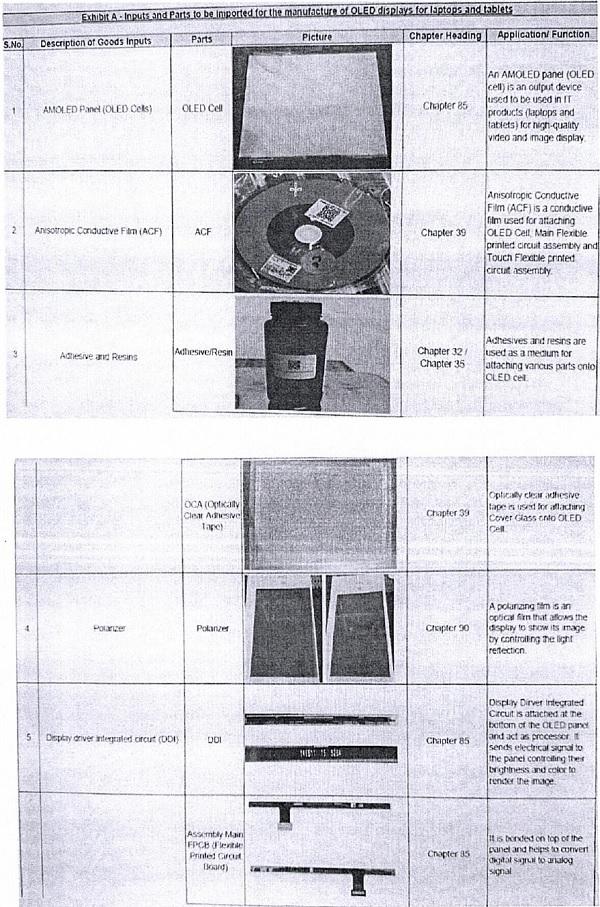
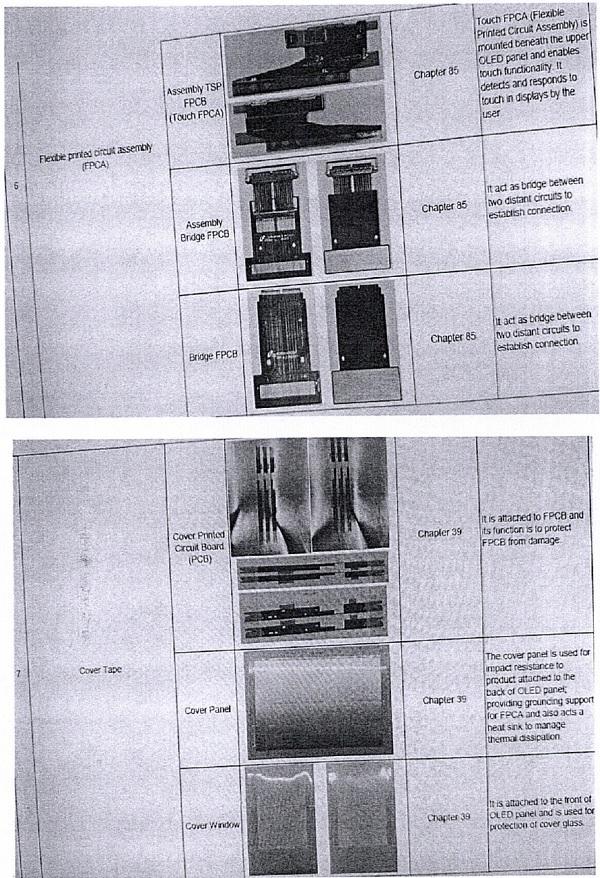
The personal hearing in the matter was conducted on 25.08.2025 wherein the authorized representatives of the applicant attended the same. During the course of personal hearing, it was requested to submit tabular details of products description & detail of how these are being used on OLED display and also mention the details of sub assembly along with photographs etc. During the personal hearing, the authorized representative reaffirmed the points that had already been presented in the applicant’s initial submission. Further, no one has joined from the concerned customs port.
4. Additional Submissions:
4.1 We, M/s Samsung Display Noida Private Limited (`the Applicant’) thank your good office for giving us an opportunity for personal hearing on 25.08.2025 along with our authorized representative.
4.2 As submitted during the hearing, the Applicant is presently engaged in the business of manufacturing of display assemblies at its manufacturing facility at Noida which in turn is supplied to manufacturers engaged in the manufacturing of mobile phones. For manufacturing display assemblies, the Applicant imports various inputs and parts (`current activity’).
4.3 Now, the Applicant is planning to expand its business and venture in manufacturing of OLED displays which in turn will be used in manufacture of laptops and tablets. In this regard, it wishes to import inputs and parts including OLED cells for the manufacture of OLED displays which in turn will be supplied to the manufacturers engaged in the manufacturing of laptops and tablets (`proposed activity’). In view of the proposed activity, the Applicant has submitted the application to seek clarity on the following issue :
“Whether benefit q.si. No. 39 of the Notification No. 24/ 2005-Customs dated March 1, 2005 (as amended) CATAI 24/ 2005′) shall he available in case of import of inputs or parts including Organic Light Emitting Diode (‘OLED’) cells for the manufacture of OLED displays which in turn will be used for the manufacture of laptops and tablets?”
4.4 Relevant entry of the exemption notification is furnished below for ease of reference:
| S.N | Heading or Sub- ing or tariff item |
Description of goods |
|---|---|---|
| 8. | 8471 | All goods |
| 39. | Any Chapter except Chapter 74 |
All goods except solar tempered glass or solar tempered (anti-reflective coated) glass for the manufacture of goods covered by S. Nos. 1 to 38 above, provided that the importer follows The procedure set out in the Customs (Import of Goods at Concessional Rate of Duty) Rules, 2017. |
4.5 During the personal hearing, the Applicant submitted that for the purpose of manufacturing OLED displays, it will import various inputs and parts. These inputs and parts will be put on the manufacturing line of the Applicant’s facility where these are put through various assembly and testing processes. The final product produced from the manufacturing line will be OLED display for the manufacture of tablets and laptops. Further, the Applicant may also import sub-assemblies of OLED displays from Korea. The sub-assemblies may consist of two or more of such inputs and parts. Post importation, these sub-assemblies will be also put on the manufacturing line for further working upon (i.e., for undertaking assembly and testing operations) at the Applicant’s facility in Noida to manufacture OLED displays.
4.6 With respect to the above, your good office has requested for a submission detailing the following information —
a. List of inputs/ parts to be imported for the proposed activity.
b. Photographs of such inputs/ parts
c. Application (function) for such inputs and parts in the OLED displays;
d. Appropriate tariff Chapter for such inputs and parts
e. List of subassemblies which may consist of two or more of such inputs and parts
4.7 Accordingly, the Company is submitting the required information as under —
| S.No. | Information requested | Submissions |
|---|---|---|
| 1 | List of inputs/ parts to be imported for the proposed activity. | Attached |
| 2 | Photographs of such inputs/ parts | |
| 3 | Application (function) for such inputs and parts in the OLED displays; | |
| 4 | Appropriate tariff Chapter for such inputs and parts | |
| 5 | List of subassemblies which may consist of two or more of such inputs and parts |
|
4.8 In light of the above facts, it is submitted that Applicant satisfy the three-fold condition provided under S.No. 39 of NN 24/ 2005 which is as under:
- Condition 1 – Goods should not be classified under Chapter 74 of the Tariff Act or
qualify as solar tempered glass or solar tempered (anti-reflective coated) glass. - Condition 2 – Goods should be imported for the manufacture of goods covered by SI. No. 1 to Si. No. 38 of NN 24/ 2005.
- Condition 3 – The importer should follow the procedure outlined in the IGCR 2022
4.9 Accordingly, the Applicant prays before CAAR, New Delhi that it is eligible to avail exemption under S. No. 39 of the NN 24/2005 on import of inputs and parts for the manufacture of OLD Display which in turn will be used for the manufacture of laptops and tablets. the Application requests CAAR, New Delhi to take the above Information on record and oblige.
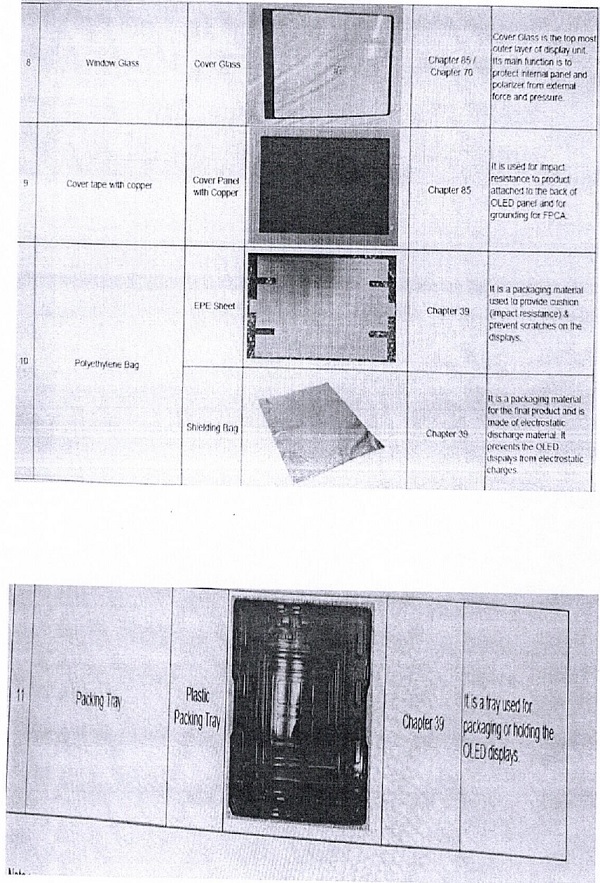
5. Findings, Discussion and Conclusion:
5.1 After finding that the application is valid in terms of the provisions of the Customs Act, 1962 and the CAAR Regulations, 2021, having gone through CAAR-1 application, reply from jurisdictional Commissionerate, oral submissions made during the hearing, synopsis of arguments after hearing and the legal framework governingNotification No. 24/2005-Customs dated 01.03.2005 (hereinafter called in short as “subject notification”), I first allow the application and proceed to deliberate upon the issue on the basis of information available on record.
Product description:
5.2 As per the applicant’s submission, they propose to import various inputs and parts such as AMOLED panels, polarizers, display driver integrated circuits (DDIs), flexible printed circuit assemblies (FPCAs), adhesives, and other related materials for the manufacture of OLED displays, which are specifically intended for use in laptops and tablets. These imported components will undergo assembly and testing processes including polarizer attachment, Chip on Glass (COG), Film on Glass (FOG), lamination, and final inspection at the Applicant’s facility in Noida. In some cases, sub-assemblies comprising two or more such parts may also be imported for further processing. The finished OLED displays will be supplied to manufacturers of laptops and tablets. The Applicant has confirmed that a coding mechanism is in place to ensure that imports used for mobile phone displays are segregated, and the benefit under S. No. 39 of said notification will be availed only for inputs used in the manufacture of OLED displays for laptops and tablets.
Issue of applicability of exemption notification:
5.3 I find that the Applicant has sought a ruling on the eligibility to claim exemption under Sr. No. 39 of Notification No. 24/2005-Customs dated 01.03.2005, as amended, in respect of import of inputs and parts, including OLED cells, which are to be used in the manufacture of OLED displays, which in turn will be supplied to manufacturers engaged in the manufacture of laptops and tablets. The subject Notification grants exemption from the whole of the duty of customs leviable thereon on specified goods subject to condition therein. The relevant Sr. No. 8 & 39 of the said Notification, which is the specific entry under consideration, reads as under:-
| S.No. | Heading, subheading or tariff item | Description |
|---|---|---|
| 8 | 8471 | All goods |
| 39 | All chapters | All goods except Chapter 74 tempered glass or solar tempered (anti-reflective coated) glass for the manufacture of goods covered by Sr. Nos. 1 to 38 above, provided that the importer follows the procedure set out in the Customs (Import of Goods at Concessional Rate of Duty) Rules, 2017 |
5.4 I find that Sr. No. 8 of the said Notification covers “All goods” under tariff heading 8471, which refers to Automatic Data Processing Machines and Units thereof, and encompasses laptops and tablets. Therefore, as per the structure of the Notification, Sr. No. 39 operates as a residuary entry and extends exemption to all goods (except those expressly excluded) that are imported for the purpose of manufacture of items listed at Sr. Nos. 1 to 38, which includes laptops and tablets under Sr. No. 8. I observe that the scope of Sr. No. 39 is clearly end-use based and the benefit thereunder is conditional upon fulfilment of the following three cumulative conditions:-
i. The imported goods should not be classified under Chapter 74;
ii. The imported goods should be used for the manufacture of goods falling under Sr. No. 1 to 38 of the Notification;
iii. The importer must comply with the procedural requirements prescribed under the Customs (Import of Goods at Concessional Rate of Duty or for Specified End Use) Rules, 2022 (IGCR 2022)
5.4.1 I now examine whether the Applicant satisfies the above three conditions. I note that the Applicant has provided a detailed list of goods proposed to be imported for the manufacture of OLED displays, such as AMOLED Panels, Display Driver ICs, Flexible Printed Circuit Assemblies (FPCAs). Adhesives, Polarizers, Window Glass, and other ancillary components as captured at para 4.9. Upon perusal of the classification of these items and based on submissions made, I find that none of the imported goods fall under Chapter 74 of the First Schedule to the Customs Tariff Act, 1975. Further, I find that the Applicant has categorically confirmed that it does not intend to claim the benefit in respect of solar tempered glass or any items falling under Chapter 74, and the benefit under Sr. No. 39 will be restricted only to eligible goods. Accordingly, I find and hold that Condition (i) supra is satisfied.
5.4.2 I find that the Applicant is engaged in the manufacture of OLED displays, which are to be supplied to OEMs/contract manufacturers of laptops and tablets. The key issue for determination is whether inputs and parts imported for manufacturing OLED displays, which in turn are supplied for use in manufacturing laptops and tablets, can be considered as being “for the manufacture of laptops and tablets” under Sr. No. 39 of the Notification. I find that OLED displays are a critical and essential component of laptops and tablets, without which such devices cannot be commercially functional. Accordingly, the manufacturing of OLED displays, which are used solely or principally in laptops and tablets, forms an integral part of the overall manufacturing process of such final products.
5.4.3 I also take note of the judicial principle of “a part of a part is a part of the whole”, as laid down by the Hon’ble Supreme Court in Collector v. Motor Industries Co. Ltd., 2003 (152) ELT 36 (SC). Applying this principle to the present case, I find that inputs used for the manufacture of OLED displays (which are parts of laptops and tablets) should also be considered as used for the manufacture of laptops and tablets. I further find that the recent ruling of the Hon’ble Authority in Re: Shriprop Aerospace Pvt. Ltd. [(2024) 18 Centax 44 (A.A.R. – Cus. – Del.)], has affirmed the applicability of exemption in similar circumstances, wherein parts of parts (turbo jet engine components) were held to be eligible for exemption as “parts of aircraft” under Notification No. 50/2017-Customs.
5.4.4 Additionally, I take note of CBIC Circular No. 26/2024-Customs dated 21.11.2024, wherein the CBIC has clarified that intermediate manufacturers or component manufacturers who are not themselves the manufacturers of the final product, are still eligible to claim concessional customs duty exemption, provided the imported goods are used in the manufacturing of final goods such as mobile phones and subject to fulfilment of IGCR condition. I find that the principle laid down therein is squarely applicable to the present case, mutatis mutandis, in respect of laptops and tablets underNotification No. 24/2005-Customs dated 01.03.2005. In view of the foregoing discussion, I find and hold that the Applicant satisfies Condition (ii), as the inputs and parts are imported for the manufacture of OLED displays, which are ultimately used in the manufacture of laptops and tablets, goods covered under Sr. No. 8 of the subject Notification.
5.4.5 I note that the benefit under Sr. No. 39 of Notification No. 24/2005-Customs dated 01.03.2005 is expressly subject to compliance with the Customs (Import of Goods at Concessional Rate of Duty or for Specified End Use) Rules, 2022 (IGCR Rules). I find that vide notification No. 74/2022 Customs (N.T.), dated 9th September 2022, the Central Government in supersession of the Customs (Import of Goods at Concessional Rate of Duty) Rules, 2017 notified the Customs (Import of Goods at Concessional Rate of Duty or for Specified End Use) Rules, 2022. Rule 5 of the Customs (Import of Goods at Concessional Rate of Duty or for Specified End Use) Rules, 2022 provides for the procedure to be followed. The procedure specified in Rule 5 is furnished below for ease of reference:
1. The importer who intends to avail the benefit of a notification shall be required to mention the UN (referred to in sub-rule (2) of Rule 4) and continuity bond number and details while filing the Bill of Entry.
2. The Deputy Commissioner of Customs or as the case may be. Assistant Commissioner of Customs at the custom station of importation shall allow the benefit of the notification to the importer.
3. Where a Bill of Entry is cleared for home consumption, the bond submitted by the importer gets debited automatically in the customs automated system and the details shall be made available electronically to the jurisdictional Customs Officer.
5.4.5.1 In the case on hand, I note that the Applicant has confirmed on record that it shall duly comply with all procedural requirements under Rule 5 of the IGCR 2022, including execution of the continuity bond, maintenance of import records, submission of end-use details, and other compliances as mandated under the said Rules. I also note that the jurisdictional Commissionerate has not raised any objection on this aspect. Accordingly, I find and hold that the Applicant fulfils Condition (iii) supra.
5.5 I further note that the subject Notification was issued in pursuance of India’s obligations under the Information Technology Agreement (ITA), 1996, and is an ITA-bound notification. As per Attachment B of the ITA, flat panel displays and parts thereof for IT products such as laptops and tablets are covered within the scope of exemption. Though OLED technology is a recent advancement not expressly named in the original ITA text, I find that the expression –other technologies” is broad enough to include OLED flat panel displays and their parts. Accordingly, import of parts for OLED displays used in laptops and tablets is consistent with the policy intent and scope of the ITA.
6. In view of the above findings, and upon consideration of the facts and applicable law, I hold that the Applicant is eligible to avail the benefit under Sr. No. 39 of Notification No. 24/2005-Customs dated 01.03.2005, as amended, in respect of import of inputs and parts including OLED cells, subject to the following conditions:
i. The imported goods are not classified under Chapter 74 or are not solar tempered glass or anti-reflective coated solar tempered glass;
ii. The imported goods are used for the manufacture of OLED displays, which are in turn supplied for manufacture of laptops and tablets, i.e., goods falling under Sr. No. 8 of the Notification;
iii. The Applicant shall comply with all provisions of the IGCR Rules, 2022;
iv. The Applicant shall ensure that no exemption is availed in respect of any goods used for non-qualifying end use or diverted for retail sale or other purposes.
7. I, rule accordingly.