Bharti Enterprises Vs Commissioner (Delhi High Court)
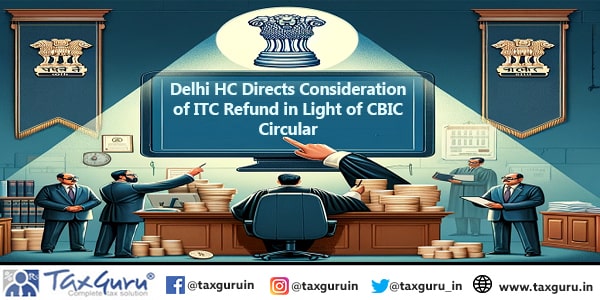
Introduction: In a significant legal development, the Delhi High Court has intervened in the case of Bharti Enterprises versus the Commissioner. The court’s directive pertains to the consideration of an Input Tax Credit (ITC) refund application in light of a Circular issued by the Central Board of Indirect Taxes and Customs (CBIC). This article delves into the details of the case, analyzing the implications of the court’s decision.
Detailed Analysis: The crux of the matter lies in the rejection of Bharti Enterprises’ application for an ITC refund, dated 27th July 2022, by Respondent No. 2. The rejection was primarily based on the contention that the application was filed belatedly. Despite a show cause notice issued to the petitioner, no response was furnished, leading to the dismissal of the application.
However, the scenario took a turn following the issuance of a Notification by the CBIC on 5th July 2022. This Notification, in alignment with the directives of the Supreme Court, extended the period of limitation, thereby affecting applications under Section 54 of the Central Goods and Services Tax Act, 2017. Consequently, Bharti Enterprises’ application for an ITC refund fell within the revised limitation period, as per the Circular.
The High Court, cognizant of these developments, found merit in Bharti Enterprises’ plea for reconsideration. Considering the retrospective effect of the Circular, the Court deemed it appropriate to remand the matter to Respondent No. 3 for a fresh consideration of the refund application.
This decision underscores the significance of legal interpretations in light of evolving regulatory frameworks. It emphasizes the need for responsive adjudication, especially in cases where subsequent developments alter the legal landscape. The Court’s intervention ensures that the petitioner’s rights are upheld within the framework of the law, showcasing the judiciary’s commitment to fair and equitable justice.
Conclusion: The case of Bharti Enterprises versus the Commissioner highlights the dynamic nature of legal proceedings, particularly in matters concerning taxation and regulatory compliance. The Delhi High Court’s directive to reconsider the ITC refund application in light of the CBIC Circular signifies a balanced approach towards addressing the petitioner’s grievances. It underscores the importance of legal precedent and regulatory clarity in ensuring procedural fairness and upholding the rights of taxpayers. This ruling sets a precedent for similar cases, emphasizing the judiciary’s role in interpreting and applying the law to achieve equitable outcomes.
FULL TEXT OF THE JUDGMENT/ORDER OF DELHI HIGH COURT
1. Issue notice.
2. Mr. Rajeev Aggarwal, learned counsel accepts notice on behalf of respondents. With the consent of parties, petition is taken up for final disposal.
3. Petitioner impugns order dated 27.07.2022 (hereafter ‘the impugned order’), passed by Respondent No. 2, rejecting the application filed by the petitioner seeking refund of accumulated input tax credit (hereafter ‘ITC’). Petitioner had filed the subject application on 12.04.2022, seeking refund of the ITC relating to tax periods July 2020 to December 2020. A Tabular statement indicating the details of the said application is set out below: