
Evershine Recreation Private Limited Vs DCIT (ITAT Chandigarh)
ITAT Chandigarh held that reopening of assessment under section 147 of the Income Tax Act based on wrong and irrelevant facts recorded under the reasons recorded for the formation of belief of escapement of income chargeable to income tax is unsustainable in law and liable to be quashed.
Facts- Vide the present appeal, the appellant contested that CIT(A) has gone wrong in upholding the Assessing Officer’s action whereby he issued notice u/s. 148 of the Income Tax Act, 1961 by merely relying on third party information without application of mind and without first verifying the facts from the record.
Further, CIT(A) has wrongly upheld the reassessment which was bad in law, being made without following the principles of natural justice, equity and fair play.
The appellant also contended that the initiation of reopening proceedings was wrongly upheld, since such initiation was based on information contained in the search material found during the search of a third party, which is contrary to the non-obstante clause contained in Sections 153A/153C of the Income Tax Act.
Conclusion- Held that the learned Commissioner of Income Tax (Appeals) has erred in upholding the Assessing Officer reliance on a third party opinion without application of his own mind, without verifying the facts from the record before issuing the notice under section 148 of the Income Tax Act.
Held that the learned Commissioner of Income Tax (Appeals) has gone wrong in upholding the initiation of the re-opening of the completed assessment on the basis of information contained in search material found during search of a third party. Since there was no incriminating material, the initiation, completion and consequential upholding of the re-assessment proceedings is not sustainable in law.
Held that the learned Commissioner of Income Tax (Appeals) erroneously upheld the re-opening, which was based on wrong and irrelevant facts recorded under the reasons recorded for the formation of belief of escapement of income chargeable to income tax for reopening by the Assessing Officer. We, therefore, cancel the assessment, as the grounds on which reassessment notice was issued are not found to exist or found to be irrelevant.
FULL TEXT OF THE ORDER OF ITAT CHANDIGARH
This is an appeal filed by the assessee, which is a company, against the order dated 31.10.2022 passed by the learned Commissioner of Income Tax (Appeals)-3, Gurgaon, for the Assessment Year 2012-13, raising the following Grounds of Appeal:
1. That the order of the learned Commissioner of Income Tax (Appeals) is bad and against the facts and Law.
2. That the learned Commissioner of Income Tax (Appeals) has wrongly upheld reliance by the Assessing officer upon third party information without application of his own mind and without verifying the facts from the record before issuing notice under section 148 of the Income Tax Act, 1961.
3. That the learned Commissioner of Income Tax (Appeals) has wrongly upheld reassessment which was bad in law being made without following the principles of natural justice, equity and fair play.
4. That the learned Commissioner of Income Tax (Appeals) has wrongly upheld the reopening under section 148 against the provisions of the Income Tax Act, 1961 after four years of completion of original assessment under section 143(3) of the Income Tax Act, without any allegation by the learned Assessing Officer that all material facts necessary for the assessment had not been disclosed fully and truly during assessment.
5. That the learned Principal Commissioner of Income Tax has wrongly granted approval without application of his mind and without verifying the facts from the record before granting approval for issue of notice under section 148 of the Income Tax Act,1961.
6. That the learned Commissioner of Income Tax (Appeals) has wrongly upheld the initiation of action under section 147 of the Income Tax Act on the basis of information contained in the search material found during search of a third party, which is contrary to law in view of the non-obstante clause in Section 153A/153C specifically prohibiting action under section 147 of the Income Tax Act.
7. That even otherwise, the initiation of proceedings under section 148 of the Income Tax Act and the consequent assessment under section 147 thereof is contrary to law in the absence of any incriminating material to form reason to believe based on the report of the Investigation Wing, which only suggests to the Assessing Officer to examine the details and only after examination, to determine whether there could be any justification for initiation of action under section 147 of the Income Tax Act. Thus, the issue of notice under section 148 of the Income Tax Act and consequent reassessment under section 147 thereof is without the authority of law and do not provide jurisdiction to the Assessing Officer to make reassessment under section 147 of the Income Tax Act.
8. That the learned Commissioner of Income Tax (Appeals)has wrongly upheld the reopening on the basis of wrong or irrelevant reasons recorded for the formation of belief of escapement of income chargeable to income tax, recorded by the Assessing Officer before issue of notice under section 148 of the Income Tax Act, 1961 and also the permission from the learned Principal Commissioner of Income Tax was taken by stating wrong & irrelevant facts before him.
9. Whether any information based on the statement of the searched person can be relied upon without providing opportunity of cross examination of such person, as requested by the appellant.
10. That the learned Commissioner of Income Tax (Appeals) has wrongly made addition of Rs. 3,90,00,000/- under section 68 of the Income Tax Act.
11.That the learned Commissioner of Income Tax (Appeals) has erred on facts and in law in upholding the additions on account of wrongly alleged accommodation entries or credits received from wrongly alleged shell entities, merely following the investigation report and treating the vague and general information of the Investigation wing as sacrosanct, ignoring the voluminous evidence to the contrary brought on record by the assessee.
12.That the appellant craves leave to add, alter, amend or withdraw any grounds of appeal before the final hearing.
GROUND NO. 1
2. Ground No. 1 is general in nature.
GROUND NOS. 2, 3, 6 to 8 AND 11
3. As per Ground No.2, the learned Commissioner of Income Tax (Appeals) has gone wrong in upholding the Assessing Officer’s action whereby he issued notice under section 148 of the Income Tax Act, 1961 (hereinafter called ‘the Income Tax Act’) by merely relying on third party information without application of mind and without first verifying the facts from the record. This Ground corresponds to Original Ground No. 2 and Additional Ground Nos. 1, 5 and 7, taken by the assessee company before the learned Commissioner of Income Tax (Appeals), as follows:
4. Original Ground No.2 taken before the learned Commissioner of Income Tax (Appeals):
“2. That the learned Assessing Officer has wrongly reopened the completed assessment under section 148 of the Income Tax Act.”
5. Additional Ground No. 1 taken before the learned Commissioner of Income Tax (Appeals):
“That the learned Assessing Officer has wrongly relied upon third party information without application of his own mind and without verifying the facts from the record before issuing notice under section 148 of the Income-tax Act, 1961.”
6. Additional Ground No. 5 taken before the learned Commissioner of Income Tax (Appeals):
“That even otherwise, the initiation of proceedings under section 148 and the consequent assessment under section 147 is contrary to law in the absence of any incriminating material to form reason to believe based on the report of the Investigation Wing, which only directs the Assessing Officer to examine the details and only after examination, to determine whether there could be any justification for initiation of action under section 147. Thus, the issue of notice under section 148 and the consequent assessment under section 147 is without the authority of law and do not provide jurisdiction to the Assessing Officer to make reassessment under section 147.”
7. Additional Ground No. 7 taken before the learned Commissioner of Income Tax (Appeals):
“That the learned Assessing Officer has erred on facts and in law in making addition on account of wrongly alleged accommodation entries or credits received from wrongly alleged shell entities, merely following the investigation report and treating the vague and general information of the Investigation Wing as sacrosanct, ignoring the voluminous evidence to the contrary brought on record by the assessee”.
8. Ground No. 3 states that the learned Commissioner of Income Tax (Appeals) has wrongly upheld the reassessment which was bad in law, being made without following the principles of natural justice, equity and fair play. The Ground corresponds to Original Ground No. 3 and Additional Ground No. 6 taken before the learned Commissioner of Income Tax (Appeals).
9. Ground No. 6 corresponds to Additional Ground No. 4 raised before the learned Commissioner of Income Tax (Appeals). As per this Ground, the initiation of reopening proceedings was wrongly upheld, since such initiation was based on information contained in the search material found during the search of a third party, which is contrary to the non-obstante clause contained in Sections 153A/153C of the Income Tax Act.
10. As per Ground No. 7, since there was no incriminating material available with the Assessing Officer to enable formation of any reason to believe escapement of income chargeable to income tax, the initiation of the re-opening proceedings and the assessment order passed in consequence thereto, is not sustainable, having been passed merely on the report of the Investigation Wing of the Department, which suggested to the Assessing Officer to examine the details, and only thereafter, to determine if there could be any justification for initiation of the re-opening proceedings. This Ground No. 7 corresponds to Additional Ground Nos. 5 and 7 (reproduced in para no. 7 above) raised by the assessee company before the learned Commissioner of Income Tax (Appeals).
11. According to Ground No. 8, wrong and irrelevant reasons recorded for the formation of belief of escapement of income chargeable to income tax formed the basis of the re-opening, as also the approval from the learned Principal Commissioner of Income Tax was taken on the basis of wrong and irrelevant facts, and so, the re-opening has wrongly been upheld.
12. According to Ground No. 11, the reopening was wrongly upheld by the learned Commissioner of Income Tax (Appeals), without considering the material on record and relying on wrong allegations of accommodation entries and shell entities, and merely following the report of the Investigation Wing of the Department.
13. Ground Nos. 2, 3, 6 to 8 and 11 have been argued together by the parties, against the reopening of the completed assessment, under the umbrella of “borrowed satisfaction”, “wrong and irrelevant facts and reasons”, “violation of the principles of natural justice” and “assessment under sections 153 A/153C of the Income Tax Act”.
As such, these Grounds are being dealt with together.
OBSERVATIONS AND FINDINGS IN THE ASSESSMENT ORDER
14. In the assessment order, the Assessing Officer observed that the assessee company had filed its return of income for the year under consideration, that is, assessment year 2012-13, at a total income of Rs. Nil, on 29.9.2012.
14.1 The Assessing Officer observed that the return was processed as such under section 143(1)(a) of the Income Tax Act, on 08.03.2014.
14.2 The Assessing Officer observed that thereafter, the assessment was completed under section 143(3) of the Income Tax Act, on 05.09.2014, at the returned income of Rs. Nil.
14.3 The Assessing Officer observed that subsequently, a search as well as survey operation under sections 132 and 133A of the Income Tax Act was conducted at various premises of persons related to the Punjab Sand Mining Auction group of cases, on 16.02.2018.
14.4 The Assessing Officer observed that the case of the assessee company belongs to the Punjab Sand Mining Auction group of cases.
14.5 The Assessing Officer observed that in this case, information had been received from the Investigation Wing of the Department, that in the State Bank of India (erstwhile Bank of Patiala) Bank Account No. 65012097085, SME Branch, Third Floor, SCO Nos. 43-48, Bank Square, Sector 17, Chandigarh, the assessee company has total credit entries of Rs. 25,83,50,000/-, including cash deposit of Rs. 71 lacs, during the financial year 2011-12 (assessment year 2012-13).
14.6 The Assessing Officer observed that on perusal of the bank statement, it was found that there are multiple credit entries in this bank account, despite the fact that the assessee company, M/s Evershine Recreation Pvt. Limited, was not undertaking any business activity during the year and it was only a shell entity having no profit earning apparatus of its own.
14.7 The Assessing Officer observed that moreover, there are multiple instances of cash deposits also in this bank account statement.
14.8 The Assessing Officer observed that the same has not been disclosed by the assessee company in its Income Tax Return.
14.9 The Assessing Officer observed that further, information was also received from the Income Tax Officer, Ward 1(5), Chandigarh, that M/s Evershine Recreation Private Limited had taken accommodation entries from the Himanshu Group of companies.
14.10 The Assessing Officer observed that thereupon, the provisions of Section 147 of the Income Tax Act were invoked by the Assessing Officer, after recording the reasons for the formation of belief of escapement of income chargeable to income tax, and notice under section 148 of the Income Tax Act was issued to the assessee company on 30.03.2019, on obtaining approval dated 29.03.2019 from the learned Principal Commissioner of Income Tax (Central), Gurgaon.
14.11 The Assessing Officer observed that in response to the said notice issued under section 148 of the Income Tax Act, the assessee company filed its return of income on 18.04.2109, at a total income of Rs. Nil.
14.12 The Assessing Officer observed that the assessee company filed its objections dated 20.06.2019 and 02.08.2019 against the reassessment proceedings.
14.13 The Assessing Officer observed that these objections were settled / disposed of by the Assessing Officer vide letter dated 08/21.10.2019; that a search and seizure operation under section 132(1) of the Income Tax Act was carried out on the Himanshu Verma Group of cases, on 29.03.2012 by the Investigation Wing, Delhi.
14.14 The Assessing Officer observed that during the search, it was unearthed that Shri Himanshu Verma was engaged in activities of providing accommodation entries to various beneficiaries by forming numerous corporate and non-corporate entities, where the directors / partners / proprietors were his employees and close associates.
14.15 The Assessing Officer observed that one of the modus operandi of Shri Himanshu Verma was that he used to take cash from the beneficiaries, deposit the same in some of his entities’ / individual bank account, routing the same and finally remitting it to the various companies of the beneficiary group in the form of share application money, share capital and unsecured loans. The Assessing Officer observed that vide notice dated 22.10.2019, the Assessing Officer required the assessee company to furnish the complete details of transactions undertaken by it with the Himanshu Group of companies during the year under consideration and copies of the Income Tax Return, Audit Report and bank account statement of the entities from whom the amount of Rs. 3,90,00,000/- had been received by it during the year, and also to produce the Directors of the Himanshu Group of companies for examination.
14.16 The Assessing Officer observed that in response, the assessee company had submitted that it had not entered into any transaction with the Himanshu Group of companies during the year under consideration.
14.17 The Assessing Officer observed that this plea of the assessee company had been considered, but it had not been found to be correct on merits.
14.18 The Assessing Officer observed that the assessee company had received an amount of Rs. 3,90,00,000/- from the companies of the Himanshu Group during the year under consideration, in its Bank Account No. 65012097085, in the State Bank of India (erstwhile Bank of Patiala), SME Branch, Third Floor, SCO Nos. 43-48, Bank Square, Sector 17, Chandigarh, that is, an amount of Rs.1,47,00,000/- from M/s White Collar Management Services Private Limited, an amount of Rs. 1 crore from Bliss Buildcon Private Limited, an amount of Rs. 85 lacs from Omexpo Ent. Private Limited, an amount of Rs.30 lacs from Rising Portfolio India Private Limited, an amount of Rs. 20 lacs from Saffron Logistics Private Limited, and an amount of Rs. 8 lacs from New Millennium Consultants Private Limited.
14.19 The Assessing Officer observed that statement of Shri Himanshu Verma, on oath, under section 132(4) of the Income Tax Act, had been recorded on 29.03.2012, in which, he had clearly accepted that he was managing and controlling a number of companies / firms / sole proprietary concerns, exclusively for the purposes of providing accommodation entries through cheques in lieu of cash, through more than seventy to eighty companies, firms and sole proprietary concerns, to different parties.
14.20 The Assessing Officer observed that from such statement, it was very clear that Shri Himanshu Verma was engaged in the business of providing accommodation entries to various parties.
14.21 The Assessing Officer observed that Shri Himanshu Verma had also provided the list of the said seventy to eighty companies which were controlled and managed by him for providing the accommodation entries.
14.22 The Assessing Officer observed that the companies mentioned earlier were all those companies, through which, Shri Himanshu Verma had provided accommodation entries to the assessee company.
14.23 The Assessing Officer observed that Shri Himanshu Verma had also cited the names of the employees who were made Directors by him in his said companies.
14.24 The Assessing Officer observed that some of them were Shri Neeraj Kumar Singh (Director of White Collar Management), Shri Baljeet Singh Sandhu, (Director of Omexpo Enterprises and Shri Saurav Malhotra (Director of Saffron Logistics & Bliss Build Co. Private Limited).
14.25 The Assessing Officer observed that these persons were only his employees, which fact had been admitted by him in his statement.
14.26 The Assessing Officer observed that further, the assessee company had not provided any plausible explanation for the credit entries of Rs.3,90,00,000/-during the year under consideration, which showed that the amount credited in its Bank Account was not a genuine transaction.
14.27 The Assessing Officer observed that the assessee company had not carried out any business activity during the year, but had raised huge unsecured loans. The Assessing Officer observed that the assessee company had also failed to furnish confirmations from the parties, its Audit Report, Income Tax Return and Bank Account Statement from the parties from whom the amount had been received, and it had also failed to prove the credit worthiness of these parties.
14.28 The Assessing Officer observed that moreover, the assessee company had not produced the Directors of the Himanshu Group of companies for examination.
14.29 The Assessing Officer observed that therefore, the amount of Rs.3,90,00,000/- credited by the assessee company in its bank account during the year under consideration was being held to be the unexplained cash credits of the assessee company within the meaning of Section 68 of the Income Tax Act, and the same was being added to the income of the assessee.
14.30 The Assessing Officer observed that further, the assessee company had also received an amount of Rs.2,48,00,000/- in its bank account no.65012097085 from M/s TJR Properties Private Limited during the year under consideration.
14.31 The Assessing Officer observed that during the search and seizure operation under section 132(1) of the Income Tax Act, conducted on the Punjab Sand Mining Group of cases on 16.02.2018, it had been found that M/s TJR Properties Private Limited and M/s Evershine Resort Private Limited, on whom, search had been conducted at SCO Nos. 80-81, Fourth Floor, Sector 17-C, Chandigarh, on 16.02.2018, were shell companies that existed only on paper and had no profit earning apparatus of their own as such, because these companies were not carrying on any kind of business activities whatsoever.
14.32 The Assessing Officer observed that during the search, statement of Shri Jagdish Rai Gupta was recorded on oath under section 132(4) of the Income Tax Act.
14.33 The Assessing Officer observed that Shri Jagdish Rai Gupta had clearly stated that M/s TJR Properties Private Limited was not involved in any kind of business activity.
14.34 The Assessing Officer observed that further, Shri Jagdish Rai Gupta had denied any knowledge of any business transactions from bank transactions carried out by M/s TJR Properties Private Limited.
14.35 The Assessing Officer observed that thus, M/s TJR Properties Private Limited was a shell company and the amount received by the assessee company from M/s TJR Properties Private Limited was not at all genuine and its credit worthiness could not be proved under any circumstances.
14.36 The Assessing Officer observed that therefore, the amount of Rs. 2,48,00,000/- credited by the assessee company in its bank account during the year under consideration was being held to be the unexplained cash credits of the assessee company within the meaning of Section 68 of the Income Tax Act and the same was being added to the income of the assessee company.
14.37 In this manner, the Assessing Officer made total addition of Rs. 6,38,00,000/- to the income of the assessee company.
ASSESSEE’S CONTENTIONS BEFORE THE COMMISSIONER OF INCOME TAX (APPEALS)
15. In its appeal before the learned Commissioner of Income Tax (Appeals), the assessee company contended that the Assessing Officer had wrongly reopened the completed assessment of the assessee company under section 148 of the Income Tax Act and the Assessing Officer had wrongly passed the assessment order in violation of the principles of natural justice.
15.1 The assessee contended that the Assessing Officer had wrongly relied on third party information without application of his own mind and without verifying the facts from the record before issuing the notice under section 148 of the Income Tax Act. The assessee contended that even otherwise, the initiation of proceedings under section 148 of the Income Tax Act and the consequent assessment under section 147 of the Income Tax Act was contrary to law in the absence of any incriminating material to form the reasons recorded for the formation of belief of escapement of income chargeable to income tax, based on the report of the Investigation Wing of the Department, which report only suggested to the Assessing Officer to examine the details and only after such examination, to determine whether there could be any justification for initiation of action under section 147 of the Income Tax Act.
15.2 The assessee contended that thus, the issuance of notice under section 148 of the Income Tax Act and the consequent assessment under section 147 of the Income Tax Act was beyond the authority of law, which did not provide jurisdiction to the Assessing Officer to make re-assessment under section 147 of the Income Tax Act. The assessee contended that the Assessing Officer had erred in making additions on account of wrongly alleged accommodation entries or credits received by the assessee company from wrongly alleged shell entities, merely following the Investigation Report of the Investigation Wing of the Department and treating the vague and general information contained in the report of the Investigation Wing of the Department as sacrosanct, ignoring the voluminous documentary evidence to the contrary, brought on record by the assessee company. The assessee contended that the Assessing Officer had acted illegally, merely on borrowed satisfaction.
15.3 The assessee submitted that notice issued after the expiry of four years from the end of the relevant assessment year by the Assessing Officer, merely acting mechanically on the information supplied by the Investigation Wing of the Department about the alleged accommodation entries provided by a person to certain entities, without applying his own mind, has been held to be not justified, in the decisions in
“PCIT Vs G.Pharma India Limited”, 384 ITR 147 (Del),
“CIT Vs Meenakshi Overseas PRIVATE Limited”, 395 ITR 67 (Del),
“Panchanan Hati Vs CIT”, 115 ITR 336 (Cal), and
“Calcutta Discount Company Limited Vs Income Tax Officer”, 41 ITR 191 (SC).
15.4 The assessee submitted that the Assessing Officer’s action of re-opening the completed assessment of the assessee company had been guided solely by the fact that there had been certain transactions between the assessee company and some persons.
15.5 The assessee submitted that the investigation conducted by the Investigation Wing of the Department could not be the final conclusion on which reliance could be rested by the Assessing Officer.
15.6 The assessee submitted that there had to be some live link between the information relied on by the Assessing Officer and the alleged escapement of income that while forming a belief that income chargeable to tax has escaped assessment, the information so relied on and the escapement of the income have to have a direct nexus inter-se, in the absence of which, the reassessment becomes liable to be declared null and void and quashed. The assessee contended that a perusal of the reasons for the formation of the belief of escapement of income chargeable to income tax, as recorded by the Assessing Officer in the assessee’s case would show that an outright allegation has been leveled against the assessee company to be a beneficiary, whereas it is evident that there is no direct live link between the information received and the alleged escapement of income chargeable to tax.
15.7 The assessee contended that it was imperative on the assessing authority to have analyzed the information to take the case in the right direction, rather than proceeding to raise the issue on some vague suspicion. The assessee contended that in the absence of any such direct live link and necessary verification/examination by the Assessing Officer, it was evident that no application of mind had been exercised by the Assessing Officer at the time of initiating the proceedings under section 147 of the Income Tax Act.
15.8 The assessee urged that in this regard, reliance was being placed on the decisions in the cases of
“PCIT Vs Meenakshi Overseas Private Limited”, 395 ITR 67(Del),
“PCIT Vs RMG Polyvinyl (I) Limited”, 83 taxmann.com 348 (Del),
“CIT Vs Independent Media PRIVATE Limited”, order dated 19.11.2015, passed by the Hon’ble Delhi High Court, in ITA No. 108/2015,
“Sabh Infrastructure Limited Vs ACIT”, order dated 25.09.2017, passed by the Hon’ble Delhi High Court in Tax WP(C) 1357/2016,
“PCIT-6 Vs Nandan-I-Tech Limited (formerly known as M/s Garg Forgings & Castings Limited)”, decision of the Hon’ble Supreme Court in Special Leave Petition (Civil) Diary No. 19506/2018, and
“PCIT Vs M/s SNG Developers Limited”, decision of the Hon’ble Supreme Court in Special Leave Petition (Civil) Diary No. 42379/2017, dated 09.02.2018.
COMMISSIONER OF INCOME TAX (APPEALS)’S FINDINGS
16. In the impugned order, the learned Commissioner of Income Tax (Appeals) has observed, inter-alia, that the Assessing Officer, in this case, after considering the material in his possession, had recorded reasons, for the formation of belief of escapement of income chargeable to income tax, under section 147 of the Income Tax Act, on 26.03.2019, that income to the extent of Rs.25,83,50,000/- had escaped assessment. The learned Commissioner observed that thereafter, the Assessing Officer had received the approval of the learned Principal Commissioner of Income Tax, Gurgaon, under section 151 of the Income Tax Act, on 29.03.2019. The learned Commissioner observed that accordingly, notice under section 148 of the Income Tax Act had been issued by the Assessing Officer to the assessee company. The learned Commissioner observed that the assessee company had filed its Income Tax Return, in response to the said notice issued by the Assessing Officer under section 148 of the Income Tax Act, on 18.04.2019.
16.1 The learned Commissioner observed that the assessee company had furnished its objections to the said notice, which had been disposed of by the Assessing Officer by passing a speaking order.
16.2 The learned Commissioner observed that the assessee had submitted that no prima-facie reasons recorded for the formation of belief of escapement of income chargeable to income tax existed.
16.3 The learned Commissioner observed that the assessee had submitted that the Assessing Officer’s reasons recorded for the formation of belief of escapement of income chargeable to income tax were merely a mechanical reproduction of the information received from the Investigation Wing of the Department, since the Assessing Officer had not conducted any independent enquiries in this regard.
16.4 The learned Commissioner observed that the assessee had submitted that thus, it was a case of borrowed satisfaction, without application of mind.
16.5 The learned Commissioner observed that the assessee had contended that the reasons recorded for the formation of belief of escapement of income chargeable to income tax were merely a change of opinion of the new Assessing Officer.
16.6 The learned Commissioner observed that the assessee had contended that this was so, since no adverse finding in respect of the credits received by the assessee company had been recorded by the Assessing Officer, whereas the original scrutiny assessment under section 143(3) of the Income Tax Act had been already completed on 15.09.2014.
16.7 The learned Commissioner observed that the assessee had contended that the action taken by the Assessing Officer under section 147 of the Income Tax Act was without jurisdiction, since there was no allegation that the escapement of income had occurred by reason of failure on the part of the assessee company to disclose fully and truly all material facts relevant for its assessment.
16.8 The learned Commissioner observed that the assessee had submitted that the assessee company had already furnished all the documentary evidences in respect of the six companies, from whom the advances had been received by it, before the Assessing Officer, during the original assessment proceedings and no adverse inference had been drawn there-against by the then Assessing Officer at that relevant point of time.
16.9 The learned Commissioner observed that the assessee had submitted that therefore, no re-opening of the completed assessment of the assessee company could be done beyond the period of four years.
16.10 The learned Commissioner observed that the assessee had contended that the learned Principal Commissioner of Income Tax had granted approval for re-opening of the completed assessment without application of mind.
16.11 The learned Commissioner observed that the assessee had contended that the initiation of action under section 147 of the Income Tax Act on the basis of information contained in the search material found during the search of a third party, was contrary to law in view of the non-obstante clause in Sections 153A/153C of the Income Tax Act, specifically prohibiting action under section 147 thereof.
16.12 The learned Commissioner of Income Tax (Appeals) observed that the case of the assessee had been selected for scrutiny through the Computer Aided Scrutiny Selection, the reason for such selection being “large increase in unsecured loans”, during the initial assessment proceedings.
16.13 The learned Commissioner observed that the issue of increase in unsecured loans had been examined by the Assessing Officer and assessment had been made on 15.09.2014, by passing order under section 143(3) of the Income Tax Act.
16.14 The learned Commissioner observed that further, on receiving information from the Income Tax Officer, Ward-1(5), Chandigarh, vide letter No. 5566, dated 04.02.2019, that the assessee company had received credits from six paper companies of Shri Himanshu Verma, an accommodation entry provider, the Assessing Officer had recorded his reasons for the formation of belief that income chargeable to income tax had escaped assessment.
16.15 The learned Commissioner observed that a list of such paper companies had been mentioned.
16.16 The learned Commissioner observed that the said letter also enclosed an Appraisal Report in the case of Shri Himanshu Verma and bank account statement of the assessee company for the year under consideration.
16.17 The learned Commissioner observed that as per the Appraisal Report, a search and seizure operation had been carried out on 29.03.2012 in the case of Shri Himanshu Verma, wherein, he had admitted in his statement, recorded on oath under section 132(4) of the Income Tax Act, that he had been providing accommodation entries to a number of conduits managed and controlled by him, against payment of commission at the rate ranging from 0.7% to 1.0%.
16.18 The learned Commissioner observed that in his statement, Shri Himanshu Verma had admitted that he had been running a network of seventy to eighty paper companies which, in fact, were not having any actual business and were being used only to give accommodation entries to parties.
16.19 The learned Commissioner observed that Shri Himanshu Verma had deposed in his statement that it was for this purpose, that he had made some employees as dummy Directors in these companies, and they used to sign the cheques and other documents to provide the accommodation entries to the parties.
16.20 The learned Commissioner observed that in his statement, Shri Himanshu Verma had mentioned, in answer to Question No.15, that Neha Yadav, Daljeet Singh, Kayanat Khan, Mukesh Kumar, Saurav Malhotra, etc., were some of such employees, who were working as dummy Directors against payment of salary of amounts ranging from Rs.2000/- to Rs.5000/-.
16.21 The learned Commissioner observed that Shri Himanshu Verma had stated that these names were also appearing as Directors in the companies from whom the assessee company had taken advances during the year under consideration, for Rs.3,90,00,000/-.
16.22 The learned Commissioner observed that in answer to Question No. 15, Shri Himanshu Verma had given a list of eighty three paper companies being managed and controlled by him, alongwith the list of bank accounts operated by him to run the activities of providing accommodation entries to parties.
16.23 The learned Commissioner observed that Shri Himanshu Verma had stated that the names of all the six companies from which the assessee company had taken advances, were included in the said list.
16.24 The learned Commissioner observed that the names of Dhanlaxmi Bank and Axis Bank were also mentioned in answer to Question No.15 by Shri Himanshu Verma, which Banks had been used by him to provide accommodation entries.
16.25 The learned Commissioner observed that through these bank accounts, the assessee had received the advances of Rs.3.90 crore from the said six paper companies.
16.26 The learned Commissioner observed that the Appraisal Report contained detailed findings and the details of the modus-operandi adopted by Shri Himanshu Verma for the purpose of providing accommodation entries to various beneficiaries.
16.27 The learned Commissioner observed that the Assessing Officer had considered the said information alongwith the findings as contained in the Appraisal Report and had reconciled the said information with the particulars contained in the Income Tax Return.
16.28 The learned Commissioner observed that the assessee company had contended that it had submitted all the documentary evidences in respect of the said six companies, from whom the advances were received by it, before the Assessing Officer during the course of the original assessment proceedings.
16.29 The learned Commissioner observed that the assessee had contended that no adverse inference had been drawn against the said documentary evidences by the Assessing Officer in the original assessment order passed on 15.09.2014, under section 143(3) of the Income Tax Act. The learned Commissioner observed that the assessee had urged that therefore, no reopening of the completed assessment of the assessee company could have been done by the Assessing Officer beyond the period of four years from the end of the relevant assessment year, since all the material facts in respect of the credits received by the assessee company stood fully and truly disclosed by the assessee before the Assessing Officer during the original assessment proceedings.
16.30 The learned Commissioner observed that from the assessment record, it was found that the case of the assessee company had been selected for scrutiny through the Computer Aided Scrutiny Selection, for the reason “large increase in unsecured loans”.
16.31 The learned Commissioner observed that the issue of increase in unsecured loans had been examined by the Assessing Officer and the assessment had been completed on 15.09.2014, by passing an order under section 143(3) of the Income Tax Act.
16.32 The learned Commissioner observed that in this regard, it had been observed from the Office Note appended to the said assessment order dated 15.09.2014, that therein, it was clearly stated that the case had been examined on account of large increase in unsecured loans.
16.33 The learned Commissioner observed that the said credits of Rs.3,90,00,000/- had not been reflected by the assessee company in its Balance Sheet as on 31.03.2012, under the head “Long Term Borrowings”.
16.34 The learned Commissioner observed that rather, the same had been reflected under the head “Advance against land – Note-4”, adjusted against fixed assets [Note-7(a) of the Balance Sheet].
16.35 The learned Commissioner observed that therefore, the said credits of Rs.3.90 crore had not been the subject-matter of examination during the original assessment proceedings.
16.36 The learned Commissioner observed that the Assessing Officer was even not having the jurisdiction to examine such credits shown as advances against land under the Computer Aided Scrutiny Selection parameters.
16.37 The learned Commissioner observed that on the strength of such facts, it could not be said that all the material facts in respect of the said credits received by the assessee company during the year under consideration had been fully and truly disclosed by the assessee before the Assessing Officer in the course of the original assessment proceedings.
16.38 The learned Commissioner observed that moreover, it was evident that no opinion had been formed by the Assessing Officer during the original assessment proceedings in respect of such credits.
16.39 The learned Commissioner observed that subsequently, the Assessing Officer had come in possession of tangible information through the letter of the Income Tax Officer Ward-1(5), Chandigarh, that the credits of Rs. 3,90,00,000/- were, in fact, in the nature of accommodation entries received by the assessee company from paper companies run by Shri Himanshu Verma.
16.40 The learned Commissioner observed that thus, in the said letter, alongwith the annexure of Appraisal Report in the case of Shri Himanshu Verma and the bank account statement of the assessee company for the year under consideration, there was prima-facie credible information in the possession of the Assessing Officer, that the assessee company had obtained accommodation entries amounting to Rs. 3,90,00,000/- from various entities of the Himanshu Verma Group, an accommodation entry provider.
16.41 The learned Commissioner observed that the said information contained the list of the six entities being operated by the said Himanshu Verma group, through whom, the assessee company had obtained the accommodation entries.
16.42 The learned Commissioner observed that the Assessing Officer was having prima-facie credible information in his possession that the assessee company had taken accommodation entries from Shri Himanshu Verma, for Rs. 3,90,00,000/-.
16.43 The learned Commissioner observed that the Assessing Officer had drawn such inference on the strength of specific information obtained consequent to the search and seizure action in the case of Shri Himanshu Verma.
16.44 The learned Commissioner observed that such information was based on the statements of Shri Himanshu Verma and other dummy Directors of the paper companies run by him, and on the various documents seized during the course of the search.
16.45 The learned Commissioner observed that thus, there was prima-facie material in the possession of the Assessing Officer to draw the inference that income had escaped assessment within the meaning of Section 147 of the Income Tax Act.
16.46 The learned Commissioner observed that at the stage of formation of belief of escapement of income under section 147 of the Income Tax Act, it is necessary for the Assessing Officer to have with him, the existence of material leading to the recording of prima-facie reasons for the formation of belief of escapement of income chargeable to income tax, but their sufficiency cannot be examined at that stage.
16.47 The learned Commissioner observed that clearly, in the assessee’s case, the Assessing Officer was having in his possession, tangible material to draw such an inference.
16.48 The learned Commissioner stated that reliance was being placed on
“Raymond Woollen Mills Versus Income Tax Officer”, 236 ITR 34 (SC),
“ACIT Versus Rajesh Jhaveri Stock Brokers Private Limited”, 291 ITR 500 (SC), and
“Sterlite Industries (I) Limited Versus Assistant Commissioner of Income Tax & Another”, 302 ITR 275 (Mad).
16.49 The learned Commissioner observed that at the time of re-opening, the Assessing Officer is not required to establish escapement of income, as held by the Hon’ble Supreme Court in its decision in the case of “Shri Krishana Private Limited Vs CIT”, 221 ITR 538 (SC).
16.50 The learned Commissioner observed that what is necessary to reopen an assessment is not the final verdict, but a prima-facie reason.
16.51 The learned Commissioner observed that clearly, in this case, the Assessing Officer was having prima facie tangible material to believe that income chargeable to tax had escaped assessment.
16.52 The learned Commissioner observed that it was not a case where the Assessing Officer had acted mechanically merely on the basis of information received from the Investigation Wing of the Department, or from the Income Tax Officer, Ward-1(5) Chandigarh.
16.53 The learned Commissioner observed that the Assessing Officer’s action of re-opening the completed assessment of the assessee company was based on specific information giving details of the accommodation entries received by the assessee company through the entry provider, with amount, identity involved and details of the modus operandi adopted.
16.54 The learned Commissioner observed that there was due application of mind by the Assessing Officer independently before recording the reasons for the formation of belief of escapement of income chargeable to income tax.
16.55 The learned Commissioner observed that subsequent to obtaining information from the Income Tax Officer, Ward-1(5), Chandigarh, the Assessing Officer had gone through the relevant material in the shape of the statement of Shri Himanshu Verma, recorded under section 132(4) of the Income Tax Act, the Appraisal Report and the particulars as contained in the Income Tax Return of the assessee company, in the light of the information obtained.
16.56 The learned Commissioner observed that thus, the Assessing Officer had based his belief of escapement of income upon such tangible information.
16.57 The learned Commissioner observed that the material available with the Assessing Officer at the time of initiating proceedings for reopening the completed assessment of the assessee company under section 147 of the Income Tax Act showed that there was a live link between the assessee company and the alleged accommodation entries taken by it through the entities managed and controlled by Shri Himanshu Verma, with specific details of transactions and the belief formed.
16.58 The learned Commissioner observed that therefore, the Assessing Officer had a prima facie belief that income chargeable to tax had escaped assessment.
16.59 The learned Commissioner further observed that the assessee had contended that the reasons recorded for the formation of belief of escapement of income chargeable to income tax were merely a change of opinion of the new Assessing Officer, since no adverse finding in respect of the credits received by the assessee company had been recorded by the Assessing Officer in the original scrutiny assessment proceedings, whereas the original assessment order under section 143(3) of the Income Tax Act had already been finalized and passed on 15.09.2014; that however, this argument of the assessee company did not carry any merit; that the Assessing Officer acquires jurisdiction to reopen an assessment under section 147 of the Income Tax Act on the basis of tangible information in his possession, subsequent to which, he has reasons for the formation of belief of escapement of income chargeable to income tax, which he must record, to believe that by reason of omission or failure on the part of the assessee to make a true and full disclosure of all material facts necessary for his assessment during the concluded assessment proceedings, any part of his income chargeable to tax has escaped assessment; that therefore, the case of the assessee company was squarely covered by the proviso to Section 147 of the Income Tax Act; that the Assessing Officer initiated re-assessment proceedings because fresh tangible material had come to his knowledge or possession, which material exposed the untruthfulness and lack of genuineness of the credits of Rs. 3,90,00,000/- received by the assessee company during the year under consideration, and introduced by it in the books of account, in the guise of advances against sale of land; that in such a situation, it could not be dubbed to be a case of change of opinion or as one of the drawing of a different inference by the Assessing Officer from the same facts as were earlier available, but that it was a case of the Assessing Officer having acted on the fresh information which came into his possession.
16.60 The learned Commissioner of Income Tax (Appeals) stated that reliance was being placed on the judgement of the Hon’ble Delhi High Court in the case of “Chetan Sabharwal Vs ACIT”, 110 taxmann.com 57 (Del), wherein, it had been held that where the original assessment order is silent on the aspect on which the reopening of the completed assessment had been made, it cannot be said that the reason to believe escapement of income constituted a change of opinion; that moreover, the issue of genuineness of the credits of Rs. 3,90,00,000/- was never a subject-matter of examination before the Assessing Officer during the original assessment proceedings; that also, even if such details were furnished during the original assessment proceedings, the Assessing Officer was not having jurisdiction to examine the same, as the case had been picked up for scrutiny through the Computer Aided Scrutiny Selection for the reason of large increase in unsecured loans; that thus, there was no question of change of opinion on this issue, since no opinion had been formed by the Assessing Officer in the first place during the original assessment proceedings. The learned Commissioner of Income Tax (Appeals) observed that reliance in this regard was being placed on the decision of the Hon’ble Supreme Court in the case of “Ess Ess Kay Engineering Co. Private Limited Vs CIT”, 247 ITR 818 (SC).
16.61 The learned Commissioner of Income Tax (Appeals) further observed that the examination of the material available on record by the Assessing Officer, in the light of the findings of the search in the case of Shri Himanshu Verma, had revealed that the assessee company had received accommodation entries in the garb of advances on account of sale of commercial space. The learned Commissioner of Income Tax (Appeals) observed that thus, the decision of the Hon’ble Delhi High Court in the case of “Vedanta Limited Vs DCIT”, 114 taxmann.com 510 (Del) was squarely applicable; that therein, it had been held that where the Assessing Officer has initiated the re-assessment proceedings on the ground that the assessee had received accommodation entries from a sham concern, the validity of the re-assessment proceedings deserves to be upheld. The learned Commissioner of Income Tax (Appeals) observed that reliance in this regard was also being placed on the Hon’ble Delhi High Court’s decision in the case of “Agriculture Investments Limited Vs ACIT”, 333 ITR 146 (Del).
16.62 The learned Commissioner of Income Tax (Appeals) observed that thus, in the case of the assessee company, the Assessing Officer had initiated the reassessment proceedings on the basis of tangible material which was in his possession, received by him subsequent to the passing of the original assessment order, which material was specific, relevant and reliable, and after recording the reasons recorded for the formation of belief of escapement of income chargeable to income tax for formation of his own belief that in the original assessment proceedings, the assessee company had not disclosed truly and fully, all material facts necessary for its assessment and, therefore, income chargeable to tax had escaped assessment.
16.63 The learned Commissioner of Income Tax (Appeals) stated that reliance was being placed on the judgment rendered by the Hon’ble Supreme Court in the case of “Phool Chand Bajrang Lal and another Vs Income Tax Officer and another”, 203 ITR 456 (SC), wherein, it was held that the jurisdiction of the Income Tax Officer to re-assess income arises if he has, in consequence of specific and relevant information, coming into his possession subsequent to the previously concluded assessment, reason to believe that income chargeable to tax had escaped assessment, and he may start reassessment proceedings either because some fresh facts come to light, which were not previously disclosed, or some information with regard to facts previously disclosed, comes into his possession, which tends to expose the untruthfulness of those facts, relating to the inference that the assessee had not disclosed the material facts truly and fully and, therefore, income chargeable to tax had escaped assessment; that from the facts of the case of the assessee company, it was evident that the Assessing Officer, subsequent to the completion of the original assessment proceedings, had come in possession of fresh material which prima-facie exposed the untruthfulness regarding the genuineness of the credits of Rs.3,90,00,000/- received by the assessee company during the year; that therefore, even if the issue of advance from the six paper companies had been examined by the Assessing Officer during the initial assessment proceedings, the later Assessing Officer had initiated re-assessment proceedings in accordance with the provisions of the Income Tax Act by forming his belief of escapement of income chargeable to tax, on the basis of tangible material which came to his possession subsequent to the completion of the original assessment proceedings, which led to the prima-facie inference that income chargeable to tax had escaped assessment; and that moreover, the provisions of clause (c) of Explanation 2 to Section 147 of the Income Tax Act are applicable to the facts of the case, as income chargeable to tax had been under-assessed.
16.64 The learned Commissioner of Income Tax (Appeals) further observed that the assessee company had been provided with a copy of the reasons recorded for the formation of belief of escapement of income chargeable to income tax, which contained the entire basis and gist of the material relied on by the Assessing Officer for forming the belief of escapement of income; that the assessee company had filed its objections on 20.06.2019/02.08.2019; that from the record, it had been found that the said objections had been disposed of by the Assessing Officer vide letter dated 18.10.2019, by passing a detailed order; that thus, there was no merit in the assessee’s submission that the Assessing Officer had not made available to it the relevant material forming the basis of the Assessing Officer’s belief of escapement of income; that it had been further noted that the Assessing Officer had not merely relied on the information received from the Income Tax Officer / the Investigation Wing, but he had independently considered the facts of the case in the light of Shri Himanshu Verma’s statement recorded on oath under section 132(4) of the Income Tax Act, the contents of the Appraisal Report, the copy of the bank statement of the assessee company and the particulars of the Income Tax Return furnished by the assessee, before drawing his own independent belief; that thus, there was application of mind by the Assessing Officer before recording the reasons recorded for the formation of belief of escapement of income chargeable to income tax under section 147 of the Income Tax Act; that the Assessing Officer had made available all the relevant material to the assessee company through the copy of the reasons recorded for the formation of belief of escapement of income chargeable to income tax; and that the Assessing Officer had disposed of the objections raised by the assessee in a detailed manner, vide letter dated 18.10.2019, having comprehensively dealt with the objections so raised by the assessee company.
16.65 The learned Commissioner of Income Tax (Appeals) stated that reliance was being placed on the decisions rendered by the Hon’ble Supreme Court in
“Thakorbhai Maganbhai Patel Vs Income Tax Officer”, 245 taxman 333 (SC), and
“Home Finder Housing Limited Vs Income Tax Officer”, 256 taxman 59 (SC).
16.66 It was further observed by the learned Commissioner of Income Tax (Appeals), that the facts of the decisions relied on by the assessee company were different from the facts of the case of the assessee; that the Assessing Officer, on the basis of subsequent tangible information available before him, had recorded the facts while recording the reasons for the formation of belief of escapement of income chargeable to income tax; that the Assessing Officer had considered the information, had gone through the record and had thereafter recorded the reasons for the formation of belief of escapement of income chargeable to income tax, by forming his own independent belief; that such belief cannot be said to be a borrowed belief; and that further, it had also been found that the Assessing Officer had perused the return of income already filed by the assessee company, before framing the reasons recorded for the formation of belief of escapement of income chargeable to income tax.
16.67 The learned Commissioner of Income Tax (Appeals) also observed that the assessee company had contended that the reassessment ought to have been framed only under section 153C of the Income Tax Act and not under section 147/148 of the Income Tax Act; that the Assessing Officer had made the assessment under section 147/148 of the Income Tax Act, based on the findings in the case of Shri Himanshu Verma, as a result of search in his case on 29.03.2012; that the provisions of Section 153C of the Income Tax Act state that where the Assessing Officer of the searched person is satisfied that any money, bullion, etc., books of account, or documents seized belong to a person other than the searched person, such money, bullion, etc., books of account, or documents seized would be handed over to the Assessing Officer of such other person and the Assessing Officer of such other person would proceed against such other person by issuing notice in accordance with the provisions of Section 153A of the Income Tax Act; that however, in this case, the statement recorded under section 132(4) of the Income Tax Act and the documents found during the search under section 132 of the Income Tax Act, in the case of Shri Himanshu Verma, conducted on 29.03.2012, which had been used by the Assessing Officer as a corroborative evidence, did not belong to the assessee company at all; that the words “belong to” have to be construed in a narrower sense, as they are different from the words “relate to” or “pertain to”; and that the pre-amended provisions of Section 153C of the Income Tax Act are applicable to the facts of the present case.
16.68 The learned Commissioner of Income Tax (Appeals) observed that reliance was being placed on the decision in the case of “Shailesh S. Patel Vs Income Tax Officer, Ward-5, Palanpur”, 97 taxmann.com 570 (Ahd); and that therefore, there was no merit in the plea of the assessee that the assessment in this case should have been framed under section 153C and not under section 147/148 of the Income Tax Act.
ASSESSEE’S SUBMISSIONS BEFORE US
17. Before us, the learned Counsel for the assessee has submitted that during the year in question, the assessee had purchased land for a commercial complex at Chandi Mandir, Sector 1, District Panchkula and had also deposited Rs. 21.86 crore as Change of Land Use Fees with the Government of Haryana, and had obtained license from the Director, Town and Country Planning, Haryana for the commercial project.
17.1 The learned Counsel for the assessee has submitted that a total cost of Rs. 28.29 crore was incurred under the project up to 31.03.2012.
17.2 The learned Counsel for the assessee has submitted that a booking advance of Rs. 6.65 crore was received during the year, which includes the advance of Rs. 3.90 crore received from the six companies, as advance against sale of commercial space under the project, which is the subject-matter of the assessee’s appeal.
17.3 The learned Counsel for the assessee has submitted that the assessee had raised a term loan from the Bank to finance the cost of the project and that the outstanding balance as on 31.03.2012 was amounting to Rs. 10,12,31,507/-, which is evident from the Balance Sheet of the assessee company, a copy whereof has been filed in the assessee’s Paper Book (‘APB’, for short) at pages 68-76.
17.4 The learned Counsel for the assessee has contended that the re-opening of the completed assessment under section 148 of the Income Tax Act was done by the Assessing Officer on the basis of information received from a third party, without any verification thereof, which amounts to nothing but borrowed satisfaction, without application of mind by the Assessing Officer.
17.5 The learned Counsel for the assessee has submitted that Para 11 of the reasons recorded for the formation of belief of escapement of income chargeable to income tax shows that the Assessing Officer has relied on the letter dated 04.02.2019 of the Income Tax Officer, Ward 1(5), Chandigarh, which states that a search had been conducted on 29.03.2012 on the premises of Shri Himanshu Verma, who was engaged in providing accommodation entries.
17.6 The learned Counsel has submitted that in Para 11.1 of the reasons recorded for the formation of belief of escapement of income chargeable to income tax, the Assessing Officer observes that as per information, M/s Evershine Recreation had taken accommodation entries of Rs. 3,90,00,000/- from the Himanshu Group, as per details given.
17.7 The learned Counsel for the assessee company has contended that while so observing, the Assessing Officer did not make reference to any list of companies alleged to be controlled and managed by Shri Himanshu Verma.
17.8 The learned Counsel for the assessee has submitted that in Para 10 of the reasons recorded for the formation of belief of escapement of income chargeable to income tax, the Assessing Officer has placed reliance on the statement of Shri Himanshu Verma.
17.9 The learned Counsel for the assessee has contended that in this statement, the names of the alleged six paper companies were not mentioned by Shri Himanshu Verma. The learned Counsel for the assessee has submitted that though this statement mentions that there were middlemen/clients, no name of any such middleman or his statement was relied on, much less provided to the assessee.
17.10 The learned Counsel for the assessee company has contended that neither the names of the Directors of the alleged six companies, nor their statements were considered by the Assessing Officer.
17.11 The learned Counsel for the assessee has submitted that though Shri Himanshu Verma had stated that he was controlling seventy to eighty companies, this averment was merely a general reply and no list of the said seventy to eighty companies was produced or even referred to, and it was also not brought on record as to whether the alleged six companies were out of such list.
17.12 The learned Counsel for the assessee has contended that the Assessing Officer did not refer to the assessment record and the original assessment proceedings, wherein the complete details and documents for the transactions, as furnished by the assessee company, had been thoroughly examined by the Assessing Officer, while completing the original assessment on 15.09.2014.
17.13 The learned Counsel for the assessee has contended that moreover, the amount received from these six companies was advanced against sales made by relinquishing the rights in the property.
17.14 The learned Counsel for the assessee has contended that in fact, the assessee company had never entered into any transaction with Shri Himanshu Verma, who was not a Director in any of the said alleged six companies.
17.15 The learned Counsel for the assessee has submitted that the statements of the Directors of the alleged six companies were neither relied on by the Assessing Officer, nor provided to the assessee.
17.16 The learned Counsel for the assessee stated that reliance was being placed on the decision of the Hon’ble Delhi High Court in the case of “PCIT Vs Meenakshi Overseas Private Limited”, 395 ITR 677 (Del).
17.17 The learned Counsel for the assessee contended that the reasons recorded for the formation of belief of escapement of income chargeable to income tax, as recorded by the Assessing Officer, do not, in fact, contain any reasons recorded for the formation of belief of escapement of income chargeable to income tax, but the conclusions of the Assessing Officer, one after the other.
17.18 The learned Counsel for the assessee has averred that there is no independent application of mind by the Assessing Officer to any tangible material which forms the basis of the reasons recorded for the formation of belief of escapement of income chargeable to income tax. The learned Counsel for the assessee has averred that the conclusions of the Assessing Officer are, at best, merely a reproduction of the conclusions contained in the Investigation Report of the Investigation Wing of the Department.
17.19 The learned Counsel for the assessee submitted that therefore, the Assessing Officer’s satisfaction is, in fact, nothing other than a mere borrowed satisfaction.
17.20 The learned Counsel for the assessee company contended that in the decision in the case of “RMJ Polyvinyl Limited”, 396 ITR 5 (Del), it has been held by the Hon’ble Delhi High Court, that the information received from the Investigation Wing of the Department cannot be considered to be any tangible material per se, when there is no further enquiry having been undertaken thereon by the Assessing Officer and there is no live link between the tangible material and the Assessing Officer’s reasons recorded for the formation of reason belief of escapement of income chargeable to income tax.
17.21 The learned Counsel for the assessee submitted that reliance was also being placed on the decision of the Hon’ble Delhi High Court in the case of “PCIT-4 Versus G & G Pharma India Limited”, 384 ITR 147 (Del).
17.22 The learned Counsel for the assessee submitted that reliance was also being placed on the decision of the Hon’ble Delhi High Court in the case of “Sabh Infrastructure Versus ACIT”, 398 ITR 198 (Del).
17.23 The learned Counsel for the assessee contended that reliance was further being placed on the order of the Chandigarh Bench of the Tribunal in the case of “Smt. Anju Jindal Versus ACIT”, order dated 17.03.2023 passed by the Chandigarh ITAT, in ITA No. 1341/CHD/2018.
17.24 The learned Counsel for the assessee contended that reliance was further being placed on the order of the Chandigarh Bench of the Tribunal in the case of “Smt. Sudesh Rani Versus Income Tax Officer, Ward 2(3), Ludhiana”, order dated 12.01.2023, passed by the Chandigarh ITAT, in ITA No. 1338/CHD/2018.
17.25 On Ground No. 3, raised before us for violation of the principles of natural justice by the Assessing Officer, the learned Counsel for the assessee contented that during the course of the assessment proceedings, the assessee, vide letter dated 20.06.2019, a copy whereof has been filed at APB 31-50, to which our attention was being drawn, requested the Assessing Officer to provide to the assessee, the information / basis of the letter dated 04.02.2019, of the Income Tax Officer, Ward 1(5), Chandigarh, and also requested for being provided with a copy of the statement of Shri Himanshu Verma, and for also being provided an opportunity to cross examine Shri Himanshu Verma.
17.26 The learned Counsel for the assessee stated that while disposing of the assessee’s preliminary objections by virtue of letter / order dated 18.10.2019 (APB 53), the Assessing Officer stated that the information received from the Income Tax Officer, Ward 1(5), Chandigarh was not required to be provided to the assessee alongwith the copy of the reasons recorded for the formation of belief of escapement of income chargeable to income tax, recorded under section 147 of the Income Tax Act.
17.27 The learned Counsel for the assessee submitted that this is in utter violation of the provisions of Section 142(3) of the Income Tax Act, as the documents relied on by the Assessing Officer were never provided to the assessee.
17.28 The learned Counsel for the assessee averred that as such, the statement and material received and relied on by the Assessing Officer cannot be relied on and the same has to be ignored; and that the assessment done by the Assessing Officer, making addition by placing reliance on such material without confronting it to the assessee company, is liable to be declared null and void ab initio and it requires to be cancelled as such.
17.29 The learned Counsel for the assessee sought to place reliance on the decision of the Hon’ble jurisdictional Punjab and Haryana High Court in the case of “Commissioner of Income Tax, Patiala II Versus Sham Lal”, 127 ITR 816 (P&H), wherein, it has been held that the Tribunal was right in law in sustaining the annulment of the assessments and in not substituting the annulment order by an order setting aside the assessments. It was held therein, that the assessee is, in law, entitled to rebut the material placed before him if he so chooses and any material placed on the record without notice to the assessee with regard thereto cannot be relied upon by the Revenue, and that it would thus be seen that in view of the finding of the Tribunal that the material placed on the record in violation of the principles of natural justice could not be relied upon and that in fact, there was no material to come to the conclusion that the assessee was a partner in the firm, the only correct course open to the Tribunal was to annul the assessment order passed by the Income Tax Officer.
17.30 The learned Counsel for the assessee company has further sought to place reliance on
“Micro Marbles Private Limited Versus Office of the Income Tax Officer”, 2023 (1) TMI 282 (Raj);
“Sabh Infrastructure Versus ACIT”, 398 ITR 198 (Del); “Tata Capital Financial”, 443 ITR 127 (Bom);
“ACIT Versus M/s Sur Buildcon Private Limited”, [2021] 90 ITR (Trib) 300 (ITAT [Del]); and
“Kishinchand Chellaram Versus Commissioner of Income Tax, Bombay City II”, 125 ITR 713 (SC),
wherein, it has been held that “It will, therefore, be seen that, even if we assume that this letter was in fact addressed by the manager of Punjab National Bank Limited to the Income Tax Officer, no reliance could be placed on it, since it was not shown to the assessee until at the stage of preparation of the supplemental statement of the case and no opportunity to cross-examine the manager of the bank could, in the circumstances, be sought or availed of by the assessee. It is true that the proceedings under the income-tax law are not governed by the strict rules of evidence and, therefore, it might be said that even without calling the manager of the bank in evidence to prove this letter, it could be taken into account as evidence. But before the Income Tax authorities could rely on it, they were bound to produce it before the assessee, so that the assessee could controvert the statements contained in it by asking for an opportunity to cross-examine the manager of the bank with reference to the statements made by him. We are clearly of the view that the letters dated 18th February, 1955, and 9th March, 1957, did not constitute any material evidence which the Tribunal could legitimately take into account for the purpose of arriving at the finding that the amount of Rs. 1,07,350/- was remitted by the assessee firm, and if these two letters are eliminated from consideration, it is obvious that there was no material evidence at all before the Tribunal which could support this finding.”
17.31 In support of Ground No. 8, the learned Counsel for the assessee company contended before us that the reopening of the completed assessment in the case of the assessee by the Assessing Officer is based on the assumption of wrong and irrelevant facts and it is, therefore, liable to be annulled. The learned Counsel for the assessee referred to Para 2 of the reasons recorded for the formation of belief of escapement of income chargeable to income tax for reopening on the Punjab Sand Mining Auction in the financial year 2017-18 and asserted that such reference to an event of the financial year 2017-18 is totally irrelevant for reopening of the assessment of the financial year 2011-12, relevant to the assessment year 2012-13 in the assessee’s case.
17.32 The learned Counsel for the assessee stated that there is no connection whatsoever of the assessee company with the Sand Mining Auction and the H1 bidders, Sh Amit Bahadur, Sh Kulwinder Paul Singh, Sh. Ajitpal Singh, Sh. Gurinder Singh and Sh. Balraj Singh.
17.33 The learned Counsel for the assessee averred that in Para 3 of the reasons recorded for the formation of belief of escapement of income chargeable to income tax, the Assessing Officer has tried to convey that Shri Triloki Nath Singla is the common link between the H1 bidders, as the paper work for them is handled by him.
The learned Counsel asserted that this is a fact which is totally irrelevant to the reopening of the assessee’s case.
17.34 The learned Counsel for the assessee submitted that as per Para 4 of the reasons recorded for the formation of belief of escapement of income chargeable to income tax, the search action was mainly focused on the flow of funds used in the benami transaction involved in the e-auction, and the earnest money was paid by five persons, who have no connection whatsoever with the assessee company.
17.35 The learned Counsel for the assessee company stated that similarly, reference to the Income Tax Returns of these five persons has no relevance in the case of the assessee company. The learned Counsel for the assessee contended that moreover, no money has flowed from the assessee company to the Mining Business, even in the assessment year 2018-19.
17.36 The learned Counsel said that in Para 6 of the reasons recorded for the formation of belief of escapement of income chargeable to income tax, the Assessing Officer has stated that during the search and in the post search investigation, numerous bank accounts owned by Sh. Triloki Nath Singla and Sh. Sahil Singla were unearthed and it was seen that funds were used in e-auction of the sand mines.
17.37 The learned Counsel for the assessee stated that this is a wrong observation, as no such bank account was unearthed during the search, which bank account had not been disclosed.
17.38 The learned Counsel for the assessee stated that there is no mention of any bank account number, or the date on which the funds were utilized.
17.39 The learned Counsel for the assessee stated that the Sand Mining auction was undertaken in the financial year 2017-18, and this is not applicable to the assessee company, which has never invested any amount in sand mining.
17.40 The learned Counsel for the assessee stated that in Paras 7 and 8 of the reasons recorded for the formation of belief of escapement of income chargeable to income tax, the Assessing Officer relied on Shri Triloki Nath Singla’s reply dated 16.06.2018, wherein, he did not mention the name of the company, though, according to the Assessing Officer, he was a Director in this company.
17.41 The learned Counsel for the assessee stated that while doing so, the Assessing Officer ignored the fact that Shri Triloki Nath Singla was not a Director in this company for the period from 28.03.2017 to 23.10.2018.
17.42 As per the learned Counsel for the assessee company, the Assessing Officer referred, in Para 9 of the reasons recorded for the formation of belief of escapement of income chargeable to income tax recorded, that the assessee company is a shell company, as it was not doing any business during the year.
17.43 The learned Counsel for the assessee has contended that this is totally wrong, as during the year under consideration, the assessee company had purchased land at Chandi Mandir and had obtained Letter of Intent from the Government of Haryana after deposit of Change of Land Use Fees of Rs. 17.44 crore.
17.44 The learned Counsel for the assessee stated that the assessee company’s total investment in fixed assets as on 31.03.2022 was of Rs. 28.29 crore. Our attention was drawn to APB, Page 71 in this regard.
17.45 The learned Counsel for the assessee averred that in Para 10 of the reasons recorded for the formation of belief of escapement of income chargeable to income tax, the total credits in the Bank are mentioned at Rs. 25,83,50,000/-.
17.46 The learned Counsel for the assessee has contended that this is wrong, as in fact, the total amounts of credit in the Bank were of Rs.27,83,50,000/-In this respect, he drew our attention to page 113 of the order passed by the learned Commissioner of Income Tax (Appeals). According to the learned Counsel for the assessee, reliance by the Assessing Officer, in Para 11 of the reasons recorded for the formation of belief of escapement of income chargeable to income tax, on the information received from the Income Tax Officer, Ward 1(5),Chandigarh, about the search on Sh Himanshu Verma, mentioning seventy to eighty companies, without linking the six companies with the seventy to eighty companies and without linking with the statement of the directors of these six companies and referring to the assessments of these six companies, is totally unjustified.
17.47 The learned Counsel for the assessee has averred that in Para 12 of the reasons recorded for the formation of belief of escapement of income chargeable to income tax, it was wrongly stated by the Assessing Officer, that during the post-search enquiries, Bank Account No. 65012097085, SBI, Chandigarh was not disclosed by Shri Triloki Nath Singla, ignoring the fact that the complete copy of bank transactions was verified by the Assessing Officer under section 143(3) of the Income Tax Act during the original assessment. Reference has been made to APB, Pages 6 and 10.
17.48 As per the learned Counsel for the assessee, in Para 13 of the reasons recorded for the formation of belief of escapement of income chargeable to income tax, the Assessing Officer has stated that the assessee company is a shell company not undertaking any business.
17.49 The learned Counsel for the assessee states that this is contrary to the records submitted by the assessee before the Assessing Officer during the original assessment proceedings.
17.50 The learned Counsel for the assessee has referred to the copy at APB, Page 8, showing that the assessee has already purchased land and that Letter of Intent stands issued from the Government of Haryana.
17.51 The learned Counsel for the assessee has contended that the Assessing Officer, in Para 14 of the reasons recorded for the formation of belief of escapement of income chargeable to income tax, has stated that the assessee had not disclosed, fully and truly, all material facts necessary for, in its return of income, ignoring the proviso to section 147 of the Income Tax Act, as per which, reopening of a completed assessment is permissible beyond four years of the end of the relevant assessment year, only if there is a failure on the part of the assessee to disclose material facts during the assessment proceedings.
17.52 The learned Counsel has submitted that moreover, the Assessing Officer has not stated as to what it is that has not been disclosed. The learned Counsel for the assessee has relied on the decision of the jurisdictional Hon’ble Punjab and Haryana High Court in the case of “CIT vs. Atlas Cycle Industries”, 180 ITR 319 (P & H), wherein, it has been held that
“we are of the view that the Tribunal was right in cancelling the reassessment, as both the grounds on which the reassessment notice was issued, were not found to exist, and the moment such is the position, the Income Tax Officer does not get the jurisdiction to make a reassessment”.
17.53 The learned Counsel for the assessee has also sought to place reliance on the decision of the Hon’ble Bombay High Court in the case of “Sagar Enterprises Versus ACIT”, (2002) 257 ITR 335 (Guj) and in the decision in “Dhiraj Lal Girdharilal Versus Commissioner of Income Tax, Bombay”, 78 ITR 657 (Bom), wherein, it has been held that it is well established that when a court of fact acts on material, partly relevant and partly irrelevant, it is impossible to say to what extent the mind of the court was affected by the irrelevant material used by it in arriving at its finding; and that such a finding is vitiated because of the use of inadmissible material and thereby, an issue of law arises.
17.54 The learned Counsel for the assessee has further sought to place reliance on the decision of the Hon’ble Allahabad High Court in the case of “S. R. Cold Storage Versus Union of India and Others”, 448 ITR 37 (All), wherein, it has been held that it is settled law that if a public functionary acts maliciously or oppressively and the exercise of power results in harassment and agony, then it is not an exercise of power, but its abuse; that no law provides protection against it; that harassment by public authorities is socially abhorring and legally impermissible, which causes more serious injury to society; and that in modern society, no authority can arrogate to itself the power to act in a manner which is arbitrary. It was held that “In a recent judgment dated August 3, 2022 in ‘NABCO Products Private Limited Versus Union of India’, [2022] 447 ITR439 (All), Writ Tax No. 997 of 2022, this Court considered the prevailing state of affairs in assessment matters and in paragraphs 6 and 7 observed that the prevailing state of affairs clearly reflects that in the absence of any effective system of the accountability of the erring officers, the harassment of the assesses and breach of principles of natural justice by the officers is resulting in an uncontrolled situation. The practice of frequently violating the principles of natural justice, non-consideration of replies of assesses on one pretext or the other or rejecting it with one or two line orders without recording reasons for rejection, is gradually increasing, which needs to be taken care of immediately by the respondents at the highest level, otherwise the prevailing situation of arbitrary approach and breach of principles of natural justice may not only adversely affect the assesses who pay revenue to the Government, but also may develop a perception amongst people / assesses that it is difficult to get justice from the authorities in statutory proceedings”.
17.55 The learned Counsel for the assessee company has also sought to place reliance on the decision of the Hon’ble Bombay High Court in the case of “Ankita A. Choksey Versus Income Tax Officer and Others”, 411 ITR 207 (Bom). Therein, it was held that it is a settled legal position that the Assessing Officer acquires jurisdiction to issue a reopening notice only when he has reason to believe that income chargeable to tax has escaped assessment. It was held that this basic condition precedent is applicable whether the return of income was processed under section 143 (1) of the Income Tax Act, 1961, by intimation, or assessed by scrutiny under section 143 (3) of the Act.
17.56 It was held that further, the reasons to believe that income chargeable to tax has escaped assessment must be correct on facts.
17.57 It was held that if the facts, as recorded in the reasons are not correct and the assessee points this out in its objections, the order on the objections must deal with it and prima facie, establish that the facts stated by the Assessing Officer in the reasons are correct.
17.58 It was held that without dealing with the assertion of the assessee that the correct facts are not as recorded in the reasons, it would be safe to draw an adverse inference against the Revenue.
17.59 It was held that even in cases where the return of income has been accepted in the assessment under section 143 (1) of the Income Tax Act, 1961, the assessment can be reopened under section 147 only when the Assessing Officer has reason to believe that income chargeable to tax has escaped assessment.
17.60 It was held that the mere fact that the return has been processed under section 143 (1) does not give the Assessing Officer a carte blanche to issue a reopening notice under section 148.
17.61 It was held that the condition precedent of reason to believe that income chargeable to tax has escaped assessment on correct facts, must be satisfied by the Assessing Officer so as to issue the reopening notice.
17.62 The learned Counsel for the assessee has contended that in the present case, the Assessing Officer has proceeded on fundamentally wrong facts to come to the erroneous belief / conclusion that income chargeable to tax has escaped assessment.
17.63 The learned Counsel for the assessee further sought to place reliance on “Baba Kartar Singh Dukki Educational Trust Versus Income Tax Officer, Ward II(1), Ludhiana”, 2015 (5) TMI 1200 : (2016) 158 ITD 965, to the effect that whether a complete go-bye to the quasi-judicial function has been provided under the Income Tax Act, 1961, and participation of assessees in proceedings under Section 148A or 148 or 147 of the Income Tax Act, 1961 would remain an empty formality, inasmuch as the Assessing Officer would create liability on assessees only on the basis of data fed in the data base / portal of the Department and would not like to adjudicate the matter in accordance with law, so as to take the risk of initiation of disciplinary proceedings against himself.
17.64 The learned Counsel for the assessee finally stated that Assessing Officer, while recording his reasons recorded for the formation of belief of escapement of income chargeable to income tax for reopening, not only relied on wrong facts, but also used irrelevant facts to create a hype and sensationalize the reasons recorded for the formation of belief of escapement of income chargeable to income tax to influence the learned Principal Commissioner of Income Tax for seeking approval.
DEPARTMENT’S STAND BEFORE US
18. On the other hand, the learned CIT (DR) has contended that the assessee has submitted that the facts mentioned in the reasons recorded for the formation of belief of escapement of income chargeable to income tax for re-opening are wrong and irrelevant.
18.1 The learned CIT (DR) has submitted that this is not correct.
18.2 The learned CIT (DR) has contended that nothing mentioned in the factual matrix of the reasons recorded for the formation of belief of escapement of income chargeable to income tax is either wrong or irrelevant. The learned CIT (DR) has contended that otherwise too, irrelevancy of facts will not make facts wrong, unless the re-opening is based on wrong material facts.
18.3 The learned CIT (DR) has submitted that Para nos. 1 to 7 of the reasons recorded for the formation of belief of escapement of income chargeable to income tax build a background to point out defaults committed by the relevant persons.
18.4 The learned CIT (DR) has contended that in Para 8 of the reasons recorded by the Assessing Officer for formation of belief of escapement of income chargeable to tax, the entire premise on which the reopening is based, has been narrated.
18.5 The learned CIT (DR) has averred that the whole dispute is regarding disclosure of Bank Account No.65012097085.
18.6 The learned CIT (DR) has asserted that though the assessee admits that the account was concealed before the DDIT, it contends that such concealment was not a valid reason for re-opening.
18.7 The learned CIT (DR) has contended that the assessee company claims that this bank account was truly disclosed in the original assessment proceedings
18.8 The learned CIT (DR) has submitted that this claim is false and baseless.
18.9 The learned CIT (DR) has contended that as seen from the assessment record, in the original assessment proceedings, the assessee company had filed only a one-liner reply, in which details of bank accounts are given. The learned CIT (DR) has contended that this may be confirmed from Pages 6, 7 & 10 of the assessee’s Paper Book.
18.10 The learned CIT (DR) has averred that a single line reply on one sheet, mentioning the Bank Account number, has been given.
18.11 The learned CIT (DR) has submitted that the account number mentioned during the assessment proceedings is different from the account number stated in the reasons recorded for the formation of belief of escapement of income chargeable to income tax.
18.12 The learned CIT (DR) has submitted that apart from a wrong bank account number, there is not even an iota of detail regarding the bank account of the assessee, in the assessment proceedings under section 143(3) of the Income Tax Act.
18.13 The learned CIT (DR) has contended that no bank statement or any other bank account, whatsoever, was ever furnished.
18.14 The learned CIT (DR) has asserted that given these facts, the entire case of the assessee falls apart and the bank account remains concealed / undisclosed in the original assessment proceedings.
18.15 The learned CIT (DR) has asserted that it has been stated that Shri Triloki Nath Singla was then the Director of the company during the original assessment proceedings and he had represented the case before the Assessing Officer.
18.16 The learned CIT (DR) has stated that thus, concealment has rightly been pointed out by the Assessing Officer, in his reasons recorded for the formation of belief of escapement of income chargeable to income tax, and in that sense, the background contained in Para nos. 1 to 7 of the reasons recorded for the formation of belief of escapement of income chargeable to income tax becomes wholly relevant and valid.
18.17 The learned CIT (DR) has contended that this also explains the correctness of Paras 9 and 10 of the reasons recorded by the Assessing Officer for forming his belief of escapement of income chargeable to tax.
18.18 The learned CIT (DR) has submitted that the whole perspective shifts in favour of the Department in the face of the non-disclosure of true and material facts by the assessee in the original assessment proceedings and thus, by operation of law, the proviso to Section 147 of the Act becomes applicable.
18.19 The learned CIT (DR) has averred that in such a scenario, no case law can come to the rescue of the assessee.
18.20 The learned CIT (DR) has contended that the assessee has pointed out that there is a difference of Rs.2 crore between the credit entries as mentioned in the reasons recorded for the formation of belief of escapement of income chargeable to income tax and as stated by the assessee.
18.21 The learned CIT (DR) has stated that however, this is only a case of oversight in totaling or calculation.
18.22 The learned CIT (DR) has contended that when the huge bank account statement runs into numerous pages, such mistakes of calculation are normal, but the fact remains that the said bank account was not disclosed.
18.23 The learned CIT (DR) has maintained that therefore, the Assessing Officer is within his rights to assume that all the credit entries are unaccounted, especially for forming the reasons recorded for the formation of belief of escapement of income chargeable to income tax, for which, only a prima facie satisfaction is required. The learned CIT (DR) has sought to place reliance on “Raymond Woollen Mills Versus Income Tax Officer & others”, 236 ITR 34 (SC), and “Vasudev Fatandas Vaswani Versus Income Tax Officer”, 2018-TIOL-2305-HC-AHM-IT.
18.24 The learned CIT (DR) has further contended that Para nos. 11 and 12 of the reasons recorded for the formation of belief of escapement of income chargeable to income tax talk of another information unearthed during the search held in the year 2012, where, Shri Himanshu Verma, entry operator, had stated on oath, that he was providing accommodation entries through some shell companies and the Assessing Officer noted that the assessee had received accommodation entries of Rs.3,90,00,000/- from these shell companies operated by the Himanshu Group.
18.25 The learned CIT (DR) contended that the Assessing Officer clearly stated that in such a scenario, the amount of Rs.3,90,00,000/- remained unexplained.
18.26 The learned CIT (DR) further submitted that in Para 13 of the reasons recorded, the Assessing Officer clearly mentioned that he was re-opening the case on the basis of Bank Account No. 65012097085, which was not disclosed, and the receipt of funds in the bank account from bogus companies.
18.27 The learned CIT (DR) has averred that both these facts are entirely correct and clearly show that the Assessing Officer had applied his mind.
18.28 The learned CIT (DR) has contended that it is also evident that there was failure on the part of the assessee to disclose material and true facts in the proceedings under section 143(3) of the Income Tax Act and also tangible new material received by the Assessing Officer, and that thus, the proviso to Section 147 of the Income Tax Act is clearly applicable, as observed by the learned Commissioner of Income Tax (Appeals).
18.29 The learned CIT (DR) further contends that whether the Assessing Officer had tangible material or not is clearly evident from the fact that the Bank Account No. 65012097085 came to surface for the first time before the Assessing Officer only after completion of the original assessment and that the post-search enquiries on the Himanshu Group revealed that the assessee had received bogus entries from companies operated by the Himanshu Group.
18.30 The learned CIT (DR) has submitted that though the search was conducted before the original assessment, the information came to the Assessing Officer only after the assessment was completed under section 143(3) of the Income Tax Act.
18.31 The learned CIT (DR) has submitted that such information received in case of search on a third party is tangible material, as held by various Courts. Reliance has been sought to be placed on:
(i) Yogendra Kumar Gupta Versus Income Tax Officer (Supreme Court)”, 51 taxmann.com 383 (SC)
ii) “Paramount Communication (Private) Limited Versus PCIT (Supreme Court)”, [2017] 84 taxmann.com 300 (SC)
iii) “Amit Polyprints (Private) Limited Versus DCIT (Gujrat High Court)”, [2018] 94 taxmann.com 393(Guj)
iv) “Ankit Financial Services Limited Versus DCIT (Gujrat High Court)”, [2017] 78 taxmann.com 58(Guj)
v) “Aaspas Multimedia Limited Versus DCIT (Gujrat High Court)”, [2017] 83 taxmann.com 82 (Guj)
vi) “Meghavi Minerals (Private) Limited Versus Income Tax Officer (Gujrat High Court)”, [2019] 110 taxmann.com 174(Guj)
vii) “Ankit Agrochem (Private) Limited Versus JCIT (Rajasthan High Court)”, [2018] 89 taxmann.com 45(Raj)
viii) “Pushpak Bullion (Private) Limited Versus DCIT (Entry Receiver) (Gujrat High Court)”, [2017] 85 taxmann.com 84 (Guj)
ix) “Jayant Security & Finance Limited (Gujrat High Court)”, [2018] 91 taxmann.com 181(Guj)
x) “Avirat star Homes Venture (Private) Limited Versus Income Tax Officer (Bombay High Court)”, [2019] 102 taxmann.com 60(Bom)
xi) “Anderson Biomed (Private) Limited Versus ACIT (Gujrat High Court)”, [2021] 129 taxmann.com 135(Guj)
xii) “Experion Developers (Private) Limited Versus ACIT (Delhi High Court)”, [2020] 115 taxmann.com 338 (Del)
xiii) “R.K.Malhotra Income Tax Officer Versus Kasturbhai Lalbhai (Supreme Court)”, [1977] 109 ITR 537 (SC)
18.32 The learned CIT (DR) has further contended that the assessee company claims that the issue stands examined in the original assessment proceedings and that thus, any re-opening on the same issue would tantamount to a change of opinion.
18.33 The learned CIT (DR) has submitted that this claim of the assessee company is false.
18.34 The learned CIT (DR) has stated that firstly, the issue was never examined in the original assessment proceedings, so as to enable the Assessing Officer to form a view on the matter.
18.35 The learned CIT (DR) has averred that secondly, fresh information had come in possession of the Assessing Officer in the post-search enquiries conducted on the Himanshu Group and the Mining Group, which gave a totally different perspective to the issue, which had never been examined in the original proceedings.
18.36 The learned CIT (DR) has asserted that the learned Commissioner of Income Tax (Appeals) has held that the reason for selection of the case was “increase in large unsecured loans”.
18.37 The learned CIT (DR) has submitted that the Learned Commissioner of Income Tax (Appeals) has held that however, the credit entries from shell companies were mentioned in “advance against land Note-4” by the assessee, as per the Office Note.
18.38 The learned CIT (DR) has stated that the learned Commissioner of Income Tax (Appeals) has held that therefore, since it was not subject-matter of scrutiny, no opinion was formed by the Assessing Officer.
18.39 The learned CIT (DR) has sought to place reliance on “Sri Kant Phul Chand Bhakkad (HUF) Versus JCIT”, 137 taxmann.com 445 (Bom).
18.40 The learned CIT (DR) has further contended that in the reply filed by the assessee company in the original assessment proceedings, no confirmation was ever filed by the assessee in respect of these companies.
18.41 The learned CIT (DR) has submitted that only Resolutions, Agreements, Allotment Letters and Bank Statements of these six companies were submitted.
18.42 The learned CIT (DR) has stated that it is not disputed that the assessee company received these amounts.
18.43 The learned CIT (DR) stated that the information only proves a limited point of such transactions.
18.44 The learned CIT (DR) has contended that however, in the absence of any confirmation or Income Tax Return details or any enquiry, the credit worthiness of these companies was never examined by the Assessing Officer in the original proceedings.
18.45 The learned CIT (DR) has submitted that the fresh information revealed that these companies were shell companies and, therefore, they were not creditworthy. The learned CIT (DR) averred that so, the assessee’s claim that the issue was examined is entirely false.
18.46 The learned CIT (DR) has contended that also, whereas the issue of loans was examined by the Assessing Officer by obtaining confirmations, no such enquiry/query was raised by the Assessing Officer in respect of these companies, which did not form part of “borrowings”.
18.47 The learned CIT (DR) has contended that thus, the Assessing Officer also did not intend to examine anything on the lines of the credit worthiness of the persons which were not part of borrowings.
18.48 The learned CIT (DR) has submitted that this is in tune with the issue not being in the scrutiny and the subsequent Office Note.
18.49 Reliance has been placed by the learned CIT (DR) on
i) “RDS Project Limited Versus ACIT (Delhi High Court)”, [2020] 113 taxmann.com 534 (Del)
ii) “Chetan Sabharwal Versus ACIT (Delhi High Court)”, [2019] 110 taxmann.com 57 (Del)
iii) “Devi Electronics Private Limited Versus Income Tax Officer (Bombay High Court)”, [2017] 77 taxmann.com 259 (Bom)
iv) “Yuvraj Versus Union of India (Bombay High Court)”, [2009] 315 ITR 84 (Bom)
18.50 The learned CIT (DR) has further submitted that as per the assessee’s contention, Shri Triloki Nath Singla resigned as Director on 28.03.2017 and at the time of recording of his statement, he was not Director in the assessee company, and that he had rejoined as Director on 23.10.2018.
18.51 The learned CIT (DR) has contended that in this regard, it is to be seen as to whether Shri Triloki Nath Singla was Director on the date of search on the Himanshu Group, as well as during the original assessment proceedings.
18.52 The learned CIT (DR) has averred that during both these relevant times, Shri Triloki Nath Singla was Director in the assessee company.
18.53 The learned CIT (DR) has maintained that it stands amply proved that there was material concealment before the Assessing Officer during the original assessment proceedings.
18.54 The learerd CIT (DR) submits that according to the assessee, the bank account was disclosed and all entries were from the same bank account, and as such, there was a full disclosure, and the re-assessment amounts to a change of opinion or non-application of mind by the later Assessing Officer.
18.55 The learned CIT (DR) contends that in this regard, it is stated that a wrong bank account number was filed during the assessment proceedings and no bank statement was ever filed.
18.56 The learned CIT (DR) has asserted that therefore, the Assessing Officer neither had the correct bank account number, nor the detailed account statement, to enable him to apply his mind.
18.57 The learned CIT (DR) has submitted that hence, there is no question of any change of opinion.
18.58 The learned CIT (DR) has contended that there is also no truth in the claim of full disclosure by the assessee.
18.59 The learned CIT (DR) contends that the assessee states that the statement of the bank account of the assessee company was on record.
18.60 The learned CIT (DR) has submitted that there is no evidence in the entire assessment record, or even in the assessee’s Paper Book, that the bank account statement was ever filed.
18.61 The learned CIT (DR) has maintained that all the case laws sought to be relied on by the assessee are distinguishable, since the disclosure of primary facts in the present case was wrong and incomplete, fresh tangible material surfaced after the original assessment year, and the issue never got examined in the original assessment proceedings.
18.62 The learned CIT (DR) has also contended that according to the assessee, no such addition was made in the other years.
18.63 The learned CIT (DR) has stated that in this regard, none of the six companies is a subject-matter of investigation in the other years, as available from the assessment orders submitted.
18.64 The learned CIT (DR) has stated that so, the facts are entirely different and in none of the other years, funds received by the assessee from these companies were in question.
ASSESSEE’S REBUTTAL
19. By way of rebuttal to the submissions of the Department, on behalf of the assessee company, it has been contended by the learned Counsel for the assessee, that the original assessment order was passed under section 143(3) of the Income Tax Act, on 15.09.2014, after verification of the alleged advances.
19.1 The learned Counsel for the assessee has contended that in the balance sheet for the year ending on 31.03.2012, the relevant advances were dealt with.
19.2 The learned Counsel for the assessee has submitted that the Assessing Officer had issued enquiry letter on 10.09.2014 (APB15) about the alleged advances against sales from all the parties.
19.3 The learned Counsel for the assessee has contended that the assessee had replied to the Assessing Officer on 15.09.2013 about the advances received, alongwith documents.
19.4 The learned Counsel for the assessee has submitted that the Assessing Officer had examined the issue of advances against sale of property by specific notice.
19.5 The learned Counsel for the assessee has averred that the assertion of the Department that the case was selected for limited scrutiny, is totally wrong, as is also evident from the notice issued under section 143(2) of the Income Tax Act, wherein, there is no reference to limited scrutiny.
19.6 The learned Counsel for the assessee has stated that otherwise too, the concept of limited scrutiny was introduced only with effect from assessment year 201516 and so, it was not applicable for the year under consideration, i.e., for assessment year 2012-13.
19.7 The learned Counsel for the assessee has submitted that the details of the bank account were furnished by the assessee company before the Assessing Officer in the original assessment proceedings, on 19.08.2014.
19.8 The learned Counsel for the assessee has submitted that the Department has claimed that the bank account number submitted during the assessment proceedings was “65012097805”, whereas the actual account number is “65012097085”.
19.9 The learned Counsel for the assessee has maintained that this is nothing but an inadvertant jumbling of the last three figures only.
19.10 The learned Counsel for the assessee has contended that moreover, the bank account was correctly mentioned in the copy of account of Shri Harish Aggarwal, as “65012097085”, even as per the assessment record.
19.11 The learned Counsel for the assessee has stated that further, the complete books of account and records were produced before the Assessing Officer during the assessment proceedings, and the same were duly examined by the Assessing Officer at that relevant time, as evident from the assessment order, and, thus, complete details were available.
19.12 In sum, it has been requested by the learned Counsel for the assessee, that in view of the fact that the Department has miserably failed to rebut, much less successfully, the assessee’s averments made with regard to the assessee’s Grounds of Appeal nos. 2, 3, 6 to 8 and 11, these Grounds of Appeal be accepted and the very initiation of the reassessment proceedings and the reassessment proceedings, culminating in the order under appeal be declared null and void ab initio and cancelled as such.
OUR FINDINGS ON GROUND NOS. 2, 3, 6 TO 8 AND 11
20. We have heard the parties on these issues and have examined the material placed on record with regard thereto. The question is as to whether or not the completed assessment was reopened on the basis of the information received from a third party, without any verification by the Assessing Officer, without following the principles of natural justice, amounting to reopening of the case only on borrowed satisfaction, contrary to the provisions of law, in the absence of any incriminating material, based on wrong and irrelevant reasons recorded for the formation of belief of escapement of income chargeable to income tax and on wrong facts and wrongly obtained approval, as alleged by the assessee company, ignoring the voluminous documentary evidence brought on record by the assessee.
ASSESSING OFFICER’S REASONS RECORDED FOR THE FORMATION OF BELIEF OF ESCAPEMENT OF INCOME CHARGEABLE TO INCOME TAX TO BELIEVE ESCAPEMENT OF INCOME
21. First off, it would be appropriate to hereunder reproduce the reasons recorded for the formation of belief of escapement of income chargeable to income tax recorded by the Assessing Officer for forming a belief of escapement of income chargeable to tax:

–
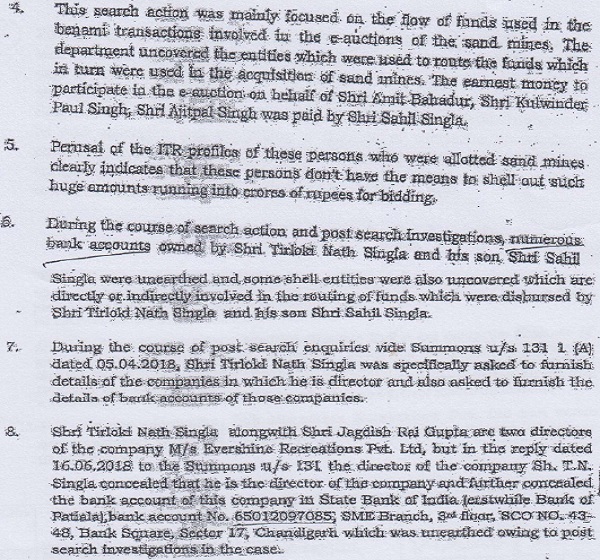
–
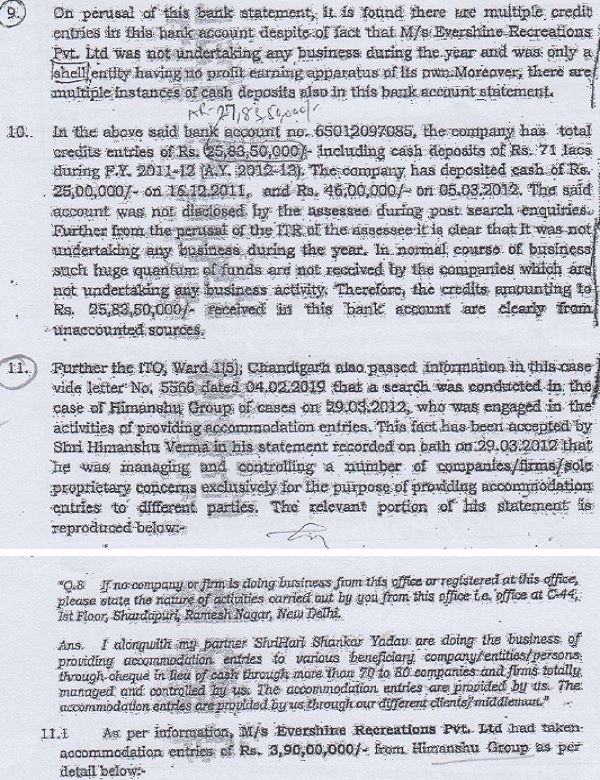
–
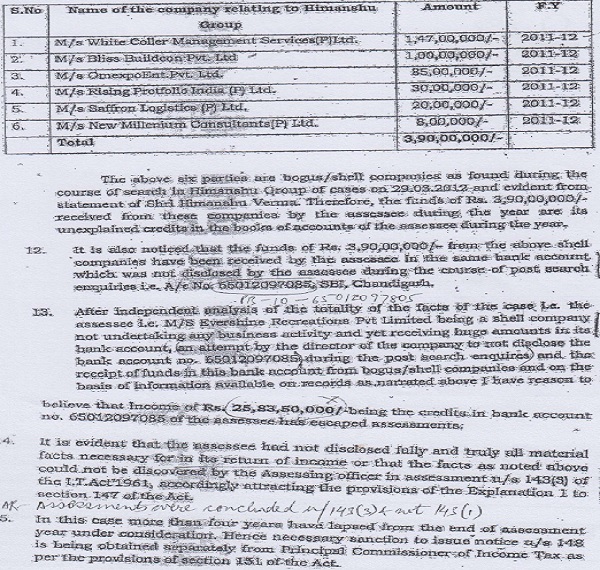
WRONG AND IRRELEVANT FACTS
22. Thus, as per Paras 2 to 5 of the reasons recorded for the formation of belief of escapement of income chargeable to income tax recorded by the Assessing Officer, inter-alia, a search was conducted in the group of cases of Punjab Sand Mining Auctions, on 16.02.2018. In the search, it was discovered that in financial year 2017-18, the Government of Punjab had introduced a new policy of progressive bidding for the auction of sand mines in the state of Punjab. Under this policy, sand mines would be allotted to the highest bidders. Subsequently, e-auction was carried out. Shri Amit Bahadur, Shri Kulwinder Paul Singh, Shri Ajit Pal Singh, Shri Gurinder Singh and Shri Balraj Singh were amongst the H-1 Bidders. Shri Triloki Nath Singla and Shri Sahil Singla were the common links amongst these persons, as all the paper work on behalf of these persons was facilitated by Shri Triloki Nath Singla and Shri Sahil Singla. The search was mainly focused on the flow of funds used in the benami transactions involved in the e-auctions of the sand mines. The Department uncovered the entities which were used to route the funds which, in turn, were used in the acquisition of sand mines. The earnest money to participate in the e-auction on behalf of Shri Amit Bahadur, Shri Kulwinder Paul Singh and Shri Ajit Pal Singh, was paid by Shri Sahil Singla. As available from the Income Tax Return profiles of these persons, they did not have the means to provide the huge sums, amounting to crores of rupees, for bidding for the sand mines.
23. The contention of the learned Counsel for the assessee before us is that mining business was done by one of the Ex-Directors, only in the assessment year 2018-19, and not in the year under consideration, that is, assessment year 2012-13, and that too, only in his personal capacity, and that the assessee company has no connection at all with the mining business, and no financial transaction with such mining business was carried out by the assessee company even in the assessment year 2018-19. The Department has remained unable to refute this factual assertion of the assessee. The assessee company has not been shown to have carried out any financial transaction with the mining business in the assessment year under consideration. In fact, there is even no specific allegation by the Department against the assessee company in this regard. No connection of the assessee company with the mining business stands established. There is only a general and vague averment of the Assessing Officer, which averment actually amounts to nothing other than a mere unsubstantiated conclusion of the Assessing Officer, and not his reason to believe escapement of income chargeable to tax, of Sh. Triloki Nath Singla and Shri Sahil Singla being the common links amongst the H-1 bidders of the mining business of the sand mines, since according to the Assessing Officer, the paper work on behalf of these persons / bidders was carried out by Shri Triloki Nath Singla and Shri Sahil Singla. It is seen that as opposed to this bald assertion of the Assessing Officer in the reasons recorded for the formation of belief of escapement of income chargeable to income tax, there is no evidence worth its name on record to prove any relevance, to the assessee’s case, of Sh. Triloki Nath Singla and Sh. Sahil Singla allegedly being the common links amongst Shri Amit Bahadur, Shri Kulwinder Paul Singh, Shri Ajit Pal Singh, Shri Gurinder Singh and Shri Balraj Singh, that is, the H-1 bidders of the sand mines under the new policy floated by the Government of Punjab.
24. Then, the assessment year under consideration before us is assessment year 2012-13, whereas Para 2 of the reasons recorded for the formation of belief of escapement of income chargeable to income tax for reopening relates the fact that the new mining policy was framed by the Government of Punjab in the financial year 2017-18, which was relevant to the assessment year 2018-19.
25. Further, during the proceedings before us, no evidence or material of any financial transaction of the assessee company with the mining business of the sand mines is even claimed by the Department to be existing on the record of the case.
26. Then, just stating, without proving, in Para 4 of the reasons recorded for the formation of belief of escapement of income chargeable to income tax, that the Department uncovered the entities which were used to route the funds which in turn were used in the acquisition of sand mines, without pin-pointing such alleged entities does not, by itself, go to inculpate either Shri Triloki Nath Singla, or Shri Sahil Singla, or the assessee company in the matter.
27. Too, the alleged factum (Para 5 of the reasons recorded for the formation of belief of escapement of income chargeable to income tax, recorded by the Assessing Officer), that the income tax return profiles of the allottees of the sand mines clearly indicate that these persons do not have the means to shell out the huge amounts, running into crores of rupees, required for bidding for the sand mines, does not go to involve either Shri Triloki Nath Singla, or the assessee company, in any manner.
28. The above apart, there is also not even an iota of evidence on record to prove that the earnest money to participate in the e-auction, on behalf of Shri Amit Bahadur, Shri Kulwinder Paul Singh and Shri Ajit Pal Singh, was paid by Shri Sahil Singla, as alleged by the Department.
29. These allegations of the Department, therefore, go entirely unsubstantiated and unproved, and they thus remain nothing else but merely bald assertions, not worthy of, or entitled to, any credence or sustainability under the law, whatsoever. The same are, accordingly, rejected.
30. As such, we are unable to find any justification in the action of the Assessing Officer in reopening the assessee’s completed assessment for assessment year 2012-13, based on Paras 2 to 5 of the reasons recorded for the formation of belief of escapement of income chargeable to income tax recorded for forming belief of escapement of income chargeable to tax. Hence, these reasons recorded for the formation of belief of escapement of income chargeable to income tax are found to be wrong and irrelevant for the reopening of the completed assessment of the assessee company.
31. Then, in Para 6 of the reasons recorded by the Assessing Officer for the formation of belief of escapement of income chargeable to income tax, recorded for reopening the assessment, it has been claimed by the Assessing Officer, that in the search and in the post search investigations, numerous bank accounts owned by Shri Triloki Nath Singla and Shri Sahil Singla were unearthed, and some shell entities were also uncovered, which were directly or indirectly involved in the routing of funds which were disbursed by Shri Triloki Nath Singla and Shri Sahil Singla.
32. In this regard, the contention of the learned Counsel for the assessee company is that no such bank account of either the assessee company, or Shri Triloki Nath Singla, or Shri Sahil Singla has been shown to have been unearthed by the Department, as no mention, either of the bank account number of any such bank account, or even the date of utilization of funds has been mentioned, either in the reasons recorded by the Assessing Officer for the formation of belief of escapement of income chargeable to income tax, or anywhere else in the record, even till date.
33. The learned Counsel for the assessee company has contended that such wrong fact has been purposely used to sensationalize the reasons recorded for the formation of belief of escapement of income chargeable to income tax, to unduly influence the sanctioning authority and that this is not justified.
34. The learned CIT (DR), on the other hand, has stated that in fact, Paras 1 to 7 of the reasons recorded by the Assessing Officer for the formation of belief of escapement of income chargeable to income tax contain the background needed to point out and highlight the defaults detailed under Para 8 of the reasons recorded for the formation of belief of escapement of income chargeable to income tax.
35. In this regard, the fact remains that however, no such allegedly unearthed bank account, as claimed in Para 6 of the reasons recorded by the Assessing Officer for the formation of belief of escapement of income chargeable to income tax, belonging either to the assessee company, or to Shri Triloki Nath Singla, or to Sh. Sahil Singla, has been produced before us by the Department. Even no attempt or endeavour has been made by the Department in the proceedings before this Bench, to point out from the record of the case, any mention of any such bank account of either the assessee company, or Sh. Triloki Nath Singla, or Sh. Sahil Singla, which account was statedly unearthed by the Department in the search proceedings, or in the post search investigations.
36. As such, the contention of the learned Counsel for the assessee, that wrong facts were used by the Assessing Officer under Para 6 of the reasons recorded for the formation of belief of escapement of income chargeable to income tax, to justify the reopening of assessment, has also remained irrefuted and unrebutted.
37. So far as regards the observations of the Assessing Officer in Paras 7 and 8 of the reasons recorded for the formation of belief of escapement of income chargeable to income tax, recorded for reopening of the assessment, that Shri Triloki Nath Singla was asked vide summons dated 05.04.2018, issued under section 131(1)(A) of the Income Tax Act by the Additional Director of Income Tax (copy appended at APB-110) to submit the details of the companies in which he is Director and also asked to furnish the details of bank accounts of those companies, the contention of the learned Counsel for the assessee is that Sh. Triloki Nath Singla was not a Director of the assessee company for the period between 28.3.2017 and 23.10.2018 and a date-wise directorship chart in the assessee company is also filed and is lying at APB 112. This chart is being reproduced hereunder, for ready reference:
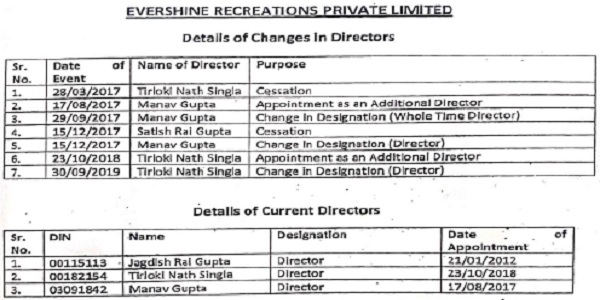
38. As such, when the summons was issued on 5.4.2018 by the Additional Director of Income Tax and it was replied to on 16.6.2018 by Shri Triloki Nath Singla, the name of the assessee company was not mentioned therein, as well as the bank account of such company, in which he was not a Director on that date, was correctly not stated.
39. The learned CIT (DR), under Para 4 at Page 3 of his written submissions, has claimed that Shri Triloki Nath Singla was Director in the assessee company during the original proceedings, and that as such, the Assessing Officer has rightly pointed out the concealment of the bank account, and that this also explains the correctness of Paras 9 and 10 of the reasons recorded by the Assessing Officer.
40. In this regard, it is seen that while stating so in his written submissions, the learned CIT (DR) has not controverted the fact stated by assessee company, that Shri Triloki Nath Singla was not a Director in the assessee company during the period between 28.3.2017 and 23.10.2018. Moreover, the reasons of reopening of the completed assessment, recorded for the formation of belief of escapement of income chargeable to income tax do not claim that since Shri Triloki Nath Singla was Director in the original assessment proceedings, it is for this, as such, that the case is sought to be reopened. This remaining the undisputed factual position on record, it is not now open, in law, for the learned CIT (DR) to improve upon, or modify the reasons for the formation of belief of escapement of income chargeable to income tax, as already recorded by Assessing Officer. It is trite law, that the reasons recorded by the Assessing Officer for the formation of belief of escapement of income chargeable to tax are to be read as they are, and that they cannot be supplement later on, nor can anything which is not contained therein, be read into such reasons recorded. In view of the above, the observations recorded by the Assessing Officer in Paras 7 and 8 of the reasons recorded for the formation of belief of escapement of income chargeable to income tax are found to be wrong.
41. So far as regards the assertion of the Assessing Officer under Para 9 of the reasons recorded for the formation of belief of escapement of income chargeable to income tax, that the assessee company is a shell entity having no profit earning apparatus of its own and that there are multiple instances of credit entries and cash deposits in the bank account statement, the contention of the learned Counsel for the assessee company has been that this assertion of the Assessing Officer is wrong, because the assessee company had already purchased a piece of land in Chandi Mandir for a commercial project and had paid Change of Land Use fees of Rs. 17.44 crore to the Government of Haryana, and that the assessee company had been allotted a Letter of Intent for such commercial project. In this respect, it is patent on the record that the assessee company had invested an amount of Rs. 28.29 crore in fixed assets, as per Note 7 of the Balance Sheet of the assessee company, as on 31.03.2012, that is, for the year under consideration, i.e., assessment year 2012-13, with regard to the fixed assets of the assessee company, a copy of which Note 7 to the Balance Sheet of the assessee company has been placed at APB, Page 71, scanned and reproduced as under, for ready reference.
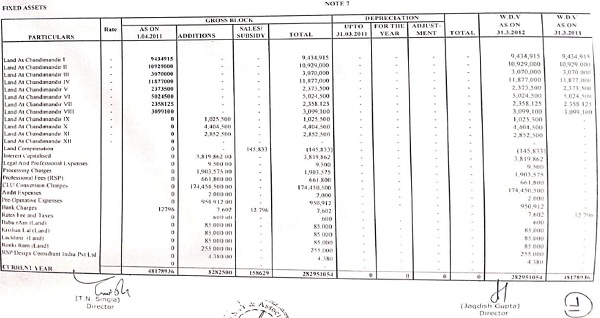
42. The investment of Rs. 28.29 crore, it is seen, was made out of bank loan of Rs. 10.12 crore, as per the Schedule of Term Loan of the Balance Sheet, annexed at ABP, Page 70. Therefore, these cash deposits as well as credit entries stand adequately explained from the record itself, as above, which has remained unrebutted by the Department before this Bench. This being so, there is no force in the observations made by the Assessing Officer in Para 9 of the reasons recorded as well.
43. Then, in further reference to the contents of Para 9 of the reasons recorded by the Assessing Officer, the learned Counsel for the assessee company has also contended that there is no definition of ‘Shell Company’, either under the Income Tax Act, or under the Companies Act. A detailed note on ‘Shell Company’ has been submitted before us by the learned for the assessee company and it forms part of the assessee’s paper book, lying at APB, Pages 295-297.
44. As per this Note, the assessee company was incorporated on 15.11.2006, with the object to carry on the business of real estate developers and to set up a commercial colony. The company was formed by respectable persons of means, for doing the business of real estate developers. To meet the object of the company, it wanted to develop a commercial colony at Chandi Mandir, in District Panchkula, Haryana. In furtherance thereof, the promoters of the company started purchase of land at Chandi Mandir. The promoters purchased lands worth Rs. 4,81,78,936/-(four crores, eighty one lacs, seventy eight thousand, nine hundred and thirty six rupees) upto 31.03.2001, and lands worth Rs. 87,92,500/- (eighty seven lacs, ninety two thousand and five hundred rupees) were purchased during the assessment year 2011-12. Further, during the year under consideration, that is, during the assessment year 2012-13, the assessee company took a bank loan of Rs. 10,00,00,000/- (ten crore rupees) from the State Bank of Patiala, and interest of Rs. 38,19,862 (thirty eight lacs, nineteen thousand, eight hundred and sixty two rupees) was paid to the State Bank of Patiala during the year by the company. An amount of Rs. 17,44,50,500/- (seventeen crores, forty four lacs, fifty thousand and five hundred rupees) was paid by the assessee company as land use charges to the Government of Haryana during the year under consideration. Further, an amount of Rs. 19,03,575/-(nineteen lacs, three thousand, five hundred and seventy five rupees) was paid to the Government of Haryana by the assessee company during the year under consideration, as processing fee for the grant of approval of a commercial colony at Chandi Mandir, District Panchkula, on twelve acres of land owned by the assessee company, located on the Shimla Highway. The assessee company also provided a bank guarantee of Rs. 9.00 crores (nine crore rupees) to the Director, Town and Country Planning, Haryana, from the State Bank of Patiala, for grant of Letter of Intent. On 05.11.2011, a Letter of Intent was granted to the assessee company by the Government of Haryana, allowing the setting up of the commercial colony by the assessee company. However, due to certain problems created by the National Highway Development Authority of India (NHAI), and a slump in the market, the proposed commercial company project remained from being developed by the assessee company and correspondence in this regard is still going on with the National Highway Development Authority (NHAI).
45. It has further been stated in the Note, that thus, the assessee company was doing the regular business of real estate developers and it was not merely a paper company, or a shell company.
46. It has been stated that since its incorporation, the assessee company is regularly preparing its Profit and Loss Account as well as its Balance Sheet, and it has also been getting its accounts audited regularly.
47. It has been stated that the assessee company has not been used merely for passing entries like a shell company, without any other activity having been carried out.
48. It has been stated that further, during the financial year 2011-12 (relevant to the assessment year 2012-13, that is, the year under consideration), an amount of Rs. 38,19,862/- (thirty eight lacs, nineteen thousand, eight hundred and sixty two rupees), as above, was paid as bank interest to the State Bank of Patiala by the assessee company.
49. It has been stated in the Note, that moreover, no funds were ever transferred by the company to any unknown person, or to any unrelated person, other than the money paid for the genuine business transactions entered into by the assessee company.
50. It has further been stated that this company is a legal entity and it is operating like any other genuine company.
51. It has been stated that however, due to certain unavoidable circumstances, the proposed project of a commercial colony could not mature, though the licence for the commercial colony is still very much in existence.
52. It has further been stated in the Note, that even the Registrar of Companies and the MCA have identified certain shell companies after 2013 and even the Directors of these shell companies have been disqualified.
53. It has been stated that however, the assessee company has been treated as a legal and genuine company.
54. It has been stated that the definition of a shell company has not been prescribed in India, either in the Companies Act, or in any other Act.
55. It has been stated that however, as per the various definitions of ‘shell company’, a shell company is a company which does not conduct any activity other than in a pass-through capacity.
56. It has been stated that however, the assessee company is regularly doing the business activity and it even made purchase of property and made sincere efforts to develop the proposed commercial colony, like other real estate developers.
57. It has been stated that moreover, for a company to be genuine, it is not necessary that there should be trading or manufacturing activity in the company.
58. It has been stated that real estate developers generally book the income or sales on the completion of the project, otherwise, for the rest of the years, the turnover is shown as Nil.
59. It has been stated that since the very incorporation of the assessee company, no transaction was ever done by it to rotate any undisclosed money or any black money, nor was any transaction done to either inflate the turnover, or to divert the bank loans during the year, and that only genuine business transactions of real estate were done.
60. It has been stated that however, loans or advances were received or given to relatives or friends or sister concern, as and when required, and that such transactions cannot, by any stretch of imagination, render the genuine and legal assessee company to be either a paper company, or a shell company.
61. It has been stated that no Director or shareholder of the assessee company is fictitious, that the Directors and shareholders of the assessee company are respectable persons of means and repute, and that therefore, there is no illegal purpose or motive of the Directors or shareholders to do business in the assessee company.
61. Considering the obtaining position as available on record in this regard, we find that it remains undisputed that vide Questionnaire (APB-59-62), dated 22.10.2019, the Assessing Officer, inter alia, put to the assessee company, specific questions with regard to the position as on 31.03.2012, concerning bank loan of Rs. 10,12,31,507/- (ten crore, twelve lac, thirty one thousand, five hundred and seven rupees) shown in the Balance Sheet of the company, investment of Rs. 21,64,51,054/- (twenty one crore, sixty four lac, fifty one thousand and fifty four rupees) in fixed assets, depicted in the Balance Sheet of the assessee company, the amount of Rs. 25,83,50,000/- (twenty five crore, eighty three lac and fifty thousand rupees) credited in the assessee’s bank account, and the amount of Rs. 71,00,000/- (seventy one lac rupees) deposited in the assessee’s bank account during the year under consideration.
63 It also remains undisputed that by virtue of Reply (APB-63-65) dated 30.10.2019 (stamped on APB-63 as having been received in the Office of the Assistant Commissioner of Income Tax, Central Circle-2, Chandigarh, on 04.11.2019) and Reply (APB-66-67) dated 19.12.2019 (stamped on APB-66 as having been received in the Office of the Assistant Commissioner of Income Tax, Central Circle-2, Chandigarh, on 19.12.2019 itself), the assessee company furnished detailed replies to the questions raised in the aforesaid Questionnaire, including the above issues.
64. With regard to the bank loan of Rs. 10,00,00,000/-, it was stated (APB-63) that this bank loan was received from the State Bank of Patiala, Sector 8-C, Chandigarh, on 21.01.2012 and interest of Rs. 12,31,507/- was due for the month of March, 2012 and, accordingly, loan of Rs. 10,12,31,507/- as on 31.03.2012 had been shown in the Balance Sheet as loan outstanding to Bank. A copy of loan sanction letter and bank account were attached.
65. Apropos the investment of Rs. 21,64,51,054/-, such investment under fixed assets was stated (APB-66) to be on account of net of charges paid to the Town and Country Planning Department, for issue of licence of commercial colony at Chandi Mandir, District Panchkula and cost of land.
66. Regarding the source of credit in the bank account of the assessee company, amounting to Rs. 25,83,50,000/-, this was stated (APB-66) to be, inter alia, on account of loan from the State Bank of Patiala, amounting to Rs. 10,00,00,000/- during the year, received in the assessee’s bank account. It was stated that in addition, the credit entries were of unsecured loan/advance received during the year, and that the sources, credibility and genuineness of these credits were being submitted alongwith the reply.
67. About the deposit of Rs. 71,00,000/- in the bank account during the year, it was submitted (APB-6465), that the cash deposits of Rs. 25,00,000/- on 16.12.2011 and of Rs. 46,00,000/- on 05.03.2012 were made out of cash withdrawals from the bank account of the company on 02.05.2011, of Rs.12,00,000/-, on 09.05.2011, of Rs. 8,00,000/-, on 11.11.2011, of Rs. 30,00,000/-, on 12.11.2011, of Rs. 20,00,000/-, and on 21.02.2012, of Rs. 4,75,000/-, and that this bank account is already available on the record of the Department. It was stated that all such transactions were fully explained during the original assessment, and also disclosed in the audited financial statements / Balance Sheet of the company for this year, already submitted with the Department.
68. Therefore, considering the facts of the case, where the assessee company, which had been formed for real estate development purposes, purchased land, obtained license from the Government of Haryana for the proposed commercial project, and invested Rs. 28.29 crore under the said project, it cannot be alleged to be a shell entity for the reasons recorded for the formation of belief of escapement of income chargeable to income tax as it has no income earning apparatus.
69. The learned CIT (DR), on the other hand, during the proceedings before us, has failed to produce the definition of a ‘Shell Company’ in India, or to point out as to which authority is the authority competent to declare a company as a shell company, on the basis of which, the assessee company has been declared as a shell company.
70. In view of the above, the observations of the Assessing Officer under Para 9 of the reasons recorded for the formation of belief of escapement of income chargeable to income tax are held to be wrong.
71. Now, coming to the assertion of the Assessing Officer under Para 10 of the reasons recorded for the formation of belief of escapement of income chargeable to income tax, that credit entries in the bank account of Rs. 25,83,50,000/-, including Rs. 25,00,000/- and Rs. 46,00,000/- in cash is claimed to be unaccounted because the said bank account was not disclosed and no business was undertaken during the year.
72. The contention of the learned Counsel for the assessee company, in this regard, was that the actual deposit was of Rs.27.83 crore. The learned CIT (DR) accepted the same and asserted that the same was due to oversight because of the large volume of the concerned data.
73. Here, we find that the observation of the Assessing Officer in the reasons recorded for the formation of belief of escapement of income chargeable to income tax, that the bank account was not disclosed during the year, is contrary to the facts on record, as discussed above. It is patent on record that the assessment for the year under consideration was completed under scrutiny assessment, by virtue of assessment order passed under section 143(3) of the Act, on 15.09.2014. A copy of the said scrutiny assessment order has been placed on the record at APB, Page 1-2. As also available from the said order, the source of the credits in the bank had already been examined in the original assessment proceedings by the Assessing Officer. However, later, ignoring the verification so conducted by the Assessing Officer during the original assessment, and without refuting the Replies (supra) furnished by the assessee company in response to the Questionnaire (supra) issued to the assessee by the Assessing Officer in the original assessment proceedings, as also in the face of the scrutiny assessment order dated 15.09.2014, while recording the reasons for the formation of belief of escapement of income chargeable to income tax without referring to such verification, the Assessing Officer formed a reason that the entire credit of Rs. 25.83 crore is unexplained. The Assessing Officer observed that in the normal course of business, such a huge quantum of funds is not received by the companies which are not undertaking any business activity. Such observation in the reasons recorded has evidently been made by the Assessing Officer in stark oblivion of the fact, as discussed, that the source of the cash deposits was explained by the assessee to be out of withdrawals of cash from the same bank account, amounting to Rs. 74.75 lac, as detailed at page 136 of the impugned order, and as also accepted by the Assessing Officer in the original scrutiny assessment order dated 15.09.2014.
74. In view of the above, the reason recorded by the Assessing Officer in Para 10 of his reasons, that the entire deposit of Rs. 25.83 crore as unexplained, is held to be unsustainable and wrong, having been recorded without considering the fact that such verification has already been done under section 143(3) of the Act by the earlier Assessing Officer.
75. So far as regards the assertion of the Assessing Officer under Para 11 of the reasons recorded, that information was received from the Income Tax Officer, Ward 1(5), Chandigarh, vide letter No. 5566, dated 04.02.2019, that a search was conducted in the case of the Himanshu Group on 29.03.2012, where Shri Himanshu Verma was engaged in the of providing accommodation entries, this fact was statedly accepted by Shri Himanshu Verma, and reliance was placed on Question No. 8 of some statement, wherein it was accepted by the alleged Shri Himanshu Verma, that he, alongwith his partner, was providing accommodation entries through some seventy to eighty companies controlled by him. On this basis, the Assessing Officer concluded that sums received by the assessee from six such companies, amounting Rs. 3.90 crore, are the assessee’s unexplained credits during the year.
76. The contention of the learned Counsel for the assessee about the information received by the Assessing Officer from the Income Tax Officer, Ward 1(5), Chandigarh is that the Assessing Officer did not provide the copy of such information or statement of Shri Himanshu Verma, either alongwith the copy of the reasons recorded for the formation of belief of escapement of income chargeable to income tax, or during the assessment proceedings, despite specific request made by the assessee to the Assessing Officer in this regard.
77. He further stated that as per Question No. 8 reproduced in the reasons recorded for the formation of belief of escapement of income chargeable to income tax, the reliance on the seventy to eighty companies is general and casual in nature, without the existence on record of any list of names of such companies.
78. It has been contended that without the availability on record, of the said list of the alleged seventy to eighty companies, which were stated by Shri Himanshu Verma to be owned and run by him, and which companies were allegedly engaged in the business of providing accommodation entries, it cannot be presumed that the six companies which had advanced money to the assessee company for purchase of commercial space were out of the said seventy to eighty companies.
79. It has been submitted that further, without linking it with the statements of the Directors of these six companies and without referring to the assessments of these six companies, there is no justification in the allegation leveled by the Assessing Officer.
80. The learned Counsel for the assessee company has further asserted that the complete details of the transaction entered into by the assessee company with these companies were filed by the assessee before the Assessing Officer during the assessment completed for the year, under section 143(3) of the Act, vide the assessment order dated 15.09.2014 and these details were available on assessment records. However, these details were not at all referred to by the Assessing Officer.
81. Per contra, the learned CIT (DR), in his submissions, has claimed that these six shell companies are operated by Shri Himanshu Verma. However, the learned CIT (DR) has not been able to put forward any counter to the contention of the assessee as to
(i) what is the total list of such companies;
(ii) how these six companies were part of this list;
(iii) how Sh. Himanshu Verma was competent to make statement on the transactions of these companies.
82. We find that there is no reference in the reasons recorded for the formation of belief of escapement of income chargeable to income tax, to any examination conducted in respect of the six companies during the original assessment completed on 15.09.2014. Non reference of any such verification, in the reasons recorded for the formation of belief of escapement of income chargeable to income tax, renders the assertions of the Assessing Officer, made in Para 11 of the reasons recorded, baseless and, therefore, unsustainable in law.
83. In so far as regards the assertion of the Assessing Officer under Para 12 of the reasons recorded for the formation of belief of escapement of income chargeable to income tax for reopening of the completed assessment, that funds of Rs. 3.90 crore have been received by the assessee in the same bank account which was not disclosed by the assessee during the post search enquiries, i.e., Account No. 65012097805 in SBI Chandigarh, the learned Counsel for the assessee stated that this observation of the Assessing Officer is totally wrong, because here it has been claimed by the Assessing Officer that the assessee had not disclosed the bank account in the post search enquiries, whereas the fact is that no enquiry letter was issued to the assessee company and the summons dated 05.04.2018, issued by the Additional director of Income Tax, Mohali, a copy whereof is at APB Page 110, was issued to Shri Triloki Nath Singla, and not to the assessee company.
84. The learned Counsel for the assessee further asserted that neither any notice was issued to the assessee company, nor was there any failure on the part of the assessee to disclose the bank account, and that moreover, as per the proviso to section 147 of the Act, where the original assessment is completed under section 147 of the Act, the failure is to be seen on the basis of all material facts furnished during the assessment proceedings and not before the Additional Director of Income Tax in subsequent notice, for the extended period of six years, under the proviso to section 147 of the Act.
85. The assertion of the learned Counsel for the assessee company is found to be correct, as indeed, no notice/summons was issued to the assessee company which was not replied to by the assessee. Therefore, the averment of the Assessing Officer under Para 12 of the reasons recorded is wrong and irrelevant.
86. So far as regards the assertions of the Assessing Officer under Para 13 of the reasons recorded for the formation of belief of escapement of income chargeable to income tax for reopening the completed assessment, the Assessing Officer has stated in this para, that the assessee is a shell company not undertaking any business, that there was an attempt by the Director of the company to not disclose the bank account no. 65012097085 during post search enquiries, and receipt of funds from bogus and shell companies.
87. In view of our discussion in the earlier paragraphs, which discussion is not being repeated here, the finding of the Assessing Officer under Para 13 of the reasons, is wrong.
88. The assertion of the Assessing Officer under Para 14 of the reasons recorded for the formation of belief of escapement of income chargeable to income tax is that the assessee company had not disclosed fully and truly all material facts necessary for in its return of Income, or that the facts, as noted above, could not be discovered by the Assessing Officer, attracting the provisions of Explanation 1 to section 147 of the Act. However, no such failure to disclose any material fact by the assessee company in its return of Income is claimed either in the Assessment Order, or in the proceedings before us.
89. The learned Counsel for the assessee has contended that the Assessing Officer, by making the remarks contained in Para 14 of the reasons recorded, is, in fact, trying to seek the extended time of six years for reopening the assessment under the proviso to section 147 of the Act, where the requirement of law is to see failure to disclose material facts in assessment proceedings.
90. We find that in the proceeding before us, the only failure claimed by the Department is by way of non-mentioning of the name of the assessee company in the reply filed by it before the Additional Director of Income Tax, which point we have already addressed. Therefore, the reopening of the assessment for the reason of the alleged failure of the assessee to disclose material facts in the return of Income is also held to be wrong.
ASSESSMENT SHOULD HAVE BEEN COMPLETED UNDER SECTION 153A/153C AND NOT UNDER SECTION 148 OF THE ACT
91. In this regard, the assertion on behalf of the assessee is that the entire decision of the Assessing Officer to reassess the income of the assessee company is based on material found / statement recorded during two independent searches conducted by the Income Tax Department. One of such actions is dated 16.02.2018 at the premises of Shri Triloki Nath Singla and Shri Sahil Singla, where it is alleged that bank accounts of Shri Triloki Nath Singla and Shri Sahil Singla were unearthed and this has formed the basis of reopening, and the second is the statement recorded of Sh. Himanshu Verma under section 132(4) of the Act, on 29.03.2012, and other material found during the search.
92. The contention of the learned Counsel for the assessee before us is that Section 153C of the Act begins with a non-obstante clause and, therefore, it has an overriding effect on Sections 147 & 148 of the Income Tax Act. Section 153C of the Income Tax Act lays down that notwithstanding anything contained in sections 139, 147, 148, 149, 151 and 153 of the Income Tax Act, where the Assessing Officer is satisfied that any money, bullion, jewellery, or other valuable article or thing seized or requisitioned, belongs to, or any books of account or documents, seized or requisitioned, pertains or pertain to, or any information contained therein, relates to, a person other than the person referred to in section 153A, then, such books of account or documents or assets, seized or requisitioned shall be handed over to the Assessing Officer having jurisdiction over such other person and the Assessing Officer shall proceed against such other person and issue notice and assess or reassess the income of such other person in accordance with the provisions of section 153A of the Income Tax Act. The said section very clearly lays down that the provisions of section 153C of the Income Tax Act are to be applied in such cases notwithstanding anything contained in sections 139, 147, 148, 151 and 153 of the Income Tax Act. Applying the said provisions to the facts of the present case, wherein certain documents / information were found during the course of search, on the basis of which, additional income was to be assessed in the hands of the assessee company, then, for making the aforesaid addition, the recourse which was open to the Assessing Officer was to initiate proceedings under section 153C of the Income Tax Act. Where the provisions of the said section are to be applied, no proceedings can be initiated under sections 147, 148, 151 and 153 of the Income Tax Act. The reassessment proceedings was initiated in this case on the basis of incriminating material found in the search of a third party, and so, the provisions of section 153C of the Income Tax Act were applicable, which provisions exclude the application of sections 147 and 148 of the Income Tax Act, and the notice issued under section 148 of the Income Tax Act and the proceedings under section 147 of the Income Tax Act are illegal and void ab initio.
93. Therefore, the issuance of notice under section 148 on the basis of the statement or the documents seized during the search under section 132 of the Income Tax Act on a third party is against the provisions of the Income Tax Act. Reliance in this regard has been placed on the order of the Chandigarh Bench of the ITAT in the case of “Kaur Jain Spinning & Weaving Mills Limited Versus ACIT”, 128 taxman.com 147 (Chd), dated 16.04.2021, the Delhi ITAT decision in the case of “Nawal Oils and Container Private Limited Versus Income Tax Officer”, ITA No. 852/DEL/2019, order dated 04.03.2020, the Chandigarh ITAT decision in the case of “Sanjay Singhal (HUF) Versus Deputy Commissioner of Income Tax”, ITA Nos. 702 to 704/Chd/2018, dated 19.06.2020, the Jaipur ITAT decision in the case of “Shri Kalyan Buildmart Private Limited Versus Assistant Commissioner of Income Tax”, ITA Nos. 152 and 153/JP/2018, dated 28.06.2018, the Amritsar ITAT decision in the case of “Arun Kumar Kapoor, Amritsar Versus Department Of Income Tax”, ITA No. 147(ASR)/2010, and the Delhi High Court decision in the case of “PCIT Versus Anand Kumar Jain (HUF)”, in ITA No. 23/2021, dated 12.02.2021.
94. The findings of the learned Commissioner of Income Tax (Appeals) on this issue are that the Assessing Officer has made assessment under section 147/148 of the Act, based on the findings in the case of Shri Himanshu Verma as a result of search under section 132 of the Act in his case on 29.03.2012, the statement recorded under section 132(4) of the Act and other documents found during the search under section 132 of the Act in the case of Shri Himanshu Verma, used by the Assessing Officer as corroborative evidence which did not belong to the assessee company at all; that the pre-amended provisions of section 153C of the Act are applicable to the facts of the present case; that reliance was being placed on the ITAT Ahmedabad Bench in the case of “Shailesh S. Patel Versus Income Tax Officer”, 97 taxmann.com 570; and that therefore, there was no merit in the argument of the learned Counsel for the assessee, that the assessment should have been framed under section 153C and not under sections 147/148 of the Income Tax Act.
95. Before us, the learned Counsel for the assessee has contended that the amendment in section 153C of the Income Tax Act, 1961, brought in by the Finance Act 2015 would be applicable retrospectively; that hence, if any material was found relating to the assessee during the course of search on a third party, then the correct course of action would have been to proceed against the assessee under section 153C of the Income Tax Act. Reliance in this regard has been placed on the Supreme Court judgment in the case of “Income Tax Officer Versus Vikram Sujit Kumar Bhatia”, 413 ITR 417 (SC), dated 06.03.2023, and the Supreme Court judgment in the case of “Assistant Commissioner of Income Tax versus Shruti Bhamasha Shah”, 7 NYPCTR 519 (SC), dated 11.03.2023.
96. The learned CIT (DR), on the other hand, has submitted before us that the provisions of section 153C of the Act are not applicable to the assessee’s case; and that during the search conducted on the Himanshu Group in 2012, no document or books of account belonging to the assessee were found, except a CD containing the details of the companies to which entries were given by the Himanshu Group along with the details of the relevant bank accounts of the group companies.
97. We find that the case has been reopened by recording fifteen reasons recorded for the formation of belief of escapement of income chargeable to income tax, which we have dealt with in detail in the preceding paras, and have decided them to be based on wrong and irrelevant facts. Therefore, this issue does not require to be adjudicated upon separately, when the reopening itself has been held to be invalid for wrong and irrelevant facts relied on by the Assessing Officer for reopening the completed assessment.
VIOLATION OF PRINCIPLES OF NATURAL JUSTICE
98. The next grievance of the assessee is that though the re-opening is stated to have been done on the basis of information received from the Income Tax Officer, Ward 1(5), Chandigarh, dated 04.02.2019 (APB-20), having jurisdiction over the assessee prior to centralization, about search conducted on 29.03.2012 on Shri Himanshu Verma, either the detail of such information, or the statement of Shri Himanshu Verma was not provided to the assessee, either alongwith the reasons recorded for the formation of belief of escapement of income chargeable to income tax, or during the assessment proceedings, or even during the first appellate proceedings before the learned Commissioner of Income Tax (Appeals).
99. The learned Counsel for the assessee contends that after reply dated 19.12.2019 was filed by the assessee company, around ten days after the passing of the final re-assessment order, an incomplete extract of the approval accorded by the learned Principal Commissioner of Income Tax under section 151 of the Income Tax Act and a two page covering letter, received from the office of the Income Tax Officer, Ward 1(5), Chandigarh, was provided to the assessee company.
100. Here, it is seen that in the objections dated 20.06.2019 and 02.08.2019, filed by the assessee against the re-assessment proceedings, the assessee made a specific request to the Assessing Officer in this regard, for being supplied the information received by the Assessing Officer (APB-49). However, vide order dated 18.10.2019 (APB 50-54), the Assessing Officer rejected such request of the assessee and disposed of the assessee’s objections, observing that the information received from the Income Tax Officer, Ward-1(5), Chandigarh, was not required to be provided to the assessee.
101. The learned CIT (DR), in his written submissions, under Para 16.1 thereof, has stated that “as regards, provisions of statement, it is to be seen, if the assessee had with him the statement of Shri Himanshu Verma or not.” Under Para 16.2, the learned CIT (DR) states that “On Page 86 of Learned CIT(A) order, as per assessee’s submissions, it is stated: There is not even a whisper about the name of the appellant company in the statement of Shri Himanshu Verma, received from the ADIT (Inv) Unit 6(3)”.
102. In Para 16.3 of the learned CIT (DR)’s submissions, it has been stated that: “The above admission of the assessee show that throughout the reassessment proceedings, the statement in question was available with the assessee.”
103. The learned Counsel for the assessee, in his rebuttal under Para 13.2, submitted that in fact, Question No. 8 of the statement of Shri Himanshu Verma was relied on by the Assessing Officer under Para 11 of the reasons recorded for the formation of belief of escapement of income chargeable to income tax for reopening, lying at APB, Page 21, which does not contain the name of the assessee company and that is why the assessee, in its reply, asserted so before the learned CIT (A). This, in any case, according to the learned Counsel, is not an admission on the part of the assessee, that the statement of Shri Himanshu Verma and the enquiries of the Assessing Officer are available with the assessee, moreso, when the Assessing Officer had specifically, in writing, refused to provide the assessee company with such material.
104. The Assessing Officer, it is seen, was, under the law as well as under the principles of natural justice, legally mandatorily required to provide to the assessee, the copy of the statement of Shri Himanshu Verma and the information received from the Income Tax Officer, Ward 1(5), Chandigarh alongwith the reasons recorded for the formation of belief of escapement of income chargeable to income tax for reopening of the completed assessment. The refusal of the Assessing Officer to provide and make available to the assessee, the information and evidences gathered at the back of the Assessee is fatal to the case of the Department and the use of such information and evidence against the assessee unilaterally is not permissible under the law. This is in blatant contravention of the provisions of section 142(3) of Income Tax Act, which mandates the Assessing Officer to provide to the assessee, the information gathered on the basis of any enquiry, and proposed to be used against the assessee in the assessment.
105. We are also, in this regard, guided by the decision of the Hon’ble jurisdictional Punjab and Haryana High Court in the case of “Commissioner of Income Tax, Patiala II Versus Sham Lal”, 127 ITR 816 (P & H), wherein, it has been held that “The assessee is, in law, entitled to rebut the material placed before him if he so chooses and any material placed on the record without notice to the assessee cannot be relied upon by the revenue. It would thus be seen that the finding of the Tribunal that the material placed on the record in violation of the principles of natural justice could not be relied upon and that in fact there was no material to come to the conclusion that the assessee was a partner in the firm, the only correct course open to the Tribunal was to annul the assessment order passed by the Income Tax Officer.”
106. Reliance is also placed on the decision of the Hon’ble Supreme Court of India in the case of “Kishinchand Chellaram versus Commissioner of Income Tax, Bombay City II”, 125 ITR 713 (SC), wherein, it has been held that “The only evidence on which the Tribunal could rely for the purpose of arriving at this finding was the letter dated 18th February, 1955, said to have been addressed by the Manager of the Punjab National Bank Limited to the Income Tax Officer. Now, it is difficult to see how this letter could at all be relied upon by the Tribunal as a material piece of evidence supportive of its finding. In the first place, this letter was not disclosed to the assessee by the Income Tax Officer and even though the AAC reproduced an extract from it in his order, he did not care to produce it before the assessee or give a copy of it to the assessee. The same position obtained also before the Tribunal and the High Court and it was only when a supplemental statement of the case was called for by this court by its order dated 16th August, 1979, that, according to the Income Tax Officer, this letter was traced by him and even then, it was not shown by him to the assessee, but it was forwarded to the Tribunal and it was for the first time at the hearing before the Tribunal in regard to the preparation of the supplemental statement of the case that this letter was shown to the assessee. It will, therefore, be seen that, even if we assume that this letter was in fact addressed by the Manager of the Punjab National Bank Limited to the Income Tax Officer, no reliance could be placed upon it, since it was not shown to the assessee until at the stage of preparation of the supplemental statement of the case and no opportunity to cross-examine the manager of the bank could in the circumstances be sought or availed of by the assessee. It is true that the proceedings under the income-tax law are not governed by the strict rules of evidence and, therefore, it might be said that even without-calling the manager of the bank in evidence to prove this letter, it could be taken into account as evidence. But before the I.T. authorities could rely upon it, they were bound to produce it before the assessee so that the assessee could controvert the statements contained in it by asking for an opportunity to cross-examine the manager of the bank with reference to the statements made by him. We are clearly of the view that the letters dated 18th February, 1955, and 9th March, 1957, did not constitute any material evidence which the Tribunal could legitimately take into account for the purpose of arriving at the finding that the amount of Rs.1,07,350/- was remitted by the assessee from Madras, and if these two letters are eliminated from consideration, it is obvious that there was no material evidence at all before the Tribunal which could support this finding”.
107. The Hon’ble Rajasthan High Court in the case of “Micro Marbles Private Limited Versus Office of the Income Tax Officer”, 2023 (1) TMI 282 (Raj), has held that “In view of the above decisions and the guidelines laid down therein, the supply of documents referred to in the reasons recorded for the formation of belief of escapement of income chargeable to income tax becomes inevitable and in the event such documents are not supplied, it would be a flagrant violation of the principles of natural justice. Accordingly, the impugned notice dated 30.03.2021 and the order dated 18.08.2021 dismissing the objections of the petitioner are hereby quashed and all consequential proceedings including the assessment order dated 29.03.2022 are declared to be illegal, null and void with liberty to the respondents to take up a fresh exercise for reassessment, if necessary, in accordance with law”.
108. The Hon’ble Delhi High Court, in the case of “Sabh Infrastructure Versus ACIT”, 398 ITR 198 (Del), has held that “Where the reasons recorded for the formation of belief of escapement of income chargeable to Income Tax make a reference to another document, whether as a letter or report, such document and/ or relevant portions of such report should be enclosed along with the reasons recorded for the formation of belief of escapement of income chargeable to income tax”.
109. The Hon’ble Bombay High Court, in the case of “Tata Capital Financial”, 443 ITR 127 (Bom), has held that “In the circumstances, the Revenue is directed to adhere to the following: (a) While communicating the reasons recorded for the formation of belief of escapement of income chargeable to income tax for reopening the assessment, a copy of the standard form/request sent by the Assessing Officer for obtaining approval of the Superior Officer should itself be provided to the assessee. This would contain comment or endorsement of the Superior Officer with his name, designation and date. The Assessing Officer shall not merely state the reasons recorded for the formation of belief of escapement of income chargeable to income tax in the letter addressed to the assessee. (b) If the reasons recorded for the formation of belief of escapement of income chargeable to income tax make reference to any other document or a letter or a report, such document or letter or report should be enclosed to the reasons recorded for the formation of belief of escapement of income chargeable to income tax. Such portion as it does not bear reference to the assessee concerned could be redacted”.
BORROWED SATISFACTION
110. The next grievance of assessee is that the assessment has been reopened on the basis of information dated 04.02.2019, received from the Income Tax Officer, Ward 1(5), Chandigarh, which contains the details of search conducted on Shri Himanshu Verma on 29.03.2012, and as per such information, six companies had provided accommodation entries of Rs. 3.90 crore to the assessee company, which six companies are controlled by Shri Himanshu Verma.
111. The learned Commissioner of Income Tax (Appeals) has observed that the Assessing Officer considered the information received alongwith the findings contained in the Appraisal Report and reconciled such information with the particulars as contained in the Income Tax Return of the assessee; that the information was received from the Income Tax Officer, Ward-1(5), Chandigarh, vide letter No. 5566 dated 04.02.2019, that the assessee had received credits from six paper companies of Shri Himanshu Verma, an accommodation entry provider; that thereupon, the Assessing Officer recorded reasons for the formation of belief of escapement of income from assessment. The grievance of the assessee is that the Assessing Officer did not apply his own mind while proceeding against the assessee company, in violation of the provisions of the law and in violation of the principles of natural justice; that the Assessing Officer has formed his reasons recorded for the formation of belief of escapement of income chargeable to income tax merely on surmises and conjectures, where in fact, no prima-facie reason to believe existed.
112. Here, it is seen that neither in the Appraisal Report, nor in the statement of Shri Himanshu Verma, the name of the assessee company has been mentioned. In fact, in the Appraisal Report itself, there is a recital that “This Appraisal Report is only advisory in nature and should be only used as a guideline”.
113. It remains an undisputed fact that the Assessing Officer did not carry out any further investigation and he just went by the Appraisal Report as it is. Shri Himanshu Verma had stated that he was engaged in providing accommodation entries to various beneficiaries; that his modus-operandi was to provide accommodation entries either in the form of share application money, or as share capital, and/or as unsecured loans in lieu of cash, through a number of corporate and non corporate paper entities formed by him. The cash received was first deposited in the accounts of the six paper companies, as cash received against bogus sales/reflected in the books of account. Thereafter, such cash was transferred to the paper companies and accommodation entries were provided through RTGS/cheques, as share application money or share capital or loans. Nothing was stated by Shri Himanshu Verma to the effect that the assessee company had received any such share application money or share capital or unsecured loan from the paper companies of the Himanshu Verma Group. There is also no allegation that any accommodation entry was taken by the assessee company, after giving cash either to Shri Himanshu Verma, or to his associates. The Assessing Officer remained oblivious of this position while initiating the re-assessment proceedings. In fact, the reasons recorded for the formation of belief of escapement of income chargeable to income tax themselves make no mention of any enquiry having been carried out by the Assessing Officer before the recording of such reasons for the formation of belief of escapement of income chargeable to income tax. It is seen that as available from the bank statement of the assessee company for the year under consideration, the cash deposits were actually re-deposits of cash withdrawn earlier from the same bank account during the year under consideration. Remarkably, in the re-assessment proceedings, these cash deposits have been accepted by the Assessing Officer as genuine deposits. The bank statement was available on record at the time of the original assessment proceedings. However, the reasons recorded for the formation of belief of escapement of income chargeable to income tax do not evince that this statement was perused or considered by the Assessing Officer before recording the reasons recorded for the formation of belief of escapement of income chargeable to income tax.
114. Though the Assessing Officer placed reliance on the statement of Shri Himanshu Verma, while recording the reasons for the formation of belief of escapement of income chargeable to income tax, it has been lost sight of that in such statement, he did not state the names of the alleged six companies. As per the reasons recorded for the formation of belief of escapement of income chargeable to income tax, the statement further makes mention of there being middlemen/clients, though no name of any such middleman occurs, much less, reliance has been placed on the statement of any such middleman, nor has any such statement been provided to the assessee. Not even the statements of the Directors of the six companies were considered, rather, what to talk of statements, not even the names of such Directors were mentioned. The facts of the case are, in view of these observations, on parity with those in “PCIT Vs Meenakshi Overseas Private Limited” (supra), wherein, it was held that where the reasons recorded for the formation of belief of escapement of income chargeable to income tax to believe contain not the reasons recorded for the formation of belief of escapement of income chargeable to income tax, but the conclusions of the Assessing Officer and there is no independent application of mind by the Assessing Officer to the material which forms the basis of the reasons recorded for the formation of belief of escapement of income chargeable to income tax, such conclusions of the Assessing Officer are, at best, a borrowed satisfaction.
CASE LAWS
115. In “RMG Polyvinyl” (supra), it has been held that the information received from the Investigation Wing of the Department cannot be said to be tangible material per-se, without further enquiry being undertaken by the Assessing Officer the tangible material and the formation of reasons recorded for the formation of belief of escapement of income chargeable to income tax to believe escapement of income. This decision is squarely applicable to the present case.
116. In “PCIT-4 Versus G&G Pharma India Limited” (supra), the Assessing Officer’s conclusion that he had also perused various materials and the report from the Investigation Wing and that on that basis, it was evident that the assessee company had introduced its own unaccounted money in its bank account by way of the accommodation entries, was held to be a conclusion not helpful in understanding whether the Assessing Officer had applied his mind to the materials that he talked about, particularly since he did not describe what those materials were. It was held that without forming a prima-facie opinion, on the basis of such material, it was not possible for the Assessing Officer to have simply arrived at the conclusion which he did; and that thus, the basic requirement that the Assessing Officer must apply his mind to the materials in order to have reasons recorded for the formation of belief of escapement of income chargeable to income tax to believe that the income of the assessee had escaped assessment, was missing. “G&G Pharma” is directly applicable hereto. In the present case also, as discussed, the Assessing Officer merely stated his conclusion at the very outset in the reasons recorded for the formation of belief of escapement of income chargeable to income tax recorded, without first forming a prima-facie opinion on the basis of the material. Rather, he did not even refer to the material available on record in the original assessment proceedings.
117. In “Sabh Infrastructure Versus ACIT” (supra), it was held that there needs to be reasons recorded for the formation of belief of escapement of income chargeable to income tax to believe and not merely reason to suspect that income has escaped assessment. It was held that the reasons recorded for the formation of belief of escapement of income chargeable to income tax failed to mention as to what facts or information were with-held by the assessee and mainly relying on the Investigation Report, which did not form part of the reasons recorded for the formation of belief of escapement of income chargeable to income tax and was not even annexed to the reasons recorded for the formation of belief of escapement of income chargeable to income tax so recorded, and merely the statement of Shri Naveen Kumar Singhania that the companies in question were paper companies, was insufficient to reopen the assessment, unless the Assessing Officer had any further information after making further enquiries into the matter and the relevant findings. Likewise, in the case before us, as dwelt upon earlier, the Assessing Officer did not carry out any investigation what-so-ever with regard to the material available. He merely relied upon the investigation Report, i.e,. the Appraisal Report and the statement of Shri Himanshu Verma, which too, were never confronted to the assessee, despite specific request. Therefore, the case at hand is directly in line with the facts and the ratio of “Sabh Infrastructure” (supra).
118. In “Anju Jindal Versus ACIT” (supra), the position remains much the same. The reasons recorded for the formation of belief of escapement of income chargeable to income tax therein were recorded simply by relying on the report and the conclusion drawn by the Investigation Wing, without any preliminary enquiry and investigation and establishing the necessary nexus between the material and the formation of the belief that income had escaped assessment. “Anju Jindal” (supra), is, as such, in pari materia with the case before us and, therefore, “Anju Jindal” (supra) is applicable.
119. “Smt. Sudesh Rani Versus Income Tax Officer, Ward 2(3), Ludhiana” (supra) is applicable too. Therein, it was observed that what information was available with the Assessing Officer was neither stated, nor enclosed with the reasons recorded for the formation of belief of escapement of income chargeable to income tax recorded by him and thus, it was not discernible from the reasons recorded for the formation of belief of escapement of income chargeable to income tax; that the mere fact that the assessee had sold certain shares with certain value on the Stock Exchange itself could not be held to be tangible material; that the Assessing Officer had not just recorded any reason to believe, but a conclusive finding of the assessee being involved in trading of penny stock; and that it was not borne out from the reasons recorded for the formation of belief of escapement of income chargeable to income tax as to how the Assessing Officer had reached this conclusive finding, or the basis thereof.
120. Apropos “Raymond Woollen Mills Versus Income Tax Officer and Others” (supra), therein, it was held, inter-alia, that the Court cannot strike down the reopening of the case in the facts of that case; that it would be open to the assessee to prove that the assumption of facts made in the notice was erroneous; that the assessee might also prove that no new facts came to the knowledge of the Income Tax Officer after completion of the assessment proceedings. The matter was remanded to the Assessing Officer holding, further, that in determining whether commencement of reassessment proceedings was valid, it has only to be seen whether there was prima-facie some material on the basis of which the department could reopen the case, and that the sufficiency or correctness of the material was not a thing to be considered at that stage.
121. We find that this decision, in the facts of the present case, works in favour of, rather than against the assessee. It was in a writ petition, which was the subject matter in “Raymond Woollen Mills Limited” (supra), that it was held that the assessee had it open to them to prove the assumption of facts in the notice being erroneous and to prove that no new facts had come to the knowledge of the assessing authority after completion of the assessment proceedings. It was for this purpose, that the matter was remanded. In the present case, on the other hand, the proceedings are in the stream of appeal and not by way of a writ petition, which is an extraordinary remedy, not to be exercised in the normal course and which the Courts are loath to so exercise. Rather, herein, what we have seen above is that the assumption of jurisdiction to reopen the completed assessment was based on wrong facts, where the issue had been verified thread-bare in the original assessment proceedings. Therefore, “Raymond Woollen Mills” (supra), is not applicable to the case at hand.
122. In “Yogendra Kumar Gupta Versus Income Tax Officer” (supra), the company, on whom, the search had been conducted by the CBI in some bribery case, admitted specifically that they had provided accommodation entries to the assessee. The original assessment proceedings having been completed after examination of receipt of amount from the company, the completed assessment was reopened.
123. The facts are palpably different from the case at hand in as much as in the present case, as discussed, the assessee was nowhere named by Shri Himanshu Verma, the alleged accommodation entry provider, nor did the assessee’s name occur anywhere in the Appraisal Report. The Assessing Officer relied on merely vague information to record the stated reasons recorded for the formation of belief of escapement of income chargeable to income tax to believe escapement of income. The SLP against this decision in “Yogendra Kumar Gupta” stands dismissed.
124. The issue before the Hon’ble High Court in “Paramount Communication Private Limited” (supra), was that the reasons recorded for the formation of belief of escapement of income chargeable to income tax recorded were not proper and the Commissioner of Income Tax (Appeals) and the ITAT had wrongly allowed the case of the assessee. The Hon’ble High Court set aside the case to the ITAT, holding that the Assessing Officer cannot be directed as to how the reasons recorded for the formation of belief of escapement of income chargeable to income tax are to be recorded. This is, obviously, not the question herein and so, “Paramount Communication” (supra), is distinguishable. Even the SLP there-against was dismissed.
125. “Pushpak Bullions Private Limited Versus DCIT” (supra), is also not attracted, as in the present case, as against in “Pushpak Bullions Private Limited” (supra), no specific question was raised to Shri Himanshu Verma with regard to the assessee company. Reference was made to seventy to eighty companies, without linking the six companies from whom the advance against sales was allegedly received, without giving the list of the seventy to eighty companies and also without stating that the six companies were out of those seventy to eighty companies.
126. In “Jayant Security & Finance Limited Versus ACIT” (supra) after completion of assessment, it came to the notice of the Investigation Wing that advances of Rs.10.25 Cr had been received by the assessee from M/s East West Finvest India Limited during assessment year 2010-11. M/s East West Finvest India Limited worked as an entry provider and earned bogus funds to provide advances to various persons. The assessment had been completed on 08.03.2012. In the case at hand, the assessment was completed on 15.09.2014, whereas the information was available with the Department prior thereto, since the statement had been recorded on 29.03.2012. “Jayant Security & Finance Limited Vs ACIT” (supra) is, thus, also not applicable, on facts.
127. “R.K. Malhotra, Income Tax Officer Versus Kasturbhai Lal Bhai” (supra) is, again, of no help to the department. The issue involved therein was as to whether an Audit Objection can be considered as information. The Supreme Court reversed the judgment of the Gujarat High Court. Later on, it was over-ruled by the Supreme Court in “Indian & Eastern Newspaper Society Versus CIT”, 119 ITR 996 (S.C). While doing so, the question as to whether the view expressed by an internal Audit Party of the Income Tax Department on a point of law is to be regarded as information for the purpose of initiating proceedings under section 147(b) of the Income Tax Act and as to whether the Income Tax Officer was legally justified in re-opening the assessments on the basis of the view expressed by the internal Audit Party and received by him subsequent to the original assessment, was answered in favour of the assessee. Therefore, “R.K. Malhotra” (supra) is also not attracted.
128. In “RBS Product Limited Versus ACIT” (supra), the assessee had received share capital from M/s Shail Investments Private Limited and M/s New Delhi Credits Private Limited. These two companies were also promoted by Shri Tarun Goyal from the same premises and so, a serious doubt had arisen with regard to the genuineness of the transaction claimed by the assessee. Per contra, in the case of the assessee before us, the allegation is of receipt of accommodation entries from six companies, whereas as noticed, there is no link established that the said six companies were promoted by Shri Himanshu Verma, or that he was a Director in all or any of them.
129. In “Chetan Sabharwal Versus ACIT” (supra), the writ petition was held to have been filed at the “Reasons recorded for the formation of belief of escapement of income chargeable to income tax” stage, before assessment. Moreover, in that case, the original assessment orders for both the years under consideration, which were passed in scrutiny assessment proceedings, did not give any indication about the Assessing Officer having formed any opinion, on the basis of which, the re-opening had been ordered. The matter was remanded to the Assessing Officer keeping open all arguments, but for the point that the re-opening constituted a change of opinion. The original assessment in that case was completed on 15.09.2010, and the enquiry by the Investigation Wing was carried out on 15.10.2015. On the other hand, in the present case, the original assessment order contains elaborate findings of the Assessing Officer, showing the unambiguous formation of opinion by the Assessing Officer in the original assessment proceedings. Then, as against the factum of conducting of enquiry by the Investigation Wing after the completion of assessment in that case, in the case at hand, the statement of Shri Himanshu Verma was recorded on 29.03.2012 and it was available to the Department at the time of passing of the original assessment order on 15.09.2014. Moreover, the proceedings in “Chetan Sabharwal” (supra), were writ proceedings, whereas no such request for exercise of extra ordinary jurisdiction is there in the present case.
130. Having thus considered the rival contentions in the light of the decisions cited by both the parties, we find that the learned Commissioner of Income Tax (Appeals) has erred in upholding the Assessing Officer reliance on a third party opinion without application of his own mind, without verifying the facts from the record before issuing the notice under section 148 of the Income Tax Act. We find that:








