Satia Industries Ltd Vs National Faceless Assessment Centre (ITAT Amritsar)
ITAT Amritsar held that transfer of REC (Renewable Energy Certificate) is capital in nature and not liable to tax under business income as the income is offshoot from environmental concern not from offshoot of business concern.
Facts- The assessee-company is manufacturer of writing and printing paper, having factory premises in the village of Rupana, situated at Muktsar Sahib. The assessee-company has a co-generation captive power division also, in which electricity is generated from renewable source i.e. bio-fuel, re-include rice husk, unlike other companies which utilized fossil fuels, i.e., coal and diesel and the same is consumed by the paper division. The generation of power from renewable energy resources helps reduce emissions of carbon/ heat, and gases in environment.
During the impugned year, the assessee earned by sale/transfer of REC/ESCs amounting to Rs.17,77,26000/-. The assessee claimed this amount u/s 115BBG of the Act and paid the tax @ 10% during filing of return U/s 139 of the Act. During the assessment proceeding the assessee amended its claim related to income earned from the sale/transfer of RECs/ESCs as capital receipt and recomputed the tax by claiming exemption of tax on said income.
AO issued a draft assessment order by rejecting the same. The assessee filed a petition before the Dispute Resolution Panel (DRP). As per the direction of DRP the said amount was taken as business income of assessee.
During proceeding in DRP, the ld. DRP recommended for addition of commission amount of Rs.4,57,32,318/- u/s 69C of the Act. Being aggrieved assessee filed an appeal before us.
Conclusion- The credits in all the three modes of reduction of ‘carbon footprint’ are not generated or created due to carrying on business to this accrued due to concern of the word to improve emission of ‘greenhouse gases’ which are primary polluters of the environment. Thus, the amount received for ‘Carbon Credits’ has no element of profit or gain, is not subjected to tax under any head of income and is not liable for tax in terms of sections 2(24), 28, 45, and 56 of the Income Tax Act, 1961.
The amount is not received, in any of the modes of incentive, by producing or selling any product, by-product or rendering any services for carrying on the business and the credit under any of the three modes is entitlement or accretion of capital and hence income earned on sales of these is a capital receipt.
The assessee claimed the transfer value of REC/ESCs amounting to Rs.17,77,26000/-in return u/s. 1115BBG and paid tax. During the time of assessment, the assessee amended the claim and treated the income as capital receipt. We relied on the orders My Home Power Ltd, and Maheshwari Devi Jute Mills Ltd, the income is offshoot from environmental concern not from offshoot of business concern. The nature is fully related to environmental health. We find that said income is capital in nature and not liable to tax under business income.
FULL TEXT OF THE ORDER OF ITAT AMRITSAR
The instant appeal of the assesseewas filed against the order of the ld. Commissioner of Income Tax (Appeals), NFAC, Assessment Unit, Delhi,[in brevity the ‘CIT (A)’], order passed u/s 250of the Income Tax Act 1961, [in brevity ‘the Act’] for A.Y. 2018-19. The assessment order is framed u/s 143(3)r.w.s. 144B of the Act.
2. The assessee has taken the following grounds:
1. That in the facts fit circumstances of the case, the Ld. AO NFAC has erred on facts & law in assessing the income at 27,39,13,236/- assessment vide order u/s 143(3) r.w.s. 144C dated 26.0 7.2022, in pursuance of directions of Dispute Resolution Panel dated 29.06.2022, and the amount of Rs. 4,57,32,318/- paid to ZYLO international has been wrongly treated as bogus expenditure u/s 69C and further the amount of Rs. 17,77,26,000/- received on account of sale/ transfer of Recs/ESCs has been wrongly treated as business income.
2. That in the facts fit circumstances of the case, the Ld. AO NFAC has erred on facts fit law in making the addition of Rs. 17,77,26,000/- received on account of sale/transfer of RECs/ESCs, in pursuance of directions of Dispute Resolution Panel dated 29.06.2022, while recording the finding that the claim of the assessee u/s 115BBG is being rejected despite the fact that the claim made in the return of income was modified during the course of assessment proceedings and in the objections filed before the DRP that the receipts from sale/transfer of RECs/ESCs are capital receipts which are not liable to tax.
2.1. That in the facts & circumstances of the case, the Ld. AO NFAC has erred on facts fit law in making the addition of Rs. 17,77,26,000/-, in pursuance of directions of Dispute Resolution Panel dated 29.06.2022, by treating the receipts from sale/transfer of RECs/ESCs as business income, and charging the tax on the same as against the claim of the assessee, based on the assessment order for A. Y 2017-18 in the case of the assessee, that the receipts from sale/transfer of RECs/ESCs are capital receipts which are not liable to tax.
2.2. The claim of the assessee before the AO NFAC & in the objection filed before the DRP that the amount received from sale/transferof RECs/ESCs is capital receipt for which judgement of various benches of ITAT (including the order of the jurisdictional benches) has been rejected by the AO NFAC and DRP without rebutting the case law relied upon by the assessee.
3. That the SCN dated 2 7.06.2022 issued by the DRP for enhancement of income of Rs. 4,57,32,318/-, on the basis of information forwarded by the Principle CIT Amritsar-1 vide letter dated 21.04.2022, to submit the reply on 28.06.2022 proves that there was violation of principle of natural justice as only one day time has been allowed to submit reply to the SCN and, in view, of the judgment of Apex Court in the case of Sona Builders the directions issued by the Dispute resolution panel for enhancement of income of Rs 4,57,32,318/- deserves to be set aside/quashed.
3.1. That the Dispute Resolution Panel has erred on law in rejecting legal objection of the assessee raised during the course of the proceedings before the panel, without providing any opportunity of hearing to the assessee, that theprovisions of Section 144C(8) does not allow the DRP to issue directions to enhance the income of the assessee to the extent of Rs. 4,57,32,318/- which was not part of the subject matter of the variations suggested by the AO and the AO had not proposed any addition on this issue in the draft assessment order
3.2. That the Dispute Resolution Panel erred on law to issue directions dated 29.06.2022 regarding enhancement of Rs.4,57,32,318/- by treating the transaction of payment of commission to Zylo International as bogus u/s69C, while relying on the judgments of High Courts of Madras and Delhi for rejecting the legal objection raised by the assessee, without confronting the above said case laws to the assessee because both the case laws are distinguishable on facts.
4. That in the facts and circumstances of the case, the Ld. AO NFAC has erred on facts fit law in making the addition of 4,57,32,318/- u/s 69C, in pursuance of directions of Dispute Resolution Panel dated 29.06.2022, by treating the payment of Rs4,57,32,318/- to ZYLO International as Bogus without appreciating the evidence filed by the assessee during the course of proceedings before the Dispute Resolution Panel.
5. That in the facts 8t circumstances of the case, the Ld. AO NFAC has erred on facts & law in making the addition of 4,57,32,318/- u/s 69C, in pursuance of directions of Dispute Resolution Panel dated 29.06.2022, by treating the payment of Rs4,57,32,318/- to ZYLO International as Bogus because the DRP has issued the directions for enhancement of income without making any independent inquiry.
5.1. That the Ld. AO NFAC has erred on facts & law invoking the provisions ofsection 115BBE of the Act and charging the special rate of tax, which is highly unjustified.
6. That the appellant craves leave to add or amend the grounds of appeal before the appeal is finally heard or disposed of.”
3. Tersely, we advert the fact of the case. The assessee-company is manufacturer of writing and printing paper, having factory premises at village Rupana situated at Muktsar Sahib. The assessee-company has a co-generation captive power division also, in which electricity is generated from renewable sourcei.e. bio-fuel, re-include rice husk, unlike other companies which utilised fossil fuel i.e. coal and diesel and the same is consumed by the paper division. The generation of power from renewable energy resources helps in reduction of emission of carbon / heat and gases in environment.
3.1 During the impugned financial year, the Ministry of New and Renewable Energy (MNRE) issued transferable and saleable credit certificates under the Electricity Act 2003, which are generally referred to as Renewable Energy Certificates (“RECs”). Such RECs are issued, under the Central Electricity Regulatory Commission Regulations, 2010 (“CERC”) issued pursuance to section 178(1) and section 66 r.w. clause (y) of section 178(2) of the Electricity Act, 2003.
3.2 During the impugned year, the assessee earned by sale/transfer of REC/ESCs amounting to Rs.17,77,26000/-. The assessee claimed this amount u/s 115BBG of the Act and paid the tax @ 10% during filing of return U/s 139 of the Act. During the assessment proceeding the assessee amended its claim related to income earned from the sale/transfer of RECs/ESCs as capital receipt and recomputed the tax by claiming exemption of tax on said income.
The ld. AO issued a draft assessment order by rejecting the same. The assessee filed a petition before the Dispute Resolution Panel (DRP). As per the direction of DRP the said amount was taken as business income of assessee.
3.3 During proceeding in DRP, the ld. DRP recommended for addition of commission amount of Rs.4,57,32,318/- u/s 69C of the Act. Being aggrieved assessee filed an appeal before us.
3.4 During the appeal proceeding, the assessee basically agitated three grievances; –
i) RECs/ESCs is income in capital in nature not in revenue in nature. And also, it is not attracted the provision u/s 115BBG as it is not come under the carbon credit.
ii) The said claim can be amended during the time of assessment by changing the revenue income into capital.
iii) The grievance related to addition of commission u/s 69C which was paid by the assessee during the year amount to Rs.4,57,332,3 18/-. The matter was taken for adjudication accordingly.
Ground No. 1
4. Ground No. 1 is general in nature.
Ground No. 2
5. The ld. AR for the assessee, Mr Sudhir Sehgal, filed a written submission which are kept in the record. Mr Sehgal first placed that the assessee earned Rs. 17,77,26,000/- by transferring of the RECs and ESCs credit during the impugned year which is capital in nature. Though in the return the assessee claimed it u/s 115BBG and paid the tax in special rate.
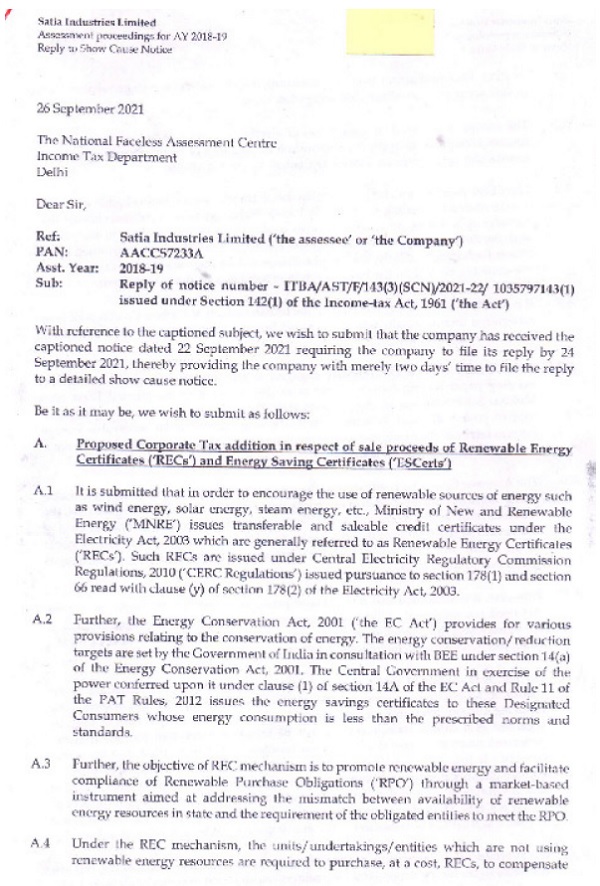
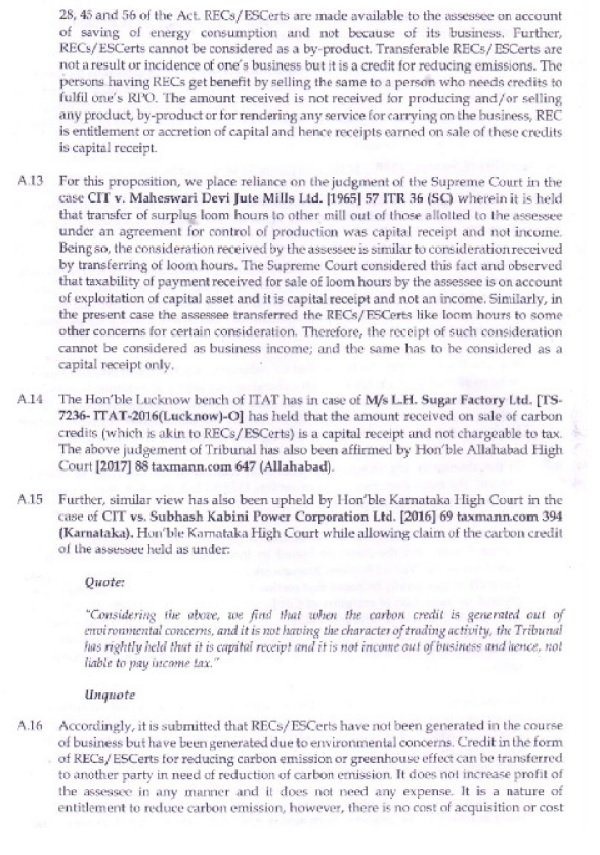
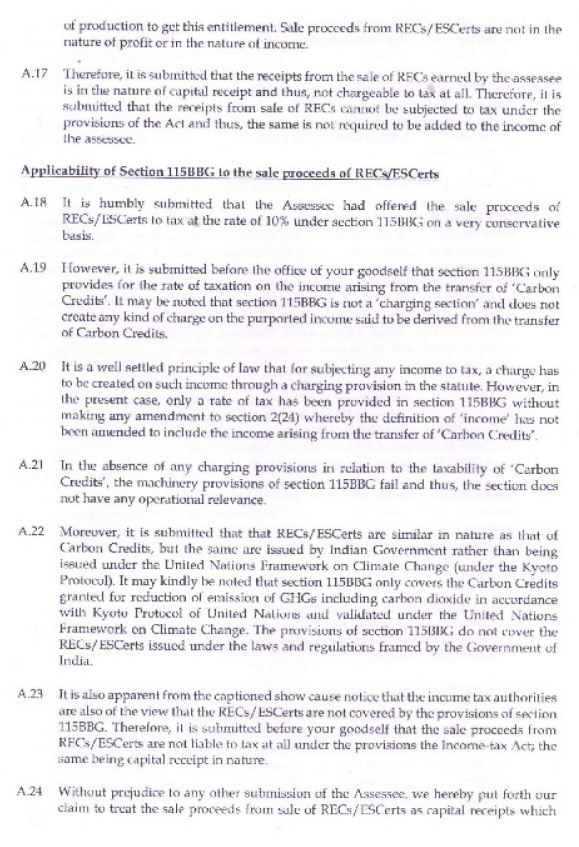
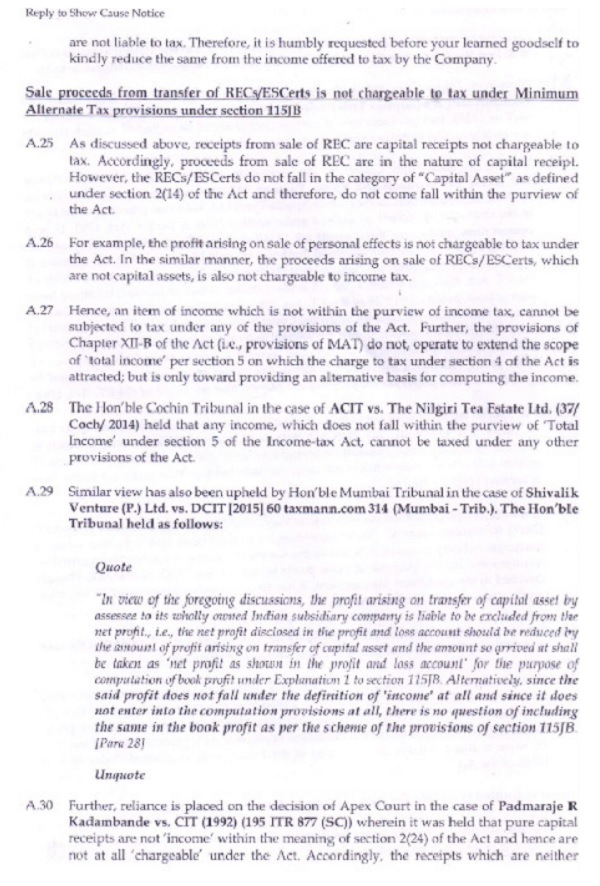
5.1 Mr Sehgal, ld. AR invited our attention in APB pages 7 to 15, the copy of the letter dated 26.09.202 1 submitted before the revenue related to claim made in which income earned from RECs/ESCs. The relevant part of the assessee’s submission is extracted as below:

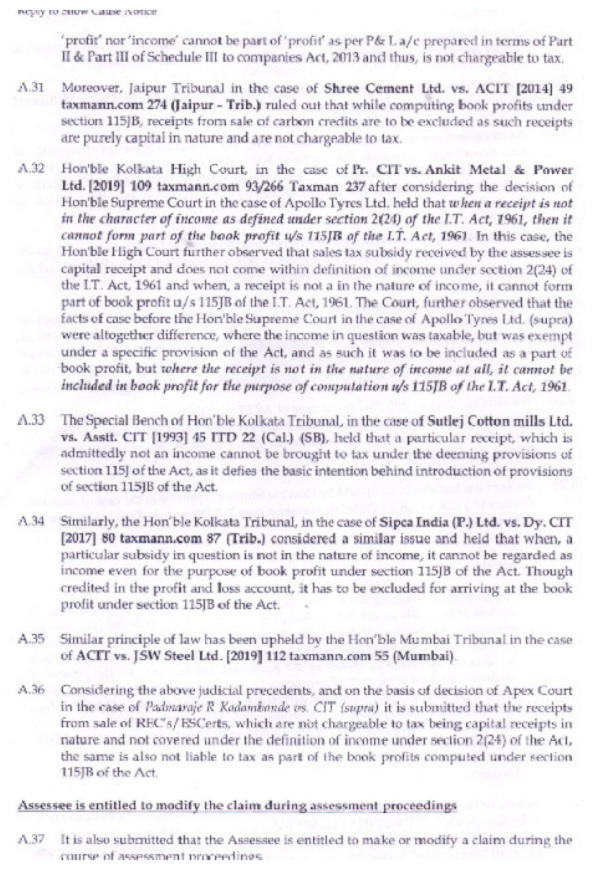
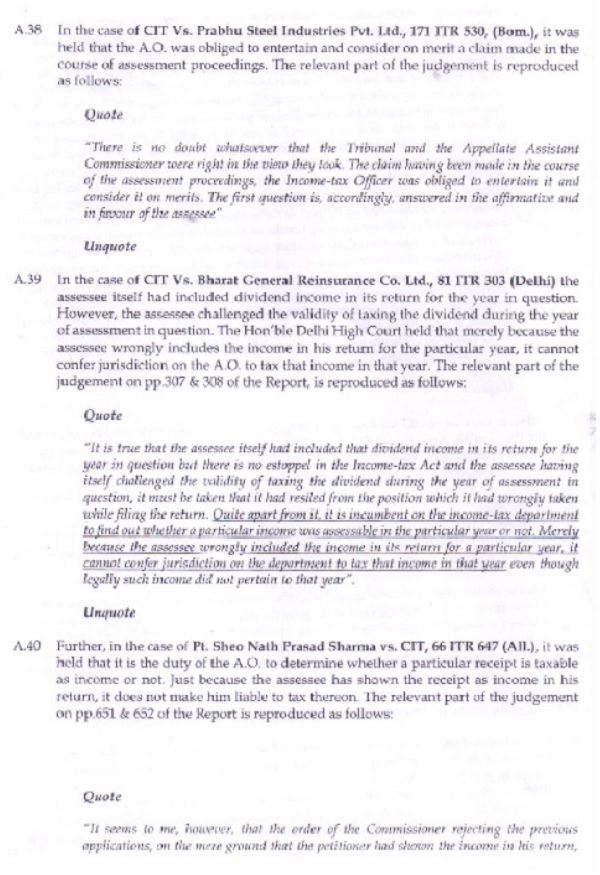
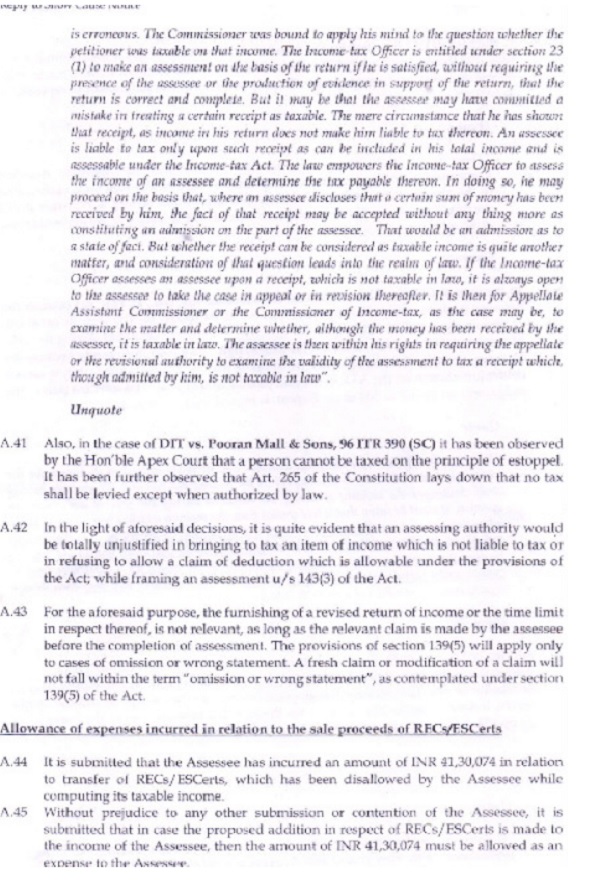
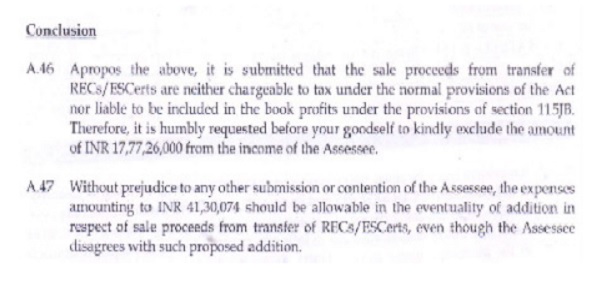
5.2 Mr Sehgal, ld. AR further explained the details about the sale of renewable energy certificate (REC and ESCarts), the relevant part is extracted as below:
“2. Receipts on sale of Renewable Energy Certificates[REC] & ESCERTS [Addition made as per directions of the DRP]:
Before we specifically, deal with the above said ground of appeal, it is important to give the ‘brief profile’ of the company and the business carried on by it which is as under:
a. The assessee is a public company engaged in the manufacturing of ‘writing & printing paper’, having factory premises in Village Rupana, situated in District Muktsar Sahib, which is Agro based area. The company has a cogeneration captive power division also, in which, electricity is generated from renewable energy sources i.e. Bio-fuels which includes ‘Rice Husk’, unlike other companies which utilize fossil fuels i.e. coal & Diesel and the same is consumed by the paper division.
b. The generation of power from renewable energy resources helps in reduction of emission of carbon/heat and gases.
c. The assessee is maintaining complete record viz a viz cashbook and ledger, which are audited and no defects have been pointed by the DRP/Ld. AO in day to day of maintenance of books of accounts.
d. It is also an undisputed fact that the electricity so generated by use of the Bio-fuels is not being sold to any other concern, but it is wholly consumed in the manufacturing activity of the appellant and this use of Bio-fuels saves the environment being an environment friendly as it reduces the carbon/heat & gas emission like carbon credits.
e. It is submitted that in order to encourage the use of renewable sources of energy, such as wind energy, solar energy, steam energy, etc., Ministry of New and Renewable Energy (‘MNRE’) issues transferable and saleable credit certificates under the Electricity Act, 2003, which are generally referred to as “Renewable Energy Certificates (‘RECs’) ”. Such RECs are issued, under Central Electricity Regulatory Commission Regulations, 2010 (‘CERC Regulations’) issued pursuance to section 178(1) and section 66 read with clause (y) of section 178(2) of the Electricity Act, 2003.
f. Further, the Energy Conservation Act, 2001 (‘the EC Act’) provides for various provisions relating to the conservation of energy. The energy conservation/reduction targets are set by the ‘Government of India’ in consultation with BEE under section 14(a) of the Energy Conservation Act, The Central Government in exercise of the power conferred upon it under clause (1) of section 14A of the EC Act and Rule 11 of the PAT Rules, 2012 issuesthe ‘energy savings certificates’ to these Designated Consumers, whose energy consumption is less than the prescribed norms and standards.
g. Further, the objective of REC mechanism is to promote ‘renewable energy’ and facilitate compliance of Renewable Purchase Obligations (‘RPO’) through a market-based instrument aimed at addressing the mismatch, between availability of renewable energy resources in state and the requirement of the obligated entities to meet the RPO.
h. Under the REC mechanism, the units/undertakings/entities, which are not using ‘renewable energy resources’ are required to purchase, at a cost, RECs, to compensate its RPO. This mechanism helps in promoting use of ‘renewable energy resources’ and in sustaining the non-renewable energy resources.
i. The company engaged in generation of electricity from use of ‘renewable energy sources’ is required to apply for registration for issuance of certificates and thereafter, transferable certificates are issued by Central Agency of MNRE.
j. The CERC Regulations also provide that the certificates issued to an eligible entity can also be placed for dealing in any of the ‘Power Exchanges’ as the certificate holder may consider appropriate, and such certificate shall be available for dealing in accordance with the Rules and Byelaws of such Power Exchange at a value pre-determined by the Power Exchange. Similarly, ESCERTS are also issued for the conservation of energy and the same can be sold on the Power Exchange regulated by the Government.
k. Regarding Energy Saving Certificates (ESCerts), it is issued to those plants who had over achieved the targets to reduce specific energy consumption in energy intensive industries & those plants who are under achievers of that targets are entitled to purchase ESCerts.
l. The energy saving certificates (ESCerts) are also issued as the energy saving also reduces the emission of carbon heat & gases.
m. It is submitted that the receipts generated from the sale proceeds of RECs/ESCerts are not liable to tax for the assessment year under consideration in terms of sections 2(24), 28, 45 and 56 of the Act. RECs/ESCerts are made available to the assessee on account of reduction in emission of carbon/heat & gases & saving of energy consumption also reduces emission of carbon/heat & gases and not because of its business. Further, RECs/ESCerts cannot be considered as a by-product. Transferable RECs/ESCerts are not a result or incidence of one’s business, but it is a credit for reducing emissions. The persons having RECs get benefit by selling the same to a person who needs credits to fulfill one’s RPO. The amount received is not received for producing and/or selling any product, by-product or for rendering any service for carrying on the business, REC/ESCerts is entitlement & an off shoot of environmental concern & not an off shoot of business.
n. In the case of carbon credits, the courts have repeatedly held that they are not directly linked with power generation as there are not an off shoot of business & it is a capital receipt and cannot be business receipt or income.”
6. The ld. DR vehemently argued and placed that the claim of the assessee is not related to carbon credit, so, it is not covered u/s 1 15BBG or as exempted income. The ld. DR argued that the revenue had properly taken it as an income from business. The ld. DR relied on the order of the ld. AO para no. 3.5.2 and 3.5.3 of the said order are extracted as below:
“3.5.2 The Panel has considered the submission. It is noticed that the AO has dealt with the assessee ’s submission at length in the Assessment order and has correctly rejected them. A bare perusal of Section 115BBG of Income Tax Act, 1961 makes it plan that the claim of assessee is erroneous and not in accordance with provisions of law. Section 115BBG deals with Income from sale of Carbon Credit does not take within its ambit the income from sale of RECs/ESCs:
‘115BBG, Tax on income from transfer of carbon credits. ~{i) Where the toad income of an assessee includes any income by way of transfer of carbon credits, the income-tax payable shall be the aggregate of-
(a) the amount of income-tax calculated mi die income by way of transfer of carbon credits, at the rate of ten per cent; and
(b) the amount of income-tax with which the assessee would have been chargeable had his total income been reduced by the amount of income referred to in clause (a).
(2) Notwithstanding anything contained in this Act mi deduction In respect of any expenditure or allowance stud! be allowed to the assessee under any provision of this Act in computing his income referred to in clause (a) of sub-section (1).
Explanation, -For the purposes of this section ’carbon credit” in respect of one unit shall mean reduction of one tonne of carbon dioxide emissions or emissions of its equivalent gases which is validated by die United Nations Framework on Climate Change and which can be traded In market at its prevailing market price.
Thus, the Panel is of the view that the assessee has wrongly claimed the Income from Sale of RECs/ESCs u/s 115BBG of Income Tax Act,1961. Income from sale of REC/ESCs is normal business income few the assessee and needs to be included in the business income and taxed at normal tale rather than at concessional rate.
3.5.3. The AO has rightly noted that the assessee has shown the income from sale of RECs/ESCs in P&L account in the item no. 33. Other Income’. The assessee claims that income from sale of Renewable Energy Certificates end Carbon Emission Reductions is income from other sources is not tenable as toy are intrinsically connected to business of the assessee. It may be noted that the assessee is engaged in the manufacturing of writing and printing paper which is agro based. The company generated captive power through renewable energy source Bio fuel. The raw material for electricity generation m hoe husk which is also used to paper production and hence it is effectively the by-product of the paper production process. Secondly, the electricity produced the renewable energy plant is used solely for to purpose of business and not sold outside. Hence it farms an integral part of the paper making process and cannot be considered as an offshoot of environmental concern but an offshoot of business. Thirdly, gains from these REC/ESCs in India contain to right to transfer it. These credits have no other value. It must be emphasized if there is no carrying on of the business there are no RECs/ESCs The question of savings to emission arises only in to course of the business. The REC/ESCs are an offshore to business and being carried in environmentally responsible manner. The activity of business and activity of earning REC/ESCs cannot, therefore, be divorced from each other. The core activity is business and being environmentally responsible is the manner to which the core activity is carried out. Fourthly, to activity of obtaining REC/ESCs is a systematic activity which requires careful planning and a series of actions before the RECs are obtained. For example, a project is to the first approved by the appropriate authorities which grant the REC/ESCs. The functioning of the business and the reduction in emission are to be monitored by the appropriate authorities. The RECs/ESCs ore not a windfall which appear out to the blue. A series of conscious decision are thus required to be taken by the assessee in order to get the RECs/ESCs and to considerations of REC/ESCs therefore have an integral part of the business activity. The generation of RECS is thus on account of business activity and the same must be included in business income. As per section 28 if any benefit or perquisite or credit is generated from the business, the same would be a profit from business and is taxable. Therefore, the same cannot be termed as income from other sources, but business income. Since on account of running the business of paper manufacturing for which power is an essential and compulsory requirement, RECs were earned which is marketable and is sold, therefore, it is an income out of business. It is hereby established that the REC/ESCs are a sresult of the assessee ’s business. The Panel, therefore, finds no infirmity in the order of the AO.
9.2 Thus following the directions of the Hon. DRP, the addition of Rs. 17,77,26,000/- is made to the total income as business income and the assessee s claim under section 115BBG is rejected.”
6.1 The ld. DR further argued and placed the order of the High Court of Orissa in the case of Orissa Rural Housing Development Corpn. Ltd. v.Assistant Commissioner of Income-tax, Circle – 1(1), 2012] 17 taxmann.com 186 (Orissa)- Held “Section 139 of the Income-tax Act, 1961 – Return of income – Revised return – Assessment year 2006-0 7 – Whether an assessee can revise his return of income by way of filing a revised statement of income after filing original return other than by way of filing revised return as contemplated under section 139(5) – Held, no”
7. The ld. AR further argued and placed that a written submission related to comparable study of comment of DRP and the assessee’ s submission in relation to claim of the income. The said submission is extracted as below: –
“14. The DRP has rejected this bonafide claim of the assessee at page 27 of the order by making the following comments and which are being distinguished as under: