Infosys Ltd Vs ACIT (ITAT Bangalore)
ITAT Bangalore held that expenditure reduced from export turnover should also be reduced from total turnover while computing deduction under section 10AA of the Income Tax Act.
Facts- During the relevant previous year, the assessee had incurred brand building expenses of Rs.81,79,53,112/-. The brand building expenditure were in the nature of subscription to research reports by research agencies and advisory services, participation/sponsorship in seminars, exhibitions, marketing and sales events, retainership amounts paid towards public relations agencies, annual and periodic customer and sales meets, etc.
Notably, Brand building expenses are included and shown under ‘Selling and Marketing expenses’ in the financial statements and claimed as revenue expenditure.
In the draft assessment order, the AO treated the brand building expenses, as deferred revenue expenditure, and allowed 20% of the said expenditure amounting and held that the balance sum constituting 80% of the expenditure will be amortized over the next 4 years.
Further it is also alleged that AO has reduced the communication expenses and expenses incurred in foreign currency only from export turnover without reducing the same from total turnover while computing deduction u/s 10AA.
Conclusion- Held that Coordinate Bench in case of the sister concerns of assessee, considered identical issue on similar facts. Nothing has been brought on record by the revenue to the expenses incurred by the assessee is towards any capital asset. Respectfully following the same, we direct the disallowance to be deleted.
This issue is no longer resintegra. Hon’ble Supreme Court in the case of CIT v HCL Technologies Ltd held that, freight, telecommunication charges, insurance charges and expenses incurred in foreign currency reduced from export turnover should also be reduced from total turnover while computing deduction under section 10A. Ratio of the said decision is squarely applicable for the purposes of section 10AA/10A and both these sections are in pari material with each other.
FULL TEXT OF THE ORDER OF ITAT BANGALORE
Present appeal arises out of final assessment order dated 28/02/2017 passed by the Ld.ACIT, Circle – 3(1)(1), Bangalore for A.Y. 2012-13 on following grounds of appeal:
General and Legal Grounds
1. The order passed by the learned assessing officer and the directions of Hon’ble DRP to the extent prejudicial to the appellant is bad in law and liable to be quashed.
Grounds on denial of deduction claimed under section 10AA in respect of 4 SEZ units viz., Chennai – Unit 1, Chandigarh, Mangalore – Unit 1 and Pune Unit 1
2. The learned assessing officer has erred in denying deduction claimed under section 10AA in the return of income totally amounting to Rs. 2227,82,65,630 in respect of profits of 4 SEZ units viz., Chennai – Unit 1, Chandigarh, Mangalore – Unit 1 and Pune Unit 1.
3. The learned assessing officer has erred in denying deduction computed under section 10AA (after making certain disallowances) in the assessment order for the impugned reason that the 4 SEZ units viz., Chennai – Unit 1, Chandigarh, Mangalore – Unit 1 and Pune Unit 1have been formed by splitting up and reconstruction of the already existing business.
4. The learned assessing officer has erred in concluding that the 4 SEZ units have been formed by splitting up and reconstruction of an already existing business and hence these SEZ units are not eligible for deduction under section 10AA.
5. On the facts and in the circumstances of the case and law applicable, the 4 SEZ units viz., Chennai – Unit 1, Chandigarh, Mangalore – Unit 1 and Pune Unit 1 were not formed by splitting up and reconstruction of an already existing business and consequently these SEZ units are eligible for deduction under section 10AA.
Grounds on transfer pricing adjustment
6. The learned Assessing Officer has erred in making a reference to TPO for determining arm’s length price without demonstrating as to why it was necessary and expedient to do so and the Hon’ble DRP has erred in confirming the action of the learned AO.
7. The lower authorities have erred in making a transfer pricing adjustment of Rs. 84,04,827, passing the orders without demonstrating that the appellant had motive of tax evasion, not appreciating that no addition can be made under Chapter X as Transfer pricing adjustment under Chapter X is not included in the definition of ‘income’ u/s 2(24) or under Chapter IV of the IT Act, 1961. The orders passed by the lower authorities are therefore bad in law and liable to be quashed.
8. The learned assessing officer and transfer pricing officer have erred in making a transfer pricing adjustment of Rs 84,04,827 by adopting the average rate of interest on fixed deposits for a period exceeding 365 days calculated at 8.53% as internal CUP for the purpose of computing arm’s length price (ALP) adjustment in respect of interest income charged on loan given to Infosys Technologies (China) Co Ltd.
9. On facts and in the circumstances of the case and law applicable, the impugned transfer pricing adjustment is liable to be deleted in entirety.
Grounds on disallowance under section 14A
10. The learned assessing officer has erred in computing disallowance of Rs. 3,30,96,246 under section 14A of the Income tax Act, 1961 (“Act”) read with rule 8D(2)(iii) of the Income tax rules, 1962 (“Rules”) and erred in making net addition of Rs. 1,58,09,987.
11. The learned assessing officer has erred in invoking rule 8D(2)(iii) for the purpose of making disallowance under section 14A without demonstrating satisfaction in terms of subsection 2 of section 14A as to why the disallowance made by the assessee under section 14A amounting to Rs. 1,72,86,259 is not correct having regard to the accounts of the assessee.
12. Without prejudice, the learned assessing officer has erred in including investment in shares of Infosys BPO Limited for the purpose of computing disallowance under section 14A read with rule 8D(2)(iii) without appreciating the fact that there was no exempt dividends from the said company and further investment in the said company was not made with a view to earn dividend income.
13. On facts and in the circumstances of the case and law applicable, the impugned computation of disallowance and the net addition is liable to be deleted in entirety.
Grounds on protective disallowance under section 40/ 40(a)(i) in respect of subscription charges paid / payable to M/s Forester Research and M/s Gartner
14. The learned assessing officer has erred in making protective disallowance of expenditure incurred on subscription charges amounting to Rs. 2,82,09,462 and Rs. 3,17,31,606 under section 40/ 40(a)(i) which was paid / payable to M/s Forrester Research and M/s Gartner respectively.
15. On facts and in the circumstances of the case and law applicable, no disallowance should be made under section 40/ 40(a)(i) in respect of the subscription charges paid / payable to M/s Forester Research and M/s Gartner respectively.
16. Without prejudice to ground 9&10 above, the protective disallowance, if any, is to be limited to the amount of subscription charges payable to M/s Forester Research and M/s Gartner as on 31st March 2012 and no disallowance is to be made in respect of subscription charges actually paid during the relevant previous year.
Grounds on disallowance under section 40(a)(ia) / 40(a)(i) in respect of software expenses
17. The learned assessing officer has erred in disallowing software expenses paid/payable to residents and non residents amounting to Rs. 30,23,602 and Rs. 14,65,417 respectively [totaling to Rs.44,88,019] under section 40(a)(ia) / 40(a)(i) for not deducting tax at source in respect of the said payments under section 194J / 195 of the Income tax Act, 1961.
18. Without prejudice, software payments made to residents totally amounting to Rs. 30,23,602was not liable for TDS under section 40(a)(ia) in view of the 1st proviso to section 40(a)(ia) read with 1st proviso to section 40(a)(i).
19. On the facts and in the circumstances of the case and law applicable, software expenses of Rs. 30,23,602 and Rs. 14,65,417 respectively [totaling to Rs. 44,88,019]was not liable for disallowance under section 40(a)(i) / 40(a)(ia) of the Act.
20. In any case and without prejudice, disallowance under section 40(a)(ia), if any, should be restricted to Rs. 9,07,081 being 30% of Rs. 30,23,602 as the amendment to section 40(a)(ia) by the Finance (No. 2) Act, 2014 w.e.f. 1.4.2015 is beneficial in nature and hence retrospective.
21. In any case and without prejudice, the disallowance, if any, is to be limited to the amount of software expenses payable as on 31st March 2012 and no disallowance is to be made in respect of payments actually made during the relevant previous year.
Grounds on disallowance of software expenses as capital expenditure
22. The learned assessing officer has erred in disallowing software expenses of Rs 451,18,32,386as capital expenditure and erred in making net addition of Rs. 338,38,74,290. On facts and in the circumstances of the case and law applicable, the impugned disallowance of software expenses and the net addition is liable to be deleted in entirety.
23. In any case and without prejudice, the learned assessing officer has erred in allowing depreciation at 25% instead of 60%.
24. In any case and without prejudice, the learned assessing officer has erred in not allowing depreciation at 60% in respect of software expenses held as capital expenditure for the earlier years.
Grounds on disallowance of brand building expenses
25. The learned assessing officer has erred in treating brand building expenses of Rs. 81,79,53,112 as ‘capital expenditure’ and making net addition of Rs. 56,85,08,898. On facts and in the circumstances of the case and law applicable, brand building expenses should be fully allowed as deduction.
Grounds on disallowance of Commission paid
26. The learned assessing officer has erred in disallowing commission paid to foreign entities amounting to Rs. 23,68,35,533. On facts and in the circumstances of the case and law applicable, commission paid should be fully allowed as deduction.
Grounds on non reduction of communication expenses from total turnover while computing deduction under section 10AA
27. The learned assessing officer has erred in not reducing the communication expenses totally amounting to Rs.2,71,11,231 from total turnover while computing deduction u/s 10AA in respect of SEZ units at Chennai (Unit 2), Trivandrum, Mysore, Hyderabad and Jaipur, for which deduction under section 10AA has been allowed. On facts and in the circumstances of the case and law applicable, communication expenses should be reduced from total turnover also in computing deduction under section 10AA for the aforesaid units.
28. The learned assessing officer has erred in concluding that communication expenses totally amounting to Rs.12,48,70,626 should not be reduced from total turnover in computing deduction under section 10AA for the other SEZ units at Chennai (Unit No 1), Chandigarh, Pune and Mangalore, for which deduction under section 10AA has not been allowed. On facts and circumstances of the case and law applicable, communication expenses should be reduced from total turnover also in computing deduction under section 10AA for the aforesaid units.
Grounds on non reduction of expenses incurred in foreign currency from total turnover while computing deduction under section 10AA
29. The learned assessing officer has erred in not reducing the expenses incurred in foreign currency totally amounting to Rs.358,08,30,087 from total turnover while computing deduction u/s 10AA in respect of the SEZ units at Chennai (Unit 2), Trivandrum, Mysore, Hyderabad and Jaipur, for which deduction under section 10AA has been allowed. On facts and in the circumstances of the case and law applicable, expenses incurred in foreign currency should be reduced from total turnover also in computing deduction under section 10AA for the aforesaid units.
30. The learned assessing officer has erred in concluding that expenses incurred in foreign currency totally amounting to Rs.1688,21,01,184 should not be reduced from total turnover in computing deduction under section 10AA for the other SEZ units at Chennai (Unit No 1), Chandigarh, Pune and Mangalore, for which deduction under section 10AA has not been allowed. On facts and circumstances of the case and law applicable, expenses incurred in foreign currency should be reduced from total turnover also in computing deduction under section 10AA for the aforesaid units.
Grounds on reduction of interest income from GLES deposit from profits of SEZ units
31. The learned assessing officer has erred in reducing interest income from GLES deposits totally amounting to Rs.2,05,18,841 from profits of SEZ units at Chennai (Unit 2), Trivandrum, Mysore, Hyderabad and Jaipur respectively, while computing deduction under section 10AA and for which deduction under section 10AA has been allowed. On facts and in the circumstances of the case and law applicable, deduction under section 10AA should be allowed in respect of interest income from GLES deposits totally amounting to Rs. 2,05,18,841 in respect of the aforesaid units.
32. The learned assessing officer has erred in concluding that interest income from GLES deposits totally amounting to Rs. 8,66,54,955should be reduced from profits of SEZ units at Chennai (Unit No 1), Chandigarh, Pune and Mangalore respectively while computing deduction under section 10AAand for which deduction under section 10AA has not been allowed. On facts and in the circumstances of the case and law applicable, interest income from GLES deposits totally amounting to Rs. 8,66,54,955 should be held as eligible for deduction under section 10AA in respect of the aforesaid SEZ units.
Grounds on reduction of interest income from loans given to employees from profits of SEZ units while computing deduction under section 10AA
33. The learned assessing officer has erred in reducing interest income from loans given to employees totally amounting to Rs.13,75,022 from profits of SEZ units at Chennai (Unit 2), Trivandrum, Mysore, Hyderabad and Jaipur respectively, while computing deduction under section 10AA and for which deduction under section 10AA has been allowed. On facts and in the circumstances of the case and law applicable, deduction under section 10AA should be allowed in respect of interest income from loans given to employees totally amounting to Rs.13,75,022.
34. The learned assessing officer has erred in concluding that interest income from loans given to employees totally amounting to Rs.58,06,978 should be reduced from profits of SEZ units at Chennai (Unit No 1), Chandigarh, Pune and Mangalore respectively while computing deduction under section 10AA and for which deduction under section 10AA has not been allowed. On facts and in the circumstances of the case and law applicable, interest income from loans given to employees totally amounting to Rs.58,06,978 should be held as eligible for deduction under section 10AA in respect of the aforesaid SEZ units.
Grounds on reduction of receipts from sale of scrap from profits of SEZ units while computing deduction under section 10AA
35. The learned assessing officer has erred in reducing receipts from sale of scrap amounting to Rs.6,54,378 from profits of SEZ unit at Trivandrum while computing deduction under section 10AA and for which deduction under section 10AA has been allowed. On facts and in the circumstances of the case and law applicable, deduction under section 10AA should be allowed in respect of receipts from sale of scrap amounting to Rs.6,54,378 relating to SEZ unit at Trivandrum.
36. The learned assessing officer has erred in concluding that receipts from sale of scrap totally amounting to Rs.63,78,336 should be reduced from profits of SEZ units at Chennai (Unit No 1), Chandigarh and Mangalore respectively while computing deduction under section 10AA and for which deduction under section 10AA has not been allowed. On facts and in the circumstances of the case and law applicable, receipts from sale of scrap totally amounting to Rs.63,78,336 should be held as eligible for deduction under section 10AA in respect of the aforesaid SEZ units.
Grounds on reduction of incentive receipts from Airlines from profits of SEZ units while computing deduction under section 10AA
37. The learned assessing officer has erred in reducing incentive receipts from Airlines totally amounting to Rs.76,176 from profits of SEZ unit at Chennai (Unit 2), Trivandrum, Mysore, Hyderabad and Jaipur respectively, while computing deduction under section 10AA and for which deduction under section 10AA has been allowed. On facts and in the circumstances of the case and law applicable, deduction under section 10AA should be allowed in respect of incentive receipts from Airlines amounting to Rs.76,176 relating to aforesaid SEZ units.
38. The learned assessing officer has erred in concluding that incentive receipts from Airlines totally amounting to Rs.3,21,709 should be reduced from profits of SEZ units at Chennai (Unit No 1), Chandigarh, Pune and Mangalore respectively while computing deduction under section 10AA and for which deduction under section 10AA has not been allowed. On facts and in the circumstances of the case and law applicable, incentive receipts from Airlines totally amounting to Rs.3,21,709 should be held as eligible for deduction under section 10AA in respect of the aforesaid SEZ units.
Grounds on reduction of income in the nature of Inter Company cessation of trading liability while computing deduction under section 10AA
39. The learned assessing officer has erred in reducing income in the nature of Inter Company cessation of trading liability totally amounting to Rs.19,97,651 from profits of SEZ unit at Chennai (Unit 2), Trivandrum, Mysore, Hyderabad and Jaipur respectively, while computing deduction under section 10AA and for which deduction under section 10AA has been allowed. On facts and in the circumstances of the case and law applicable, deduction under section 10AA should be allowed in respect of income in the nature of Inter Company cessation of trading liability totally amounting to Rs.19,97,651 relating to aforesaid SEZ units.
40. The learned assessing officer has erred in concluding that income in the nature of Inter Company cessation of trading liability totally amounting to Rs.84,36,456should be reduced from profits of SEZ units at Chennai (Unit No 1), Chandigarh, Pune and Mangalore respectively while computing deduction under section 10AA and for which deduction under section 10AA has not been allowed. On facts and in the circumstances of the case and law applicable, income in the nature of Inter Company cessation of trading liability totally amounting to Rs.84,36,456 should be held as eligible for deduction under section 10AA in respect of the aforesaid SEZ units.
Grounds on reduction of deduction u/s 10AA in respect of pure onsite revenue
41. The learned assessing officer has erred in computing and reducing a sum of Rs.1,02,27,137 from deduction computed u/s 10AAfor the reason that 1.08% (pure onsite revenue) of 50.8% (onsite revenue percentage) with a profit margin of 10.59% relating to 5 SEZs [viz., Chennai (unit 2), Trivandrum, Mysore, Hyderabad and Jaipur in respect of which deduction under section 10AA has been allowed] are not eligible for deduction under section 10AA. On facts and in the circumstances of the case and law applicable, no reduction should be made from deduction computed u/s 10AA and the sum of Rs. 1,02,27,137 should be held as eligible for deduction under section 10AA of the Act.
42. Without prejudice, similar disallowance in relation to other SEZ units viz., Chennai (Unit No 1), Chandigarh, Pune and Mangalore, if any, is also not warranted and the same should be deleted in entirety.
Grounds on disallowance of deduction u/s 80JJAA:
43. The learned assessing officer has erred in disallowing deduction u/s 80JJAA amounting to Rs. 307,52,60,884. On facts and in the circumstances of the case and law applicable, deduction u/s 80JJAA should be fully allowed as deduction.
Grounds on disallowance of Sub Contracting charges paid to Infosys Technologies China Co Ltd under section 40(a)(i) for not deducting tax at source under section 195.
44. The learned assessing officer has erred in disallowing sub contracting charges paid to Infosys Technologies (China) Co Ltd amounting to Rs.262,02,26,125 under section 40(a)(i) for the impugned reason that TDS under section 195 has not been made in respect of the said payments.
45. On facts and circumstances of the case and law applicable, as payments made to Infosys Technologies (China) Co Ltd amounting to Rs.262,02,26,125 were not chargeable to tax in India under the IT Act, 1961 and / or under the India – China DTAA, the said payments were not liable for TDS u/s 195 and consequently not liable for disallowance under section 40(a)(i).
46. Assuming without admitting that the payments made to Infosys Technologies (China) Co Ltd amounting to Rs.262,02,26,125 are liable for TDS u/s 195, deduction under section 10AA should be allowed in respect of increase in profits on account of the impugned disallowance as relatable to SEZ units.
47. Assuming without admitting that the payments made to Infosys Technologies (China) Co Ltd amounting to Rs.262,02,26,125 are liable for TDS u/s 195, as the demand raised under section 201(1)/(1A) in respect of the aforesaid payment has been fully paid in FY 2013-14, the said expenditure should be allowed as a deduction in computing the total income for AY 2014-15.
Grounds on allowability of deduction u/s 35(2AB) for a sum of Rs.249,91,38,982 in respect of Scientific Research Expenditure incurred from 1.4.2011 to 22.11.2011 amounting to Rs.124,95,69,491
48. The learned AO has erred in not allowing deduction under section 35(2AB) in respect of scientific research expenditure incurred from 1.4.2011 to 22.11.2011 amounting to Rs.124,95,69,491
49. The learned AO has erred in not appreciating that as deduction u/s 35(2AB) for scientific research expenditure incurred from 23.11.2011 to 31.3.2012 was claimed in the return of income and the same has been allowed in the draft and final assessment order, the assessee is also eligible for deduction under section 35(2AB) in respect of scientific research expenditure incurred from 1.4.2011 to 22.11.2011 amounting to Rs.124,95,69,491.
50. On facts and circumstances of the case and law applicable, incremental deduction under section 35(2AB) amounting to Rs.249,91,38,982 [200% of Rs.124,95,69,491] should be allowed in respect of the scientific research expenditure incurred from 1.4.2011 to 22.11.2011.
TDS credit not allowed fully
51. The learned AO has erred in not allowing TDS credit to the extent of Rs.1,06,50,855 [Rs 223,20,83,172 as claimed during assessment less Rs.222,14,32,317 as allowed in the draft and final assessment order].
52. On facts and in the circumstances of the case and law applicable, TDS credit should be fully allowed to the extent of Rs.223,20,83,172 as claimed during the assessment.
TDS credit and advance tax relating to ICIL not allowed even though it was allowed in the Draft assessment order
53. The learned AO has erred in not allowing TDS credit and advance tax relating to Infosys Consulting India Ltd merged with the appellant amounting to Rs.27,73,096 and Rs.75,00,000 even though the same was allowed in the draft assessment order.
Grounds on allowability of incremental foreign tax credit which was allowed in the Draft assessment order
54. The learned assessing officer has erred in not allowing foreign tax credit to the extent of Rs.343,52,84,882 [680,43,71,180 less336,90,86,298] in the final assessment order, which in turn was allowed in the draft assessment order.
55. The learned assessing officer has erred in not allowing additional deduction for state taxes paid amounting to Rs.37,30,57,123, while computing net business income as claimed during the assessment vide letter dated 29.02.2016.
Grounds on allowability of state taxes paid outside India.
56. The learned AO has erred in
i. not allowing incremental deduction in respect of state taxes paid outside India to local authorities of foreign countries amounting to Rs.37,30,57,123
ii. disregarding the claim made by assessee before the learned AO vide letter dated 29th February 2016.
57. Without prejudice, the learned AO has erred in not allowing relief under section 91 in respect of state tax paid outside India totally amounting to Rs.141,01,15,640 as per the decision of the Jurisdictional High Court in the case of Wipro Ltd v CIT [2016] 382 ITR 179.
Interest on IT Refund granted under section 143(1) but subsequently recovered on completion of assessment proceedings is allowable as deduction
58. The learned AO has erred in not allowing deduction for interest on IT refund amounting to Rs.1,16,28,374 which was granted in the intimation passed under section 143(1) dated 04.02.2009 for AY 2007-08 but which was subsequently recovered in the order passed under section 143(3) for AY 2007-08 as part of assessed tax.
59. The learned AO has erred in not allowing deduction for interest on IT refund amounting to Rs.7,24,03,804 which was granted in the intimation passed under section 143(1) dated 27.09.2010 for AY 2008-09 but which was subsequently recovered in the order passed under section 143(3) for AY 2008-09 as part of assessed tax.
Grounds on Interest levied under section 234B and 234D
60. The learned assessing officer has erred in levying interest under section 234B and 234D. On the facts and in the circumstances of the case, interest under section 234B and 234D is not leviable. The appellant denies its liability to pay interest under section 234B and 234D.
Prayer
61. In view of the above and other grounds to be adduced at the time of hearing, the appellant prays that the DRP directions and the final assessment order passed by the learned AO be quashed or in the alternative, the aforesaid grounds and the relief prayed for there under be allowed.
The appellant submits that each of the above grounds/ sub-grounds are independent and without prejudice to one another.
The appellant craves leave to add, alter, vary, omit, substitute or amend the above grounds of appeal, at any time before or at, the time of hearing, of the appeal, so as to enable the Income-tax Appellate Tribunal to decide the appeal according to law.
The appellant prays accordingly.
2. Assessee has also filed application seeking admission of additional grounds in respect of secondary and higher secondary education cess paid.
3. It is submitted that this ground has been decided against assessee by Hon’ble Supreme Court and accordingly, the assessee do not wish to press this issue.
Accordingly, the additional ground raised by assessee stands dismissed.
4. Brief facts of the case are as under:
4.1. For the assessment year 2012-13, assessee filed its return of income on 30/11/2012 and the return was revised on 25/03/2014 declaring an income of Rs.8543,76,14,970/-. Subsequently, the case was selected for scrutiny and the notice u/s. 143(2) was sent to the assessee asking for details.
4.2. In response to the statutory notices, representatives of assessee appeared before the Ld.AO and filed requisite details and documents as called for. As there was international transaction of assessee with its associated enterprises, the appeal was referred to the transfer pricing officer. The Ld.TPO called for economic details of the international transaction in form 3CEB. The Ld.TPO issued notice on 05/09/2014. The assessee filed all requisite details. The Ld.TPO examined the international transactions. The Ld.TPO noted that the assessee had entered into following international transactions with its AE.
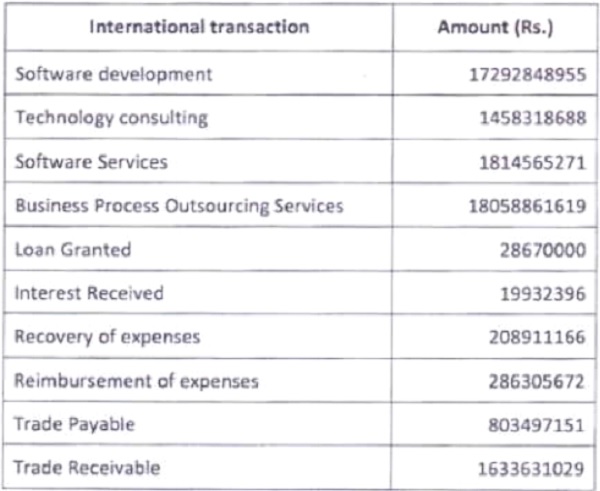
The Ld.TPO noted that assessee aggregated all the transactions related to export of software services and had earned a profit margin of 43.07%. As this was higher than the margins of the comparables, no adjustment was proposed.
4.3. The Ld.TPO observed that assessee has made advances to its associated enterprises being Infosys China & Infosys Brazil. The assessee in response to the notice issued by the Ld.TPO submitted that the loan provided was denominated in US dollar currency and assessee had charged interest at the rate of 6% p.a. It was noticed that the assessee benchmarked the transaction by using the prevailing USD-LIBOR rate which was not acceptable to the Ld.TPO. The Ld.TPO computed the interest rate based on the BBB+ grade corporate bond at 11.76% for 1-2 years. The Ld.TPO thus vide order dated 28/12/2015 proposed an adjustment at Rs.1,71,75,081/-.
4.4. As Infosys Consulting India Ltd. was merged into Infosys Ltd., a separate order u/s. 92CA was passed based on the international transactions between Infosys Consulting India Ltd. and the AE being Infosys Consulting Inc. The Ld.TPO has recorded as under:
“ICIL was incorporated in 19th August 2009 as a public limited company under the Companies Axt 1956. The company was a wholly owned subsidiary of Infosys Consulting Inc., which in turn was a 100 percent subsidiary of Infosys. However, during the year ended 315′ March 2012, Infosys Consulting Inc. had been terminated and hence, ICIL became a wholly owned subsidiary of Infosys. Later ICIL got merged with Infosys Ltd.”
4.5. The Ld.TPO noted that Infosys Consulting India Ltd. had following international transaction with Infosys Consulting Inc.