Union Bank Of India Vs Sh D.C. Chaturvedi (Delhi High Court)
Section 4(6)(a) of the Act, however, provides that the gratuity of an employee, whose services may have been terminated for the reasons as specified therein, can be forfeited to the extent of damage or loss so caused. The relevant provision reads as under:
“(6) Notwithstanding anything contained in subsection (1),—
(a) the gratuity of an employee, whose services have been terminated for any act, wilful omission or negligence causing any damage or loss to, or destruction of, property belonging to the employer shall be forfeited to the extent of the damage or loss so caused;
(b) the gratuity payable to an employee 17 [may be wholly or partially forfeited]—
(i) if the services of such employee have been terminated for his riotous or disorderly conduct or any other act of violence on his part, or
(ii) if the services of such employee have been terminated for any act which constitutes an offence involving moral turpitude, provided that such offence is committed by him in the course of his employment.”
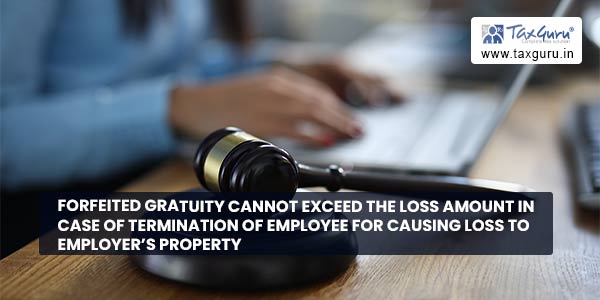
Thus, any employer can forfeit the gratuity of an employee if the employee is terminated for any act or omission or negligence causing any damage or loss to the property belonging to the employer. The forfeiture can only be to the extent of the damage or loss caused, and not beyond that.
Issuing of notice wherein the loss caused to the Bank is clearly quantified is a sine qua non for forfeiture of gratuity. In the first case before this Court, the forfeiture of gratuity was not even communicated to Employee No.1. Though some justification is sought to be laid on the basis of the inter office memo, this is, at best, an internal document and cannot constitute notice to the employee as required to be given under section 4(6)(a) of the Act. In the second petition, it is the case of Employee No.2 that the notice for forfeiture was itself issued after the claim was filed by the said employee and the said position is not disputed by the Bank. Thus, in both the cases, the employees were kept in dark as to the forfeiture of their gratuity. In both these petitions, neither proper notice was issued nor was any hearing afforded on the aspect of forfeiture to the employees.
In a banking system, there may be various factual situations which may have resulted in termination of the employee. The misconduct alleged may be at an individual level or at the level of the team, for example, for sanctioning of a loan, only one employee of a bank may not be fully responsible. As per Section 4(6)(a) of the Act, the omission or negligence has to exist and forfeiture can be only to the extent of damage or loss caused to the employer. These are factors which are subjective in nature and would depend on the facts of each case. Gratuity being a statutory right, as held in Hindalco Industries Appellate Authority (supra), the standard for forfeiture of gratuity would be much higher. As held in H. Jayaram Shetty v. the Sangli Bank Ltd. 2005 (3) Bom CR 10, the obligation of the employer to pay the gratuity of their employees is an extremely high obligation.
In the present two cases, both the employees were held to be delinquent employees whose personal integrity and honesty was in question. The termination of these two employees has attained finality.
On a careful perusal of the submissions of ld. counsels and material on record, the factual and legal position that emerges is as under:
i. In case of both the employees, chargesheets were issued, inquiries were conducted and they were terminated.
ii. The Bank resorted to forfeiture of gratuity but without giving proper notice as contemplated under section 4(6)(a) of the Act.
iii. In the case of Employee No.1, the claim for gratuity was filed approximately after 16 years from the date of decision of the Appellate Authority confirming the dismissal. Thus, there was a delay of approximately 16 years by the employee in staking his claim to the gratuity amount.
iv. In the case of Employee No.2, the claim was filed within a reasonable period, however, the employee was a person of doubtful integrity and honesty as the charges against him have attained finality and he stands
v. In the case of Employee No.1, the only justification on record for forfeiting of gratuity is an inter-office memo. In case of Employee 2, the notice of forfeiture was issued after Employee No.2 filed the claim.
vi. The settled legal position is that the three conditions of notice, quantification and hearing have to be complied with, prior to forfeiture of gratuity. This has clearly not been done by the Bank in both the
In view of the above, this Court is of the opinion that forfeiture of gratuity by the Bank under section 4(6)(a) of the Act is clearly not justifiable.
FULL TEXT OF THE JUDGMENT/ORDER OF DELHI HIGH COURT
1. This pronouncement has been done through hybrid conferencing. Facts in W.P.(C) 4486/2021
2. The Respondent herein- Mr. D.C. Chaturvedi, was an employee of the Petitioner Bank-Union Bank of India (hereinafter “Bank”). A charge sheet was issued against him on 7th November, 1994, alleging that loans were issued by him accommodating certain parties which caused losses to the Bank. A show cause notice was issued and, thereafter, an Inquiry Officer was appointed. The report of the Inquiry Officer held the Respondent/Employee (hereinafter “Employee No.1 ”) guilty of the charges levelled against him. Accordingly, the Disciplinary Authority of the Bank vide order dated 21st August, 1998 imposed the penalty of dismissal on Employee No.1. The relevant extract of the dismissal order passed by the Disciplinary Authority is set out hereinbelow:
“The inquiry record proves that three tractor loans and several crop loans were raised in fictitious names. The complaints of the real persons are on the records denying availment of loans in their names. It further strengthened the allegations that such tractor loans were adjusted within a period of 3 to 4 months after sanction. Had the borrowers so much of funds to repay the Bank loans of Rs. 1,30,000/- to Rs. 1,70,000/- within a period of 3 to 4 months then there was no need for them to avail loans after going through the cumbersome procedure. However, the fact is that such loans were adjusted within 3 to 4 months instead the longer period of say 5 to 7 years generally taken for repayment of such loans. The loan applications/papers had number of irregularities and were not complete in all respects. Before sanctioning such loans, had Shri Chaturvedi taken due care as regards establishment of identity of borrowers as also the completion of formalities/papers/documents, the true things would have come to light. However, he did not do so but sanctioned loans in fictitious names in haste without even thinking that the huge funds of the Bank were being put to stake. Considering the vital issue from various angles, I am of the view that
Shri Chaturvedi did not discharge his duty with integrity. Once the aspect of integrity is under cloud, such employee cannot be said to be honest and therefore J am of the opinion that he has failed to perform his duties with honesty and integrity.
Considering the nature and gravity of the misconducts proved against Shri Chaturvedi, I am of the opinion that the punishment of dismissal, if imposed on Shri Chaturvedi, would be just and proper. In pursuance of the powers vested in terms of Regulation 7 of the Union Bank of India Officer Employees’ (Discipline & Appeal) Regulations, 1976, I pass the following order:
ORDER
Shri D. C. Chaturvedi be and is hereby dismissed from the service of the Bank with immediate effect.”
3. In the appeal filed against the order of the Disciplinary Authority, the Appellate Authority of the Bank went through the entire record, examined the charges and upheld the penalty imposed. The operative portion of the Appellate Authority’s order dated 30th December, 1999 is set out below:
“…I am, therefore, of the opinion that the punishment of dismissal from the services of the Bank with immediate effect imposed on the Appellant by the Disciplinary Authority by holding him guilty of all the charges levelled against him including that of failure to discharge his duties with honesty and integrity is just and proper to meet the ends of justice and I do not find any reason to interfere with the same. Similarly, the contention of the appellant that he should be paid salary for the period of his suspension is not tenable as he has been found guilty of the charges levelled against him and has been punished suitably for the same. The appeal dated 15.10.98 of Shri D.C. Chaturvedi is therefore rejected.”
4. Thereafter, vide inter-office memo dated 27th June, 2002 the gratuity of Employee No.1 was forfeited. The same was supposed to be communicated to the Employee No.1, however, it was never communicated. The basis of the said inter-office memo was the monetary loss caused to the Bank which was also quantified in another inter-office memo dated 29th September 1999. In view of the said memo, gratuity was never paid to Employee No.1.
5. After a gap of almost 14 years, on 15th April, 2016, Employee No.1, approached the Controlling Authority. The Controlling Authority framed the following three issues for consideration:
“i. Whether the delay in filing claim for gratuity can be condoned?
ii. Whether the action of forfeiting the amount of gratuity payable to the applicant on account of unquantified loss occurred to the bank? 1f not what amount is payable to him?
iii. If the gratuity is payable to the applicant, whether it should be paid with interest or not?”
6. The Controlling Authority vide order dated 16th May, 2019 condoned the delay in filing the claim for gratuity. On issue number (ii), the Controlling Authority passed an order directing the release of the gratuity amount on the presumption that the employee was compulsorily retired from service and held that interest would be payable to the employee. The operative portion of the order of the Controlling Authority dated 16th May, 2019 reads as under:
“Thus, the applicant is entitled for payment of gratuity of Rs. 2,12,158/-(Rupees Two Lac Twelve Thousands One Hundred fifty eight only) along with interest @10%per annum. Non-applicant is directed to pay the amount of Rs. 2,12,158/-(Rupees Two Lac Twelve Thousands One Hundred fifty eight only) along-with simple interest @10% per annum on the payable gratuity amount of Rs, 2,12,158/- (Rupees Two Lac Twelve Thousands One Hundred fifty eight only) with effect from 07-09-1998 to the date on which it is paid to Shri D.C. Chaturvedi (Employee No :-1 63527) within Thirty days of receipt of this order. As per section 8 of the Payment of Gratuity Act 1972 provided that the amount of interest payable shall in no case exceed the amount of gratuity payable under this Act.”
7. This order was appealed against by the Bank and the Appellate Authority vide order dated 1 3th July, 2020 merely held that the Controlling Authority has elaborately decided all the issues and no interference is called for. The operative portion of the order of the Appellate Authority reads as under:
“On perusal of relevant records submitted by both the parties along with the records in claim application No. ALC-II//36(21)/2016, I am of the considered opinion that the CA has elaborately dealt with all the issues raised by the Appellant and has decided all the relevant and pertinent issues by applying his mind judiciously by citing the relevant judgments of Hon’ble Delhi High Court in his order. I find no reason to differ with the findings of the CA. The order dated 16.05 .2019 of the Controlling Authority is thus confirmed.”
8. In the first round of litigation before this Court, the Bank had challenged the order of the Appellate Authority dated 1 3th July, 2020 in writ petition being P.(C) 7643/2020 titled Union Bank of India v. D.C. Chaturvedi & Anr. After hearing the ld. Counsels for the parties and considering the nature of the order which was passed by the Appellate Authority, this Court directed as under:
“11. The Court has perused the impugned orders of the Appellate Authority and the Controlling Authority, as well as the various documents placed on record. The stand of the Bank appears to be justified, inasmuch as the order of the Controlling Authority proceeds on the footing that the employee was compulsorily retired whereas the order of the Disciplinary Authority is clear that he was dismissed from service. The order of dismissal has not been challenged by the employee and has attained finality. The question as to whether gratuity would be liable to be forfeited or not in spite of the dismissal, would be an issue to be determined by the Appellate Authority after perusing the record. Thus, the Appellate Authority ought to have considered the stand of the Bank without being affected by the findings of the Controlling Authority and ought to have taken into consideration, the documents relating to the dismissal, the show cause notice for the forfeiture of the gratuity and the orders passed forfeiting the gratuity etc., Without considering these documents, the appeal could not have been decided without attributing any reasons.
12. After hearing the parties, this Court is convinced that the Appellate Authority ought to take a relook at the appeal filed by the Bank. The amounts, which have been imposed upon the Bank, are stated to have already been deposited before the Appellate Authority. Thus, no prejudice is caused to the employee.
13. Accordingly, the impugned order dated 13th July, 2020 passed by the Appellate Authority under the Act is set aside. The Appellate Authority shall now consider the appeal filed by the Bank on merits and pass a reasoned order after considering the record and the provisions of law. The Appellate Authority shall also consider the issue of limitation.
14. The writ petition is allowed in the above terms and the matter is remanded back to the Appellate Authority. All the pending applications are also disposed of. Considering that the dismissal took place way back in 1998, the Appellate Authority shall endeavour to conclude the proceedings and pass its order by 31st January, 2021.”
9. The Appellate Authority was directed to conclude the proceedings by 31st January 2021 and pass a reasoned order. In pursuance of the said order, the impugned order dated 29th January, 2021 has come to be passed by the Appellate Authority. The impugned order of the Appellate Authority dated 29th January 2021 has been challenged again by the Bank resulting in the present second round of litigation before this Court. The operative portion of the order impugned in the present petition reads as under-
“The Controlling Authority has discussed each and every issue mentioned above in detail with relevant judgment to substantiate his decision on each of the issues.
I have gone through in detail the Order of the Controlling Authority dated 16.05 .2019 and find it in order. There is no reason to change or modify the order dated 16.05 .2019. Hence it is confirmed.
The Appeal is disposed off accordingly. Given under my hand and deal on 29 January 2022 and parties are informed accordingly.”
Facts in WP(C) 4604/2021
10. The Respondent herein- Rajinder Kumar Singhal was also an employee of the Petitioner Bank. A charge sheet was issued against him on 5th March, 2012 alleging that he was involved in lending loans in blatant violation of lending norms without completing the requisite formalities, sanctioning higher amounts of loans to borrowers whose earlier loans were either NPA or overdue, which allegedly caused losses to the Bank. A show-cause notice was issued and, thereafter, an Inquiry Officer was appointed. The report of the Inquiry Officer dated 6th October, 2012 held the Respondent/employee (hereinafter, “Employee no.2 ”) guilty of the charges levelled against him. Accordingly, the Disciplinary Authority of the Bank vide order dated 7th March, 2013 imposed major penalty of dismissal on the Employee No.2. The relevant extract of the dismissal order passed by the Disciplinary Authority is set out hereinbelow:
“Based on the allegations proved against the CSO, the Inquiring Authority has rightly held following charges as proved against him and I concur with the findings of the Inquiring Authority:
1. Failure to take all possible steps to ensure and protect the interest of the Bank.
2. Failure to discharge his duties with utmost devotion and diligence.
3. Failure to discharge his duties with utmost integrity and honesty.
4. Acting otherwise than in his best judgement in the performance of his official duties.
Looking to the nature & seriousness of the aforesaid allegations/charges held as proved against Shri Singhal, I am of the opinion that the ends of the justice will be met by imposing on him the major penalty of Dismissal from the services of the Bank with immediate effect.
Accordingly, in exercise of the powers vested in me in term of Regulation 7 of Union Bank of India Officer Employees’ (Discipline & Appeal) Regulations, 1976, I hereby pass the following order.
ORDER
The major penalty of Dismissal from the services of the Bank will immediately effect, be and is hereby imposed on Shri R. K. Singhal.”
11. In the appeal filed against the order of the Disciplinary Authority, the Appellate Authority of the Bank went through the entire record, examined the charges and upheld the penalty imposed. The operative portion of the Appellate Authority’s order dated 17th April, 2014 is set out below:
“The Appellant has not brought on record any new facts/evidence which would warrant reconsideration of the penalty imposed on him. Therefore, I do not find any merit to interfere with the decision of the Disciplinary Authority. I am of the opinion that the Major penalty of ‘Dismissal from the services of the Bank’ imposed on the Appellant is just and proper. The appeal of Shri RK Singhal is hereby rejected”
12. Later, the Employee No.2 is stated to have filed an application with the Controlling Authority in December 2016 claiming gratuity from the Bank. Thereafter, notice of forfeiture of gratuity was issued by the Bank for forfeiture of gratuity on 24th March, 2017. The basis of the said notice was that monetary loss to the tune of Rs. 6,17,89,079/- caused to the Bank. It was stated that as per Section 4(6)(a) of the Payment of Gratuity Act, 1972 (hereinafter “Act”) the gratuity amount was liable to be forfeited. This notice resulted in order dated 29th June, 2017 directing forfeiture of the gratuity amount of Rs. 10,00,000/- due to Employee No.2 under section 4(6)(a) & 4(6)(b)(ii) of the Act.
13. In the application filed by Employee No.2, the Controlling Authority framed the following four issues for consideration:
“i. Whether the applicant can file the gratuity case in controlling authority Delhi jurisdiction.
ii. Whether the delay in filing claim for gratuity can be condoned?
iii. Whether the action of forfeiting the amount of gratuity payable to the applicant on account of quantified loss occurred to the bank? 1f not what amount is payable to him?
iv. If the gratuity is payable to the applicant, whether it should be paid with interest or not?”
14. Thereafter, the Controlling Authority vide order dated 23rd January 2019 held that it had jurisdiction to decide the issue as the employee was residing in Delhi. The delay in filing the claim for gratuity was condoned. On issue number (iii), the Controlling Authority passed an order directing the release of the gratuity amount on the presumption that the employee was compulsorily retired from service and held that interest would be payable to Employee No.2. The order of the Controlling Authority dated 23rd January, 2019 reads as under:
“Thus the applicant is entitled-for payment of gratuity of Rs. 1 0,00,000/- (Rupees Ten Lac Only) along with interest @10% per annum. Non-applicant is directed to pay the amount of Rs. 10,00,000/- (Rupees ten Lac Only) along-with simple interest @10% per annum on the payable gratuity amount of Rs.10,00,000/ with effect from 13-03-2013 to the date on which it is paid to Sh. Rajinder Kumar Singhal (Employee No:-212 705) within Thirty days of receipt of this order and I order accordingly. Section 8 of the Payment of Gratuity Act 1972 provides that the amount of interest payable shall in no case exceed the amount of gratuity payable under this Act.”
15. This order was appealed against by the Bank and the Appellate Authority vide impugned order dated 13th July, 2020 merely held that the Controlling Authority has elaborately decided all the issues and no interference is called for. The operative portion of the order of the Appellate Authority reads as under:
“On perusal of relevant records submitted by both the parties along with the records in claim application No. ALC-II//36(70)/2016, I am of the considered opinion that the CA has elaborately dealt with all the issues raised by the Appellant and has decided all the relevant and pertinent issues by applying his mind judiciously by citing the relevant judgments of Hon’ble Delhi High Court in his order. I find no reason to differ with the findings of the CA. The order dated 23.01.2019 of the Controlling Authority is thus confirmed.”
16. The Bank had then challenged the order of the Appellate Authority dated 13th July, 2020 in writ petition being P.(C) 7642/2020 titled Union Bank of India v. Rajinder Kumar Singhal & Anr. After hearing the ld. Counsels for the parties and considering the nature of the order which was passed by the Appellate Authority, this Court on 9th October, 2020 directed as under:
“11. The Court has perused the impugned orders of the Appellate Authority and the Controlling Authority, as well as the various documents placed on record. The stand of the Bank appears to be justified, inasmuch as the order of the Controlling Authority proceeds on the footing that the employee was compulsorily retired whereas the order of the Disciplinary Authority is clear that he was dismissed from service. The order of dismissal has not been challenged by the employee and has attained finality. The question as to whether gratuity would be liable to be forfeited or not in spite of the dismissal, would be an issue to be determined by the Appellate Authority after perusing the record. Thus, the Appellate Authority ought to have considered the stand of the Bank without being affected by the findings of the Controlling Authority and ought to have taken into consideration, the documents relating to the dismissal, the show cause notice for the forfeiture of the gratuity and the orders passed forfeiting the gratuity etc., Without considering these documents, the appeal could not have been decided without attributing any reasons.
12. After hearing the parties, this Court is convinced that the Appellate Authority ought to take a relook at the appeal filed by the Bank. The amounts, which have been imposed upon the Bank, are stated to have already been deposited before the Appellate Authority. Thus, no prejudice is caused to the employee.
13. Accordingly, the impugned order dated 13th July, 2020 passed by the Appellate Authority under the Act is set aside. The Appellate Authority shall now consider the appeal filed by the Bank afresh on merits and pass a reasoned order after considering the record and the provisions of law. The Appellate Authority shall also consider the issue of limitation. The writ petition is allowed in the above terms and the matter is remanded back to the Appellate Authority. All pending applications are also disposed of. Considering that the dismissal took place way back in 2012, the Appellate Authority shall endeavour to conclude the proceedings and pass its order by 31st January, 2021.”
14. The Appellate Authority was directed to conclude the proceedings by 31st January 2021 and pass a reasoned order. In pursuance of the said order, the impugned order dated 29th January, 2021 has come to be passed by the Appellate Authority. The impugned order of the Appellate Authority dated 29th January 2021 has been challenged again by the Bank vide the present petition. The operative portion of the impugned order reads as under:
“The Controlling Authority has discussed each and every issue mentioned above in detail with relevant judgment to substantiate each of the issues. Therefore, I am of the considered opinion that the Order of the Controlling Authority is in order and there is no reason to change or modify the order dated 23.01.2019. Hence it is confirmed. The Appeal is disposed off accordingly. Given under my hand and seal on 29 January 2021 and parties are informed accordingly.”
Submissions
18. Arora, ld. counsel appearing for the Bank submits that firstly, the order passed by this Court in WP(C) 7643/2020 & WP(C) 7642/2020 have not been complied with, as no adequate reasoning has been given by the Appellate Authority for holding that the gratuity would be liable to be awarded. The first reason that is stated to be given by the Appellate Authority is that there was no “full and final settlement of accounts” by the Bank and this gave an opportunity to the employees to challenge the forfeiture at a later date. It is further submitted by Mr. Arora, ld. Counsel, that the second reason given by the Authority is that the loss was also not established on record. He submits that the Appellate Authority has failed to consider that the application by the employee before the Controlling Authority was hopelessly barred by limitation, inasmuch as in the case of Employee No.1, the termination took place on 21st August, 1998 and as per the inter-office memo his gratuity was forfeited on 27th June 2002. But the application before the Controlling Authority was filed by only on 15th April, 2016 i.e., almost 14 years later. In terms of Rule 10(1) of The Payment of Gratuity (Central) Rules, 1972, (hereinafter “Rules”) any application for a claim of gratuity amount has to be filed within 90 days of the occurrence of the cause for the application. Though, of course there is a proviso that the said application may be accepted even after the expiry of the specified period on sufficient cause being shown by the applicant. In the present case, there can be no reason or justification for accepting a claim 14 years after the gratuity was forfeited by the Bank.
19. As far as full and final settlement of accounts in case of Employee No.1 is concerned, he relies upon the letter dated 27th June, 2002, which is in the form of inter-office memo, which clearly states the amount of loss caused to the Bank to be Rs.3,26,854/-. The same is justified on the basis of the interoffice memo dated 29th September, 1999 where three loan transactions are clearly set out. Out of the three transactions, in respect of the first two transactions, the loan amount was fully justified. In respect of third loan transaction, it was held to have been irregularly dealt with by the Employee 1, in which the total loss caused towards principal amount was to the tune of Rs.1,74,859/- and interest was Rs.1,51,995/-. Thus, the total amount of loss caused to the Bank was Rs.3,26,854/- which was fully justified within the Bank’s record. He, thus, submits that the forfeiture of gratuity is permitted under Section 4(6)(a) of the Act, so long as the loss is quantifiable.
20. Reliance is placed upon the judgement of the Bombay High Court in Ramchandra S. Joshi v. Bank of Baroda, 2010-IV-LLJ-119 (Bom) to argue that the entire concept of gratuity itself is that the gratuity is meant to be given to persons who render long and unblemished service to the employer. The Bombay High Court has followed the judgement of the Supreme Court in The Management of Tournamulla Estate v. Workmen, AIR 1973 SC 2344 to hold that the gratuity amount is not a payment which is gratuitously made i.e., merely as a matter of boon. It is an amount paid to deserving persons who render meritorious service to an organization. Reliance is also place upon the judgment of the Supreme Court in U.P. State Sugar Corporation v. Kamal Swaroop Tandon, AIR 2008 SC 1235. Moreover, the issue of limitation has not even been discussed by the Controlling Authority or the Appellate Authority. Thus, as per Mr. Arora, the orders are liable to be set aside.
21. On the other hand, on behalf of Employee No.1, Mr. Tripathi, ld. counsel submits that the forfeiture of gratuity under Section 4(6)(a) of the Act, though permissible, there is a specific procedure which has to be followed, before the said forfeiture can be effected. Firstly, a notice has to be given to the employee informing that the gratuity is being forfeited. The amount which the organization claims to be its loss, has to be mentioned and justified in the said notice. Secondly, an opportunity ought to be granted to the employee to reply to these allegations and it is only thereafter the forfeiture can be effected. In support of this submission, Mr. Tripathi relies upon the following judgments.