Ajay Kumar Vs Pivotal Infrastructure Pvt. Ltd. (NAA)
It is established from the perusal of the above facts that the Respondent has benefited from the additional ITC to the extent of 2.67% of the turnover during the period from July 2017 to December 2018 and hence the provisions of Section 171 of the CGST Act, 2017 have been contravened by the Respondent as he has not passed on the benefit of ITC to his customers. Thus the profiteered amount is determined as Rs. 1,95,86,429/- inclusive of GST @ 12% or 8% in terms of Rule 133 (1) of the CGST Rules, 2017. Further, it is also determined that the Respondent has realized an additional amount of Rs. 25,282/- from each of the Applicant No. 1 and Applicant No. 2 which includes both the profiteered amount @ 2.67% of the taxable amount (base price) and 12% GST on the said profiteered amount.
As has been held supra the Respondent has passed on the benefit of Rs. 2,06,88,394/- to his buyers on account of ITC which has been duly confirmed by the DGAP. Therefore, the Respondent is directed to pass on the balance benefit of ITC of Rs. 19,40,731/- to the remaining 148 residential flat buyers and Rs. 5,67,310 to the remaining 9 commercial shop buyers, mentioned at Sr. 2 & 4 of Table-E, as per Annexure-3 and Annexure-5 of the DGAP’s Report dated 28.02.2020. The details of the profiteered amount and the buyers have been mentioned by the DGAP in the above Annexures. These buyers are identifiable as per the documents placed on record and therefore, the Respondent is directed to pass on an aggregate amount of Rs. 25,08,041/- to the above mentioned 157 buyers along with the interest @ 18% per annum from the dates from which the above amount was collected by him from them till the payment is made, within a period of 3 months from the date of passing of this order as per the details mentioned in Annexure-3 and Annexure-5 attached with the Report dated 28.02.2020 in terms of Rule 133 (3) (b) of the above Rules. The Respondent shall not adjust any excess ITC benefit which he has passed on as per Annexure-2, Annexure-4, and Annexure-6 again the benefit which is due to the beneficiaries as per Annexure-3 and Annexure-5. In case the above amount is not refunded by the Respondent during the above period it shall be recovered by the concerned Commissioner CGST/CGST and paid to the eligible buyers.
It is also apparent from the record that the Respondent has passed on ITC benefit of Rs. 2,06,88,3941- during the month of March, 2019 and August, 2019. Therefore, he is also liable to pass on interest @18% on profiteered amount to the flat buyers from the dates from which he has received the additional amount of consideration from them till the passing on of the ITC benefit, as he has used this amount in his business, as per the provisions of Section 171 (1) of the CGST Act, 2017 read with Rule 133 (3) (b) of the above Rules. Accordingly, the DGAP is directed to ensure that the interest is paid to be eligible house buyers and submit report confirming payment of the interest. In case the interest is not paid the same shall be recovered by the concerned CGST/SGST Commissioner and paid to the eligible buyers.
Accordingly, this Authority under Rule 133 (3) (a) of the CGST Rules, 2017 orders that the Respondent shall reduce the prices to be realized from the buyers of the flats of the above Project commensurate with the benefit of ITC received by him as has been detailed above. Since the present investigation is only up to 31.12.2018 any benefit of ITC which accrues subsequently shall also be passed on to the buyers by the Respondent.
It is also evident from the above narration of the facts that the Respondent has denied the benefit of ITC to the buyers of the flats being constructed by him in his above project in contravention of the provisions of Section 171 (1) of the CGST Act, 2017 and he has thus resorted to profiteering. Hence, he has committed an offence under Section 171 (3A) of the CGST Act, 2017, and therefore, he is liable for imposition of penalty under the provisions of the above Section. Accordingly, a Show Cause Notice be issued to him directing him to explain why the penalty prescribed under Section 171 (3A) of the above Act read with Rule 133 (3) (d) of the CGST Rules, 2017 should not be imposed on him.
FULL TEXT OF ORDER OF NATIONAL ANTI-PROFITEERING APPELLATE AUTHORITY
1. The present Report dated 19.06.2019 has been received from the Applicant No. 3 i.e. the Director-General of Anti-Profiteering (DGAP) after a detailed investigation under Rule 129 (6) of the Central Goods & Service Tax (CGST) Rules, 2017. The brief facts of the case are that vide their applications dated 09.10.2018 and 16.12.2019 filed before the Standing Committee on Anti-profiteering under Rule 128 (1) of the CGST Rules, 2017, the Applicant No. 1 and 2 had alleged profiteering by the Respondent in respect of the purchase of Flats in his “Paradise” project located in Sector-62, Gurgaon. The above Applicants had also alleged that the Respondent had not passed on the benefit of Input Tax Credit (ITC) availed by him by way of commensurate reduction in the price of the above flats. The aforesaid first application was considered by the Standing Committee on Anti-profiteering, in its meeting held on 13th December 2018, wherein it was decided to forward the same to the DGAP to conduct a detailed investigation into the allegation made in the complaint according to Rule 129 (1) of the CGST Rules, 2017. The second application was considered by the Standing Committee on Anti-profiteering, in its meeting held on 11th March 2018, wherein it was also decided to forward the same to the DGAP to conduct a detailed investigation.
2. On receipt of the recommendation from the Standing Committee on Anti-profiteering, the DGAP had issued a Notice dated 15.01.2019 under Rule 129 (3) of the above Rules, asking the Respondent to intimate as to whether he admitted that the benefit of ITC had not been passed on to the above Applicants by way of commensurate reduction in the price of the flats and in case it was so, to suo-moto compute the quantum of the same and mention it in his reply to the Notice along with the supporting documents. The Respondent was allowed to inspect the non-confidential evidence/information furnished by the Applicant No. 1 during the period between 21.01.2019 to 23.01.2019 in accordance with Rule 129 (5) of the above Rules but the Respondent did not avail of the said opportunity. Vide e-mail dated 10.06.2019, the above Applicants were also allowed to inspect the non-confidential documents/reply submitted by the Respondent on 13.06.2019 or 14.06.2019. However, the above Applicants did not avail of the said opportunity.
3. The DGAP has covered the period from 01.07.2017 to 31.12.2018 during the current investigation. The time limit to complete the investigation was extended by this Authority, vide its order dated 19.03.2019 in terms of Rule 129 (6) of the above Rules.
4. The DGAP has further stated that the Respondent had submitted replies vide his letters/emails dated 29.01.2019, 08.02.2019, 20.02.2019, 05.03.2019, 21.05.2019, 06.06.2019, 11.06.2019, and 17.06.2019. The submissions of the Respondent were summed up by the DGAP as has been mentioned in the subsequent Paras.
5. The Respondent had stated before the DGAP that he had telephonically and through e-mails informed the above Applicants regarding passing on the benefit of input tax credit. Further, at that time several changes were taking place in the GST law, such as changes in the GST rate and applicability of GST on Affordable Housing Projects. The Respondent had ensured that the benefit of actual input tax credit should be passed on to all his home buyers. The Respondent, vide his e-mail dated 07.06.2019, had submitted sample copies of letters issued to the individual home buyers, informing them about the benefit of the input tax credit as per his calculation and credit of the same to them. The Respondent had submitted that he had passed on the benefit of Rs. 81,82,783/- to the home buyers.
6. The Respondent had also submitted the following documents/information to the DGAP vide his above-mentioned letters/e-mails during the course of the investigation:-
(a) Copies of GSTR-1 Returns for the period July 2017 to December 2018.
(b) Copies of GSTR-3B Returns for the period July 2017 to December 2018.
(c) Copies of VAT Returns (including all annexures) & ST-3 Returns for the period April 2016 to June 2017.
(d) Copies of all demand letters issued and sale agreement made with the Applicant.
(e) Copies of Balance Sheet for FY 2016-17& 2017-18.
(f) Copy of Electronic Credit Ledger for the period 01.07.2017 to 31.12.2018.
(g) CENVAT/Input Tax Credit register for the FY 2016-17 and 2017-18 and April 2018 to December 2018.
(h) Details of VAT, Service Tax, ITC of VAT, CENVAT Credit for the period April 2016 to June 2017, for the project “Paradise”.
(i) List of homebuyers of the project “Paradise” along with details of benefit passed on.
(j) Copy of RERA Registration Certificate of the Project “Paradise”.
(k) Copy of Tran-1.
7. The DGAP has also stated that all the documents placed on record were carefully examined by him and he had found that the main issues for determination were whether there was a reduction in the rate of tax or benefit of ITC on the supply of construction service by the Respondent after implementation of the GST w.e.f. 01.07.2017 and in case it was so, whether the Respondent had passed on the above benefits to the home buyers as per the provisions of Section 171 of the CGST Act, 2017 or not.
8. The DGAP has further stated that the Respondent, vide his letter dated 29.01.2019 had submitted that he had informed the above Applicants from time to time through telephonic discussions about the benefit of GST input tax credit and assured the Applicant that he would pass on such benefit to all his home buyers as early as possible. Further, vide letter dated 08.02.2019, the Respondent had informed that he was in the process of computation of additional profit under the GST regime and that he would pass on the GST benefit to all his recipients. The Respondent, vide e-mail dated 07.06.2019 had submitted sample copies of letters issued to the individual flat buyers, informing them about the benefit from the input tax credit as per his calculations and credit of the same to his homebuyers’ accounts.
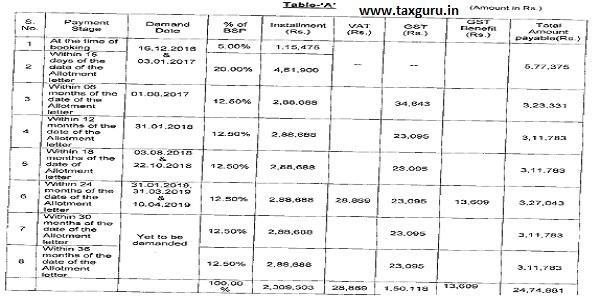
9. The Respondent had submitted a copy of the RERA Registration Certificate of his Project “Paradise” and the payment schedule for the purchase of flats at the basic sale price of Rs. 4,000/- per square feet for carpet area and Rs. 5001- per square feet for the balcony area. The Respondent, vide letter dated 08.02.2019 and subsequent e-mails, had submitted copies of demand letters issued to Applicant No.1 . The details of amounts and taxes paid by the Applicant to the Respondent were furnished by the DGAP as is given in Table-A below:-
10. The DGAP has further stated that para 5 of Schedule-III of the Central Goods and Services Tax Act, 2017, defining activities or transactions which shall be treated neither as a supply of goods nor a supply of services, reads as “Sale of land and, subject to clause (b) of paragraph 5 of Schedule II, sale of building”. Further, Clause (b) of para 5 of Schedule II of the Central Goods and Services Tax Act, 2017 reads
“(b) construction of a complex, building, civil structure or a part thereof, including a complex or building intended for sale to a buyer, wholly or partly, except where the entire consideration has been received after issuance of the completion certificate, where required, by the competent authority or after its first occupation, whichever is earlier”. In the light of these provisions, the DGAP has contended that the ITC of the units which were under construction but not sold was provisional ITC that may be required to be reversed by the Respondent, if such units would remain unsold at the time of issue of CC, in terms of Section 17 (2) & Section 17 (3) of the Central Goods and Services Tax Act, 2017 which read as under:-
17 (2) Where the goods or services or both are used by the registered person partly for effecting taxable supplies including zero-rated supplies under this Act or under the Integrated Goods and Services Tax Act and partly for effecting exempt supplies under the said Acts, the amount of credit shall be restricted to so much of the input tax as is attributable to the said taxable supplies including zero-rated supplies.
17 (3) The value of exempt supply under sub-section (2) shall be such as may be prescribed and shall include supplies on which the recipient is liable to pay tax on reverse charge basis transactions in securities, sale of land, and, subject to clause (b) of paragraph 5 of Schedule Il, sale of building.
Therefore, the DGAP has claimed that the ITC of the unsold units was outside the scope of this investigation and the Respondent was required to recalibrate the selling price of such units to be sold to the prospective buyers by considering the net benefit of additional ITC available to him post-GST.
11. The DGAP has also observed that before 01.07.2017, i.e., before the GST was introduced, as the service of construction of affordable housing provided by the Respondent, was exempt from Service Tax vide Notification No. 25/2012-ST dated 20.06.2012 (as amended by Notification No. 9/2016-ST dated 01.03.2016) and thus the Respondent was not eligible to avail CENVAT credit of Central Excise duty paid on the inputs or Service Tax paid on the input services, as per the CENVAT Credit Rules, 2004, which were in force at the material time. However, the Respondent was eligible to avail credit of Service Tax paid on the input services (CENVAT credit of Central Excise duty was not available) in respect of the commercial shops sold by him. The Respondent was also eligible to avail input tax credit of VAT paid on the inputs. Further, post-GST, the Respondent could avail input tax credit of the GST paid on all the inputs and input servic From the data submitted by the Respondent covering the period April 2016 to December 2018, the details of the input tax credit availed by him, his turnover from the project “Paradise” and the ratio of input tax credit to turnover, during the pre-GST (April 2016 to June 2017) and post-GST (July 2017 to December 2018) periods was furnished by the DGAP as per the Table-B given below:-